Banco Central de Chile
Documentos de Trabajo
Central Bank of Chile
Working Papers
N° 586
Julio 2010
HETERODOX
CENTRAL
BANKING
Luis Felipe Céspedes
Roberto Chang Javier
García-Cicco
La serie de Documentos de Trabajo en versión PDF puede obtenerse gratis en la dirección electrónica:
http://www.bcentral.cl/esp/estpub/estudios/dtbc. Existe la posibilidad de solicitar una copia impresa con un costo de $500 si es dentro de Chile y US$12 si es para fuera de Chile. Las solicitudes se pueden hacer por fax: (56-2) 6702231 o a través de correo electrónico: [email protected].
Working Papers in PDF format can be downloaded free of charge from:
http://www.bcentral.cl/eng/stdpub/studies/workingpaper. Printed versions can be ordered individually for US$12 per copy (for orders inside Chile the charge is Ch$500.) Orders can be placed by fax: (56-2) 6702231 or e-mail: [email protected].
BANCO CENTRAL DE CHILE
CENTRAL BANK OF CHILE
La serie Documentos de Trabajo es una publicación del Banco Central de Chile que divulga
los trabajos de investigación económica realizados por profesionales de esta institución o
encargados por ella a terceros. El objetivo de la serie es aportar al debate temas relevantes y
presentar nuevos enfoques en el análisis de los mismos. La difusión de los Documentos de
Trabajo sólo intenta facilitar el intercambio de ideas y dar a conocer investigaciones, con
carácter preliminar, para su discusión y comentarios.
La publicación de los Documentos de Trabajo no está sujeta a la aprobación previa de los
miembros del Consejo del Banco Central de Chile. Tanto el contenido de los Documentos
de Trabajo como también los análisis y conclusiones que de ellos se deriven, son de
exclusiva responsabilidad de su o sus autores y no reflejan necesariamente la opinión del
Banco Central de Chile o de sus Consejeros.
The Working Papers series of the Central Bank of Chile disseminates economic research
conducted by Central Bank staff or third parties under the sponsorship of the Bank. The
purpose of the series is to contribute to the discussion of relevant issues and develop new
analytical or empirical approaches in their analyses. The only aim of the Working Papers is
to disseminate preliminary research for its discussion and comments.
Publication of Working Papers is not subject to previous approval by the members of the
Board of the Central Bank. The views and conclusions presented in the papers are
exclusively those of the author(s) and do not necessarily reflect the position of the Central
Bank of Chile or of the Board members.
Documentos de Trabajo del Banco Central de Chile
Working Papers of the Central Bank of Chile
Agustinas 1180, Santiago, Chile
Documento de Trabajo
Working Paper
N° 586
N° 586
HETERODOX
CENTRAL
BANKING
‡
Luis Felipe Céspedes
Roberto Chang Javier
García-Cicco
Chief of Research Department Banco Central de Chile
Department of Economics Rutgers University
Gerencia de Análisis Macroeconómico Banco Central de Chile
Resumen
El presente documento examina aspectos teóricos y prácticos de las numerosas políticas monetarias no convencionales que se han implementado desde la crisis de 2008-2009. En términos teóricos, comenzamos por revisar el rol de la credibilidad en la adopción de metas inflacionarias cuando la tasa de interés nominal ya está en su límite inferior, prestando especial atención a la importancia del balance contable del banco central. Además, presentamos un modelo cuyo rasgo principal es una imperfección financiera que subraya el rol del capital del banco, así como la relevancia de políticas crediticias alternativas que se pueden utilizar durante una crisis financiera. Por otro lado, analizamos la evidencia de la experiencia reciente. En particular, nos centramos en el tipo de de políticas no convencionales que se han utilizado y la oportunidad de su aplicación. Luego exploramos medidas alternativas para evaluar la expansividad de la política monetaria en una situación en la que la tasa de política ya ha sido llevada a su mínimo posible. Finalmente, presentamos evidencia descriptiva sobre la forma en que las políticas adoptadas afectaron la forma de la curva de rendimiento y el margen entre captaciones y colocaciones.
Abstract
This paper discusses theoretical and practical aspects of the various unconventional central bank policies during the 2008-2009 crisis. In terms of theory, we first discuss the role of credibility in the attainment of inflationary goals once the nominal interest rate is at a lower bound, paying particular attention to the role of the central bank’s balance sheet. Additionally, we present a model which has at its core a financial imperfection that highlights the role of bank’s capital as well as the relevance of alternative credit policies that can be used to deal with financial distress. On the other hand, we review evidence regarding the recent experience. We discuss the timing and type of observed unconventional policies. We then explore alternative measures to assess the stance of monetary policy in a situation when the policy rate has reached its lower bound. Finally, we present some descriptive evidence on the effect of the applied policies on the shape of the yield curve and the lending-deposit spread.
We appreciate the helpful comments provided by our discussant, Michael Dooley. We thank Felipe Labbé and Yan Carrière-Swallow for excellent research assistance.
Introduction
In response to the current global crisis, the US Federal Reserve and other central banks around the world have implemented diverse policy measures, including purchasing a wide range of securities, lending to financial institutions, intervening exchange rates, and paying interest on reserves. Some central banks have also reduced monetary policy interest rates to minimum levels (lower bound) and have announced an explicit commitment to keep interest rates there for a prolonged period. This set of instruments contrasts with a conventional view, embedded in the predominant monetary policy models, within which a central bank controls only a short-term interest rate, such as the Federal Funds rate.
Some of the previous actions may be classified as responses to increasing demand for liquidity in a context of enormous financial uncertainty. An example of this liquidity provision by central banks is repo operations to provide US dollar liquidity in many economies, in the period around the bankruptcy of Lehman Brothers. Other actions may be sorted into those attempting to deal with malfunctioning financial markets (insufficient lending to non-financial firms or high lending spreads) and those attempting to enhance the monetary policy stimulus under the lower-bound constraint.
This paper discusses the theoretical and practical aspects of these heterodox policies. In terms of theory, the paper focuses on the two alternative arguments that have been offered to rationalize such policies: the desirability of further monetary stimulus when interest rates are already at zero and the need to unlock financially intermediated credit, when it freezes in a crisis. On the first argument, we provide a framework to analyze the theoretical mechanisms through which quantitative easing may be effective to deal with the lower bound constraint. We then show that the effectiveness of such unconventional policies depends crucially on the central bank’s ability to commit to future policy, in line with Krugman (1998). Regarding the second argument, we present a model that helps us to introduce a role for unconventional monetary policy, in the context of non-trivial financial intermediation. We then argue that the introduction of financial intermediaries in standard models produces results that challenge conventional wisdom about the effects of non-conventional policies.
In terms of recent practice, we provide evidence arising from the recent experience of central banks that have implemented inflation targets as part of conducting monetary policy. We associate the different monetary policy actions with different phases of the recent financial crisis and with different objectives. In our analysis we focus on evaluating efforts to increase monetary policy stimulus and deal with disrupted financial markets.
The rest of the paper is organized as follows. Section 1 presents a theoretical discussion of two relevant issues that have been at center stage in both policy and academic discussions about unconventional policies during the current crisis: the role of credibility and the importance of financial frictions and bank capital. Section 2 provides a more empirically oriented account of recent events. We first discuss the timing and the type of unconventional policies that have been implemented. We then compare several alternative measures that can be used to assess the monetary policy approach, particularly when the policy rate has reached its lower bound. Finally, we provide descriptive evidence on the effects of these policies on the shape of the yield curve and the lending-deposit spreads. Section 3 concludes.
1.
Rationalizing Heterodox Monetary Policy
1.1 Monetary Policy at the Edge: The Role of Credibility
One often mentioned justification for unconventional monetary policy is that the usual monetary instrument, the control of an overnight interest rate in the interbank market, may have reached a limit. In particular, this is the case when a monetary stimulus is deemed to be desirable but the policy rate is a nominal one that cannot be pushed below zero (or a value
slightly greater than zero). If the policy rate is already at or close to the lower bound, the central bank must look for alternatives to provide monetary stimulus.
Clearly, the current crisis has brought several countries to a situation in which policy interest rates are close to zero, but expansionary policy appears warranted. Much less clear, however, is whether that fact is sufficient to justify the kind of unconventional policies that we have observed in practice. Can one appeal to the zero lower bound problem to rationalize, for example, the striking expansion in the size of the Federal Reserve’s balance sheet and the changes in its composition? Here we argue that the answer can be positive or negative, depending on the policy environment and, above all, on the central bank’s ability to commit to future policy.
The starting point of our argument is the observation that currently accepted macroeconomic theory implies that the zero bound on interest rates will rarely, if ever, be a truly binding constraint for a central bank that can perfectly commit to future policy. Recent theories emphasize that a central bank can affect economic decisions not only through the current setting of its policy instrument (e.g. today’s interest rate) but also, and perhaps much more effectively, through its impact on the public’s expectations regarding the future settings of the instrument. The corollary is that the central bank can always provide some stimulus to the economy, even if the policy rate is at the zero bound, by committing to reducing future policy rates below levels previously expected (which is feasible if the policy rate was expected to be positive at some point in the future).
Thus, for example, Bernanke and Reinhart (2004, p. 85) argue that one of the strategies available for “stimulating the economy that do not involve changing the current value of the policy rate...[is] providing assurance to financial investors that short rates will be lower in the future than they currently expect”. The same argument has been embraced recently by the European Central Bank (Bini Smaghi 2009), the Bank of Canada (Murray 2009), and others. In fact, even Krugman’s (1998) pioneering discussion of Japan implied that the Bank of Japan could have escaped the liquidity trap there, by promising to keep interest rates sufficiently low for some period, even after inflation had become positive (see also Svensson 2003).
In short, the zero lower bound on interest rates is unlikely to be a serious constraint on a central bank that can precommit policy. One could conjecture, however, that unconventional policies such as “quantitative easing” or “credit easing” may be still be useful to complement conventional policy. It is somewhat surprising, however, to realize that that conjecture is quite unlikely to hold.
This key point has been developed most convincingly by Eggertsson and Woodford (2003). They show that, once a strategy for setting current and future policy rates is in place (for example, using a Taylor-type rule), real allocations and asset prices become independent of whatever the central bank does with the composition or size of its balance sheet, in periods in which the policy rate is zero.
It may be worth expanding on the intuition behind this important result, if only to stress its generality. Eggertsson and Woodford’s model is a variant of the canonical New Keynesian sticky price model developed by Woodford (2003) and others. In that model, and many others, all asset prices are determined once the equilibrium pricing kernel or stochastic discount factor is given. Likewise, the stochastic discount factor determines the relevant budget constraint for the household and producers’ pricing decisions.
In this context, an interest rate rule can affect aggregate outcomes by establishing a relation between the stochastic discount factor and other variables, such as inflation or the output gap. In equilibrium, an equation as follows, expresses the relationship:
1 1 1
1
( )
t t t t t t tP
E
i
P
Z
λ
β
λ
φ
− + +⎡
⎤
= +
⎢
⎥
⎣
⎦
=
where
β
is the average household’s discount factor,λ
t is the marginal utility of consumption, the price of consumption, the nominal interest rate for loans between periodst
and tP
i
tt
+
1
,and
φ
is a function of a vector of variablesZ
t, typically inflation and output. The first equality reflects the household’s optimal portfolio decisions; here, the stochastic discount factor is given by the random variableβλ
t+1/
λ
t. The second equality says that the central bank sets the interest rate as a functioni
tφ
of the vector of variablesZ
t. In equilibrium, then, interest rate policy (e.g. a choice of the functionφ
and the vectorZ
t ) implies a relation between the stochastic discount factor, inflation, and vectorZ
t. Indeed, this is the main (and often the only) way in which interest rate policy affects aggregate outcomes.If the zero bound on the policy rate were not a binding constraint, a choice of an interest rate rule
t
i
( )
Z
tφ
would leave no room for “quantitative easing”, that is, independent control of the monetary base. Demand would determine the quantity of money, with the central bank adjusting the base as necessary to clear the market (this indeed is what an interest rate rule would mean). In addition, under usual assumptions on fiscal policy, changes in the composition of the central bank’s balance sheet (and, more generally, in the consolidated version of government’s) are irrelevant for aggregate outcomes. This is because the latter can be shown to depend only on the present value budget constraint of the government, which is given by its initial debt plus the appropriately discounted value of (possibly state contingent) fiscal deficits.Eggertsson and Woodford (2003) extend this logic to situations in which the interest rate policy
φ
( )
Z
t may prescribe a zero interest rate under some circumstances (i.e. for some values of the vectorZ
t ). In those cases, they assume that the demand for money is indeterminate (the real demand for money being only bounded below by some satiation level). This allows the central bank to determine the quantity of money independently, in other words, to engage in “quantitative easing”. They show, however, that aggregate allocations are independent of the details of such quantitative easing. The logic is simple: as we just discussed, quantitative easing might affect aggregate outcomes, if it had some impact on the stochastic discount factor. But the latter is pinned down by the functionφ
, as in the absence of the lower bound problem.The justification for the last assertion is illuminating. The assertion would be immediate if the marginal utility of consumption
λ
t were independent of real money balances. Eggertsson and Woodford assume, however, that utility may depend on real balances in a nonseparable way, soλ
t may depend onM P
t/
t. However, if the interest rate is driven to zero, real balances must exceed the satiation level, which in turn means that the quantity of money has no longer any effect on utility and, all the more certainly, onλ
t. (It is in this exact sense that money and bonds becoming perfect substitutes at zero interest rates.)Having established that quantitative easing is irrelevant at zero interest rates, the irrelevance of altering the composition of the central bank’s balance sheet follows, as before.
Our discussion (we hope) stresses that the logic behind the Eggertsson-Woodford irrelevance result is quite general and, hence, extends to a very broad class of models, including those most current. The result, in particular, does not hinge on the absence of imperfectly substitutable assets, which may have led some to suspect that changes in the size and composition of the central bank balance sheets would have “portfolio balance“ effects. Indeed, the absence of portfolio balance effects could be considered a significant flaw, and one could conjecture that models featuring such effects may overturn the irrelevance argument. But a compelling portfolio balance model of the effects of policies regarding the central bank
balance sheet has yet to be developed. In addition, the empirical evidence about portfolio balance effects provides little support for them, as stressed by Bernanke and Reinhart (2004): “the limited empirical evidence suggests that, within broad classes, assets are close substitutes, so that changes in relative supplies of the scale observed in US experience are unlikely to have a major impact on risk premiums or even term premiums (Reinhart and Brian Sack, 2000).”
To summarize, we have argued that a central bank that can commit in advance to a conventional interest rate policy will generally find that the zero bound on interest rates is not a binding restriction and, in particular, can provide monetary stimulus, even in a liquidity trap, by promising that future policy rate levels will be lower than they would have been otherwise. In addition, such a central bank will find that quantitative easing, portfolio management maneuvers, and other strategies for altering the size and composition of its balance sheet at times of zero interest rates are irrelevant.
This given, why is it that central banks have often been unable to come out of deflationary liquidity traps by just promising expansionary policy in the future? The key conjecture is that such promises may not be credible. Credibility as a crucial constraint in this situation as several authors have, of course, emphasized, starting with Krugman’s analysis of the Japanese recession (1998).
One implication of this observation is that the literature is full of warnings and admonitions about the need for central banks to ensure that announcements of future policy are believable, suggesting that central banks can even “manage expectations” independently of interest rate policy. For example, the Banque de France recently stated that one unconventional policy is “influencing the yield curve by guiding expectations” (Banque de France 2009: 5). There is little guidance in these statements, however, as to how, precisely, the central bank can independently manage expectations. Bernanke and Reinhart (2004, p.86) acknowledged this fact, stating: “Ultimately, however, the central bank’s best strategy for building credibility is to build trust by ensuring that its deeds match its words...the shaping of expectations is not an independent policy instrument in the long run.”
Others have responded to the credibility issue by emphasizing the need for improving “transparency” and “clear communication” of central bank policy intentions. Of course, it is hard to argue with the view that transparency and clear communication are desirable aspects of central bank policy. Aside from the fact that it is not clear why the need for them is greater when interest rates are close to zero than at other times, however, there is no generally accepted theory of how more or less transparency affects monetary transmission channels.
A related claim, of particular relevance to our discussion, is that changes in the size and composition of the central bank balance sheet can help the credibility of the central bank’s announcements about future policy. And, in fact, some authors have claimed that this is the main role of unconventional policies. For example, Bernanke and Reinhart (2004, p. 88) argue that a central bank policy of setting a high target for bank reserves “...is more visible, and hence may be more credible, than a purely verbal promise about future short term interest rates.” Likewise, Eggertsson and Woodford (2003) conjectured that “shifts in the portfolio of the central bank could be of some value in making credible to the private sector the central bank’s own commitment to a particular kind of future policy... ‘Signaling ‘ effects of this kind...might well provide a justification for open market policy when the zero bound binds.”
To date, however, attempts to make these claims more precise are lacking. But a longstanding theory of monetary policy under imperfect credibility suggests several ways to develop this view. To illustrate, let us examine the implications of a simple model of monetary policy.
1.1.1 Unconventional Policy: An Illustrative Model
We shall extend the model of Jeanne and Svensson (2007, henceforth ). Consider a small, open economy with a representative agent that maximizes the discounted, expected utility of money holdings and consumption of tradables and nontradables. The period utility of tradables is
lo
, where is a Cobb-Douglass aggregate of home ( ) nontradables and foreign (JS
g
C
tC
th
f
) tradables 1 t htC
=
C C
−α αft htC
is, in turn, a conventional Dixit Stiglitz aggregate of domestic varieties. With the world price of foreign tradables normalized at one, the price of consumption is, therefore1
t ht t
P
=
P S
−α α,where
P
ht is the price of home nontradables andS
t the nominal exchange rate.The representative agent chooses consumption and holdings of money, a world noncontingent bond, and domestic bonds. His sources of income in each period are wages, profits of domestic firms, income from previous investments, and a transfer from the central bank (
Z
in ). It turns out that these transfers are not needed for our argument, but let us keep them in for now to preserve the JS notation.JS
There is a central bank that can print domestic currency freely to finance transfers and a portfolio of securities. A bond of maturity,
k
, is a promise to pay one unit of consumption at time . For simplicity, assume that can be either one or two, e.g. there are “short” (one-period) bonds and “long” (two-(one-period) bonds.t k
+
k
1
Let
Q
ts denote the home currency price att
of a bond promising one unit of consumption att s
+
,s
=
1, 2
. Letting st
B
be the central bank holdings at the end of periodt
of the corresponding bond, the central bank’s budget constraint is
1 1 2 2 1 1 2 1 1
t t t t t t t t t t 1
Z
+
Q B
+
Q B
=
M
−
M
−+
B
−+
Q B
−In contrast with
JS
, who examine the role of foreign exchange intervention, we assume that the central bank keeps zero foreign exchange reserves. Instead, it holds a portfolio of short and long bonds. This means that, in the central bank’s budget constraint, the crucial term will be the last one in the RHS, which denotes the current value of long bonds purchased the previous period. Hence, changes in the price of long bonds can be a source of gains or losses for the central bank.JS
prove two results. The first is that a central bank that minimizes a conventional, expected discounted value for losses that depends only on inflation and the output gap may be unable to implement an optimal policy to escape from a liquidity trap, if it cannot commit to honoring promises of future policy. The second result is that this commitment problem may be solved if the central bank cares enough about its capital position. The mechanism described by is for the central bank to initially acquire enough foreign exchange reserves, by either printing domestic currency or reducing transfers to the Treasury. This results in a currency mismatch and implies that, were the central bank to subsequently deviate from a promise of high inflation, the concomitant currency appreciation would, via the fall within the value of the central bank’s foreign reserves, resulting in a capital loss. This would deter the central bank from reneging on a promise of high inflation, if we can assume that central bank cares about its capital.JS
1. Notice that we assume that bonds are real promises. This is a nontrivial assumption, discussed at length in the working paper version of
JS
.Here, we will describe a similar argument that relies on management of maturities for assets in the central bank’s portfolio. While the logic of the mechanism is essentially the same as in
JS
, we will see that there are some interesting differences .First, note that the capital of the central bank is, by definition, the value of its assets minus liabilities: 1 1 2 2 t t t t t
V
=
Q B
+
Q B
−
M
t tZ
which, using the budget constraint above, can be rewritten as:
1 1 2 1 1 1
t t t t t
V
= −
M
−+
B
−+
Q B
−−
This expresses, in particular, that the capital position of the central bank improves if , the price of short bonds, increases and the central bank had a long position in two period bonds at the end of the previous period. This will prove to be crucial.
1
t
Q
Before elaborating on this point, let us discuss competitive equilibria.
JS
make the (usual) assumptions setting the current account always at zero and making tradable consumption constant. Nontradable consumption, meanwhile, equals nontradable output:ht t
Nontradables are produced with only labor and a linear technology, by monopolistically competitive firms that choose prices one period in advance. As is well known, the typical firm ( ) chooses a price that is a constant markup over marginal cost:
C
=
Y
z
1( )
1
t ht t tW
P z
E
A
ε
ε
−=
−
,where
ε
is the elasticity of substitution between varieties, the wage, and aggregate productivity. Now, optimal labor choice impliest
W
A
t1
1
t ht t htW
C
Y
P
=
−
α
=
−
α
,from which ‘s relative price is
z
1
( )
ht t t ht tP z
Y
E
P
=
−Y
∗ , where(
1
)
1
t tY
ε
α
A
ε
∗=
−
−
is the rate of natural output. In equilibrium, ht
( )
1
ht
P z
P
=
, because all firms are identical, we arrive at the aggregatesupply equation: 1
1
t t tY
E
Y
− ∗=
.Here, the real exchange rate is defined as
/
t t
Q
=
S P
htwhich, in equilibrium, is given by
/
(1
) /
(1
)
ft t ht t fC
Q
C
Y
C
α
α
α
α
=
−
=
−
where
C
f is the constant equilibrium consumption of tradables. The real exchange rate, therefore, depreciates if domestic output increases (this is one source ofJS
’s main results).To allow for the possibility of a “liquidity trap,” assume that there is a nominal bond. Then the nominal interest rate must equal
, 1 1 t i ht t t h t t
P
Y
e
E
P
Y
δ
− + +=
from the household’s Euler condition. The real interest rate must then satisfy:
1 1 t r t t t
Y
e
E
Y
αδ
− − +⎛
⎞
=
⎜
⎟
⎝
⎠
.This is a key equation: it says that the real interest rate must fall, if output is expected to decline. JS consider a situation in which at
t
=
1
the log of productivity is equal to its previous steady state, say , but we know that it will fall toa
b
<
a
from period on. This can lead the economy to a liquidity trap, as we now argue.2
t
=
Start by assuming that the central bank minimizes a conventional loss: t t
E
∑
δ
L
, where 2 21
[(
)
(
) ]
2
t t t tL
=
π π
−
+
λ
y
−
y
(From hereon, lowercase variables are logs of respective uppercase ones.) To see how a liquidity trap may emerge, note that
1 1
t
p
tp
tp
htq
tp
tπ
=
−
−=
+
α
−
−Letting the “natural” real exchange rate be defined in the obvious way,
(1
)
t t fY
Q
C
α
α
=
−
we obtain 1(
)
tp
htq
tp
ty
ty
tπ
=
+
α
−
−+
α
−
Under discretion, the policymaker would minimize subject to the preceding equation, which would yield t
L
(
)
ty
ty
tλ
π
π
α
= −
−
.Recalling, however, that there are no unexpected shocks in periods on, in equilibrium
2
t
=
t t
Y
=
Y
for allt
except possibly fort
=
1
. Therefore,π
t=
π
,t
2,3,
...
. Th .=
is is key,and it means that inflation is at the target in all periods, expect possibly in period
t
=
1
JS
show that, ifb
is sufficiently low relative toa
, the economy will fall into a liquidity trap in period one, that is, a situation in which the interest ratei
1 falls to zero, and output falls short of the natural level. This results in lower welfare than under commitment. With commitment, the central bank would promise to increaseπ
2 overπ
to spread the cost of the productivity fall between periods one and two. However, in the absence of a commitment device, this promise would not be kept: in period 2, it would be optimal for the central bank to reduceπ
2 to the targetπ
.To see the role of debt management, let us focus on the pricing of bonds of different maturities. Recall that there is no more uncertainty after period one. Hence, by arbitrage,
1 1 t i t t
P
e
Q
+=
.This says that the return on one-period bonds must be equal to the return on nominal bonds. Now, recalling that
π
t=
π
fort
≥
2
,1 1 1 1 t i r t t t t t t
P
P
P
e
e
Q
P Q
π ∗+ +=
+=
=
,where
r
∗ is the natural real rate of interest,1 r t
Q
=
e P
−∗t. (1)
Note that this says that the price of one-period bonds is proportional to the price level from period 2 on.
Also, under perfect foresight, arbitrage implies that the price of a two period bond equals the product of the prices of one-period bonds now and next period:
2 1 1 1
t t t
Q
=
Q Q
+ . (2)These facts now lead us to our main result. Suppose that, at $t=1$, the central bank learns about a future decline in productivity and sells $x$ short bonds and buys an equivalent amount of long bonds. The amount of long bonds purchased is denoted by , that is 1 2 2 1 1 1
0
Q x Q B
+
=
1 2 1 1 2 1Q
B
x
Q
= −
.By construction, this operation has no impact on either the budget constraint or the central bank’s capital position at
t
=
1
.If the central bank could commit to the optimal (under commitment) policy, the operation would not affect its budget constraint nor its capital position in any subsequent periods either. This is because the arbitrage condition (2) would guarantee that the value of the inherited portfolio would be zero:
1 1 1 2 1 1 1 2 1 2 2 1
(
Q
)
B
Q B
x Q
x
Q
+
= +
−
=
0
.Notably, this is an instance of Eggertsson and Woodford’s irrelevance result: under commitment, open market operations are irrelevant.
But suppose that the central bank has no commitment and can contemplate a deviation from the optimal plan. As shown in (and intuitively obvious), the central bank would then have an incentive to reduce inflation towards the target, thus cutting from its optimal level to a lower level, say . However, since there are no incentives for further deviations, prices of bonds maturing at
JS
2P
2P
′t
=
3
would fall, by (1), to some level 1 2( )
Q
′. Then the value of the central bank portfolio would be:1 1 1 2 1 1 1 2 1 2 2 1 1 2 2 1
( )
[1 ( ) (
)
( )
(1
)
Q
B
Q B
x
Q
Q
Q
x
Q
′ ′ ′+
=
+
−
=
−
]
This is less than zero if
x
is negative and( )
Q
12 ′Q
1 2<
, that is, if the central bank surprisingly changes policy in a way that leads to lower prices. It follows that the deviation is not profitable for the central bank, if it cares about its capital position andx
is negative and sufficiently large in absolute value.In words, the central bank can ensure the credibility of an inflationary policy by changing the composition of its balance sheet, selling short-term bonds and holding long term bonds. This is crucial to equilibrium, not because such an “unconventional” measure would
change the equilibrium outcome (which is the same as the outcome under commitment), but because the debt structure can change the incentives for the central bank, to discourage deviation from the desired equilibrium: a deflationary surprise would reduce the value of the latter, inflicting a punishment on the central bank.
The argument here is therefore related to the classic Lucas and Stokey (1983) study of optimal policy under time inconsistency. As in that paper, debt maturity is irrelevant under commitment, but can be crucial under discretion.
Our discussion also stresses that the composition of the central bank’s balance sheet can be managed in several alternative ways to provide the proper incentives for the central bank. As mentioned, our argument here is similar but not the same as in , who focused on international reserves management. Compared with their argument, the one here is cleaner, because we do not need to worry about central bank transfers (the
JS
Z
s above), which figure somewhat prominently in JS. In fact, we eliminated the transfers completely. On the other hand, and obviously, we depend on having a rich enough menu of assets, in this case debts with different maturities.Our analysis provides a concrete setting in which unconventional central bank policy not only helps but is in fact crucial to implementing optimal monetary policy. What is the value of such an exercise? For one thing, it clarifies the sense in which management of the central bank balance sheet can indeed complement conventional interest rate policy, much more effectively than vague statements, such as “the central bank’s open market operations should be chosen with a view to signaling the nature of its policy commitments”. Indeed, our analysis has not relied on the existence of asymmetric information of any sort, and therefore leaves no room for any kind of signaling.
Moreover, a formal analysis opens the way to interpreting and identifying the validity (or lack thereof) of many claims in the policy literature. To cite but one example, to justify unconventional measures, the Bank of Canada has cited the principle of “prudence “, meaning that the Bank should “mitigate financial risks to its balance sheet, which could arise from changes in yields (valuation losses) or from the credit performance of private sector assets (credit losses),” (Bank of Canada 2009, p. 29). But in the analysis above it is precisely the possibility of such valuation losses that lend credibility to the central bank’s promises to keep interest rates low, even as inflation overshoots its target.
Notably, our analysis explains why, for justification’s sake, these operations may have to be carried out by the central bank, instead of, say, the Treasury. This is relevant, because often the reasons given to justify altering the size and composition of the central bank’s balance sheet are really reasons to change “fiscal” policy rather than central bank policy. Here, the open market operations in play are designed to affect the central bank’s incentives, which would not happen if an alternative agency were to carry out such operations.
1.1.2 Alternative Solutions to the Commitment Problem
Our discussion has emphasized that one fruitful way to rationalize unconventional policy may be to see the management of the central bank’s portfolio as a commitment device. This perspective also suggests we should look for more general insights in the rich literature on policy under time inconsistency and lack of commitment.
Walsh (1995), for example, emphasized that one way to solve the classical time inconsistency problem in monetary policy is to provide optimal contracts to central bankers, a view that has been associated with the widespread acceptance of inflation targeting in a context of central bank independence.
Arguably, Walsh’s view remains quite relevant to solving the credibility problem with zero interest rates too. In the context of the model described in the preceding subsection (and the analysis in ), we mentioned that a critical part of the “solution” is the assumption that the central bank cares about its capital. But, where does this concern come from? The problem arose because, presumably, the central banker had been assigned (at some point before the
start of the analysis) a mandate to minimize a loss function with inflation and the output gap as arguments. A suggestion echoing Walsh’s would then be to enlarge that loss function with a term inflicting a penalty on the central banker, if bank capital were to fall below some value.
But if that is in fact the case, one could and should also ask the more general (Walsh’s) question of what is the optimal contract to the central banker. This would recognize, in particular, that the contract may not entail an inflation target, even if inflation targeting would be optimal under commitment. This issue may, in fact, have gone beyond theory and become quite influential in practice. Specifically, Svensson (2001) has advocated that one way to solve the credibility problem in a liquidity trap may be to switch the objective of the central bank from inflation targeting to price level targeting, and that strategy has actually been embraced by Sweden. Our analysis suggests that this reform may be understood as a way to modify the loss function assigned to the central banker, to provide the correct incentives for implementing the optimal monetary policy.
1.2 Financial Frictions, Bank Capital, and Heterodox Policy
An alternative prima facie justification for central banks resorting to new policy instruments has been that the recent crisis involved a combination of skyrocketing interest rate spreads, frozen credit markets, and paralyzed financial institutions. In this context, it was clear that the traditional monetary policy tool, that is, the supply of bank reserves to target an overnight interbank interest rate, seemed to have become completely ineffective. In particular, additional liquidity in the interbank market was hoarded by the banks, apparently in some cases in an effort to reconstitute their severely impaired capital levels. Thus, as described, several central banks stepped into credit markets and started expanding the size and scope of rediscounting operations, swapping questionable assets for safer government debt and, in some cases, lending directly to the private sector.
These developments have stimulated a small but growing literature attempting to understand the interaction of unconventional monetary policies with financial imperfections and the behavior of the banking system. As the discussion suggests, significant progress on this front will require not only analyzing the implications of endowing the monetary authorities with a policy arsenal that includes more than interest rate control, but also introducing a nontrivial banking system into current theory. This will demand, in turn, dropping the crucial assumption of frictionless financial markets, which currently pervades dominant models.2
Unfortunately, no current theory of banks exists yet that is both widely accepted and tractable enough to be embedded into the stochastic dynamic models that characterize modern monetary theory. As a result, recent attempts have been as much about this modeling issue as about the effects of unconventional policy. For example, an influential study by Christiano, Motto, and Rostagno (2007) models banks, following what Freixas (2008) calls the “industrial organization” approach. In contrast, in Gertler and Karadi (2009), banks are agents that borrow from households and lend to firms, subject to a moral hazard problem. Similarly, Cúrdia and Woodford (2009) modify the basic New Keynesian model, by assuming that households differ in their preferences, thus creating a social function for financial intermediation.
On the consequences for monetary policy of these studies, one initial conclusion is that augmenting a standard Taylor rule to respond mechanically to changes in the spread between lending rates and deposit rates may not be optimal. How effective this action is, will depend on the type of shock that generates the increase in the spread. Now, in terms of credit policy, i.e. direct lending by the central bank to non-financial firms, this policy would be optimal if private financial markets are sufficiently impaired (Cúrdia and Woodford (2010) and Gertler and Karadi (2009)).
2. Needless to say, the analysis of the previous subsection may require significant changes, if perfect financial markets are not assumed.
However, the state of affairs is such that it may be premature to try to draw firm conclusions from these studies, and indeed the papers just cited are still being refined and may change substantially. Nevertheless, they represent a shifting perspective that is likely to stay and, hence, worth discussing in more detail. To do so, we discuss next a related model of ours, designed to illustrate several of the issues involved.
1.2.1 An Illustrative Model
This model is a stochastic, discrete time version of Edwards and Végh (1997), with one crucial modification: bank lending is constrained by their capital. This change is not only warranted by current events but also implies, as we will see, a substantial departure in terms of model solution and dynamics.
Consider an infinite horizon, small, open economy. There is only one good in each period, freely traded and with a world price that we assume to be constant (at one) in terms of a world currency.
The economy is populated by a representative household that maximizes
(log
log(1
))
t
t t
t
E
∑
β
c
+
−
l
,where and denote consumption and labor effort.
c
tl
tTo motivate a demand for bank deposits, we assume that deposits are necessary for transactions. This results in a deposit in advance constraint
t t
d
≥
α
c
,where
α
is a fixed parameter. Deposits pay interest, which can be expressed in real terms by:1
1
d(1
d)
t t t tP
r
i
P
++
= +
The household owns domestic firms and banks, and receives transfers from or pays taxes to the government. Hence its flow budget constraint is given by:
1 1
(1
)
f b d t tT
tw l
t tr
t−d
t−d
tc
Ω + Ω + +
+ +
=
+
t whereΩ
bt andΩ
tf tw
are profits from banks and firms, government transfers (or taxes, if negative), and is the real wage. For simplicity, we are assuming that the household cannot lend or borrow in the world market. Our arguments extend easily, if the household can lend but not borrow there, as we shall see.
t
T
Let
λ ω
t t andλ
t be the Lagrange multipliers associated with the deposit in advance constraint and the flow budget constraint respectively. Optimal household behavior is then given by the first order conditions:1
[1
]
t t tc
=
λ
+
αω
,1
1
t t tw
l
=
λ
−
, 1(1
)
d tE
t tr
t t tλ β λ
=
++
+
λ ω
.These have natural interpretations. In particular, the first condition emphasizes that the household equates the marginal utility of consumption to its shadow cost, inclusive of the cost of the deposit in advance constraint. Likewise, the third condition emphasizes that the return to deposits must include the benefit from relaxing the deposit in advance constraint.
We now turn to production. There is a continuum of identical domestic firms, each able to produce tradables, with a linear technology that employs only labor:
t t t
where is an e ogenous productivity shock.
T riately discounted value of dividends:
where flow profits are given by: l t
A
xhe typical firm maximizes the approp
t f t t
E
∑
β λ
Ω
t 1)
1 t t(1
f tA l
t tw l
t th
tr
−h
−Ω =
−
+ − +
γ
Here, we assume that the firm must borrow from banks a fraction of the wage bill
t t t
h
≥
γ
w l
.This working cap al assumption is introduced to motivate a demand for bank loans. So it
h
tdenotes the amount that the firm must borrow, and the real loan rate is l t
r
, with: 11
+ = +
r
l(1
i
l)
P
t . t t tP
+In each period the firm chooses and . Letting
l
th
tφ
t be the multiplier on the finance constraint, the first order conditions for the firm problem a ’s re(1
)
t t tA
w
1(1
)
t(1
l)
t t t tE
r
γφ
=
+
λ
φ
β
λ
++
=
+
Note that the first condition stresses that the cost of labor must include the financial cost associated with the working capital constraint.
Next, turn to the banking sector. As in Edwards and Végh (1997), banks are modeled following an industrial organization approach. This is appealing, because that approach implies that there will be spreads between deposit and lending rates. But, as mentioned, we depart from Edwards and Végh (1997), by assuming that bank lending is constrained by bank capital. Banks maximize t b t t
E
tβ λ
Ω
∑
, where 1 1 1 1 1 1 1 1(1
)
(1
)
(1
)
( , )
b l t d t t t t t t t t t t t t t t tP
r
z
f
d
x
r
x
z
f
r
d
z d
P
ξ η
− − − − − − − −Ω = +
+
+ + − +
− − − +
−
tand
z
t denotes credit to firms,f
t required reserves,x
t foreign borrowing, and costn :
t
r
offoreig borrowing. We also assume a reserve requirement
t t
f
≥
δ
d
,δ
where is the required reserves coefficient. Finally, we assume that leverage is limited:
t
n
tz
≤
χ
,where the bank’s capita is given by The leverage ratio
l
n
t t t t t
n
= + − −
f
z
d
x
χ
, which could be time varying, is the key innovation of this model relative to Edwards and Végh (1997) and others (such as Catão and Rodriguez 2000). One could rationalize the leverage constraint as a shortcut to modeling agency problems of the type emphasized by Kiyotaki and Moore (1997) and, more recently, Gertler and Karadi (2009). We assumeχ
is greater than one, and reflects either regulation or agency issues.Finally,
ξ η
t( , )
z d
t t(.)
is the resource cost of “producing” deposits and credit. We use the functional form for
η
, proposed by Edwards & Végh (1997), but introduce a parameterκ
that determines the weight of firm credit in the bank’s cost function:2
(1
)
2z
d
η
=
κ
+ −
κ
.Assume that the reserve requirement holds with equality, and let
θ
t be the multiplier of the leverage requirement. The first-order conditions are1 2 1
(1
)
( , )
(1
)
t(1
d t)
t t t t t t t tP
z d
E
r
P
λ
δ
ξ η
θ χ
δ
β
δ
λ
+ +−
−
−
−
=
+
−
11
t t t tE
λ
(1
r
t)
θ χ β
λ
+−
=
+
(4) 1 11
( , )
(
1)
t(1
l t t t t t t tz d
E
λ
r
)
ξ η
θ χ
β
λ
++
−
− =
+
The model is closed by a specification of government policy. Clearly, we have set up the model so that we can discuss the effects of “unconventional” policy on allocations and prices, including the volume of bank intermediation and credit spreads.
For now, assume the simplest: the government rebates to households the gains from imposing reserve requirements. Also, assume (as in Edwards and Végh 1997) that
ξ η
t( , )
z d
t tis paid to the government, perhaps because it represents monitoring services. Then
1 1 t
( , )
t t t t t t tP
T
f
f
z d
P
ξ η
− −= −
+
To finish, we need a specification for inflation policy. Here the government controls . This matters, despite flexible prices, because required reserves are paying the inflation tax. 1
/
t tP P
−= Π
t t+
Note that, with these assumption, in equilibrium, the economy’s overall constraint reduces to
1 1
(1
+
r
t−)
x
t−=
A l
t t−
c
tx
,whose interpretation is clear: the repayment on foreign borrowing is equal to the trade surplus plus new borrowing.
Finally, we need to make an assumption about the world interest rate . For now, assume it is constant at
r
. Also, we will assumet
r
∗
β
(1
+
r
∗) 1
<
. The need for this becomesapparent upon examination of the nonstochastic steady state. In steady state, the bank’s optimality condition for the amount to borrow in the world market, (4), reduces to
1
−
β
(1
+
r
∗)
=
θχ
(5)As we are about to solve for a linear approximation of the dynamics around the steady state, we need to make a decision as to whether the leverage constraint binds in steady state. We will assume that it does, which requires that
θ
be strictly positive in steady state. Hencemust be less than one.
(1
r
)
β
+
∗The interpretation of the Lagrange multiplier
θ
is illuminating.θ
is the shadow cost to banks of the leverage requirement. Accordingly, if the leverage coefficientχ
increases,θ
must fall. This is natural since a higherχ
allows banks to increase leverage.The model can be calibrated and solved in the usual way. Then one can examine the implications of alternative policies of interest. For illustrative purposes, we assume a world interest rate percent of 2%, a reserve requirement ratio (
δ
) percent of 10%, and a leverageratio (
χ
) equal to 3%. The household’s deposit requirement (α
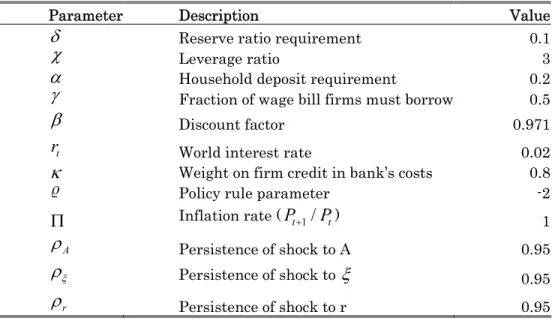
) is assumed to be 0.2 while the fraction of the wage bill that firms must borrow is assumed to equal 0.5. The remaining parameters are presented in Table 1. Our parametrization implies that the steady state, interest rate spread is equal to 7.7%. In the steady state, the economy’s external debt corresponds to almost 30% of total lending to firms, deposits 41%, and the remainder is financed with the banks’ own net worth.Table 1. Parameter Values
Parameter Description Value
δ
Reserve ratio requirement 0.1χ
Leverage ratio 3α
Household deposit requirement 0.2γ
Fraction of wage bill firms must borrow 0.5β
Discount factor 0.971t
r
World interest rate 0.02κ
Weight on firm credit in bank’s costs 0.8
Policy rule parameter -2Π
Inflation rate (P
t+1/
P
t) 1 Aρ
Persistence of shock to A 0.95 ξρ
Persistence of shock toξ
0.95 rρ
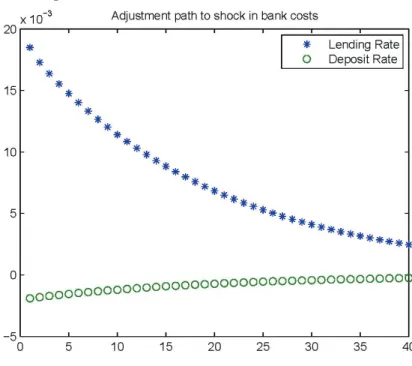
Persistence of shock to r 0.95To evaluate the dynamics of the economy, we study the impulse response functions of the model’s main variables to world interest rate and banking cost shocks. Figures 1-2 display the impulse responses of the calibrated model to a 1% shock to the bank cost
ξ
. As Edwards and Végh (1997) stress, this can be interpreted as a domestic shock (change in regulation or shocks to the underlying banking technology) or as an external shock (such as an international financial crisis). A shock to the bank’s cost function is associated with an increase in the real lending rate and a fall in the deposit rate (see Figure 1). The increase in banking costs increases the marginal cost of extending credit. On the deposit side, the increase in producing deposits reduces the deposit rate paid to consumers. This reduction in the deposit rate increases the price of consumption. On the lending side, the increase in the marginal cost of producing loans increases the lending rate. In equilibrium, the lending spread increases. This is in line with intuition and is consistent with Edwards and Végh’s discussion. Figure 2 shows that the result is an aggregate contraction, expressed in a fall in credit and, concomitantly, labor employment and wages.Figure 1. Adjustment path to shock in bank costs
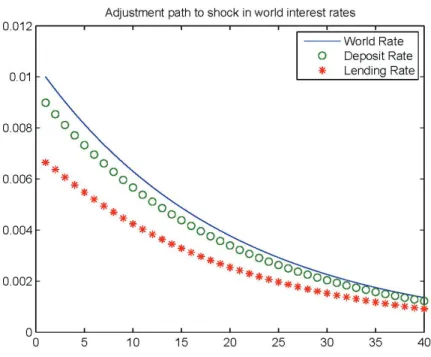
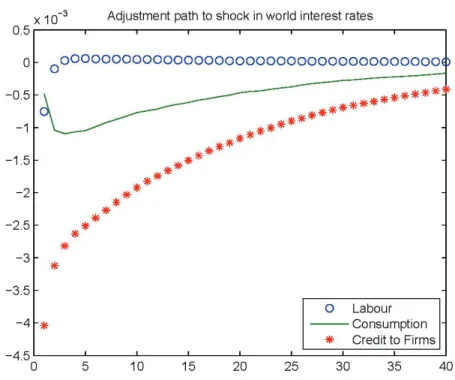
Figures 3-4 display impulse responses to an one-hundred-basis-point increase in the world interest rate. Figure 3 shows that both domestic rates, lending and deposit rates, increase as a result. But interestingly, deposit rates increase more than lending rates, so the spread between the two shrinks. The increase in the world interest rate increases the cost of external borrowing. Banks will try to substitute this external lending by increasing the deposit rate. The lending rate increases, but less than the deposit rate, as the higher world interest rate has a negative wealth effect on the economy, which reduces consumption and lending in equilibrium. Figure 4 shows that credit and consumption fall persistently. Aside from a small impact decrease, labor employment is essentially not affected.
Figure 3. Adjustment path to shock in world interest rates
In this model, we can examine the effects of different, “unconventional” policies. For example, one might conjecture that a policy of reducing reserve requirements when spreads increase could be stabilizing. To analyze this conjecture in our model, we drop the assumption of a constant
δ
, and assume that(
)
= +
l−
dt
r
tr
δ
δ
twhere
δ
is the steady state value ofδ
t and governs the sensitivity of the reserve coefficient’s response to the domestic spread.
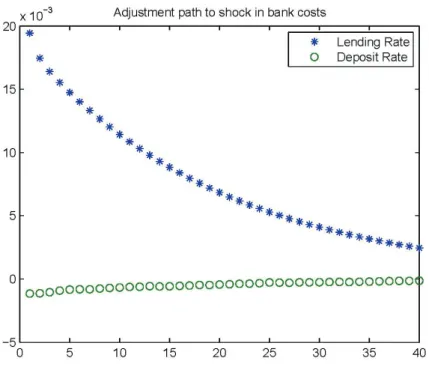
Figures 5-6 and 7-8 display the impulse responses to the same shocks as those represented in Figures 1-4, namely shocks to the banking cost function and to the world interest rate. Figure 5 is quite similar to Figure 1, suggesting that reducing reserve requirements in response to increases in the domestic spread may have little impact on deposit and lending rates. Comparing Figure 6 to Figure 2, however, reveals that this policy has significantly stabilizes credit and labor employment on impact, although for this parametrization the stabilizing effect only lasts for one period. The reduction in reserve requirement slightly mitigates the impact of higher marginal costs in the production of deposit and loans.
Figure 6. Adjustment path to shock in bank costs
Figure 7 shows that the reserve requirement policy also has negligible effects on the response of domestic interest rates to an increase in the world rate. Figure 8, however, shows that the policy has somewhat surprising real effects: credit falls by more and consumption by less than without the policy (as depicted in Figure 4). The reason is that the policy rule makes
t
δ
increase, not fall, in response to an increase in the world interest rate: such a shock makes domestic lending rates and deposit rates increase, but their difference falls.Figure 8. Adjustment path to shock in world interest rates
There are a number of lessons here. The effect of an “obvious policy” is not obvious and depends delicately on the both model and policy details. But our model clarifies and provides useful information about the different channels. Here, for example, given our discussion, one could now conjecture that the problem is that
δ
t is responding to the domestic spread, but that it may be better forδ
t to respond to the international spread, as in(
)
= +
l−
t
r
tr
δ
δ
twhere is the world rate of interest. But here such a change is probably of little help, because increases by less than in response to a shock to the latter, and hence
t
r
l t
r
r
tδ
t would alsoincrease (perversely) with the modified policy.
More generally, the model here is an example of the kind of theory that needs to be developed to be able to discuss consistently the unconventional policies that have been implemented in practice. Only with this kind of framework can we trace the effects of policies that respond to interest rate spreads or prescriptions to inject equity into banks. In contrast, standard models are silent about these issues, because their perfect financial market assumption clouds perception of financial intermediation.
2.
Heterodox Monetary Policy: Recent Experience and Evidence
From the previous section, we have concluded that quantitative easing (outright purchases of assets by the central bank and changes in the central bank portfolio) appears relevant only if it helps to increase the credibility of a given monetary policy rate path. We have also noted that it is premature to conclude that credit easing is useful as a policy in and of itself or as a commitment device for a particular monetary policy trajectory. Nevertheless, credit policy may be seen as necessary in case of disrupted financial markets or as a complement to traditional monetary policy actions in particular cases.
With this in mind we present some evidence regarding monetary policy actions in the recent financial crisis, as some countries reached the (actual) lower bound. We restrict our
analysis to countries with some (quasi) formal inflation target to have a more adequate comparison.
2.1 Recent Experience with Unconventional Monetary Policy
Starting with the sub-prime mortgage crisis, we have witnessed an unprecedented period of monetary policy activism. Even though the original trigger for the various kinds of interventions can be traced to the international financial crisis, the objectives and immediate motivations are somehow different. In the first, pre-Lehman Brothers period, monetary policy rates in most countries aimed to control inflation, which was high due to high energy and other commodity prices. At the same time, governments took actions to provide liquidity in foreign currency markets. After the Lehman bankruptcy, things changed. Liquidity provision intensified, while the rapid fall in commodity prices opened the door for aggressive cuts to interest rates. In this period, some central banks also implemented policies to address malfunctioning financial markets (credit policy). As interest rate cuts intensified, some countries reached a lower bound for the monetary policy rate. At this point, we saw some central banks implementing additional non-conventional policies to reinforce the credibility of the announcement that interest rates would be kept low for a long time.
2.1.1 The Pre-Lehman Bankruptcy Period
The outbreak of the mortgage-backed, security crisis was the beginning of a period of significant tensions in financial markets around the world. These tensions were initially limited to the US and England, but expanded to other developed economies during the first half of 2008. In most cases, they led to the need to inject significant amounts of liquidity in foreign currency markets. The basic objective of the liquidity provision actions was to reduce pressures on US dollar, short-term funding markets. In particular, from September 2007 to September 2008, many central banks implemented different varieties of US dollar repo transactions. Sometimes these operations were complemented by reciprocal swap agreements between the US Federal Reserve and some central banks.
In the same period, monetary policy in most central banks focused on dealing with rising inflation, due to the commodity prices shock. In fact, during this period many countries increased interest rates as they implemented measures to inject liquidity in domestic financial markets. Nevertheless, those countries (USA, Canada and the UK) most exposed to the sub-prime mortgage crisis started reducing policy interest rates as credit conditions tightened and the macroeconomic outlook worsened.
2.1.2 The Post-Lehman Bankruptcy Period
The Lehman Brothers bankruptcy in September 2008 triggered a new phase in monetary policy. The demand for liquidity intensified significantly, causing central banks around the world to either introduce or intensify previous efforts to provide liquidity.
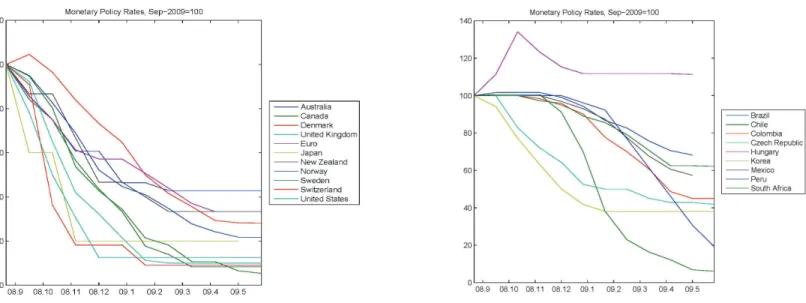
This is also the period in which we started to observe a clear change towards an expansionary monetary policy stance. With inflationary pressures subsiding due to a marked decline in energy and other commodity prices, and the intensification of the financial crisis, which increased the downside risks to growth and thus to price stability, some easing of global monetary conditions was warranted. In line with this outlook, in the fourth quarter of 2008, a group of countries aggressively cut the monetary policy rate (see Figure 9). Others stopped raising interest rates, due to the worsening economic outlook (see Figure 9). An additional signal of the (potential) magnitude of events facing the world the unprecedented joint action taken by a group of major central banks in October 8: a coordinated cut to interest rates. This measure involved the Bank of Canada, the Bank of England, the European Central Bank, the Federal Reserve, the Sveriges Riksbank and the Swiss National Bank. The Bank of Japan expressed its strong support.
Figure 9. Monetary Policy Rates Since Lehman
During this period, financial conditions deteriorated markedly. The combination of high uncertainty, lower growth perspectives (and commodity prices) and the worsening international financial conditions gave rise to very restrictive credit conditions. Lending spreads increased significantly (see Figure 10) and credit to firms became quite scarce. In this scenario, many central banks contemplated the possibility of disruptions in the monetary policy transmission channel. This explains why, in some cases, monetary policy focused initially on restoring the financial market functioning rather than to reducing interest rates. Also some countries did not reduce interest rates until it was clear that inflation pressures had been mitigated. As commodity prices started to fall, in the last quarter of 2008, inflation also plunged.
Figure 10. Lending-Deposit Spread and Monetary Policy Rates3
In the scenario of tight credit conditions, some countries implemented asset purchase programs, while others started lending to banks, accepting commercial paper as collateral. The
3 Note: The left axes indicates the lending-deposit spread and the right axes plots the monetary policy rate. The data for Canada and Norway is quarterly.
asset purchase programs sought to push up the price of treasury bills. For countries with more severe financial market disruptions, the asset purchase programs involved buying private assets directly (US, England) or through special funds (Korea, Switzerland). Now, the most common action to improve the supply of loans to the
corporate sector was to expand the list of acceptable collateral in operations with the central bank to include commercial paper, corporate securities, asset-backed securities, mortgage securities and securities with lower credit ratings. In some cases, the easing of collateral requirements was complemented by the introduction of special credit facilities to eligible financial institutions against selected collateral, mainly commercial papers. Additionally, some central banks broadened eligible counterparties for liquidity provision operations.
Since January 2009 all central banks in our sample started to lower interest rates. At that point it became clear that the deterioration in world activity, the reduction in commodity prices, and higher output gaps was giving rise to deflation concerns. Many central banks revised their inflation forecasts downward, by significant amounts. As a result, actions to inject liquidity to financial markets continued, but liquidity concerns subsided. Instead, the focus of monetary policy shifted to the financial crisis’ effects on economic activity. Some countries also hit the lower bound in this period and implemented measures to deal with this problem.
At this point, some countries engaged in exchange rate intervention. In particular, and in line with the search for ways to deal with the lack of monetary policy stimulus at the lower bound, developed countries started to buy dollars to avoid further appreciation of their currencies. Additionally some central banks started to buy bonds issued by private sector borrowers. One special feature of these interventions was that many central banks stated clearly that unconventional measures did not compromise medium- and long-term price stability.
Even though some central banks recognized that financial systems were well prepared to face the turbulence, the financial crisis’ effect on credit provision was evident. As mentioned before, that led some central banks to establish loan facilities to increase access to credit with longer duration.
Tight credit conditions led many central banks to open new facilities to financial intermediaries, to stimulate bank lending to non-financial companies. Many central banks were concerned about direct lending. The Riksbank stated in November 28 “…the Riksbank should not lend directly to non-financial companies, because that would be a departure from the Riksbank’s traditional role as the banks’ ba