(will be inserted by the editor)
A Survey on the Use of Topic Models when Mining
Software Repositories
Tse-Hsun Chen · Stephen W. Thomas ·
Ahmed E. Hassan
Received: date / Accepted: date
Abstract Researchers in software engineering have attempted to improve soft-ware development by mining and analyzing softsoft-ware repositories. Since the ma-jority of the software engineering data is unstructured, researchers have applied Information Retrieval (IR) techniques to help software development. The recent advances of IR, especially statistical topic models, have helped make sense of un-structured data in software repositories even more. However, even though there are hundreds of studies on applying topic models to software repositories, there is no study that shows how the models are used in the software engineering research community, and which software engineering tasks are being supported through topic models. Moreover, since the performance of these topic models is directly related to the model parameters and usage, knowing how researchers use the topic models may also help future studies make optimal use of such models. Thus, we surveyed 167 articles from the software engineering literature that make use of topic models. We find that i) most studies centre around a limited number of software engineering tasks; ii) most studies use only basic topic models; iii) and researchers usually treat topic models as black boxes without fully exploring their underlying assumptions and parameter values. Our paper provides a starting point for new researchers who are interested in using topic models, and may help new researchers and practitioners determine how to best apply topic models to a par-ticular software engineering task.
Keywords Topic modeling·LDA·LSI ·Survey
1 Introduction and Motivation
Researchers in software engineering have attempted to improve software develop-ment by mining and analyzing software repositories, such as source code changes, email archives, bug databases, and execution logs (Godfrey et al., 2008; Hassan, Tse-Hsun Chen·Stephen W. Thomas·Ahmed E. Hassan
Software Analysis and Intelligence Lab (SAIL) School of Computing, Queen’s University, Canada E-mail:{tsehsun, sthomas, ahmed}@cs.queensu.ca
2008). Research shows that interesting and practical results can be obtained from mining these repositories, allowing developers and managers to better understand their systems and ultimately increase the quality of their products in a cost effec-tive manner (Tichy, 2010). Particular success has been experienced withstructured
repositories, such as source code, execution traces, and change logs.
However, automated techniques to understand the unstructured textual data in software repositories are still relatively immature (Hassan, 2008), even though 80–85% of the data is unstructured (Blumberg and Atre, 2003; Grimes, 2008). Un-structured data is a current research challenge because the data is often unlabeled, vague, and noisy (Hassan, 2008). For example, the Eclipse bug database contains the following bug report titles:
– “NPE caused by no spashscreen handler service available”(#112600) – “Provide unittests for link creation constraints” (#118800) – “jaxws unit tests fail in standalone build”(#300951)
This data isunlabeled andvague because it contains no explicit links to the source code entity (e.g., package, file, or method) to which it refers, or even to a topic or task from some pre-defined ontology. Instructions such as “link creation con-straints,” with no additional information or pointers, are ambiguous at best. The data is noisy due to misspellings and typographical errors (“spashscreen”), un-conventional acronyms (“NPE”), and multiple phrases used for the same concept (“unittests”, “unit tests”). The sheer size of a typical unstructured repository (for example, Eclipse has received an average of 115 new bug reports a day for the last 10 years), coupled with its lack of structure, makes manual analysis extremely challenging and in many cases impossible. The end result is that this unstructured data is still waiting to be mined and analyzed.
Despite the above-mentioned challenges, mining unstructured repositories has the potential to benefit software development teams in several ways. For example, linking emails to the source code entities that they discuss could provide developers access to the design decisions made about each code entity. Determining which source code entities are related to a new bug report would significantly reduce the maintenance effort that is required to fix the bug. Automatically creating labels for source code entities would allow developers to more easily browse and understand the code, understand how certain concepts are changing over time, and uncover relationships between entities. All of these tasks would help decrease maintenance costs, increase software quality, and ultimately yield pleased, paying customers.
Advances in the field of Information Retrieval (IR), Machine Learning (ML), and statistical learning, especially the development ofstatistical topic models(Blei and Lafferty, 2009; Blei et al., 2003; Griffiths et al., 2007), have helped make sense of unstructured data in other research communities, including the social sciences (Griffithset al., 2007; Ramageet al., 2009b) and computer vision (Barnard
et al., 2003). Topic models, such Latent Semantic Indexing (LSI) (Deerwester
et al., 1990) and latent Dirichlet allocation (LDA) (Bleiet al., 2003), are models that automatically discover structure within an unstructured corpus of documents, using the statistical properties of its word frequencies. Topic models can be used to index, search, cluster, summarize, and infer links within the corpus, all tasks that were previously manually performed or not performed at all.
In addition to discovering structure, topic models are hold great promise for several reasons. The models require no training data, which makes them easy to use in practical settings (Blei et al., 2003). The models operate directly on the
raw, unstructured text without expensive data acquisition or preparation costs. (The textual data is often preprocessed, for example by removing common English-language stop words and removing numbers and punctuation, but these steps are fast and simple (Marcus et al., 2004)). Most models, even generative statistical models like LDA, are fast and scalable to millions of documents in real time (Por-teouset al., 2008). Some topic models are well equipped to handle both synonymy and polysemy, as explained in Section 2.3. Finally, all topic models can be applied to any text-based software repository, such as the identifier names and comments within source code, bug reports in a bug database, email archives, execution logs, and test cases.
Indeed, researchers are beginning to use topic models to mine software repos-itories. Recent studies focus on concept mining (e.g., Abebe et al., 2013; Cleary
et al., 2008; Grantet al., 2008; Kagdiet al., 2012b; Marcuset al., 2004, 2005; Me-dini, 2011; Poshyvanyk and Marcus, 2007; Poshyvanyket al., 2006; Revelleet al., 2010; Van der Spek et al., 2008), constructing source code search engines (e.g., Bajracharya and Lopes, 2010; Grechaniket al., 2010; Tianet al., 2009), recover-ing traceability links between artifacts (e.g., Aliet al., 2014; Antoniolet al., 2008; Asuncionet al., 2010; Biggerset al., 2014; de Boer and van Vliet, 2008; De Lucia
et al., 2004, 2007; Hayeset al., 2006; Jianget al., 2008; Loharet al., 2013; Lormans and Van Deursen, 2006; Lormanset al., 2006; Marcus and Maletic, 2003; McMil-lan et al., 2009), calculating source code metrics (e.g., Bavotaet al., 2010; Chen
et al., 2012; Gallet al., 2008; Gethers and Poshyvanyk, 2010; Hu and Wong, 2013; Kagdiet al., 2010; Linstead and Baldi, 2009; Liuet al., 2009; Marcuset al., 2008; Ujhazi et al., 2010), and clustering similar documents (e.g., Brickey et al., 2012; Galvis Carre˜no and Winbladh, 2013; Gorla et al., 2014; Kuhnet al., 2005, 2007, 2008, 2010; Linet al., 2006; Maletic and Marcus, 2001; Maletic and Valluri, 1999; Raja, 2012). Although there are hundreds of studies on applying topic models to software repositories, there is no study that shows how the models are used in the software engineering research community, and which software engineering tasks are being supported through topic models. Moreover, since the performance of these topic models is directly related to the model parameters and usage, knowing how researchers use the topic models may also help future studies make optimal use of such models.
Prior studies focus on studying the use of topic models on a specific SE task. Thus, in this paper, we survey the software engineering field to determine how topic models have thus far been applied to one or more software repositories. We follow the mapping study approach (Kitchenhamet al., 2011; Petersenet al., 2008). Our primary goals are to characterize and quantify:
– which topics models are being used,
– which SE tasks are being supported through topic models, – how researchers are evaluating their results,
– what preprocessing steps are being performed on the data, and – what are the typical tools and input parameter values.
Although recent studies have shown promising results (e.g., Borget al.(2014); Dit et al. (2013c, 2014)), we performed a detailed analysis of the literature and found several limitations. In particular, we find that most studies to date:
– use only basic topic models; and
– treat topic models as black boxes without fully exploring their underlying as-sumptions and parameter values.
We examine a total of 167 articles from the Software Engineering literature that use topic models (see Appendix A for details regarding our article selection process). Section 2 discusses background of the field Mining Software Repositories and topic models. Section 3 collects and presents 37 attributes on each article that help quantify and distinguish it from the others. We use the attributes to present aggregated findings, discuss current research trends, and highlight future research opportunities. Section 4 discusses common uses of topic models on dif-ferent Software Engineering tasks. Section 5 provides a general guideline on how to avoid common pitfalls when applying topic models to support SE tasks. Sec-tion 6 discusses possible future research direcSec-tions. Finally, SecSec-tion 7 concludes the paper.
2 Background
In this Section, we first provide background information on the field of Mining Software Repositories. We then highlight the differences between mining structured and unstructured data. Finally, we introduce topic models and their background knowledge.
2.1 Mining Software Repositories
Mining Software Repositories (MSR) is a field of software engineering research, which aims to analyze and understand the data repositories related to software development. The main goal of MSR is to make intelligent use of these software repositories to support the decision-making process of software development (God-freyet al., 2008; Hassan, 2004, 2008; Hassan and Holt, 2005).
Software development produces several types of repositories during its lifetime, detailed in the following paragraphs. Such repositories are the result of the daily interactions between the stakeholders, as well as the evolutionary changes to var-ious software artifacts, such as source code, test cases, bug reports, requirements documents, and other documentation. These repositories offer a rich, detailed view of the path taken to realize a software system, but they must be transformed from their raw form into something usable (Godfreyet al., 2008; Hassan, 2008; Hassan and Xie, 2010; Tichy, 2010; Zimmermannet al., 2005). A prime example of mining software repositories isbug prediction. By mining the characteristics of source code entities (such as size, complexity, number of changes, and number of past bugs), researchers have shown how to accurately predict which entities are likely to have future bugs and therefore deserve additional quality control resources.
2.2 Structured vs. Unstructured Data in Software Repositories
The term “unstructured data” is difficult to define and its usage varies in the literature (Bettenburg and Adams, 2010; Manninget al., 2008). In this paper, we adopt the definition given by Manninget al.(2008):
“Unstructured data is data which does not have clear, semantically overt, easy-for-a-computer structure. It is the opposite of struc-tured data, the canonical example of which is a relational database, of the sort companies usually use to maintain product inventories and personnel records.”
Unstructured datausually refers to natural language text, since such text has no explicit data model. Most natural language text indeed has latent structure, such as parts-of-speech, named entities, relationships between words, and word sense, that can be inferred by humans or advanced machine learning algorithms. However, in its raw, unparsed form, the text is simply a collection of characters with no structure and no meaning to a data mining algorithm. Examples of unstructured data in software repositories include: bug report titles and descriptions; source code linguistic data (i.e., identifier names, comments, and string literals); requirements documents; descriptions and comments in design documents; mailing lists and chat logs; and source control database commit messages.
Structured data, on the other hand, has a data model and a known form. Ex-amples of structured data in a software repository include: source code parse trees, call graphs, inheritance graphs; execution logs and traces; bug report metadata (e.g., author, severity, date); source control database commit metadata (e.g., au-thor, date, list of changed files); and mailing list and chat log metadata.
2.3 Topic Models
Atopic model(orlatent topic modelorstatistical topic model) is a method designed to automatically extract topics from a corpus of text documents (Anthes, 2010; Blei and Lafferty, 2009; Steyvers and Griffiths, 2007). Here, a topic is a collection of words that co-occurred frequently in the documents of the corpus. Due to the nature of language usage, the words that constitute a topic are often semantically related.
Topic models were originally developed as a means of automatically indexing, searching, clustering, and structuring large corpora of unstructured and unlabeled documents. Within the topic modeling framework, documents can be represented by the topics within them, and thus the entire corpus can be indexed and organized in terms of this discovered semantic structure.
2.3.1 Common Terminology
Topic models share a common vernacular, which we summarize below. To make the discussion more concrete, we use a running example of a corpus of three simple documents (shown in Figure 1).
term (word or token)w: a string of one or more alphanumeric characters. In our example, we have a total of 101 terms. For example, predicting, bug, there, have, bug andof are all terms. Terms might not be unique in a given document.
documentd: an ordered set ofN terms,w1, . . . , wN.
In our example, we have three documents:d1, d2,andd3.d1hasN= 34 terms, d2 hasN= 35 terms, andd3 hasN= 32 terms.
Predicting the incidence of faults in code has been commonly associated with measuring com-plexity. In this paper, we propose complexity metrics that are based on the code change process instead of on the code.
(a) Documentd1.
Bug prediction models are often used to help allocate software quality assurance efforts (for example, testing and code reviews). Mende and Koschke have re-cently proposed bug prediction models that are effort-aware.
(b) Documentd2.
There are numerous stud-ies that examine whether or not cloned code is harmful to software sys-tems. Yet, few of these studies study which char-acteristics of cloned code in particular lead to soft-ware defects (or faults).
(c) Documentd3.
Fig. 1 A sample corpus of three documents.
queryq: an ordered set of|q|terms created by the user, q1, . . . , q|q|.
In our example, a user might query for “defects” (with|q|=1 term) or “cloned code” (with|q|=2 terms).
corpusC: an unordered set ofndocuments,d1, . . . , dn.
In our example, there is one corpus, which consists ofn= 3 documents:d1, d2, andd3.
vocabularyV: the unordered set ofmunique terms that appear in a corpus. In our example, the vocabulary consists of m = 71 unique terms across all three documents:code, of, are, that, to, the, software,. . ..
term-document matrixA: anm×n matrix whose ith, jth entry is the weight of termwi in documentdj (according to some weighting function, such as term-frequency).
In our example, we have
A= d1 d2d3 code 3 1 2 of 2 0 2 are 1 2 1 . . . .
indicating that, for example, the term code appears in document d1 with a weight of 3, and the termareappears in document d2 with a weight of 2. topic (concept)z: an m-length vector of probabilities over the vocabulary of a
corpus.
In our example, we might have a topic
code of are that to the software . . . z1= 0.25 0.10 0.05 0.01 0.10 0.17 0.30 . . .
indicating that, for example, when a term is drawn from topic z1, there is a 25% chance of drawing the term code and a 30% chance of drawing the term
software. (This example assumes a generative model, such as PLSI or LDA. See Section 2.3.3 for the full definitions.)
topic membership vectorθd: For document d, a K-length vector of probabilities of theK topics.
In our example, we might have a topic membership vector z1 z2 z3 z4 . . . θd1= 0.25 0.0 0.0 0.70. . .
indicating that, for example, when a topic is selected for document d1, there is a 25% chance of selecting topic z1 and a 70% chance of selecting topicz3 . document-topic matrixθ(also called document-topic matrixD): an nby K
ma-trix whose ith, jth entry is the probability of topiczj in document di. Row i ofθcorresponds toθdi.
In our example, we might have a document-topic matrix
θ=
z1 z2 z3 z4 . . . d1 0.25 0.0 0.0 0.70. . . d2 0.0 0.0 0.0 1.0 . . . d3 0.1 0.4 0.2 0.0 . . .
indicating that, for example, document d3 contains topicz3 with probability 20%.
topic-term matrixφ(also called topic-term matrixT): a K by m matrix whose ith, jth entry is the probability of termwj in topiczi. Rowiofφcorresponds tozi.
In our example, we might have a topic-term matrix:
φ=
code of are that to the software . . . z1 0.25 0.10 0.05 0.01 0.10 0.17 0.30 . . . z2 0.0 0.0 0.0 0.05 0.2 0.0 0.05 . . . z3 0.1 0.04 0.2 0.0 0.07 0.10 0.12 . . . . . . .
Some common issues arise with any language model:
synonymy: Two termsw1andw2,w16=w2, aresynonymsif they possess similar semantics.
homonymy: A termwis ahomonym if it has multiple semantics.
We note that the termsemantic is hard to define and takes on different mean-ings in different contexts. In the field of information retrieval, often a manually-created oracle is used (e.g., WordNet (Miller, 1995)) to determine the semantics of a term (i.e., relationships with other terms).
2.3.2 The Vector Space Model
While not a topic model itself, the Vector Space Model (VSM) is the basis for many advanced IR techniques and topic models. The VSM is a simple algebraic model directly based on the term-document matrix (Salton et al., 1975). In the VSM, a document is represented by its corresponding column vector in A. For example, if a vector for a document d was [0,1,1,0,0], then according to the VSM, dcontains the two terms, namely those with index 2 and 3. Likewise, it is
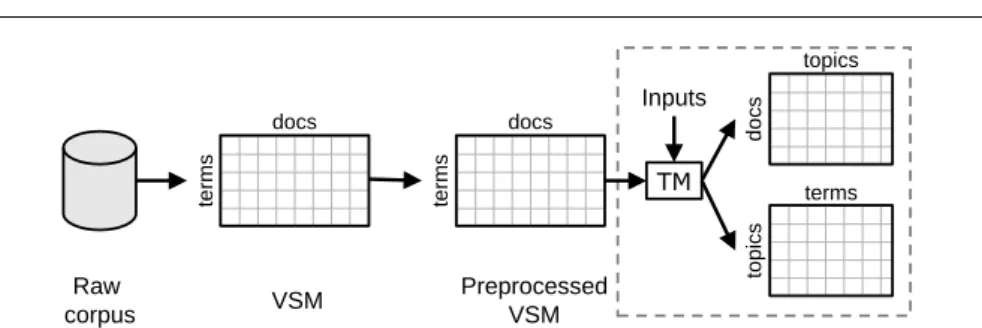
VSM terms docs Raw corpus terms docs do c s topics Preprocessed VSM Inputs topi c s terms TM Topic Models
Fig. 2 The path from a raw corpus to a topic model (TM). Here, “Topic Models” includes LSI, ICA, PLSI, LDA, and all LDA variants.
possible to determine which documents contain a given termwby simply selecting the non-zero elements ofw’s vector inA.
With this representation, one can query the corpus as follows. First, compute the m-lengthed term vector q for the query, as if it were another document in the corpus. Then, compute the semantic-relatedness (often the cosine-similarity) between q and each column of A. Finally, sort the semantic relatedness results to obtain a ranked list of documents that are similar to q. In a similar way, it is possible to determine which of the original documents in the query are most similar to one another.
2.3.3 Topic Models
Atopic model (orlatent topic model) is designed to automatically extract topics
from a corpus of text documents (Anthes, 2010; Blei and Lafferty, 2009; Steyvers and Griffiths, 2007; Zhai, 2008). Here, a topic is a collection of terms that co-occur frequently in the documents of the corpus, for example{mouse, click, drag, right, left}and{user, account, password, authentication}. Due to the nature of language use, the terms that constitute a topic are often semantically related (Bleiet al., 2003).
Topic models were originally developed as a means of automatically indexing, searching, clustering, and structuring large corpora of unstructured and unlabeled documents. Using topic models, documents can be represented by the topics within them, and thus the entire corpus can be indexed and organized in terms of this dis-covered semantic structure. By representing documents by the lower-dimensional topics, as opposed to terms, topic models (i) uncoverlatentsemantic relationships and (ii) allow faster analysis on text (Zhai, 2008). Figure 2 shows the general pro-cess of creating basic topic models from a raw corpus; we describe several topic modeling techniques below.
Latent Semantic Indexing Latent Semantic Indexing (LSI) (or Latent Semantic Analysis (LSA)) is an information retrieval model that extends the VSM by re-ducing the dimensionality of the term-document matrix by means of Singular Value Decomposition (SVD) (Deerwester et al., 1990). During the dimensional-ity reduction phase, terms that are related (in terms of co-occurrence) will be
grouped together into topics1. This noise-reduction technique has been shown to provide increased performance over VSM in terms of dealing with polysemy and synonymy (Baeza-Yates and Ribeiro-Neto, 1999).
SVD is a factorization of the original term-document matrixAthat reduces the dimensionality ofAby isolating thesingular valuesofA(Salton and McGill, 1983). SinceAis likely to be very sparse, SVD is a critical step of the LSI approach. SVD decomposesAinto three matrices:A=T SDT, whereT is anmbyr=rank(A) term-topic matrix, S is the r by r singular value matrix, and D is the n by r document-topic matrix.
LSI augments the reduction step of SVD by choosing a reduction factor, K, which is typically much smaller than the rank of the original term-document matrix r. Instead of reducing the input matrix to r dimensions, LSI reduces the input matrix toK dimensions. There is no perfect choice forK, as it is highly data- and task-dependent. In the literature, typical values range between 50–300. A common approach to chooseK for LSI is to examine the amount of variance (e.g., singular values) in the data after computing the SVD (Huet al., 2003; Jolliffe, 2002). The number of dimensions (K) is chosen such that the variance in the data is lower than a cut-off point, or such that the dimensions that include 70% of the variance are retained (Huet al., 2003; Jolliffe, 2002).
As in VSM, terms and documents are represented by row and column vectors, respectively, in the term-document matrix. Thus, two terms (or two documents) can be compared by some distance measure between their vectors (e.g., cosine sim-ilarity) and queries can by formulated and evaluated against the matrix. However, because of the reduced dimensionality of the term-document matrix after SVD, these measures are more equipped to deal with noise in the data.
Independent Component Analysis Independent Component Analysis(ICA) (Comon, 1994) is a statistical technique used to decompose a random variable into statis-tically independent components (i.e., dimensions). Although not generally consid-ered a topic model, it has been used in similar ways to LSI to model source code documents in aK-dimensional conceptual space.
Like LSI, ICA reduces the dimensionality of the term-document matrix to help reduce noise and associate terms. However, unlike LSI, the resulting dimensions in ICA are statistically independent of one another, which helps capture more variation in the underlying data (Grant and Cordy, 2009).
Probabilistic LSI Probabilistic Latent Semantic Indexing (PLSI) (orProbabilistic Latent Semantic Analysis (PLSA)) (Hofmann, 1999, 2001) is a generative model that addresses the statistical unsoundness of LSI. Hofmann argues that since LSI uses SVD in its dimension-reduction phase, LSI is implicitly making the unquali-fied assumption that term counts will follow a Gaussian distribution. Since this as-sumption is not verified, LSI is “unsatisfactory and incomplete” (Hofmann, 1999). To overcome this assumption, PLSI defines a generative latent-variable model, where the latent variables are topics in documents. At a high level, a generative model has the advantages of being evaluable with standard statistical techniques, such as model checking, cross-validation, and complexity control; LSI could not be
1 The creators of LSI call these reduced dimensions “concepts”, not “topics”. However, to
evaluated with any of these techniques. And since the latent variables are topics in documents, PLSI is also well-equipped to more readily handle polysemy and synonymy.
The generative model for each term in the corpus can be summarized with the following steps.
– Select a documentdi with probabilityP(di). – Select a topiczkwith probabilityP(zk|di). – Generate a termwj with probabilityP(wj|zk).
Given the observations in a dataset (i.e., terms), one can perform inference against this model to uncover the topics z1, ..., zk. We refer interested readers to the original articles (Hofmann, 1999, 2001).
Subsequent articles (e.g., Bleiet al., 2003; Zhai, 2008) show that the generative model of PLSI suffers from at least two critical problems. First, since dis used as an index variable in the first step, the number of parameters that need to be estimated grows linearly with the size of the corpus, which can lead to severe over-fitting issues. Second, since thezkvectors are only estimated for documents in the training set, they cannot be easily applied to new, unseen documents.
Latent Dirichlet Allocation Latent Dirichlet Allocation (LDA) is a popular prob-abilistic topic model (Blei et al., 2003) that has largely replaced PLSI. One of the reasons for its popularity is because it models each document as a multi-membership mixture ofKcorpus-wide topics, and each topic as a multi-membership mixture of the terms in the corpus vocabulary. This means that there is a set of topics that describe the entire corpus, each document can contain more than one of these topics, and each term in the entire repository can be contained in more than one of these topics. Hence, LDA is able to discover a set of ideas or themes that well describe the entire corpus (Blei and Lafferty, 2009).
LDA is based on a fully generative model that describes how documents are created. Intuitively, this generative model makes the assumption that the corpus contains a set of K corpus-wide topics, and that each document is comprised of various combinations of these topics. Each term in each document comes from one of the topics in the document. This generative model is formulated as follows:
– Choose a topic vectorθd ∼ Dirichlet(α) for documentd. – For each of theN termswi:
– Choose a topiczk∼ Multinomial(θd). – Choose a termwi from p(wi|zk, β).
Here, p(wi|zk, β) is a multinomial probability function,αis a smoothing parameter for document-topic distributions, and β is a smoothing parameter for topic-term distributions.
The two levels of this generative model allow three important properties of LDA to be realized: documents can be associated with multiple topics, the number of parameters to be estimated does not grow with the size of the corpus, and, since the topics are global and not estimated per document, unseen documents can easily be accounted for.
Like any generative model, the task of LDA is that ofinference: given the terms in the documents, what topics did they come from (and what are the topics)? LDA
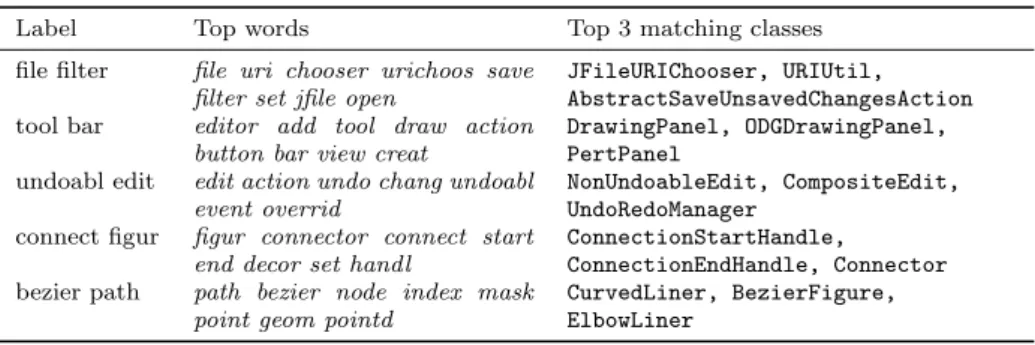
Table 1 Example topics from JHotDraw source code version 7.5.1. The labels are automatically-generated based on the most popular bigram in the topic.
Label Top words Top 3 matching classes
file filter file uri chooser urichoos save filter set jfile open
JFileURIChooser, URIUtil, AbstractSaveUnsavedChangesAction tool bar editor add tool draw action
button bar view creat
DrawingPanel, ODGDrawingPanel, PertPanel
undoabl edit edit action undo chang undoabl event overrid
NonUndoableEdit, CompositeEdit, UndoRedoManager
connect figur figur connector connect start end decor set handl
ConnectionStartHandle,
ConnectionEndHandle, Connector bezier path path bezier node index mask
point geom pointd
CurvedLiner, BezierFigure, ElbowLiner
performs inference withlatent variable models (orhidden variable models), which are machine learning techniques devised for just this purpose: to associate observed variables (here, terms) with latent variables (here, topics). A rich literature exists on latent variable models (Bartholomew, 1987; Bishop, 1998; Loehlin, 1987); for the purposes of this paper, we omit the details necessary for computing the pos-terior distributions associated with such models. It is sufficient to know that such methods exist and are being actively researched.
For the above-mentioned reasons, it is argued that LDA’s generative process gives it a solid footing in statistical rigor—much more so than previous topic models (Blei et al., 2003; Griffiths and Steyvers, 2004; Steyvers and Griffiths, 2007). As such, LDA may be better suited for discovering the latent relationships between documents in a large text corpus.
Table 1 shows example topics discovered by LDA from version 7.5.1 of the source code of JHotDraw (Gamma, 2007), a framework for creating simple drawing applications. For each topic, the table shows an automatically-generated two-word topic label, the top (i.e., highest probable) words for the topic, and the top three matching Java classes in JHotDraw. The topics span a range of concepts, from opening files to drawing Bezier paths. The discovered topics intuitively make sense and the top-matching classes match our expectations—there seems to be a natural match between the “Bezier path” topic and theCurvedLinearandBezierFigure classes.
A prior study by Wallach et al.(2009a) shows that choosing a larger K for LDA does not significantly affect the quality of the generated topics. The additional topics are rarely used (i.e., noise) in the LDA sampling process and may be filtered out. For example, if the data has only 10 topics, running LDA with 15 topics will likely identify 10 real topics and five noise topics (Wallach et al., 2009a). Topic filtering approaches may vary for different domains, and future studies are needed to examine the best approach to filter these noise topics. On the other hand, choosing a smallK may be more problematic, since the information (i.e., topics) cannot be separated precisely (Wallachet al., 2009a).
Variations of LDA Several variants and offshoots of LDA have been proposed. All of these variants apply additional constraints on the basic LDA model. Although promising, the software engineering literature usually does not make use of many
of these variants, and therefore we omit a detailed presentation of each. However, the details can be found in references to the original papers.
– Hierarchical Topic Models (HLDA) (Bleiet al., 2004, 2010). HLDA discovers a tree-like hierarchy of topics within a corpus, where each additional level in the hierarchy is more specific than the previous. For example, a super-topic “user interface” might have sub-topics “toolbar” and “mouse events”.
– Cross-Collection Topic Models (ccLDA) (Paul, 2009). ccLDA discovers topics from multiple corpora, allowing the topics to exhibit slightly different behavior in each corpus. For example, a “food” topic might contain the words {food cheese fish chips}in a British corpus and the words{food cheese taco burrito}
for a Mexican corpus.
– Supervised Topic Models (sLDA) (Blei and McAuliffe, 2008). sLDA consid-ers documents that are already marked with a response variable (e.g., movie reviews with a numeric score between 1 and 5), and provides a means to auto-matically discover topics that help with the classification (i.e., predicting the response variable) of unseen documents.
– Labeled LDA (LLDA) (Flaherty et al., 2005; Ramage et al., 2009a). LLDA takes as input a text corpus in which each document is labeled with one or more labels (such as Wikipedia) and discovers the term-label relations. LLDA discovers a set of topics for each label and allows documents to only display topics from one of its labels.
– Correlated Topic Models (CTM) (Blei and Lafferty, 2007). CTM discovers the correlation between topics and uses the correlation when assigning topics to documents. For example, a document about the “genetics” topic is more likely to also contain the “disease” topic than the “X-ray astronomy” topic.
– Networks Uncovered by Bayesian Inference(Nubbi) (Changet al., 2009). Nubbi discovers relationships between pairs of entities in a corpus, where entities are specified as inputs into the model (e.g., people or places). For example, if the entities George W. Bush andGerald Ford were input into Nubbi as entities, along with a corpus of political documents, then Nubbi might connectGeorge W. Bush toGerald Ford through a “republican” topic.
– Author-Topic Model (Rosen-Zviet al., 2004). The author-topic model consid-ers one or more authors for each document in the corpus. Each author is then associated with a probability distribution over the discovered topics. For exam-ple, the authorStephen King would have a high probability with the “horror” topic and a low probability with the “dandelions” topic.
– Polylingual Topic Models (PLTM) (Mimno et al., 2009). PLTM can handle corpora in several different languages, discovering aligned topics in each lan-guage. For example, if PLTM were run on English and German corpora, it might discover the aligned “family” topics {child parent sibling} and {kind eltern geschwister}.
– Relational Topic Models (RTM) (Chang and Blei, 2009). RTM models docu-ments as does LDA, as well as discovers links between each pair of docudocu-ments. For example, if document 1 contained the “planets” topic, document 2 con-tained the “asteroids” topic, and document three concon-tained the “Michael Jack-son” topic, then RTM would assign a stronger relationship between documents 1 and 2 than between documents 1 and 3 or documents 2 and 3, because topics 1 and 2 are more closely related to each other.
– Markov Topic Models(MTM) (Wanget al., 2009). Similar to the Cross-Collection Topic Model, MTM discovers topics from multiple corpora, allowing the topics to exhibit slightly different behavior in each corpus.
– Pachinko Allocation Model (PAM) (Li and McCallum, 2006). PAM provides connections between discovered topics in an arbitrary directed acyclic graph. For example, PAM might connect the “language processing” topic to the “speech recognition” topic, but not to the “snorkeling” topic.
– Topic Modeling with Network Regularization (TMN) (Meiet al., 2008). TMN can model corpora which have networks defined between documents, such as social networks or call-graph dependencies. TMN discovers topics that overlay on the network in a meaningful way. For example, if a network was formed from author-coauthor relationships in academic articles, then topics that are assigned to author A have a high likelihood of being assigned to one of the coauthors of author A.
– Biterm Topic Model (BTM) (Yanet al., 2013). Topic models generally perform poorly on short documents. BTM is designed for short documents (e.g., tweets). BTM learns topics by modeling the word co-occurrence patterns (i.e., biterms). Recent experiments show that BTM generated topics are more prominent, coherent topics, and include more relevant words (according to manual analysis of the topics) (Yan et al., 2013).
2.3.4 Topic Evolution Models
Several advanced techniques have been proposed to extract the evolution of a topic in a time-stamped corpus—how the usage of a topic (and sometimes the topic itself) changes over time as the terms in the documents are changed over time. Such a model is usually an extension to a basic topic model that accounts for time in some way. We call such a model atopic evolution model.
Initially, the Dynamic Topic Model (Blei and Lafferty, 2006) was proposed. This model represents time as a discrete Markov process, where topics themselves evolve according to a Gaussian distribution. This model thus penalizes abrupt changes between successive time periods, discouraging rapid fluctuation in the topics over time.
The Topics Over Time (TOT) (Wang and McCallum, 2006) model represents time as a continuous beta distribution, effectively removing the penalty on abrupt changes from the Dynamic Topic Model. However, the beta distribution is still rather inflexible in that it assumes that a topic evolution will have only a single rise and fall during the entire corpus history.
The Hall model (Hall et al., 2008) applies LDA to the entire collection of documents at the same time and performs post hoc calculations based on the observed probability of each document in order to map topics to versions. Linstead
et al.(2008a) and Thomaset al.(2010) also used this model on a software system’s version history. The main advantage of this model is that no constraints are placed on the evolution of topics, providing the necessary flexibility for describing large changes to a corpus.
The Link model, proposed by Mei and Zhai (2005) and first used on software repositories by Hindleet al.(2009), applies LDA to each version of the repository
separately, followed by a post-processing phase to link topics across versions. Once the topics are linked, the topic evolutions can be computed in the same way as in
the Hall model. The post-processing phase must iteratively link topics found in one version to the topics found in the previous. This process inherently involves the use of similarity thresholds to determine whether two topics are similar enough to be called the same, since LDA is a probabilistic process and it is not guaranteed to find the exact same topics in different versions of a corpus. As a result, at each successive version, some topics are successfully linked while some topics are not, causing past topics to “die” and new topics to be “born”. Additionally, it is difficult to allow for gaps in the lifetime of a topic.
2.4 Applying Topic Models to SE Data
Before topic models are applied to SE data, several preprocessing steps are gener-ally taken in an effort to reduce noise and improve the resulting models.
– Characters related to the syntax of the programming language (e.g., “&&”, “->”) are removed; programming language keywords (e.g., “if”, “while”) are removed.
– Identifier names are split into multiple parts based on common naming con-ventions, such as camel case (oneTwo), underscores (one two), dot seperators (one.two), and capitalization changes (ONETwo)).
– Common English-language stopwords (e.g., “the”, “it”, “on”) are removed. – Word stemming is applied to find the root of each word (e.g., “changing”
be-comes “chang”), typically using the Porter algorithm (Porter, 1980). Other word normalization approaches such as lemmatization, which groups the dif-ferent inflected forms of a word, may also be used.
– In some cases, the vocabulary of the resulting corpus is pruned by removing words that occur in, for example, over 80% or under 2% of the documents (Mad-sen et al., 2004).
The main idea behind these steps is to capture the semantics of the develop-ers’ intentions, which are thought to be encoded within the identifier names and comments in the source code (Poshyvanyk et al., 2007). The rest of the source code (i.e., special syntax, language keywords, and stopwords) are just noise and will not be beneficial to the results of topic models.
3 Research Trends
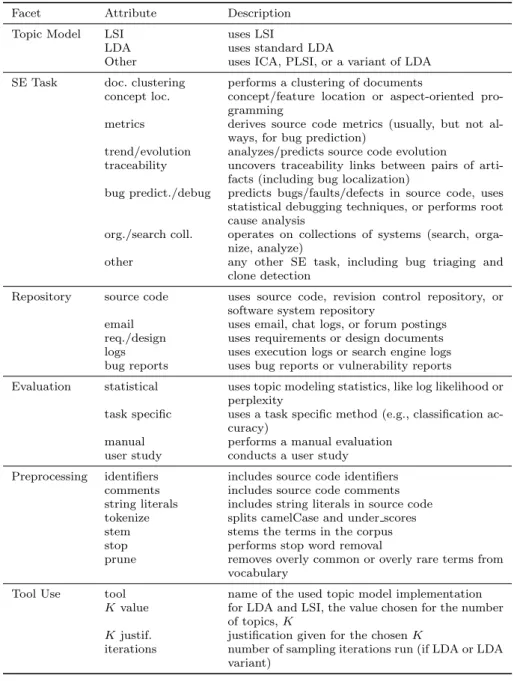
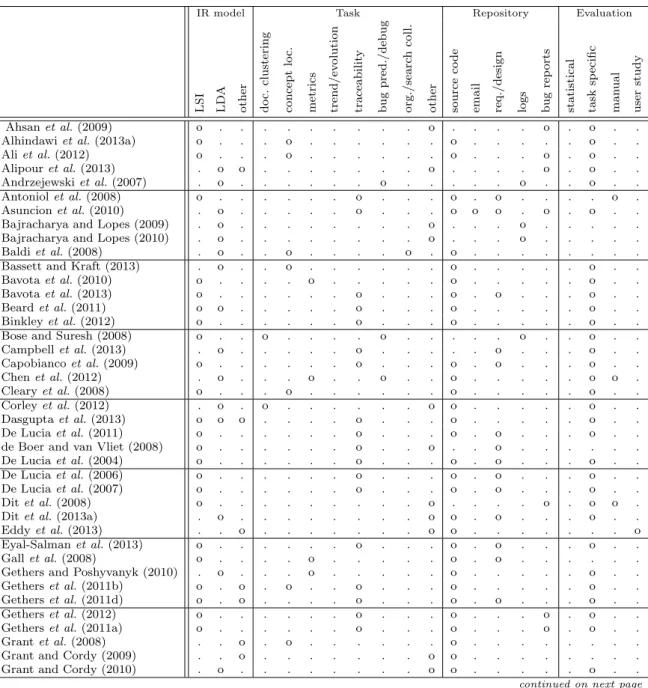
In this section, we identify and describe the research trends in the area of mining unstructured repositories using topic models. We define a set of attributes that allow us to characterize each of the surveyed articles. Additionally, we define six facets of related attributes, summarized in Table 2.
First and foremost, we are interested in whichtopic model was primarily used in the study: LSI, LDA or some other model. (Note that if an article evaluates its proposed technique, which uses topic model X, against another technique, which uses topic model Y, we only mark the article as using model X. However, if the main purpose of an article is to compare various topic models, we mark the article with all the considered topic models.) Second, we are interested in theSE task that was being performed. We include a range of tasks to allow a fine-grained view of that
● ● ● ● ● ● ● ● ● ● ● ● ● ● ● ● 0 25 50 75 100 2000 2005 2010 2014 Year Cum ulativ e Number of Ar ticles ●LSI LDA
Fig. 3 Trends of LSI and LDA use. The cumulative number of articles indicates the total number of articles published up to the year shown on the x-axis.
literature. Third, we document the repository being used in the article. Fourth, we are interested in how the authors of the article evaluated their technique, as some topic models are known to be difficult to objectively evaluate. Fifth, we are interested in how the corpus was preprocessed, as there are several proposed techniques. Finally, we are interested in which topic modelingtool was used in the article, along with which parameter values were chosen for the tool, and how they were chosen.
We manually processed each of the articles in our article set and assigned at-tribute sets to each. The results allow the articles to be summarized and compared along our six chosen facets.
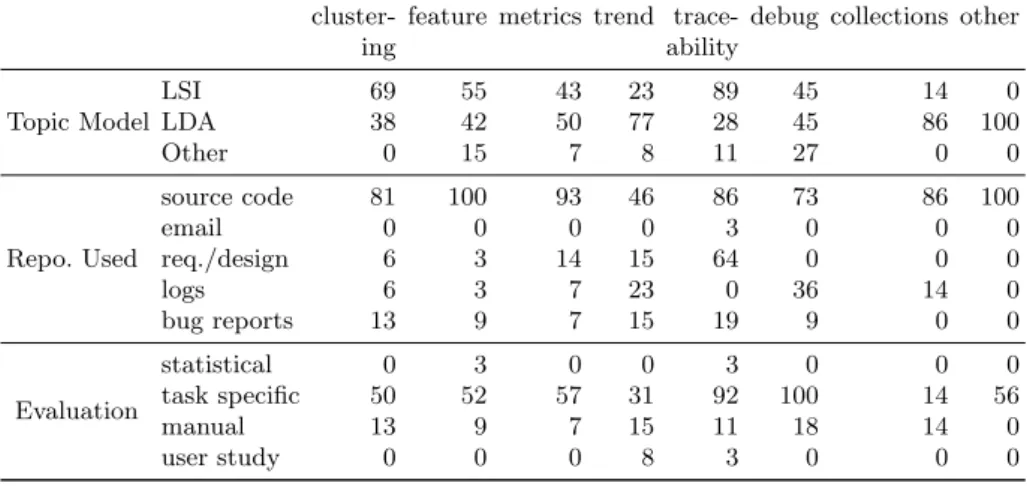
The results are shown in Appendix B (Tables B1 and B2). Table B1 shows our first four facets: which topic model was used, which software engineering task was being performed, which repository was used, and how the authors evaluated their technique. Table B2 shows our last two facets: which preprocessing steps were taken, and what topic modeling tools and parameters were used. We now analyze the research trends of each facet.
3.1 Facet 1: Which Topic Models Were Used?
The majority of surveyed articles (66%) used LDA or an LDA variant (some papers aim to compare different topic models, so the sum is over 100%), indicating that LDA is indeed a popular choice. On the other hand, 47% of the surveyed used LSI as the primary topic model. As Figure 3 illustrates, the use of LDA is increasing rapidly since its introduction into the software engineering field in 2006. Although we see some articles that compare the performance of different topic models, we only see a few studies (e.g., the study by Ditet al.(2013b), Getherset al.(2011c), and Thomaset al.(2013)) that combine different topic models. Nevertheless, com-bining the models may increase the performance significantly (Dietterich, 2000; Thomaset al., 2013).
Table 2 The final set of attributes we collected on each article.
Facet Attribute Description
Topic Model LSI uses LSI
LDA uses standard LDA
Other uses ICA, PLSI, or a variant of LDA SE Task doc. clustering performs a clustering of documents
concept loc. concept/feature location or aspect-oriented pro-gramming
metrics derives source code metrics (usually, but not al-ways, for bug prediction)
trend/evolution analyzes/predicts source code evolution
traceability uncovers traceability links between pairs of arti-facts (including bug localization)
bug predict./debug predicts bugs/faults/defects in source code, uses statistical debugging techniques, or performs root cause analysis
org./search coll. operates on collections of systems (search, orga-nize, analyze)
other any other SE task, including bug triaging and clone detection
Repository source code uses source code, revision control repository, or software system repository
email uses email, chat logs, or forum postings req./design uses requirements or design documents logs uses execution logs or search engine logs bug reports uses bug reports or vulnerability reports
Evaluation statistical uses topic modeling statistics, like log likelihood or perplexity
task specific uses a task specific method (e.g., classification ac-curacy)
manual performs a manual evaluation
user study conducts a user study Preprocessing identifiers includes source code identifiers
comments includes source code comments string literals includes string literals in source code tokenize splits camelCase and under scores
stem stems the terms in the corpus
stop performs stop word removal
prune removes overly common or overly rare terms from vocabulary
Tool Use tool name of the used topic model implementation
Kvalue for LDA and LSI, the value chosen for the number of topics,K
Kjustif. justification given for the chosenK
iterations number of sampling iterations run (if LDA or LDA variant)
Although LSI appeared earlier than LDA, the majority of surveyed articles used LDA or LDA variant. Moreover, we found little research that combines the results of different topic modeling approaches to improve their overall performance.
0 5 10 15 20 25 30 35 1999 2001 2003 2005 2007 2009 2011 2013 Doc. Clustering Concept Loc. Metrics Trend/Evolution Traceability Bug pred./Debug Org./Search coll. Other
Fig. 4 A stacked bar plot which shows the trends of the investigated tasks. The y-axis shows the number of articles published in a year.
3.2 Facet 2: Which Software Engineering Task Was Supported?
The most popular software engineering tasks in the surveyed articles are traceabil-ity link recovery (25% of articles) and concept location (24% of articles). Traceabil-ity link recovering is a task well-suited for topic models, since the goal of traceabil-ity recovering is to find the textual similartraceabil-ity between pairs of documents. Thus, using the document similarity metrics defined on the topic membership vectors of two documents is a direct implementation of traceability link recovery.
Concept location is an ideal task for topic models, since many researchers (e.g., Baldiet al.(2008)) believe that the topics discovered by a topic model are essentially equivalent (or can be directly mapped) to the conceptual concerns in the source code.
The tasks in the “other” category include bug triaging (Ahsan et al., 2009; Naguibet al., 2013), search engine usage analysis (Bajracharya and Lopes, 2009, 2010), auditor support for exploring the implementation of requirements (de Boer and van Vliet, 2008), analyzing bug report quality (Alipouret al., 2013; Ditet al., 2008), estimating the number of topics or other topic model parameters in source code (Dit et al., 2013a; Grant and Cordy, 2010; Panichella et al., 2013), clone identification (Grant and Cordy, 2009; Marcus and Maletic, 2001), finding related code on the web (Poshyvanyk and Grechanik, 2009), web service discovery (Wu
et al., 2008), source code summarization and labelling (De Luciaet al., 2012, 2014; Eddyet al., 2013; Iacob and Harrison, 2013; Medini et al., 2012), topic
interpre-tation (Hindleet al., 2012c), and refactoring (Bavotaet al., 2012). Section 4.8 has a more detailed discussion on the articles in the “other” category.
Figure 4 shows a stacked bar plot of the trend of the tasks performed by the surveyed articles across the years. We see the emergence of articles that conduct studies on collections of systems since 2007 (org./search coll). The reason may be the increased popularity of LDA and its variants, which gives researchers the right technique for analyzing trends and patterns on collections of systems. In addition, debug/bug prediction studies also emerged around 2007, and we notice several articles that are published on a yearly basis on this task since 2007.
Most research performs traceability link recovery or concept location.
3.3 Facet 3: Which Repositories Were Mined?
The overwhelming majority (72%) of the articles mine the source code repository, with the second most being requirements or design documents (21%). One possi-ble reason for the popularity of mining source code is that source code is usually the only repository that is (easily) available to researchers who study open source systems. Requirements and design documents are not created as often for open source systems, and if they are, they are rarely accessible to researchers. Email archives are usually only available for large systems, and when they are available, the archives are not usually in a form that is suited for analysis without compli-cated preprocessing efforts, due to their unstructured nature. Execution logs are most useful for analyzing ultra-large scale systems under heavy load, which is dif-ficult for researchers to simulate. Bug reports, although gaining in popularity, are typically only kept for large, well-organized projects. In addition, we found that most articles only considered a single snapshot of the repository, even when the repositories history was available.
Figure 5 shows a stacked bar plot of the trends of the mined repositories. We find that source code and requirement repositories have been used by researchers since the earlier 2000. Recently, we see more articles that mine bug reports, logs, mobile applications, and developer discussions.
The majority of prior research mines only the source code of the system, and only mines a single snapshot of the repository.
3.4 Facet 4: How Were the Topic Models Evaluated?
The most typical evaluation method used is task-specific (75% of the surveyed articles). For example, many articles use precision and recall, or the number of recovered bugs as the evaluation approach. This result makes sense, because most researchers are using topic models as a tool to support some software engineering task. Hence, the researchers evaluate how well their technique performed at the given task, as opposed to how well the topic model fit the data, as is typically done in the topic model community.
0 10 20 30 40 1999 2001 2003 2005 2007 2009 2011 2013 Source Code Email Reqs Logs Bugs
Fig. 5 A stacked bar plot which shows the trends of mined repositories.
0 10 20 30 40 1999 2001 2003 2005 2007 2009 2011 2013 Statistical Task Specific Manual User Study
Perhaps surprising is that 19% of articles performed a manual evaluation of the topic model results—an evaluation technique that is difficult and time consuming. Manual evaluation requires humans to manually verify the generated results or topics. This may be due to the seemingly “black-box” nature of topic models— documents are input, results are output, and the rest is unknown. In articles that used topic models such as LDA, manual evaluation is deemed to be the only way to be sure that the discovered topics make sense for software repositories. This may also be due to the limited ground truth available for many software engineering tasks. We also see a few articles that conduct user studies, which usually involve asking developers to verify or interpret the topics/results.
Although articles in the Machine Learning (ML) community, topic models, and natural language processing articles tend to use statistical means to evaluate topic models, only a few surveyed articles used statistical evaluation techniques (e.g., Maskeri et al.(2008)). This is perhaps a result of the software engineering community being task-focused, as opposed to model-focused.
Nevertheless, following topic evaluation approaches from the ML community can still benefit MSR studies. ML articles usually evaluate topics using unseen documents (Wallachet al., 2009b). They train the topic model using part of the documents (e.g., 90% of the documents), and estimate the probability of the held-out documents (e.g., rest 10% of the documents). By doing inferences on the held-out documents, one can compute held-out likelihood (e.g., perplexity) for measuring the topic quality (Blei et al., 2003). Bleiet al. (2003) state that “the perplexity, used by convention in language modeling, is monotonically decreasing in the likelihood of the test data, and is algebraicly equivalent to the inverse of the geometric mean per-word likelihood”. In general, perplexity, or similar metrics, measure how well the topic model “generalizes” to the held-out documents. A lower perplexity score indicates better generalization performance.
Wallach et al. (2009b) conducted an empirical study on comparing different likelihood computation approaches. They found that Chib-style estimator and left-to-right are better approaches for estimating the quality of topic models. Newman
et al.(2010) “’search” the topics on Wikipedia, WordNet, and Google search en-gine, and they use the search result to compute the score for the quality of the topic. They found that using Wikipedia and Google search engine yield the best performance (very close to inter-annotator agreement). However, we note that Wikipedia or WordNet may not be suitable for evaluating topics in the source code, and other code search engine may be used in future studies.
Figure 6 shows a stacked bar plot of the trends of how the tasks are evaluated by the surveyed articles. We see that only a few of the recent articles evaluate the tasks using statistical approach or user studies, whereas most earlier studies make use of task specific evaluation approaches. We also see that, although more articles are published in recent years, most articles still only apply task-specific evaluation approaches.
Most prior research uses task-specific or manual evaluation of the topic mod-els.
3.5 Facet 5: How Was the Data Preprocessed?
Of the articles that analyzed a source code repository, 54% mention that they include the identifiers, 4% mention that they include the comments, and 13% mention that they include string literals. The relatively high percentages for iden-tifiers and comments seem to follow the idea that the semantics of the developers’ intention is captured by their choice of identifier names and comments (Abebe
et al., 2013; Poshyvanyk et al., 2007).
The majority of articles that analyzed source code created “documents” at the class level (32%), with a close second being the method level (22%). 8% of the articles left the choice of method or class as an input to their tool and reported results on both. 15% of the articles did not specify the level of granularity used.
Studies (Jin et al., 2011; Phan et al., 2008a; Tang et al., 2014) in the Ma-chine Learning and Data Mining community have found that topic models per-form poorly on short documents (e.g., methods and logs). As a result, many new approaches have been proposed to handle short documents (Guo and Diab, 2012; Jinet al., 2011; Yan et al., 2013). However, we found there are no MSR studies that discuss such a problem nor ones that adapt one of the more advanced topic models for short documents.
The majority of articles that analyzed source code chose to tokenize terms (55%). One reason for this is that identifier names in source code are often written in a form that lends itself to tokenization (e.g.,camelCaseandunder score). By tokenizing these identifier names, the terms are being broken down into their base form and generating a larger likelihood of finding meaningful topics.
To further reduce the size of the vocabulary and increase the effectiveness of topic models, 45% of articles report stemming words, 60% report removing stop words, and 15% report pruning the vocabulary by removing overly- and/or underly-used terms. We did not find any paper that report using lemmatization. Thus, a possible direction may be studying the effect of lemmatization when ap-plying topic models on software engineering data.
In general, many articles were unclear as to how they preprocessed the tex-tual data, even though this step may have a large impact on the results of topic models (Thomas et al., 2013). For example, 15% of the surveyed articles did not mention the document granularity of their technique (e.g., an entire class or an individual method) and 50% of the articles did not indicate whether they used word stemming, a common preprocessing step in the topic model community.
Data preprocessing techniques are not well documented and are not consistent across current research. Even though topic models perform poorly on short documents, many studies still apply topic models on methods and logs etc.
3.6 Facet 6: Which Tools Were Used, and What Parameter Values Were Used? For LDA-based articles, MALLET (McCallum, 2002) was the most frequently reported tool used (7 times). The other commonly-used tools include GibbsLDA and JGibbLDA (Phanet al., 2008b). For LSI-based articles, no tool was used by more than on article.
Choosing the number of topics.Not reporting the value ofK was the norm, with 45% of articles giving no indication of their choice. Of those that did, values ranged between 5 and 1,000, with the most frequent values being between 10 and 500. 61% of the articles that did specify the value ofK did not specifywhy that particular value was used. Of the articles that did specify why, 42% came to an optimal value by testing a range of K values and evaluating each in some way (usually task-specific). A single article used an expert’s opinion on what the number of topics should be (“The number of topics for each program are chosen according to domain expert advice.” (Andrzejewskiet al., 2007)), although the actual value was not reported. A few articles also determineK based on the number of unique terms in the source code files (e.g., Xiaet al.(2013); Xueet al.(2012)).
Panichella et al. (2013) also proposed an approach to automatically find the optimal LDA parameters for software engineering tasks. They used a genetic algo-rithm to search for the combinations of LDA parameters that give the best result for traceability, feature location, and software labeling. They found that the choices of the parameters have large impacts on the results. Loharet al.(2013) also used a genetic algorithm to search for the best combination of LSI parameters, as well as preprocessing approaches. Biggerset al.(2014) measured the performance of LDA-based feature location approaches when using different configurations. They also proposed a recommendation for LDA-based feature location approaches. Thomas
et al.(2013) applied different combinations of information retrieval models, model configurations, and preprocessing approaches to find the best classifier for bug lo-calization. They found that after properly preprocessing the source code entities, VSM gives the best performance. Bradford (2008) conducted an empirical study on choosingKfor LSI. They found that whenK is around 300, LSI provides very good results on moderate-sized corpus. Moreover, checking the amount of variance in the data after applying SVD can be used to find the optimal K for LSI (Wall
et al., 2003).
There are a number of studies which proposed approaches to find optimal topic model parameters. Grant and Cordy (2010) tackled the challenge of choosing the optimal number of topics to input into LDA when analyzing source code. The authors’ technique varied the number of topics and used a heuristic to determine how well a particular choice is able to identify two pieces of code located in the same document. The authors concluded with general guidelines and case studies. A prior study by Wallach et al. (2009a) in the ML community shows that choosing a largerK for LDA does not significantly affect the quality of the gener-ated topics. The extra topics can be considered noise during the LDA generative process. However, choosing a smallK may not separate the information (i.e., in-formation) precisely (Wallachet al., 2009a). In short, researchers can filter out the noise topics in the case of over-fitting K, but under-fitting will make the topics non-separable. Nevertheless, we still see many MSR studies only use a relative small number of topics (Table B1 in Appendix B), and only a few studies that apply topic filtering.
Choosing hyperparameters and sampling iterations. The reporting of other input parameters, such as α, β, and the number of sampling iterations (in the case of LDA) was even more scarcer. 72% of the articles that used LDA did not indicate the number of iterations sampled. Of those that did, values ranged between 50 and 10,000, with 1,000 and 3,000 being the norm. Wallachet al. (2009a) in the
ML community found that using optimized hyperparameters result in improved consistency in topic usage. Namely, using optimized hyperparameters, topics won’t be dominated by common words (e.g., a topic of pure stopwords), and the topics are more stable when K increases. Hence, important topics and noise topics will be clearly separated. Thus, future studies may consider using hyperparameter optimization for optimizingαandβ.
Ditet al.(2013c, 2014) found that 95% of their studied articles do not use the same dataset for evaluation, and only 38% of their studied articles compared the proposed approach with prior studies. In our paper, we found that most articles do not report the topic model parameters they use. Thus, it is difficult to reproduce or compare the performance of the approaches proposed by prior studies. We recommend future studies to include a discussion of the parameters used to improve the reproducibility of the research.
#
" !
Key study design decisions are often not well documented. For instance, 45% of the surveyed articles we studied did not report the value of K (topics or reduction factor) that is used in the topic model, even though it is well known that this choice greatly affects the output of the topic model, and thus the results of the study.
3.7 Conclusions
The above-identified trends reveal many potentials for advancement of the state of the art. First, concept location and traceability linking are the most often ad-dressed software engineering tasks, leaving many tasks under explored.
Second, most research only uses a single topic model, even though research in other communities indicates that combining multiple models can improve overall performance (Misirliet al., 2011).
Finally, research is inconsistent as to which data preprocessing steps are per-formed, and most articles lack any justification as to why some steps are performed and others are not. In addition, parameter values are often not reported, and when they are, they are not justified or consistent with previous research. Most research rarely explores the sensitivity of topic models to their parameters.
4 Common Uses of Topic Models on Software Engineering Tasks
In this section, we describe and evaluate related work that uses topic models to mine software repositories and perform some software engineering tasks. We organize the work into subsections by software engineering task. We provide a brief description of each task, followed by a presentation of the relevant articles.
4.1 Concept/Feature Location
The task of concept location (or feature location) is to identify the parts (e.g., documents or methods) of the source code that implement a given feature of the
software system (Rajlich and Wilde, 2002). This is useful for developers wishing to debug or enhance a given feature. For example, if the so-calledfile printingfeature contained a bug, then a concept location technique would attempt to automatically find those parts of the source code that implement file printing (i.e., parts of the source code that are executed when the system prints a file).
Related to concept location isaspect-oriented programming(AOP), which aims at providing developers with the machinery to easily implement aspects of func-tionality whose implementation spans over multiple source code documents.
4.1.1 LSI-based Techniques
LSI was first used for the concept location task by Marcus et al. (2004), who developed a technique to take a developer query and return a list of related source code documents. The authors showed that LSI provides better results than existing methods (i.e., regular expressions and dependency graphs) and is easily applied to source code, due to the flexibility and light-weight nature of LSI. The authors also noted that since LSI is applied only to the comments and identifiers of the source code, it is language-independent and thus accessible for any system.
Marcuset al.(2005) demonstrated that concept location is needed in the case of Object-Oriented (OO) programming languages, contrary to previous beliefs. The authors compared LSI with two other techniques, namely regular expressions and dependency graphs, for locating concepts in OO source code. The authors concluded that all techniques are beneficial and necessary, and each possesses its own strengths and weaknesses.
Poshyvanyket al.(2006) combined LSI and Scenario Based Probabilistic rank-ing of execution events for the task of feature location in source code. The authors demonstrated that using the two techniques, when applied together, outperform either of the techniques individually.
Poshyvanyk and Marcus (2007) and Poshyvanyk et al. (2013) combined LSI and Formal Concept Analysis (FCA) to locate concepts in source code. LSI is first used to map developer queries to source code documents, then FCA is used to organize the results into a concept lattice. The authors found that this technique works well, and that concept lattices are up to four times more effective at grouping relevant information than simple ranking methods.
Clearyet al.(2008) compared several IR (e.g., VSM, LSI) and NLP techniques for concept location. After an extensive experiment, the authors found that NLP techniques do not offer much of an improvement over IR techniques, which is contrary to results in other communities.
Van der Speket al.(2008) used LSI to find concepts in source code. The authors considered the effects of various preprocessing steps, such as stemming, stopping, and term weighting. The authors manually evaluated the resulting concepts with the help of domain experts.
Grant et al.(2008) used ICA, a conceptually similar model to LSI, to locate concepts in source code. The authors argued that since ICA is able to identify statistically independent signals in text, it can better find independent concepts in source code. The authors showed the viability of ICA to extract concepts through a case study on a small system.
Revelle and Poshyvanyk (2009) used LSI, along with static and dynamic anal-ysis, to tackle the task of feature location. The authors combined the different
techniques in novel ways. For example, textual similarity was used to traverse the static program dependency graphs, and dynamic analysis removed textually-found methods that were not executed in a scenario. The authors found that no technique outperformed all others across all case studies.
Revelle et al. (2010) performed data fusion between LSI, dynamic analysis, and web mining algorithms (i.e., HITS and PageRank) to tackle the task of fea-ture location. The authors found that combining all three techniques significantly outperforms any of the individual methods, and outperforms the state-of-the-art in feature location.
Binkley et al. (2012) studied possible ways to improve the performance of feature location techniques. They proposed a way to normalize the vocabulary in the source code, which goes beyond simple identifier name splitting. They found that expanding the identifier names (e.g., expanding acronyms) can improve the accuracy of feature location techniques.
4.1.2 LDA-based Techniques
Linsteadet al.(2007b) were the first to use LDA to locate concepts in source code in the form of LDA topics. Their technique can be applied to individual systems or large collections of systems to extract the concepts found within the identifiers and comments in the source code. The authors demonstrated how to group related source code documents based on comparing the documents’ topics.
Linsteadet al.(2007a) applied a variant of LDA, the Author-Topic model (Rosen-Zvi et al., 2004), to source code to extract the relationship between developers (authors) and source code topics. Their technique allows the automated summa-rization of “who has worked on what”, and the authors provided a brief qualitative argument as to the effectiveness of this technique.
Maskeriet al.(2008) applied LDA to source code to extract the business con-cepts embedded in comments and identifier names. The authors applied a weight-ing scheme for each keyword in the system, based on where the keyword is found (e.g., class name, parameter name, method name). The authors found that their LDA-based technique is able to successfully extract business topics, implementa-tion topics, and cross-cutting topics from source code.
Baldiet al.(2008) proposed a theory that software concerns are equivalent to the latent topics found by statistical topic models. Further, they proposed that aspects are those latent topics that have a high scattering metric. The authors applied their technique to a large set of open-source systems to identify the global set of topics, as well as perform a more detailed analysis of a few specific systems. The authors found that latent topics with high scattering metrics are indeed those that are typically classified as aspects in the AOP community.
Savageet al.(2010) introduced a topic visualization tool, called TopicXP, which supports interactive exploration of discovered topics located in source code.
Grantet al.(2011b) developed a technique for visualizing the software main-tenance activities captured by LDA. They also examined the relationship between the maintenance activities and concept location captured by LDA.
Nie and Zhang (2012) computed the topic cohesion and coupling using software dependency network to improve the accuracy of LDA-based feature location tech-niques. They found that their approach can improve the effectiveness of feature location techniques.
Bassett and Kraft (2013) proposed a new weighting algorithm for the vocabu-laries in the source code. They evaluated the effect of their weighting algorithm on LDA-based concept location technique, and found that they could achieve a sta-tistically significant improvement to the accuracy of concept location techniques.
4.2 Traceability Recovery and Bug Localization
An often-asked question during software development is: “Which source code doc-ument(s) implement requirement X?”Traceability recovery aims to automatically uncover links between pairs of software artifacts, such as source code documents and requirements documents. This allows a project stakeholder to trace a require-ment to its implerequire-mentation, for example to ensure that it has been implerequire-mented correctly (or at all!). Traceability recovery between pairs of source code documents is also important for developers wishing to learn which source code documents are somehow related to the current source code file being worked on.Bug localization
is a special case of traceability recovery in which traceability links between bug reports and source code are sought.
4.2.1 LSI-based Techniques
Marcus and Maletic (2003) were the first to use LSI to recover traceability links be-tween source code and documentation (e.g., requirements documents). The authors applied LSI to the source code identifiers and comments and the documentation, then computed similarity scores between each pair of documents. A user could then specify a similarity threshold to determine the actual links. The authors compared their work to a VSM-based recovery technique and found that LSI performs at least as good as VSM in all case studies.
De Lucia et al. (2004) integrated a traceability recovery tool, based on LSI, into a software artifact management system called ADAMS. The authors presented several case studies that use their LSI-based technique to recover links between source code, test cases, and requirements documents. In subsequent work, De Lucia
et al.(2006) proposed an incremental technique for recovering traceability links. In this technique, a user semi-automatically interacts with the system to find an optimal similarity threshold between documents (i.e., a threshold that properly discriminates between related and unrelated documents). The authors claimed that a better threshold results in fewer links for the developer to consider, and thus fewer chances for error, making human interaction a necessity.
Hayeset al.(2006) evaluated various IR techniques for generating traceability links between various high- and low-level requirements, concentrating on the tf-idf and LSI models. The authors implemented a tool called RETRO to aid a requirements analyst in this task. The authors concluded that, while not perfect, IR techniques provide value to the analyst.
Lormans and Van Deursen (2006) evaluated different linking strategies (i.e., thresholding techniques) for traceability recovering using LSI by performing three case studies. The authors concluded that LSI is a promising technique for recov-ering links between source code and requirements documents and that different linking strategies result in different results. However, the authors observed that no linking strategy is optimal under all scenarios. In subsequent work, Lormans