S
MORPHOLOGICAL AND CONDUCTIVITY STUDIES OF POLYANILINE
FABRIC DOPED PHOSPHORIC ACID
(Kajian Morfologi dan Kekonduksian Fabrik Polianilina yang telah Terdop oleh Asid Fosforik)
Nazreen Che Roslan1, Muhammad Faiz Aizamddin1, Siti Nurzatul Ikma Omar1, Nur Aimi Jani1,2,
Mohamed Izzharif Abdul Halim3, Zaidah Zainal Ariffin4, Mohd Muzamir Mahat1* 1School of Physics and Materials Studies, Faculty of Applied Sciences
2Centre of Functional Materials and Nanotechnology, Institute of Science 3School of Chemistry and Environmental Studies, Faculty of Applied Sciences
4School of Biology, Faculty of Applied Sciences
Universiti Teknologi MARA, 40450 Shah Alam, Selangor, Malaysia
*Corresponding author: [email protected]
Received: 30 March 2020; Accepted: 9 September 2020; Published: 12 October 2020
Abstract
Polyaniline doped phosphoric acid was synthesised through chemical oxidation. The morphology and conductivity properties of the materials were characterised with field emission scanning electron and electrochemical impedance spectroscopy. UV-Vis analysis confirmed the presence of polyaniline through the observation of benzenoid and quinoid structure. The protonation of polyaniline emeraldine base (PANI-EB) into PANI-ES was confirmed when the solution changed from blue to green. The addition of hydrochloric acid (HCl) in the protonation supplied H+ ion to the polymer backbone. Three batches of PANI solutions were treated with 10% v/v, 20% v/v and 30% v/v phosphoric acid as the dopant. Conductive polyaniline was fabricated by immersing bare cotton fabric into PANI solutions of different concentrations, followed by drying. Conductivity studies with EIS revealed that doped sample had higher conductivity compared to undoped sample, with the highest recorded conductivity of 3.37 x 10⁻⁶ ± 8.89 x 10⁻⁷ S/m at a concentration of 30% v/v. This result was supported by FESEM analysis which showed a homogenous distribution of PANI on the cotton, which reflected optimum incorporation of PANI into the fabric. Furthermore, the amount of deposited precipitate increased as the concentration of dopant acid increased. This observation was in line with the results from EIS analysis that showed higher conductivity of fabric in tandem with increasing concentration of dopant.
Keywords:
polyaniline, conductive fabrics, cotton, electro impedance spectroscopy, field emission scanning electron microscope Abstrak
Polianilina, suatu bentuk polimer pengalir elektrik telah disintesis melalui kaedah pengoksidaan kimia menggunakan asid fosforik sebagai dopan. UV-Vis telah menunjukkan kehadiran struktur benzenoid dan quinoid dalam sampel selari dengan struktur polianilina. PANI-EB yang pada mulanya berwarna biru berubah menjadi hijau apabila melalui protonasi (PANI-ES). Protonasi ini berlaku disebabkan oleh penambahan asid hidroklorik (HCl) yang membekalkan caj H+ terhadap rantaian utama polimer. Fabrik konduktif polianilina dihasilkan melalui kaedah perendaman. Proses ini dilakukan dengan merendamkan kain kapas kosong ke dalam larutan PANI yang dirawat dengan asid fosforik sebagai dopan pada kepekatan yang berbeza, iaitu 10% v/v, 20% v/v dan 30% v/v diikuti dengan proses pengeringan. Kajian konduktiviti menggunakan EIS menunjukan bahawa sampel
yang terdop dengan asid mempunyai kekonduksian yang lebih tinggi berbanding sampel tidak terdop. Kekonduksian tertinggi didapati pada 30% v/v (3.37 x 10⁻⁶ ± 8.89 x 10⁻⁷ S/m). Analisis morfologi menggunakan FESEM menunjukkan pengedaran PANI yang sekata pada permukaan kapas. Ini membuktikan penyerapan PANI yang baik ke dalam kain. Selain itu, lebih banyak mendakan PANI didapati pada permukaan kain apabila kepekatan asid dopan bertambah. Ini adalah selari dengan hasil bacaan tahap kekonduksian elektrik.
Kata kunci: polianilina, fabrik konduktif, fabrik, spektroskopi impedansi elektrokimia, mikroskop pengimbasan pelepasan medan
Introduction
Conducting polymers (CPs) can conduct electricity due to the existence of conjugated double bonds. Such polymers exhibit unusual chemical, optical and electronic properties. CPs have found their way in various applications such as antistatic coating material to avoid electrical discharge exposure on primary and secondary batteries [1], antistatic coatings [2] and biosensors [3]. Mawad et al. stated that the conductivity of CPs could be induced by doping. In this process, the polymer is introduced to oxidising (p-type) dopant or reducing (n-type) dopant. These dopants can remove or add electrons to the backbone of a polymer which will modify its conductivity [4]. In addition, Mahat et al. also claimed any modification in the polymeric backbone will influence the electrical conductivity and disparity in oxidation state [5].
Among the CPs, polyaniline (PANI) is favoured in research due to its simple synthesis, unique electrochemical properties and chemical stability [6]. The conductivity of PANI can be achieved by treatment with acids [7]. The conductivity and thermal properties of PANI are highly dependent on the dopant acid and filler. This characteristic opens the possibility to study the various effects that come from the combination of different dopant acids [8]. Conductive nature of PANI is a complex phenomenon that can be attributed to polaron charge carriers due to the protonation of acids [9]. PANI can be prepared through a facile method of electro-polymerisation [10] or chemical oxidative polymerisation [11]. Both methods allow the electron valence of PANI to be controlled to achieve various colours of PANI with specific properties [12]. However, chemical oxidation polymerisation is highly favoured since the technique is easier to be performed with higher yield in sample production.
PANI could be integrated with other elements to be composite materials [13, 14] to enhance its properties such as mechanical [15], conductivity [16] and biocompatibility [17]. In biomedical applications, fabrics are highly sought after due to its flexibility and non-toxic properties to CPs. [18]. The integration of CPs into fabric can impart electrical conductivity to the material. The hydrophilic properties of cotton make them an ideal substrate to study the deposition of CPs [19]. The polymerisation of these materials on textiles can produce flexible conductive materials with a wide range of conductivity, structure, mechanical and electromagnetic properties. The field of intelligent textiles and wearable sensors are driven by the progress in conductive materials [20]. For instance, PANI was incorporated within the textile to fit these properties [21]. Despite its potential for future bioelectronic material, its application is hindered due to its low conductivity and more works are necessary to be conducted to find the ideal conductivity.
This study analysed the variation in the conductivity of PANI when phosphoric acid of different concentrations was used as the dopant. PANI was first synthesised via chemical oxidation. A few fabrics was immersed in PANI doped phosphoric acid. These fabrics were then characterised with electrochemical impedance spectroscopy (EIS) and field emission scanning electron microscope (FESEM) to investigate their conductivity and morphology, respectively.
Materials and Methods Materials
Aniline solution (99.5%) and phosphoric acid (H3PO4,
85%) were purchased from Sigma-Aldrich. Hydrochloric acid (HCl, 37%), ammonium persulphate (APS), sodium hydroxide (NaOH) pellets and dimethyl sulfoxide (DMSO) were sourced from ACROS, United
Kingdom. Cotton fabrics (100 gsm) were purchased from a local fabric retailer. All reagents were in analytical reagent grade and used without further purification.
Synthesis of polyaniline
10 mL of aniline was dissolved in 100 mL of 6 M HCl. 22 g of ammonium persulphate (APS) was dissolved in 10 mL of distilled water. The aniline and APS solution were cooled to room temperature. This step was followed by the addition of APS to aniline solution drop by drop and the mixture was stirred for 4 hours to promote the polymerisation process. A green solution was produced when it passed through a filter paper (Whatman, 2.5 μm). The filtrate was rinsed with hydrochloric acid, acetone and distilled water in this particular order. Next, the sample was dried in an oven at 60 °C for 24 hours. Polyaniline emeraldine base (PANI-EB) was acquired with the addition of 200 mL of sodium hydroxide (NaOH) to the precipitate.
Synthesis of polyaniline-doped phosphoric acid The undoped PANI was subjected to doping with phosphoric acid. 0.3 wt.% PANI-EB (0.18 g) was diluted with DMSO solvent followed by protonating with phosphoric acid. The solutions were centrifuged for 30 minutes at 2000 rpm to separate them from precipitates. In this study, there are only three different volume percentage of dopant were used which are 10% v/v, 20% v/v and 30% v/v. The percentage of dopant was designed to be at minimum as possible, in order to in line with concentration the prepared PANI. 30%, is the highest condition that can be fitted with the synthesized PANI as reported by Omar et al. [22].The colour of the solution changed from blue to green. This change of colour signalled the permutation of emeraldine base EB) to emeraldine salt (PANI-ES). As for the control solution, an undoped solution was prepared by dissolving 0.3 wt.% PANI-EB (0.18 g) with dimethyl sulfoxide (DMSO) solvent without the addition of phosphoric acid. Cotton fabrics with a dimension of 5 cm x 5 cm were immersed in the PANI solution for 30 minutes. The solutions were removed after 30 minutes, and the samples were dried in a dark room before they were subjected to testing.
Material characterisation: UV-Visible spectroscopy (UV-Vis)
UV-Vis was used to study the molecular structure of PANI-ES and PANI-EB with DMSO solvent as the reference. The energy absorbed by the sample was measured and compared. The percentage of absorption was measured by scanning the sample in the UV-Visible range (250-800 nm).
Electrochemical impedance spectroscopy (EIS) Electrochemical impedance spectroscopy (HIOKI 3520 LCR Hi-Tester) was employed to determine the conductivity of the sample. The range of frequency was 100 Hz to 1000 kHz at room temperature. Two stainless steel disc electrodes with a diameter of 2 cm were used to clip the PANI-infused fabric sample. EIS works by applying a small sinusoidal potential or time-varying potential across the sample, and the resulting current through the sample is measured. The impedance was recorded for each operating frequency. The value of conductivity was derived from the impedance.
Field emission scanning electron microscope (FESEM)
The morphology of doped and undoped PANI was examined with Oxford Instruments: IncaPentaFETx3 field emission scanning electron microscope (FESEM). The undoped and doped fabric were coated with gold to impart electrical conductivity. FESEM analysis was performed with 200x and 500x magnifications. EDX analysis followed suit to analyse the elemental composition of sulphur (S) and phosphate (PO43-) in the
sample.
Results and Discussion Synthesis of polyaniline
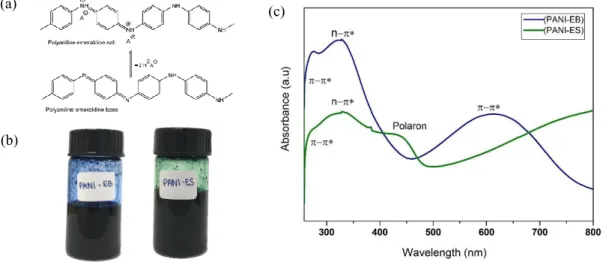
A green solution of polyaniline emeraldine salt (PANI-ES) was obtained upon rinsing with HCl. This process is known as protonation, where HCl, contributed an H+
ion to the existing aniline at the amine group (-NH-). This protonation activated the conjugation of the electron along the backbone. Undoped PANI was obtained through deprotonation. Deprotonation was achieved by adding NaOH solution to PANI-ES. The change in the colour of the solution from blue to green indicated a successful protonation (Figure 1b).
UV-Vis analysis was performed to determine the changes in molecular structure. Both PANI-EB and PANI-ES solutions were diluted with DMSO solvent. As shown in Figure 1c, PANI-ES showed three absorption peaks at 256 nm, 329 nm and 439 nm. The absorption of the first peak, 255 nm and 328 nm represented π - π* benzene ring [23] which pointed to conjugation between adjacent phenyl rings in the copolymer chain [24]. The π-π* interactions are typical behaviour of CP. Peaks of 256 nm and 329 nm both shifted by 1 nm to 255 nm and 328 nm when they were in deprotonated state (PANI-EB). The band at 439 nm implied the occurrence of polaron absorption from the doping process and the conductivity of PANI-ES. Electron absorption in the backbone of the polymer is evidence of successful doping of acids as displayed by the green solution. According to Karaoğlan and Bindal [25], the decreasing of the absorption band in region 615 nm of PANI-EB illustrates the conversion of imine nitrogen atoms of the quinonoid rings to benzenoid rings. However, this peak disappeared after successful doping. This is in line with study conducted by Wang et al. where peak at 630 nm disappeared upon doping which is due to quinone ring being ruptured from the doping. [25]. Table 1 is a summary of absorption values in the UV-Vis spectrum of PANI-ES and PANI-EB. Immersion of fabrics
The colour of the fabric changed when they were immersed in undoped and doped PANI solutions. The pre-immersion fabric was white (Figure 2a). FESEM image of bare cotton fabric showed a fibrous structure, as seen in Figure 2b. The colour of the fabric changed to blue and green upon immersion in undoped and doped PANI solutions, respectively (Figure 2c and Figure 2d). The blue fabric represented PANI-EB, while the green fabric represented PANI-ES. The differences in the colour of pre and post-immersion fabric proved the successful preparation of PANI fabric.
Electrochemical impedance spectroscopy (EIS) Fabrics were tested using EIS to measure the electrical conductivities. This analysis was repeated three times for each sample to draw an average value. The undoped fabric was also subjected to similar EIS analysis.
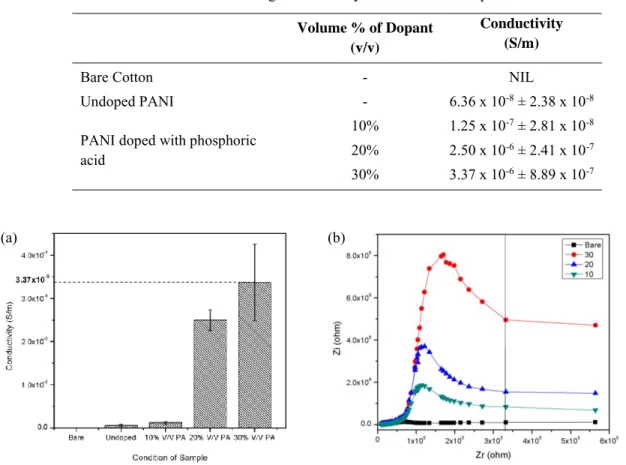
Table 2 shows the average conductivity for each fabric sample.
EIS analysis proved that the conductivity of fabric increased when they were assimilated with PANI solutions. Undoped PANI had a conductivity of 6.36 x 10⁻⁸ ± 2.38 x 10⁻⁸ S/m, which was the lowest among the
samples due to the absence of dopant that is essential to impart conductivity [27]. On the contrary, doped sample ranges 1.25 x 10⁻⁷ ± 2.81 x 10⁻⁸ S/m to 3.37 x 10⁻⁶ ±
8.89 x 10⁻⁷ S/m which suggests that the incorporation of
PANI may potentially inflate number of electrical pathways across the sample [28]. This is supported by Omar et al. that indicate the increase of conductivity is contributed by the presence of polaron in the backbone of PANI upon addition of dopant. The dopant promotes mobility of charge transfer throughout the polymer chain [29].
Figure 3a illustrates the conductivity of fabrics under different conditions. It was found that there are differences of conductivity value for the various concentration of dopant used. The highest conductivity value was recorded at 30% v/v that suggest the optimum concentration of dopant for phosphoric acid is at 30% v/v. These conductivity value substantiate that dopant acid increases the conductivity of PANI-EB [30]. This is due to presence of polarons in the backbone of PANI, attributed from the protonation by dopant. The electrochemical impedance spectrum for PANI at different condition is shown in Figure 3b. Doped samples showed higher real impedance value (Zr), correspond to the value of charge-transfer resistance of the fabrics, which is depending on the ionic diffusion of the fabric [31]. Bare fabrics illustrate relatively straight line in the low frequency region, which indicates the limiting diffusion of electron migration. On the contrary, doped fabrics are in higher frequency region as they have higher ionic diffusion.
Morphological analysis using FESEM
FESEM images were captured to study the surface morphology of the PANI fabrics at two different magnification (200x and 500x) (See Figure 4).
FESEM analysis shows the micrograph of all fabrics, compromised of fibrils and bundles. These structures were contributed from the natural structure of cotton fabrics. We observe that the fibres of the fabric were finely- covered by polyaniline particles, similar to a previous study by Wu et al. [32]. In addition, doped samples showed more distribution of granules structure as compared to undoped sample indicating PANI is well absorbed into the fabric during the immersion process.
Based on previous studies, the conductivity may be influenced by the significant amount of polyaniline particle present throughout the fabric. Thus, with higher deposition of precipitate, the higher conductivity values are expected. As illustrated in Figure 4 (e-f), PANI doped-PA 10% v/v cotton sample has relatively smooth surface which indicates PANI are well incorporated into the fibres. On contrary, PANI doped-PA 20% v/v cotton and PANI doped-PA 30% v/v cotton illustrated rough and uneven surface. This result is in line with the conductivity values obtained using EIS, in which the more concentration of dopant incorporated, the higher the conductivity of the fabrics.
Figure 1. (a) Chemical structure of PANI-ES and PANI-EB, (b) Image of PANI-EB and PANI-ES, and (c) UV-Vis spectrum of PANI-EB and PANI-ES
Table 1. Summary of absorption bands of PANI-ES and PANI-EB with UV-Vis Reference (nm) PANI-ES (nm) Reference (nm) PANI-EB (nm) π → π* (Benzene Ring) 286 [24] 256 285 [26] 255 π → π* (Benzene Ring) 350 [24] 329 345 [24] 328 π → π* (Quinoid Ring) 450[25] 439 592[25] 615 (a) (b) (c)
Figure 2. Photograph of (a) bare cotton fabric, (b) undoped PANI fabric, (c) doped PANI fabric and d) FESEM image of bare cotton fabric at 200x magnification
Table 2. Average conductivity for each fabric sample Volume % of Dopant
(v/v)
Conductivity (S/m)
Bare Cotton - NIL
Undoped PANI - 6.36 x 10⁻⁸ ± 2.38 x 10⁻⁸
PANI doped with phosphoric acid
10% 1.25 x 10⁻⁷ ± 2.81 x 10⁻⁸
20% 2.50 x 10⁻⁶ ± 2.41 x 10⁻⁷
30% 3.37 x 10⁻⁶ ± 8.89 x 10⁻⁷
Figure 3. (a) Conductivity of various condition of fabric and (b) EIS spectrum for PANI at different v/v% of dopant
20 µm
(a) (b) (c) (d)2 cm
2 cm
2 cm
(a) (b)Figure 4. FESEM images of (a-b) undoped cotton, (c-d) PANI doped PA 10% v/v, (e-f) PANI doped PA 20% v/v and (g-h) PANI doped PA 30% v/v at 200x and 500x magnification, respectively
Conclusion
Polyaniline-doped with phosphoric acid using chemical oxidation method was successfully synthesized. This is proven by UV-Vis analysis that identified the presence of benzenoid and quinoid structures, corresponded to the structure of polyaniline. PANI was incorporated into the fabric by immersion method. Conductivity measurement using Electrochemical Impedance Spectroscopy (EIS) has shown that conductivity of PANI increased with addition of dopant since doped
fabrics showed distinct different in conductivity as compared to bare and undoped fabric. The highest conductivity of conductive fabric was found at 3.37 x 10⁻⁶ ± 8.89 x 10⁻⁷ S/m, for the 30% v/v sample.
Morphological study using FESEM showed homogenous distribution of precipitate on the surface of sample. Also, more precipitate was found as the higher volume concentration of acid dopant used. Overall, this study reinforces the correlation between higher amounts of PANI precipitate on the fabric surface with higher
(a) (b) (e) (g) (c) (d) (f) (h)
20 µm
20 µm
20 µm
20 µm
20 µm
20 µm
20 µm
20 µm
conductivity values. In the near future, the durability of PANI fabrics when exposed to real environment such as humidity, pH and washing condition can be further explored. This is highly important to ensure the stability and extended functionality of the fabrics when in used. Alternatively, researchers may also venture a study on the effect of other types of dopant from natural sources (citric acid, acetic acid, and nitric acid) that can best fit for various applications.
Acknowledgement
Authors are grateful for the funding from Research Management Center UiTM under 600- IRMI 5/3/LESTARI (029/2019).
References
1. Ahmad, S., Sultan, A., Raza, W., Muneer, M. and Mohammad, F. (2016). Preparation, characterization and application of polyaniline/silk fibroin composite. Polymers and Polymer Composites, 24(8): 633-642.
2. Mirmohseni, A., Azizi, M. and Dorraji, M. S. (2020). Cationic graphene oxide nanosheets intercalated with polyaniline nanofibers: A promising candidate for simultaneous anticorrosion, antistatic, and antibacterial applications. Progress in Organic Coatings, 139: 105419.
3. Ma, Z., Shi, W., Yan, K., Pan, L. and Yu, G. (2019). Doping engineering of conductive polymer hydrogels and their application in advanced sensor technologies. Chemical Science, 10(25): 6232-6244.
4. Mawad, D., Mansfield, C., Lauto, A., Perbellini, F., Nelson, G. W., Tonkin, J. and Stevens, M. M. (2016). A conducting polymer with enhanced electronic stability applied in cardiac models. Science Advances, 2(11): e1601007.
5. Mahat, M. M., Mawad, D., Nelson, G. W., Fearn, S., Palgrave, R. G., Payne, D. J. and Stevens, M. M. (2015). Elucidating the deprotonation of polyaniline films by X-ray photoelectron spectroscopy. Journal of Materials Chemistry C, 3(27): 7180-7186.
6. Yang, Y., Chen, S. and Xu, L. (2011). Enhanced conductivity of polyaniline by conjugated
crosslinking. Macromolecular Rapid Communications, 32(7): 593-597.
7. Noby, H., El-Shazly, A., Elkady, M. and Ohshima, M. (2019). Strong acid doping for the preparation of conductive polyaniline nanoflowers, nanotubes, and nanofibers. Polymer, 182: 121848.
8. Ansari, M. O., Khan, M. M., Ansari, S. A., Amal, I., Lee, J. and Cho, M. H. (2014). pTSA doped conducting graphene/polyaniline nanocomposite fibers: Thermoelectric behavior and electrode analysis. Chemical Engineering Journal, 242: 155-161.
9. Price, A. D. and Naguib, H. E. (2008). Synthesis and characterization of porous polyaniline conductive polymers. Cellular Polymers, 27(3): 201-212.
10. Aggadi, S. E., Loudiyi, N., Chadil, A., Abbassi, Z. E. and Hourch, A. E. (2020). Electropolymerization of aniline monomer and effects of synthesis conditions on the characteristics of synthesized polyaniline thin films. Mediterranean Journal of Chemistry, 10(2): 138-145.
11. Taş, R., Can, M. and Sarı, H. (2019). The chemical synthesis and characterizations of silver-doped polyaniline: Role of silver–solvent interactions. Polymer Bulletin, 77(4): 1913-1928.
12. Boeva, Z. A. and Sergeyev, V. G. (2014). Polyaniline: Synthesis, properties, and application. Polymer Science Series C, 56(1): 144-153.
13. Ramli, R., Arawi, A. Z., Mahat, M. M., Mohd., A. F. and Yahya, M. F. (2011). Effect of silver (Ag) substitution nano-hydroxyapatite synthesis by microwave processing. 2011 International Conference on Business, Engineering and Industrial Applications, Kuala Lumpur: pp. 180-183
14. Ramli, J., Jeefferie, A. R. and Mahat, M. M. (2011). Effects of UV curing exposure time to the mechanical and physical properties of the epoxy and vinyl ester fiber glass laminates composites, ARPN Journal of Engineering and Applied Sciences, 6(4): 104-109.
15. Sharma, S., Kumar, V., Pathak, A. K., Yokozeki, T., Yadav, S. K., Singh, V. N. and Singh, B. P. (2018). Design of MWCNT bucky paper reinforced PANI–DBSA–DVB composites with superior electrical and mechanical properties. Journal of Materials Chemistry C, 6(45): 12396.
16. Wu, L., Ge, Y., Zhang, L., Yu, D., Wu, M. and Ni, H. (2018). Enhanced electrical conductivity and competent mechanical properties of polyaniline/polyacrylate (PANI/PA) composites for antistatic finishing prepared at the aid of polymeric stabilizer. Progress in Organic Coatings, 125: 99-108.
17. Humpolíček, P., Radaszkiewicz, K. A., Capáková, Z., Pacherník, J., Bober, P., Kašpárková, V. and Stejskal, J. (2018). Polyaniline cryogels: Biocompatibility of novel conducting macroporous material. Scientific Reports, 8(1): 135.
18. Aizamddin, M. F., Roslan, N. C., Kamaruddin, M. A., Omar, S. N., Safian, M. F., Abdul Halim, M. I. and Mahat, M. M. (2020). Study of conductivity and thermal properties of polyaniline doped with p-toluene sulfonic acid. Malaysian Journal of Analytical Sciences, 24(3): 413-421.
19. Hao, L., Wang, R., Fang, K. and Cai, Y. (2017). The modification of cotton substrate using chitosan for improving its dyeability towards anionic microencapsulated nano-pigment particles. Industrial Crops and Products, 95: 348-356. 20. Liu, Y., Zhao, X., Tuo, X. (2016). Preparation of
polypyrrole coated cotton conductive fabrics. The Journal of the Textile Institute, 108(5): 829-834. 21. Cruz-Pacheco, A. F., Paredes-Madrid, L., Orozco,
J., Gómez-Cuaspud, J. A., Batista-Rodríguez, C. R. and Gómez, C. A. (2020). Assessing the influence of the sourcing voltage on polyaniline composites for stress sensing applications. Polymers, 12(5): 1164.
22. Omar, S. N., Ariffin, Z. Z., Zakaria, A., Safian, M. F., Halim, M. I., Ramli, R., Mahat, M. M. (2020). Electrically conductive fabric coated with polyaniline: Physicochemical characterisation and antibacterial assessment. Emergent Materials, 3: 469-477.
23. Tang, S. J., Wang, A. T., Lin, S. Y., Huang, K. Y., Yang, C. C., Yeh, J. M. and Chiu, K. C. (2011). Polymerization of aniline under various concentrations of APS and HCl. Polymer Journal, 43(8): 667-675.
24. Paschoalin, R. T., Steffens, C., Manzoli, A., Paris, E. C. and Herrmann, P. S. (2012). PANI conductivity: A dependence of the chemical synthesis temperature. Macromolecular Symposia, 319(1): 48-53.
25. Karaoğlan, N. and Bindal, C. (2018). Synthesis and optical characterization of benzene sulfonic acid doped polyaniline. Engineering Science and Technology, an International Journal, 21(6): 1152-1158.
26. Wang, Y., Chen, K., Li, T. and Li, H. (2015). One-step and template-free synthesis of itaconic acid– doped polyaniline nanorods in aqueous solution. High Performance Polymers, 28(3): 322-330. 27. Ziadan, K. (2016). Study of the electrical
characteristics of polyaniline prepared by electrochemical polymerization. Energy Procedia, 19(2012): 71-79.
28. Alamer, F. A. (2018). Structural and electrical properties of conductive cotton fabrics coated with the composite polyaniline/carbon black. Cellulose, 25(3): 2075–2082.
29. Omar, S., Ariffin, Z., Akhir, R., Shri, D., Halim, M., Safian, M. and Mahat, M. (2019). Polyaniline (PANI) fabric doped p-toluene sulfonic acid (pTSA) with anti-infection properties. Materials Today: Proceedings, 16: 1994-2002.
30. Mostafaei, A. and Zolriasatein, A. (2012). Materials international synthesis and characterization of conducting polyaniline nanocomposites containing ZnO nanorods. Progress in Natural Science: Materials International, 22(4): 273-280.
31. Perumalraj, R. (2015). Electrical surface resistivity of polyaniline coated woven fabrics. Journal of Textile Science & Engineering. 5(3): 1-5.
32. Wu, B., Zhang, B., Wu, J., Wang, Z., Ma, H. and Yu, M. (2015). Electrical switchability and dry-wash durability of conductive textiles. Scientific Report, 5: 11255.