HAL Id: hal-02087414
https://hal.archives-ouvertes.fr/hal-02087414
Submitted on 2 Apr 2019
HAL
is a multi-disciplinary open access
archive for the deposit and dissemination of
sci-entific research documents, whether they are
pub-lished or not. The documents may come from
teaching and research institutions in France or
abroad, or from public or private research centers.
L’archive ouverte pluridisciplinaire
HAL
, est
destinée au dépôt et à la diffusion de documents
scientifiques de niveau recherche, publiés ou non,
émanant des établissements d’enseignement et de
recherche français ou étrangers, des laboratoires
publics ou privés.
SmartML: A Meta Learning-Based Framework for
Automated Selection and Hyperparameter Tuning for
Machine Learning Algorithms
Mohamed Maher, Sherif Sakr
To cite this version:
Mohamed Maher, Sherif Sakr. SmartML: A Meta Learning-Based Framework for Automated Selection
and Hyperparameter Tuning for Machine Learning Algorithms. EDBT: 22nd International Conference
on Extending Database Technology, Mar 2019, Lisbon, Portugal. �10.5441/002/edbt.2019.54�.
�hal-02087414�
SmartML
: A Meta Learning-Based Framework for Automated
Selection and Hyperparameter Tuning for Machine Learning
Algorithms
Mohamed Maher, Sherif Sakr
University of Tartu, Estonia {mohamed.abdelrahman,sherif.sakr}@ut.ee
ABSTRACT
Due to the increasing success of machine learning tech-niques, nowadays, thay have been widely utilized in almost every domain such as financial applications, marketing, recommender systems and user behavior analytics, just to name a few. In practice, the machine learning model creation process is a highly iterative exploratory process. In particular, an effective machine learning modeling process requires solid knowledge and understanding of the differ-ent types of machine learning algorithms. In addition, all machine learning algorithms require user-defined inputs to achieve a balance between accuracy and generalizability. This task is referred to asHyperparameter Tuning. Thus, in practice, data scientists work hard to find the best model or algorithm that meets the specifications of their prob-lem. Such iterative and explorative nature of the modeling process is commonly tedious and time-consuming.
We demonstrateSmartML, a meta learning-based frame-work for automated selection and hyperparameter tuning for machine learning algorithms. Being meta learning-based, the framework is able to simulate the role of the machine learning expert. In particular, the framework is equipped with a continuously updated knowledge base that stores in-formation about the meta-features of all processed datasets along with the associated performance of the different classifiers and their tuned parameters. Thus, for any new dataset,SmartMLautomatically extracts its meta features and searches its knowledge base for the best performing algorithm to start its optimization process. In addition,
SmartML makes use of the new runs to continuously en-rich its knowledge base to improve its performance and robustness for future runs. We will show how our approach outperforms the-state-of-the-art techniques in the domain of automated machine learning frameworks.
1
INTRODUCTION
Machine learning is the field of computer science that fo-cuses on building algorithms that can automatically learn from data and automatically improve its performance with-out end-user instructions, influence or interference. In gen-eral, the effectiveness of machine learning techniques mainly rests on the availability of massive datasets, of that there can be no doubt. The more data that is available, the richer and the more robust the insights and the results that machine learning techniques can produce. Nowadays, © 2019 Copyright held by the owner/author(s). Published in Proceed-ings of the 22nd International Conference on Extending Database Technology (EDBT), March 26-29, 2019, ISBN 978-3-89318-081-3 on OpenProceedings.org.
Distribution of this paper is permitted under the terms of the Cre-ative Commons license CC-by-nc-nd 4.0.
we are witnessing a continuous growth in the size and availability of data in almost every aspects of our daily life. Thus, recently, we have been witnessing many leaps achieved by machine learning in wide range of fields [1, 9]. Consequently, there are growing demand to have increasing number of data scientists with strong knowledge and good experience with the various machine learning algorithms in order to be able to build models that can achieve the tar-get performance and to keep up with exponential growing amounts of data which is produced daily.
In practice, the machine learning modeling process is a highly iterative exploratory process. In particular, there is no one-model-fits-all solution, i.e, there is no single model or algorithm which is well-known to achieve the highest accuracy for all data set varieties in a certain application domain. Hence, trying many machine learning algorithms with different parameter configurations is commonly con-sidered an inefficient, tedious, and time consuming process. Therefore, there has been growing interest to automate the machine learning modeling process as it has been ac-knowledged thatdata scientists do not scale1. Therefore, recently, several frameworks have been designed to sup-port automating the machine learning modeling process. For exampleAuto-Weka[8] is an automation framework for algorithm selection and hyper-parameter optimization which is based on Bayesian optimization using sequential model-based algorithm configuration (SMAC) and tree-structured parzen estimator (TPE).Auto-Sklearn[3] is a framework that has been implemented on top of the popu-lar pythonscikit-learnmachine learning package that automatically considers the past performance on similar datasets for its automation decision. Other tools include
Google Vizierwhich is based on grid or random search [5] andTPOTwhich is based on genetic programming [10].
In this demonstration, we presentSmartML, a meta learning-based framework for automated selection and hyperpa-rameter tuning for machine learning algorithms (using 15 classifiers). In our framework, the meta-learning feature is emulating the role of the domain expert in the field of machine learning [4, 11]. In particular, we exploit the knowledge and experience from previous runs by storing a set of data meta-features along with their performance. In addition, our knowledge base is continuously updated after running each task overSmartML which contributes to improving framework performance over the time. Our meta-learning mechanism is mainly used for the algorithm selection process in order to reduce the parameter-tuning search space which is conducted using SMAC Bayesian op-timization [7]. This is different from other tools [3, 8] which
1https://hbr.org/2015/05/data-scientists-dont-scale
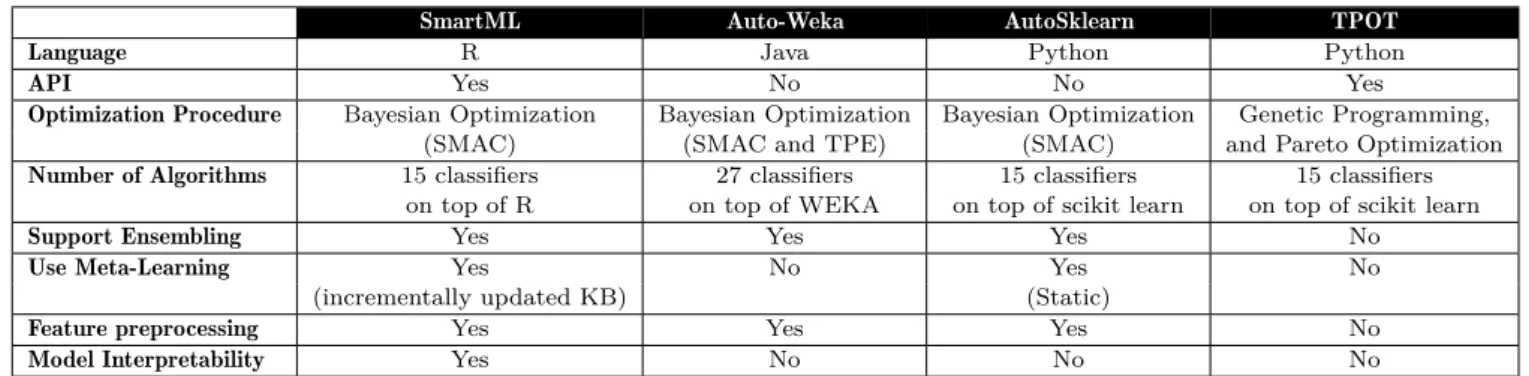
SmartML Auto-Weka AutoSklearn TPOT
Language R Java Python Python
API Yes No No Yes
Optimization Procedure Bayesian Optimization Bayesian Optimization Bayesian Optimization Genetic Programming,
(SMAC) (SMAC and TPE) (SMAC) and Pareto Optimization
Number of Algorithms 15 classifiers 27 classifiers 15 classifiers 15 classifiers
on top of R on top of WEKA on top of scikit learn on top of scikit learn
Support Ensembling Yes Yes Yes No
Use Meta-Learning Yes No Yes No
(incrementally updated KB) (Static)
Feature preprocessing Yes Yes Yes No
Model Interpretability Yes No No No
Table 1: Comparison between State-of-the-art Automated Machine Learning Frameworks
deal with algorithm selection as one of the parameters to be tuned.
SmartMLcan be used as a package inR language, one of the most popular languages in the data science domain, or as a Web application2. It is also designed to be pro-gramming language agnostic so that it can be embedded in any programming language using its available REST APIs. Table 1 shows a feature comparison between our framework and other state-of-the-art frameworks. In our demonstration, we will show thatSmartMLcan outperform other tools especially at small running time budgets by reaching better parameter configurations faster. In addi-tion,SmartMLhas the advantage that its performance can be continuously improved over time by running more tasks which makesSmartMLsmarter by getting more experience based on the growing knowledge base.
2
SMARTML ARCHITECTURE
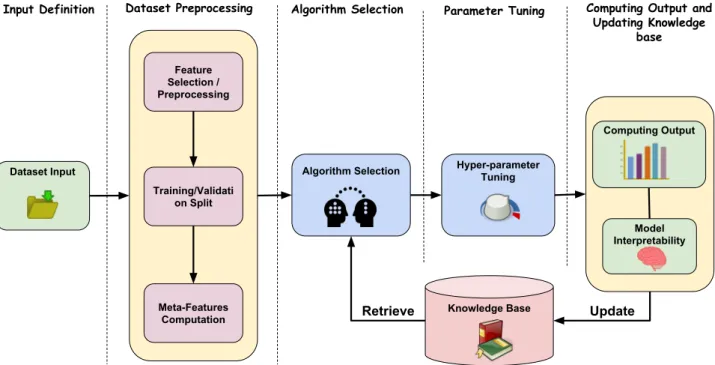
Figure 1 illustrates the framework architecture ofSmartML. In theinput definitionphase, the user uploads the dataset, choose the required options for features selection and pre-processing, specify which features of the dataset should be included in the modeling process, specify the target column which represents the classes of labels of the instances in the dataset and specify thetime budgetconstraint for the framework for conducting the hyper-parameter tuning pro-cess.SmartMLacceptscsvandarff(attribute relation file format developed with the Weka machine learning software) file formats.
In thepreprocessing phase,SmartMLstarts by perform-ing the feature preprocessperform-ing operations specified by the selected features. Table 2 lists the feature preprocessing operations supported by theSmartML framework. In this phase, the dataset is randomly split intotraining and val-idation partitions where the former is used in algorithm selection and hyper-parameter tuning while the later is used for evaluating the selected configurations during pa-rameter tuning. In addition, a list of 25 meta-features are extracted from the training split describing the dataset characteristics. Examples of these features includenumber of instances,number of classes,skewnessandkurtosis of numerical features, andsymbols of categorical features.
Currently,SmartMLsupports 15 different classifiers (Ta-ble 3). In thealgorithm selection phase, the meta features of the input dataset at hand, which is extracted during
2
https://bigdata.cs.ut.ee/smartml/index.html
thepreprocessingphase, are compared with the meta fea-tures of the datasets that are stored in the knowledge base in order to identify thesimilar datasets, using a nearest neighbor approach. The dataset similarity detection pro-cess follows a weighted mechanism between two different factors. The first factors is theEuclidean distancebetween the meta-features of the dataset at hand and meta-features of all datasets stored in the knowledge base. The second factor is the magnitude of the best performing algorithms on the similar dataset. For example, it may be better to select the top𝑛top performing algorithms on a single very similar dataset than selecting the first outperforming algo-rithm for𝑛similar datasets. We use the retrieved results of the best performing algorithms on similar dataset(s) to nominate the candidate algorithms for the dataset at hand.
In thehyper-parameter tuning phase,SmartMLattempts to tune the selected classifiers hyper-parameters for achiev-ing the best performance. In particular, the knowledge base contains information about the best parameter configura-tions for each algorithm on each dataset. The configuraconfigura-tions of the nominated best performing algorithms are used to initialize the hyper-parameter tuning process for the se-lected algorithms. The time budget constraint specified by the end user represents the time used in hyper parameter tuning of the selected classifiers. In particular, this budget is divided among all the selected algorithms according to the number of hyper-parameters to tune in each algorithm (Table 3).SmartMLapplies the SMAC technique for hyper-parameter optimization [7]. In particular, SMAC attempts to draw the relation between the algorithm performance and a given set of hyper-parameters by estimating the pre-dictive mean and variance of their performance along the trees of the random forest model. The main advantage of us-ing SMAC is its robustness by havus-ing the ability to discard low performance parameter configurations quickly after the evaluation on low number of folds of the dataset [7].
Finally, the results obtained from the hyper-parameter tuning process of the different nominated algorithms are compared with each other to recommend the best per-forming algorithm to the end user. In addition, a weighted ensembling [2] output of the top performing algorithms can be recommended to the end user based on their choice. In addition, we have integrated theInterpretable Machine Learning (iml)package3 in order to explain for the user the most important features that have been used by the
3https://cran.r-project.org/web/packages/iml/index.html
Dataset Input Feature Selection / Preprocessing Training/Validati on Split Meta-Features Computation
Algorithm Selection Hyper-parameter Tuning
Computing Output
Knowledge Base
Model Interpretability
Input Definition Dataset Preprocessing Algorithm Selection Parameter Tuning Computing Output and Updating Knowledge
base
Update Retrieve
Figure 1:SmartML: Framework Architecture
center subtract mean from values scale divide values by standard deviation range values normalization
zv remove attributes with zero variance
boxcox apply box-cox transform to non-zero positive values yeojohnson apply Yeo-Johnson transform to all values pca transform data to the principal components ica transform data to their independent components
Table 2: Integrated Feature Preprocessing Algorithms
Classification Categorical Numerical Package Algorithm parameters parameters
SVM 1 4 e1071 NaiveBayes 0 2 klaR KNN 0 1 FNN Bagging 0 5 ipred part 1 2 RWeka J48 1 2 RWeka RandomForest 0 3 randomForest c50 3 2 C50 rpart 0 4 rpart LDA 1 1 MASS PLSDA 1 1 caret LMT 0 1 RWeka RDA 0 2 klaR NeuralNet 0 1 nnet DeepBoost 1 4 deepboost
Table 3: Integrated Classifier Algorithms
selected model for directing its prediction process [6]. The interactive interface of our system has been designed using theShinyR Package4.
4https://shiny.rstudio.com/
Dataset # Att. # Classes # Instances Auto-Weka SmartML Accuracy Accuracy abalone 9 2 8192 25.14 27.13 amazon 10000 49 1500 57.56 58.89 cifar10small 3072 10 20000 30.25 37.02 gisette 5000 2 2800 93.71 96.48 madelon 500 2 2600 55.64 73.84 mnist Basic 784 10 62000 89.72 94.91 semeion 256 10 1593 89.32 94.13 yeast 8 10 1484 51.80 66.23 Occupancy 5 2 20560 93.99 95.55 kin8nm 8 2 8192 93.99 96.42
Table 4: Performance Comparison:SmartMLVSAuto-Weka
3
DEMO SCENARIO
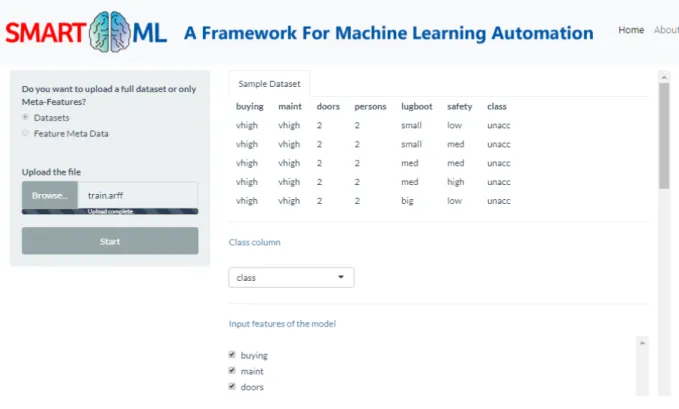
SmartMLis available both as a Web application as well as RESTful APIs5. In this demonstration6, we will present to the audience the workflow of theSmartMLframework (Fig-ure 1). In particular, we will show that how our approach can help non-expert machine learning users to effectively identify the machine learning algorithms and their associ-ated hyperparameter settings that can achieve optimal or near-optimal accuracy for their datasets with little effort. We start by introducing to the audience the challenges we tackle, the main goal and the functionalities of our framework. Then, we take the audience through the au-tomated algorithm selection and hyper-parameter tuning process for sample datasets. We start by showing different features which is provided for the end-user (Figure 2). For example, the user can upload either a dataset file or a direct URL for the dataset. In addition, the user can choose either to perform both algorithm selection and hyper-parameter
5The source code of the
SmartMLframework is available on https: //github.com/DataSystemsGroupUT/Auto-Machine-Learning
6
A demonstration screencast is available on https://www.youtube. com/watch?v=m5sbV1P8oqU&feature=youtu.be
Figure 2: Screenshot: Configuring an experiment for a dataset
Figure 3: Screenshot: Sample experiment output from SmartML
tuning or only algorithm selection. In the later case, it is possible to upload only the dataset meta-features file instead of the whole dataset. The user will be also able to configure different options such as whether any kind of feature preprocessing is needed or not, whether model interpretability is needed or not and specify the time bud-get for hyper-parameter tuning. Then, we will take the audience through the different phases of the framework until returning the final results (Figure 1).
Table 4 shows the performance comparison between
SmartMLandAuto-Weka7 using 10 datasets where atime budgetof 10 minutes has been allocated for each dataset in each framework. In our experiments, we have bootstrapped the knowledge base of SmartML using 50 datasets from various sources includingOpenMl8,UCI repository9and
Kaggle10. The results show that, using this relatively very small knowledge base, the accuracy results of SmartML 7https://www.cs.ubc.ca/labs/beta/Projects/autoweka/
8
https://www.openml.org/
9http://archive.ics.uci.edu/ml/index.php 10Kaggle:https://www.kaggle.com/
outperform the results of Auto-Wekafor all the datasets. As a part of our demonstration, we will provide the au-dience with the live chance to compare the performance ofSmartMLwithAuto-Wekaand other related frameworks using various datasets.
ACKNOWLEDGMENT
This work is funded by the European Regional Devel-opment Funds via the Mobilitas Plus programme (grant MOBTT75)
REFERENCES
[1] Rahul C Deo. 2015. Machine learning in medicine.Circulation
132, 20 (2015), 1920–1930.
[2] Thomas G Dietterich. 2000. Ensemble methods in machine learning. InInternational workshop on multiple classifier sys-tems.
[3] Matthias Feurer et al. 2015. Efficient and Robust Automated Machine Learning. InNIPS.
[4] Matthias Feurer et al. 2015. Initializing Bayesian Hyperparam-eter Optimization via Meta-learning. InAAAI.
[5] Daniel Golovin et al. 2017. Google Vizier: A Service for Black-Box Optimization. InKDD.
[6] Riccardo Guidotti et al. 2018. A survey of methods for explain-ing black box models.ACM CSUR51, 5 (2018).
[7] Frank Hutter et al. 2011. Sequential Model-based Optimization for General Algorithm Configuration. InLION.
[8] Lars Kotthoff et al. 2017. Auto-WEKA 2.0: Automatic Model Selection and Hyperparameter Optimization in WEKA. J. Mach. Learn. Res.18, 1 (2017).
[9] Sendhil Mullainathan and Jann Spiess. 2017. Machine learn-ing: an applied econometric approach. Journal of Economic Perspectives31, 2 (2017).
[10] Randal S. Olson and Jason H. Moore. 2016. TPOT: A Tree-based Pipeline Optimization Tool for Automating Machine Learning. InProceedings of the Workshop on Automatic Ma-chine Learning.
[11] Matthias Reif et al. 2012. Meta-learning for Evolutionary Parameter Optimization of Classifiers. Mach. Learn.87, 3 (2012).