Using a structural root system model
for an in-depth assessment of
root image analysis pipeline
Guillaume Lobet
1,2,*, Iko Koevoets
3, Pierre Tocquin
1,
Loïc Pagès
4and Claire Périlleux
1 1 InBioS-PhytoSYSTEMS,University of Liège, 4000 Liège, Belgium
2 Institut fur Bio-und Geowissenschaften: Agrosphare,
Forschungszentrum Jülich, D52425 Jülich, Germany
3 Plant Cell Biology, Swammerdam Institute for Life Sciences,
University of Amsterdam, 1098 XH Amsterdam, The Netherlands
4 INRA, Centre d’ Avignon, UR 1115 PSH,
Site Agroparc, 84914 Avignon cedex 9, France
Abstract
1
Root system analysis is a complex task, often performed using fully automated image analysis 2
pipelines. However, these pipelines are usually evaluated with a limited number of ground-truthed 3
root images, most likely of limited size and complexity. 4
5
We have used a root model, ArchiSimple to create a large and diverse library of ground-truthed 6
root system images (10.000). This library was used to evaluate the accuracy and usefulness of 7
several image descriptors classicaly used in root image analysis pipelines. 8
9
Our analysis highlighted that the accuracy of the different metrics is strongly linked to the type of 10
root system analysed (e.g. dicot or monocot) as well as their size and complexity. Metrics that have 11
been shown to be accurate for small dicot root systems might fail for large dicots root systems or 12
small monocot root systems. Our study also demonstrated that the usefulness of the different 13
metrics when trying to discriminate genotypes or experimental conditions may vary. 14
15
Overall, our analysis is a call to caution when automatically analysing root images. If a thorough 16
calibration is not performed on the dataset of interest, unexpected errors might arise, especially for 17
large and complex root images. To facilitate such calibration, both the image library and the 18
different codes used in the study have been made available to the community. 19
Introduction
21
Roots are of outmost importance in the life of plants and hence selection on root systems 22
represents great promise for improving crop tolerance (as reviewed in (Koevoets et al., 2016)). As 23
such, their quantification is a challenge in a multitude of research projects. This quantification is 24
usually twofold. The first step consists in acquiring an image of the root system, either using classic 25
image techniques (CCD cameras) or more specialized ones (microCT, X-Ray, fluorescence, ...). The 26
next step is to analyse the picture in order to extract meaningful descriptors of the root system. 27
28
To paraphrase the famous belgian surrealist painter, René Magritte, figure 1A is not a root system. 29
Figure 1A is an image of a root system and that distinction is important. Such an image is indeed a 30
two dimensional representation of a root system, which is usually a three dimensional object. Until 31
now, measurements are generally not performed on the root systems themselves, but on the images 32
and this raises some issues. 33
34
Image analysis is, by definition, the obtention of metrics (or descriptors) describing the objects 35
contained in a particular image . In a perfect situation, these descriptors would accurately represent 36
the biological object of the image with negligible deviation from the biological truth (or data). 37
However, in many cases, artefacts might be present in the images so that the representation of the 38
biological object is not accurate anymore. These artefacts might be due to the conditions in which 39
the images were taken or to the object itself. Mature root systems, for instance, are complex 40
branched structure, composed of thousands of overlapping (fig. 1B) and crossing linear segments 41
(fig. 1C). These features are likely to impede image analysis and create a gap between the 42
descriptors and the data. 43
45 46
Root image descriptors can be separated into two main categories: morphological and geometrical 47
descriptors. Morphological descriptors refer to the shape of the different root segments forming the 48
root system (table 1). They include, among others, the length and diameter of the different roots. 49
For complex root system images, morphological descriptors are difficult to obtain and are prone to 50
error as mentioned above. 51
52
Geometrical descriptors give the position of the different root segments in space. They summarize 53
root system, crossing and overlapping roots have little impact on their estimation and they can be 56
considered as relatively errorless. Geometrical descriptors are expected to be loosely linked to the 57
actual root system topology, as identical shapes could be reached by different root systems (the 58
opposite is true as well). They are usually used in genetic studies, to identify genetic bases of root 59
system shape and soil exploration. 60
61
Several automated analysis tools were designed in the last few years to extract both type of 62
descriptors from root images (Armengaud et al., 2009; Bucksch et al., 2014; Galkovskyi et al., 2012; 63
Pierret et al., 2013). However, the validation of such tools is often incomplete and/or error prone. 64
Indeed, for technical reasons, the validation is usually performed on a small number of ground-65
truthed images of young root systems for which most analysis tools were actually designed . In the 66
few cases where validation is performed on large and complex root systems, it is usually not on 67
ground-truthed images, but in comparison with previously published tools (measurement of X with 68
tool A compared with the same measurement with tool B). This might seem reasonable approach 69
regarding the scarcity of ground-truthed images of large root systems. However, the inherent 70
limitations of these tools, such as scale or plant type (monocot, dicot) are often not known. Users 71
might not even be aware that such limitations exist and apply the provided algorithm without 72
further validation on their own images. This can lead to unsuspected errors in the final 73
measurements. 74
75
One strategy to address the lack of in-depth validation of image analysis pipeline would be to use 76
synthetic images generated by structural root models (models designed to recreate the physical 77
structure and shape of root systems). Many structural root models have been developed, either to 78
model specific plant species (Pagès et al., 1989), or to be generic (Pagès et al., 2004; 2013). These 79
models have been repeatedly shown to faithfully represent the root system structure (Pagès and 80
Pellerin, 1996). In addition, they can provide the ground-truth data for each synthetic root system 81
generated, independently of its complexity. However, except one recent tool designed for young 82
seedlings with no lateral roots (Benoit et al., 2014). they have almost never been used for validation 83
of image analysis tools (Rellán-Álvarez et al., 2015). A 84
85
Here we (i) illustrate the use of a structural root model, Archisimple, to systematically analyse and 86
evaluate an image analysis pipeline and (ii) evaluate the usefulness of different root metrics 87
commonly used in plant root research. 88
Material and methods
90
Nomenclature used in the paper
91
92
Ground-truth data: The real (geometric and morphometric) properties of the root system as a 93
biological object. Determined by either manual tracing of roots or by using the output of modelled 94
root systems.
95
(Image) Descriptor: Property of the root image. Does not necessarily have a biological meaning. 96
Synthetype: For each simulation, a parameter set is defined randomly. Then, 10 root systems are 97
created. Since the model has an intrinsic variability, each of these root system is slightly different 98
from the others, although similar, forming what we called a synthetic genotype, or synthetype. 99
Root axes: first order roots, directly attached to the shoot 100
Lateral root: second (or lower) order roots, attached to an other root 101
Creation of a root system library
102
We used the model ArchiSimple, which was shown to allow generating a large diversity of root 103
systems with a minimal amount of parameters (Pagès et al., 2013). In order to produce a large 104
library of root systems , we ran the model 10.000 times, each time with a random set of parameters. 105
106
The simulations were divided in two main groups: monocots and dicots. For the monocot 107
simulations, the model generated a random number of first-order axes and secondary (radial) 108
growth was disabled. For dicot simulations, only one primary axis was produced and secondary 109
growth was enabled (the extend of which was determined by a random parameter) . For all 110
simulation, only first order laterals were created, to limit complexity. 111
112
The root system created from each simulation was stored in an RSML file. Each RSML file was then 113
read by the RSML Reader plugin from ImageJ to extract metrics and generate ground-truth data for 114
the library (Lobet et al., 2015). These ground-truth data included geometrical,morphological and 115
topological parameters (table 1). For each RSML data file, the RSML Reader plugin also created a 116
PNG image (at a resolution of 300 DPI) of the root system. 117
118
Table 1: Root system parameters used as ground-truth data 119
Name Description Unit
tot_root_length The cumulative length of all roots mm
tot_prim_length The cumulative length of all root axes mm
tot_lat_length The cumulative length of all lateral roots mm
mean_prim_length The mean first-order roots length mm
mean_lat_length The mean lateral root length mm
n_primary The total number of first order roots
-n_laterals The total number of lateral roots
-mean_lat_density
The mean lateral root density: for each first-orde root, the number of lateral roots divided by the axis length
(total length). mm-1
mean_prim_diam The mean diameter of the first-order roots mm
mean_lat_diam The mean diameter of the lateral roots mm
Root image analysis
121
Each generated image was analysed using a custom-made ImageJ plugin, Root Image Analysis-J (or 122
RIA-J). The source code of RIA-J, as well as a compiled version is available at the address: 123
https://zenodo.org/record/61509.
124 125
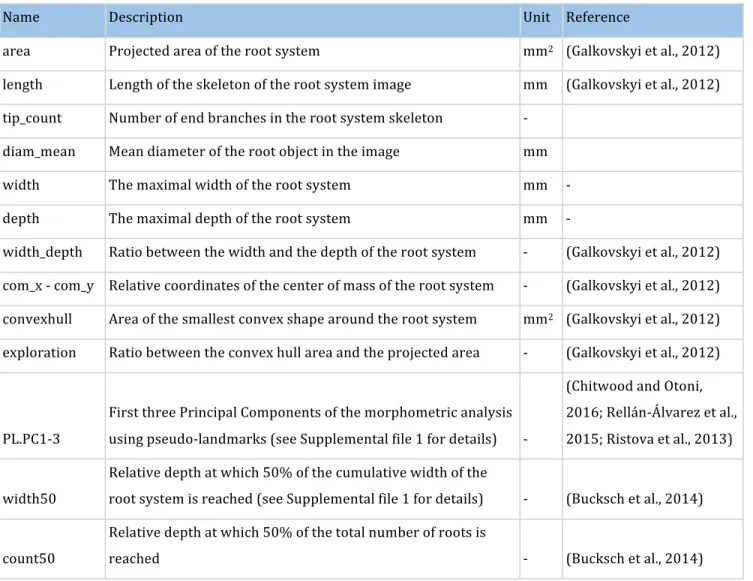
For each image, we extracted a set of classical root image descriptors, such as the total root length, 126
the projected area or the number of visible root tips. In addition, we included shape descriptors, 127
such as pseudo-landmarks, or a-dimensional metrics such as the exploration ratio, of the width 128
proportion at 50% depth (see Supplemental file 1 for details about the shape descriptors). The list 129
of metrics and algorithms used by our pipeline is listed in the table 2. 130
Data analysis
131
Data analysis was performed in R (R Core Team). Morphometric analyses were performed using the 132
momocs (Bonhomme et al., 2014) and shapes (Dryden, 2015)packages. Plots were created using 133
ggplot2 (Wickham, 2009) and lattice (Sarkar, 2008). 134
The Relative Root Square Mean Errors (RRSME) were estimated using the equation: 135 𝑅𝑅𝑀𝑆𝐸 = (𝑦𝚤−𝑦𝑖) 𝑦𝚤 ! 𝑛
where 𝑛 is the number of observations, 𝑦𝚤 is the mean and 𝑦𝑖is the estimated mean. 136
The Linear Discriminant Analysis (LDA) was performed using the lda function from the MASS
137
package (M and D, 2002). For each analysis, we used the synthetype information as grouping factor. 138
We used half of the samples (5) of each synthetype to build the model and the other half to assess 139
the discriminant power of the each class of metrics (morphology and shape). 140
Data availability
141
All data used in this paper (including the image and RSML libraries) are available at the address 142
https://zenodo.org/record/61739
143
An archived version of the codes used in this paper is available at the address 144
https://zenodo.org/record/152083
145
Results and discussions
147
Production of a large library of ground-truthed root system images
148
We combined existing tools into a single pipeline to produce a large library of ground-truthed root 149
system images. The pipeline combines a root model (ArchiSimple (Pagès et al., 2013)), the Root 150
System Markup Language (RSML) and the RSML Reader plugin from ImageJ (Lobet et al., 2015). In 151
short, ArchiSimple was used to create a large number of root systems, based on random input 152
parameter sets. Each output was stored as an RSML file (fig. 2A), which was then used by the RSML 153
Reader plugin to create a graphical representation of the root system (as a .jpeg file) and a ground-154
truth dataset (fig. 2B). Details about the different steps are presented in the Materials and Methods 155
section. 156
157 158
We used the pipeline to create a library of 10,000 root system images, separated into monocots 159
(multiple first order roots and no secondary growth) and dicots (one first order root and secondary 160
growth). For each input parameter-set used for ArchiSimple (1.000 different ones), 10 repetitions 161
were performed to create synthetic genotypes, or synthetypes (fig. 2A). The synthetype repetitions 162
were done such as the structure of the final dataset would mimic the structure of a dataset 163
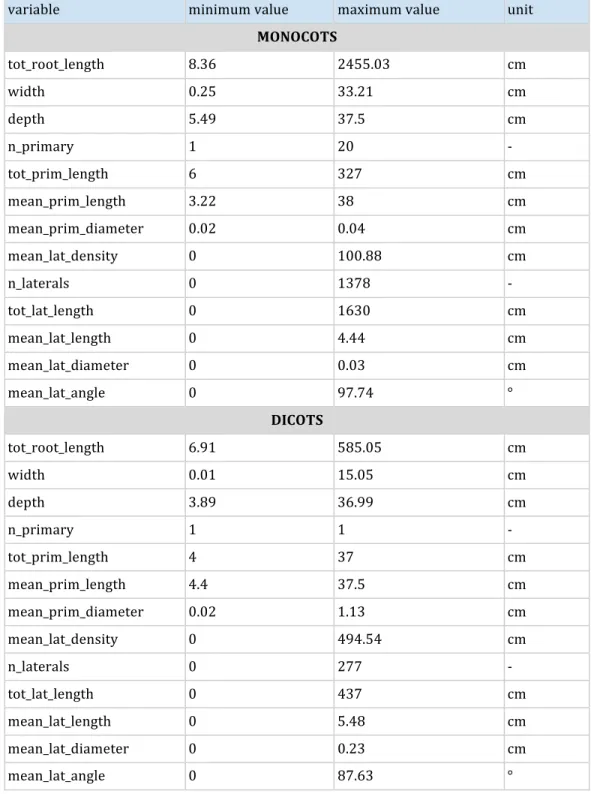
containing phenotypic data of different genotypes. The ranges of the different ground-truth data are 164
shown in table 2 and their distribution is shown in the Supplemental Figure 1. The pipeline 165
produced perfectly thresholded black and white images and hence the following analyses were 166
focused on the characterisation of the root objects themselves. 167
168
We started by evaluating whether monocots and dicots should be separated during the analysis. We 169
performed a Principal Component Analysis on the ground-truthed dataset to assess if the species
170
grouping had an effect on the overall dataset structure (fig. 3A). Monocots and dicots formed 171
distinct groups (MANOVA p-value < 0.001), with only minimal overlap. The first principal 172
component, that represented 33.2% of the variation within the dataset, was mostly influenced by 173
the number of primary axes. The second principal component (19.6% of the variation) was 174
influenced, in part, by the root diameters. These two effects were consistent with the clear grouping 175
of monocots and dicots, since they expressed the main difference between the two species. 176
Therefore, since the species grouping had such a strong effect on the overall structure, we decided 177
to analyse them separately rather than together for the following analyses. 178
Table 3: Ranges of the different ground-truth data from the root systems generated using 180
ArchiSimple 181
variable minimum value maximum value unit MONOCOTS tot_root_length 8.36 2455.03 cm width 0.25 33.21 cm depth 5.49 37.5 cm n_primary 1 20 -tot_prim_length 6 327 cm mean_prim_length 3.22 38 cm mean_prim_diameter 0.02 0.04 cm mean_lat_density 0 100.88 cm n_laterals 0 1378 -tot_lat_length 0 1630 cm mean_lat_length 0 4.44 cm mean_lat_diameter 0 0.03 cm mean_lat_angle 0 97.74 ° DICOTS tot_root_length 6.91 585.05 cm width 0.01 15.05 cm depth 3.89 36.99 cm n_primary 1 1 -tot_prim_length 4 37 cm mean_prim_length 4.4 37.5 cm mean_prim_diameter 0.02 1.13 cm mean_lat_density 0 494.54 cm n_laterals 0 277 -tot_lat_length 0 437 cm mean_lat_length 0 5.48 cm mean_lat_diameter 0 0.23 cm mean_lat_angle 0 87.63 ° 182
Systematic evaluation of root image descriptors
184
In order to demonstrate the utility of a synthetic library of ground-truthed root systems, we 185
analysed every image of the library using a custom-built root image analysis tool, RIA-J. We decided 186
to do so because our purpose was to test the usefulness of the synthetic analysis and not to assess 187
the accuracy of existing tools. Nonetheless, RIA-J was designed using known and published 188
algorithms, often used in root system quantification. A detailed description of RIA-J can be found in 189
the Materials and Methods section. 190
191
Table 3: Root image descriptors extracted by RIA-J
192
Name Description Unit Reference
area Projected area of the root system mm2 (Galkovskyi et al., 2012) length Length of the skeleton of the root system image mm (Galkovskyi et al., 2012) tip_count Number of end branches in the root system skeleton
-diam_mean Mean diameter of the root object in the image mm width The maximal width of the root system mm - depth The maximal depth of the root system mm -
width_depth Ratio between the width and the depth of the root system - (Galkovskyi et al., 2012) com_x - com_y Relative coordinates of the center of mass of the root system - (Galkovskyi et al., 2012) convexhull Area of the smallest convex shape around the root system mm2 (Galkovskyi et al., 2012) exploration Ratio between the convex hull area and the projected area - (Galkovskyi et al., 2012)
PL.PC1-3
First three Principal Components of the morphometric analysis using pseudo-landmarks (see Supplemental file 1 for details)
-(Chitwood and Otoni, 2016; Rellán-Álvarez et al., 2015; Ristova et al., 2013)
width50
Relative depth at which 50% of the cumulative width of the
root system is reached (see Supplemental file 1 for details) - (Bucksch et al., 2014)
count50
Relative depth at which 50% of the total number of roots is
We extracted 16 descriptors from each root system image (Table 3) and compared them with their 194
own ground-truth data. For each pair of descriptor/data, we performed a linear regression and 195
computed its r-squared value. Figure 4 shows the results from the different combinations for both 196
monocots and dicots. We can observe that, as a general rule, good correlations were rare, with only 197
3% of the combinations having an r-squared above 0.8. In addition, even a good correlation is not 198
necessarily directly useful as the relationship between the two variables might not follow a 1:1 rule 199
(fig. 4B-C). In such case, an additional validation might be needed to define the relation between 200
both variables. 201
202
It also has to be noted that the correlations were different between species. As an example, within 203
the dicot dataset, no good correlation was found between the tip_count and diam_mean estimators 204
while better correlation was found for the monocots. As a consequence, validation of the different 205
image analysis algorithms should be performed, at least, for each group of species. An algorithm 206
giving good results for a monocot might fail when applied on dicot root system analysis. 207
Errors from image descriptors are likely to be non linear
209
In addition to being related to the species of study, estimation errors are likely to increase with the 210
root system size. As the root system grows and develops, the crossing and overlapping segments 211
increase, making the subsequent image analysis potentially more difficult and prone to error. 212
However, a systematic analysis of such error is seldom performed. 213
214
Figure 5 shows the relationship between the ground-truth and descriptor values for three 215
parameters: the total root length (fig. 5A), the number of roots (fig. 5B) and the root system depth 216
(fig. 5C). For each of these variables, we quantified the Relative Root Mean Square Error (see 217
Materials and Methods for details) as a function of the total root length. We can observe that for the 218
estimation of both the total root length and the number of lateral roots, the Relative Root Square 219
Mean Error increased with the size of the root system (fig. 5A-B). As stated above, such increase of 220
the error was somehow expected with increasing complexity. For other metrics, such as the root 221
system depth, no errors were expected (depth is supposedly an error-less variable) and the Relative 222
Root Mean Square Error was close to 0 whatever the size of the root system. 223
224
Such results are a call to caution when analysing root images as unexpected errors in descriptors 225
estimation can arise. This is probably even more true with real images, that are susceptible to 226
contain non-root objects (e.g. dirt) and lower order laterals roots (as stated above, simulations used 227
here were limited to first order laterals). 228
229 230
Differentiation power differs between metrics
232
Finally, we wanted to evaluate which metrics were the most useful to discriminate between root 233
systems of different genotypes or experimental series (control vs treatment). As explained above, 234
for each parameter set used in the ArchiSimple run for library construction, we generated 10 root 235
systems. Given the intrinsic variability existing in the model, each of these 10 root systems were 236
similar although different, as could be expected from plants of the same genotype. These so-called 237
synthetypes, were then used to evaluate how efficient were the different metrics to discriminate 238
them. 239
240
To estimate the differentiation of the image metrics, we used a Linear Discriminant Analysis (LDA) 241
prediction model. For each synthetype, half of the plants were used to create the LDA model. The 242
model was then used to predict a synthetype for the remaining half of the plants. This approach 243
allowed us to evaluate the prediction accuracy, or differentiation power, of the different metrics. A 244
prediction accuracy of 100% means that all plants were correctly assigned to their synthetype. To 245
evaluate the differentiation power of single metrics, we used an approach in which each metric was 246
iteratively added to the model, based on the model global prediction power (see Supplemental 247
Figure 3 for details about the procedure) . We performed the analysis either on a full dataset (fig. 248
6D-E), or on a data restrictedto the smallest plants (fig. 6A), in order to test the influence of the 249
underlying data structure. 250
251
Two main observations can be made on the figure 6. First, for three out of four scenarios, only 5 (or 252
less) descriptors were needed to achieve a differentiation accuracy of 90%. Depth, area and length
handful of variables were sufficient to distinguish synthetypes, and by extension genotypes or 256
treated plants. However, we can also observe that the most important parameters changed 257
depending on the underlying data structure (either due to species or the size of the dataset). This 258
indicates that it is difficult to have an a priori evaluation of the important variables. Keeping as 259
many variable a possible might always be the most efficient solution. 260
Conclusions
263
The automated analysis of root system images is routinely performed in many research projects. 264
Here we used a library of 10.000 modelled images to estimate the accuracy and usefulness of 265
different image descriptors extracted with an home-made root image analysis pipeline. The analysis 266
highlighted some important limitations during the image analysis process. 267
268
Firstly, general structure of the root system (e.g monocot vs dicots) can have a strong influence on 269
the descriptors accuracy. Descriptors that have been shown to be good predictors for one type of 270
root systems might fail for another type. In some cases, the calibration and the combination of 271
different descriptors might improve the accuracy of the predictions, but this needs to be assessed 272
for each analysis. 273
274
A second factor influencing strongly the accuracy of the analysis is the root system size and 275
complexity. As a general rule, for morphological descriptors, the larger the root system, the larger 276
the error is. So far, a large proportion of the root research has been focused on seedlings with small 277
root systems and have de facto avoided such errors. However, as the research questions are likely 278
to focus more on mature root system in the future, these limitations will become critical. 279
280
Finally we have shown that not all metrics have the same benefit when comparing genotype or 281
treatments. Again, depending on the root system type or size, different metrics will have different 282
differentiation powers. 283
284
It is important to highlight that the images used in our analysis were perfectly thresholded, without 285
any degradation in the image quality. Therefore, the errors computed in our analysis are likely 286
under-estimated compared to real images (with additional background noise and lesser quality). 287
Since the quality of the images is dependent on the underlying experimental setup, artificial noise 288
could be added to the generated images in order to mimic any experimentally induced artifact and 289
to improve the analysis pipeline evaluation, as proposed by (Benoit et al., 2014). 290
291
To conclude, our study is a reminder that thorough calibrations are needed for root image analysis 292
pipelines. Here we have used a large library of simulated root images, that we hope will be helpful 293
for the root research community to evaluate current and future image analysis pipelines. 294
295
Conflict of Interest
297
The authors declare that the research was conducted in the absence of any commercial or financial 298
relationships that could be construed as a potential conflict of interest. 299
Author Contributions
300
GL, LP, PT and CP designed the study. IK developed the image analysis pipeline RIA-J. GL generated 301
the image library, did the image analysis and data analysis. LP developed the ArchiSimple model. All 302
authors have participated in the writing of the manuscript. 303
Funding
304
This research was funded by the Interuniversity Attraction Poles Programme initiated by the 305
Belgian Science Policy Office, P7/29. GL is grateful to the F.R.S.-FNRS for a postdoctoral research 306
grant (1.B.237.15F). 307
Supplementary Material
308
- Supplemental figure 1: Distribution of the properties of the modelled root images 309
- Supplemental figure 2: Distribution of the descriptors of the modelled root images 310
- Supplemental figure 3: Workflow used for the accuracy analysis 311
- Supplemental file 1: Defintions of the shape descriptors 312
References
314
Armengaud, P., Zambaux, P., Hills, A., Sulpice, R., Pattison, R. J., Blatt, M. R., et al. (2009). EZ-Rhizo: integrated
315
software for the fast and accurate measurement of root system architecture. Plant J 57, 945–956.
316
Benoit, L., Rousseau, D., Belin, É., Demilly, D., and Chapeau-Blondeau, F. (2014). Simulation of image
317
acquisition in machine vision dedicated to seedling elongation to validate image processing root
318
segmentation algorithms. Computers and Electronics in Agriculture 104, 84–92.
319
doi:10.1016/j.compag.2014.04.001.
320
Bonhomme, V., Picq, S., and Gaucherel, C. (2014). Momocs: outline analysis using R. Journal of Statistical ….
321
Bucksch, A., Burridge, J., York, L. M., Das, A., Nord, E., Weitz, J. S., et al. (2014). Image-based high-throughput
322
field phenotyping of crop roots. doi:10.1104/pp.114.243519.
323
Chitwood, D. H., and Otoni, W. C. (2016). Morphometric analysis of Passiflora leaves I: the relationship
324
between landmarks of the vasculature and elliptical Fourier descriptors of the blade.
325
doi:10.1101/067512.
326
Dryden, I. L. (2015). shapes package. Vienna, Austria.
327
Galkovskyi, T., Mileyko, Y., Bucksch, A., Moore, B., Symonova, O., Price, C. A., et al. (2012). GiA Roots: software
328
for the high throughput analysis of plant root system architecture. BMC Plant Biol 12, 116.
329
doi:10.1186/1471-2229-12-116.
330
Koevoets, I. T., Venema, J. H., Elzenga, J. T. M., and Testerink, C. (2016). Roots Withstanding their
331
Environment: Exploiting Root System Architecture Responses to Abiotic Stress to Improve Crop
332
Tolerance. Front Plant Sci 07, 91–19. doi:10.3389/fpls.2016.01335.
333
Lobet, G., Pound, M. P., Diener, J., Pradal, C., Draye, X., Godin, C., et al. (2015). Root System Markup Language:
334
Toward a Unified Root Architecture Description Language. Plant Physiol 167, 617–627.
335
doi:10.1104/pp.114.253625.
336
M, V. W., and D, R. B. (2002). Modern Applied Statistics with S
337
. New-York: Springer.
Pagès, L., Bécel, C., Boukcim, H., Moreau, D., Nguyen, C., and Voisin, A.-S. (2013). Calibration and evaluation of
342
ArchiSimple, a simple model of root system architecture. Ecological Modelling 290, 76–84.
343
doi:10.1016/j.ecolmodel.2013.11.014.
344
Pagès, L., Jordan, M. O., and Picard, D. (1989). A simulation model of the three-dimensional architecture of the
345
maize root system. Plant and Soil 119, 147–154. doi:10.1007/BF02370279.
346
Pagès, L., Vercambre, G., Drouet, J.-L., Lecompte, F., Collet, C., and LeBot, J. (2004). RootTyp: a generic model
347
to depict and analyse the root system architecture. Plant and Soil 258, 103–119.
348
Pierret, A., Gonkhamdee, S., Jourdan, C., and Maeght, J.-L. (2013). IJ-Rhizo: an open-source software to
349
measure scanned images of root samples. Plant and Soil, 1–9. doi:10.1007/s11104-013-1795-9.
350
R Core Team R: A Language and Environment for Statistical Computing.
351
Rellán-Álvarez, R., Lobet, G., Lindner, H., Pradier, P.-L., Sebastian, J., Yee, M.-C., et al. (2015). GLO-Roots: an
352
imaging platform enabling multidimensional characterization of soil-grown root systems. eLife 4,
353
e07597. doi:10.7554/eLife.07597.
354
Ristova, D., Rosas, U., Krouk, G., Ruffel, S., Birnbaum, K. D., and Coruzzi, G. M. (2013). RootScape: A
landmark-355
based system for rapid screening of root architecture in Arabidopsis thaliana.
356
doi:10.1104/pp.112.210872.
357
Sarkar, D. (2008). Lattice: Multivariate Data Visualization with R. New York: Springer.
358
Wickham, H. (2009). ggplot2. New York, NY: Springer New York doi:10.1007/978-0-387-98141-3.
359