A Comparative Study of Hadoop MapReduce,
Apache Spark & Apache Flink for Data Science
Bilal Akil
Supervised by: A/Prof. Uwe R¨ohm
Faculty of Engineering and IT School of Information Technology The University of Sydney, Australia
A thesis submitted in fulfilment of the requirements for the degree of Master of Philosophy
I’ll take this opportunity to express my deepest gratitude to Joy, my fam-ily, and Uwe R¨ohm, for your support and faith in my ability to persevere through this candidature. Without such, I surely would not have made it.
Furthermore, I’d like to thank Uwe R¨ohm again, and Ying Zhou, Alan Fekete, and the school’s Database Research Group, for the critical feedback and tutelage that kept this research on track and helped me to present at an international conference – a feat I was doubtful of being able to achieve.
I also acknowledge and appreciate the quality research of Veiga et al. [36], whose performance comparison data was used to accommodate the per-formance dimension of this multidimensional comparison. This has been further acknowledged within the thesis text wherever their research has been utilised.
Ying Zhou provided great assistance in updating the cluster and software for the usability study, as well as the Flickr data, problems, and solutions for assignment 1.
Uwe R¨ohm, the supervisor for my Master’s candidature, developed new, and updated existing learning materials for the course, which were depended on by the usability study, and helped immensely through all stages of its execution.
They both provided invaluable feedback and support as I devised the usability study and compiled its results, as well as in reviewing and editing my writing of the below publications.
Related Publications
The following publications arose from work related to this thesis, including some content from the introduction and conclusion, as well as from Chap-ters 2 and 3:
• Bilal Akil, Ying Zhou, and Uwe R¨ohm. “On the Usability of Hadoop MapReduce, Apache Spark & Apache Flink for Data Science”. In: 2017 IEEE International Conference on Big Data. IEEE Big Data’17. 2017, pp. 303–310
• Bilal Akil, Ying Zhou, and Uwe R¨ohm. Technical Report: On the Usability of Hadoop MapReduce, Apache Spark, & Apache Flink for Data Science. Tech. rep. 709. School of IT, University of Sydney, 2018
Statement of Originality
This is to certify that to the best of my knowledge, the content of this thesis is my own work. This thesis has not been submitted for any degree or other purposes.
I certify that the intellectual content of this thesis is the product of my own work and that all the assistance received in preparing this thesis and sources have been acknowledged.
Bilal Akil
Human Ethics
Ethics approval was attained prior to commencement of the usability study described in Chapter 3, from the University of Sydney’s Human Research Ethics Committee under project number 2017/212. This application was supported by the university’s Research Cluster for Human-centred Technol-ogy.
Abstract
Distributed data processing platforms for cloud computing are impor-tant tools for large-scale data analytics. Apache Hadoop MapReduce has become the de facto standard in this space, though its programming interface is relatively low-level, requiring many implementation steps even for simple analysis tasks. This has led to the development of advanced dataflow ori-ented platforms, most prominently Apache Spark and Apache Flink. Those not only aim to improve performance, but also provide high-level data pro-cessing functionality, such as filtering and join operators, which should make data analysis tasks easier to develop. But with limited comparison data, how would data scientists know which system they should choose?
This research compares: Apache Hadoop MapReduce; Apache Spark; and Apache Flink, from the perspectives of performance, usability and prac-ticality, for batch-oriented data analytics. We propose and apply a method-ology which guides the preparation of multidimensional software compar-isons and the presentation of their results. The methodology was effective, providing direction and structure to the comparison, and should serve as helpful for future comparisons. The comparison results confirm that Spark and Flink are superior to Hadoop MapReduce in performance and usability. Spark and Flink were similar in all three perspectives, however as per the methodology, readers have the flexibility to adjust weightings to their needs, which could differentiate them on a case-by-case basis.
We also report on the design, execution and results of a large-scale us-ability study with a cohort of masters students, who learn and work with all three platforms, solving different use cases in data science contexts. Our findings show that Spark and Flink are preferred platforms over MapReduce. Among participants, there was no significant difference in perceived prefer-ence or development time between both Spark and Flink. These results were included in the usability component of the multidimensional comparison.
Contents
1 Introduction 1
1.1 Study Conception . . . 5
1.2 Systems . . . 7
1.2.1 Apache Hadoop MapReduce . . . 8
1.2.2 Apache Spark . . . 11 1.2.3 Apache Flink . . . 13 2 Literature Review 16 2.1 System Comparisons . . . 16 2.2 Usability Studies . . . 18 2.3 Comparison Methodologies . . . 19 2.4 Interdisciplinary Usage . . . 20 2.4.1 Web Scraper . . . 22 3 Usability Study 29 3.1 Background . . . 29 3.2 Design . . . 31 3.2.1 Assignment Tasks . . . 32
3.2.2 Data Analysis Scenarios . . . 33
3.2.3 Self-Reflection Surveys . . . 34
3.2.4 System Usability Scale (SUS) . . . 35
3.3 Execution . . . 37
3.3.1 Self-Reflection Surveys . . . 40
3.4 Analysis . . . 41
3.4.2 Background of Participants . . . 44
3.4.3 Preferences and SUS Scores . . . 45
3.4.4 Influence of Assignments . . . 46
3.4.5 Programming Duration versus System . . . 48
3.4.6 Influence of Programming Experience . . . 49
3.4.7 Influence of Programming Language . . . 51
3.4.8 Individual SUS Statements . . . 54
3.4.9 Free-text Feedback and Other Impressions . . . 55
4 Comparison and Methodology 58 4.1 Methodology . . . 59
4.1.1 Outline . . . 59
4.1.2 Design and Justification . . . 62
4.2 Result . . . 68
4.2.1 Step 1: Context and audience . . . 68
4.2.2 Step 2: High-level considerations . . . 69
4.2.3 Steps 3 & 5: Breakdown and results . . . 71
5 Conclusion 85
Chapter 1
Introduction
Across many scientific disciplines, automated scientific experiments have fa-cilitated the gathering of unprecedented volumes of data, well into the ter-abyte and petter-abyte scale [24]. Big data analytics is becoming an important tool in these disciplines, and consequently more and more non-computer sci-entists require access to scalable distributed computing platforms. However, distributed data processing is a difficult task requiring specialised knowledge. Distributed computing platforms were created to abstract away distri-bution challenges. One of the most popular systems is Apache Hadoop which provides a distributed file system, resource negotiator, scalable pro-gramming environment named MapReduce, and other features to enable or simplify distributed computing [6, 14]. While a tremendous step in the right direction, effective use of this environment still requires familiarity with the functional programming paradigm and with a relatively low-level program-ming interface.
Following the success of Hadoop MapReduce, several newer systems were created introducing higher levels of abstraction. MapReduce addresses the main challenges of parallelising distributed computations – including high scalability, built-in redundancy, and fail safety. Newer systems including Apache Flink [5, 13] and Apache Spark [7, 38] extend their focus to the needs of efficient distributed data processing: dataflow control (including support for iterative processing), efficient data caching, and declarative data processing operators.
Scientists have now a choice between several distributed computing plat-forms, and to guide their decision several comparison studies have been pub-lished recently [9, 28, 29]. The focus of those studies was performance, which is perhaps not the primary problem for platforms built from the ground up with scalability in mind. More interesting is the question of the usability of those platforms, given that they will be used by non-computer scientists. Here we define usability as the ease of learning the concepts and usage of, and becoming proficient with a given system. But there are no reliable comparisons or large-scale usability studies so far.
Furthermore, users would need to consider the practicality of the systems given their individual circumstances. For instance, is their existing cluster configuration supported by the system, and could they use a programming language for which they have already got a workflow and development en-vironment setup? These real-world considerations are often left behind in system comparisons, but would be an important part of the decision mak-ing process for a potential user. The user may not have the know-how, or even permission, to enact changes on cluster configurations or install and configure new programming languages and environments.
We have now described three factors that potential users tend to consider before deciding on a system to use: performance; usability; and practicality. While some may have the resources available to investigate these factors themselves, this will not be an option for many, who for the lack of other options, will instead resort to utilising software as described in previous research.
This is often not a bad choice. However, it could sometimes lead to the usage of an inappropriate system, in turn increasing cost or reducing poten-tial impact, for instance where a more appropriate system could have been used to run more experiments given the same amount of time and resources. In more extreme cases however, where too small a portion of research is conducted utilising modern or experimental technology in a particular dis-cipline, it can be considered as slowing the technological progression of that discipline as a whole. As an example, we observed that when distributed computing is used in the bioinformatics discipline, MapReduce remains the dominant computational engine, which is strange considering both the
per-formance and usability benefits of MapReduce’s modern competitors – see Chapter 1.2 Section 2.4 for this discussion. This could indeed be due to the repeated following of past practices, as the more modern options remain largely unexplored there.
Thus we aim to provide a succinct, reliable multidimensional comparison of distributed computing engines that will help data scientists identify the system which would best suit their research, instead of potentially resorting to suboptimal tooling which could increase their effort and reduce their reward. The comparison must be suitable for viewers of differing technical backgrounds, as a data scientist or bioinformatician, for instance, would likely not be as familiar with the deeper concepts of distributed computing than a computer scientist would. And while all this will be useful in the present, the distributed computing space will continue to evolve, and these comparisons would need to be adjusted and repeated considering the major systems of the times, helping disciplines who utilise these tools to not fall behind – which is similarly the case in contexts other distributed computing and data science, as the rapid development of technology is a somewhat universal challenge across both sciences and in the industry.
To address these needs we propose a methodology for conceiving and dis-playing the results of multidimensional software comparisons, and employ it for the first time in this thesis. We present a comparison of Apache Hadoop MapReduce; Apache Spark; and Apache Flink, considering performance, us-ability and practicality, in a batch-oriented data analytics context. The per-formance component of the methodology will utilise an existing perper-formance comparison (Veiga et al. [36]) between the three systems; the practicality component consists of various static analyses; and to complete the usabil-ity component we combine static analysis with the results of a large-scale usability study that we performed as part of this thesis.
The usability study was conducted within a cloud computing course at The University of Sydney. The course was targeted at masters students from various backgrounds, including IT and data science. It is, to the best of our knowledge, the largest usability study of modern data processing platforms. Participants of the study had to implement three different data analysis tasks with use cases involving social media, immunology and genomics. The
first task was implemented using MapReduce, while the last two tasks were implemented in a crossed A/B test with half the class first using Flink and the other half Spark.
All in all, this thesis details the following contributions:
Chapter 2 A literature review of related works considering existing com-parisons, usability studies, and comparison methodologies, all in the context of distributed computing systems or software in general.
Chapter 2 Section 2.4 A survey of the types of software developed for large-scale DNA analysis in recent research from the BMC Bioinfor-matics journal (as performed using a custom web scraper) and the IEEE BigData conference.
Chapter 3 Details on the design, execution, data analysis method and re-sults of what is, to the best of our knowledge, the largest usability study of modern data processing platforms. We find that in-class us-ability studies are very effective and surprisingly underutilised (at least in the computer science space), and believe that our learnings in exe-cution will prove useful in guiding others, thus discussing the successes and challenges met throughout our experience.
Chapter 4 The initial proposal of a methodology to conceive and display the results of multidimensional system comparisons, and its first appli-cation – comparing Apache Hadoop MapReduce, Apache Spark and Apache Flink, from the perspectives of performance, usability and practicality, in a batch-oriented data analytics context.
Further in this chapter, you will find:
Section 1.1 The background of what led to this research, and its initial focus on bioinformatics.
Chapter 1.2 Descriptions of the architecture and usage patterns of the compared systems.
1.1
Study Conception
This research was originally focused on the bioinformatics discipline, where we heard from colleagues that new research was being conducted using Apache Hadoop MapReduce. With our knowledge of various modern dis-tributed computing engines and the benefits they had, especially in terms of usability, we found it strange that Hadoop MapReduce was still being considered and used in new research.
Looking further in to it, we got the impression that very little bioin-formatics research was being conducted with MapReduce’s modern descen-dants. Thus our initial project was to try and develop a better understanding of why this was the case (without going into the psychology or sociology of it), which involved exploring the strengths and weaknesses that the modern systems have in bioinformatics contexts. We found that the strengths did indeed outweigh the weaknesses, and so proceeded to investigate methods to increase awareness and adoption of these systems, with the goal of helping to lower their barriers to entry.
Moving forward, we first performed a preliminary literature review and then a more thorough examination of recent bioinformatics research in an attempt to validate our intuition – that the more modern systems were in fact being underutilised. The examination is presented in Chapter 1.2 Section 2.4 of this thesis, including details on the custom web scraper that was made to traverse, scrape and filter articles from the BMC Bioinformatics journal.
Thus validated, we considered that a reliable, multidimensional system comparison in a bioinformatics context would serve as effective, and de-cided that this would become our goal. We then selected prominent dis-tributed computing engines – Apache Hadoop MapReduce; Apache Spark; and Apache Flink – and worked to identify bioinformatics algorithms or tasks which both involve significant amounts of data, and present a variety of challenges in implementation or scalability. From that point we planned to implement each of the decided algorithms on each of the selected systems, thus providing the data for a comparison of the systems in terms of usability, performance, and the development experience as a whole.
However before getting started with the implementations, we realised that there had to be more structure in the comparison and implementations such to reduce potential biases and increase the comparison’s integrity. The first decision made was that instead of proceeding immediately to imple-menting an algorithm on each system, we should instead initially create a ‘blueprint implementation’ for each task in an unrelated, non-distributed en-vironment, such as plain Python, and then work on mapping that blueprint implementation to each of the individual systems. This would separate any difficulties in understanding and implementing the algorithm itself from struggles with the distributed computing systems.
Secondly, some details for the comparison needed to be decided up front so we would know what to keep track of or look out for during the im-plementation process. It was this hurdle that led to the proposal of the methodology that will be discussed in Chapter 4. We realised the proposed methodology would need to be flexible enough to handle the different use cases and systems, and with a bigger picture in mind, also different com-parison dimensions and audiences – otherwise there would be little benefit in proposing a methodology at all.
Following completion of the first blueprint, where the use case was DNA short-read correction based on the Blue algorithm [20], we presented our project and an early draft of the methodology to The University of Syd-ney’s Database Research Group, of which we were members of, and received important feedback which resulted in our research changing direction to-wards what it is now. The group emphasised that while the methodology is conceptually sound, the usability component of the comparison would suffer greatly from the subjectivity in having a single person (myself) implement the use cases across the systems – especially considering that we are not members of the target audience.
Instead they strongly suggested performing a usability study, and fortu-nately we had the opportunity to do so. Thus the direction of the research changed: with a cloud computing course starting in the coming months, we switched focus to attaining ethics approval and developing a usability study to be run as part of that class. The design, execution, data analysis method and results of the usability study are discussed in Chapter 3. Data from the
usability study corresponded with the usability component of the compari-son, alongside some additional static analyses. The performance component was covered using existing research between the systems, of which we found plenty to exist, and ‘static’ research was performed to complete the practi-cality component by examining the characteristics of each system.
1.2
Systems
Apache Hadoop MapReduce [14] has long been the de facto standard for large-scale data analytics, being one of the earliest systems available to ab-stract the challenges of distributed computing and fault tolerance away from its users, significantly reducing the barrier to entry that was present in the big data space.
Its success led to the creation of systems which provided higher-level approaches to distributed computing. Apache Spark [38] and Apache Flink (formerly Stratosphere) [13] are two prominent examples of such systems. Spark and Flink are seen as common rivals, and have had much attention paid to their performance merits and pitfalls [28, 31, 36]. However, these comparisons focus primarily on the systems’ performance, while this com-parison is also to consider usability and practicality.
Due to their prominence and competitiveness, Spark and Flink will be the subject of this study’s comparison. Hadoop MapReduce will also be part of the comparison, acting more as a control of sorts, allowing examination of the relative advantages or disadvantages of each newer system compared. We examined data from Google Scholar, the IEEE BigData Conference and the BMC Bioinformatics journal, in an attempt to confirm that MapReduce did indeed remain the dominant choice for distributed computing in bioin-formatics and likely other scientific disciplines, as discussed in this chapter’s interdisciplinary usage section.
For the purpose of the usability study in Chapter 3, all three systems were run using Apache Hadoop YARN for resource management [35] and HDFS as the distributed file system [33]. The following versions were used in the usability study: Apache Hadoop MapReduce v2.7.2; Apache Spark v2.1.1; Apache Flink v1.2.1. These were all the stable or highest non-beta
versions at the time of the study’s preparation.
The three following sections will describe the background and architec-ture of each system, as well as a high-level description of their usage. Then Section 2.4 will discuss the apparent prevalence of each system in scientific disciplines like bioinformatics.
1.2.1 Apache Hadoop MapReduce
This brief history of Apache Hadoop is paraphrased and summarised from an enjoyable article by Bonaci [11].
Hadoop has a long history, having been given a name by Doug Cutting in 2006 but in development much earlier. Cutting was working with Mike Cafarella from the University of Washington with the aim of indexing the entire web, and also running Google’s PageRank algorithm against it. Of course this proved an immense challenge in distribution and scalability – hence the creation of Hadoop’s HDFS, MapReduce, and then YARN and MapReduce 2. The former two were born with inspiration from Google publications including The Google File System [19] and MapReduce [14].
Following Hadoop’s initial success at Google, Yahoo! took guidance from Cutting to get themselves on-board with Hadoop, which proved to be a great decision for the company. Later, newer web-scale companies like Twitter, Facebook and LinkedIn started using Hadoop and contribute to its open source codebase and tooling, thus continuing to grow the software’s ecosystem. In 2008 Hadoop transitioned from a subproject of Apache Lucene to the top level Apache Hadoop where it still remains, now with many subprojects of its own.
A large part of its success was due to how it abstracted away many distributed computing challenges from its users, being one of the earliest systems to do so. HDFS was presented as a single reliable file system, when in fact it handled the tasks of monitoring for failures and rebalancing the distribution of blocks, while itself not imposing any restrictions on schema or structure. Its acceptance of failure promoted a shift from expensive, spe-cialised hardware to commodity hardware: if your scale is large enough, there are inevitably going to be hardware failures, so why not expect them
instead of treating them as an exception? MapReduce further solved the problems of parallelisation, distribution and fault tolerance in program ex-ecution.
However, the original MapReduce had a flaw in the sense that it prac-tically handled all responsibilities (other than the distributed file system), including scheduling, managing job execution, interfacing towards clients, and of course actually executing the provided code and managing the flow of data. As a growing number of specialised applications requiring differ-ent processing models demanded attdiffer-ention, newer distributed computing engines to support them had to either be build atop MapReduce itself, or face the challenge of reimplementing the surrounding tooling like scheduling and managing job execution. This was a problem because MapReduce’s batch processing model is not suitable for all applications, being especially problematic for those requiring iterative execution like machine learning or graph processing.
Thus YARN (Yet Another Resource Negotiator) was born, separating the resource management, workflow management and fault-tolerance from MapReduce, and allowing other frameworks to be built atop it. MapReduce was modified to use YARN, becoming MapReduce 2.
Usage
As the name suggests, Apache Hadoop MapReduce is executed in the Hadoop ecosystem, typically utilising YARN for cluster management [35] and HDFS as a distributed file system [33]. Specifically, Hadoop MapReduce is a soft-ware framework which is managed by Hadoop YARN, a resource negotiator. HDFS is separate in the sense that it does not run on YARN, however the software is distributed as a part of the Hadoop ecosystem.
MapReduce jobs usually utilise HDFS for input and output, often on the same nodes to minimise data transportation. MapReduce communi-cates with YARN for resource negoitation and scheduling, and monitors the running jobs in case it needs to request re-execution from YARN.
The architecture of YARN and HDFS will not be described here, as they are shared between the comparison of the three distributed computing
systems. You can learn more about YARN and HDFS from the Hadoop website [6], which provides great descriptions of their architectures.
MapReduce facilitates the fault-tolerant, distributed execution of ‘jobs’ or applications, which encompasses the following processing steps:
1. Read input from HDFS blocks and split to mappers.
2. Map, applying a user-defined function (UDF) in a completely parallel manner.
3. If there is no reducer specified: output one file per mapper, typically to HDFS, and finish.
4. Optionally combine output from mappers using a UDF.
5. Partition, shuffle, sort and merge data into reducers. Default partition and sort behaviour can be overridden.
6. Reduce using a UDF, turning multiple values per key into a single value, also in a completely parallel manner (per key).
7. Output one file per reducer, typically to HDFS.
In MapReduce, the user provides a driver Java class which utilises the MapReduce package to configure, start and interact with jobs. It can access written data between jobs by reading their output, for instance from HDFS. Alternatively, in streaming mode, the driver is instead a set of shell commands, where scripts are specified to act as the mapper, combiner and reducer, each operating via standard input and output. This allows any method of programming available throughout the cluster to be used, and may present other contextual advantages or disadvantages [15]. Chaining jobs would then become a matter of chaining shell commands.
The mapper and reducer are classes or scripts that operate on key value pairs. A single mapper receives an iterator of key value pairs and can output zero or more key value pairs. A single reducer receives one key and an iterator of values – or an iterator of key value pairs in sorted key order in Hadoop Streaming – and can output zero or more key value pairs. A combiner is a reducer that is executed on each mapper following mapping
but prior to data being shuffled over the network, primarily used to reduce communication overhead.
Other distributed computing operations are implemented in terms of mapping and reducing. For instance, filter is usually performed in the map step, while joining and aggregation would be in one or both of the mapper and reducer, presenting different trade-offs [10]. Iteration can be imple-mented using a loop in the driver, and in that loop configuring and starting new jobs that use the previous completed jobs’ output. Higher level systems have been created to improve support for or simplify iteration in MapRe-duce, such as Twister [16].
1.2.2 Apache Spark
Spark was born in 2012 by the need for improvement for iteration and data mining algorithms, with its initial publication of Resilient Distributed Datasets (RDDs) which “lets programmers perform in-memory computa-tions on large clusters in a fault-tolerant manner” [37].
Soon after, Zaharia et al. announced Discretized Streams, providing a “high-level programming API, strong consistency, and efficient fault recov-ery” to distributed stream computation, in the Spark environment. Thus Spark became one of the earliest high-level systems supporting both dis-tributed batch and stream computation, as well as iterative querying.
Its high-level API was a breath of fresh air compared to the verbosity of Apache Hadoop MapReduce, and while initially available in Scala, its APIs soon became available in Java and Python, and later R.
Open source at its inception, the project was later donated to the Apache Foundation, whence it became the top level Apache Spark in 2014. By then the project already had a significant contributor and user base, which contin-ued to grow to today’s staggering levels – considerably Hadoop MapReduce’s top competitor, as explored in Section 2.4.
Usage
Apache Spark turns input data into RDDs, and then applies lazy transforma-tions to them, creating new RDDs, where execution of said transformatransforma-tions
Listing 1.1: Apache Spark Python word count example as shown at: https: //spark.apache.org/examples.html t e x t _ f i l e = sc . t e x t F i l e ( " h d f s : / / . . . " ) c o u n t s = t e x t _ f i l e . f l a t M a p ( l a m b d a l i n e : l i n e . s p l i t ( " " )) \ . map ( l a m b d a w o r d : ( word , 1)) \ . r e d u c e B y K e y ( l a m b d a a , b : a + b ) c o u n t s . s a v e A s T e x t F i l e ( " h d f s : / / . . . " )
do not occur until necessary for consumption by an ‘action’ – for instance for collection onto the driver or for storage into HDFS.
Spark has resource requests fulfilled by one of three resource managers: Spark Standalone; YARN; or Apache Mesos. Its core API features various generic transformations and actions, and additional APIs have been built atop the core API to provide higher-level support for various contexts. API libraries are provided for different programming languages, with the core API currently supporting Scala, Java, Python and R.
The driver is any program which utilises the core API and optionally the other more specialised APIs. It creates RDDs from various input sources, including the local file system or HDFS, and applies lazy transformations and actions to those RDDs. The driver can also be an interpreter, which is often useful for exploration or debugging.
Iteration can be performed similarly to Apache Hadoop MapReduce; using a loop in the driver. However, instead of configuring, starting and blocking on new jobs which write to and from HDFS, Spark would simply apply additional lazy transformations, collect them into a variable when necessary, and repeat.
Spark predominantly performs in-memory computation in an attempt to minimise disk communication. This has the potential to provide speed im-provements compared to MapReduce in many situations, including iteration, but can also degrade performance if memory is insufficient [21]. More effort is being dedicated to improving memory management to improve resiliency and performance [28].
The core API operates on either key value pairs or arbitrary objects. It includes transformations such as: map,filter,reduceByKey,distinct,
union, intersection, sortByKey, aggregateByKey, join, and so forth. Actions includesaveAsTextFile,collect,count,countByKey,first,foreach,
takeSample, and so forth. Some transformations or operations can only op-erate on key value pairs – not on arbitrary objects.
With thanks to its high-level APIs, Apache Spark programs can end up looking quite simple, such as in the word count example in Listing 1.1. However, in reality users will need to understand various system internals, such as when data is shuffled, to support the design of efficient and scalable programs.
Fault tolerant, distributed stream processing is achieved in Apache Spark by using the Spark Streaming extension of the core API. It works by dividing or ‘micro-batching’ live input data streams into a ‘discretized stream’ or
DStream[39], which is a sequence of RDDs that can be operated on by the core API and with additional streaming operations such aswindow. Other Spark API libraries, including MLlib and GraphX, also provide DStream
support. Spark’s method of micro-batching has been found to be slower, but more resilient to failure than native streaming in Apache Storm and Apache Flink [27].
Spark’s core APIs have been revamped in more recent versions. Looking at the documentation for Spark v2.2.1 – the stable version at the time of performing the comparison in Chapter 4 – we can see that usage of DataSet
and DataFrame APIs are recommended for working with RDDs, or Spark SQL for relational data.
1.2.3 Apache Flink
In 2014, Alexandrov et al. presented Stratosphere [4], an “open-source soft-ware stack for parallel data analysis” which included a program optimiser, and at the time its own query language named Meteor, and much more. It claimed a major point of differentiation from competing systems was in its support for efficient incremental iteration.
In one year’s time the engine received a great amount of attention and development. While it maintained most of its architectural and conceptual features, much of its implementation changed, and even its name changed
as it become the top level Apache Flink [13].
For instance, the Meteor query language was no longer mentioned. In-stead, Flink featured aDataSetAPI for batch processing, and aDataStream
API for stream processing, which would both execute against a ‘common fabric’ of streaming dataflows.
Thus was one of Flink’s highlights: the unification of stream and batch processing. In fact, Flink treated a batch process as a special case of a stream process – where the stream is finite. Furthermore, the project boasted a strong, wide set of features, supporting incremental asynchronous stream iterations, query optimisation, its own memory management to support spilling to disk in memory intensive applications, and more.
Usage
Apache Flink has changed much since its Stratosphere days. Thus, the information here is based on the Apache Flink v1.2 documentation found at
https://flink.apache.org.
Flink is natively a stream processor where batch processing is repre-sented as a special case of steaming – more specifically, bounded streaming with some adjustments to features such as fault tolerance and iteration. In Flink, users specify lazy streams and transformations which the engine then maps to a streaming dataflow using a cost-based optimiser. This dataflow is a directed acyclic graph (DAG) from sources to sinks, with transforma-tion operators in between. Sinks trigger the executransforma-tion of necessary lazy transformations.
The engine can be run in standalone, Hadoop YARN, or Apache Mesos cluster modes, similar to Apache Spark. It provides APIs with different levels of abstraction. The core DataSet (batch) andDataStream APIs are the most commonly used, with table and SQL APIs sitting at atop them. Other libraries are provided to directly support various specific contexts. Core API libraries are provided for Java and Scala, with theDataSet API additionally supporting Python.
Similar to Apache Spark, the driver is any program which utilises the Flink APIs. It createsDataSets orDataStreams from various input sources
and applies lazy transformations to them, creating newDataSets orDataStreams, until eventually directing them all various sinks.
Iteration can be achieved either using a loop in the driver, or via the
IterativeStreamorIterativeDataSet classes. Using a loop is technically not iteration, but rather the driver continuously extending the DAG as nec-essary, which is limited in its scalability. The provided classes, on the other hand, can be thought to add a single node in the DAG which performs a set of transformations iteratively (given exit conditions), either using the last computed value or a solution set state that is modifiable in each iteration.
Flink also primarily utilises in-memory computation to minimise disk communication. For robustness it implements its own memory management within the JVM, attempting to reduce garbage collection pressure, prevent out of memory errors by spilling to disk, and more.
The system does not operate on key value pairs, but requires ‘virtual’ keys for some operators like grouping. Instead, it operates on arbitrary data types, and provides additional support for tuples and ‘plain old Java objects’ (POJOs) by simplifying keying – allowing specification of ‘virtual’ keys as a tuple index or object property.
Its core API supports a set of transformations that is largely similar to those in Spark’s core API. As a result, Flink programs can also appear quite simple upon completion, but its users also will need to understand various system internals, such as when data is shuffled, to support the design of efficient and scalable programs.
Chapter 2
Literature Review
The first section of this literature review searches for related work compar-ing the subject distributed computcompar-ing systems, considercompar-ing performance and other factors. The second examines usability studies which compared pro-gramming systems and were set in university class contexts, and the third attempts to find existing methodologies or other relevant information on multidimensional software comparisons.
2.1
System Comparisons
There have been several comparison studies of distributed computing engines in the context of scientific applications before, which however typically focus on the performance and scalability of the systems, somewhat neglecting us-ability metrics. For example, Bertoni et al. are comparing Apache Flink and Apache Spark with regard to genomics applications [9], but only report on differences in implementation techniques and runtime performance. Similar performance comparison studies of Spark and Flink with varying analytical workloads have been done by Marcu et al. [28], Perera et al. [31], Veiga et al. [36], and likely others.
We will in fact be utilising experimental results from the last mentioned paper by Veiga et al. [36] to accommodate the performance component of our multidimensional comparison. This decision was made considering that this thesis involves performing a broad and comprehensive comparison of the
systems – not specific only to performance. Being a Master’s candidature, and with effort needing to be devoted to the other aspects of the comparison and development of a methodology, we would not be able to perform as thorough and diligent a performance comparison as Veiga et al. have.
We choose this research because it compares the same systems as ours, exercising the three systems against six tasks – some characterised as CPU bound, one I/O bound, and three iterative algorithms – on common big data benchmarks including as TeraSort, PageRank, and k-means. Careful attention was paid to the configuration of each system, and one section of the comparison was even devoted to the impact of parameter tuning. For the purpose of our research, we use their execution speed results in completing the six tasks, and also look at how the speed changes as the number of nodes used increases. The application of this paper’s findings in our comparison can be found in Chapter 4.
It is clear that plentiful research is available in regards to the perfor-mance of these distributed computing engines. However, there were far fewer options when it came to multidimensional comparisons, and especially com-parisons focusing on non-performance related comcom-parisons like usability or practicality.
• Mehta et al. present a study comparing five big data processing sys-tems (Apache Spark; SciDB; Myria; Dask; and TensorFlow) with re-gard to their suitability and performance for scientific image analysis workflows [29]. This paper also gives a brief qualitative assessment of each system, considering the ease of use and overall implementation complexity, however based on measuring lines of code and observing issues experienced during implementation – not quite capturing the usability of the systems.
• Richter et al. present a multidimensional comparison of Apache Hadoop MapReduce, Apache Storm and Spark via some of their higher level APIs, like MlLib for Spark, in the context of various distributed com-puting algorithms such as k-means and linear regression [32]. The dimensions of the comparison include four performance or ‘capability’ related metrics – speed, fault tolerance, scalability and extensibility
– and also usability. However, the usability dimension appears to primarily be based on static analyses, for instance of the available interface features or programming language support, providing little information on the ease of use or human interaction aspect, and how the final scores were actually decided. This is yet another a good performance comparison, however lacking depth in the usability di-mension.
• Galilee et al. present a poster comparing Hadoop MapReduce, Spark and Flink on the grounds of performance, understandability, usability and practicality [18]. It is refreshing to see a focus on these non-performance related factors, however considering the nature of the publication, there is lacking detail in how the scores were compiled, and concern over the subjectivity in having been performed all from a single researcher’s perspective.
We can see that performance comparisons are plentiful, and that what we have found will be sufficient in accommodating the performance aspect of our multidimensional comparison – specifically by using the data from Veiga et al. [36] which provides both the system coverage we require at a level of quality that consider reliable. Now we will shift focus to the important factors of usability and practicality, which was notably lacking in the above articles. Without this information available, potential users will find it difficult to accurately and efficiently judge the applicability of these systems to their use cases. This is especially a problem for users without a strong technical background, as they perhaps would not be able to compare and judge these factors themselves.
2.2
Usability Studies
We found no usability studies comparing the exact set of distributed systems in this paper, or in fact any distributed systems at all. Thus we had to broaden our search in an attempt to learn what challenges laid ahead of us, and of any useful techniques that could improve the quality of our usability study. Particularly, we were looking for usability studies which compared
two or more programming systems, and was set in a university class or course environment.
The usability study by Nanz et al. [30] compared concurrent program-ming languages, and while similar in how it subjected a university class to two different programming languages and compared the results, it had spanned only four hours and was set in a more controlled environment – in that participants utilised self-study material under supervision, and contin-ued to the measured exercise session later on the same day – and thus would not face many of the challenges that our semester-long study would. With that being said, this research was excellently composed and executed, so despite it not being especially applicable to our situation as just described, it still contained helpful advice and techniques that we tried to implement in our study such to increase its reliability and reduce potential biases.
The usability study by Hochstein et al. [25] compared the programming effort of two parallel programming models. While being roughly similar to the previous paper in terms of comparative nature and participant base, it had a time-frame of two weeks, which is notably closer to our intentions than the previous paper’s four hours. However, this one heavily utilised instrumented compilers in producing its data, which in our case would be impractical considering time restraints and system complexity. It also was focused on comparing effort in the form of development time and correctness, which we felt would not be sufficient to describe and compare the broader usability of a system.
In both of these studies, participants were grouped and only used one of the two compared systems, with data being compared across the groups. Our study differs in that participants would use each of the three systems and provide feedback on them all. This would present a series of challenges for us, such as dealing with potential first-used biases, which we unfortunately did not manage to find any guidance on via literature review.
2.3
Comparison Methodologies
Our research aims to compare multiple systems, considering multiple dimen-sions, and faced the challenge of devising, collecting and portraying those
results effectively. The display of the results must be suitable for audi-ences of differing technical ability. Before deciding to propose a comparison methodology that meets these requirements, we of course searched for any existing methodologies that could be used or learned from.
Interestingly, none were found. The search was continually broadened, from being for multidimensional comparisons of software or programming systems, to multidimensional comparisons in any context, to comparison methodologies in general, and yet nothing relevant could be found.
Comparisons do indeed need to be context appropriate in how they are performed and displayed, perhaps explaining the lack of a developed methodology. Particularly in regards to the display, there are many cre-ative approaches that could be more suitable to given audiences, and so authors would likely do what seems best for them rather than using a stan-dard methodology. For instance, it is common to see infographics used to display comparison results online – to a non-technical audience – but it is not always appropriate, and so would likely not be found in any particular methodology.
With that being said, we still aim to apply a well-thought methodology to this thesis’ comparison, and so have taken the step to propose one in Chapter 4 considering the lack thereof. This methodology will be quite high-level or generalised, allowing it to guide researchers with different contexts or needs instead of only being useful in very similar circumstances to ours.
2.4
Interdisciplinary Usage
The hypothesis that led to us starting this research project was specific to the bioinformatics discipline – that Apache Hadoop MapReduce remained the dominant distributed computing engine despite the recent development of more modern dataflow-oriented platforms such as Apache Spark or Apache Flink. We took some steps to validate this hypothesis on a larger scale by surveying the literature, however still within the context of bioinformatics.
We believe that if the problem exists in the bioinformatics discipline, it would likely exist in other scientific disciplines where big data plays a similarly critical role, such as in astronomy, chemistry, and likely many
Table 2.1: Google Scholar search results
Query 2015/06/22 2016/04/26 2016/09/15 2018/01/30
“hadoop” dna alignment OR assembly OR searching 1220a 1520a 1740a 2690a “apache spark” dna alignment OR assembly OR searching 46a 104a 163a 444a
“apache storm” dna alignment OR assembly OR searching -b 18 33a 68a “apache flink” dna alignment OR assembly OR searching 1 9 18a 52a
“apache hama” dna alignment OR assembly OR searching -b 6 8 10
“apache apex” dna alignment OR assembly OR searching -b 0 1 2
aResult is approximate, indicated as “About 46 results” instead of “46 results” (for instance)
on the search results page.
bThat particular query was not performed at that time.
Source:https://scholar.google.com/ – The raw number of search results given a par-ticular search query, with numbers collected at 2015/06/22, 2016/04/26, 2016/09/15 and 2018/01/30. Note that the query dates are not evenly separated.
other natural sciences. As these disciplines continue to collect significantly more data from significantly more numerous and powerful sensors, they face a similar challenge to bioinformatics, in that they grow increasingly reliant on distributed computing systems despite their practitioners often lacking the traditional computing background necessary to operate them without great difficulty.
The intention in this section is to give an overview and to highlight any trends that may be present in the usage of distributed data science platforms, rather than to provide a fine-grained measurement of the system usage in each individual disciplines, which would be a very difficult task. Considering this, we concentrated on one specific application area of data science, namely bioinformatics.
Our first attempt at gauging usage trends for each system, in the mid-dle of 2015, was to compare the number of Google Scholar query results between each system, as portrayed in Table 2.1. To this end, we issued several search queries to Google Scholar, each looking for the mentioning of a different data processing platform in the context of a research paper on DNA alignment, sequencing or searching. Indeed, this is not a precise measurement, as there would likely be many false-positives. However after cross-checking a sample of these papers (see below in Section 2.4.1), we are positive that simply observing differences in the order of magnitude between the systems provides a good indication of an apparent trend. For instance,
in the first measurement in June 2015 it was clear that Hadoop was almost the only compared system being compared at all, with Apache Spark only beginning to emerge with 3.77% of Hadoop’s occurrences.
It is interesting to see that trend change over time, as other systems begin to emerge. However, they all remain mostly negligible in comparison to Hadoop and Spark, as the number of articles for both continue to grow, with Spark amounting to 16.51% of Hadoop’s occurrences by the beginning of 2018 – a substantial improvement from 3.77%, and almost seven times more than any other compared system.
Thus this rough observation supports the hypothesis that Hadoop MapRe-duce remains the dominant choice, but by a shortening margin, with Spark particularly on the rise. The following subsections will attempt to provide more specific measurements to support this hypothesis.
2.4.1 Web Scraper
Our look at Google Scholar for trends yielded interesting numbers, however at that point we still had not seen first-hand an imbalance in actual research being performed – we wanted to look at the actual papers being published to validate this hypothesis.
To achieve this, we selected a major bioinformatics journal and examined a sample of its papers to see which systems were being used. Specifically, we wanted to look at DNA analysis articles, as that was the main bioinformatics topic which we, at the time, had the ability judge confidently for the survey’s purpose. This approach does of course not consider many bioinformatics articles solving other problems, however DNA analysis is well known to be a big data problem – which is perhaps not the case with other topics like microbial or transcriptome analysis. It also provided a well-defined scope for the sampling of the articles, as otherwise there would be far too many articles to handle if we tried to do them all.
We selected BMC Bioinformatics as it was a high quality, open access journal, and had a relatively straight forward web portal including the full content of the articles in HTML (not requiring a PDF download) – an im-portant trait as we were planning on implementing a web scraper to traverse
its web pages and scrape relevant papers to be part of our survey. Although we have no intention of abusing their service, we were careful to also look at the journal’s policies, where we found no clause mentioning restrictions on programmatic access or scraping of its articles.
The web scraper we implemented is a Python 3 script utilising standard HTTP modules to download the pages, and the BeautifulSoup4 module for parsing them. While we provided a Docker container to promote repro-ducibility, the BMC Bioinformatics website itself is frequently updated, so it is unlikely that the script would work in future without adjustment. Consid-ering this, we tried to make the parsing process easily adjustable, however only on a shallow level – significant changes to the website’s structure would understandably require more substantial changes to the parsing process. In application, it took about 30 minutes to adjust the scraper to function in 2018 compared to when it was first used in 2016. You can view or download the web scraper code from https://www.github.com/bilalakil/mphil.
The scraper performs a binary search through the online journal, looking for the first and last page with articles in the provided search range, and then proceeds through all pages in between collecting relevant articles’ DOIs. It then accesses each article via their DOI and categorises it as a match if any provided regular expressions are matched within the article’s contents (excluding attachments and the bibliography). Although the web scraper is single-threaded, it does not take too long to do its job, considering that it is more or less a one-off operation. If being expanded to a larger search, then multi-threaded execution would be a natural optimisation.
The inputs provided to the web scraper when working to validate our hypothesis were:
Date range From 2015/09/01 to 2016/08/31 (inclusive).
Sections Which article sections (as visible athttps://bmcbioinformatics. biomedcentral.com/articles/sections/) to search through. The provided parameters were “Sequence analysis (applications)” and “Se-quence analysis (methods)”.
contain (at least one of) to be considered a match. The provided key-words were fasta|fastq| embl|gcg|genbank| sam[ .,] (in sepa-rate regular expressions). These keywords each refer to a popular DNA read file format, at least one of which would likely be used and mentioned in any paper detailing a process of performing DNA anal-ysis.
Article Types The scraper could be made more efficient by skipping ar-ticles which did not match a provided type, however this ended up being unnecessary – all article types were allowed.
Note some the spaces in keyword regular expressions, such as " embl"
and " sam[ .,]". These were necessary to avoid matching in the middle common words, such as ‘sample’ or ‘assemble’.
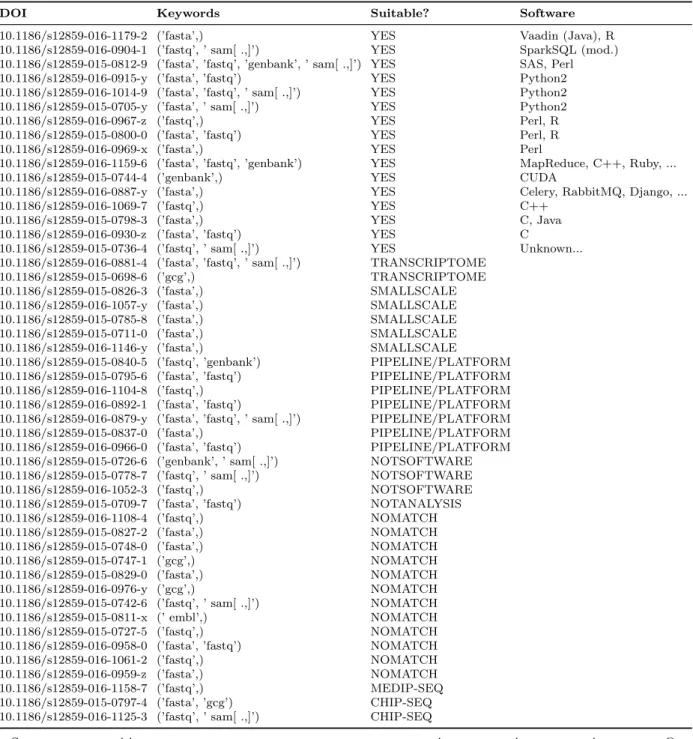
The scraper outputs the DOIs of the matches along with which key-words were matched. From there we manually looked through each article to determine whether it was suitable, and if it was suitable, what software was being used, the result of which is visible in Table 2.2. Considering that we were particularly searching for DNA analysis articles involving big data processing, the values in the suitable column were derived as follows:
YES Suitable – none of the below points apply, and this article should be considered for the purpose of testing the hypothesis.
NOMATCH The keyword that was matched was not actually relevant to the research being performed. For instance: “We created a new format for ..., as inspired by the FASTA format...”
SMALLSCALE The nature of the analysis was too small – in terms of the data or processing involved – to warrant usage of a distributed computing engine.
PIPELINE/PLATFORM The article discussed a platform or pipeline which would support the execution of existing DNA analysis and other bioinformatics tools, instead of a tool or process for analysing DNA itself. There were surprisingly many of these articles.
MICROBIAL or TRANSCRIPTOME or MEDIP-SEQ or CHIP-SEQ
Other kinds of analyses were being performed, outside of our areas of expertise.
NOTANALYSIS The software itself does not analyse the DNA. For in-stance, it might be a specialised storage layer to improve the efficiency of downstream tools.
NOTSOFTWARE The article discusses DNA analysis algorithms or the-ory – not presenting any new software or processes.
OTHER Not categorisable to any of the above, yet still not relevant. These articles were typically far beyond our areas of expertise (considering that we are not bioinformaticians).
The web scraper returned 49 articles which matched at least one of the provided keywords, of which 16 were deemed suitable. Of those 16, only three used any form of distributed computing – the rest executing on a single machine. Of the three distributed solutions, one involved Apache Hadoop MapReduce, one involved Apache Spark, and the last involved Celery – a distributed task queue.
Unfortunately, the dominance of non-distributed tools was too great in this set of articles from BMC Bioinformatics, and so we were not able to collect enough data to meaningfully validate or invalidate our hypothesis. This is an interesting result in itself however: the tools of choice for BMC Bioinformatic’s authors appear to primarily be scripting languages. Perhaps we will see this change following further improvement in the usability and on-boarding processes in modern engines, as the performance gain trumps the lowering barrier to entry.
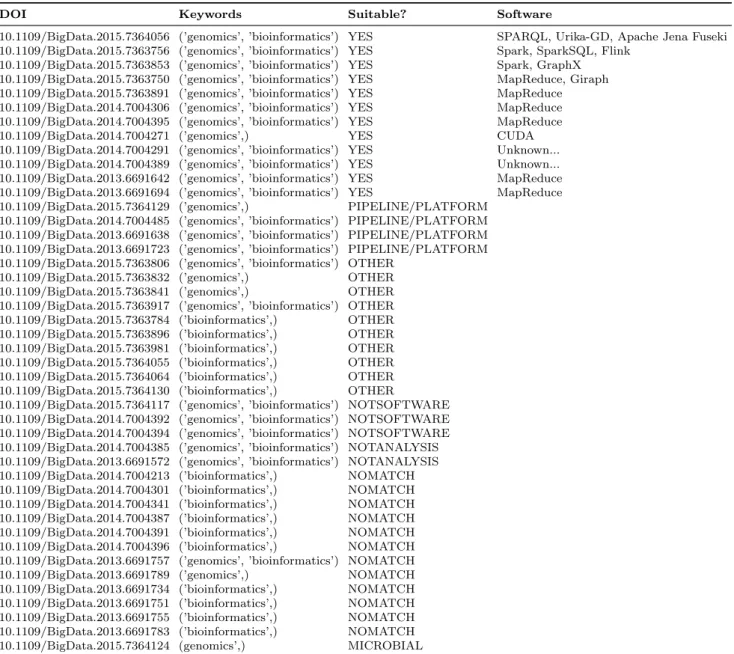
We then decided to examine the IEEE BigData conference, a conference that is not specific to bioinformatics, but undoubtedly includes more solu-tions utilising distributed computing engines – hopefully providing us with enough data to challange or support our hypothesis. We filtered our search within the conference only to DNA analysis articles, for the same reasons as with BMC Bioinformatics.
After a quick look, we found that we could not apply the same keywords to the conference’s articles, as practically no results were returned. This made sense considering that the conference was not targeted at bioinfor-maticians, so submissions would likely not contain such specific details in a shorter conference paper format. Instead, we applied the more general terms “genomics” and “bioinformatics”, and this returned a manageable amount of results: 44 papers that we looked through in a similar manner to the BMC Bioinformatics paper for classification, whose results are shown in Table 2.3. Of the 44 relevant articles found in the three IEEE BigData conferences, 12 were deemed suitable. Of those 12, 6 involved Hadoop MapReduce, 1 involved Spark, and 1 involved both Apache Flink and Spark – itself an evaluation of the two.
We found this result particularly interesting considering the venue – the bleeding edge of big data. While we expected that to provide bias to newer systems, MapReduce remained the dominant choice in the DNA analysis papers found. Although not quite a substantial amount of supporting data, we felt it sufficed as a direct look at the research being performed to validate our hypothesis.
Table 2.2: BMC Bioinformatics system usage web scraper results
DOI Keywords Suitable? Software
10.1186/s12859-016-1179-2 (’fasta’,) YES Vaadin (Java), R 10.1186/s12859-016-0904-1 (’fastq’, ’ sam[ .,]’) YES SparkSQL (mod.) 10.1186/s12859-015-0812-9 (’fasta’, ’fastq’, ’genbank’, ’ sam[ .,]’) YES SAS, Perl 10.1186/s12859-016-0915-y (’fasta’, ’fastq’) YES Python2 10.1186/s12859-016-1014-9 (’fasta’, ’fastq’, ’ sam[ .,]’) YES Python2 10.1186/s12859-015-0705-y (’fasta’, ’ sam[ .,]’) YES Python2 10.1186/s12859-016-0967-z (’fastq’,) YES Perl, R 10.1186/s12859-015-0800-0 (’fasta’, ’fastq’) YES Perl, R 10.1186/s12859-016-0969-x (’fasta’,) YES Perl
10.1186/s12859-016-1159-6 (’fasta’, ’fastq’, ’genbank’) YES MapReduce, C++, Ruby, ... 10.1186/s12859-015-0744-4 (’genbank’,) YES CUDA
10.1186/s12859-016-0887-y (’fasta’,) YES Celery, RabbitMQ, Django, ... 10.1186/s12859-016-1069-7 (’fastq’,) YES C++
10.1186/s12859-015-0798-3 (’fasta’,) YES C, Java 10.1186/s12859-016-0930-z (’fasta’, ’fastq’) YES C
10.1186/s12859-015-0736-4 (’fastq’, ’ sam[ .,]’) YES Unknown... 10.1186/s12859-016-0881-4 (’fasta’, ’fastq’, ’ sam[ .,]’) TRANSCRIPTOME
10.1186/s12859-015-0698-6 (’gcg’,) TRANSCRIPTOME 10.1186/s12859-015-0826-3 (’fasta’,) SMALLSCALE 10.1186/s12859-016-1057-y (’fasta’,) SMALLSCALE 10.1186/s12859-015-0785-8 (’fasta’,) SMALLSCALE 10.1186/s12859-015-0711-0 (’fasta’,) SMALLSCALE 10.1186/s12859-016-1146-y (’fasta’,) SMALLSCALE
10.1186/s12859-015-0840-5 (’fastq’, ’genbank’) PIPELINE/PLATFORM 10.1186/s12859-015-0795-6 (’fasta’, ’fastq’) PIPELINE/PLATFORM 10.1186/s12859-016-1104-8 (’fastq’,) PIPELINE/PLATFORM 10.1186/s12859-016-0892-1 (’fasta’, ’fastq’) PIPELINE/PLATFORM 10.1186/s12859-016-0879-y (’fasta’, ’fastq’, ’ sam[ .,]’) PIPELINE/PLATFORM 10.1186/s12859-015-0837-0 (’fasta’,) PIPELINE/PLATFORM 10.1186/s12859-016-0966-0 (’fasta’, ’fastq’) PIPELINE/PLATFORM 10.1186/s12859-015-0726-6 (’genbank’, ’ sam[ .,]’) NOTSOFTWARE 10.1186/s12859-015-0778-7 (’fastq’, ’ sam[ .,]’) NOTSOFTWARE 10.1186/s12859-016-1052-3 (’fastq’,) NOTSOFTWARE 10.1186/s12859-015-0709-7 (’fasta’, ’fastq’) NOTANALYSIS 10.1186/s12859-016-1108-4 (’fastq’,) NOMATCH 10.1186/s12859-015-0827-2 (’fasta’,) NOMATCH 10.1186/s12859-015-0748-0 (’fasta’,) NOMATCH 10.1186/s12859-015-0747-1 (’gcg’,) NOMATCH 10.1186/s12859-015-0829-0 (’fasta’,) NOMATCH 10.1186/s12859-016-0976-y (’gcg’,) NOMATCH 10.1186/s12859-015-0742-6 (’fastq’, ’ sam[ .,]’) NOMATCH 10.1186/s12859-015-0811-x (’ embl’,) NOMATCH 10.1186/s12859-015-0727-5 (’fastq’,) NOMATCH 10.1186/s12859-016-0958-0 (’fasta’, ’fastq’) NOMATCH 10.1186/s12859-016-1061-2 (’fastq’,) NOMATCH 10.1186/s12859-016-0959-z (’fasta’,) NOMATCH 10.1186/s12859-016-1158-7 (’fastq’,) MEDIP-SEQ 10.1186/s12859-015-0797-4 (’fasta’, ’gcg’) CHIP-SEQ 10.1186/s12859-016-1125-3 (’fastq’, ’ sam[ .,]’) CHIP-SEQ
Source:https://bmcbioinformatics.biomedcentral.com/articles/sections/ - Our Python web scraper was executed on the “Sequence analysis (applications)” and “Sequence analysis (methods)” sections of BMC Bioinformatics’ online list of articles, scraping all articles published in the one year period from 2015/09/01 to 2016/08/31. Only articles containing a match of the following regular expression were included: fasta|fastq| embl|gcg|genbank| sam[ .,].
Table 2.3: IEEE BigData 2013–2015 bioinformatics system usage search results
DOI Keywords Suitable? Software
10.1109/BigData.2015.7364056 (’genomics’, ’bioinformatics’) YES SPARQL, Urika-GD, Apache Jena Fuseki 10.1109/BigData.2015.7363756 (’genomics’, ’bioinformatics’) YES Spark, SparkSQL, Flink
10.1109/BigData.2015.7363853 (’genomics’, ’bioinformatics’) YES Spark, GraphX 10.1109/BigData.2015.7363750 (’genomics’, ’bioinformatics’) YES MapReduce, Giraph 10.1109/BigData.2015.7363891 (’genomics’, ’bioinformatics’) YES MapReduce 10.1109/BigData.2014.7004306 (’genomics’, ’bioinformatics’) YES MapReduce 10.1109/BigData.2014.7004395 (’genomics’, ’bioinformatics’) YES MapReduce 10.1109/BigData.2014.7004271 (’genomics’,) YES CUDA 10.1109/BigData.2014.7004291 (’genomics’, ’bioinformatics’) YES Unknown... 10.1109/BigData.2014.7004389 (’genomics’, ’bioinformatics’) YES Unknown... 10.1109/BigData.2013.6691642 (’genomics’, ’bioinformatics’) YES MapReduce 10.1109/BigData.2013.6691694 (’genomics’, ’bioinformatics’) YES MapReduce 10.1109/BigData.2015.7364129 (’genomics’,) PIPELINE/PLATFORM
10.1109/BigData.2014.7004485 (’genomics’, ’bioinformatics’) PIPELINE/PLATFORM 10.1109/BigData.2013.6691638 (’genomics’, ’bioinformatics’) PIPELINE/PLATFORM 10.1109/BigData.2013.6691723 (’genomics’, ’bioinformatics’) PIPELINE/PLATFORM 10.1109/BigData.2015.7363806 (’genomics’, ’bioinformatics’) OTHER
10.1109/BigData.2015.7363832 (’genomics’,) OTHER 10.1109/BigData.2015.7363841 (’genomics’,) OTHER 10.1109/BigData.2015.7363917 (’genomics’, ’bioinformatics’) OTHER 10.1109/BigData.2015.7363784 (’bioinformatics’,) OTHER 10.1109/BigData.2015.7363896 (’bioinformatics’,) OTHER 10.1109/BigData.2015.7363981 (’bioinformatics’,) OTHER 10.1109/BigData.2015.7364055 (’bioinformatics’,) OTHER 10.1109/BigData.2015.7364064 (’bioinformatics’,) OTHER 10.1109/BigData.2015.7364130 (’bioinformatics’,) OTHER
10.1109/BigData.2015.7364117 (’genomics’, ’bioinformatics’) NOTSOFTWARE 10.1109/BigData.2014.7004392 (’genomics’, ’bioinformatics’) NOTSOFTWARE 10.1109/BigData.2014.7004394 (’genomics’, ’bioinformatics’) NOTSOFTWARE 10.1109/BigData.2014.7004385 (’genomics’, ’bioinformatics’) NOTANALYSIS 10.1109/BigData.2013.6691572 (’genomics’, ’bioinformatics’) NOTANALYSIS 10.1109/BigData.2014.7004213 (’bioinformatics’,) NOMATCH 10.1109/BigData.2014.7004301 (’bioinformatics’,) NOMATCH 10.1109/BigData.2014.7004341 (’bioinformatics’,) NOMATCH 10.1109/BigData.2014.7004387 (’bioinformatics’,) NOMATCH 10.1109/BigData.2014.7004391 (’bioinformatics’,) NOMATCH 10.1109/BigData.2014.7004396 (’bioinformatics’,) NOMATCH 10.1109/BigData.2013.6691757 (’genomics’, ’bioinformatics’) NOMATCH 10.1109/BigData.2013.6691789 (’genomics’,) NOMATCH 10.1109/BigData.2013.6691734 (’bioinformatics’,) NOMATCH 10.1109/BigData.2013.6691751 (’bioinformatics’,) NOMATCH 10.1109/BigData.2013.6691755 (’bioinformatics’,) NOMATCH 10.1109/BigData.2013.6691783 (’bioinformatics’,) NOMATCH 10.1109/BigData.2015.7364124 (genomics’,) MICROBIAL
Source:Publications displayed from searching the terms “genomics” and “bioinformatics” (separately) from the IEEE Xplore listings for the IEEE BigData conferences run in 2013, 2014 and 2015.
Chapter 3
Usability Study
The aim of this usability study is to compare the usability of three pop-ular distributed computing systems: Apache Hadoop MapReduce; Apache Spark; and Apache Flink, thus providing data for the usability component of the systems’ multidimentional comparison. The participants of this us-ability study were masters students from a cloud computing class at the University of Sydney, where the mentioned systems were taught. The focus of that course is on data processing in the cloud, assessed with practical programming assignments. Stream processing is not covered in this course or the usability study – all exercises are in the form of batch processing.
As highlighted in the related work section, our study is quite novel and unique as the two closest existing usability studies of similar circumstance still differed fundamentally in scope and study duration. We adapted effec-tive study design considerations from those and other papers where possible, and otherwise applied our knowledge and best judgment in designing this usability study. This section will describe the background of the study, the study design and decisions that were made in its regard, and the strengths and challenges in its execution.
3.1
Background
The usability study was conducted as part of a regular master’s level class on cloud computing at the University of Sydney. This class attracts a
di-verse student cohort because it is available for selection in several different degrees, most prominently including students studying computer science at either master’s or undergraduate (4th year) level, or studying a Master of Data Science – which does not require a computer science background. Par-ticipation in this study was voluntary, so it was paramount to design and organise the usability study in such a way that students who did not opt-in to participate were not at an advantage or disadvantage.
The class of 2017 was scheduled to start in early March, and consider-ation and preparconsider-ation for this usability study began in early-mid February. Topics relevant to the usability study began being taught in early April through to late June, with the earlier weeks dedicated to general concepts like the cloud and data centres. Thus the time-frame for the usability study was 2.5 months, with 1.5 months preparation.
The author of this thesis and his supervisor both held roles in execution of the unit of study while the study was being performed. A. Prof. Uwe R¨ohm was the unit of study coordinator and lecturer. Bilal Akil was the unit of study teaching assistant and one of its five tutors. Thus, once granted ethics approval, we had the means to reshape the class to better fit the usability study – bearing in mind the students who may not have opted-in. In previous years, this course covered Apache Hadoop MapReduce and Apache Spark, and this year a third system – Apache Flink – was taught too. A YARN enabled cluster was available to this course’s students, and needed Apache Flink installed and all relevant systems updated. Teaching mate-rial and exercises were prepared for all three systems and updated where necessary. Because of the diversity of the student cohort, this course sup-ports both the Java and Python programming languages, which individual students can select as they prefer. This means six variants of exercise and assignment solutions (3 systems×2 programming languages) were prepared. We realised that the preparation time was not long enough to address everything before the usability study commenced. Assignments and learning materials would need to be developed and the cluster would need to be updated as the usability study was being executed. With this in mind, time being a scarce resource was a factor that had to be considered in the study’s design.
The assessment component of the class comprised three practical pro-gramming assignments that students worked on in pairs, plus a written final exam that is not part of this study. Students were provided with between three and four weeks to complete assignments, each of which were an in-creasingly complex series of distributed computing tasks in some domain.
3.2
Design
To be fair to all the class’ students, we decided that they would all learn and use each of the three distributed computing engines, as opposed to dividing usage among them. This choice was made to avoid circumstances such as: “Why did (s)he use System X but I had to use System Y?”
Each assignment was targeted at different distributed computing engines (cf. Table 3.1), and provided students with an experience which they could then reflect upon to consider the usability of each system. The first assign-ment covered the lower level framework, Apache Hadoop MapReduce. This placed participants on an equal starting point for comparison to the more modern, higher level data processing frameworks to come. This decision also complemented the existing course structure, where the fundamental and lower level distributed computing concepts are taught first. We sus-pected that the majority of participants would not prefer to use Hadoop MapReduce compared to the other systems (and you can see in Section 3.4 that this was indeed the case), and thus were not concerned by the possibil-ity of slight biases in favour of it that may be introduced by having used it first.
On the other hand, we were concerned that the order of usage for the next two systems could have an effect on their comparison results – or at least that it would be difficult to be confident that they would not. To account for this, we decided to employ a crossed A/B test for the remaining two assignments: half of the participants used Apache Spark for assignment 2 and Apache Flink for assignment 3, and the other half did the opposite. Therefore teaching and learning resources for both systems were to be made available at the roughly same time and depth.