algorithms and machine learning techniques for
information retrieval. PhD thesis, University of
Nottingham.
Access from the University of Nottingham repository:
http://eprints.nottingham.ac.uk/47696/1/Osman_Approved_PhD_Thesis.pdf Copyright and reuse:
The Nottingham ePrints service makes this work by researchers of the University of Nottingham available open access under the following conditions.
This article is made available under the University of Nottingham End User licence and may be reused according to the conditions of the licence. For more details see:
http://eprints.nottingham.ac.uk/end_user_agreement.pdf
Learning Techniques for Information Retrieval
Osman Ali Sadek Ibrahim, MSc
A thesis submitted for the degree of
Doctor of Philosophy
ASAP Research Group
School of Computer Science
The University of Nottingham
United Kingdom
September, 2017
Techniques for Information Retrieval
Osman Ali Sadek Ibrahim
Submitted for the degree of Doctor of Philosophy
September, 2017
Abstract
In the context of Artificial Intelligence research, Evolutionary Algorithms and Ma-chine Learning (EML) techniques play a fundamental role for optimising Information Retrieval (IR). However, numerous research studies did not consider the limitation of us-ing EML at the beginnus-ing of establishus-ing the IR systems, while other research studies compared EML techniques by only presenting overall final results without analysing im-portant experimental settings such as the training or evolving run-times against IR effec-tiveness obtained. Furthermore, most papers describing research on EML techniques in IR domain did not consider the memory size requirements for applying such techniques. This thesis seeks to address some research gaps of applying EML techniques to IR sys-tems. It also proposes to apply (1+1)-Evolutionary Strategy ((1+1)-ES) with and without gradient step-size to achieve improvements in IR systems. The thesis starts by identifying the limitation of applying EML techniques at the beginning of the IR system. This lim-itation is that all IR test collections are only partially judged to only some user queries. This means that the majority of documents in the IR test collections have no relevance labels for any of the user queries. These relevance labels are used to check the quality of the evolved solution in each evolving iteration of the EML techniques. Thus, this the-sis introduces a mathematical approach instead of the EML technique in the early stage of establishing the IR system. It also shows the impact of the pre-processing procedure in this mathematical approach. The heuristic limitations in the IR processes such as in pre-processing procedure inspires the demands of EML technique to optimise IR systems after gathering the relevance labels. This thesis proposes a (1+1)-Evolutionary Gradient
Strategy ((1+1)-EGS) to evolve Global Term Weights (GTW) in IR documents. The GTW is a value assigned to each index term to indicate the topic of the documents. It has the dis-crimination value of the term to discriminate between documents in the same collection. The (1+1)-EGS technique is used by two methods for fully and partially evolved pro-cedures. In the two methods, partially evolved method outperformed the mathematical model (Term Frequency-Average Term Occurrence (TF-ATO)), the probabilistic model (Okapi-BM25) and the fully evolved method. The evaluation metrics for these exper-iments were the Mean Average Precision (MAP), the Average Precision (AP) and the Normalized Discounted Cumulative Gain (NDCG).
Another important process in IR is the supervised Learning to Rank (LTR) of the fully judged datasets after gathering the relevance labels from user interaction. The relevance labels indicate that every document is either relevant or irrelevant in a certain degree to a user query. LTR is one of the current problems in IR that attracts the attention from researchers. The LTR problem is mainly about ranking the retrieved documents in search engines, question answering and product recommendation systems. There are a num-ber of LTR approaches from the areas of EML. Most approaches have the limitation of being too slow or not being very effective or presenting too large a problem size. This thesis investigates a new application of a (1+1)-Evolutionary Strategy with three initial-isation techniques hence resulting in three algorithm variations (ES-Rank, IESR-Rank and IESVM-Rank), to tackle the LTR problem. Experimental results from comparing the proposed method to fourteen EML techniques from the literature, show that IESR-Rank achieves the overall best performance. Ten datasets; which are MSLR-WEB10K dataset, LETOR 4 datasets, LETOR 3 datasets; and five performance metrics, Mean Av-erage Precision (MAP), Root Mean Square Error (RMSE), Precision (P@10), Reciprocal Rank (RR@10), Normalised Discounted Cumulative Gain (NDCG@10) at top-10 query-document pairs retrieved, were used in the experiments. Finally, this thesis presents the benefits of using ES-Rank to optimise online click model that simulate user click interac-tions. Generally, the contribution of this thesis is an effective and efficient EML method for tackling various processes within IR. The thesis advances the understanding of how EML techniques can be applied to improve IR systems.
The work in this thesis is based on research carried out at the ASAP Research Group, the School of Computer Science, The University of Nottingham, UK. No part of this thesis has been submitted elsewhere for any other degree or qualification and it is all my own work unless referenced to the contrary in the text.
I appreciate for ALLAH who give me the ability to do this research. HE helped me in every moment in my life and giving me the blessing, the motivation and the power for doing this research. Secondly, I am much appreciate to my family for their help in my whole life. I think that without their support, I can not finish this work.
I am deeply grateful to my main supervisor Dr. Dario Landa-Silva for his guidance, encouragement and patience throughout the doctoral programme. In particular, for his help in securing all the necessary funding. He is always being willing to review my writ-ing and givwrit-ing me a feedback before the deadlines. His support has been much more than his academic duties.
I would like to thank as well my second supervisor Dr. Steven Bagley for his insightful comments and suggestions before each annual review. My gratitude goes also to my viva voce examiners Professor Bob John and Dr. Craig Macdonald. Their valuable comments were included in the final version of this thesis. I also more grateful for my ASAP group colleagues because they help me more than expected during my PhD journey. Further-more, I am appreciate for Professor Bob John as the Head of ASAP group who support all ASAP researchers with every support available not only as Professor and supervisor, but also as a father for every PhD student in ASAP.
Finally, this research programme would not have been possible without the financial support provided by: Minia University, Egypt via the scholarship (M11/11). Thus, I ap-preciate their support to me.
Abstract iii
Declaration v
Acknowledgements vi
1 Introduction 1
1.1 Research Motivation . . . 3
1.2 Thesis Statement and Scope . . . 5
1.3 Research Questions . . . 7 1.4 Thesis Contributions . . . 8 1.5 Publications . . . 11 1.6 Thesis Outline . . . 12 1.6.1 Chapter 2 . . . 12 1.6.2 Chapter 3 . . . 12 1.6.3 Chapter 4 . . . 13 1.6.4 Chapter 5 . . . 13 1.6.5 Chapter 6 . . . 14 1.6.6 Chapter 7 . . . 14 1.6.7 Chapter 8 . . . 14 1.6.8 Chapter 9 . . . 15 2 Background 16 2.1 General Information Retrieval Overview . . . 16
2.1.2 Natural Language Pre-Processing in Information Retrieval . . . . 19
2.1.3 Indexing and Query Transformation . . . 20
2.1.4 Matching and Ranking for Information Retrieval . . . 21
2.1.5 Relevance Judgement in Information Retrieval . . . 22
2.1.6 Information Retrieval System Evaluation . . . 24
2.2 Information Retrieval Models. . . 27
2.2.1 Boolean Model . . . 28
2.2.2 Vector Space Model (VSM) . . . 30
2.2.3 Probabilistic Models (PM) . . . 34
2.2.4 Language Models (LM) . . . 40
2.2.5 Evolutionary and Machine Learning Models (EML) . . . 42
2.3 Evolution Strategies Overview . . . 43
2.3.1 Evolutionary Algorithms (EAs) . . . 43
2.3.2 Evolution Strategies Techniques . . . 44
2.4 Chapter Summary . . . 49
3 Test Collections 50 3.1 Textual Test Collections. . . 50
3.1.1 Cranfield Paradigm . . . 51
3.1.2 Pooling Paradigm . . . 54
3.1.3 Analysis of Textual Collections for Evolving TWS . . . 57
3.2 Distilled (LETOR) Benchmark Datasets . . . 60
3.2.1 LETOR 3 Datasets . . . 63
3.2.2 LETOR 4 Datasets . . . 64
3.2.3 Microsoft Bing Search Engine Dataset . . . 65
3.3 Chapter Summary . . . 66
4 Related Work 67 4.1 Learning Approaches Based on the Term Vector Model (TVM) . . . 67
4.1.1 Document Indexing Problem . . . 68
4.1.2 Query Representation Problem . . . 71
4.2 Learning to Rank Based on Feature Vector Model (FVM) . . . 77
4.2.1 SVMRank: Support Vector Machine for Ranking . . . 80
4.2.2 RankBoost: An Efficient Boosting Algorithm for Combining Pref-erences . . . 82
4.2.3 RankNET: Learning to Rank Using Neural Nets. . . 82
4.2.4 ListNET: Listwise Learning to Rank Based on Neural Nets . . . . 84
4.2.5 AdaRank: A Boosting Algorithm for Information Retrieval. . . . 85
4.2.6 RankGP: Learning to Rank Using Genetic Programming . . . 86
4.2.7 LambdaRank . . . 87
4.2.8 Random Forest . . . 88
4.2.9 Gradient Boosted Regression Tree (MART or GBRT) . . . 89
4.2.10 LambdaMART . . . 89
4.2.11 Coordinate Ascent . . . 90
4.2.12 CoRR: Combined Regression with Ranking . . . 90
4.2.13 RankDE: Learning to Rank Using Differential Evolution (DE) . . 91
4.2.14 Linear Regression . . . 92
4.2.15 Initialised GBRT using Random Forests (IGBRT) . . . 92
4.3 Chapter Summary . . . 93
5 Term Frequency With Average Term Occurrences (TF-ATO) 94 5.1 Introduction . . . 94
5.2 The Proposed Term-Weighting Scheme . . . 96
5.3 Discriminative Approach (DA) . . . 97
5.4 Implementation and Experimental Study . . . 98
5.4.1 Building the IR System . . . 98
5.4.2 Experimental Results and Analysis . . . 100
5.5 Stop-words Removal and DA Case Studies. . . 105
5.5.1 Related Work on Stop-word Lists . . . 107
5.5.2 Experimental Results and Analysis . . . 109
6 (1+1)-Evolutionary Gradient Strategy to Evolve Global Term Weights 117
6.1 Introduction . . . 117
6.2 The Proposed Approach . . . 120
6.3 Experimental Study and Evaluation . . . 125
6.3.1 Test Collections. . . 125
6.3.2 Experimental Results . . . 126
6.4 Chapter Summary and Conclusion . . . 132
7 Learning to Rank Model Based on Feature Vector Model 134 7.1 Introduction . . . 134
7.2 The Proposed Approaches . . . 135
7.3 Implementation and Experimental Results . . . 139
7.3.1 Dataset Benchmarks . . . 139
7.3.2 Results . . . 141
7.4 Chapter Summary and Conclusion . . . 148
8 ESClick: Learning to Rank Using Evolutionary Strategy Based Click Model151 8.1 Introduction . . . 151
8.2 Dependent Click Model . . . 153
8.3 Implementation and Experimental Results . . . 156
8.4 Chapter Summary and Conclusion . . . 158
9 Conclusions and Future Work 159 9.1 Introduction . . . 159
9.2 Answers to Research Questions. . . 159
9.3 Review of Contributions . . . 162
9.4 Conclusions . . . 165
9.5 Practical Implications and Future Work . . . 166
Appendix 187
B Learning to Rank Model Based on Feature Vector Model 211
B.1 The Predictive results on test data for Mean Average Precision (MAP) as a Fitness and an Evaluation Function . . . 211 B.2 The Predictive results on test data for Normalized Discounted Cumulative
Gain (NDCG@10) as a Fitness and an Evaluation Function . . . 217 B.3 The Predictive results on test data for Precision (P@10) as a Fitness and
an Evaluation Function . . . 222 B.4 The Predictive results on test data for Reciprocal Rank (RR@10) as a
Fitness and an Evaluation Function . . . 228 B.5 The Predictive results on test data for Error Rate (ERR@10) as Fitness
and Evaluation Functions . . . 233
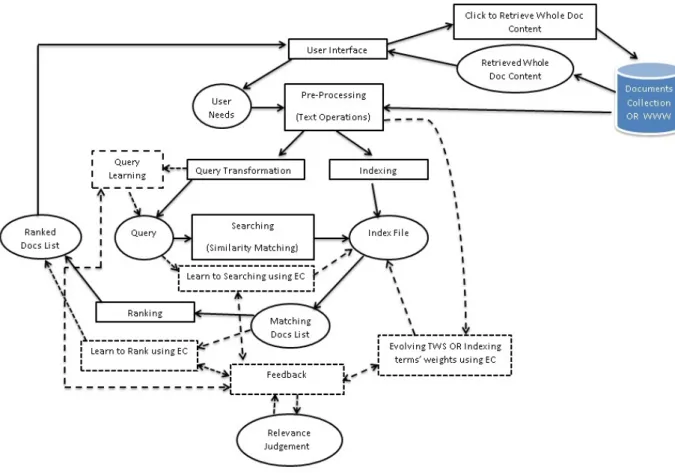
2.1 Main Processes Involved in the Implementation of an IR System Archi-tecture. . . 18 2.2 Indexing Procedure from Assigning Weights (Term Frequency) to
Pro-ducing Inverted Index Containing Term List and Postings Lists. . . 20 2.3 Recall and Precision Ratios in IR Systems. . . 25 2.4 Term Weighting Components By (Salton and Buckley, 1988).. . . 32
3.1 Learning to Rank (LTR) approach architecture as discussed in Liu (2009). 62
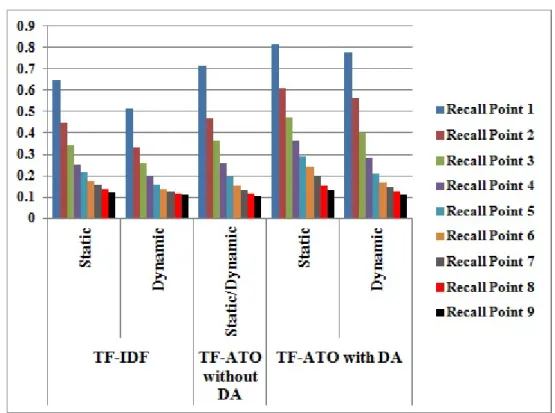
5.1 Illustrating the Average Precision performance for Static/Dynamic Exper-iments on Ohsumed Collection.. . . 105 5.2 Illustrating the Average Precision performance for Static/Dynamic
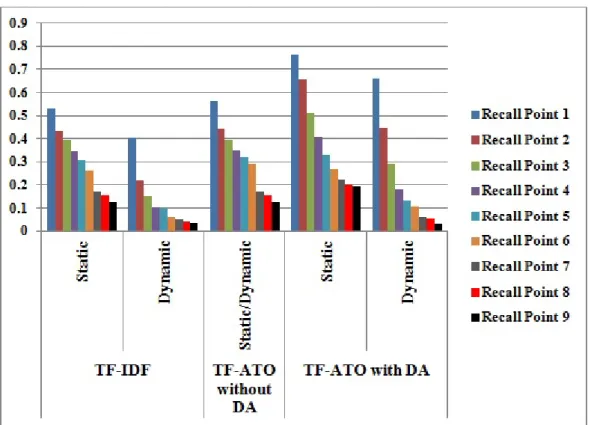
Exper-iments on LATIMES Collection. . . 106 5.3 Zipf’s Relationship Frequency vs. Rank Order for Words and Luhn’s
Cut-off Points for Significant and Non-significant Words on Text as in (Rijsbergen, 1979). . . 107
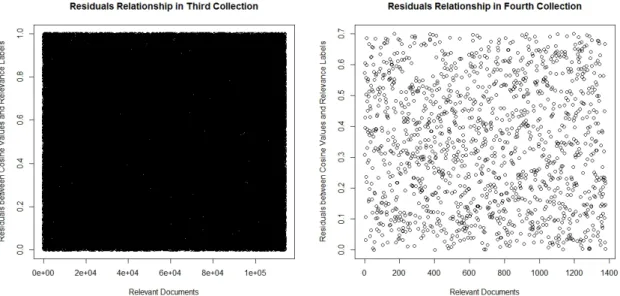
6.1 The Construction of the Index File (also called post file) which serves as an index for the IR system. It contains the global and local term weights for every term in each document and the document and term identifiers with the local term weight for each term. . . 118 6.2 Shows Residuals between Relevant Documents/Queries Matching with
Relevance Labels for First and Second Collection Combinations. . . 127 6.3 Shows Residuals between Relevant Documents/Queries Matching with
6.4 Illustrating the MAP and NDCG@30 performance for Okapi-BM25,
TF-ATO with DA, Fully and Partially Evolved Experiments. . . 132
7.1 Illustrating the MAP performance for all LTR methods on the LETOR datasets. . . 145
7.2 Illustrating the NDCG@10 performance for all LTR methods on the LETOR datasets. . . 146
7.3 Illustrating the P@10 performance for all LTR methods on the LETOR datasets. . . 146
7.4 Illustrating the RR@10 performance for all LTR methods on the LETOR datasets. . . 147
7.5 Illustrating the RMSE performance for all LTR methods on the LETOR datasets. . . 147
8.1 Illustrating the Table 8.1 performance for on the LETOR datasets. . . 157
8.2 Illustrating the Table 8.2 performance for on the LETOR datasets. . . 158
A.1 One document from the Cranfield collection . . . 187
3.1 Cranfield Paradigm Test Collections General Characteristics. . . 53 3.2 Characteristics of the Pooling test Collections Used in this Thesis. . . 56 3.3 Test Collections General Basic Characteristics. . . 58 3.4 Characteristics of Test Collections to Consider When Evolving TWS. . . 59 3.5 Learning to Rank (LTR) Query-Document Pairs Representation. . . 62 3.6 The properties of LETOR 3 datasets used in the experimental study. . . . 64 3.7 LTR Dataset Folds From Dataset Partitions S1, S2, S3, S4 and S5. . . 66
5.1 Average Recall-Precision and MAP for Static Experiment Applied on Ohsumed collection. . . 101 5.2 Average Recall-Precision and MAP for Static Experiment Applied on
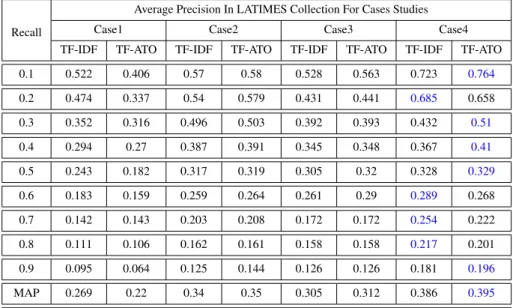
LATIMES collection. . . 102 5.3 Average Recall-Precision Using TF-IDF and TF-ATO with DA in
Dy-namic Experiment for Ohsumed. . . 103 5.4 Average Recall-Precision Using TF-IDF and TF-ATO with DA in
Dy-namic Experiment for LATIMES. . . 104 5.5 Paired T-test for Static and Dynamic Experiments . . . 106 5.6 Mean Average Precision (MAP) Results Obtained From Each Case in
the Experiments. Using and Not-using Stop-words Removal is Indicated With sw(y) and sw(n) Respectively, Similarly for the DA. . . 110 5.7 Average Recall-Precision Results Obtained on the Ohsumed Collection. . 111 5.8 Average Recall-Precision Results Obtained on the LATIMES Collection. . 111 5.9 Average Recall-Precision Results Obtained on the FBIS Collection. . . . 112 5.10 Average Recall-Precision Results Obtained on the Cranfield Collection. . 112
5.11 Average Recall-Precision Results Obtained on the CISI Collection. . . 113 5.12 The Ratios (%) Of Reduction Of The Size Of The Index File Obtained
From Its Original Index Size For Each Case in the Experiments. . . 113 5.13 The Indexing Time in Minutes Using TF-IDF and TF-ATO For Each Case
in the Experiments. . . 114
6.1 The Notations Used in Algorithm 2. . . 122 6.2 Characteristics of the Test Collections Used in the Experiments. . . 126 6.3 The NDCG@30 in the Four Collection Combinations of Using
Okapi-BM25, TF-ATO with DA and the Proposed Approach. . . 127 6.4 The Mean Average Precision in the Four Collection Combinations of
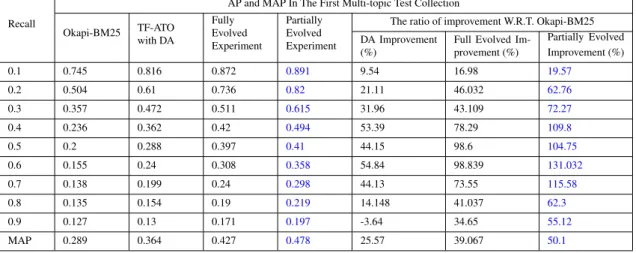
Us-ing Okapi-BM25, TF-ATO with DA and the Proposed Approach. . . 128 6.5 The improvement in MAP and AP on Partially Evolved and Fully Evolved
Experiments of the first collection. . . 129 6.6 The improvement in MAP and AP on Partially Evolved and Fully Evolved
Experiments of the second collection. . . 130 6.7 The improvement in MAP and AP on Partially Evolved and Fully Evolved
Experiments on TREC Disk 4&5 Robust 2004 relevance feedback (TREC, 2004). . . 130 6.8 The improvement in MAP and AP Partially Evolved and Fully Evolved
Experiments on TREC Disk 4&5 crowdsource 2012 relevance feedback (Smucker et al., 2012). . . 131 6.9 The Average Computational runtime per a Document in the Four
Col-lection Combinations of Using Okapi-BM25, TF-ATO with DA and the proposed Approach. . . 131
7.1 Properties of the benchmark datasets used in the experimental study. . . . 140 7.2 Algorithms Average Performance Applied on 10 Datasets Using MAP
Fitness Evaluation Metric . . . 142 7.3 Algorithms Average Performance Applied on 10 Datasets Using NDCG@10
7.4 Algorithms Average Performance Applied on 10 Datasets Using P@10
Fitness Evaluation Metric . . . 143
7.5 Algorithms Average Performance Applied on 10 Datasets Using RR@10 Fitness Evaluation Metric . . . 143
7.6 Algorithms Performance Applied on 10 Datasets Using RMSE Fitness Evaluation Metric . . . 144
7.7 Average run-time for the five evaluation fitness metrics in seconds of the algorithms on the datasets. . . 144
7.8 P-values of Paired t-test between ES-Rank, IESR-Rank, IESVM-Rank and the Fourteen LTR Techniques . . . 148
7.9 Winner Number of Accuracy Per Each Algorithm . . . 149
8.1 Average of the Training Data Results of Nine LETOR Datasets . . . 156
8.2 Average of the Test Data Results of Nine LETOR Datasets . . . 156
A.1 The MSLR-WEB10K and MSLR-WEB30K feature list as in (Qin and Liu, 2016) . . . 188
A.1 The MSLR-WEB10K and MSLR-WEB30K feature list as in (Qin and Liu, 2016) . . . 189
A.1 The MSLR-WEB10K and MSLR-WEB30K feature list as in (Qin and Liu, 2016) . . . 190
A.1 The MSLR-WEB10K and MSLR-WEB30K feature list as in (Qin and Liu, 2016) . . . 191
A.1 The MSLR-WEB10K and MSLR-WEB30K feature list as in (Qin and Liu, 2016) . . . 192
A.1 The MSLR-WEB10K and MSLR-WEB30K feature list as in (Qin and Liu, 2016) . . . 193
A.1 The MSLR-WEB10K and MSLR-WEB30K feature list as in (Qin and Liu, 2016) . . . 194
A.1 The MSLR-WEB10K and MSLR-WEB30K feature list as in (Qin and Liu, 2016) . . . 195
A.1 The MSLR-WEB10K and MSLR-WEB30K feature list as in (Qin and
Liu, 2016) . . . 196
A.1 The MSLR-WEB10K and MSLR-WEB30K feature list as in (Qin and Liu, 2016) . . . 197
A.1 The MSLR-WEB10K and MSLR-WEB30K feature list as in (Qin and Liu, 2016) . . . 198
A.1 The MSLR-WEB10K and MSLR-WEB30K feature list as in (Qin and Liu, 2016) . . . 199
A.1 The MSLR-WEB10K and MSLR-WEB30K feature list as in (Qin and Liu, 2016) . . . 200
A.2 The MQ2007 and MQ2008 feature list as in (Qin and Liu, 2013). . . 201
A.2 The MQ2007 and MQ2008 feature list as in (Qin and Liu, 2013). . . 202
A.2 The MQ2007 and MQ2008 feature list as in (Qin and Liu, 2013). . . 203
A.3 The TREC .Gov LETOR datasets feature list as in (Qin et al., 2010). . . . 203
A.3 The TREC .Gov LETOR datasets feature list as in (Qin et al., 2010). . . . 204
A.3 The TREC .Gov LETOR datasets feature list as in (Qin et al., 2010). . . . 205
A.3 The TREC .Gov LETOR datasets feature list as in (Qin et al., 2010). . . . 206
A.3 The TREC .Gov LETOR datasets feature list as in (Qin et al., 2010). . . . 207
A.4 The Ohsumed LETOR datasets feature list as in (Qin et al., 2010). . . 207
A.4 The Ohsumed LETOR datasets feature list as in (Qin et al., 2010). . . 208
A.4 The Ohsumed LETOR datasets feature list as in (Qin et al., 2010). . . 209
A.4 The Ohsumed LETOR datasets feature list as in (Qin et al., 2010). . . 210
B.1 MAP results for ranking models using evolutionary and machine learning techniques on MSLR-WEB10K . . . 211
B.2 MAP results for ranking models using evolutionary and machine learning techniques on MQ2008 . . . 212
B.3 MAP results for ranking models using evolutionary and machine learning techniques on MQ2007 . . . 212
B.4 MAP results for ranking models using evolutionary and machine learning techniques on Ohsumed . . . 213
B.5 MAP results for ranking models using evolutionary and machine learning techniques on HP2003 . . . 213 B.6 MAP results for ranking models using evolutionary and machine learning
techniques on TD2003 . . . 214 B.7 MAP results for ranking models using evolutionary and machine learning
techniques on NP2003 . . . 214 B.8 MAP results for ranking models using evolutionary and machine learning
techniques on HP2004 . . . 215 B.9 MAP results for ranking models using evolutionary and machine learning
techniques on TD2004 . . . 215 B.10 MAP results for ranking models using evolutionary and machine learning
techniques on NP2004 . . . 216 B.11 NDCG@10 results for ranking models using evolutionary and machine
learning techniques on MSLR-WEB10K . . . 217 B.12 NDCG@10 results for ranking models using evolutionary and machine
learning techniques on MQ2008 . . . 218 B.13 NDCG@10 results for ranking models using evolutionary and machine
learning techniques on MQ2007 . . . 218 B.14 NDCG@10 results for ranking models using evolutionary and machine
learning techniques on Ohsumed . . . 219 B.15 NDCG@10 results for ranking models using evolutionary and machine
learning techniques on HP2003 . . . 219 B.16 NDCG@10 results for ranking models using evolutionary and machine
learning techniques on TD2003. . . 220 B.17 NDCG@10 results for ranking models using evolutionary and machine
learning techniques on NP2003 . . . 220 B.18 MAP results for ranking models using evolutionary and machine learning
techniques on MSLR-WEB10K . . . 221 B.19 NDCG@10 results for ranking models using evolutionary and machine
B.20 NDCG@10 results for ranking models using evolutionary and machine learning techniques on NP2004 . . . 222 B.21 P@10 results for ranking models using evolutionary and machine learning
techniques on MSLR-WEB10K . . . 222 B.22 P@10 results for ranking models using evolutionary and machine learning
techniques on MQ2008 . . . 223 B.23 P@10 results for ranking models using evolutionary and machine learning
techniques on MQ2007 . . . 223 B.24 P@10 results for ranking models using evolutionary and machine learning
techniques on Ohsumed . . . 224 B.25 P@10 results for ranking models using evolutionary and machine learning
techniques on HP2003 . . . 224 B.26 P@10 results for ranking models using evolutionary and machine learning
techniques on TD2003 . . . 225 B.27 P@10 results for ranking models using evolutionary and machine learning
techniques on NP2003 . . . 225 B.28 P@10 results for ranking models using evolutionary and machine learning
techniques on HP2004 . . . 226 B.29 P@10 results for ranking models using evolutionary and machine learning
techniques on TD2004 . . . 226 B.30 P@10 results for ranking models using evolutionary and machine learning
techniques on NP2004 . . . 227 B.31 RR@10 results for ranking models using evolutionary and machine
learn-ing techniques on MSLR-WEB10K . . . 228 B.32 RR@10 results for ranking models using evolutionary and machine
learn-ing techniques on MQ2008 . . . 229 B.33 RR@10 results for ranking models using evolutionary and machine
learn-ing techniques on MQ2007 . . . 229 B.34 RR@10 results for ranking models using evolutionary and machine
B.35 RR@10 results for ranking models using evolutionary and machine learn-ing techniques on HP2003 . . . 230 B.36 RR@10 results for ranking models using evolutionary and machine
learn-ing techniques on TD2003 . . . 231 B.37 RR@10 results for ranking models using evolutionary and machine
learn-ing techniques on NP2003 . . . 231 B.38 RR@10 results for ranking models using evolutionary and machine
learn-ing techniques on HP2004 . . . 232 B.39 RR@10 results for ranking models using evolutionary and machine
learn-ing techniques on TD2004 . . . 232 B.40 RR@10 results for ranking models using evolutionary and machine
learn-ing techniques on NP2004 . . . 233 B.41 ERR@10 results for ranking models using evolutionary and machine
learn-ing techniques on MSLR-WEB10K . . . 233 B.42 ERR@10 results for ranking models using evolutionary and machine
learn-ing techniques on MQ2008 . . . 234 B.43 ERR@10 results for ranking models using evolutionary and machine
learn-ing techniques on MQ2007 . . . 234 B.44 ERR@10 results for ranking models using evolutionary and machine
learn-ing techniques on Ohsumed. . . 235 B.45 ERR@10 results for ranking models using evolutionary and machine
learn-ing techniques on HP2003 . . . 235 B.46 ERR@10 results for ranking models using evolutionary and machine
learn-ing techniques on TD2003 . . . 236 B.47 ERR@10 results for ranking models using evolutionary and machine
learn-ing techniques on NP2003 . . . 236 B.48 ERR@10 results for ranking models using evolutionary and machine
learn-ing techniques on HP2004 . . . 237 B.49 ERR@10 results for ranking models using evolutionary and machine
B.50 ERR@10 results for ranking models using evolutionary and machine learn-ing techniques on NP2004 . . . 238
C.1 The training data results for DCM and ES-Click on MQ2008 . . . 239 C.2 The test data results for DCM and ES-Click on MQ2008 . . . 239 C.3 The training data results for DCM and ES-Click on MQ2007 . . . 240 C.4 The test data results for DCM and ES-Click on MQ2007 . . . 240 C.5 The training data results for DCM and ES-Click on HP2004 . . . 240 C.6 The test data results for DCM and ES-Click on HP2004 . . . 241 C.7 The training data results for DCM and ES-Click on TD2004 . . . 241 C.8 The test data results for DCM and ES-Click on TD2004 . . . 241 C.9 The training data results for DCM and ES-Click on NP2004 . . . 242 C.10 The test data results for DCM and ES-Click on NP2004 . . . 242 C.11 The training data results for DCM and ES-Click on HP2003 . . . 242 C.12 The test data results for DCM and ES-Click on HP2003 . . . 243 C.13 The training data results for DCM and ES-Click on TD2003 . . . 243 C.14 The test data results for DCM and ES-Click on TD2003 . . . 243 C.15 The training data results for DCM and ES-Click on NP2003 . . . 244 C.16 The test data results for DCM and ES-Click on NP2003 . . . 244 C.17 The training data results for DCM and ES-Click on Ohsumed . . . 244 C.18 The test data results for DCM and ES-Click on Ohsumed . . . 245
Introduction
In many contexts, such as textual documents on the web, data changes rapidly over time. Hence, there is a growing need to develop effective methods of automated Information Retrieval (IR) systems that provide reasonable results and meet users needs. An IR system is an information system used to store items of information that need to be processed, indexed, searched, retrieved and disseminated according to various users’ needs. Most IR systems store collections of text documents acting as a data repository.
Previous studies of IR research employedMathematical Models (MM), Probabilistic learning Models (PM), Language learning Models (LM), Evolutionary and Machine Learning models (EML) to store and then rank the retrieved documents. Various Term-Weighting Scheme (TWS) methods have been used in these models. The TWS is a mathematical or probabilistic or Boolean equation used to assign real numbers to each significant word in IR system documents. This real value denotes the importance of the word within the document to allow efficient document retrieval.
The ability to rank the retrieved documents with respect to their relevance according to the user query is an important requirement in the domain of IR research. The historical user interaction data with the IR system can be used as a method to measure the relevance degree for each clicked and browsed document. However, the historical user interaction data suffers from many problematic issues, such as random user decisions, unfamiliarity with the system, education level and user intelligence (Lorigo et al., 2006; Al-Maskari
and Sanderson, 2011). The relevance judgements are values that indicate the relevance degrees of the user queries to specific documents in the IR test collection. These values are extracted from the historical user interaction data with the IR system. The relevance judgements of the documents are limited and expensive to have fully judged test collections at the start of the IR system. Thus, standardised test collections have been produced to simulate actual IR test collections. In these collections, the relevance judgement value represents the degree of relevance of each document relative to user query.
Traditionally, the process of ranking retrieved documents was based on learning document or query representations using probabilistic and EML techniques. These techniques are based onTerm Vector Model (TVM) representation. The TVM approach represents each document and query as a vector of term-weights. Recent evidence suggests that the use of only one term-weighting model is not sufficient for effective IR systems (Qin et al., 2010;Qin and Liu, 2016;Liu, 2011;Liu et al., 2007;Hofmann, 2013;Schuth,2016). Thus, recent IR research has investigated data features for learning, to develop rank models based on combinations of MM, PM and LM term-weighting models. As a consequence, recent test collections contain more than one of the MM, PM and LM term-weighting models as feature vector representations. This feature representation is calledFeature Vector Model (FVM).
Finally, recent research provides fully judged collections of documents that simulate those available from existing search engines. This type of fully judged test collection is usually obtained some time (maybe several years) after establishing the IR system (or search engine), also following the gathering of historical user data interactions and reducing the noise from user behaviours. These collections can then be used in supervised
Learning to Rank (LTR)models, applying various EML techniques.
Several attempts have been made to evolve document representations but without fully considering the limitations of EML techniques. These limitations are as follows:
because the lack of existing user interaction data with the IR system;
2. The memory usage of some EML techniques in IR is typically large when consid-ering all the training documents; some techniques instead do not consider all the training documents in each learning iteration which can affect effectiveness; and
3. The computational runtime for most EML applications is typically large and in-creases substantially according to the size of the test collection.
1.1
Research Motivation
As mentioned above, ranking retrieved documents with respect to their relevance to the user query is an important issue in an IR system. A huge amount of time and effort is spent searching for relevant documents, if the IR system cannot efficiently rank the retrieved documents. This inspires the need for developing EML approaches to improve the performance of IR systems.
A considerable amount of research has been published regarding the use of EML techniques to improve the performance of IR systems. However, the problem size for Evolutionary Computation (EC) techniques in the IR literature research has yet to be addressed (Cummins and O’Riordan, 2006; Oren, 2002; Escalante et al., 2015). Thus, this particular limitation can hinder the application of these techniques to large test collections. This is because using the whole test collection will usually slow down significantly the evolutionary process of EC techniques in TVM approaches. EC techniques have been used to evolve all the document or the query representations of the test collections.
On the other hand, the increase in the problem size of the technique increases the computational evolving runtime (Nopiah et al., 2010). According to (Escalante et al., 2015), the computational runtime problem for evolving TWS, using a subset of 20-Newsgroup collection (Rennie, 2015), with population-based Genetic Programming (GP) was 18 hours. The other GP approaches (Cummins and O’Riordan, 2006; Oren,
2002) were applied to very small collections using either a cluster of computers or taking long computational runtimes. However, evolving the term weights of the document representations and evolving TWS using EC have resulted in better IR effectiveness in terms ofMean Average Precision (MAP)(Cummins,2008;Cordon et al.,2003).
Another limitation of EML approaches for IR relates to the relevance judgement values collected from user interactions with IR systems. These values cannot be gathered in the early stages of system development when building the IR systems for large test collections. The relevance judgement requires sufficient historical user interactions with the test collection to maximise the IR system’s effectiveness. Thus, there is a need for a new perspective when applying the mathematical models and EML in the early stage of IR systems which have partially relevance judged values or do not have any. In this thesis, Chapters5and6cover this new perspective on applying EML techniques for TVM with well-known partially judged test collections. The mathematical model is proposed as a starting point for document representations to construct an IR system without the need to have the user feedback at the beginning. Then, Chapter6proposes a new methodology for evolving document representation in partially judged test collection stage considering the problem size and the limitation of existing the relevance judgement values.
As more time passes using the IR system, the test collection gradually becomes a fully or nearly fully judged collection, with comprehensive user relevance feedback. Thus, research trends can make use of the new challenge of test collection representation after the fully judged relevance feedback became available from users. In this representation, each document is represented as a vector of features that include numerous of TWS, document reputation and business importance features on the web. In this thesis this representation is referred to as Feature Vector Model (FVM) or Bag-of-Features (BoF). The research field using this representation is referred to as supervised LTR. This field typically uses EML techniques. This is because the use of an IR system by one TWS without including the business importance and web page reputation of the document is not sufficient for effective IR system on the web (such as in Search engines).
Another motivation for research work in this thesis is the need for comparing computational efficiency of the various EML techniques proposed in the literature for LTR. Most comparisons to date, present only the accuracy for EML techniques without mentioning the corresponding computational training runtimes. Moreover, some studies comparing EML techniques did not reveal the experimental settings used to produce the reported experimental results. In other words, numerous researchers have considered the accuracy values when comparing EML techniques but they have not reported on the computational runtime for the proposed approach. Additionally, this thesis is the first to investigate the LTR problem using an adaptiveEvolutionary Strategy (ES). The adaptive EC techniques have outperformed non-adaptive EC techniques (such as GP and Differential Evolution) in many Combinatorial Optimisation Problems, which was an additional motivation for this research. The ES-Rank algorithm proposed in this thesis is much faster than those for most of the population-based EML techniques in the LTR problem, as it requires the lowest memory size. In the FVM approach, some of the EML techniques also experienced the same issues and limitations as those in the TVM approach. These issues are related to the computational runtime and the effect of the problem size on the performance of the EML technique. This causes some alternative EML techniques do not consider the entire training instances (documents) in each learning iteration to overcome these issues. Unfortunately, the accuracy values of the ranking model by these techniques are not effective compared to methods that consider all training instances (documents) in each learning iteration. The computational runtime required to have an effective approach increases exponentially with increases in the size of the input data, when the technique considers all training documents in each learning iteration. A further limitation when handling large data-set is the memory size. These issues have not been investigated in previous research published in the existing literature.
1.2
Thesis Statement and Scope
This thesis hypothesis is that evolutionary and machine learning (EML) techniques can improve the accuracy of IR systems using the historical user interaction data. In
particular, it suggests that the proposed (1+1)-Evolutionary Strategy with/without gradi-ent mutation step-size will have the lowest memory size and the lowest computational runtime requirements when improving IR systems, if compared with the other EML techniques reported in the literature. Furthermore, we hypothesise that the use of static collection characteristics when performing term-weighting functions has a negative effect on the accuracy of a TVM IR system. Moreover, that relevance judgement values or historical user interactions are vital for determining the use of evolutionary and machine learning or the use of mathematical term-weighting functions. We also illustrate the importance of the initialisation procedure in ES technique in LTR problem. Finally, we illustrate that the ES technique can improve the accuracy of the user interaction simulation (Dependent Click Ranking Model). This click model is a well-known click model related to an online LTR package (Loret) and this thesis compared its performance with ES-Rank performance.
The current study of this thesis examines the use of evolutionary and machine learning techniques in an offline LTR evaluation. It means that the explicit relevance judgement labels existing in the standardised test collections are used to evaluate the quality of the solutions produced by EML techniques. However, the current online LTR evaluation re-search uses the same explicit relevance judgement values to produce user click models first and then evaluate the quality of LTR technique based on click models which simu-late user clicks (Schuth,2016;Hofmann,2013). This means that the online LTR research in the literature uses click models to simulate online user interaction and then evaluate the EML by the explicit relevance judgement labels. This is because the cost and time demands of real online user interaction evaluation are daunting. Moreover, real user rel-evance judgement assessment is biased by the user familiarity with the IR system and user education levels, as mentioned in the literature (Lorigo et al.,2006;Al-Maskari and Sanderson, 2011; Kharitonov, 2016). In addition to the time consuming for having in-teractive user interaction during the training time is significant. Thus, the test collections used in this thesis are standardised collections created by TREC, Microsoft IR research teams and well-known IR researchers (Liu et al., 2007;Qin et al., 2010; TREC, 2016a; Voorhees, 2000; Soboroff, 2007; Tonon et al., 2015; Urbano, 2016; Cleverdon, 1960;
Sanderson, 2010; Hersh et al., 1994). The relevance judgement values of these collec-tions are collected by trained and expert human annotators in the test collection topic domains and validated by multiple IR systems. These test collections are also used in online LTR research in the literature due to the limitations of having online non-biased relevance judgement labels (Schuth, 2016; Hofmann, 2013). These test collections in-clude many types of user relevance judgements, provided by expert users from Microsoft and the National Institute of Standards and Technology (Liu et al.,2007;Qin et al.,2010; TREC, 2016a; Voorhees, 2000; Soboroff, 2007; Tonon et al., 2015; Urbano, 2016). In addition, the test collections used in this thesis have been created, validated and tested over several years before dissemination for IR researchers (Liu et al., 2007; Qin et al., 2010;TREC,2016a;Voorhees,2000;Soboroff,2007;Tonon et al.,2015;Urbano, 2016; Cleverdon,1960; Sanderson, 2010; Hersh et al.,1994). Chapter3 discuss the details of creating these test collections. Moreover, the cognitive level variation issues for creating the datasets (test collections) relevance judgement values is out of the thesis scope.
1.3
Research Questions
The research questions identified in this research are as follows:
1. What are the limitations of applying EML techniques on IR systems for TVM rep-resentation (Bag-of-Words)? This question is addressed in Chapters5and6.
2. Why there is a need for mathematical (non-learning) term-weighting schemes in IR systems? This question is addressed in Chapters3and5.
3. What is the importance of relevance judgement and relevance labels in evolutionary and machine learning approaches? This question is addressed in Chapters 3, 4, 5 and6.
4. What is the limitation in respect of static collection characteristics for different IR weighting functions on TVMs? How will this parameter affect dynamic variation in test collection? These questions are addressed in Chapter5.
5. What is the impact of the pre-processing procedure (stop-word removal) in term-weighting functions? This question is addressed in Chapter5.
6. What is the importance of EML approaches in IR to overcome the impact of pre-processing (stop-word removal and stemming) to enhance effectiveness? This ques-tion is addressed in Chapters4and6.
7. What are the limitations of applying EML techniques on IR systems for FVM rep-resentation (Bag-of-Features)? This question is addressed in Chapters4and7.
8. How can the adaptive (1+1)-evolutionary technique be used to improve the IR sys-tem with the lowest problem size and the lowest computational time? This question is addressed in Chapters6and7.
9. What is the importance of the initialisation procedure in the (1+1)-ES technique? This question is addressed in Chapter7.
10. Can the (1+1)-ES technique improve the user click ranking model? This question is addressed in Chapter8.
1.4
Thesis Contributions
The research presented in this thesis contributes to understanding the application of evo-lutionary and machine learning techniques in the IR research field by:
1. An analysis of commonly used test collections, provides an argument in favour of using heuristic (non-learning) TWS instead of TWS and term weights evolved via EC techniques at the beginning of establishing IR system (Section 3.1.3). We believe that this analysis also supports the argument that more appropriate test test collections, instead of general IR test test collections, should be considered when using EC techniques to evolve TWS or term weights. This analysis is related to research questions 1, 2 and 3.
2. A new non-learning (mathematical) TWS is proposed termed the Term Frequency With Average Term Occurrence (TF-ATO), with a Discriminative Approach (DA)
for removing less significant weights from the documents. A study is conducted to compare the performance of TF-ATO to the widely used TF-IDF approach, using various types of test collections such as sampled, pooled (Soboroff,2007) and those from real IR systems (Hersh et al.,1994). Our experimental results show that the proposed TF-ATO gives higher effectiveness in both cases of static and dynamic test collections. This TWS can be used at the early IR stage to gather the user interaction feedback data. This mathematical TWS is related to the research questions 1, 2 and 4.
3. Using various test collections, we study the impact of our DA and the stop-words removal process for IR system effectiveness and performance when using the pro-posed TF-ATO and when using the TF-IDF. We find that these two processes have a positive effect on both TF-ATO and TF-IDF for improving the IR performance and effectiveness. This study is related to the research question 5.
4. A new method has been proposed to evolve better representations of documents in the collection for the trained queries with less computer memory usage. This is accomplished by evolving the Global Term Weights (GTWs) of the collection rather than evolving document representations for the whole collection as is typically done in other EC approaches in the literature. Hence, the main contribution of Chapter 6is the development of a(1+1)-Evolutionary Gradient Strategy ((1+1)-EGS)with
Adaptive Ziggurat Random Gaussian Mutation (Kuo and Zulvia, 2015; Doornik, 2005;Loshchilov, 2014) to evolve GTWs. The proposed methodology reduces the problem size, from evolving(N×M)document representation vectors to evolving (1×M)vector, whereN is the number of documents in the collection andM is the number of index terms in the collection. This method also considers the limitation of the relevance judgement of the partially judged test collections in EC techniques. This method is concluded from the research questions 1, 2, 3, 6 and 8.
5. An Evolutionary Strategy (ES) technique has been proposed to tackle the LTR prob-lem. The proposed method is called ES-Rank and consists on evolving a vector of weights where each weight represents a desirable feature. The mutation step-size in ES-Rank has been tuned based on preliminary experimentation. Details of the
proposed method are presented in Section7.2. In order to assess the performance of ES-Rank,Mean Average Precision (MAP),Root Mean Square Error (RMSE), Nor-malised Discounted Cumulative Gain (NDCG@10),Reciprocal Ranking (RR@10)
and Precision (P@10) at top-10 query-document pairs retrieved (Liu, 2011; Li, 2014) are used and comparison is carried out against fourteen state-of-the-art LTR approaches from the literature. Experimental results in Chapter 7 show that ES-Rank performs very well when compared to those other methods in terms of MAP, RMSE, RR@10, NDCG@10 and P@10. Furthermore, most of the other meth-ods consumed very long computation time while ES-Rank was much faster. For example, some of the other methods consumed more than 9 hours on each MSLR-WEB10K dataset fold (Qin et al., 2010) while ES-Rank consumed only around 30 minutes on each fold. Another feature of ES-Rank is that it has small memory re-quirements according to the problem size (2XM dimensions whereM represents the number of features in the training dataset). This technique is produced after addressing the limitation identified from the research question 7 and 8.
6. The importance of initialisation procedure in ES-Rank to tackle the LTR problem is investigated. The initialisation procedure in ES-Rank has been tuned based on Linear Regression and Support Vector Machine ranking model to produce Rank and IESVM-Rank methods. In order to assess the performance of IESR-Rank and IESVM-IESR-Rank, MAP, RMSE, NDCG@10, RR@10 and P@10 at top-10 query-document pairs retrieved (Liu,2011; Li, 2014) are used and comparison is carried out against fourteen state-of-the-art LTR approaches from the literature. Experimental results in Chapter 7 show that the use of machine learning ranking model as an initialisation procedure has a positive impact on ES-Rank technique. Furthermore, the initialisation procedure using Linear Regression (LR) machine learning ranking model has a better positive impact for improving ES-Rank in most cases than Support Vector Machine (SVM) and zero values initialisation methods. This study is related to the research question 9.
7. The ES-Rank technique has been used to optimise Click Dependent Model (DCM) to tackle click ranking models problem. This click model is an extension of Cascade
Click Model (CCM). These click models are used in online LTR techniques as in Lerot package (Schuth et al.,2013). At the beginning, online LTR models are pro-duced by Lerot package using online probabilistic interleave and DCM technique (Hofmann, 2013;Schuth, 2016). Then, ES-Rank optimises these ranking models. This study is related to the research question 10.
1.5
Publications
The following submitted/published articles have resulted from the research work de-scribed in this thesis
1. Osman A. S. Ibrahim and Dario Landa-Silva, A New Weighting Scheme and Dis-criminative Approach for Information Retrieval in Static and Dynamic test Col-lections, Proceedings of the 14th UK Workshop on Computational Intelligence (UKCI2014), Bradford UK, September 2014, doi: 10.1109/UKCI.2014.6930160.
2. Osman A. S. Ibrahim and Dario Landa-Silva, Term Frequency with Average Term Occurrences for Textual Information Retrieval, Soft Computing Journal, Volume 20, Issue 8, August 2016, doi: 10.1007/s00500-015-1935-7
These first two publications cover the findings and research analysis existing in Chapter5and Section3.1.3.
3. Osman A. S. Ibrahim and Dario Landa-Silva, (1+1)-Evolutionary Gradient Strategy to Evolve Global Term Weights in Information Retrieval, Advances in Computational Intelligence Systems Contributions presented at the 16th UK Workshop on Computational Intelligence, September 7-9, 2016, Lancaster, UK, doi: 10.1007/978-3-319-46562-3 25
This publication presents the research outcomes in Chapter 6 which includes evolving Global Term-Weights (GTW) using (1+1)-Evolutionary Gradient Strategy.
4. Osman A. S. Ibrahim and Dario Landa-Silva, ES-Rank: Evolution Strategy Learn-ing to Rank Approach, ACM Symposium on Applied ComputLearn-ing (SAC 2017), Mar-rakech, Morocco, April 03-07, 2017, ISBN: 978-1-4503-4486-9/17/04.
5. Osman A. S. Ibrahim and Dario Landa-Silva, An Evolutionary Strategy with Machine Learning for Learning to Rank in Information Retrieval, Accepted in Soft Computing Journal
These two publications demonstrate the research findings in Chapter 7 which illustrates the using of ES to improve LTR problem.
1.6
Thesis Outline
This section summarises the contents of the remaining chapters of this thesis.
1.6.1
Chapter 2
This chapter presents the background material for IR and Evolutionary Strategies (ES). It begins by detailing the IR architecture and then explains various IR models, such as Boolean, vector space and language models. Then, the chapter introduces the introductory material for EML techniques in IR. Finally, the historical development of ES from method to another is presented in the last section (section2.3).
1.6.2
Chapter 3
This chapter describes the available methods to create test benchmarks. It introduces the two available methods for creating the relevance judgement in the partially judged test collections. Then, the fully judged LETOR Benchmarks are presented. The partially judged test collections are used for both TVM in learning and mathematical techniques. They are used in Chapter 6 ((1+1)-Evolutionary Gradient Strategy for evolving global term weights) as a learning approach, while they are used in Chapter 5 for mathemati-cal term-weighting schemes and to identify the limitations of EC applications in TVM.
The fully judged LETOR benchmarks are then used with supervised LTR techniques in Chapters7and8.
1.6.3
Chapter 4
This chapter presents the relevant literature about EML in TVM and FVM. The chapter commences with the TVM and introduces the limitations that arise when applying EML in TVM when evolving term weights. The limitations are summarised in relation to the accuracy, the problem size and the computational runtime when evolving the whole docu-ment representations. This is in addition to the relevance judgedocu-ment limitations that arise when applying EC orMachine Learning (ML)techniques to a newly established IR sys-tem. These limitation inspires the need for proposing a new methodology of evolving the document representations using EML techniques. This chapter also introduces the various LTR techniques on FVM. In this research domain, the EML techniques are used to learn the most suitable ranking model weights for the training data and for testing the performance of the techniques on the test data. The limitations of these techniques relate to their comparability with each other. This is because the majority of the literature re-search did not identify the experimental settings nor the training computational runtimes when making their comparisons. Furthermore, most of the EML techniques deliver high accuracy with a higher training runtime.
1.6.4
Chapter 5
This chapter presents the benefits of using non-learning term-weight schemes and it pro-poses a new TWS. TF-ATO is a Term Frequency-Average Term Occurrence weighting scheme. This TWS is proposed to avoid the limitations of the mathematical models with dynamic document variation that causes the collection size parameter to vary by adding/removing a document and consequently causing the need to re-compute the term weights for large variations in the IR test collection. However, TF-ATO is not sufficiently effective when compared with EC, Probabilistic and EML weighting functions. This gen-erates a need for Discriminative Approach (DA) to overcome some of these limitations. Furthermore, the removal of stopwords as a pre-processing component in IR has an
im-portant role in TF-ATO performance variation, which should be considered when using the TF-ATO weighting function. The improved accuracy inspires the need for an EC approach to improve IR while using TF-ATO as local TWS, as shown in Chapter6.
1.6.5
Chapter 6
Due to the need to improve TF-ATO, this chapter proposes (1+1)-EGS to improve global term weight and TF-ATO as a local term weight. The term weight can be divided into two parts, the Global Term Weight (GTW) and the Local Term Weight (LTW). The GTW is a value assigned to each index term to indicate the topics of the documents. It has the dis-crimination value of the term to discriminate between documents in the same collection. The LTW is a value used to measure the contribution of the index term in the docu-ment. This approach considers the limitation of previous studies that used EC approaches for TVM. However, this approach consumed more computational time than probabilistic learning models and language models but it is less time consuming and less memory de-manding compared to EC approaches in the previous studies. Furthermore, this chapter considers the limitations of relevance judgement when using partially judged test collec-tions.
1.6.6
Chapter 7
This chapter presents an efficient EC application to produce a ranking model in LTR re-search field based on data feature weights. This ranking model represents the importance value of each feature in search engine query-document pairs. This approach is faster than other machine learning approaches. The test benchmarks are LTR benchmarks containing more than one TWS and other features that indicate the business importance and reputa-tion of the documents on the web. ES-Rank ((1+1)-ES for Learning to Rank) applicareputa-tion is a supervised learning approach in the LTR problem.
1.6.7
Chapter 8
This chapter shows the capability of ES in LTR domain as a tool to improve user Click Models to achieve improved accuracy values. The ES-Rank can improve the performance
of the Dependent Click ranking Model (DCM) in five evaluation fitness metrics. This approach is called ES-Click. It begins with a learning DCM ranking model and then the ES-Rank uses the DCM ranking models to evolve better ranking models. In most cases of IR system evaluation performance, click models replace the interactive user clicks without bias caused by neither user education level, intelligence nor familiarity with the IR system.
1.6.8
Chapter 9
The final chapter presents the conclusion from the research findings and the outcomes of this thesis. It started with answering the research questions presented in this chapter and then it reviews the research contributions. Finally, it presents a summary of conclusions of the thesis and presents the future work avenues.
Background
This chapter presents a discussion of background knowledge about Information Retrieval (IR) research field. This discussion begins with presenting the general IR architecture in sections2.1 and 2.2. Then, the evolution Strategies background is presented in section 2.3.
2.1
General Information Retrieval Overview
An Information Retrieval (IR) system is an information system that stores, organises and indexes the data for retrieval of relevant information responding to a user’s query (user information need) (Salton and McGill, 1986). Generally, an IR system consists of the following three main components (Baeza-Yates and Ribeiro-Neto,2011):
• Document Set. It stores the documents and theirInformation Content Representa-tions. It is related to the indexer module, which generates a representation for each document by extracting the document features (terms). Atermis a keyword or a set of keywords in the document.
• Similarity Matching and Ranking Mechanism. It evaluates the degree of simi-larity to which each document in the test collection satisfies the user information need. It also ranks the retrieved documents, according to their relevance to the user query.
information needs that stored in online IR systems. This component also trans-forms the users query into itsinformation contentby extracting the query’s features (terms) that correspond to document features.
2.1.1
Information Retrieval Architecture
The implementation of an IR system may be divided into a set of main processes as shown in Figure 2.1. Some of these processes (dotted lines rectangles) can be implemented using Machine Learning (ML) or Computational Intelligence (CI) approaches. An outline of the core processes in IR (solid lines rectangles) is also presented in this figure.
The User Interface module manages the interaction between the user and the IR system. In this module, the user can request information afterPre-processingandQuery Transformation from the index file. The result of this query is in the form of links or document numbers referring to documents in the test collection or World Wide Web (WWW). ThePre-processingmodule represents the lexical analysis, stop-words removal and stemming procedures that are applied to the user query and the test collection. TheIndexing module processes the documents in the collection using a term-weighting scheme (TWS) in order to create the index file. Such index file contains information in the form of inverted indexes where each term has references to each document in the collection where that term appears and a weight representing the importance of that term in the document. Similarly to indexing, the user query undergoes a process of Query Transformationafter pre-processing for building queries of terms and their corresponding weights for those terms. TheSearchingmodule conducts a similarity matching between the query of terms with their weights and the index file in order to produce a list of links or document numbers referring to documents in the test collection. In the past, theRankingof the matching list depended only on the degree of similarity between the documents and the user query. Nowadays, this ranking may depend on some additional criteria such as the host server criteria among others (Liu,2009).
After outlining the core processes in the implementation of an IR system, we now focus on the aspect where machine learning and meta-heuristic techniques applied to
Figure 2.1: Main Processes Involved in the Implementation of an IR System Architecture.
some IR processes exhibit some weakness in our opinion. TheRelevance Judgementfile is the file that contains the set of queries for the test collection and their corresponding relevant documents from the collection. Also, this file sometimes contains the degree of relevancy of documents for the queries (i.e. some number indicating that the document is non-relevant, partially or totally relevant). However, all IR test test collections are partially judged as it is not feasible to have fully judged test collections as mentioned in (Qin et al., 2010). Since machine learning, meta-heuristic, probabilistic and language model techniques applied to IR depend on the relevance judgement file, the efficiency of such techniques for IR is limited. The following sections explain the details of the core components of the IR system.
2.1.2
Natural Language Pre-Processing in Information Retrieval
Natural language pre-processing (Baeza-Yates and Ribeiro-Neto, 2011) for classical IR models is the procedure of text transformation that may utilise the following steps:
1. Each document is tokenised into data elements such as words or group of words or n-letters (n-grams). Moreover, the digits, punctuation marks and the case of letters of these data elements are treated to produce lower-case letters of tokens.
2. Stop-words (negative words) are removed. These stop-words have poor discrimina-tion values that would make poor index terms for similarity matching and retrieval purposes (Fox, 1989). Examples for the stop-words (common words) are the and a. These keywords are common in every English document and they do not have discrimination capability between the documents each other.
3. If the data elements are words it can be stemmed by removing prefixes and suffixes by using any of stemming algorithm such as Porter Stemmer (Porter,1997), Lovins Stemmer (Lovins,1968) among others.
4. Then the unique data elements (keywords or a group of keywords) are chosen to be index terms for the IR system.
5. Some IR systems use thesaurus terms and term categorisation for alternative terms and meanings of keywords or data elements in index terms that may be helpful in similarity matching between users’ queries and index terms on IR systems (Baeza-Yates and Ribeiro-Neto,2011).
This process is one of the important steps that affects the IR system efficiency. Research work has concluded that inappropriate pre-precessing can affect the text classification accuracy (Uysal and Gunal, 2014; Makrehchi and Kamel, 2008; Toman et al., 2006; Toraman et al.,2011). It has also been demonstrated that pre-processing is topic domain dependent in text classification problem (Uysal and Gunal,2014).
Figure 2.2: Indexing Procedure from Assigning Weights (Term Frequency) to Producing Inverted Index Containing Term List and Postings Lists.
2.1.3
Indexing and Query Transformation
Generally, the index (i.e. an inverted index) for the test collection is a structure that stores, each term (keyword) that occurred somewhere in the collection combined with its weight (Yan et al.,2009). The weight value represents the information content or the importance of the term in the document. As shown in Figure2.2, the two main components of an inverted index are the term list and the postings lists. For each term in the test collection, there is a postings list that contains information about the term’s occurrences or the term’s weights in the collection (Buettcher et al.,2010). The information found in these postings lists is used by the system to process search queries. The term list serves as a look-up data structure on top of the postings lists. For every query term in an incoming search query, the information retrieval system first needs to locate the term’s postings list before it can start processing the query. The term list job is to map between terms and their corresponding posting list locations in the index. In Figure2.2, the Document Frequency (DF) is the simplest kind of Global Term Weight (GTW)that represents the number of documents in which the term occurred. The GTW contribute to identify the
topic of the documents. DF is the number of documents in which a term is existed, while the Term Frequency (TF) is the number of repetitions of a term in a document. From Figure2.2, after the test collection undergoes the pre-processing procedure, the TF and DF for each term are calculated. Then, the inverted index is created from term list and posting list. The term list consists of the index terms and their document frequencies, while the posting list consists of the term frequencies in each document for each term. A more detailed discussion about the local and the global term weights will be presented in chapters4and6.
2.1.4
Matching and Ranking for Information Retrieval
Matching and ranking in IR is the process of searching the IR data resource (IR test collection) for the matched documents responding to the user query and then ranking them according to their degree of similarity match and/or their importance. The main categories of matching and ranking methods are as follows:
1. Exact matching which is the matching between the query and the documents ac-cording to the terms (keywords) existing in both or not. If the terms exist in both the query and the document, then the document is more similar to the query hence matching the query requirement. This category of matching can be done in the stan-dard Boolean Model. Thus, the Boolean exact matching uses AND and OR Algebra between the binary term occurrence value (1 if the term exists, 0 if the term does not exist). The problem with Boolean exact matching is that there is not ranking or distinguishing between the matched documents that are returned as relevant to the query, i.e. all are considered ’equally’ relevant which would not be always precise enough (Greengrass,2000).
2. Similarity matching, this produces a real numerical value that represents the degree of similarity between the document and the query. This category can be used in
Vector Space Model (VSM). Examples of the similarity matching functions used in this category are: Cosine Similarity, Jaccard Similarity Coefficient, Inner Product
and Dice’s Coefficient (Baeza-Yates and Ribeiro-Neto,2011).
3. PageRank matching (Page et al., 1998), this measure calculates the importance of the web-document on the web. This approach is based on assigning a value for the document based on its relation with other web-pages on the web.
4. Probabilistic relevance matching, this method is based on the probability distribu-tions of the data. This category considers the probability distribution of the terms existing in the test collection with respect to the collection relevance judgement. Example of this category are:Best Match version 25 (BM25), a probabilistic model (see Section2.2.3) andDirichlet Similarity Matching (DSM)on Dirichlet language model (Zhai and Lafferty,2004).
5. Learning to rank based on Term Vector Model (TVM) approach is one of the simi-larity matching methods. An example of this category is the Genetic Programming approach that is used for evolving similarity matching functions (Fan et al.,2004). This method is discussed in more details in Chapter4.
6. Learning to Rank based on Feature Vector Model (FVM) approach is one of the state-of-the-art research directions in IR (Bollegala et al.,2011). The ranking func-tion in this methodology is called ranking model. This model will be discussed in details in the following chapters.
Section 2.2 demonstrate the well-known retrieval models existing in the literature which based on the matching and ranking procedure.
2.1.5
Relevance Judgement in Information Retrieval
The relevance judgement component of the IR test collection contains the list of relevant and irrelevant documents. The relevance judgement is identified by monitoring the user behaviours (interaction) and their corresponding user information needs (queries) on the IR systems. There are three paradigms for producing the relevance judgements for test collections.
The first category is the Cranfield paradigm (Cleverdon, 1960;Sanderson,2010). In this category, the test collections were produced by collecting the abstracts of scientific articles as the document set. The query set was produced by the authors of these scientific articles. Those authors are asked to assign all relevance values to their queries with their articles. These values indicate which document is relevant or irrelevant for each query in the query set. Then, experts in the articles’ topic assess and validate the authors relevance judgement values. This paradigm is the most accurate method for producing the relevance judgements as claimed by (Cleverdon, 1960;Sanderson,2010). However, this method is very expensive and time consuming for producing relevance judgements for large test collections.
The second paradigm is produced by TREC (Text REtrieval Conference) and the National Institute of Standards and Technology (NIST) for large test collections. This paradigm is called Pooling paradigm (Voorhees, 2000; Soboroff, 2007). The pooling paradigm starts with crawling the web or specific web domains by queries for collecting the document set for these queries. Then, multiple term-weighting schemes were used to retrieve the matched documents for human assessors. Then, the human assessors examine the relevance degree of the top k (for example top 100 or 1000) documents retrieved from the document pool retrieved. After-that, TREC conference used the test collection for TREC conference tracks. Finally, TREC validates the conference outcomes with multiple IR systems for the test collections using multiple TWS. The limitation of this method is that the pool of the documents retrieved and the pool depth are biased to the retrieval strategy used (Sanderson,2010;Buckley et al.,2007). Recent research identified that TREC Disk 4 and 5 with Robust 2004 and Crowdsource relevance judgement is the most reliable pooled collection to compare between the performances of the IR systems (Tonon et al.,2015;Urbano,2016).
On the other hand, the learning IR models such as language models, computational intelligence models and probabilistic models which do not consider the limitation of the relevance judgement on their supervised and semi-supervised learning approaches as it will be discussed and investigated later in this thesis (chapters3and5). The reason is that