Studies on Determinants and Consequences
of Financial Reporting Quality
Studies on Determinants and Consequences
of Financial Reporting Quality
Studies naar de determinanten en consequenties van de kwaliteit van financiële verslaggeving
Thesis
to obtain the degree of Doctor from the Erasmus University Rotterdam by command of the rector magnificus
Prof.dr. H.A.P. Pols
and in accordance with the decision of the Doctorate Board.
The public defence shall be held on Thursday, November 26 2015 at 13:30 hours
by Anastasios Elemes born in Athens, Greece
Doctoral committee
Promoter: Prof.dr. E. Peek
Other members: Prof.dr. E. Roelofsen Prof.dr. A. Vanstraelen Prof.dr. D. Veenman
Erasmus Research Institute of Management – ERIM
The joint research institute of the Rotterdam School of Management (RSM) and the Erasmus School of Economics (ESE) at the Erasmus University Rotterdam Internet: http://www.erim.eur.nl
ERIM Electronic Series Portal: http://repub.eur.nl/pub ERIM PhD Series in Research in Management, 354 ERIM reference number: EPS-2015-354-F&A ISBN 978-90-5892-420-9
© 2015, Anastasios Elemes
Design: B&T Ontwerp en advies www.b-en-t.nl
Cover image: Kinderdijk, May 2015. Picture taken by the author.
This publication (cover and interior) is printed by haveka.nl on recycled paper, Revive®. The ink used is produced from renewable resources and alcohol free fountain solution.
Certifications for the paper and the printing production process: Recycle, EU Flower, FSC, ISO14001. More info: http://www.haveka.nl/greening
All rights reserved. No part of this publication may be reproduced or transmitted in any form or by any means electronic or mechanical, including photocopying, recording, or by any information storage and retrieval system, without permission in writing from the author.
Acknowledgements
I am indebted to my supervisor, Erik Peek, for his useful comments and suggestions on my dissertation and his enduring willingness to help throughout the PhD program. Erik has always been there to provide valuable insight whenever difficulties would arise and high quality advice on how to become a better researcher. I would additionally like to thank Gerard Mertens for showing trust in me and selecting me as a PhD candidate. I am grateful to the members of my PhD committee Anna Gold, Frank Hartmann, Maarten Pronk, Erik Roelofsen, Ann Vanstraelen, and David Veenman for their time and effort. I particularly thank Ole- Kristian Hope and David Veenman who, alongside my supervisor, generously provided their help in my job market. I would also like to extend my thanks to my colleagues and fellow PhDs at RSM and Rotman School of Management for the engaging discussions but also for making my PhD an opportunity for self- development and growth, as well as my two paranymphs, Konstantina and Nicola, for being part of this important day of my life. Finally, and most importantly, I would like to thank my family for their support and encouragement throughout my PhD.
Table of Contents
Chapter 1 ... 1 1.1 General Introduction ... 1 1.2 Declaration of Contribution ... 4 Chapter 2 ... 5 2.1 Introduction ... 52.2 Background and Hypothesis Development ... 9
2.3 Methodology ... 14 2.3.1 Earnings Attributes ... 14 2.3.2 Empirical Specifications ... 16 2.4 Data ... 19 2.4.1 Sample Selection ... 19 2.4.2 Descriptive Statistics ... 22 2.4.3 Correlations ... 23 2.5 Results ... 25 2.5.1 Cost of Debt ... 25
2.5.2 Short to Total Debt ... 28
2.5.3 Trade Credit ... 30
2.6 Conclusion ... 32
Appendix A ... 35
Chapter 3 ... 39
3.1 Introduction ... 39
3.3 Methodology ... 51
3.3.1 Audit Quality Measures ... 51
3.3.2 Empirical Models ... 53
3.3.3 Propensity- Score Matching ... 55
3.4 Data ... 55
3.4.1 Sample Selection ... 55
3.4.2 Descriptive Statistics and Correlations ... 57
3.5 Results ... 60
3.5.1 Univariate Comparisons ... 60
3.5.2 Multivariate Results ... 63
3.5.3 Non- Big 4 Multivariate Analysis ... 70
3.5.4 Additional Robustness Tests ... 72
3.6 Conclusion ... 73
Appendix B ... 75
Chapter 4 ... 77
4.1 Introduction ... 77
4.2 Background and Hypothesis Development ... 84
4.3 Methodology ... 92
4.3.1 Political Connections Measures ... 92
4.3.2 Empirical Models ... 93
4.4 Data ... 96
4.4.1 Audit Office Political Connections Data ... 96
4.4.2 Main Sample Data ... 99
4.5.1 Auditor Political Connections ... 101
4.5.2 Auditor- Client Political Connections ... 104
4.5.3 Restatement Frequency and Competing Explanations ... 106
4.5.4 Placebo Analysis ... 107
4.5.5 ICW Restatement Sensitivity ... 110
4.5.6 Propensity- Matched Control Sample ... 114
4.6 Conclusion ... 116
Appendix C ... 118
Chapter 5 ... 121
Summary and Concluding Remarks ... 121
Summary in Dutch ... 123
Summary in Greek ... 127
Bibliography ... 131
Chapter 1
General Introduction
The three studies of this dissertation shed light on the determinants and consequences of financial reporting quality. Chapter 2 examines the economic consequences of accounting quality in a setting that is characterized by low demand for high quality financial reporting. Chapters 3 and 4 focus on audit- specific determinants of financial reporting quality. In particular, chapter 3 investigates the association between auditor size and audit quality in a low litigation, reputation, and regulatory scrutiny setting. Chapter 4 explores the interplay between auditor political connections and audit quality.
Accounting research concludes that accounting quality has economic consequences for public firms. Financial reporting quality mitigates information asymmetry between the firm and its capital providers and therefore alleviates adverse selection concerns. Consistent with this argument, prior research has repeatedly documented a strong link between attributes of accounting earnings and public firm’s cost of debt and equity. It is not ex- ante certain, however, that this relation would persist in the private firm setting, where the demand for high quality financial reporting is substantially weaker. Private firms typically develop insider communication channels with their stakeholders. They therefore rely less on publicly available financial statements to communicate their true economic performance. Chapter 2 investigates the relation between attributes of accounting earnings and private firms’ access to two main sources of financing: bank debt and trade credit capital. To this end, I use a sample of private firms from the European Union’ five largest economies (UK, Germany, Italy, France, and Spain) during the period 1997- 2010. Results
indicate that high quality financial reporting is associated with lower cost of debt and lower levels of short to total debt. Furthermore, financial reporting quality is associated with better access to trade credit capital. Consequently, the financial reporting quality of private firms does have economic consequences even in the presence of private communication channels that serve as alternative information asymmetry- mitigating mechanisms.
The quality of financial statement verification is a fundamental determinant of financial reporting quality. In audit research, the size of the auditor has been frequently used as a surrogate measure for audit quality. The positive link between auditor size and audit quality, however, rests on the assumption of strong large- auditor incentives to deliver superior quality as a result of reputation, litigation, and regulatory scrutiny considerations. In the absence of such incentives, the relation between auditor size and audit quality becomes less obvious. This observation gains particular importance in the presence of strong incentives by small auditors to maintain a sufficient level of high audit quality as well in light of arguments suggesting that non- Big 4 auditors have better knowledge of their clients compared to Big 4 auditors. Such small- auditor audit quality advantages might not be able to materialize in the presence of strong Big 4 incentives to retain their audit quality advantage. However, when these incentives become materially weak, the manifestation of a non- Big 4 audit quality advantage becomes more likely. In chapter 3, I investigate the interplay between auditor size and audit quality in the UK private firm setting. Auditor litigation and reputation considerations are significantly weaker in private firm settings. Furthermore, the UK is characterized by low alignment between financial and tax reporting. As a result, auditors are less likely to be scrutinized by
tax authorities. This further reduces auditor incentives to deliver high quality audits. The UK private firm setting therefore qualifies as a setting in which large auditors have reduced incentives to offer high quality audits. Using a sample of UK private firm auditees that spans from 2005 to 2012, I find that clients of non- Big 4 auditors are associated with better audit quality compared to clients of Big 4 auditors. Results are robust to a battery of alternative specifications and indicate that, in the absence of strong large- auditor incentives to deliver high quality audits, the otherwise positive relation between auditor size and audit quality reverses. Chapter 3 contributes to the literature primarily by being the first to document the existence of a negative relation between auditor size and audit quality in the private firm setting when large auditors has materially weak incentives to deliver high quality audits. It additionally contributes to audit research by assessing the importance of auditor incentives over competing explanations in shaping the Big 4 audit quality advantage that typically characterizes public firm settings.
In chapter 4, I investigate a relatively unexplored determinant of audit quality: the level of auditor political connectedness. Accounting research seems to conclude that politically connected firms are associated with lower financial reporting quality as a result of their ability to capture regulators and enforcement agencies. The purpose of chapter 4 is to investigate the relation between auditor political connections and audit quality at the audit office level. Using a sample of long- term Big 4 audit employee PAC contributions to members of committees responsible for auditor regulation and oversight that spans from 2003 to 2012, I find that clients of political connected offices are less likely to restate their earnings. However, in contrast to the firm- specific results, I report no evidence of regulatory capture by auditors. I argue that politically connected auditors have increased
reputation considerations and superior standard setting and audit- relevant knowledge as a result of their network connections and position. Results further indicate that the negative relation between audit office political connectedness and client restatement frequency does not persist for politically connected clients. This finding suggests that politically connected auditors are less likely to deliver high quality audits for those clients for which the likelihood that an audit failure is detected is lower. Chapter 4 contributes to the literature by being the first to investigate the relation between auditor political connections and audit quality at the office level. It demonstrates that the political connections of auditors accrue audit quality benefits to their clients and, as such, auditor- and firm- specific political connections affect accounting quality in opposite directions. It additionally contributes to the audit literature by recognizing audit office political connectedness as a potential threat to auditor independence but only for those clients that are politically connected themselves.
1.2
Declaration of Contribution
In this section, I declare my contribution to the three studies of this dissertation and acknowledge the contribution of other parties where relevant.
Chapter 2: This chapter is based on Elemes and Peek (2015). A significant part of this paper has been completed by the author under the guidance of the co-author.
Chapter 3: This chapter has been completed independently by the author. The feedback of the supervisor has been implemented.
Chapter 4: This chapter has been completed independently by the author. The feedback of the supervisor has been implemented.
Chapter 2
The Economic Consequences of Private Firms’ Financial Reporting
Quality
2.1
Introduction
Bank and trade credit financing are the two primary sources of external capital for
private firms (Berger and Udell 1998)1. Nevertheless, empirical evidence on the
association between financial reporting quality and private firms’ access to debt and trade credit financing is scarce. Prior research has primarily focused on the financial reporting differences between public and private firms (Ball and Shivakumar 2005; Burgstahler et al. 2006; Peek et al. 2010; Hope et al. 2013), the effect of auditing on private firms’ cost of debt and access to external financing (Allee and Yohn 2009; Hope et al. 2011; Minnis 2011; Kim et al. 2011; Karjalainen 2011; Koren et al. 2014) or on the relation between financial reporting quality and the cost of debt for the private debt of publicly listed companies (Bharath et al. 2008; Wittenberg-Moerman 2008; Callahan et al. 2014). There is a recent exception, Vander Bauwhede et al. (2015), who investigate the relation between financial reporting quality and the cost of debt for private firms. However, their study merely focuses on the cost of debt rather than overall access to private firms’ most important forms of capital and is additionally restricted to the Belgian private firm setting only.
This chapter is based on Elemes and Peek (2015). I thank Urska Kosi, Ann Vanstraelen, workshop participants
at Erasmus University Rotterdam, Humboldt University, and the 2014 AAA IAS Midyear Meeting.
1 Consistent with this argument, I report mean (median) bank debt to total assets and trade payables to total assets
The purpose of this paper is to examine the association between attributes of accounting earnings and private firms’ access to debt and trade credit capital. To this end, I use a sample of private firms from the European Union’s five largest economies, i.e., the United Kingdom, Germany, France, Italy, and Spain, which spans from 1997 to 2010. Because my primary objective is to investigate the impact of accounting choices (rather than economic factors) on the financing decisions of private firms, I focus on accrual-based earnings attributes. The earnings attributes that I consider are accrual quality and accrual informativeness. Accrual quality captures the precision with which accruals map on past, present, and future cash flows, whereas accrual informativeness measures the ability of accruals to predict future cash flow changes. To my knowledge, this is one of the first papers to investigate the relation between the financial reporting choices of private firms and their access to their foremost sources of financing, namely bank debt and trade credit capital.
According to the European Commission more than 99% of all European businesses are private firms. They provide two out of three of the private sector jobs and contribute to more than half of the total value-added created by businesses in the EU. Yet private firms’ financial reporting choices have received disproportionally low attention in accounting research. This seems to be partly due to the consensus in accounting research that private firms have weaker incentives for high-quality reporting than public firms. Cloyd et al. (1996), Ball and Shivakumar (2005), and Burgstahler et al. (2006) argue that tax, dividend, and compensation considerations are some of the main drivers of private firms’ financial reporting quality. Furthermore, private firms are characterized by different ownership, governance, and financing structures compared to public firms (Ball and Shivakumar
2005; Burgstahler et al. 2006; Chen et al. 2011; Hope et al. 2013). Public firms’ creditors are typically at arm’s length from the firms to which they provide financing. Instead, private firms’ suppliers and capital providers develop private communication channels with their customers and therefore rely less on financial statements to mitigate information asymmetry (Petersen and Rajan 1997; Boot 2000).
Potential capital providers, however, do not enjoy the information acquisition benefits of existing financiers. Instead, they are characterized by severe information asymmetry problems, primarily in the form of adverse selection. This latter observation is important for private firms since they gradually become informationally captured by their relationship lenders. In particular, the relationship lending literature establishes a link between financial reporting opacity and higher-than-competitive interest rates (Sharpe 1990; Boot 2000). Furthermore, the customer base of trade credit suppliers is typically more risky compared to that of banks. Suppliers are therefore severely exposed to default risk (Ng et al. 1999) and often require that buyers take actions to establish creditworthiness prior to the provision of credit (Fisman and Raturi 2004; Ng et al. 1999). I therefore expect accounting quality to play an important role in the customer screening process of both banks and suppliers.
The results of the empirical analysis confirm the existence of a link between the financial reporting quality of private firms and their cost of debt. The regressions of the cost of debt on accrual quality show that, the cost of debt difference between the worst and best accrual quality deciles amounts to up to 37 basis points. The corresponding difference between the worst and best accrual informativeness deciles is roughly 9 basis points. Furthermore, both accrual quality and accrual informativeness are associated with lower
levels of short to total debt. In particular, the difference between the worst and best deciles amount to up to 1.94 and 2.35 percentage points for the corresponding measure. These findings suggest that financial reporting quality is priced by private firms’ debt capital providers. Furthermore, high quality financial reporting allows private firms gain better access to long- term financing and therefore rely less on short- term debt, which is relatively more expensive. Financial reporting quality therefore also affects private firms’ debt structure decisions.
In a second step, I investigate the link between high quality financial reporting and access to trade credit capital. The respective analysis shows that both earnings attributes are positively associated with access to trade credit. The difference between the worst and best accrual quality deciles amounts to up to 1.5 percentage points, whereas the difference between the worst and best accrual informativeness deciles amounts to up to 1.26 percentage points. Therefore, the accounting choices of private firms determine the financing decision of not merely debt providers, but trade credit providers as well.
This paper contributes to the literature in three ways. First, it offers insight into the financial reporting incentives of private firms. To a large extent, prior research has either investigated the accounting quality of private firms in comparison to that of public firms or has focused on the implications of auditing on private firms’ cost of debt. My finding that high quality financial reporting has economic implications for private firms illustrates that private firms have incentives to adopt transparent financial reporting practices.
Second, to my knowledge, this is the first paper to examine the association between financial reporting quality and private firms’ access to trade credit capital. Trade credit constitutes the second most importance source of capital for private firms (Berger and
Udell 1998). I show that private firms with high quality financial reporting gain better access to trade credit financing.
Finally, this paper is also relevant in light of the voluntary adoption of IFRS for SMEs in the European Union. In July 2009 the IASB published an International Financial Reporting Standard (IFRS) designed for use by small and medium-sized enterprises (SMEs), the adoption of which is currently voluntary in the EU. By providing evidence of the favorable market outcomes that are associated with high quality financial reporting, this paper is relevant to policymakers who actively seek ways to improve accounting standards and customize them to the financial reporting needs of private firms and their stakeholders.
The remainder of this paper is organized as follows. In section 2, I review the related literature and develop the hypotheses. Section 3 presents the earnings attributes and the empirical models used. In section 4, I describe the sample selection process and offer descriptive statistics, as well as the correlations among the earnings attributes. Empirical tests and results are presented in section 5. Section 6 concludes.
2.2
Background and Hypothesis Development
The consensus in the accounting literature seems to be that private firms exhibit lower levels of financial reporting quality than public firms. This idea has been confirmed in many studies using different properties of accounting earnings. Ball and Shivakumar (2005) and Peek et al. (2010), for example, focus on timely loss recognition and report that private firms exhibit lower levels of conditional conservatism than public firms. Burgstahler et al. (2006) employ various proxies of earnings management, such as earnings
smoothness and the magnitude of total accruals, and conclude that European private firms are more likely to engage in earnings management. More recently, Hope et al. (2013) find that US public firms have higher accrual quality and are more conservative compared to private firms. Ball and Shivakumar (2005) support the view that the financial reporting quality of private firms is primarily driven by tax, dividend and compensation payment policies. In line with this argument, Cloyd et al. (1996) and Burgstahler et al. (2006) find that tax considerations play an important role in determining private firms’ financial reporting decisions.
Private firms have weak incentives to communicate their true economic performance through public financial reports due to lower market demand. They typically have more concentrated ownership structures compared to public firms and are characterized by greater shareholder involvement in the management of the firm (Hope et al. 2012). These factors result in lower shareholder- management conflicts (La Porta et al. 1999). Moreover, private firms tend to make more use of relationship lending and trade credit financing. Whereas, public firms’ shareholders and creditors are more at arm’s length from management, private stakeholders use private communication channels to acquire information about firms’ true economic performance. Private communication channels strongly characterize both bank lending and trade credit financing in the private firm setting.
Bank lending in private firms typically takes the form of relationship banking. Boot (2000) argues that relationship banking resolves problems of asymmetric information and provides capital to firms whose informational opacity hinders their ability to obtain financing. However, relationship banking is also associated with significant hold- up costs
as firms gradually become informationally captured by banks (Rajan 1992; Sharpe 1990). Firms’ reporting opacity gives relationship banks an informational advantage over outside creditors thus allowing banks to extract rents to the detriment of their borrowers. In other words, financial reporting opacity increases information asymmetry among existing and potential providers of bank capital. As a result, outside lenders are unable to determine potential borrowers’ true repayment ability and command high interest rates to compensate themselves for the incurred uncertainty. Existing lenders who have inside information about their clients’ creditworthiness are therefore able to charge interest rates that are still higher than what their borrowers’ true level of riskiness would justify. This creates incentives for private firms to improve financial reporting quality as a means of mitigating information asymmetry and the associated hold- up problems.
In the current paper, I focus on the following earnings attributes: accrual quality and accrual informativeness. My estimate of accrual quality is the precision with which working capital accruals map into past, present, and future cash flows of operations (Dechow and Dichev 2002; McNichols 2002). Cash flow from operations represent the valuation- relevant construct that earnings are intended to capture. Consequently, intentional and unintentional errors incur uncertainty about the distribution of future cash flows. I therefore expect that low levels of accrual quality impair the ability of lenders to assess borrowers’ repayment capacity. Accrual informativeness captures the extent to which accruals predict future cash flow changes. In this context, accrual informativeness is a useful measure for capital providers because it improves their ability to estimate the future cash flows of their customers. Taken together, I consider favorable values of each of
these measures to alleviate the information asymmetry that exists between private firms and their potential lenders.
To the degree that high quality financial reporting shape debt providers’ lending decisions, I expect that there is a direct link between the two earnings attributes and private firm’s cost of debt. I additionally expect the accounting choices of private firms to determine their debt structure decisions by allowing them to gain more access to long- term debt compared to short- term debt, which is relatively more expensive. Following this analysis, I formulate my first two hypotheses as follows:
H1a: Financial reporting quality is negatively associated with private firms’ cost of debt.
H1b: Financial reporting quality is negatively associated with private firms’ short to total debt ratios.
Like banks, suppliers also rely heavily on private communication channels to extract information about their customers’ creditworthiness. Petersen and Rajan (1997) express the view that suppliers have an information advantage in inferring customer financial strength. They argue that suppliers are able to visit buyers’ premises more often than financial institutions. In addition, suppliers use early payment discounts (two- part payment terms) that mitigate information asymmetry problems between the two parties (Smith 1987; Pike et al. 2005; Petersen and Rajan 1997; Ng et al. 1999). Petersen and Rajan (1997) add that early payment discounts serve as trip wires alerting suppliers of a potential deterioration of their clients’ creditworthiness. They explain that failure to claim
the generous discount that is implied in the two- part payment terms provides a strong signal that the customer may be facing financial difficulties.
On the other hand, suppliers can have a risky base of customers. This argument is consistent with the price discrimination theory which predicts that trade credit is overpriced for creditworthy customers, yet constitutes an attractive source of financing for
less creditworthy customers (Petersen and Rajan 1997; Ng et al. 1999; Pike et al. 2005)2.
Trade credit therefore exposes the seller to default risk (Ng et al. 1999). This enhances the incentives that suppliers have to use financial statements in order to infer customer creditworthiness. Although providers of trade credit can cut off the supply and seize the products for which credit has been granted if the buyer defaults, they have strong reasons to extend the credit terms and avoid termination of their business relationship. This is especially true when suppliers make non- salvageable investments on customers, such as the development of buyer- specific equipment or investments in salespersons who develop specific knowledge about buyers’ operations (Smith 1987). Suppliers therefore have an implicit equity stake in the firm equal to the present value of the margins they make on current and future sales of their products. Petersen and Rajan (1997) argue that this equity stake may far exceed the implicit equity stake of financial institutions because of the potential for future business.
Furthermore, the trade credit literature appears to support the argument that buyers may need to exert effort to establish creditworthiness prior to the provision of trade credit.
2 Petersen and Rajan (1997) provide three main reasons to explain why suppliers offer trade credit to financially
constrained buyers. First, compared to financial institutions, suppliers are better able to force repayment by threatening to cut- off supply. Alternatively, they can repossess and sell the products against which credit has been granted if the buyer is unable to meet his financial obligations. Second, suppliers often invest in relationships with currently unprofitable but growing firms in anticipation of capturing future business. Finally, they are often able to acquire the information they need at low cost from other market participants, e.g., other
This may take the form of either industry- specific sunk investments (Ng et al. 1999) or up- front relationship- specific investments (Fisman and Raturi 2004). In particular, Fisman and Raturi (2004) argue that prior to the provision of credit sellers may request that buyers take actions to increase the transparency of their accounts and operations. Examining a potential customer’s financial statements helps suppliers evaluate the firm’s future cash flows, make inferences about its riskiness and determine whether investing in a long- term relationship is viable. From this perspective, financial reporting transparency would allow sellers to evaluate customer financial strength and accurately estimate the distribution of future cash flows.
Based on these arguments, I formulate the next hypothesis as follows:
H2: Financial reporting quality is positively associated with private firms’ access to trade credit capital.
2.3
Methodology
2.3.1 Earnings Attributes2.3.1.1Accrual Quality
My proxy of accrual quality is the Dechow and Dichev (2002) measure, as modified by McNichols (2002), which captures the extent to which working capital accruals map on past, present, and future CFO:
𝑾𝑪𝑨𝒊,𝒕= 𝜶𝟎+ 𝜶𝟏𝑪𝑭𝑶𝒊,𝒕−𝟏+ 𝜶𝟐𝑪𝑭𝑶𝒊,𝒕+ 𝜶𝟑𝑪𝑭𝑶𝒊,𝒕+𝟏+ 𝜶𝟒𝚫𝐒𝐚𝐥𝐞𝐬𝒊,𝒕+ 𝜶𝟓𝑷𝑷𝑬𝒊,𝒕+ 𝜺𝒊,𝒕 (𝟏),
𝐖𝐂𝐀𝐢,𝐭: The working capital accruals of firm i in year t, calculated as change in current assets less change in current liabilities less change in cash plus change in short- term debt (𝑊𝐶𝐴𝑖,𝑡= Δ𝐶𝐴𝑖,𝑡− Δ𝐶𝐿𝑖,𝑡− 𝛥𝐶𝐴𝑆𝐻𝑖,𝑡+ 𝛥𝑆𝑇𝐷𝐵𝑖,𝑡 ).
𝑪𝑭𝑶𝒊,𝒕: The cash flow from operations of firm i in year t calculated as net income before
extraordinary items less total accruals, where total accruals equal working capital accruals less depreciation (𝐶𝐹𝑂𝑖,𝑡= 𝑁𝐼𝐵𝐸𝑖,𝑡− 𝑇𝐴𝑖,𝑡 𝑎𝑛𝑑 𝑇𝐴𝑖,𝑡= 𝑊𝐶𝐴𝑖,𝑡− 𝐷𝑒𝑝𝑟𝑖,𝑡).
𝚫𝑺𝒂𝒍𝒆𝒔𝒊,𝒕: The change in revenue of firm i in year t relative to year t-1. 𝑷𝑷𝑬𝒊,𝒕:The property, plant, and equipment of firm i in year t.
𝜺𝒊,𝒕: The error term.
I scale all variables by lagged total assets and winsorize them at the 1% and 99% levels. Following Francis et al. (2005), I estimate equation (1) for each of the Fama and French's (1997) 48 industry groups with at least 20 firms in year t. The industry-year estimates from these regressions allow us to calculate firm and year- specific residuals. My firm and year- specific accrual quality measure is the 5-year standard deviation of the residuals estimated in the previous step, multiplied by -1, so that higher values indicate better accrual quality:
Accrual Quality: −𝒔𝒕𝒅𝒕−𝟒,𝒕𝜺𝒊,𝒕
2.3.1.2Accrual Informativeness
My measure of accrual informativeness is the beta coefficient of the regression of cash flow changes on lagged total accruals. The purpose of this measure is to capture the ability of accruals to predict future cash flow changes.
where:
𝜟𝑪𝑭𝑶𝒊,𝒕+𝟏: The cash flow from operations of firm i in year t+1 minus the cash flow from operations of firm i in year t.
𝑻𝑨𝒊,𝒕: The total accruals of firm i in year t. 𝜺𝜟𝑪𝑭𝑶𝒊,𝒕+𝟏: The error term.
All variables are scaled by lagged total assets and winsorized at the 1% and 99% levels. Due to the lack of sufficient time- series data to produce unbiased firm- specific OLS estimates, I employ a random coefficient model (RCM) and estimate regression (2) at the firm-year level using 5- year rolling windows. My accrual informativeness measure is the firm- year specific beta coefficients of these regressions:
Accrual Informativeness: 𝜷𝟏
2.3.2 Empirical Specifications
I now discuss the models used to test the hypotheses and provide definitions for the control variables used. In order to test Hypothesis 1a, I regress the cost of debt on each of the 2 earnings attributes separately. Instead of using the raw values of the earnings attributes, I follow Francis et al. (2004) and rank each attribute in deciles. The use of deciles allows us to better compare coefficient estimates across attributes and control for the existence of outliers and non- linearities. I additionally control for a number of variables that have been identified in prior research to determine the cost of debt (Francis et al. 2005; Minnis 2011; Karjalainen 2011). The controls that I use are firm size, return on assets, leverage, current ratio, earnings volatility, debt maturity, asset tangibility, Altman’s Z-score, and firm age:
𝑪𝒐𝒔𝒕 𝒐𝒇 𝑫𝒆𝒃𝒕𝒊,𝒕= 𝝋𝟎+ 𝝋𝟏𝑨𝒕𝒕𝒓𝒊𝒃𝒖𝒕𝒆𝒊,𝒕+ 𝝋𝟐𝑺𝒊𝒛𝒆𝐢,𝐭+ 𝛗𝟑𝑹𝑶𝑨𝒊,𝒕+ 𝝋𝟒𝑳𝒆𝒗𝒆𝒓𝒂𝒈𝒆𝒊,𝒕+ 𝛗𝟓𝑪𝒖𝒓𝒓𝒆𝒓𝒏𝒕 𝑹𝒂𝒕𝒊𝒐𝒊,𝒕+ 𝝋𝟔𝒁𝒔𝒄𝒐𝒓𝒆𝒊,𝒕+ 𝛗𝟕𝑬𝒂𝒓𝒏𝒊𝒏𝒈𝒔 𝑽𝒐𝒍𝒂𝒕𝒊𝒍𝒊𝒕𝒚𝒊,𝒕+
𝛗𝟖𝑺𝒉𝒐𝒓𝒕 𝒕𝒐 𝑻𝒐𝒕𝒂𝒍 𝑫𝒆𝒃𝒕𝒊,𝒕+ 𝛗𝟗𝑻𝒂𝒏𝒈𝒊𝒃𝒊𝒍𝒊𝒕𝒚𝒊,𝒕+ 𝝋𝟏𝟎𝑨𝒈𝒆𝒊,𝒕+ 𝜺𝑪𝒐𝒔𝒕𝑫𝒆𝒃𝒕𝒊,𝒕 (𝟑), where:
𝑪𝒐𝒔𝒕 𝒐𝒇 𝑫𝒆𝒃𝒕𝒊,𝒕: The ratio of interest expense of firm i in year t to the average interest- bearing debt (short and long- term debt) in years t and t-1.
𝑨𝒕𝒕𝒓𝒊𝒃𝒖𝒕𝒆𝒊,𝒕 : The decile rank of the corresponding earnings attribute (accrual quality or accrual informativeness) of firm i in year t. Higher decile ranks correspond to more favorable earnings attribute values.
𝑺𝒊𝒛𝒆𝒊,𝒕: The natural logarithm of total assets (in euros) of firm i in year t.
𝑹𝑶𝑨𝒊,𝒕: The ratio of net income before extraordinary items of firm i in year t to total assets in year t-1.
𝑳𝒆𝒗𝒆𝒓𝒂𝒈𝒆𝒊.𝒕: The ratio of interest- bearing debt (short and long- term debt) of firm i in year t to total assets in year t-1.
𝑪𝒖𝒓𝒓𝒆𝒏𝒕 𝑹𝒂𝒕𝒊𝒐𝒊,𝒕: The ratio of current assets to current liabilities of firm i in year t. 𝒁𝒔𝒄𝒐𝒓𝒆𝒊,𝒕: The Z-score of firm i in year t calculated as 1.2*(Net Working Capital/Total Assets)+ 1.4*(Retained Earnings/Total Assets)+3.3*(EBIT/Total Assets)+ 0.6* (Book Value of Equity/Book Value of Total Liabilities)+ Operating Revenue/Total Assets. 𝑬𝒂𝒓𝒏𝒊𝒏𝒈𝒔 𝑽𝒐𝒍𝒂𝒕𝒊𝒍𝒊𝒕𝒚𝒊,𝒕:The 5-year (from year t-4 to year t) standard deviation of net income before extraordinary items of firm i in year t divided by the average total assets during the same period.
𝑺𝒉𝒐𝒓𝒕 𝒕𝒐 𝑻𝒐𝒕𝒂𝒍 𝑫𝒆𝒃𝒕𝒊,𝒕: The ratio of short- term debt to total debt of firm i in year t. 𝑻𝒂𝒏𝒈𝒊𝒃𝒊𝒍𝒊𝒕𝒚 : The ratio PPE of firm i in year t to total assets in year t-1.
𝑨𝒈𝒆𝒊,𝒕: The age in years of firm i in year t. 𝜺𝑪𝒐𝒔𝒕𝑫𝒆𝒃𝒕𝒊,𝒕: The error term.
Furthermore, to test Hypothesis 1b, I regress the level of short to total debt on each earnings attribute after controlling for size, return on assets, leverage, current ratio, Altman’s Z- Score, earnings volatility, asset tangibility, and firm age. In particular, I perform the following regression:
𝑺𝒉𝒐𝒓𝒕 𝒕𝒐 𝑻𝒐𝒕𝒂𝒍 𝑫𝒆𝒃𝒕𝒊,𝒕
= 𝜸𝟎+ 𝜸𝟏𝑨𝒕𝒕𝒓𝒊𝒃𝒖𝒕𝒆𝒊,𝒕+ 𝜸𝟐𝑺𝒊𝒛𝒆𝒊,𝒕+ 𝛄𝟑𝑹𝑶𝑨𝒊,𝒕+ 𝛄𝟒𝑳𝒆𝒗𝒆𝒓𝒂𝒈𝒆𝒊,𝒕 + 𝛄𝟓𝑪𝒖𝒓𝒓𝒆𝒓𝒏𝒕 𝑹𝒂𝒕𝒊𝒐𝒊,𝒕+ 𝜸𝟔𝒁𝒔𝒄𝒐𝒓𝒆𝒊,𝒕+ 𝛄𝟕𝑬𝒂𝒓𝒏𝒊𝒏𝒈𝒔 𝑽𝒐𝒍𝒂𝒕𝒊𝒍𝒊𝒕𝒚𝒊,𝒕 + 𝛄𝟖𝑻𝒂𝒏𝒈𝒊𝒃𝒊𝒍𝒊𝒕𝒚𝒊,𝒕+ 𝜸𝟗𝑨𝒈𝒆𝒊,𝒕+ 𝜺𝑺𝒉𝒐𝒓𝒕 𝒕𝒐 𝑻𝒐𝒕𝒂𝒍 𝑫𝒆𝒃𝒕 (𝟒)
Variables are defined as previously.
Finally, to test Hypothesis 2, I regress trade credit on each of the 2 earnings attributes separately while controlling for firm size, return on assets, leverage, change in sales, earnings volatility, and firm age (Petersen and Rajan 1997). I also control for the degree of asset tangibility because I expect that firms with higher levels of tangible assets are less likely to use trade credit capital. Tangible assets can serve as collateral and they therefore facilitate debt financing. It follows that, in the presence of significant levels of tangible assets, firms are more likely to opt for bank debt instead trade credit capital because bank debt is a cheaper source of financing.
𝑻𝒓𝒂𝒅𝒆 𝑪𝒓𝒆𝒅𝒊𝒕𝒊,𝒕 = 𝜽𝟎+ 𝜽𝟏𝑨𝒕𝒕𝒓𝒊𝒃𝒖𝒕𝒆𝒊,𝒕+ 𝜽𝟐𝑺𝒊𝒛𝒆𝒊,𝒕+ 𝜽𝟑𝑹𝑶𝑨𝒊,𝒕+ 𝜽𝟒𝑳𝒆𝒗𝒆𝒓𝒂𝒈𝒆𝒊,𝒕 + 𝜽𝟓𝑺𝒂𝒍𝒆𝒔 𝑮𝒓𝒐𝒘𝒕𝒉𝒊,𝒕+ 𝜽𝟔𝑬𝒂𝒓𝒏𝒊𝒏𝒈𝒔 𝑽𝒐𝒍𝒂𝒕𝒊𝒍𝒊𝒕𝒚
where:
𝑻𝒓𝒂𝒅𝒆 𝑪𝒓𝒆𝒅𝒊𝒕𝒊,𝒕:The ratio of trade payables of firm i in year t to total assets in year t-1. 𝑺𝒂𝒍𝒆𝒔 𝑮𝒓𝒐𝒘𝒕𝒉𝒊,𝒕:The change in revenue of firm i in year t relative to year t-1 divided by total assets in year t-1.
𝜺𝑻𝒓𝒂𝒅𝒆 𝑪𝒓𝒆𝒅𝒊𝒕𝒊,𝒕:The error term.
I winsorize all non- logarithmic variables of regressions (3), (4), and (5) at the 1% and 99% levels. Moreover, I perform regressions (3), (4), and (5) with and without the inclusion of industry, year, and country fixed effects.
2.4
Data
2.4.1 Sample Selection
My source of financial data is the Amadeus database supplied by Bureau van Dijk. Amadeus provides financial statement data for approximately 19 million public and private companies with audited financial accounts from 34 European countries. Financial data for firms within Amadeus is retained for a rolling period of 10 years. When a new year of data is added, the oldest year is dropped. This means that only the most recent data for each company is available. In order to overcome this restriction and create a longer time- series of data I merge the online version of Amadeus with older offline versions (updates). In particular, I merge twelve (12) past Amadeus updates issued between 1999 and 2010 with the July 2013 online version of the database.
The initial sample consists of all private firms that have their domicile in the European Union’s 5 largest economies, namely Germany, the United Kingdom, France,
Italy, and Spain. I subsequently adopt size restrictions consistent with the 4th EU directive. That is, I require that at least 2 of the following criteria are met in at least one year: a) total assets greater than or equal to EUR 2.5 million, b) sales greater than or equal to EUR 5 million, and c) number of employees greater than or equal to 50. By adopting size criteria consistent with the 4th EU directive, I explicitly exclude small private firms for which certain reporting requirement may not fully apply (Burgstahler et al. 2006). I remove financials (one- digit SIC code 6) and public institutions (one- digit SIC code 9), as well as firms with no industry classification in any of the fiscal years for which data is available. I also exclude firms that are subsidiaries of quoted companies because investment, financing, and operating decisions of these subsidiaries could be influenced by parent companies and therefore bias my results (Burgstahler et al. 2006; Peek et al. 2010). Finally, I remove all firm-years in which the fiscal year is not exactly 12 months as well as identification number and fiscal year duplicates requiring that only those observations with the smallest number of missing values in key variables are retained.
In line with the findings of prior literature (Pittman and Fortin 2004; Francis et al. 2005; Minnis 2011), I find that my cost of debt measure contains significant noise. The noise persists even after truncating the variable at the 5th and 95th percentile. I therefore follow Minnis (2011) and further truncate the variable so that the cost of debt falls within
10% of the risk- free rate3. My final sample consists of 40,127 firms and 115,652 firm-
year observations and covers the period 1997-2010. For every firm that ends up in my final sample, I require at least 8 years of consecutive and complete data4.
3 I use the 10-year government bond as my yearly risk- free rate measure. I obtain this data from Datastream. 4 This requirement allows us to use a balanced sample for my analyses as well as compute all relevant standard
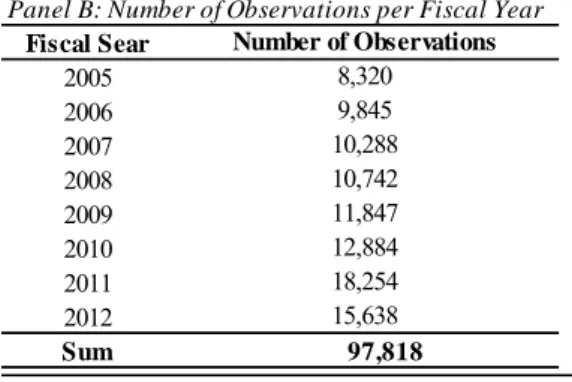
Table 2.1, Panel A, presents the distribution of the number of firms per fiscal year for the sample period 1997-2010. The increase in the number of firms over time demonstrates the gradual improvement in the coverage of the database. Panel B shows the allocation of firms and firm- year observations per country. Germany is less represented compared to the other four countries. This is primarily due to the insufficient coverage of
large German firms by Amadeus5.
5 In its manual, Amadeus acknowledges that the coverage of German firms is insufficient due to gaps in the Fiscal Year 1997 3,715 1998 4,268 1999 3,337 2000 4,935 2001 5,744 2002 6,793 2003 6,978 2004 7,685 2005 8,663 2006 9,174 2007 9,038 2008 13,436 2009 15,792 2010 16,094 Country Germany 988 2,061 UK 4,215 12,744 Italy 18,781 52,309 Spain 9,928 34,728 France 6,215 13,810 Sum 40,127 115,652
Panel B: Number of Firms\ Firm- Year Observations per Country
Number of Observations
Panel A presents the distribution of the final sample per fiscal year. Panel B presents the number of firms per country in the final sample, as well as the number of firm- year observations
Number of Firms TABLE 2.1 Panel A: Number of Observations per Fiscal Year
2.4.2 Descriptive Statistics
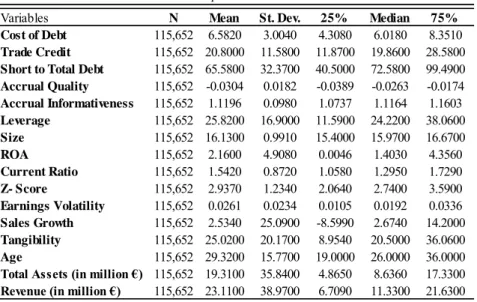
Table 2.2 presents the descriptive statistics of the final sample. The mean (median) firm has € 19.31 (€ 8.64) million in total assets and € 23.11 (€ 11.33) million in revenue. I report mean (median) values of debt and trade credit as a percentage of lagged total assets of 25.82% (24.22%) and 20.80% (19.86%) respectively. These figures indicate that bank debt and trade credit constitute significant sources of financing for private firms. Furthermore, the mean (median) cost of debt amount to 6.58% (6.02%). On average, profitability as a percentage of lagged total assets amounts to 2.16% and PPE as a percentage of lagged total assets amount to roughly 25.02%. This latter ratio measures the
Variables N Mean St. Dev. 25% Median 75%
Cost of Debt 115,652 6.5820 3.0040 4.3080 6.0180 8.3510 Trade Credit 115,652 20.8000 11.5800 11.8700 19.8600 28.5800 Short to Total Debt 115,652 65.5800 32.3700 40.5000 72.5800 99.4900 Accrual Quality 115,652 -0.0304 0.0182 -0.0389 -0.0263 -0.0174 Accrual Informativeness 115,652 1.1196 0.0980 1.0737 1.1164 1.1603 Leverage 115,652 25.8200 16.9000 11.5900 24.2200 38.0600 Size 115,652 16.1300 0.9910 15.4000 15.9700 16.6700 ROA 115,652 2.1600 4.9080 0.0046 1.4030 4.3560 Current Ratio 115,652 1.5420 0.8720 1.0580 1.2950 1.7290 Z- Score 115,652 2.9370 1.2340 2.0640 2.7400 3.5900 Earnings Volatility 115,652 0.0261 0.0234 0.0105 0.0192 0.0336 Sales Growth 115,652 2.5340 25.0900 -8.5990 2.6740 14.2000 Tangibility 115,652 25.0200 20.1700 8.9540 20.5000 36.0600 Age 115,652 29.3200 15.7700 19.0000 26.0000 36.0000
Total Assets (in million €) 115,652 19.3100 35.8400 4.8650 8.6360 17.3300
Revenue (in million €) 115,652 23.1100 38.9700 6.7090 11.3300 21.6300
TABLE 2.2 Descriptive Statistics
This table presents summary statistics for all firm- year observations of the final sample. The cost of debt is restricted so that it ranges within 10% of the risk- free rate. All other non- logarithmic variables have been winsorized at the 1% and 99% levels. Variables Cost of Debt, Trade Credit, Short to Total Debt, Leverage, ROA, Sales Growth, and Tangibility have been multiplied by 100. See Appendix for variable definitions.
degree to which assets can be pledged as security for a debt under the scenario that the borrower reneges on his financial obligations. Finally, the mean (median) firm age is 29 years (26 years).
2.4.3 Correlations
Table 2.3 presents the pairwise Pearson correlations for all variables. The table shows that accrual quality is positively correlated with accrual informativeness. The corresponding correlation coefficient amounts to 0.209 and is statistically significant at the 1% level. Furthermore, accrual quality is negatively associated with the cost of debt (-0.0425) and positively associated with the level of trade credit (0.0627). Both correlation coefficients are statistically significant at the 1% level. These correlations provide some initial evidence that private firm providers of debt financing as well as trade credit view accrual quality as a favorable earnings attribute. Table 2.3 additionally shows that accrual informativeness is positively associated with the level of trade credit (0.0471) but positively associated with the cost of debt as well (0.0503). Again, the corresponding correlation coefficients are significant at the 1% level. The positive correlation between the ability of accruals to predict future cash flow changes and the cost of debt appears to contradict initial expectations. However, this analysis does not take into account the effect of control variables and therefore the use of multivariate specifications is necessary before drawing further inferences.
Cost of Debt Trade Credit Short to Total Debt Accrual Quality Accrual Informati-veness
Leverage Size ROA Current
Ratio Z- Score Earnings Volatility Sales Growth Tangi-bility Age Cost of Debt 1 Trade Credit 0.1558 1
Short to Total Debt 0.1363 0.2087 1
Accrual Quality -0.0425 0.0627 -0.0117 1 Accrual Inform. 0.0503 0.0471 0.0045 0.209 1 Leverage -0.1583 -0.156 0.031 -0.0031 -0.0852 1 Size -0.1109 -0.2389 -0.1353 0.1373 -0.0349 0.1192 1 ROA -0.0121 -0.0655 -0.0793 0.0539 0.0554 -0.3453 -0.003 1 Current Ratio -0.0431 -0.3428 -0.2313 -0.019 -0.0324 -0.3683 0.0449 0.2352 1 Z- Score 0.0381 -0.055 0.0446 0.0041 0.0445 -0.4762 -0.1998 0.481 0.4493 1 Earnings Volatility 0.0448 -0.1248 -0.0361 -0.5918 -0.0694 -0.1448 -0.1042 0.0415 0.1088 0.1007 1 Sales Growth 0.0422 0.1314 0.0126 0.0368 0.025 -0.0619 0.0493 0.2722 -0.0718 0.1578 -0.026 1 Tangibility -0.0975 -0.3764 -0.3379 0.046 0.035 0.102 0.2034 -0.014 -0.1821 -0.1514 0.0157 0.0228 1 Age -0.0029 -0.1466 -0.0222 0.0717 0.0225 -0.0785 0.1892 -0.032 0.0906 0.0234 0.0043 -0.0125 0.092 1 TABLE 2.3
This table presents pairwise Pearson correlations for all firm- year observations of the final sample. See Appendix A for variable definitions. For both Accrual Quality and Accrual Informativeness larger values indicate better financial reporting quality. Bold indicates significance at the two-tailed 1% level.
2.5
Results
2.5.1 Cost of DebtTable 2.4 presents the results of the regressions of the cost of debt on each earnings attribute after controlling for a number of known determinants of the cost of debt. For each earnings attribute, two regressions are performed: one without fixed effects and one including industry, year, and country fixed effects.
Consistent with expectations, accrual quality is negatively associated with the cost of debt and statistically significant at the 1% level in both specifications (with and without fixed effects). The average coefficient estimate of the regression that does not include fixed effects ( -0.0262) suggests a difference of roughly 24 basis points (9 deciles x 0.0262) in the cost of debt between the worst and the best accrual quality deciles. The effect is stronger in the specification that includes fixed effects (average coefficient estimate: -0.0406) and corresponds to a difference of approximately 37 basis points between the worst and best accrual quality deciles. The coefficient of accrual informativeness on the other hand, is positive and statistically significant at the 1% level in the specification that does not include fixed effects. This finding seems to indicate that there is a positive relation between the ability of accruals to predict future cash flow changes and the cost of debt. However, the respective coefficient turns negative and statistically significant at the 1% level upon the inclusion of industry, year, and country fixed effects. Under this latter specification, the difference between the worst and best earnings informativeness deciles corresponds to a difference of roughly 9 basis points in the cost of debt.
Variables Attribute -0.0262*** -0.0406*** 0.0528*** -0.0102*** (0.000) (0.000) (0.000) (0.006) Size -0.1855*** -0.1994*** -0.1877*** -0.2141*** (0.000) (0.000) (0.000) (0.000) ROA -0.0260*** -0.0365*** -0.0277*** -0.0371*** (0.000) (0.000) (0.000) (0.000) Leverage -0.0364*** -0.0339*** -0.0351*** -0.0335*** (0.000) (0.000) (0.000) (0.000) Current Ratio -0.2873*** -0.1784*** -0.2734*** -0.1808*** (0.000) (0.000) (0.000) (0.000) Z- Score -0.0673*** -0.1255*** -0.0712*** -0.1234*** (0.000) (0.000) (0.000) (0.000) Earnings Volatility 1.8619*** -1.9179*** 3.9543*** 0.3428 (0.001) (0.000) (0.000) (0.472)
Short to Total Debt 0.0089*** 0.0017*** 0.8887*** 0.1712***
(0.000) (0.000) (0.000) (0.000) Tangibility -0.0077*** -0.0078*** -0.0082*** -0.0081*** (0.000) (0.000) (0.000) (0.000) Age 0.0016* -0.0010 0.0010 -0.0014 (0.069) (0.243) (0.240) (0.107) Constant 10.8672*** 14.7558*** 10.4036*** 14.8015*** (0.000) (0.000) (0.000) (0.000)
Year FE No Yes No Yes
Industry FE No Yes No Yes
Country FE No Yes No Yes
Observations 115,652 115,652 115,652 115,652
R-squared 0.0620 0.2258 0.0641 0.2248
TABLE 2.4
Regressions of Cost of Debt on Earnings Attributes
This table presents the regressions of the cost of debt on each earnings attribute for the final sample with and without industry, year, and country fixed effects. The regressions are performed using robust standard errors, clustered at the firm level. Earnings attributes are ranked in deciles. Higher decile ranks correspond to better financial reporting quality. The cost of debt is limited to 10% over the risk- free rate. All remaining non- logarithmic variables have been winsorized at the 1% and 99% levels. See Appendix for variable definitions. *, **, and *** indicate significance at the two-tailed 10%, 5%, and 1% levels, respectively.
Dependent Variable: Cost of Debt
In untabulated tests, I repeat the last two regressions of Table 2.4 using as my measure of accrual informativeness the 5- year standard deviation of the residuals of regression (2). I further multiply this measure by -1, so that greater values correspond to higher levels of accrual informativeness. In both specifications (with and without fixed effects), my alternative proxy of earnings informativeness is negatively associated with the cost of debt. In addition, the difference between the worst and best earnings informativeness deciles amounts to roughly 19 basis points. Overall, the findings of the above analysis indicate that debt providers consider accrual quality and accrual informativeness as favorable earnings attributes and take them into account when pricing debt.
In all specifications, the coefficient estimate on leverage is negative as opposed to the predicted positive sign. Minnis (2011) uses private firm data and also reports negative coefficients on leverage in his cost of debt regressions. In order to investigate whether this is due to possible misclassification of debt components as liabilities or due to the mechanical relation between the cost of debt and leverage (the denominator of the former variable is used as the numerator for the latter variable), I introduce two alternative cost of debt and leverage measures. That is, I measure cost of debt as interest expense divided by average total liabilities and leverage as the ratio of total liabilities to average interest- bearing debt. I subsequently replace either one or both of the original variables with their alternative specifications and perform the regressions of table 2.4. In all regressions leverage has a positive sign, consistent with expectations6.
2.5.2 Short to Total Debt
Table 2.5 presents the results of regression (4) which investigates Hypothesis 1b for both accrual quality and accrual informativeness. I argue that, to the extent that financial reporting quality has economic consequences for private firms, it should also affect their propensity to use long- term debt in place of short- term debt, since the latter is relatively more expensive. Table 2.5 shows that results are consistent with this hypothesis. In particular, accrual quality is negatively associated with the level of short to total debt in the specification that does not include industry, year, and country fixed effects. The estimated coefficient is equal to -0.1344 and is statistically significant at the 1% level. This value indicates a difference of roughly 1.21 percentage points in the level of short to total debt between the worst and best accrual quality deciles. Furthermore, in the specification that includes industry, year, and country fixed effects, the negative relation between accrual quality and short to total debt persists and remains highly statistically significant (at the 1% level). The estimated coefficient is equal to -0.2106 and corresponds to a difference of roughly 1.9 percentage points between the worst and best accrual quality deciles.
The last two columns of Table 2.5 present the results of the regressions of short to total debt on accrual informativeness and controls. This analysis shows that, in the specification that does not include industry, year, and country fixed effects, the estimated coefficient on accrual informativeness is positive and insignificant. However, upon inclusion of industry, year, and country fixed effects, the related coefficient becomes negative and highly statistically significant (at the 1% level). In particular, the estimated coefficient is equal to -0.2616 and corresponds to a difference of 2.38 percentage points between the worst and best accrual informativeness deciles. In untabulated tests, I repeat
Variables Attribute -0.1344*** -0.2106*** 0.0443 -0.2616*** (0.006) (0.000) (0.277) (0.000) Size -0.3486** -0.5732*** -0.3822** -0.6747*** (0.035) (0.000) (0.020) (0.000) ROA -0.5905*** -0.5688*** -0.5938*** -0.5692*** (0.000) (0.000) (0.000) (0.000) Leverage -0.0053 -0.0054 -0.0030 -0.0067 (0.567) (0.556) (0.749) (0.471) Current Ratio -13.6953*** -12.8429*** -13.6791*** -12.8884*** (0.000) (0.000) (0.000) (0.000) Z- Score 5.0651*** 6.1826*** 5.0555*** 6.2016*** (0.000) (0.000) (0.000) (0.000) Earnings Volatility -18.3262*** -15.7870*** -9.8441* -6.4956 (0.002) (0.006) (0.068) (0.215) Tangibility -0.6063*** -0.5151*** -0.6075*** -0.5154*** (0.000) (0.000) (0.000) (0.000) Age 0.0849*** 0.0655*** 0.0832*** 0.0644*** (0.000) (0.000) (0.000) (0.000) Constant 92.7554*** 92.1594*** 92.1220*** 94.3711*** (0.000) (0.000) (0.000) (0.000)
Year FE No Yes No Yes
Industry FE No Yes No Yes
Country FE No Yes No Yes
Observations 115,652 115,652 115,652 115,652
R-squared 0.2298 0.2893 0.2297 0.2896
This table presents the regressions of the short to total debt ratio on each earnings attribute for the final sample with and without industry, year, and country fixed effects. The regressions are performed using robust standard errors, clustered at the firm level. Earnings attributes are ranked in deciles. Higher decile ranks correspond to better financial reporting quality. The cost of debt is limited to 10% over the risk- free rate. All remaining non- logarithmic variables have been winsorized at the 1% and 99% levels. See Appendix for variable definitions. *, **, and *** indicate significance at the two-tailed 10%, 5%, and 1% levels, respectively.
TABLE 2.5
Regressions of Short to Total Debt on Earnings Attributes Dependent Variable: Short to Total Debt
the last two regressions of Table 2.5 using the alternative accrual informativeness measure of section 2.5.1, which is based on the negative 5-year standard deviation of the residuals of regression (2). In both specifications (with and without fixed effects), the estimated coefficients are negative and statistically significant at the 1% level indicating a difference between the worst and best accrual informativeness deciles of up to 3.06 percentage points. Overall, these findings suggest that higher values of both accrual quality and accrual informativeness are associated with better access to long- term debt and lower use of short- term debt.
2.5.3 Trade Credit
Table 2.6 presents the results of the regressions of trade credit on each earnings attribute after controlling for known determinants of trade credit. For each earnings attribute I provide again two alternative specifications: one without fixed effects and one including industry, year, and country fixed effects.
The regressions of trade credit on accrual quality show that accrual quality is positively and significantly (at the 1% level) associated with trade credit in both specifications (with and without fixed effects). Its sign is therefore consistent with expectations. The average coefficient estimate on accrual quality amounts to 0.1622 for the regression that does not include fixed effects. This corresponds to a difference of 1.46 percentage points between the worst and best accrual quality deciles. The difference between the worst and best accrual quality deciles for the regression that includes fixed effects is 0.84 percentage points (0.067*9). Furthermore, accrual informativeness is positively associated with trade credit and highly statistically significant (at the 1% level) when no fixed effects are
included. The difference between the worst and best accrual informativeness deciles is 1.26 percentage points. The positive relation between accrual informativeness and trade
Variables Attribute 0.1622*** 0.0670*** 0.1399*** 0.1137*** (0.000) (0.000) (0.000) (0.000) Size -1.8750*** -1.7598*** -1.8127*** -1.7215*** (0.000) (0.000) (0.000) (0.000) ROA -0.4293*** -0.3643*** -0.4285*** -0.3649*** (0.000) (0.000) (0.000) (0.000) Leverage -0.1255*** -0.1490*** -0.1252*** -0.1483*** (0.000) (0.000) (0.000) (0.000) Sales Growth 0.0825*** 0.0713*** 0.0822*** 0.0714*** (0.000) (0.000) (0.000) (0.000) Earnings Volatility -64.7176*** -48.2722*** -72.9694*** -50.8326*** (0.000) (0.000) (0.000) (0.000) Tangibility -0.1850*** -0.1398*** -0.1851*** -0.1401*** (0.000) (0.000) (0.000) (0.000) Age -0.0789*** -0.0724*** -0.0778*** -0.0721*** (0.000) (0.000) (0.000) (0.000) Constant 62.7373*** 58.0108*** 62.0339*** 56.9930*** (0.000) (0.000) (0.000) (0.000)
Year FE No Yes No Yes
Industry FE No Yes No Yes
Country FE No Yes No Yes
Observations 115,652 115,652 115,652 115,652
R-squared 0.2577 0.3406 0.2577 0.3412
This table presents the regressions of trade credit on each earnings attribute for the final sample with and without industry, year, and country fixed effects. The regressions are performed using robust standard errors, clustered at the firm level. Earnings attributes are ranked in deciles. Higher decile ranks correspond to better financial reporting quality. All remaining non- logarithmic variables have been winsorized at the 1% and 99% levels. See Appendix for variable definitions. *, **, and *** indicate significance at the two-tailed 10%, 5%, and 1% levels, respectively.
TABLE 2.6
Regressions of Trade Credit on Earnings Attributes Dependent Variable: Trade Credit
credit persists and remains highly statistically significant at the 1% level when industry, year, and country fixed effects are included in the regression. In particular, the estimated coefficient amounts to 0.1137 which indicates a difference of 1.02 percentage points in the level of trade credit between the worst and best accrual informativeness deciles.
2.6
Conclusion
In this paper, I investigate the link between the financial reporting quality of private firms and their financing decisions through two main venues: bank debt and trade credit. Private firms have been traditionally characterized by lower quality financial reporting compared to public firms. The argument is that, private firms have weaker incentives to communicate their true economic performance through the use of publicly available financial statements. To facilitate the exchange of relevant information with their stakeholders, private firms develop private communication channels, which in practice serve as alternative information asymmetry- mitigating mechanisms. In view of this argument, I ask the following questions: Does financial reporting quality matter for private firms? What are the benefits of preparing high quality financial reporting in the presence of private communication channels?
To test this hypothesis, I consider two measures of financial reporting quality. These measures are accrual quality and accrual informativeness, which capture the precision with which accruals map on past, current, and future cash flow from operations, as well as the ability of accruals to predict future cash flow changes. I further examine the association of these earnings attributes with private firms’ access to bank debt and trade
credit capital. My sample includes private firms from the five largest economies of the European Union (U.K., Germany, France, Italy, and Spain) and spans from 1997 to 2010.
The results show that both accrual quality and accrual informativeness are negatively associated with the cost of debt. Furthermore, higher levels of accrual quality and accrual informativeness are associated with lower levels of short to total debt. These findings suggest that debt providers consider accrual quality and accrual informativeness as favorable earnings attributes in the private firm market and incorporate them in the financing decisions. They additionally demonstrate that the accounting choices of private firms affect their debt structure decisions by allowing them to make more use of long- term debt relative to short- term debt.
I further show that the accounting decisions of private firms also affect their access to trade credit financing. In particular, I provide evidence that higher levels of accrual quality and accrual informativeness are associated with higher levels of trade credit. Therefore, the financial reporting quality of private firms affects the financing decisions of not merely debt providers but trade credit providers as well.
Based on these findings, I conclude that high quality financial reporting does have economic consequences even in the private firm setting where private communication channels serve as alternative information asymmetry- mitigating mechanisms. By highlighting the importance of financial reporting quality in the private firm market, the results of the current study are therefore directly relevant to the standard setters involved in the formulation of IFRS for SMEs. High quality financial reporting facilitates private firms’ access to their foremost means of financing, namely bank debt and trade credit capital. Consequently, accounting standards specifically designed for small and medium-
sized enterprises need to actively promote financial reporting transparency despite the findings of prior literature that effectively downplay its importance in the private firm market.
Appendix A
Panel A: Dependent Variables
Cost of Debt The ratio of interest expense to the average interest- bearing debt (short and long- term debt) in the current and previous year. Following Minnis (2011), I initially truncate this variable at the 5th and 95th levels. I subsequently require that the cost of debt ranges within 10% of the corresponding 10- year government bond. Trade Credit The ratio of trade payables to lagged total assets.
I winsorize this variable at the 1% and 99% levels.
Short to Total Debt The ratio of short- term debt to total debt. I winsorize this variable at the 1% and 99% levels.
Panel B: Test Variables
Accrual Quality The 5- year standard deviation of the of the modified by McNichols (2002), Dechow and Dichev (2002) accrual quality measure, multiplied by -1.
Accrual Informativeness The beta coefficient of the regression of the change in cash flow from operations on lagged total accruals.
Attribute The decile rank of the corresponding earnings
attribute (accrual quality or accrual
informativeness). For both earnings attributes, higher decile ranks correspond to more favorable earnings attribute values.
Panel C: Control Variables
Size The natural logarithm of total assets.
ROA The ratio of net income before extraordinary
items to lagged total assets. I winsorize this variable at the 1% and 99% levels.
Leverage The ratio of interest- bearing debt (short and long- term debt) to lagged total assets. I winsorize this variable at the 1% and 99% levels.
Current Ratio The ratio of current assets to current liabilities. I winsorize this variable at the 1% and 99% levels.
Growth The change in sales relative to the previous fiscal year divided by lagged total assets. I winsorize this variable at the 1% and 99% levels.
Z- Score Altman’s Z- Score calculated as 1.2* (Net Working Capital/Total Assets) + 1.4* (Retained Earnings/Total Assets) + 3.3* (EBIT/Total Assets) + 0.6* (Book Value of Equity/Book