M E T H O D O L O G Y
Open Access
Measuring workload for tuberculosis service
provision at primary care level: a methodology
Lucie Blok
1*, Susan van den Hof
2,3, Sayoki G Mfinanga
4, Amos Kahwa
4, Esther Ngadaya
4, Liesbeth Oey
5and
Marjolein Dieleman
1Abstract
We developed and piloted a methodology to establish TB related work load at primary care level for clinical and laboratory staff. Workload is influenced by activities to be implemented, time to perform them, their frequency and patient load. Of particular importance is the patient pathway for diagnosis and treatment and the frequency of clinic visits. Using observation with checklists, clocking, interviews and review of registers, allows assessing the contribution of different factors on the workload.
Background
In view of reaching the Millennium Development Goals’ (MDG) targets for health, the demand for well trained and productive health staff in global health programmes is high [1]. The global Stop TB Strategic Plan 2006-2015, established to facilitate the achievement of TB-related MDGs, describes the need for expanded services in order to halt and reverse TB incidence [2]. The application of new technologies and improvements in service delivery according to quality standards, create additional demands on health staff. Therefore, the global strategic plan for TB stresses the importance of careful planning for human resources for health, citing the insufficient quantity and quality and the mal-distribution of staff as the main barriers limiting effective TB control [3].
Given the current crisis in human resources for health in many resource-poor countries, combined with often major staff shortages in rural and remote areas, rational planning for HRH is crucial and requires better justifica-tion of staffing requests for specific intervenjustifica-tions. The use of generic staffing norms for planning of human resources for health (HRH) in TB control is unsatisfac-tory. Field experience shows that there is significant variability in workload and productivity of staff within and between countries [4,5]. Major factors contributing to this are patient load, organisation of services and Human Resource Management activities, all will be
different in different settings. This implies that context specific staffing norms need to be developed to maximize effectiveness of services, and thereby assuring to reach the TB program targets. Such norms can only be formu-lated on the basis of local evidence. In light of this, a comprehensive insight into the organization of services, the patient flow in TB control, and the workload of staff within countries or districts is required to estimate HRH requirements.
In this article we describe a methodology that we devel-oped to establish TB related work load in a given context and for a given patient load for use by TB program man-agers and health planners. We piloted this methodology in Tanzania in three districts; one rural, one urban and one semi-urban district. Tanzania is an appropriate location to pilot the study as the country currently faces a health workforce shortage of 65% in the public sector and 86% in the private sector, with unequal distribution between urban and rural areas [6].
Workload is defined in this article as“the total time required to provide all TB services for a certain patient load in a defined period of time”(adapted from Needham [7]).
The scope of our study in Tanzania is limited to eval-uating workload regarding patient and community ser-vice delivery tasks at primary care level. It is especially at this level that shortages of qualified staff occur and where most TB patients are diagnosed and (should) receive care. In this article we present and discuss the methodology to measure actual workload for TB-related tasks at primary care level.
* Correspondence: [email protected] 1
Development Policy and Practice, Royal Tropical Institute (KIT), P.O. Box 95001, Amsterdam 1090 HA, The Netherlands
Full list of author information is available at the end of the article
Methodology
Review of available methods
The first step was a comprehensive review of published and grey literature on work load study methodologies and other methods to determine staffing requirements. Analysis of a total of 25 studies, models or tools that ful-filled the review criteria, shows that over the past years, a number of methodologies have been developed to mea-sure or estimate HR requirements for various health ser-vices [8]. Generally, two types of focus were found amongst the methods described. On the one hand, there are studies that aimed to assess the current workload sta-tus of staff within a specific context [9-14]. In many cases this was related to a broader purpose of the study such as assessing the effect of organizational changes [15,16] to explore workload related to other staff dynamics [17-19], to quantify the state of health service delivery nationwide [20] or to improve quality or efficiency of the services [21,22].
The second type of methodologies included 11 studies and models that principally aimed at quantifying staff requirements to provide certain services. Five of these [23-27] used the Workload Indicators for Staffing Needs (WISN) methodology developed by the WHO [28]. In this method, HR estimations are calculated by appraising the tasks that are needed to provide the services followed by estimation of the time required per task. Other studies, the Zambian workforce study [29] and the Quantity Task Productivity model [5] emphasized more on productivity. Four HR estimation methods were based on projections [30-33]. Among the reviewed documents we found a vari-ety in scope of the studies and specificity of the workload calculations. Different approaches and methodologies are used for data collection such as various forms of direct observation, self-reported data, or review of secondary data. The review showed that none of the available meth-odologies would be adequate to calculate workload for TB, although certain elements of these methodologies can be used.
Protocol development and piloting
A protocol to assess workload of TB services at primary care level was developed and tested as a collaborative effort between KIT, KNCV Tuberculosis Foundation, the National Institute for Medical Research, Muhimbili Medical Research Centre (NIMR-Muhimbili), and the National TB and Leprosy control Program (NTLP) of Tanzania. After training of the researchers, initial field testing and adaptation of the draft generic protocol to the specific Tanzanian context the methodology was piloted in three districts of Tanzania. The results of the pilot were used to finalise the methodology presented below.
Scope, concepts and variables
The workload components evaluated in our study include all tasks in TB diagnosis and care, all registra-tion, supervision and training-related time spent by service delivery staff and all tasks related to advocacy, communication and social mobilization which are implemented by primary care service providers. With regard to staffing cadres, all staff at primary care service delivery level performing TB related tasks, including lab staff, is covered. Supervisory and district management tasks are excluded.
Workload by primary care level cadres regarding implementing TB services and activities at primary care level is considered to be composed of a number of components:
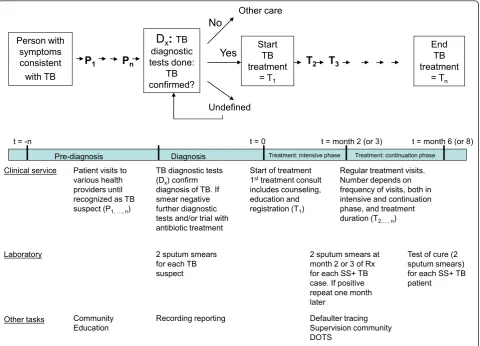
Thefirstelement is the time required to implement all the different tasks needed to provide a TB service according to standard quality, which is defined in this study as “performing tasks according to algorithms, guidelines or protocols” and is visualised in Figure 1. The time required is influenced by the diagnostic and treatment protocols chosen, the organization of services and patient flow, the frequency and numbers of follow up visits and the experience and expertise of the staff.
Thesecondelement is the TB case load. The number of cases diagnosed and treated depends on disease bur-den and is further influenced by patient’s health seeking behaviour, access to services and by the responsiveness and ability of health providers to identify TB suspects. The third element of TB workload is the efficiency of the system within which the staff operates. This is influ-enced by the distribution of cases and services and ade-quate management of resources.
Furthermore, the required number of staff is also influenced by staff productivity, which is highly context-specific and is influenced by training and staff motiva-tion and depends on the organizamotiva-tion of services as well as adequate availability and use of resources [34,35]. The study protocol developed by our team uses mixed methods and covers all of these elements. In this article however we focus on the description of the methodol-ogy to measure actual workload.
Pilot study
We developed a methodology to assess the actual work-load related to TB tasks at patient service delivery level within a specific context. We piloted this methodology with data collection focussing on:
ii. Assessment of actual workload, that was operatio-nalized as the average actual measured time for each service delivery task, the observed average frequency of these different service delivery tasks for each patient and the estimated average time for TB program support tasks, in combination with patient load.
iii. Reviewing how the time used to perform TB related tasks correlates with the quality and complete-ness of task performance against standard protocol.
We used the information to calculate how much time is needed to provide services for one TB patient from the moment (s) he is seeking care up to the moment a patient is declared cured. We calculated this for clinical and lab services separately and combined. In Tanzania, TB services are integrated with other general services in certain facilities, but in places where the patient load is high, TB specific staff may be appointed. This means that the percentage of time dedicated to TB services per cadre will vary per facility. For this reason we have calculated the time required per patient, allowing managers to asses in their own facility what this implies for staffing require-ments. No distinction in workload calculations is made
between doctors, nurses, clinical officers, etc., as in facil-ities different types of primary care providers may be responsible for TB tasks.
Results
Here we first describe the data collection methods used to measure workload for all steps in the patient pathway. This is followed by the actual calculation of workload in three districts in Tanzania. We will only mention differences between districts when they are statistically significant.
Data collection methods
The methodology developed uses mixed methods and includes observations and clocking of specific tasks, com-pilation of standardised data from TB registers and reports, structured interviews with patients and health staff and semi-structured interviews. Given the different steps in the patient pathway (see Figure 1) workload data are compiled for the pre-diagnosis period, for the inten-sive treatment phase and for the continuation treatment phase and calculated separately for the clinical service providers and the laboratory staff.
Clinical service Patient visits to various health providers until recognized as TB suspect (P1, …, n)
TB diagnostic tests (Dx) confirm
diagnosis of TB. If smear negative further diagnostic tests and/or trial with antibiotic treatment
Start of treatment 1st treatment consult
includes counseling, education and registration (T1)
Regular treatment visits. Number depends on frequency of visits, both in intensive and continuation phase, and treatment duration (T2,…, n)
Other tasks Recording reporting Defaulter tracing Supervision community DOTS
t = 0
t = -n t = month 2 (or 3) t = month 6 (or 8)
Pre-diagnosis Diagnosis Treatment: intensive phase Treatment: continuation phase
P1 Pn
Person with symptoms consistent with TB
D
x:
TB diagnostic tests done:TB confirmed?
No
Yes
Undefined Start
TB treatment
= T1
T2
End TB treatment
= Tn
Other care
T3
Laboratory 2 sputum smears at
month 2 or 3 of Rx for each SS+ TB case. If positive repeat one month later
Test of cure (2 sputum smears) for each SS+ TB patient
2 sputum smears for each TB suspect
Community Education
Clinical services
Patient provider encounters were observed and the dura-tion of different types of consultadura-tions was clocked using a stop watch. Check lists were used during the observations of diagnostic and treatment consultations to establish completeness with regards to the various tasks according to the standard TB protocols. The checklists were devel-oped on the basis of a task analysis in management of TB and on existing standard operating procedures for TB con-trol [36] and adapted to the organisation of services in Tanzania.
TB patients’diagnostic pathways, including the average number of patient-provider contacts, beginning as a TB suspect continuing until completion of treatment, were assessed through structured interviews with TB patients at facility level and semi-structured and structured interviews with the TB supervisor. TB statistics, such as treatment outcomes, and clinical records were used to assess the caseload and program performance at district level. Laboratory
The research team measured the time required for sputum smears by clocking the time it took to examine sputum smears (including time to instruct patients, receive spu-tum, prepare and read smears and register and report results) and through interviews with laboratory techni-cians. Instruments used for observations of slide reading were a checklist for lab staff and a stopwatch.
Other tasks
Lastly, we established the time spent on indirect TB-related activities. Indirect TB tasks include administrative tasks such as recording and reporting, TB drugs stock management and ordering or quality assurance. It further consists of time related to receiving supervision, attending TB related trainings and meetings as well as time spent on community outreach and defaulter tracing. The total amount of time spent on these activities during a year was estimated for each TB facility based on structured inter-views with the person in charge of the TB activities and was inventoried separately for laboratory personnel and other health staff providing TB services.
Measuring workload of TB-related tasks Clinical service workload for diagnosis of TB
The average number of patient provider contacts required before a diagnosis is reached was established through interviews with patients currently on treatment. The number of visits required depends on the capacity of a general health provider to recognize TB related symp-toms and on the way the services are organised. Patients reported that they had undergone an average of 2.0 diag-nostic consultations of any formal health provider before their diagnosis was confirmed. The average number of pre-diagnostic visits was higher in the rural district (3.0 visits) than in the two (semi-) urban districts (1.8 visits).
The reason for this difference is not clear but relative inexperience of rural health workers and the distance to diagnostic facilities may have contributed to delayed referral for sputum check. We also found a slight differ-ence in number of consultations before diagnosis by type of TB varying from 1.8 for smear negative pulmonary TB to 2.4 for extra pulmonary TB, however these differences were considered too small to have a major impact on the workload calculations.
The time spent on each patient during a diagnostic or treatment consultation was measured by clocking the total duration of the consultation and noting the number of seconds. A distinction was made between patients with symptoms consistent with TB in various stages of diagnosis and patients with other types of symptoms.
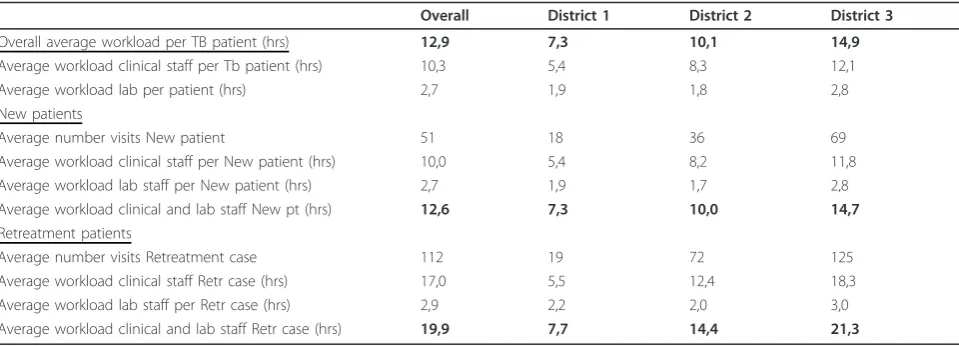
There was a significant difference in average duration between a patient coming with TB like symptoms with a mean of 7 minutes 9 seconds (median 5 minutes 24 sec-onds, n = 38) and patients with other symptoms (mean 4 minutes 6 seconds; median 3 minutes 18 seconds; n = 776). Despite a possible Hawthorn effect or observation bias, none of the consultations was complete with regards to history taking and physical examination. To observe quality and completeness of each consultation the researchers recorded on a check list which elements of the standard consultation protocol were covered, such as specific questions to be asked during history taking and elements to be covered in physical examination. In all consultations elements were missing, therefore we con-clude that the measured average time of 7 minutes 9 sec-onds is an underestimation of the required time for a complete and good quality consultation. For example a separate analysis of consultations in which at least 3 out of 6 questions were asked and some form of physical exam performed and the suspected diagnosis of TB was explained, resulted in an average duration of 13 minutes 16 seconds (median 13 minutes 12 seconds, n = 4). If at least one of these elements were included the average time was 10 minutes 12 seconds (median 10 minutes 2 seconds, n = 25). The workload was calculated twice; once using the measured average time of 7 minutes and 9 seconds (Table 1) and once using a minimal required time of 13 minutes 16 seconds (Table 2)
Clinical service workload for TB treatment
come for daily observed treatment (usually 5 or 6 times a week) during the full 6 months of their treatment, others are observed daily only during the first 2 months of their treatment or are seen on a weekly, bi-weekly or monthly basis during their entire treatment.
The study used two sources to establish the average number of treatment follow up visits for each patient. First, patients currently under treatment were inter-viewed and asked the frequency with which they had to come for treatment. Second, the TB providers were inter-viewed and asked the frequency for each of their patients. The first method has the disadvantage of a selection bias. Patients that visit the clinic with higher frequency are overrepresented. The second method may lead to a re-call bias if the provider cannot refer to a register showing the frequency for each individual patient and/or a repor-ter bias if the standard protocol prescribes daily observed treatment by the provider, which is not in all situations feasible. We found that providers were rather well informed and seemed to be open in sharing reality and
challenges faced, however they reported on average a 30% higher number of visits than the patients themselves. This means that both methods likely lead to overestima-tion. For that reason we use the lower number as reported by the patients for our calculations of the overall workload.
Our study showed no important differences in number of treatment visits for different forms of TB (smear posi-tive, negative or extra-pulmonary TB). However important differences in frequency of visits were found among the three districts covered in the pilot study; an average of 18, 36 or 69 visits for new cases and 19, 72 and 125 visits for retreatment cases. Differences are influenced amongst others by distance to the clinics and by acceptance and use of community volunteers and family members as treatment observers.
Overall we found that 39% of new TB patients in the intensive phase of treatment reported to visit the clinic 5 days a week while 51% and 10% visited the clinic once a week and bi-weekly respectively (see Table 3). The
Table 1 Measured Workload for Primary TB Care for Each Patient in Pilot Study Area
Overall District 1 District 2 District 3
Overall average workload per TB patient (hrs) 8,0 5,3 6,4 8,8
Average workload clinical staff per Tb patient (hrs) 5,4 3,4 4,7 6,0
Average workload lab per patient (hrs) 2,7 1,9 1,8 2,8
New patients
Average number visits New patient 51 18 36 69
Average workload clinical staff per New patient (hrs) 5,3 3,4 4,6 5,9
Average workload lab staff per New patient (hrs) 2,7 1,9 1,7 2,8
Average workload clinical and lab staff New pt (hrs) 7,9 5,3 6,4 8,7 Retreatment patients
Average number visits Retreatment case 112 19 72 125
Average workload clinical staff Retr case (hrs) 7,9 3,5 6,2 8,3
Average workload lab staff per Retr case (hrs) 2,9 2,2 2,0 3,0
Average workload clinical and lab staff Retr case (hrs) 10,8 5,6 8,2 11,4
Table 2 Estimated Minimally Required Workload for Each Patient in Primary TB Care
Overall District 1 District 2 District 3
Overall average workload per TB patient (hrs) 12,9 7,3 10,1 14,9
Average workload clinical staff per Tb patient (hrs) 10,3 5,4 8,3 12,1
Average workload lab per patient (hrs) 2,7 1,9 1,8 2,8
New patients
Average number visits New patient 51 18 36 69
Average workload clinical staff per New patient (hrs) 10,0 5,4 8,2 11,8
Average workload lab staff per New patient (hrs) 2,7 1,9 1,7 2,8
Average workload clinical and lab staff New pt (hrs) 12,6 7,3 10,0 14,7 Retreatment patients
Average number visits Retreatment case 112 19 72 125
Average workload clinical staff Retr case (hrs) 17,0 5,5 12,4 18,3
Average workload lab staff per Retr case (hrs) 2,9 2,2 2,0 3,0
frequency of visits diminished during the continuation phase of treatment with 28% still visiting daily while 31% visited weekly, 39% once every two weeks and 3% monthly. This leads to an overall average of 51 visits including adjustment for 3% patients that failed to sputum convert at month 2 and need an additional month of treatment. Retreatment cases (patients that had undergone earlier TB treatment) have not only a longer duration of treatment but also a higher average frequency of clinic visits and pay an average of 112 clinic visits.
The actual duration of first time treatment consultation and follow up treatment consultations was measured by observation with a stopwatch and a check list. A TB treat-ment start up consultation lasted 12 minutes 41 sec (med-ian 12 minutes 33 seconds, n = 19). Similar as in the diagnostic consultations we found that most first time consultations did not include all actions that should be done during a first time consultation such as full counsel-ling, preparing a patient card, entering the patient in the register, prepare and provide drugs. In 7 of the in total 19 first time consultations that were observed the patient was counselled for at least 3 of 5 elements that are consid-ered essential in TB treatment counselling, such as the diagnosis of TB, treatment process/duration, importance of adherence, explanation of the risk of HIV infection, offering of an HIV test. The consultation lasted on average 14 minutes 36 seconds. If also the use and role of a treat-ment supporter was discussed and a treattreat-ment card pre-pared, the consultation took on average 16 minutes 10 seconds (n = 3). This is considered the minimal dura-tion of a first treatment consultadura-tion, but this time is still an underestimate as none of these patients were coun-selled for all 5 elements and the time for dispensing the drugs was not included in this measurement.
Follow up visits lasted on average 2 minutes and 34 seconds (median 2 minutes 50 sec, n = 199). The mini-mum required time if at least 4 most important tasks were done was 6 minutes 53 sec (n = 28).
Laboratory service provision
The workload for the laboratory depends on the num-ber of sputum smears to be performed to diagnose all TB cases and to monitor the treatment of smear posi-tive TB cases. In our study area cultures are not done on a routine basis. The total time requirement for per-formance of sputum smears includes time for instruct-ing a patient to produce good quality sputum, time to receive and label the sample, time to prepare and stain the smear and the time to read the slide and to record the result. Some of these were observed and clocked for individual patients (instruction and receiving spu-tum) while other activities are done in bulk for a num-ber of smears (preparing, staining and reading slides). The latter activities are clocked for the total time and divided by the number of sputum samples. The time required to process one sputum sample is 12 minutes and 54 seconds on average (mean: 13 minutes and 9 seconds).
The calculation of the overall number of diagnostic spu-tum smears that is done for each identified patient is based on the total number of smears needed for diagnosis of all suspects. Suspect registers in the pilot study area were not well kept and there is no accurate record of the total number of smears done on suspects. We assume however that for each SS + case detected, 10 suspects were checked [37]. The current guidelines prescribe 2 spu-tum samples to be collected and checked for each suspect. This means that the estimated load of diagnostic smears is 20 times the SS + case notification.
For monitoring treatment effectiveness each SS + patient requires on average 2 follow up smears; one at month 2 (or month 3 for retreatment cases) and one at the end of treatment. In case of a positive smear at month 2 (or 3) this needs to be repeated one month later. With a smear conversion rate of 97% for Tanza-nia the total number of follow up smears is 2.03 per patient.
Table 3 Number of Follow up Clinic Visits during Intensive and Continuation Treatment Phases for New and Retreatment TB cases
New Patient intensive phase
New patient continuation phase
Retr Patient intensive phase
Retr Patient continuation phase
n % n % n % n %
All three district
5x/week 32 39% 22 28% 14 78% 11 55%
Weekly 41 51% 25 31% 3 17% 5 25%
Bi-weekly 8 10% 31 39% 1 6% 4 20%
Monthly 0 0% 2 3% 0 0% 0 0%
Overall 81 100% 80 100% 18 100% 20 100%
Average # visits (treatment phase) 21 30 50 62
Indirect time
The time spent on indirect TB related tasks includes administrative tasks, attending TB related trainings and meetings and receiving supervision. In addition we assessed for clinical staff the time spent on community outreach activities such as TB awareness raising, supervi-sion of community volunteers and defaulter tracing.
For lab staff the indirect time includes also time spend on internal and external quality assurance. The total time spent annually on indirect tasks by clinical staff was divided by the total TB patient load in that clinic over the same year. The time spent on administration, training and supervision was 1.1 hour per patient. The time spent on community outreach was on average 0.6 hours per patient but showed major variations between districts. For labora-tory personnel the indirect time spent in each facility was divided by the total number of sputum smears done in this clinic in a year to calculate an average time per smear resulting in 2 minutes to be added to the time per slide.
Calculation of actual workload in TB
Actual TB-related workload at primary care level (TTb)
consists of:
1) Time needed for all TB related tasks performed by clinical staff dealing with TB patients (Tclin)
2) Time needed for all TB-related tasks by laboratory personnel (Tlab)
TTB =Tclin+Tlab
Additional file 1 gives a detailed description of the for-mula to calculate the overall workload on TB at primary care level within a given context on a year basis and explains the variables within the formula.
The times clocked showed a highly right skewed distri-bution. Therefore we calculated both mean and median times. For the calculation of workload we used the mean time as this results in a more accurate reflection of the total time needed including all patients. Subsequently this was used to calculate the average workload per patient.
Within the pilot study the current time spent to diag-nose and treat one TB patient was calculated to be 8.0 hrs. Between the three districts included this varied from 5.3 to 8.8 hrs per patient (see Table 1). Variation depended mainly on the number of follow up treatment visits per patient which was highest in district 3. We found a differ-ence in workload between new and retreatment patients of 7.9 against 10.8 hrs which can be explained by the greater number of follow up treatment consultations required.
Assessment of quality and program performance
The measured average time per patient does not take into account the quality of the services provided. Using the time measured to perform consultations according
to standard protocol one can calculate a ‘minimum’ time requirement per TB patient. In our pilot study the calculated‘minimum’time per patient was 12.6 hrs or 19.9 hrs for a newly diagnosed Tb patient and for a retreatment case respectively (see Table 2).
The influence of patient load and available staff time on the actual time spent per patient can be analysed by comparing average measured time in clinics with high and low patient load per staff available. Furthermore one could correlate time spent with programme perfor-mance by comparing treatment outcomes between dis-tricts with high and with low time spent per patient. In our pilot study we found signs of inefficient use of staff time in clinics with small number of patients, resulting in relative large amount of staff time spent on indirect tasks such as reporting and recording and other admin-istrative tasks.
Discussion
The pilot study clearly shows that within a disease such as Tuberculosis, that requires a relative long treatment and frequent patient provider contacts, the way the ser-vices are organised, the protocols/guidelines that are used and the extent to which standards are followed have an important influence on the workload of health providers.
There are a number of factors influencing the time required for a complete diagnosis and treatment of one TB patient. First this is influenced by the extent to which a health worker performs consultations according to the standard as described in the TB guidelines. In our exam-ple evidently health workers in most situations did not perform all tasks described in the standard guidelines. This resulted in an average diagnostic consultation dura-tion of 7.2 minutes as opposed to a duradura-tion of 13.3 min-utes for a consultation in which at least 3 out of 6 anamnesis questions were asked and some form of physi-cal examination was performed. Similar differences were found in duration of treatment consultations.
The methodology to establish TB related workload pro-posed here facilitates estimating the numbers of staff required to perform first line TB care. For this calculation a manager will need to take into account the number of staff available to perform the tasks, the percentage of their time they can spend on TB tasks. However, as a result of the large variation in the ways in which services are organized and the important influence of the different approaches on the time requirements it is important that the method for measuring workload takes all these factors into account.
Furthermore, given sub-national differences, one will need to calculate time estimates for each type of treat-ment protocol or programme design used in the coun-try. If the aim is to extrapolate findings to national level workload estimates in order to calculate staff requirements, this needs to be followed by an assess-ment of the number of districts that use these different protocols. If the districts where data are collected are considered a good representation of the country, the average can be calculated from all data combined in these districts. If not, weighted calculations may be necessary.
Additionally, our workload assessment method pro-vides a more accurate way in estimating the effects of change in protocols such as frequency of clinic visits on the overall workload of the health staff. If combined with programme performance data it can be used as a man-agement tool to identify potential efficiency gains and to guide the debate on the cost efficiency of different poten-tial programme decisions. The potenpoten-tial gains in improv-ing the productivity of existimprov-ing staff and system are crucial in the light of staff shortages [38].
For example, one striking finding was that out of the overall 8 hrs spent on each TB patient, 1.1 hrs was report-edly spent on indirect tasks such as administration, train-ing and supervision. Given an indication that clinics with lower numbers of TB patients may spend disproportionate amounts of time on these tasks, this may warrant a search for alternative approaches for reporting practices.
Other potential benefits of using this workload assess-ment are the possibility to combine measureassess-ments of actual workload with a study on perceived workload amongst the same health workers. It is possible to find a low correlation between actual and perceived work load, for instance in a situation where multiple tasks in differ-ent departmdiffer-ents can lead to a perceived busy work schedule, but not necessarily a productive use of time. In our interviews, health workers and managers com-plained about important staff shortages, leading to multi-tasking and perceptions of a heavy workload. Workload that is perceived as heavy may lead to demo-tivated staff or burn out [39].
As in any method there are limitations to the level of accuracy and validity. The most important limitation we identified is the difficulty to estimate the amount of staff time spent on indirect TB related tasks and on their absence. In our protocol we base this on standar-dised interviews with managers in the clinics. The reported time spent on recording and reporting, stock management, TB meetings, receiving supervision and attending TB trainings varied enormously between the different interviewees. Scatter plots of time per patient against patient load do not show a clear pattern, but especially in clinics with low numbers of TB patients we identified major variations in indirect time spent per TB patient.
Similar variations were found in time that was spent on community outreach. While some staff reported sub-stantive outreach activities on a weekly basis, others hardly ever left the clinic.
The described methodology excludes time spent on care for hospitalised patients, which is no problem for Tanzania where the number of patients hospitalized for TB is extremely limited. The study protocol will need to be adapted in situations where hospitalisation is more common. Other important time requirements such as tasks performed by TB managers or time required for the management of multi drug resistant TB also need to be estimated separately.
Conclusions
We present a newly designed methodology to measure workload related to primary level TB care within a specific context and programme design that answers to a widely felt need to estimate staff requirements in TB care.
Piloting of the methodology provided evidence that it is feasible to be used under field circumstances both in urban and rural settings. The outcome of the assessment of time requirements allows not only estimating staff requirements, it also differentiates the amounts of time spent on different tasks within TB care. The method therefore can be used to identify those tasks that staff spent most of their time on. Furthermore the protocol assesses a number of variables such as the duration of consultations, frequency of follow up visits of patients under treatment, patient flow, and the number of con-sultations before a diagnosis is made. In this way it can be used to identify areas for potential efficiency gains through changes in program design, patient flows and frequency or organization of patient follow up. The observation of completeness of tasks performed allows correlation of time required for specific tasks to quality according to guidelines.
into a management tool so urgently required for rational planning of HRH in TB control programs.
Additional material
Additional file 1: Formula to Calculate TB related Workload for Clinical and Laboratory Staff within a given Setting.
Acknowledgements
The authors wish to thank the research team members of the National Institute of Medical Research for their time and contributions to the data collection. The authors further thank dr. Said Egwaga and Irnei Myemba from the National Tuberculosis Control programme and Ineke Petter for their valuable contributions to the conceptualisation of the study and acknowledge the Ministry of Development Aid in the Netherlands (DGIS) and the KNCV-Tuberculosis foundation for financing this study.
Author details
1
Development Policy and Practice, Royal Tropical Institute (KIT), P.O. Box 95001, Amsterdam 1090 HA, The Netherlands.2Research unit, KNCV Tuberculosis Foundation, P.O. Box 146, The Hague 2501 CC, The Netherlands. 3Department of Global Health, Academic Medical Center and Amsterdam Institute of Global Health and Development, P.O. Box 22700, Amsterdam 1100 DE, The Netherlands.4Muhimbili Medical Research Centre, National Institute for Medical Research (NIMR), P.O. BOX 3436, Dar es Salaam, Tanzania.5Unit Africa, KNCV Tuberculosis Foundation, P.O. Box 146, The Hague 2501 CC, The Netherlands.
Authors’contributions
LB was one of the main developers of the study methodology, participated in the analysis of the results of the pilot study, and drafted the manuscript. SvdH and MD participated in the development of the study methodology and the analysis of the results of the pilot study and contributed to the drafting of the manuscript. SM was overseeing the implementation of the pilot study. AK and EN took part in data collection and analysis of the results. LO contributed to the analysis of results. All authors have read and approved the final manuscript.
Competing interests
The authors declare that they have no competing interests.
Received: 29 December 2010 Accepted: 28 May 2012 Published: 28 May 2012
References
1. World Health Organization:World Health Report 2006. Working together for healthGeneva: World Health Organization; 2006 [http://www.who.int/whr/ 2006/en/], [Accessed 23 June 2011].
2. Stop TB Partnership:The global plan to stop TB 2006-2015Geneva: World Health Organization; 2006 [http://www.stoptb.org/global/plan/], [Accessed 23 June 2011].
3. Stop TB Partnership:The global plan to stop TB 2011-2015. Transforming the fight towards elimination of tuberculosisGeneva: World Health Organisation; 2010 [http://www.stoptb.org/assets/documents/global/plan/
TB_GlobalPlanToStopTB2011-2015.pdf], [Accessed 17 June 2011]. 4. Shipp PJ, Workload Indicators of Staffing Need (WISN):A manual for
implementationGeneva: World Health Organization; 1998 [http://whqlibdoc. who.int/HQ/1998/WHO_HRB_98.2.pdf], [Accessed 23 June 2011]. 5. Kurowski C, Mills A:Estimating human resource requirements for scaling up
priority health interventions in low income countries of Sub-Saharan Africa: A methodology based on service quantity, tasks and productivity. Health Economics and Financing Program Working Paper 01/06London School of Hygiene and Tropical Medicine; 2006 [http://www.hrhresourcecenter.org/ node/2922], [Acessed 23 June 2011].
6. Ministry of Health and Social Welfare:Human Resources for Health Strategic Plan 2008-2013Dar Es Salaam: Ministry of Health and Social Welfare; 2008 [http://hdptz.esealtd.com/fileadmin/documents/Key_Sector_Documents/
HRH_Documents/Human_Resources_for_Health_Strategic_Plan-_2008-2013_.pdf], [Accessed 23 June 2011].
7. Needham J:Accuracy in workload measurement: a fact or fallacy.J Nurs Manag1997,5(2):83-87 [http://www.ncbi.nlm.nih.gov/pubmed/9146207], [Accessed 23 June 2011].
8. Voorend C:Workload assessment in Human Resources for Health Planning. Master’s ThesisAmsterdam: Royal Tropical Institute; 2010.
9. Gonçalves LA, Padilha KG, Cardoso Sousa RM:Nursing activities score (NAS): a proposal for practical application in intensive care units.
Intensive Crit Care Nurs2007,23(6):355-361 [http://www.ncbi.nlm.nih.gov/ pubmed/17689247], [Accessed 23 June 2011].
10. Li IC, Yin TJ:Care needs of residents in community-based long-term care facilities in Taiwan.J Clin Nurs2005,14(6):711-718 [http://www. unboundmedicine.com/evidence/ub/citation/15946279/Care_needs_of_ residents_in_community_based_long_term_care_facilities_in_Taiwan_], [Accessed 23 June 2011].
11. Padilha KG, Sousa RM, Kimura M, Miyadahira AM, da Cruz DA, de Vattimo MF, Fusco SR, de Campos ME, Mendes EM, Mayor ER:Nursing workload in intensive care units: a study using the Therapeutic Intervention Scoring System-28 (TISS-28).Intensive Crit Care Nurs2007, 23(3):62-69 [http://www.ncbi.nlm.nih.gov/pubmed/17329107], [Accessed 23 June 2011].
12. Van Damme W, Kheang ST, Janssens B, Kober K:How labour intensive is a doctor-based delivery model for antiretroviral treatment (ART)? Evidence from an observational study in Siem Reap, Cambodia.Hum Resour Health
2007,5:12[http://www.human-resources-health.com/content/5/1/12], [Accessed 23 June 2011].
13. Simba DO, Mwangu M, Msamanga G:Rationalising human resource deployment in the wake of reforms: the need for measuring health workers workload.Tanzan Med J2004,19(2):1-4 [http://indexmedicus.afro. who.int/iah/fulltext/TMJ/tmj_19-2/Rationalising.doc], [Accessed 23 June 2011].
14. Bergstrom K, Figueroa-Munoz J:Assessment of human resources and time needed to implement the DOTS strategy for TB control in health facilities. Survey instrument and guide to implementationGeneva: World Health Organization; 2008 [http://whqlibdoc.who.int/hq/2008/
WHO_HTM_TB_2008.395_eng.pdf], [Accessed 23 June 2011].
15. Adam T, Amorim DG, Edwards SJ, Amaral J, Evans DB:Capacity constraints to the adoption of new interventions: consultation time and the Integrated Management of Childhood Illness in Brazil.Health Policy Plan
2005,20(Suppl 1):i49-i57[http://www.ncbi.nlm.nih.gov/pubmed/16306069], [Accessed 23 June 2011].
16. Nordyke RJ:Determinants of PHC productivity and resource utilization: a comparison of public and private physicians in Macedonia.Health Policy
2002,60(1):67-96 [http://www.ncbi.nlm.nih.gov/pubmed/11879946], [Accessed 23 June 2011].
17. Kelley E, Geslin C, Djibrina S, Boucar M:Compliance, workload, and the cost of using the Integrated Management of Childhood Illness algorithm in Niger
Bethesda: Centre for Human Services; 2002 [http://www.hciproject.org/sites/ default/files/276582.pdf], [Accessed 23 June 2011].
18. Mæstad O, Torsvik G, Aakvik A:Overworked? The relationship between workload and health worker performance in rural TanzaniaChr Michelsen Institute Working Paper 2; 2009 [http://bora.cmi.no/dspace/bitstream/10202/ 424/1/Working%20paper%20WP%202009-2.pdf], [Accessed 23 June 2011]. 19. Penn-Kekana L, Blaauw D, Tint KS, Monareng D, Chege J:Nursing staff
dynamics and implications for maternal health provision in public health facilities in the context of HIV/AIDSWashington: US Agency for International Development (USAID); 2005 [http://www.popcouncil.org/pdfs/frontiers/ FR_FinalReports/SA_QOC.pdf], [Accessed 23 June 2011].
20. Picazo O, Kagulura S:The State of Human Resources for Health in Zambia: findings from the Public Expenditure Tracking and Quality of Service Delivery Survey (PET/QSDS)PET/QSDS Team of Ministry of Health & the University of Zambia (UNZA); 2006 [http://www.hrhresourcecenter.org/hosted_docs/ State_HRH_Zambia_PET_QSDS.pdf], [Accessed 23 June 2011]. 21. Ruwoldt P, Hassett P:Zanzibar Health Care Worker Productivity Study:
Preliminary Study FindingsChapel Hill: The Capacity Project; 2007 [http:// www.intrahealth.org/~intrahea/files/media/health-systems-and-hrh/ zanzibar_productivity_study.pdf], [Accessed 23 June 2011].
AIDS Care2008,20(6):677-682[http://www.ncbi.nlm.nih.gov/pubmed/ 18576169], [Accessed 23 June 2011].
23. Daviaud E:How much is not enough? Human resources requirements for primary health care: a case study from South Africa.Bull World Health Organ2008,86(1):46-51[http://www.ncbi.nlm.nih.gov/pmc/articles/ PMC2647342/], [Accessed 23 June 2011].
24. Hossain B, Alam SA:Likely benefit of using Workload Indicators of Staffing Need (WISN) for human resources management and planning in the health sector of Bangladesh.Hum Resour Health Dev J1999, 3:99-111.
25. Mugisha JF, Namaganda G:Using the Workload Indicator of Staffing Needs (WISN) methodology to assess work pressure among the nursing staff of Lacor Hospital.Health Pol Dev2008,6(1):1-15.
26. Musau P, Nyongesa P, Shikhule A, Birech E, Kirui D, Njenga M, Mbiti D, Bett A, Lagat L, Kiilu K:Workload Indicators of Staffing Need method in determining optimal staffing levels at Moi Teaching and Referral Hospital.East Afr Med J2008,85(5):232-239[http://www.ncbi.nlm.nih.gov/ pubmed/18814533], [Accessed 23 June 2011].
27. Nyamtema AS, Urassa DP, Massawe S, Massawe A, Lindmark G, Van Roosmalen J:Staffing Needs for Quality Perinatal Care in Tanzania.Afr J Repr Health2008,12(3):113-124[http://www.jstor.org/pss/20617079], [Accessed 23 June 2011].
28. Shipp PJ:Workload Indicators of Staffing Need (WISN). A manual for implementationGeneva: World Health Organization; 1998 [http://whqlibdoc. who.int/HQ/1998/WHO_HRB_98.2.pdf], [Accessed 23 June 2011]. 29. Huddart J, Furth R, Lyons J:The Zambia HIV/AIDS Workforce Study: preparing
for scale-upBethesda: Quality Assurance Project; 2004 [http://www. hciproject.org/sites/default/files/ORMZambiaWorkforcel.pdf], [Accessed 23 June 2011].
30. Ghosh B, Cruz G:Nurse requirement planning: a computer-based model.
J Nurs Manag2005,13(4):363-371[http://www.ncbi.nlm.nih.gov/pubmed/ 15946176].
31. Hagopian A, Micek MA, Vio F, Gimbel-Sherr K, Montoya P:What if we decided to take care of everyone who needed treatment? Workforce planning in Mozambique using simulation of demand for HIV/AIDS care.
Hum Resour Health2008,6:3[http://www.human-resources-health.com/ content/6/1/3], [Accessed 23 June 2011].
32. Lund C, Boyce G, Flisher AJ, Kafaar Z, Dawes A:Scaling up child and adolescent mental health services in South Africa: human resource requirements and costs.J Child Psychol Psychiatry2009,50(9):1121-1130 [http://www.ncbi.nlm.nih.gov/pubmed/19243477], [Accessed 23 June 2011]. 33. Management Sciences for Health and World Health Organization:Tools for
planning and developing human resources for HIV/AIDS and other health servicesCambridge, Geneva: Management Sciences for Health and the World Health Organization; 2006 [http://www.who.int/hrh/tools/ tools_planning_hr_hiv-aids.pdf], [Accessed 23 June 2011].
34. Birch S, Tomblin-Murphy G, Brien-Pallas LO, Mackenzie A:Health human resources planning and the production of health: development of an analytical framework for needs-based health human resources planning.
Can Publ Pol2007,33(Supp):1-39[http://economics.ca/cgi/jab? journal=cpp&view=v33s1/CPPv33s1p001.pdf], [Accessed 23 June 2011]. 35. O’Brien-Pallas L, Murphy GT, Birch S, Meyer R, Eisler K, Lethbridge L,et al:
Health human resources modelling: challenging the past, creating the future
Ottawa: Canadian Health Services Research Foundation; 2007 [http://www. hrhresourcecenter.org/node/1827], [Accessed 23 June 2011].
36. World Health Organization:Task analysis. The basis for development of training in management of tuberculosisGeneva: World Health Organization; 2005 [http://whqlibdoc.who.int/hq/2005/WHO_HTM_TB_2005.354_eng.pdf], [Accessed 23 June 2011].
37. Rieder H, Enarson DA:A computer-based ordering system for supplies in national tuberculosis programs.Tuber Lung Dis1995,76(5):450-454[http:// www.ncbi.nlm.nih.gov/pubmed/7496008], [Accessed 23 June 2011]. 38. Kurowski C, Wyss K, Abdulla S, Mills A:Scaling up priority health
interventions in Tanzania: the human resources challenge.Health Policy Plan2007,22(3):113-127[http://heapol.oxfordjournals.org/content/22/3/113. abstract], [Accessed 23 June 2011].
39. Dieleman M, Biemba G, Mphuka S, Sichinga-Sichali K, Sissolak D, Van der Kwaak A, Van der Wilt GJ:“We are also dying like any other people, we are also people": perceptions of the impact of HIV/AIDS on health workers in two districts in Zambia.Health Policy Plan2007,22(3):139-148
[http://heapol.oxfordjournals.org/content/22/3/139.abstract], [Accessed 23 June 2011].
doi:10.1186/1478-4491-10-11
Cite this article as:Bloket al.:Measuring workload for tuberculosis service provision at primary care level: a methodology.Human Resources
for Health201210:11.
Submit your next manuscript to BioMed Central and take full advantage of:
• Convenient online submission
• Thorough peer review
• No space constraints or color figure charges
• Immediate publication on acceptance
• Inclusion in PubMed, CAS, Scopus and Google Scholar
• Research which is freely available for redistribution