
P R O C E E D I N G S
Open Access
Intelligent security and privacy solutions for
enabling personalized telepathology
Bernd Blobel
From
The 10th European Congress on Telepathology and 4th International Congress on Virtual Microscopy
Vilnius, Lithuania. 1-3 July 2010
Abstract
Starting with the paradigm change of health systems towards personalized health services, the paper introduces the technical paradigms to be met for enabling ubiquitous pHealth including ePathology. The system-theoretical, architecture-centric approach to mobile, pervasive and autonomous solutions has to be based on an open component system framework such as the Generic Component Model. The crucial challenge to be met for comprehensive interoperability is multi-disciplinary knowledge representation, which must be integrated into the aforementioned framework. The approach is demonstrated for security and privacy services fundamental for any eHealth or ePathology environment.
Introduction
For increasing quality and safety of care as well as the efficiency of care processes, health systems around the globe undergo organizational and thereby structural and functional changes. They move from organization-cen-tric to process-controlled care paradigm, also called managed care or shared care. In the organization-centric case, just locally defined policies, process definitions, workflows, terminologies, and sometimes even technolo-gies are sufficient to determine care. There is almost no inter-organizational communication and collaboration which is clearly organized and technically supported. For managed care, the aforementioned care environment and conditions have to be (a priori) negotiated and agreed between the different players cooperatively involved in patients care. This process of changing para-digms continues towards personalized (individualized) care, where care processes are not predefined but deter-mined by the subject of care’s status, contextual and environmental conditions, expectations, intentions, etc., also considering methodologies for individually tailoring diagnosis and therapy. This includes predictive medi-cine, considering genomics, public health reference data,
clinical studies’ outcome, etc. If such care is not just organizationally distributed but also delivered indepen-dently of time and location of the actors and resources involved, we move to tele-medicine (or by including public health, prevention and social care to tele-health) and its specialties like tele-pathology. This requires the inclusion of enabling technologies such as information and communication technology (ICT), specialized bio-medical engineering including sensors and actuators, etc. As a result, terms like eHealth, pHealth (persona-lized health) or mHealth (mobile health), but also ePathology have been introduced.
Methodologies and principles
More information about paradigm changes to enable eHealth and pHealth can be found, e.g., in [1]. Fol-lowing, the basic methodologies and principles like technical paradigms to be met, the need for architec-ture-centric, ontology-driven approaches will be shortly introduced, thereby partially extending and partially referencing the aforementioned paper. Over-coming current terminology confusions, the author endeavors to keep definitions simple and practical, starting with the definition of architectures crucial for this paper: A system’s architecture defines its compo-nents, their functions and interrelations.
Correspondence: [email protected]
eHealth Competence Center, University Hospital Regensburg, Franz-Josef-Strauss-Allee 11, 93053 Regensburg, Germany
Technical paradigms to be met for ePathology
The provision of fully distributed health services inde-pendent of time and locations requires technical para-digms enabling such approach. Overall communication and collaboration is enabled by mobile technology (or in the focus to ICT by mobile computing). Remote inter-vention requires pervasive technology (pervasive com-puting) thereby bridging the gap between all principals [2] involved (systems, persons, devices, applications, components). This also includes the subject of care. Here, sensors, actuators, nano-technology, etc., come on stage. Since every subject of care is special, individua-lized medicine requires individuaindividua-lized systems. Such solutions cannot be manually produced anymore, but have to be provided automatically. This requires autono-mous, i.e., adaptive, self-organizing solutions (autonomic computing). Especially the latter two paradigms require the formal representation of all systems involved.
A practical definition of interoperability
Interoperability describes successful collaboration between actors to achieve a certain business goal. This might be supported by involving other principals accord-ing to the aforementioned OMG definition. Interoper-ability requires the designation of the system in question as well as its environmental relations, the intended busi-ness objectives and the actions to be taken. Thereby, sys-tem and environment have to be observed, observation have to be interpreted and the action must be specified, performed and the outcome validated in relation to the objectives. The presented information cycle must be con-tinued if needed. Interpretations and actions require knowledge. Supporting systems have to be intercon-nected thereby using appropriate technical protocols. The latter is the concern of many interoperability defini-tions. In summary, interoperability is first of all a matter of knowledge management and not a protocol challenges.
The GCM framework for eSystems architectures
The first challenge for designing collaborative environ-ments is the definition of the system in consideration as mentioned. This is a highly dynamic process, as parts of a system’s environment can be included in a more com-plex consideration, or parts of a system can be selected for a specialized and detailed focus. As a consequence, details of a histological image, the specimen, the pathol-ogy department, or a collaborative environment of dif-ferent medical specialties involved in a service request and delivery chain can be defined as system in question and of course modified for the next process step. The system may represent different domains such as medical, legal, technical, administrative, etc., also combining them to reflect special aspects of the same system. Therefore, a hospital can be considered from a medical,
administrative, legal, technical, etc., viewpoint separately to reflect certain business aspects. For the real process, the different domains are impacting the system in their combination.
For separately and flexibly enabling structural and functional as well as multi-disciplinary considerations, an appropriate abstraction level is recommended, bor-rowing from system theory and system engineering. This abstraction will get as more concrete as more structural and functional details of the real system are included in the investigation.
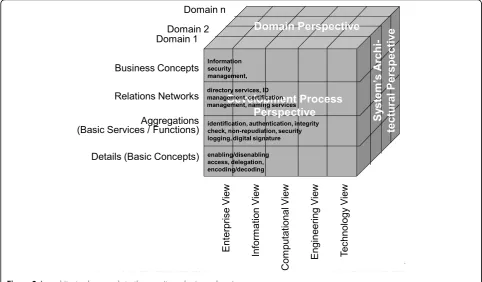
Many years ago already, the Generic Component Model (GCM) has been introduced, matured, and meanwhile widely deployed as abstract architectural framework for any eSystem, thereby describing the com-ponents’composition/decomposition, the representation of the domains involved, and the ICT development pro-cess of the intended solution (Figure 1). For describing the practical process of developing ICT solutions in a
model-driven way, ISO 10764 Information technology–
Reference Model - Open Distributed Processing [3] and its recent updates have been used. Seeing that interoper-ability focuses on the business process, just the Enterprise View has to be considered. Domains describe the afore-mentioned aspects a system serves. Because different domains use their special language derived from a special ontology, ontologies can be deployed for separating domains.
Aggregation of components both within and between domains can just be performed at the same level of granularity! If architectural principles have been ignored as it happened for many systems such as legal, terminol-ogy or ontolterminol-ogy ones, interrelations as well as binding
to other domains’ components are poor as it can be
shown in SNOMED, ICD 9 an ICD 10, etc.
Results
Layered security services model
Security issues can be grouped into the concepts commu-nication security and application security. Commucommu-nication security deals with the connection to, and the communica-tion between, systems, thereby preventing attacks on sys-tem and communication channel. Application security concerns the use of a system’s functions and data. Figure 2 presents the layered security services model covering the security system from concepts through services, mechan-isms, algorithms and data. Just mechanmechan-isms, algorithms and data might be specific for pathology.
with, covering safety, security and privacy of health-related services and personal health information. While technical specifications such as the identification and authentication of entities are manageable depending on the distinguishing features used such as knowledge, tokens, properties, privacy-related services such as privi-lege management, authorization, access control, etc., summarized as policies, are defined in legislation, regu-lations, rules, consent statements or documents, codes
of ethics, etc. They are usually not formally expressed and a matter of interpretation (so keeping myriads of lawyers busy). All aspects of an eHealth system such as the medical, legal, administrative and technical ones have to be managed (analyzed, specified, implemented and maintained) in an architecture-centric and forma-lized way. Therefore, they must be related to the archi-tectural framework chosen, as presented in Figure 3 for security and privacy services using the GCM.
10th European Telepathology Congress 4th International Congress on Virtual Microscopy 1-3 July 2010, Vilnius, Lithuania
Bernd Blobel eHealth Competence Center University Hospital Regensburg
eHCC Domain n Domain 2 Domain 1 E nterpri se Vi ew In form ation Vi ew Com putat ional V iew Engi neeri ng Vi ew Te ch nology Vi ew S ys tem Com pone nt Com po si tion System Viewpoint Sy ste m ’s A rchi -tec tur al Pe rs pec tiv e Development Process Perspective Domain Perspective Business Concepts Relations Networks Aggregations (Basic Services / Functions)
Details (Basic Concepts)
Figure 1The Generic Component Model (GCM).
communication
security applicationsecurity
authori-sation accesscontrol
availa-bility conc epts se rv ic e s me ch a n is ms data digital signature
...
firepro-tection digital signature encryp-tion key es-crowing
...
...
firepro-tection
...
account-ability functionsnotary’s
audit availa-bility notary’s functions
identi-fication authen-tication
account-ability pudiation
non-re- confi-dentiality integrity non-re-pudiation confi-dentiality multiple comp.
hashing encryp-tion hashing key re-covery
multiple comp. al go ri thm s
DES IDEA RSA DSA
EL-GAMAL DSA RSA IDEA DES EL-GAMAL
data keys certifi-cates data keys certifi-cates
SHA-1 MD5 SHA-1 MD5
security quality
safety
access
control integrity accuracy
Thereby, the system’s components, their functions and interrelations–in other words, its architectural description –can be instantiated for any object such as documents, messages, devices, specimen, images, holograms, etc. So, integrity check for images can be provided by an image sig-nature, using special algorithms to characterize color histo-grams, texture properties, global and local attributes. Authentication of origin or ownership can be provided by watermarks, frequently used for managing copyrights. Here, visible or invisible information is provided to an image in a way that is difficult to remove. Digital watermarks can be modified by, e.g., lossy compression of data, cropping an image or video, or intentionally adding noise. In this paper, we do not tackle steganography which enables the transpor-tation of secret information hidden in an image.
In the next step, the architectural specification has to be developed for a security and privacy sub-domain: the domain of policies. In its general definition, a policy is a complex of legal, organizational, functional, medical, social, ethical and technical aspects, which must be considered in the context of security and privacy. A security policy defines the framework, rights and duties of principals involved, but also consequences and penalties in the case of disregarding the fixings taken (limited to persons). Using
the GCM according to ISO 22600“Health informatics–
Privilege management and access control”[4], Figure 4 pre-sents the architectural composition/decomposition of policies.
The knowledge representation challenge
As introduced in above, interoperability is based on knowledge shared between the involved principals about the common business objectives, the business context, motivation, etc., as well as the appropriate actions taken. Therefore, knowledge representation (KR) is crucial for advanced cooperation. Since this is a difficult task within one domain already, among others depending on the complexity of a certain domain, the aforementioned challenge is even bigger in a multi-disciplinary approach like pHealth.
The science dealing with the representation of struc-ture and behavior of systems is called ontology. To avoid the endless battle between philosophers and domain experts who consider general aspects of reality vs. domain-specific specializations, a layered system of ontologies has been introduced providing an architec-tural approach to the system“ontology”, thereby reflect-ing the different granularity levels of the GCM (Figure 5). Application ontology describes the business concepts the ICT solution should support. For achieving intero-perability between different applications within a certain domain (e.g. medicine), the involved application ontolo-gies have to be mapped using the domain ontology. Integration of different disciplines represented by differ-ent domain ontologies is moderated by top-level ontolo-gies. Health-related ontologies contributing to an interoperability environment have been checked,
10th European Telepathology Cong 4th International Congress on Virtual Micros
1-3 July 2010, Vilnius, Lithu Bernd Blobel
eHealth Competence Center University Hospital Regensburg
eHCC
Domain n
Domain 2 Domain 1
E
nt
erpris
e V
iew
Info
rm
atio
n V
ie
w
Com
put
at
ional V
iew
E
ngine
er
in
g V
ie
w
Te
chnology V
iew
Sy
ste
m
’s A
rc
hi-te
ct
u
ral
P
er
sp
ec
ti
ve
Development Process
Perspective
Domain Perspective
Business Concepts
Relations Networks
Aggregations (Basic Services / Functions)
Details (Basic Concepts) enabling/disenabling access, delegation, encoding/decoding
identification, authentication, integrity check, non-repudiation, security logging, digital signature directory services, ID management, certification management, naming services Information
security management,
lligent Security and Privacy Solutions in Telemedicine/Telepath
10th European Telepathology Congress 4th International Congress on Virtual Microscopy 1-3 July 2010, Vilnius, Lithuania
Bernd Blobel
eHealth Competence Center University Hospital Regensburg
Figure 4Composition/decomposition of a policy sub-domain [8].
10th European Telepathology Con 4th International Congress on Virtual Micro 1-3 July 2010, Vilnius, Lith Bernd Blobel
eHealth Competence Center University Hospital Regensburg
eHCC
Enterp
rise
V
ie
w
In
fo
rm
a
tio
n
V
ie
w
Co
m
pu
tat
io
na
l V
ie
w
E
ng
ine
er
in
g Vi
ew
Te
chn
ol
o
gy Vi
ew
Sy
s
tem
’s A
rch
i-tect
u
ral
P
er
sp
ect
iv
e
Development Process Perspective
Business Concepts
Relations Networks
Aggregations (Basic Services / Functions)
Details (Basic Concepts) Application
Ontology Domain Ontology Top-Level Ontology General Ontology
harmonized, and approved as member of the Open Bio-medical Ontology Foundry (OBO Foundry). They have been derived from the Basic Formal Ontology (BFO), which is a formal top-level ontology based on tested principles for ontology construction, subdividing reality into two orthogonal categories and thereby bridging the gap to the next ontology level [5]. They can be used as references to overcome weaknesses and inconsistencies of existing terminologies claiming for an ontology, and to reflect the aforementioned system of ontologies appropriately. The final criterion proofing the correct-ness of the approach is the universal reality (philosophi-cally the thing itself, or the philosophical categories) independent of the scientific interpretation of special instances of the universe. So, the generalization leads from the representation of scientific concepts and their relations as knowledge representation up to the defini-tion of universal building blocks (components) and their interrelations within the classic ontology.
Practical interoperability models describe the business case (Enterprise View) of multi-disciplinary pHealth solutions, where pathology is one domain with several sub-domains. They represent the systems in question using the corresponding application ontologies harmo-nized by a domain ontology. Different domains are inte-grated by mapping them through top-level ontologies. The resulting business model is informationally repre-sented using ICT ontology and thereafter implemented according to a unified development process. This is, by the way, the least challenging part in the game, even if computer scientists or informaticians usually like to be the most prominent player in eSociety solutions.
The representation of both knowledge and high level ontologies is also a matter of the representation lan-guage, ranging from natural language through vocabul-aries, dictionvocabul-aries, thesauri, meta-languages such as XML, frames, formal languages, prepositional logics, predicate logic and modal logics up to universal logic [6]. The abstraction or formalization level depends on the level of commonality achievable. As more different the domains are as more knowledge including meta-knowledge about the representation style has to be
communicated, guaranteeing commonality in “
under-standing”just at a level of higher abstraction.
Examples for formal policies represented in XML, pre-dicate logic, or formal languages can be found in [7].
Privilege management and access control
Managing rights and duties of actors regarding the differ-ent personal information objects of an iddiffer-entified subject of care has traditionally been ignored or as much as (or even more than) possible simplified, leading to privilege or authorization attributes in databases or role-based pri-vilege management and access control solutions in open
and distributed environments. Here, actors have been grouped according to their role in a business process. Furthermore, the information objects have been classified according to their sensitivity. As a result, the relations between actors as well as between them and related objects have been dramatically reduced.
In pHealth including pPathology, such coarse-grained approach does not appropriately reflect the process con-text with its environmental as well as personal condi-tions. So, all the components have to reflect those constraints expressed by corresponding policies, as shown in Figure 6.
Structural and functional roles thereby represent the rela-tions of a principal to an organization or to an activity within a process respectively according to ISO 21298 Health informatics–Functional and structural roles [9]. Design and specification of all architectural components of the selected business case and their binding is done highly dynamically. This concerns all domains involved including the policy domain ruling privileges and access control.
A generic reference model for the informational repre-sentation of privilege management and access control in a business context has recently been standardized in the HL7 Common Security and Privacy Domain Analysis Model. This specification, provided as Draft Standard for Trial Use and thereby offering the opportunity to implement, to test and to improve the specification, is the first international standard which took up the chal-lenge to combining the very advanced definitions of, e.g., ISO 22600, ISO 21298, OASIS SAML 1.1 [10], OASIS OASIS XACML 2.0 [11], OASIS AVDL 1.0 [12], etc., to one harmonized and comprehensive view, as demonstrated in Figure 7.
The offered model provides a combination of the composition/decomposition schema of policy base classes, of informational references (to be developed and refined in the future), the actor schema (to be developed and refined in the future) as well as the actions defined. Here, the reference to Figure 3 is recommended. The standard document also provides specifications to migrate to existing HL7 solutions like the HL7 RBAC Permission Catalogue [14], the Patient Consent Policy Document [15], and many others.
Discussion
Principal SR_Policy
Structural_Role
Role_Hierarchy
1..* 1
FR_Policy
Functional_Role 0..*
0..* 0..*
0..*
User_Assignm ent 1.. *
1
Process_P olicy Session
1..* 0..*
1..* 0..*
User_Session
1
1..*
1
1..*
Session_Role
1..* 1
Target_Policy
Target_Component
0..* 0..* 0..* 0..*
Permission_Assignment 1..*
1 1..*
1
1 1..*
1..* 1
1 1..*
Figure 6Policy-driven, role-based access control [8].
telligent Security and Privacy Solutions in Telemedicine/Telepathology
10th European Telepathology Congress 4th International Congress on Virtual Microscopy 1-3 July 2010, Vilnius, Lithuania Bernd Blobel
eHealth Competence Center University Hospital Regensburg
framework models a system regarding its structure and behavior in three dimensions: the different domains a system is serving, the architectural composition/decom-position of the system (to be provided for each of the considered domains), and the unified development pro-cess for analyzing, designing, specifying, implementing and deploying the ICT solution to facilitate the business process in questions. For appropriately describing the system with its domains, application ontology has to be exploited, which defines the business concepts including the terminology deployed. This application ontology has been derived from domain ontologies and is maintained and used by the domain experts. Domain ontologies enable mapping between different application ontologies within that domain, while top-level ontologies enable mapping between different domain ontologies. The sys-tem of ontologies used for the representation of the business system has to be managed separately from the system in question.
The knowledge represented in the system architecture model is contained in the concepts, which are repre-sented by the components as well as rules to be applied to relations such as constraints for specializations or aggregations within one domain, mapping/binding of components from different domains as well as transfor-mation within the development process. It provides the essence for successful collaboration to achieve the busi-ness objectives.
Examples for relations between the system compo-nents at different granularity level are the assignment of privileges, an authorization statement, or other pro-cesses. Beyond security and privacy, relations could represent rules such as truth statements, decision sup-porting rules, algorithms to evaluate parameters, by that way facilitating, e.g., (partially) automated analysis pro-cesses in pathology. An example for such knowledge-driven data representation and processing is for example given in [16] in this volume, even if the used term ontology might be problematic without the detailed con-siderations performed in this paper.
Conclusion
Like any system, eHealth/pHealth systems as well as parts thereof such as tele-pathology/ePathology solutions must be analyzed, designed, specified, imple-mented, deployed and maintained based on a system-theoretical, engineered methodology of an architecture-centric approach. The Generic Component Model (GCM) has been proven as appropriate framework for formally describing any system in question. Meanwhile, the methodology has been validated and adopted for international standards. All architectural components defined for a pHealth business case in question are designed and implemented dynamically, thereby leading
to highly flexible and personalized solutions. Aggrega-tions of components within and between different domains are restricted to the same level of granularity, presented as neighbored components, if the relation can be logically/ontologically proven. Complexity/granularity of the system in question, the number of domains included as well as the formalization level for knowledge representation should always be limited to the level absolutely needed.
Acknowledgement
The author is indebted to the colleagues from HL7, ISO TC 215, CEN TC 251, IMIA, EFMI, COST Action IC0604“Euro-Telepath”, and many other institutions for kind support.
This article has been published as part ofDiagnostic PathologyVolume 6 Supplement 1, 2011: Proceedings of the 10th European Congress on Telepathology and 4th International Congress on Virtual Microscopy. The full contents of the supplement are available online at
http://www.diagnosticpathology.org/supplements/6/S1.
Competing interest
The author declares that he has no competing interests.
Published: 30 March 2011
References
1. Blobel B:Architectural approach to eHealth for enabling paradigm changes in health.Methods Inf Med2010,49(2):123-134.
2. Object Management Group Inc:The CORBA Security Specification, Object Management Group.Framingham; 1997.
3. International Standards Organization:ISO 10764 Information technology– Reference model–Open distributed processing.Geneva; 1997. 4. International Standards Organization:ISO 22600 Health informatics–
Privilege management and access control.Geneva; 2006.
5. Smith B, Ashburner M, Rosse C, Bard J, Bug W, Ceusters W, Goldberg LJ, Eilbeck K, Ireland A, Mungall CJ, OBI Consortium, Leontis N, Roca-Serra P, Ruttenberg A, Sansone SA, Scheuermann RH, Shah N, Whetzel PL, Lewis S:
The OBO Foundry: coordinated evolution of ontologies to support biomedical data integration.Nature Biotechnology2007,25(11):1251-1255. 6. Blobel B, Oemig F:Ontology-Driven Health Information Systems
Architectures.InMedical Informatics in a United and Healthy Europe– Proceedings of MIE 2009, Series Studies in Health Technology and Informatics. Volume 150.IOS Press, Amsterdam, Berlin, Oxford, Tokyo, Washington; Adlassnig K-P, Blobel B, Mantas J, Masic I 2009:195-199.
7. Blobel B:Ontology Driven Health Information Systems Architectures Enable pHealth for Empowered Patients.Int J Med Inf2011,80:e17-e25. 8. Blobel B, Nordberg R, Davis JM, Pharow P:Modelling privilege
management and access control.International Journal of Medical Informatics2006,75(8):597-623.
9. International Standards Organization:ISO 21298 Health informatics– Functional and structural roles.Geneva; 2006.
10. OASIS:Security Assertion Markup Language 1.1.2003.
11. OASIS:eXtensible Access Control Markup Language (XACML) Version 2.0.
2005.
12. OASIS:Application Vulnerability Description Language 1.0.2004. 13. HL7 International Inc.[http://www.hl7.org].
14. HL7 International Inc. RBAC Permission Catalog[http://www.hl7.org]. 15. HL7 International Inc. CDA R2 Consent Directive[http://www.hl7.org]. 16. Racoceanu D, Roux L, Tutac A, Veillard A, Huang C-H, Lomenie N, Klossa J,
Putti T:The MICO platform: cognitive virtual microscopy for breast cancer grading.
doi:10.1186/1746-1596-6-S1-S4
![Figure 4 Composition/decomposition of a policy sub-domain [8].](https://thumb-us.123doks.com/thumbv2/123dok_us/632732.1559239/5.595.58.543.89.429/figure-composition-decomposition-of-a-policy-sub-domain.webp)
![Figure 6 Policy-driven, role-based access control [8].](https://thumb-us.123doks.com/thumbv2/123dok_us/632732.1559239/7.595.61.542.309.709/figure-policy-driven-role-based-access-control.webp)
