Open Access
Research
The Quality Improvement Demonstration Study: An example of
evidence-based policy-making in practice
Riti Shimkhada
1, John W Peabody*
1, Stella A Quimbo
2and Orville Solon
2Address: 1Institute for Global Health, University of California San Francisco, 50 Beale Street, Suite 1200, San Francisco, California, USA and 2School of Economics, University of the Philippines, Diliman, Quezon City, Philippines
Email: Riti Shimkhada - [email protected]; John W Peabody* - [email protected]; Stella A Quimbo - [email protected]; Orville Solon - [email protected]
* Corresponding author
Abstract
Background: Randomized trials have long been the gold-standard for evaluating clinical practice. There is growing recognition that rigorous studies are similarly needed to assess the effects of policy. However, these studies are rarely conducted. We report on the Quality Improvement Demonstration Study (QIDS), an example of a large randomized policy experiment, introduced and conducted in a scientific manner to evaluate the impact of large-scale governmental policy interventions.
Methods: In 1999 the Philippine government proposed sweeping reforms in the National Health Sector Reform Agenda. We recognized the unique opportunity to conduct a social experiment. Our ongoing goal has been to generate results that inform health policy. Early on we concentrated on developing a multi-institutional collaborative effort. The QIDS team then developed hypotheses that specifically evaluated the impact of two policy reforms on both the delivery of care and long-term health status in children. We formed an experimental design by randomizing matched blocks of three communities into one of the two policy interventions plus a control group. Based on the reform agenda, one arm of the experiment provided expanded insurance coverage for children; the other introduced performance-based payments to hospitals and physicians. Data were collected in household, hospital-based patient exit, and facility surveys, as well as clinical vignettes, which were used to assess physician practice. Delivery of services and health status were evaluated at baseline and after the interventions were put in place using difference-in-difference estimation.
Results: We found and addressed numerous challenges conducting this study, namely: formalizing the experimental design using the existing health infrastructure; securing funding to do research coincident with the policy reforms; recognizing biases and designing the study to account for these; putting in place a broad data collection effort to account for unanticipated findings; introducing sustainable policy interventions based on the reform agenda; and providing results in real-time to policy makers through a combination of venues.
Conclusion: QIDS demonstrates that a large, prospective, randomized controlled policy experiment can be successfully implemented at a national level as part of sectoral reform. While we believe policy experiments should be used to generate evidence-based health policy, to do this requires opportunity and trust, strong collaborative relationships, and timing. This study nurtures the growing attitude that translation of scientific findings from the bedside to the community can be done successfully and that we should raise the bar on project evaluation and the policy-making process.
Published: 25 March 2008
Health Research Policy and Systems 2008, 6:5 doi:10.1186/1478-4505-6-5
Received: 22 January 2008 Accepted: 25 March 2008
This article is available from: http://www.health-policy-systems.com/content/6/1/5
© 2008 Shimkhada et al; licensee BioMed Central Ltd.
Background
While clinical interventions are typically grounded in sci-entific evidence before widespread adoption, public poli-cies are not typically subjected to the same scientific rigor [1,2]. By definition public policies are made to affect whole populations [3]. This alone is a compelling reason to be judicious and well-informed before implementing new policy. The sheer costs of maligned policy add further to the gravity of choosing unwisely. Arguably, therefore, policy interventions should be put through the same level of caution and consideration as clinical trials, which do not nearly have the same scope or reach of social policies [4]. Increasingly, there is greater credence given to this argument and there is growing demand that decision-making in the policy environment be science-based [1,2,5-7].
There are a variety of scientific approaches for generating and finding the best evidence for diagnosing and treating disease, with the standard being the randomized clinical trial (RCT). In an RCT, the link between clinical care and health outcomes is often more direct than with policy change, thus causality is more readily evaluated and, for the most part, more easily measured. Generating rand-omized policy trials is more challenging in several impor-tant ways. Policy interventions can be difficult to randomize among populations, and challenges will arise when trying to time the introduction of interventions so that proper pre- and post- assessments are completed; similarly, measuring outcomes of interest is not trivial– collecting data of high caliber can not only be costly but often a significant lag time is required before population changes are seen. Additionally, interventions are rarely introduced devoid of political context, making it all the more difficult to separate science from the often conten-tious and fracconten-tious political environment. Perhaps one of the biggest limitations, however, is that policy interven-tions are often assumed to be effective when there is scant evidence that they are and, as a result, they are not even considered to be worthy of scientific investigation. The Philippine Child Health and Policy Experiment, also known as the Quality Improvement Demonstration Study (QIDS), is a unique example of how a large randomized control longitudinal study can be introduced in a rigorous scientific manner to evaluate the impact of governmental policy interventions. In this paper, we describe how we were able to conduct a prospective randomized policy experiment, the lessons learned, and the few obstacles that remain.
Methods
Setting for the experiment
The Philippines Department of Health (DOH) took a major step towards improving the performance of the
health sector in 1999 by launching the National Health Sector Reform Agenda (HSRA) to change the way health services were being financed and administered. The reform policies were directed mainly at a) increasing access to personal health services, especially for the poor, and b) improving the quality of care delivered at hospi-tals.
Institutions
The Philippines Department of Health is the principal government agency that formulates national health poli-cies and programs, and guides the development of local health systems, programs, and services. The DOH is led by the Secretary of Health, who is appointed by the Presi-dent. An institution attached to the DOH, the Philippine Health Insurance Corporation (PhilHealth) is the govern-mental financial institution implementing the National Health Insurance Program, making it the largest insurance carrier in the Philippines. Mandated by the National Health Insurance Law of 1995, PhilHealth's priorities are to achieve universal coverage, expand insurance benefits, and ensure high quality of care and member satisfaction. The National Health Insurance Program covers employees from the formal sector, retirees and pensioners, self-employed individually paying individuals, and the poor. PhilHealth reimburses on a first-peso basis payment for inpatient services including room and board, surgical pro-cedures, physician services, selected diagnostic and treat-ment procedures, and drugs. In 2006, PhilHealth had an estimated active membership coverage of 16 million members with more than 68 million beneficiaries, thus covering about 79% of the estimated 86.9 million in the entire country.
PhilHealth, however, has faced challenges in reaching their goals of universal coverage and improved health care delivery [8]. Recognizing that the ultimate success of reform policies lies in the understanding of how they affect the quality of health care provided to those in need and whether these changes have beneficial effects on health, 10 years ago PhilHealth committed itself to the financing and implementation of health reform policies targeted at improving health care for children and the poor.
private health services for indigent members through Phil-Health's Sponsored Program. In 2006 there were close to 5 million indigent families, or 25 million individuals, enrolled in this program.
The Visayas and health status of children in the region
While the National Health Sector Agenda was intended to be implemented nationwide, the DOH designated the Visayas, one of the three major island groups, as the site for QIDS implementation. The Visayan islands cover about one-third of the geographical area of the entire country. A main advantage of the Visayas in this study is the geographic isolation of many island sites, limiting cross-over of people between intervention sites. As most of the Visayas is rural, many of its residents are poor and depend on farming and fishing as their source of income [10,11]. Children in such rural areas of the Philippines have a high burden of disease. According to the 2003 National Demographic and Health Survey conducted by the Philippines Department of Health, infant mortality is 24 deaths per 1,000 for urban areas and 36 deaths per 1,000 in rural areas [12]. The national mortality rate for children under age 5 is 30 per 1,000 for urban areas and 52 per 1,000 in rural areas. From 2000 to 2003, diarrheal disease and pneumonia accounted for 25% of all deaths among children under age 5 [13]. Approximately 12% of children in rural areas have symptoms of acute respiratory illness, but only 43% of them were taken to a health facil-ity or provider for treatment. Among those with diarrhea, only 29% were taken to a health facility or provider. Data from the 6th National Nutrition Survey reveal that 30% of Filipino children under age 5 are stunted (less than 2 standard deviations (SD) below the mean height for age), 27% are underweight (less than 2 SD below the mean weight for age) and 5.3% are wasted (less than 2 SD below the mean weight for height) [14].
Results
To implement a social policy experiment required that we first recognize the research opportunity in a complex envi-ronment surrounded with scientific, bureaucratic and eco-nomic pressures. However, this, we found, was just the beginning. Establishing the scientific basis for evaluating policy, overcoming the unique challenges of randomiza-tion, carrying out the policy interventions and collecting community level data are all key elements that, in our experience, distinguished both the challenge of conduct-ing a social experiment and the integrity of a policy exper-iment from clinical trials and other evaluation efforts. Herein we describe the vital factors that led to the success-ful implementation of the QIDS social policy experiment.
Success in establishing QIDS – recognizing opportunity
At the outset, we realized two important facts about the broad reform agenda in the Philippines. The first was,
despite global interest in health sector reform, there was little scientific information on the effectiveness of even the most basic reform policies considered in the Philip-pines and other parts of the world. In this case, there was a dearth of compelling evidence to show that increasing insurance coverage leads to improved health status in populations and an international debate over the benefits of pay-for-performance. Second, the Philippines govern-ment lacked the financial resources for a national roll-out of either proposed reform policies. The scientific uncer-tainty of the effectiveness of either policy, coupled with the practical problem of financing a large-scale introduc-tion of the policies, was the opportunity that we recog-nized for putting a policy experiment in place.
Though conceived and spearheaded by Dr. Peabody of the Institute for Global Health at University of California San Francisco (UCSF) and Dr. Solon of the UPecon Founda-tion based at the University of the Philippines School of Economics, QIDS was designed in close relationship with the DOH and PhilHealth. We discussed at length, for example, the opportunity for a scientific study beginning with the then Secretary of Health, Dr. Alberto Romualdez. The DOH, recognizing the unique opportunities around informing policy and establishing global solidarity, brought PhilHealth into the discussion from the start, giv-ing them a central role since PhilHealth is the payer for the national health insurance program and the institution that could best implement these reform policies. Through these discussions, a new type of collaborative was formed. We then linked the two broad HSRA reform goals– increasing access and improving quality–with the detailed, specific hypothesis-driven interventions and their experimental introduction.
Funding and timing of the study
out-side of the Philippines. In due course, we successfully obtained an R01 grant from the National Institute of Child Health and Human Development (NICHD) for the 5-year study (R01-HDO42117), making the argument that the effects of pay-for-performance, which was under-going a similar renaissance in the U.S., and universal cov-erage, being pursued through initiatives such as the State Children's Health Insurance Program, were poorly under-stood.
A related and formidable challenge was to time the intro-duction of the official policies with the arrival of the research funding. Our rigorous design required that we conduct a pre- and post-intervention assessment around the outcomes of interest. We timed the grant application to follow policy approval but to precede policy imple-mentation. In part this was due to good planning and coordination with our partners at DOH and PhilHealth. Thus, while announcements were made early on, imple-mentation was more flexible and could, in this case, be accelerated to meet our research funding schedule.
Formalizing the experiment into the legal and regulatory systems
The policy environment from a methodical, scientific per-spective is uncertain and fraught with unplanned events. In other policy reform settings, we had observed an eva-nescent enthusiasm accompanying research activities that, in the day-to-day context of institutional operations, would dissipate. Recognizing these realities we sought to minimize their impact. We thus obtained legislative and regulatory sign-off that codified the integration of the experimental design directly into the existing infrastruc-ture. Specifically, QIDS did this early on by creating several formal partnerships–provincial, local and national–for the experiment. For the provincial partnerships, we executed legally binding Memorandums of Agreement (MOAs). To obtain buy-in at the local level, we extended these commit-ments down to the 30 participating local government units in the participating provinces, through additional MOAs obtained prior to site randomization. Once these agree-ments were signed, we vetted QIDS a second time with the national government (PhilHealth) and requested formal resolutions from the PhilHealth Executive Board.
To further minimize external events, PhilHealth played an operational role, both centrally and regionally, to imple-ment the study. Through the partnership, the central office designated formal budget administrative responsi-bilities and the regional staff explicitly collaborated at the ground-level to implement the policy interventions, administer the clinical vignettes (which assessed the qual-ity of care), disbursed the bonus payments, conducted some of the intervening data collection, and monitored insurance coverage levels.
Randomizing the policies and controlling for experimental biases
In the Philippines, there are 220 districts, with an average population size of 250,000. Since the interventions were to be implemented at the provincial district level, an administrative unit that manages the delivery of health and other social services, we needed to randomize the experimental design to this level of the community. The two policy interventions, including controls, were thus randomly assigned to the 30 districts situated in the 11 provinces in the Visayas.
Randomization, proved to be complex, because there was an a priori assumption made by communities that partic-ipation in the study meant receiving a new policy with new resources. Accordingly, after the sites were identified, the study team held a series of meetings with government officials, provincial governors, provincial and municipal health officers, regional PhilHealth officers and the may-ors (who were the heads of municipalities or cities), to seek their voluntarily consent to participate in the rand-omization and to provide them with the operational details pertaining to the implementation of policies and data collection.
We grouped districts with similar population characteris-tics into matched blocks of three before randomizing. The group characteristics, obtained from national census and local data, included population size, average income, labor force participation rate, functional literacy, infant mortality rate, maternal mortality rate, percentage of the population with insurance, proportion of the population that is rural, and proximity to Manila. To minimize within-block variation for each characteristic, the matched locations had to be within 10 to 25% of the exist-ing variation. Randomization was then done among the matched blocks, with one site randomly chosen as an 'A' site, one as a 'B' site, and the third as a control or 'C' site, which are described in more detail below.
rel-ative changes over time. Another potential participation bias was due to patient selection, wherein there might be substantive differences between children who came to the hospital versus the general population. We thus included a population-based survey of random households from the catchment areas surrounding QIDS hospitals.
QIDS interventions
When we developed the policy interventions for the study, naturally, we wanted them to be linked closely to the areas that corresponded to the primary HSRA reforms. Our explicit task was to tie well-defined hypothesis-driven interventions to the actual HSRA policies aimed at improving health care access to the poor and increasing the quality of care. QIDS thus introduced expanded Phil-Health membership to children under 6 years of age and then measured changes in utilization of all services. We call this the Access Intervention carried out in the 'A' sites. PhilHealth membership in the A sites was made available at no cost to all indigent children under the age of 6 years and their families. In addition, this scheme typically results in 100% financial coverage for ordinary cases such as pneumonia and diarrhea; if charges exceed the PHIC benefit limits, they are shouldered by the local govern-ment unit hospital.
The second policy, a supply-side intervention, targeted physicians by introducing financial incentives for doctors providing high quality care, which is in essence a pay-for-performance scheme. We call this the Bonus Intervention, carried out in 'B' sites. Physicians in the district hospitals randomized to the B sites had to meet quality standards, which were pre-determined, to be eligible for bonus pay-ments. We used a measurement standard of quality, referred to as Q*, wherein we combined an average of clinical vignette scores, which measured the quality of clinical care of doctors caring for patients with diarrhea and pneumonia, with a measure of facility case load, and a measure of patient satisfaction [15]. Each quarter, the QIDS Q* metric is computed from randomly selected physicians for each hospital assigned to this intervention and official PhilHealth issuances are made to hospitals indicating whether or not it is qualified to receive bonus payments. The bonus amount is calculated quarterly for qualifying hospitals and distributed to all clinical staff, with half going to the physicians, and the remaining half divided between nurses, administrators and support staff.
Longitudinal and multi-level assessment of health determinants and outcomes
Data collection presented two distinct challenges relative to evidence generation: timeliness and comprehensive-ness. We conducted a baseline, or pre-intervention, evalu-ation of study facilities and participants. Smaller data collection efforts were carried out at various intervals after
the introduction of the policy interventions followed by a second major round of data collection after approxi-mately two years. With these pre- and post-intervention assessments, we are able to observe transition states over time and other changes in variables of interest not possi-ble from a cross-sectional study; this design also allows the control for otherwise-omitted variation in outcomes among individuals [16]. Our design and related data col-lection allow us to measure the impact of the policy inter-ventions on outcomes of interest using difference-in-difference estimators, which we use to compare the changes (before and after intervention) in the outcomes in intervention sites with the corresponding changes in con-trol sites. By looking at the changes over time we control for individual and area-specific characteristics and secular trends that might confound the estimated policy impact. The second challenge to data collection was ensuring that we captured all changes, not just the outcomes of interest that might occur as a result of the policy interventions. Given the potential of the policy interventions to change provider and patient behaviors and outcomes, facilities and physicians, patients and their households were all included in the assessments. Figure 1 illustrates the multi-level nature of the study as well as its longitudinal design, which we briefly describe below.
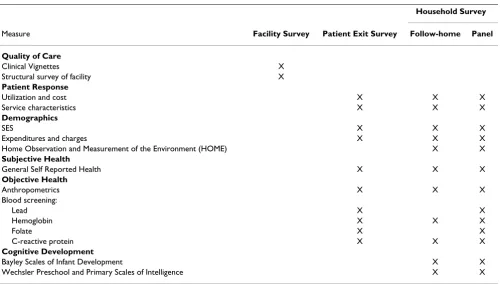
The comprehensive data collection started with QIDS hos-pitals and physicians, surveyed on a semestral basis and on a quarterly basis respectively, giving numerous data points for longitudinal study. At each facility, structural measures, such as the availability of electricity and sanita-tion, overall cleanliness, qualified staff, organization of services, drugs, and equipment, were collected. However, while structural measures are necessary to monitor certain aspects of quality, they are insufficient indicators of care provision. Thus to assess the quality of care and accurately measure the patient-provider interaction, we used clinical vignettes. Vignettes, written case scenarios which simulate patient visits and are followed by questions for doctors to answer, are used as an accurate, affordable, and valid measure of a doctor's ability to evaluate, diagnose, and treat specific conditions [17-19]. Table 1 outlines the measures used at each assessment.
were followed home 4 to 10 weeks post hospital dis-charge. Apart from detailed information on the house-hold, blood, subjective health, and cognitive data were also collected during this home visit, which we called the Follow-Home Household assessment. These same patients were then followed two years after the initial hos-pital visit for another assessment of health and cognitive status in the Panel Household survey.
Data collection team and data quality
Because of its breadth, QIDS required a large, well-quali-fied multidisciplinary data collection team. Accordingly, in each of the 11 study provinces QIDS assigned a team of three medical technologists, two psychologists and one supervisor. Supervisors are responsible for the timeliness and rigor of data collection and ensure that all eligible children are asked to participate, the survey visits are scheduled on time, facilitate team logistics and timely delivery of the biomarkers. Three regional program man-agers oversee the supervisors in the 11 provinces
address-ing concerns and issues raised by the field staff. Finally, central staff, consisting of a survey leader, a program man-ager, research assistants, and a data entry team, contribute to a data collection process that is efficient, on-time, and available.
As a result, QIDS has a high response rates for both initial and continued participation. In both rounds of data col-lection only about 10% of eligible participants refused to take part in the study. Of those who agreed to participate in the study, 0.5% refused at the time of the follow-home household survey. The refusal rate for panel children who were initially surveyed two years earlier was 1.5%. And between the two rounds of data collection less than 1% of children were lost to follow-up.
Inter-current use of the QIDS data
A common, and valid, criticism of policy research is that results are not timely and accordingly often not relevant to policy-makers where the study is being conducted [20]. To
Multi-level data collection in the Quality Improvement Demonstration Study
Figure 1
overcome this concern, we conceived of using QIDS data to guide government initiatives in real-time. In 2006, for example, the original 1997 HSRA implementation strat-egy was revised under a new administration and called FOURmula One (F1) for Health. We did some analyses from the first round of QIDS that led to shifting the focus of F1 towards increasing PhilHealth enrollment, quality of care, and no-balance insurance billing. More recently, in 2007, the QIDS methodology and data were again crit-ical inputs for the DOH in designing the Monitoring and Evaluation of the F1 agenda. QIDS analyses have also formed the basis for bilateral assistance from USAID, whose goal is to strengthen and institutionalize policy evaluation and coordinated policy reform. The QIDS framework has been used by the Philippine Government to demand impact evaluation for a host of other bilateral and multilateral projects the country. QIDS also produces policy briefs, published three to four times a year, to update the policy community on policy-relevant analysis. QIDS data are publicly available. All non-identifiable data along with questionnaires and data codebooks are in the public domain and available on the Internet [21]. The QIDS website also serves as a repository of findings from completed analyses.
Discussion
This paper reports on the successful implementation of QIDS, a large policy experiment in the Philippines. We
argue that policy should be evidence-based and thus there ought to be a strong interest in making the policy environ-ment more amenable to scientific analyses. QIDS demon-strates that with a scientific framework, collaboration and coordination, opportunistic insights and some serendip-ity, large-scale policy experiments can be conducted. Below, we first discuss the importance of bringing evi-dence into policy making and its major challenges. Then we show how the lessons learned from QIDS might advance our collective experience with policy experiments and integrated science-based policy making. We conclude with a discussion on our limitations.
Integrating evidence into policy making
Experience suggests that policy-making is typically devoid of scientific evidence and frequently not even supported by anecdotal evidence [22]. The evidence-base for poli-cies, both inside and outside the health sector, is certainly weak when compared to evidence required for decision making in other areas, such as clinical medicine. This is often attributed to the complex nature of the policy envi-ronment [23,24]. First among these complexities is the breadth of social policies that, by nature, affect individu-als and communities as a whole through a variety of dis-parate pathways [25]. Modeling or quantifying the impacts of these broad policies is necessarily a challenge. For instance, even more focused health policies are rarely evaluated because of the difficulties in monitoring and
Table 1: Summary of Measures Collected for QIDS Assessments of Patients, Households, Physicians and Facilities
Household Survey
Measure Facility Survey Patient Exit Survey Follow-home Panel
Quality of Care
Clinical Vignettes X
Structural survey of facility X
Patient Response
Utilization and cost X X X
Service characteristics X X X
Demographics
SES X X X
Expenditures and charges X X X
Home Observation and Measurement of the Environment (HOME) X X
Subjective Health
General Self Reported Health X X X
Objective Health
Anthropometrics X X X
Blood screening:
Lead X X
Hemoglobin X X X
Folate X X
C-reactive protein X X X
Cognitive Development
Bayley Scales of Infant Development X X
evaluating multiple activities, the challenges of observing disparate effects, or because there has been too little time to observe meaningful changes. Secondly, the "politics" of policy-making make for an environment where decision-makers are less interested in science, health impact or effectiveness, and more concerned with electoral interests, financial implications, and views of particular communi-ties or groups. A related barrier to evidence-based policy-making are structural barriers to communication between researchers and decision makers, which include "differ-ences in priorities, language, means of communication, integration of findings and definition of the final product of research" [4].
Despite the challenges to evidence-based policy making, the fact remains that governments need to know at the outset of policy development, and after policies have been implemented, the likely and achieved impacts in terms of both the positive and negative outcomes. The most rigor-ous way of monitoring the impact of an intervention or program, when feasible, is using a randomized controlled design, which assesses the impact of a policy by exposing a group of people to the policy intervention of interest at random while withholding the policy to a control group [16]. Baseline data are collected prior to the introduction of the policy, and again at an appropriately determined follow-up time. The differences between the measure-ments at baseline and follow-up estimate the net effect of the policy of interest, assuming proper randomization and large enough sample size to identify a minimum detectable effect [16]. Randomizing policies to whole communities, securing the units of analysis, maintaining internal consistency, timing the interventions with data collection, ensuring high quality data, and the inherently political nature of the evaluation process are all unique to the social experimental setting.
A notable example of a randomized policy study that arose from a governmental sponsored social investment in evidence-based policy is PROGRESA or Oportunidades in Mexico. Like QIDS, PROGRESA, was a major govern-ment initiative; aimed at reducing long-existing poverty and developing human capital within poor households [26]. Introduced in 1997, this was the first national con-trolled randomized anti-poverty intervention program in a developing country [27]. The intervention offered con-ditional cash transfers in order to promote incentives for positive behavior, such as participation in health and nutrition programs, including prenatal care, immuniza-tion, and nutrition supplementaimmuniza-tion, and provided incen-tives to promote children's school attendance. Communities were also randomly phased into treatment, allowing researchers to identify the impact of transfers on a variety of child health and educational outcomes. A key feature of the program was the opportunistic series of
rig-orous impact evaluations. While PROGRESA evaluations are considered some of the most expensive ever intro-duced by the government, they have been internationally acknowledged as being an invaluable source of data for governments in guiding policy decisions [28]. PROGRESA has subsequently expanded into the ongoing Oportuni-dades Program, which continues the evaluation practice. Similar to the experiences with PROGRESA, QIDS under-scores the feasibility and value of studying policy inter-ventions in a scientifically rigorous fashion and then using these data for large sector governmental changes in a systematic and integrated fashion.
Lessons learned
Some of the lessons learned from QIDS might guide future research, help avoid pitfalls and foster interest in evidence-based policy research. We list here seven of the most important lessons we learned that formed the foun-dation of our work: 1) recognizing opportunity and form-ing a multi-institutional collaboration, 2) identifyform-ing and securing funding and timing the study with policy changes, 3) formalizing the study, 4) randomizing the policies and controlling for potential biases, 5) introduc-ing sustainable policy interventions, 6) collectintroduc-ing compre-hensive data, and 7) using results to inform policy-making in real-time. Those that are more complex are described in more detail below.
First, we found opportunity in the Philippines health reform process in the scientific uncertainty surrounding the effectiveness of the policies in question. Since few pol-icies have been scientifically validated, there are likely many opportunities to be found to assess health impacts [25]. Although there is always serendipity around oppor-tunity, policy analysis lends itself to opportunistic evalua-tions if for no other reason than this dearth of scientific data.
flow from financial impediments that prohibit large-scale implementation of policies of interest.
Not surprisingly, we found that success requires a high degree of multi-institutional collaboration, involving gov-ernment entities and the private entrepreneurship of the investigators. Our partnership involved disparate institu-tions: the Philippines Department of Health, which has a strong relationship as well as some rivalries with Phil-Health, the National Insurance payer, and our two aca-demic institutions. Our collaboration was not always easy; however it was rooted in dedicated leadership com-mitted to improving health and advancing research. Lead-ership, we observed, also involved a significant level of risk taking from both the policy makers and researchers involved. For policy makers, there is risk in that the part-nership or experiment might fail to materialize, be funded, or be implemented. In QIDS, the Philippine gov-ernment had to trust their academic counterparts, who ultimately could not control the outcomes, and thus risked their own political capital by sponsoring a study that might uncover effects of government policy that were not flattering or even become the source of eventual embarrassment. From the perspective of the academic leadership, the risks stem from the limited control of the policy environment and the inability to create a stable set-ting that is the usual basis for a scientific study. There is additional professional risk associated with the opportu-nity costs of pursuing an opportuopportu-nity that may never materialize, thus hurting chances for promotion or advancement. Arguably, research funding for policy eval-uation is harder to obtain, the costs typically are high and there are legitimate concerns over the generizability of the ultimate findings. Accordingly, given the risks involved, the early dialog between the collaborating entities neces-sitates understanding and trust between partners.
In our experience, tensions may arise when collaborating entities that have varying levels of financial investment in the study. Perhaps conflicts can be discouraged if costs are shouldered equally or if a neutral outside source provides the necessary financial resources, but this seems unlikely to happen in the uncertain funding environments that characterize competitive research. In the developing coun-try setting in particular, co-funding is almost always nec-essary to conduct these types of large-scale policy experiments. To ensure scientific integrity, study funding should come from donor agencies free of conflicts of interest with participating entities. Securing these funds, for example from the U.S. National Institutes of Health (NIH), bestows legitimacy as well. The challenge is to suc-ceed in the highly competitive environment, and a good degree of luck is involved in this process. Ultimately, suc-cess will be largely dependent on the ability to delineate or distinguish between plan and implementation.
Researchers have thus proposed an International NIH to overcome the challenges of finding funds for research in less developed countries [29]. Lastly, as we described in our Results, the funding stream must be timed with the introduction of the interventions as well as data collec-tion. Probably the only assurance would be to secure funding ahead of formal approvals for the study, which requires a great deal of work and perhaps serendipity on the part of the investigators to coordinate.
Though partnerships and funding are the building blocks of the policy study, a key finding from QIDS that might be overlooked is the formalization and legalization of the policy interventions into the existing health care system. We find that this integration is required to maintain secu-rity in what may be a highly uncertain or changing bureaucratic environment. It is not untypical in develop-ing countries that research endeavors fail due to shifts in political parties, changes in agency heads, or economic downturn [30]. We found that formal board resolutions and signed legal documents protected us against unfore-seen events.
With agreements in place, randomizing communities is another achievable step in the policy experiment; so is introducing a control arm. Voluntary participation is not only a cornerstone of research, but essential in a policy environment that will likely become even more complex once the study is underway. Randomizing populations to interventions is always contentious, particularly in an intervention-control design where some communities will 'not get something'. We anticipated and certainly experienced reluctance at the district level to randomiza-tion to the control arm, mainly by hospital directors. We ultimately overcame this hurdle by describing the control arm to participants as part of ongoing change justifiable given the introduction of other policies in an environ-ment that was not strategically or operationally static in the long term. Our discussions at the local, provincial and national levels explaining the design ex ante were key in QIDS.
receive the greatest amount of political support. How-ever, a criterion set by PhilHealth was that a child must be a dependent of a PhilHealth member in order to take advantage of expanded insurance benefits. Thus, we felt it was necessary, as part of this intervention for QIDS to take additional measures to enroll entire families into PhilHealth and set goals for enrolling a certain number of families. These goals were individualized with each mayor and then formal arrangements were put in place to achieve them. This strategy demonstrated to be cost-effec-tive at $0.86 USD per enrollee, making it an inexpensive yet effective approach that can be scaled-up by Phil-Health [31].
Similarly, we designed our Bonus Intervention in a way that could also be easily expanded by PhilHealth. This intervention introduced a performance-based payment scheme for hospitals and physicians based on a quality of care performance measure which we refer to as Q*, a met-ric that measures clinical performance, patient satisfaction and volume of physician services. We found that the Q* measure was readily introduced into our 30 different study sites distributed over a wide-geographic and dispa-rate-cultural area, largely because data collection did not require a great deal of marginal resources [15]. Data on Q* component indicators are collected through three straightforward mechanisms. The clear transparency of the measurement and issuances based on Q* through the notification of provincial governors, hospital directors and physicians proved to enhance credibility and support for the data collection. This measure is now used for inter-nal monitoring and to evaluate new approaches for improving performance. As Q* measurements are tied to bonus payments to the hospitals, it has also given the met-ric meaning and consequence. As with enrollment, the quality measurement has proven to be inexpensive and implementable, thus making it more likely to be expanded at the national level.
We believe that comprehensive data collection is critical to informing large-scale policy changes. Beyond the obvi-ous, which is the need to collect data to evaluate the effi-cacy of the policies and the demonstration that multilevel data can be collected around a policy evaluation, there are other benefits of comprehensive data collection. First, there may be unexpected findings. In the QIDS study so far we have found a high prevalence of elevated blood lead levels among children that was previously unknown, unexpected prescribing practices among physicians, and a negative impact of extra budgetary insurance funding for the poor [31-33]. Second, with the public release of the data, there now exists a substantial learning opportunities around such a rich data set for other investigators in the Philippines and internationally. The data has attracted a number of investigators and continues to draw more.
Perhaps, most importantly, QIDS data has given rise to a deeper commitment to the health sector reform agenda. And it has informed policy-making in real-time. While health policy by its very nature is dynamic, research, by contrast, is slow to provide real time guidance to policy makers [34]. To surmount this, we partnered QIDS with governmental policy monitoring and evaluation (referred to as ME3), developed policy briefs and other activities to integrate research in a time-conscious man-ner. Monitoring and evaluation systematically monitors the progress towards targets and evaluation of policy out-comes within the policy cycle, which are key components of evidence-based policy making [28]. It has gained atten-tion as a means to enhance sound governance by provid-ing input into decision-makprovid-ing, includprovid-ing the budget process, providing information to support evidence-based policy discussions, and for understanding perform-ance, critical for learning, planning and growth [35]. ME3, using QIDS methodology and data, will form the basis for real-time guidance to the Secretary of Health in assessments of how the health reform policies benefit the Filipino people.
Limitations
There are a number of study limitations that warrant men-tion here. The first is that we are challenged by the study size in our hierarchically-designed study in three ways: While we were able to include a large sample of children in the study, we would have liked to include more com-munities and thus improved our overall sample size. With a larger number of units to randomize, we would be able to better assess policy impacts in differing settings and to have larger power in our statistical analyses. Similarly, while we were able to include a random household sam-ple at our baseline assessment, we did not have the finan-cial resources to conduct a second random household survey during the second round of data collection. Lastly, while we are able to follow our screened-in children and facilities as a whole over time and create a panel data set, our other data, such as physician vignettes, are obtained through serial cross-sections conducted every six months. This makes it difficult to follow specific providers over time and to link providers with children except at the facil-ity level.
Conclusion
One of the biggest challenges to evidence-based policy making is balancing scientific evidence with context. The policy environment is slanted away from evidence and toward context or the social milieu, driven largely by financial constraints [34]. Apart from this, policy-makers often rely heavily on personal experience, local informa-tion, expert opinions, and pressure from advocates [36]. Clearly, policy made devoid of context runs the risk of fail-ure. However, it is possible that there is a balance between evidence and context [34]. One of the ways to achieve this balance is by bringing together science with policy-mak-ing and engagpolicy-mak-ing researchers and decision-makers in the study process. QIDS shows that evidence-based policy making done in conjunction with the goals and objectives of the governmental reform agenda can marry science with context.
As we have described, through collaboration with govern-ment decision-makers a large, prospective, randomized controlled policy experiment was successfully imple-mented at the national level as part of sectoral reform. While we believe policy experiments such as this can be used to inform health policy, our experience highlights the importance of key factors in success: being opportun-istic, building strong collaborative relationships, timing the policy interventions with data collection, providing real-time feedback to policymakers during the course of the study, and integrating the study into the existing deliv-ery of care infrastructure.
QIDS nurtures the growing attitude that translation of sci-entific findings from the bedside to the community can be done successfully and raises the bar on project evaluation and the policy-making process.
Competing interests
The author(s) declare that they have no competing inter-ests.
Authors' contributions
RS participated in the conceptualization and drafting of this manuscript. JP was involved in the conception of the study and in the conceptualization and drafting of this manuscript. SQ participated in the study and helped draft the manuscript. OS was involved in the conception of the study and the drafting parts of this manuscript. All authors have read and approved the final manuscript.
Acknowledgements
The Quality Improvement Demonstration Study is funded by the U.S. National Institutes for Child Health and Human Development through an R01 grant (HD042117).
References
1. Macintyre S, Chalmers I, Horton R, Smith R: Using evidence to inform health policy: Case study. BMJ 2001, 322:222-225. 2. Thomson H, Hoskins R, Petticrew M, Ogilvie D, Craig N, Quinn T,
Lindsay G: Evaluating the health effects of social interven-tions. BMJ 2004, 328:282-285.
3. Dunn W: Public Policy Analysis: An Introduction. New Jersey , Pearson Prentice Hall; 2004.
4. Frenk J: Balancing relevance and excellence: Organizational responses to link research with decision making. Soc Sci Med
1992, 35(11):1397-1404.
5. Niessen LW, Grijseels EW, Rutten FF: The evidence-based approach in health policy and health care delivery. Soc Sci Med
2000, 51(6):859-869.
6. Klein R: From evidence-based medicine to evidence-based policy? J Health Serv Res Policy 2006, 5:65-66.
7. Harries U, Elliott H, Higgins A: Evidence-based policy-making in the NHS: Exploring the interface between research and the commissioning process. J Public Health Med 1999, 21:29-36. 8. Obermann K, Jowett MR, Alcantara MO, Banzon EP, Bodart C:
Social health insurance in a developing country: the case of the Philippines. Soc Sci Med 2006, 62(12):3177-3185.
9. Philippines Department of Health: National Objectives for Health, Philippines, 1999-2004. Manila, Philippines , Department of Health; 1999.
10. Food and Agriculture Organization of the United Nations: National sectoral report for the Philippines - Women, agriculture and rural development. Rome, Italy , Food and Agriculture Organiza-tion of the United NaOrganiza-tions; 1995.
11. Philippine National Statistical Coordination Board: Philippine Sta-tistical Yearbook. Manila, Philippines , Philippine National Statisti-cal Coordination Board; 2005.
12. Philippines Department of Health: The 2003 National Demo-graphic and Health Survey. Manila, Philippines , Department of Health; 2003.
13. World Health Organization: World Health Statistics 2006.
Geneva, Switzerland , The World Health Organization; 2006. 14. Philippines Department of Health: Philippines National Nutrition
Survey. Manila, Philippines , Department of Health; 2003. 15. Solon O, Woo K, Quimbo SA, Shimkhada R, Florentino J, Peabody
JW: A novel method for measuring health care system per-formance: Experience from QIDS in the Philippines. Manu-script submitted for publication 2008.
16. Davies P: Policy Evaluation in the United Kingdom. In KDI Inter-national Policy Evaluation Forum Seoul, Korea ; 2004.
17. Dresselhaus TR, Peabody JW, Luck J, Bertenthal D: An evaluation of vignettes for predicting variation in the quality of preven-tive care. J Gen Intern Med 2004, 19(10):1013-1018.
18. Peabody JW, Luck J, Glassman P, Dresselhaus TR, Lee M: Compari-son of vignettes standardized patients and chart abstraction - A prospective validation study of 3 methods for measuring quality. JAMA 2000, 283(13):1715-1722.
19. Peabody JW, Luck J, Glassman P, Jain S, Hansen J, Spell M, Lee M:
Measuring the quality of physician practice by using clinical vignettes: A prospective validation study. Ann Intern Med 2004,
141(10):771-780.
20. Trostle J, Bronfman M, Langer A: How do researchers influence decision-makers? Case studies of Mexican policies. Health Pol-icy Plan 1999, 14:103-114.
21. Quality Improvement Demonstration Study : Quality Improve-ment Demonstration Study . [http://www.qids.ph].
22. Leatherman S, Sutherland K: Designing national quality reforms: a framework for action. Int J Qual Health Care 2007,
19(6):334-340.
23. Cole BL, Shimkhada R, Fielding JE, Kominski G, Morgenstern H:
Methodologies for realizing the potential of health impact assessment. Am J Prev Med 2005, 28(4):382-389.
24. Sterman JD: Learning from evidence in a complex world. Am J Public Health 2006, 96:505-514.
25. Joffe M, Mindell JS: Complex causal process diagrams for ana-lyzing the health impacts of policy interventions. Am J Public Health 2006, 96(3):473-479.
Publish with BioMed Central and every scientist can read your work free of charge "BioMed Central will be the most significant development for disseminating the results of biomedical researc h in our lifetime."
Sir Paul Nurse, Cancer Research UK
Your research papers will be:
available free of charge to the entire biomedical community
peer reviewed and published immediately upon acceptance
cited in PubMed and archived on PubMed Central
yours — you keep the copyright
Submit your manuscript here:
http://www.biomedcentral.com/info/publishing_adv.asp
BioMedcentral 27. Gertler PJ: Do conditional cash transfers improve child health?
Evidence from PROGRESA's control randomized experi-ment. Am Econ Rev 2004, 94(2):336-341.
28. Mackay K: Institutionalization of Monitoring and Evaluation Systems to Improve Public Sector Management. Independ-ent Evaluation Group ECD working paper No.15. Washing-ton, D.C. , Independent Evaluation Group, The World Bank; 2006. 29. Feachem RGA, Sachs JD: Global Public Goods for Health:
Report of Working Group 2 of the Commission on Macr-oeconomics and Health. Geneva, Switzerland , World Health Organization; 2002.
30. Sparks BL, Gupta SK: Research in family medicine in developing countries. Ann Fam Med 2004, 26(Suppl 2):S55-9.
31. Solon O, Peabody JW, Woo K, Quimbo SA, Florentino J, Shimkhada R: A cost-effective approach to improving access to care using policy navigators. Manuscript submitted for publication 2008. 32. James C: Studies of Philippine public district hospitals and pri-vate pharmacies. London School of Tropical Medicine and Hygiene; 2008.
33. Riddell T, Solon O, Quimbo S, Tan C, Butrick E, Peabody JW: Ele-vated blood-lead levels among children living in the rural Philippines. Bull World Health Organ 2007, 85(9):649-732. 34. Dobrow MJ, Goel V, Upshur REG: Evidence-based health policy:
Context and utilisation. Soc Sci Med 2004, 58:207-217. 35. World Bank: Chile: Study of Evaluation Program Impact
Eval-uation and EvalEval-uations of Government Programs. Washing-ton D.C. , The World Bank; 2005.
36. Black N: Evidence based policy: proceed with care. BMJ 2001,