Stability Analysis of Model Regenerative Chatter of
Milling Process Using First Order Least Square Full
Discretization Method
Ezugwu Chinedu A. K.1, Okonkwo Ugochukwu C.2,*, Sinebe Jude E.3, Okokpujie Imhade P.2
1Landmark University, Omu-Aran, Nigeria
2Department of Mechanical Engineering, Nnamdi Azikiwe University, Awka, Nigeria 3Department of Mechanical Engineering, Delta State University, Oleh Campus, Nigeria
Abstract
Regenerative chatter is an instability phenomenon in machining operation that must be avoided if high accuracy and greater surface finish is to be achieved. It comes with its own consequences such as poor surface finish, low accuracy, excessive noise, tool wear and low material removal rate (MRR). In this paper, an analytical method base on first order least square approximation full-discretization method is use for the stability analysis on the plane of axial depth and radial depths of cut. A detail computational algorithm has been developed for the purpose of delineating stability lobe diagram into stable and unstable regions using mathematical models. These algorithms enabled the performance of sensitivity analysis. From the results axial depth of cut enhances the unstable region and suppresses the stable region. This means that inverse relationship exists between the axial and limiting radial depths of cut thus highlighting the need to determine the maximum value of their product for achieving maximized MRR thereby reducing the chatter in the milling process. It is also seen that the peak radial depths of cut occasioned by the lobbing effects occur at fixed spindle speeds irrespective of the axial depth of cut. Similarly, the rise in spindle speed enhances the stable region and suppresses the unstable region. This means that for us to have chatter-free milling process, parameters like axial and radial depths of cut should be carefully selected together at high machining speed. With these behaviour, one can locate the productive spindle speed at which the lobbing effects occur and depths of cut combination for the operator.Keywords
Delineation, Regenerative chatter, Full discretization, Stability lobs diagram, Milling1. Introduction
Milling is an intermittent process in which shock loads are associated with both engagement and disengagement of the teeth with the workpiece [1]. Milling machine is widely used for the higher material removal rate (MRR) operating at very high speed [2]. Because of high speed, dynamic problem occurs in milling machine spindle and tool. As there is relative motion between tool and work piece, various internal and external forces rises in tool and work piece. These forces set up vibration in machine part which is in motion or in rest. Basically three types of vibration occur in machine, free vibration, forced vibration and self-excited vibration [3]. First two vibrations can be easily detected and controlled by using dampers and by other means. But, mainly chatter prediction is major task for the operator while operating at higher speed. It has a very poor surface finish
* Corresponding author:
[email protected] (Okonkwo Ugochukwu C.) Published online at http://journal.sapub.org/mechanics
Copyright © 2016 Scientific & Academic Publishing. All Rights Reserved
which directly decreases the productivity [4].
effect is a concept used to explain the sustained vibration occurring during machining as resulting from cutting force variation due to vibration induced surface waviness. Arnold first suggested regenerative effects as the potential cause of chatter and is now arguably considered the cause of detrimental type of machine tool vibration (Davies et al, 1999).
Chatter is the most obscure and delicate of all problems facing the machinist [7]. The first stability analysis on regenerative chatter for the orthogonal cutting process was discovered by Tobias [8] and Tlusty [9]. They obtained stability lobe diagram (SLD) on the basis of stability analysis. It shows the boundary between stable an unstable cut. By using SLD, operator may select chatter free operations for the milling machine. A detailed discussion can be seen in many papers regarding SLD. Chatter vibration has various negative effects such as:
Poor surface quality and unacceptable accuracy, Tool wear and tool damage,
Excessive noise,
Low material removal rate (MRR), Low productivity rate.
2. Phenomenon of Regenerative Chatter
The milling process is most pronounced if the material removal rate is large enough while maintaining a high quality level [10]. The topmost limitation in machining productivity and part quality are the instability phenomenon that is frequently witness in cutting operations called regenerative chatter [11, 12]. The chatter vibrations of machine tool occur due to a self-excitation mechanism in the generation of chip thickness during machining operations. Due to the cutter vibrations a wavy surface is left on the surface of the workpiece by means of a tooth of cutter [13].
Then the very next tooth strikes the wavy surface and generates the new wavy surface as can be seen in the figure. 1 bellow. The phase difference between the two wavy surfaces varies the chip thickness. This increase the cutting forces of cutter. Then system becomes unstable, and chatter vibrations grow until the tool jump out of the cut which results in non-smooth surface. Thus if the chatter vibrations continue the material removal rate will be greatly affected [9].
Figure 1. Regenerative wave milling model
3. Milling Chatter Model
Two degree of freedom milling model is the form of milling model chosen for this work more and this is because of lack of rigidity of the tool in its transverse plane causing compliance in both the feed and normal to feed directions.
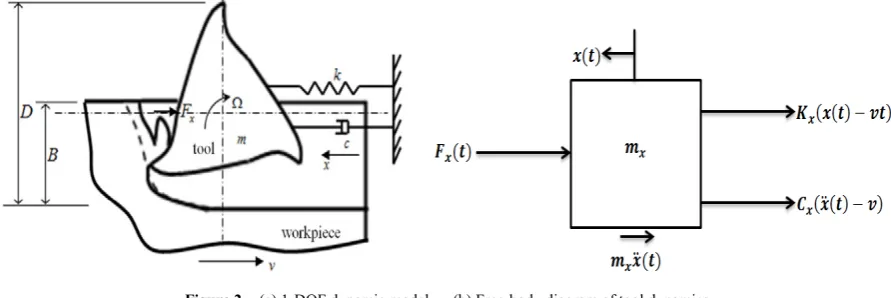
The free-body diagram for the tool dynamics when the motion of the tool 𝑥𝑥(𝑡𝑡) is considered to be a summation of feed motion and vibrations is as shown in Fig. 2.
Figure 2. (a) 1-DOF dynamic model (b) Free-body diagram of tool dynamics
The differential equation governing the motion of the tool as seen from the free-body diagram above now becomes
𝑚𝑚𝑥𝑥̈(𝑡𝑡) +𝑐𝑐[𝑥𝑥̇(𝑡𝑡)− 𝑣𝑣] +𝑘𝑘[𝑥𝑥(𝑡𝑡)− 𝑣𝑣𝑡𝑡] + 𝐹𝐹𝑥𝑥(𝑡𝑡) = 0 (1) A tool-workpiece disposition is considered for the 𝑗𝑗𝑡𝑡ℎ tooth of the tool. The cutting force is considered as having normal and tangential components designated 𝐹𝐹𝑛𝑛,𝑗𝑗(𝑡𝑡) and 𝐹𝐹𝑡𝑡,𝑗𝑗(𝑡𝑡) respectively. Axial component of cutting force is neglected
𝐹𝐹𝑥𝑥(𝑡𝑡) =∑𝑁𝑁𝑗𝑗=𝑔𝑔𝑗𝑗(𝑡𝑡)�𝐹𝐹𝑛𝑛,𝑗𝑗(𝑡𝑡)𝑠𝑠𝑠𝑠𝑛𝑛𝜃𝜃𝑗𝑗(𝑡𝑡) + 𝐹𝐹𝑡𝑡,𝑗𝑗(𝑡𝑡)𝑐𝑐𝑐𝑐𝑠𝑠𝜃𝜃𝑗𝑗(𝑡𝑡)� (2)
The cutting forces on 𝑗𝑗𝑡𝑡ℎ tooth are given by the non-linear law as follows
𝐹𝐹𝑡𝑡,𝑗𝑗(𝑡𝑡) =𝑐𝑐𝑡𝑡𝑤𝑤[𝑓𝑓𝑎𝑎𝑠𝑠𝑠𝑠𝑛𝑛𝜃𝜃𝑗𝑗(𝑡𝑡)]𝛾𝛾 (3a)
𝐹𝐹𝑛𝑛,𝑗𝑗(𝑡𝑡) =𝑐𝑐𝑛𝑛𝑤𝑤[𝑓𝑓𝑎𝑎𝑠𝑠𝑠𝑠𝑛𝑛𝜃𝜃𝑗𝑗(𝑡𝑡)]𝛾𝛾=𝑥𝑥𝐹𝐹𝑡𝑡,𝑗𝑗(𝑡𝑡) (3b)
The symbols 𝐶𝐶t and 𝐶𝐶n are the tangential and normal cutting coefficients which are numerically influenced by workpiece
material properties and tool shape. The symbol 𝑁𝑁 stands for the number of tool teeth. Where 𝑤𝑤 is the depth of cut, 𝑥𝑥 is the ratio of 𝑐𝑐𝑛𝑛/𝑐𝑐𝑡𝑡, 𝑓𝑓𝑎𝑎 is the actual feed given as 𝑥𝑥(𝑡𝑡)− 𝑥𝑥(𝑡𝑡 − 𝜏𝜏) which is the difference between present and one period
delayed position of tool and 𝛾𝛾 is an exponent that is usually less than one, having a value of ¾ for the three-quarter rule. The instantaneous angular position of 𝑗𝑗th tooth 𝜃𝜃𝑗𝑗(𝑡𝑡) is given as
𝜃𝜃𝑗𝑗(𝑡𝑡) =�𝜋𝜋Ω30� 𝑡𝑡+ (𝑗𝑗 −1)2N𝜋𝜋+𝛼𝛼 (4)
where Ω is the spindle speed in rpm and 𝛼𝛼is the initial angular position of the tooth. The screen function 𝑔𝑔𝑗𝑗(𝑡𝑡) has values
of either unity or nullity depending on whether the tool is cutting or not. Given start and end angles of cut 𝜃𝜃𝑠𝑠𝑎𝑎𝑛𝑛𝑎𝑎𝜃𝜃𝑒𝑒
respectively, 𝑔𝑔𝑗𝑗(𝑡𝑡) becomes
𝑔𝑔𝑗𝑗(𝑡𝑡) =�0 1 𝑠𝑠𝑓𝑓𝜃𝜃𝑠𝑠<𝜃𝜃𝑐𝑐𝑡𝑡ℎ𝑒𝑒𝑒𝑒𝑤𝑤𝑠𝑠𝑠𝑠𝑒𝑒𝑗𝑗(𝑡𝑡) <𝜃𝜃𝑒𝑒 (5)
The mathematical form for 𝑔𝑔𝑗𝑗(𝑡𝑡) is given as
𝑔𝑔𝑗𝑗(𝑡𝑡) =12�1 +𝑠𝑠𝑔𝑔𝑛𝑛�𝑠𝑠𝑠𝑠𝑛𝑛�𝜃𝜃𝑗𝑗(𝑡𝑡)− 𝑡𝑡𝑎𝑎𝑛𝑛−1𝒫𝒫� − 𝑠𝑠𝑠𝑠𝑛𝑛[𝜃𝜃𝑠𝑠− 𝑡𝑡𝑎𝑎𝑛𝑛−1𝒫𝒫]�� (6)
For up milling 𝜃𝜃𝑠𝑠𝑎𝑎𝑛𝑛𝑎𝑎𝜃𝜃𝑒𝑒 are expressed in terms of radial depth of cut b [22]
𝜃𝜃𝑠𝑠=�cos0 −1(2𝑏𝑏 𝐷𝐷⁄ −1) 𝐷𝐷𝑐𝑐𝑤𝑤𝑛𝑛 − 𝑚𝑚𝑠𝑠𝑚𝑚𝑚𝑚𝑠𝑠𝑛𝑛𝑔𝑔𝑈𝑈𝑈𝑈 − 𝑚𝑚𝑠𝑠𝑚𝑚𝑚𝑚𝑠𝑠𝑛𝑛𝑔𝑔 (7a)
𝜃𝜃𝑒𝑒 =�cos
−1(1−2𝑏𝑏 𝐷𝐷⁄ ) 𝑈𝑈𝑈𝑈 − 𝑚𝑚𝑠𝑠𝑚𝑚𝑚𝑚𝑠𝑠𝑛𝑛𝑔𝑔
𝜋𝜋 𝐷𝐷𝑐𝑐𝑤𝑤𝑛𝑛 − 𝑚𝑚𝑠𝑠𝑚𝑚𝑚𝑚𝑠𝑠𝑛𝑛𝑔𝑔 (7b)
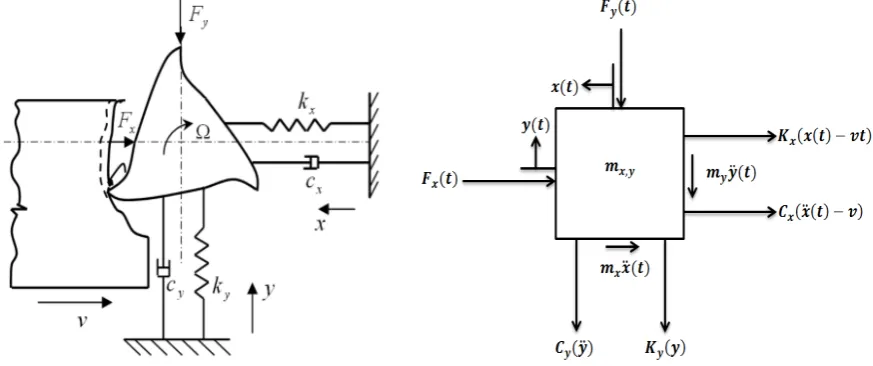
Figure 3 below is a 2 DOF depiction of an end-milling tool, with the stiffness and damping elements oriented in the 𝑥𝑥 − 𝑦𝑦
plane (horizontal plane). The modal parameters 𝑘𝑘𝑥𝑥,𝑚𝑚𝑥𝑥 and 𝑐𝑐𝑥𝑥 are for 𝑥𝑥 −vibration while 𝑘𝑘𝑦𝑦,𝑚𝑚𝑦𝑦 and 𝑐𝑐𝑦𝑦 are for
𝑦𝑦 −vibration
Figure 3. (a) 2-DOF tool dynamics (b) Free-body diagram of toll dynamics
The governing equation of motion now becomes
𝑚𝑚𝑥𝑥𝑥𝑥̈(𝑡𝑡) +𝑐𝑐𝑥𝑥[𝑥𝑥̇(𝑡𝑡)− 𝑣𝑣] +𝑘𝑘𝑥𝑥[𝑥𝑥(𝑡𝑡)− 𝑣𝑣𝑡𝑡] + 𝐹𝐹𝑥𝑥𝑥𝑥(𝑡𝑡) = 0 (8a)
𝑚𝑚𝑦𝑦𝑦𝑦̈(𝑡𝑡) +𝑐𝑐𝑦𝑦𝑦𝑦̇(𝑡𝑡) +𝑘𝑘𝑦𝑦(𝑡𝑡) + 𝐹𝐹𝑦𝑦(𝑡𝑡) = 0 (8b)
The 𝑥𝑥 and 𝑦𝑦 −component of the cutting force on the tool are
𝐹𝐹𝑥𝑥(𝑡𝑡) =∑𝑁𝑁𝑗𝑗=𝑔𝑔𝑗𝑗(𝑡𝑡)�𝐹𝐹𝑛𝑛,𝑗𝑗(𝑡𝑡)𝑠𝑠𝑠𝑠𝑛𝑛𝜃𝜃𝑗𝑗(𝑡𝑡) + 𝐹𝐹𝑡𝑡,𝑗𝑗(𝑡𝑡)𝑐𝑐𝑐𝑐𝑠𝑠𝜃𝜃𝑗𝑗(𝑡𝑡)� (9a)
The actual feed rate 𝑓𝑓𝑎𝑎 of 𝑗𝑗𝑡𝑡ℎ tooth at angular position 𝜃𝜃𝑗𝑗(𝑡𝑡) is given as
𝑓𝑓𝑎𝑎(𝑡𝑡) = [𝑋𝑋(𝑡𝑡)− 𝑥𝑥(𝑡𝑡 − 𝜏𝜏)]𝑠𝑠𝑠𝑠𝑛𝑛𝜃𝜃𝑗𝑗(𝑡𝑡) + [𝑌𝑌(𝑡𝑡)− 𝑦𝑦(𝑡𝑡 − 𝜏𝜏)𝑐𝑐𝑐𝑐𝑠𝑠𝜃𝜃𝑗𝑗(𝑡𝑡) (10)
where𝑋𝑋(𝑡𝑡) =𝑣𝑣𝑡𝑡+𝑥𝑥𝑡𝑡(𝑡𝑡) +𝑥𝑥(𝑡𝑡),𝑌𝑌(𝑡𝑡) =𝑦𝑦𝑡𝑡(𝑡𝑡) +𝑦𝑦(𝑡𝑡).
The quantity 𝑥𝑥(𝑡𝑡) and 𝑦𝑦(𝑡𝑡) are perturbations in the 𝑥𝑥 and 𝑦𝑦 −directions respectively. The linearized Taylor series expansion of 𝑓𝑓𝑎𝑎𝛾𝛾 about 𝑣𝑣𝜏𝜏𝑠𝑠𝑠𝑠𝑛𝑛𝜃𝜃𝑗𝑗(𝑡𝑡) then reads
𝑓𝑓𝑎𝑎𝛾𝛾= [𝑣𝑣𝜏𝜏𝑠𝑠𝑠𝑠𝑛𝑛𝜃𝜃𝑗𝑗(𝑡𝑡)]𝛾𝛾+𝛾𝛾[𝑣𝑣𝜏𝜏𝑠𝑠𝑠𝑠𝑛𝑛𝜃𝜃𝑗𝑗(𝑡𝑡)]𝛾𝛾−1{[𝑥𝑥(𝑡𝑡)− 𝑥𝑥(𝑡𝑡 − 𝜏𝜏)]𝑠𝑠𝑠𝑠𝑛𝑛𝜃𝜃𝑗𝑗(𝑡𝑡) + [𝑦𝑦(𝑡𝑡)− 𝑦𝑦(𝑡𝑡 − 𝜏𝜏)]𝑐𝑐𝑐𝑐𝑠𝑠𝜃𝜃𝑗𝑗(𝑡𝑡) (11)
When 𝑥𝑥(𝑡𝑡) and 𝑦𝑦(𝑡𝑡) are considered to be zero in equations (11), (3a-3b) and (9a- 9b) above, we will form equations (12a) and (12b) from equations (8a) and (8b)
𝑚𝑚𝑥𝑥𝑥𝑥̈(𝑡𝑡) +𝑐𝑐𝑥𝑥𝑥𝑥̇𝑡𝑡(𝑡𝑡) +𝑘𝑘𝑥𝑥𝑥𝑥𝑡𝑡(𝑡𝑡) =−𝐹𝐹𝑈𝑈𝑥𝑥(𝑡𝑡) (12a)
𝑚𝑚𝑦𝑦𝑦𝑦̈(𝑡𝑡) +𝑐𝑐𝑦𝑦𝑦𝑦̇𝑡𝑡(𝑡𝑡) +𝑘𝑘𝑦𝑦𝑦𝑦𝑡𝑡(𝑡𝑡) =−𝐹𝐹𝑈𝑈𝑦𝑦(𝑡𝑡) (12b)
Where
𝐹𝐹𝑈𝑈𝑥𝑥(𝑡𝑡) =𝑐𝑐𝑤𝑤(𝑣𝑣𝜏𝜏)𝛾𝛾∑𝑗𝑗𝑁𝑁=𝑔𝑔𝑗𝑗(𝑡𝑡)𝑠𝑠𝑠𝑠𝑛𝑛𝛾𝛾𝜃𝜃𝑗𝑗(𝑡𝑡)�𝑥𝑥𝑠𝑠𝑠𝑠𝑛𝑛𝜃𝜃𝑗𝑗(𝑡𝑡) + 𝑐𝑐𝑐𝑐𝑠𝑠𝜃𝜃𝑗𝑗(𝑡𝑡)� (13a)
𝐹𝐹𝑈𝑈𝑦𝑦(𝑡𝑡) =𝑐𝑐𝑤𝑤(𝑣𝑣𝜏𝜏)𝛾𝛾∑𝑗𝑗𝑁𝑁=𝑔𝑔𝑗𝑗(𝑡𝑡)𝑠𝑠𝑠𝑠𝑛𝑛𝛾𝛾𝜃𝜃𝑗𝑗(𝑡𝑡)�−𝑥𝑥𝑐𝑐𝑐𝑐𝑠𝑠𝜃𝜃𝑗𝑗(𝑡𝑡) + 𝑠𝑠𝑠𝑠𝑛𝑛𝜃𝜃𝑗𝑗(𝑡𝑡)� (13b)
The periodic forces −𝐹𝐹𝑈𝑈𝑥𝑥(𝑡𝑡) and −𝐹𝐹𝑈𝑈𝑦𝑦(𝑡𝑡) respectively drives the two orthogonal 𝜏𝜏 −periodic tool responses 𝑥𝑥𝑡𝑡(𝑡𝑡) and
𝑦𝑦𝑡𝑡(𝑡𝑡).
Putting equations (12a-12b) into equation (8a-8b) and simplifying give
𝑚𝑚𝑥𝑥𝑥𝑥̈𝑥𝑥(𝑡𝑡) +𝑐𝑐𝑥𝑥𝑥𝑥̇𝑥𝑥(𝑡𝑡) +𝑘𝑘𝑥𝑥𝑥𝑥𝑥𝑥(𝑡𝑡) =−ℎ𝑥𝑥𝑥𝑥(𝑡𝑡)[𝑥𝑥(𝑡𝑡)− 𝑥𝑥(𝑡𝑡 − 𝜏𝜏)]− ℎ𝑥𝑥𝑦𝑦(𝑡𝑡)[𝑦𝑦(𝑡𝑡)− 𝑦𝑦(𝑡𝑡 − 𝜏𝜏)] (14a)
𝑚𝑚𝑦𝑦𝑦𝑦̈𝑦𝑦(𝑡𝑡) +𝑐𝑐𝑦𝑦𝑦𝑦̇𝑦𝑦(𝑡𝑡) +𝑘𝑘𝑦𝑦𝑦𝑦𝑦𝑦(𝑡𝑡) =−ℎ𝑦𝑦𝑥𝑥(𝑡𝑡)[𝑥𝑥(𝑡𝑡)− 𝑥𝑥(𝑡𝑡 − 𝜏𝜏)]− ℎ𝑦𝑦𝑦𝑦(𝑡𝑡)[𝑦𝑦(𝑡𝑡)− 𝑦𝑦(𝑡𝑡 − 𝜏𝜏)] (14b)
In the light of specific periodic cutting force variations, we have as
ℎ𝑥𝑥𝑥𝑥(𝑡𝑡) =𝐶𝐶𝑡𝑡∑𝑁𝑁𝑗𝑗=1𝑔𝑔𝑗𝑗(𝑡𝑡) sin�𝜃𝜃𝑗𝑗(𝑡𝑡)� �(𝐶𝐶𝑛𝑛⁄𝐶𝐶𝑡𝑡)sin𝜃𝜃𝑗𝑗(𝑡𝑡) + cos𝜃𝜃𝑗𝑗(𝑡𝑡)� (15a)
ℎ𝑥𝑥𝑦𝑦(𝑡𝑡) =𝐶𝐶𝑡𝑡∑𝑁𝑁𝑗𝑗=1𝑔𝑔𝑗𝑗(𝑡𝑡)cos𝜃𝜃𝑗𝑗(𝑡𝑡)�(𝐶𝐶𝑛𝑛⁄𝐶𝐶𝑡𝑡)sin𝜃𝜃𝑗𝑗(𝑡𝑡) + cos𝜃𝜃𝑗𝑗(𝑡𝑡)� (15b)
ℎ𝑦𝑦𝑥𝑥(𝑡𝑡) =𝐶𝐶𝑡𝑡∑𝑁𝑁𝑗𝑗=1𝑔𝑔𝑗𝑗(𝑡𝑡) sin�𝜃𝜃𝑗𝑗(𝑡𝑡)� �(𝐶𝐶𝑛𝑛⁄𝐶𝐶𝑡𝑡)cos𝜃𝜃𝑗𝑗(𝑡𝑡)−sin𝜃𝜃𝑗𝑗(𝑡𝑡)� (15c)
ℎ𝑦𝑦𝑦𝑦(𝑡𝑡) =𝐶𝐶𝑡𝑡∑𝑁𝑁𝑗𝑗=1𝑔𝑔𝑗𝑗(𝑡𝑡)cos𝜃𝜃𝑗𝑗(𝑡𝑡)�(𝐶𝐶𝑛𝑛⁄𝐶𝐶𝑡𝑡)cos𝜃𝜃𝑗𝑗(𝑡𝑡)−sin𝜃𝜃𝑗𝑗(𝑡𝑡)� (15d)
Equations (14a) and (14b) are put in matrix form gives
ẍ(𝑡𝑡) + M−1Cẋ(𝑡𝑡) + M−1Kx(𝑡𝑡) = M−1H(t)[x(𝑡𝑡)−x(𝑡𝑡 − 𝜏𝜏)] (16)
Where 𝑋𝑋(𝑡𝑡) = {𝑥𝑥(𝑡𝑡) 𝑦𝑦(𝑡𝑡)}𝑇𝑇 is the vector of chatter vibration in the two orthogonal directions of 𝑥𝑥 and 𝑦𝑦, the mass M,
damping C and stiffness K matrices are respectively given as
𝑀𝑀=�𝑚𝑚0𝑥𝑥 𝑚𝑚0
𝑦𝑦�, 𝐶𝐶=�
𝑐𝑐𝑥𝑥 0
0 𝑐𝑐𝑦𝑦�, 𝐾𝐾=�
𝑘𝑘𝑥𝑥 0
0 𝑘𝑘𝑦𝑦� (17)
The forcing function in equation (17) 𝐻𝐻(𝑡𝑡)𝑋𝑋(𝑡𝑡 − 𝜏𝜏) contains a time-periodic function 𝐻𝐻(𝑡𝑡) that results from rotational motion of the milling teeth
𝐻𝐻(𝑡𝑡) =−𝑤𝑤 �ℎℎ𝑥𝑥𝑥𝑥(𝑡𝑡) ℎ𝑥𝑥𝑦𝑦(𝑡𝑡)
𝑦𝑦𝑥𝑥(𝑡𝑡) ℎ𝑦𝑦𝑦𝑦(𝑡𝑡)� (18)
By pre-multiplying equation (16) with the inverse of the mass matrix, the modal form of the governing model upon little re-arrangement becomes
ẍ(𝑡𝑡) + M−1Cẋ(𝑡𝑡) + M−1[K−H(t)]x(𝑡𝑡) =−M−1H(t)x(𝑡𝑡 − 𝜏𝜏) (19)
The expanded form of equation (19) when each of the matrix operations M−1C, M−1K and M−1[K−H(t)] are carried
out reads
�𝑥𝑥̈𝑦𝑦̈((𝑡𝑡𝑡𝑡))�+�2𝜁𝜁𝑥𝑥0𝜔𝜔𝑛𝑛𝑥𝑥 2𝜁𝜁0
𝑦𝑦𝜔𝜔𝑛𝑛𝑦𝑦� �𝑥𝑥̇
(𝑡𝑡)
𝑦𝑦̇(𝑡𝑡)�+�
𝜔𝜔𝑛𝑛𝑥𝑥2 +𝑤𝑤ℎ𝑚𝑚𝑥𝑥𝑥𝑥(𝑡𝑡) 𝑥𝑥
𝑤𝑤ℎ𝑥𝑥𝑦𝑦(𝑡𝑡) 𝑚𝑚𝑥𝑥 𝑤𝑤ℎ𝑦𝑦𝑥𝑥(𝑡𝑡)
𝑚𝑚𝑦𝑦 𝜔𝜔𝑛𝑛𝑦𝑦
2 +𝑤𝑤ℎ𝑦𝑦𝑦𝑦(𝑡𝑡) 𝑚𝑚𝑦𝑦
� �𝑥𝑥𝑦𝑦((𝑡𝑡𝑡𝑡))�=�
𝑤𝑤ℎ𝑥𝑥𝑥𝑥(𝑡𝑡) 𝑚𝑚𝑥𝑥
𝑤𝑤ℎ𝑥𝑥𝑦𝑦(𝑡𝑡) 𝑚𝑚𝑥𝑥 𝑤𝑤ℎ𝑦𝑦𝑥𝑥(𝑡𝑡)
𝑚𝑚𝑦𝑦
𝑤𝑤ℎ𝑦𝑦𝑦𝑦(𝑡𝑡) 𝑚𝑚𝑦𝑦
� �𝑥𝑥𝑦𝑦((𝑡𝑡 − 𝜏𝜏𝑡𝑡 − 𝜏𝜏))� (20)
4. Progress in Stability Analysis of Milling
Stability analysis of milling process is normally carried out on either the state space form or non-state space form of the governing model. Most stability analysis carried out on milling process using the methods of semi-discretization [14, 5], temporal finite element analysis [16] and the full-discretization method [17, 18] are formulated on the state space form of the governing model while stability analysis based on the methods of Zero order approximation or multi-frequency solution can be formulated on the non-state space version of the governing model.
Considering the governing model (equation (20)), four state variables can be identified; 𝑥𝑥(𝑡𝑡), 𝑦𝑦(𝑡𝑡), 𝑥𝑥̇(𝑡𝑡) and 𝑦𝑦̇(𝑡𝑡). The state variables are then designated as follows; 𝑦𝑦1(𝑡𝑡) =𝑥𝑥(𝑡𝑡), 𝑦𝑦2(𝑡𝑡) =𝑦𝑦(𝑡𝑡), 𝑦𝑦3(𝑡𝑡) =𝑥𝑥̇(𝑡𝑡) and 𝑦𝑦4(𝑡𝑡) =𝑦𝑦̇(𝑡𝑡). For better
understanding of the process of state space transformation of equation (20), two constituent equations are written out as
𝑥𝑥̈(𝑡𝑡) + 2𝜁𝜁𝑥𝑥𝜔𝜔𝑛𝑛𝑥𝑥𝑥𝑥̇(𝑡𝑡) +�𝜔𝜔𝑛𝑛𝑥𝑥2 +𝑤𝑤ℎ𝑚𝑚𝑥𝑥𝑥𝑥𝑥𝑥(𝑡𝑡)� 𝑥𝑥(𝑡𝑡) +𝑤𝑤ℎ𝑚𝑚𝑥𝑥𝑦𝑦𝑥𝑥(𝑡𝑡)𝑦𝑦(𝑡𝑡) =𝑤𝑤ℎ𝑚𝑚𝑥𝑥𝑥𝑥𝑥𝑥(𝑡𝑡)𝑥𝑥(𝑡𝑡 − 𝜏𝜏) +𝑤𝑤ℎ𝑚𝑚𝑥𝑥𝑦𝑦𝑥𝑥(𝑡𝑡)𝑦𝑦(𝑡𝑡 − 𝜏𝜏) (21a)
𝑦𝑦̈(𝑡𝑡) + 2𝜁𝜁𝑦𝑦𝜔𝜔𝑛𝑛𝑦𝑦𝑥𝑥̇(𝑡𝑡) +𝑤𝑤ℎ𝑚𝑚𝑦𝑦𝑥𝑥𝑦𝑦(𝑡𝑡)𝑥𝑥(𝑡𝑡) +�𝜔𝜔𝑛𝑛𝑦𝑦2 +𝑤𝑤ℎ𝑚𝑚𝑦𝑦𝑦𝑦𝑦𝑦(𝑡𝑡)� 𝑦𝑦(𝑡𝑡) =𝑤𝑤ℎ𝑚𝑚𝑦𝑦𝑥𝑥𝑦𝑦(𝑡𝑡)𝑥𝑥(𝑡𝑡 − 𝜏𝜏) +𝑤𝑤ℎ𝑚𝑚𝑦𝑦𝑦𝑦𝑦𝑦(𝑡𝑡)𝑦𝑦(𝑡𝑡 − 𝜏𝜏) (21b)
In light of the identified state variables, equation (21a-21b) can be re-written as
𝑦𝑦̇1(𝑡𝑡) =𝑦𝑦3(𝑡𝑡) (22a)
𝑦𝑦̇2(𝑡𝑡) =𝑦𝑦̇(𝑡𝑡) =𝑦𝑦4(𝑡𝑡) (22b)
𝑦𝑦̇3(𝑡𝑡) =− �𝜔𝜔𝑛𝑛𝑥𝑥2 +𝑤𝑤ℎ𝑚𝑚𝑥𝑥𝑥𝑥𝑥𝑥(𝑡𝑡)� 𝑦𝑦1(𝑡𝑡)−𝑤𝑤ℎ𝑚𝑚𝑥𝑥𝑦𝑦𝑥𝑥(𝑡𝑡)𝑦𝑦2(𝑡𝑡)−2𝜁𝜁𝑥𝑥𝜔𝜔𝑛𝑛𝑥𝑥𝑦𝑦3(𝑡𝑡) +𝑤𝑤ℎ𝑚𝑚𝑥𝑥𝑥𝑥𝑥𝑥(𝑡𝑡)𝑦𝑦1(𝑡𝑡 − 𝜏𝜏) +𝑤𝑤ℎ𝑚𝑚𝑥𝑥𝑦𝑦𝑥𝑥(𝑡𝑡)𝑦𝑦2(𝑡𝑡 − 𝜏𝜏) (22c)
𝑦𝑦̇4(𝑡𝑡) =−𝑤𝑤ℎ𝑚𝑚𝑦𝑦𝑥𝑥𝑦𝑦(𝑡𝑡)𝑦𝑦1(𝑡𝑡)− �𝜔𝜔𝑛𝑛𝑦𝑦2 +𝑤𝑤ℎ𝑚𝑚𝑦𝑦𝑦𝑦𝑦𝑦(𝑡𝑡)� 𝑦𝑦2(𝑡𝑡)−2𝜁𝜁𝑦𝑦𝜔𝜔𝑛𝑛𝑦𝑦𝑦𝑦4(𝑡𝑡) +𝑤𝑤ℎ𝑚𝑚𝑦𝑦𝑥𝑥𝑦𝑦(𝑡𝑡)𝑦𝑦1(𝑡𝑡 − 𝜏𝜏) +𝑤𝑤ℎ𝑚𝑚𝑦𝑦𝑦𝑦𝑦𝑦(𝑡𝑡)𝑦𝑦2(𝑡𝑡 − 𝜏𝜏) (22d)
It is seen that equation (22a-22d) is the four-dimensional state space form written in compact form as
𝑦𝑦̇(𝑡𝑡) =𝐀𝐀(𝑡𝑡)𝑦𝑦(𝑡𝑡)− 𝐁𝐁(𝑡𝑡)𝑦𝑦(𝑡𝑡 − 𝜏𝜏) (23) Where 𝑦𝑦(𝑡𝑡) = {𝑦𝑦1(𝑡𝑡) 𝑦𝑦2(𝑡𝑡) 𝑦𝑦3(𝑡𝑡) 𝑦𝑦4(𝑡𝑡)}𝑇𝑇 (the superscript “T” means transposition)
𝐀𝐀(𝑡𝑡) =
⎣ ⎢ ⎢ ⎢ ⎢
⎡ 00 00 10 01
−𝜔𝜔𝑛𝑛𝑥𝑥2 −𝑤𝑤ℎ𝑚𝑚𝑥𝑥𝑥𝑥𝑥𝑥(𝑡𝑡) −𝑤𝑤ℎ𝑚𝑚𝑥𝑥𝑦𝑦𝑥𝑥(𝑡𝑡) −2𝜁𝜁𝑥𝑥𝜔𝜔𝑛𝑛𝑥𝑥 0
−𝑤𝑤ℎ𝑦𝑦𝑥𝑥(𝑡𝑡)
𝑚𝑚𝑦𝑦 −𝜔𝜔𝑛𝑛𝑦𝑦
2 −𝑤𝑤ℎ𝑦𝑦𝑦𝑦(𝑡𝑡)
𝑚𝑚𝑦𝑦 0 −2𝜁𝜁𝑦𝑦𝜔𝜔𝑛𝑛𝑦𝑦⎦
⎥ ⎥ ⎥ ⎥ ⎤
(24)
𝑩𝑩(𝑡𝑡) =
⎣ ⎢ ⎢ ⎢ ⎢
⎡ 00 00 0 00 0
−𝑤𝑤ℎ𝑥𝑥𝑥𝑥(𝑡𝑡) 𝑚𝑚𝑥𝑥 −
𝑤𝑤ℎ𝑥𝑥𝑦𝑦(𝑡𝑡) 𝑚𝑚𝑥𝑥 0 0
−𝑤𝑤ℎ𝑦𝑦𝑥𝑥(𝑡𝑡) 𝑚𝑚𝑦𝑦 −
𝑤𝑤ℎ𝑦𝑦𝑦𝑦(𝑡𝑡)
𝑚𝑚𝑦𝑦 0 0⎦
⎥ ⎥ ⎥ ⎥ ⎤
(25)
Equation (23) is then re-arranged by splitting matrix 𝐀𝐀(𝑡𝑡) into 𝐁𝐁(𝑡𝑡) and a constant matrix 𝐀𝐀 so that the governing model can conform with the full-discretization method such that equation (23) becomes
𝑦𝑦̇(𝑡𝑡) =𝐀𝐀𝑦𝑦(𝑡𝑡) +𝐁𝐁(𝑡𝑡)𝑦𝑦(𝑡𝑡)− 𝐁𝐁(𝑡𝑡)𝑦𝑦(𝑡𝑡 − 𝜏𝜏) (26) where
𝐀𝐀=
⎣ ⎢ ⎢
⎡ 00 00 10 01
−𝜔𝜔𝑛𝑛𝑥𝑥2 0 −2𝜁𝜁𝑥𝑥𝜔𝜔𝑛𝑛𝑥𝑥 0
0 −𝜔𝜔𝑛𝑛𝑦𝑦2 0 −2𝜁𝜁𝑦𝑦𝜔𝜔𝑛𝑛𝑦𝑦⎦
⎥ ⎥ ⎤
(27)
The procedure which involves discretizing the system’s period and interpolating or approximating the solution in the discrete intervals is adopted for this work. The full-discretization method is the choice of stability analysis in this work because it has been proven to save more computational time than the semi-discretization method. This is due to the introduction of interpolation polynomials in the integration scheme of full-discretization method which upon solving produces a discrete map that is used for stability analysis. The full-discretization method is heavily based on discretization. The discretization and solution schemes are summarized from the work [18] to involve dividing the period of the governing full-discretization model (equation (26)) τ into 𝑒𝑒 equal discrete time intervals [𝑡𝑡𝑠𝑠,𝑡𝑡𝑠𝑠+1] where 𝑠𝑠= 0, 1, 2, … … … (𝑒𝑒 −1)
and 𝑡𝑡𝑠𝑠 =𝑠𝑠𝜏𝜏𝑒𝑒=𝑠𝑠∆𝑡𝑡=𝑠𝑠(𝑡𝑡𝑠𝑠+1− 𝑡𝑡𝑠𝑠).
Equation (26) is then handled as the governing model in the general discrete interval [𝑡𝑡𝑠𝑠,𝑡𝑡𝑠𝑠+1]. The solution in the discrete
y𝑠𝑠+1 = eA∆𝑡𝑡y𝑠𝑠+∫𝑡𝑡𝑡𝑡𝑠𝑠𝑠𝑠+1𝑒𝑒𝐴𝐴(𝑡𝑡𝑠𝑠+1−𝑠𝑠)[B(𝑠𝑠)𝑦𝑦(𝑠𝑠)−B(𝑠𝑠)𝑦𝑦(𝑠𝑠 − 𝜏𝜏)]d𝑠𝑠 (28)
What differentiates various full-discretization methods is the manner of proceeding from equation (28). The original full-discretization method [17] approximated the milling solution or motion 𝑦𝑦(𝑠𝑠) with the tool of linear interpolation theory. Other subsequent full-discretization methods which are seen in the reference list of the work [18] are also based on interpolation theory of various orders and kinds (i.e, Lagrange, Newton and Hermite interpolation theories). The work [18] has introduced full-discretization methods for which the milling motion 𝑦𝑦(𝑠𝑠) is approximated with least squares theory to yield considerable savings in computational time. The first-order least squares approximation of the state terms 𝑦𝑦(𝑠𝑠), 𝐵𝐵(𝑠𝑠) and 𝑦𝑦(𝑡𝑡 − 𝜏𝜏) is as follows
The first order least squares approximation of the state term 𝑦𝑦(𝑠𝑠) is seen as
𝑦𝑦(𝑠𝑠) = {1 𝑠𝑠}�� �𝑠𝑠+1 𝑠𝑠1𝑚𝑚�{1 𝑠𝑠}
𝑚𝑚=𝑠𝑠 � −1
� �𝑠𝑠1𝑚𝑚� 𝑦𝑦𝑚𝑚 𝑠𝑠+1
𝑚𝑚=𝑠𝑠 (29)
It should be noted that 𝑚𝑚=𝑠𝑠 and 𝑚𝑚=𝑠𝑠+ 1 in the summation signs of equation (29) corresponding to terms at 𝑡𝑡𝑠𝑠 and 𝑡𝑡𝑠𝑠+1.
This is re-written as
𝑦𝑦(𝑠𝑠) = {1 𝑠𝑠}
⎣ ⎢ ⎢ ⎢ ⎢ ⎢
⎡ i 1 1
l i
1 1 2
1
i ll i
i i
l l
l i l i
s
s
s
+ + = = + + = =∑ ∑
∑
∑
⎦ ⎥ ⎥ ⎥ ⎥ ⎥⎤−1 1
1 i l l i i l l l i
y
y
s
+ = + =
∑
∑
(30)Equation (30) is further re-written as
𝑦𝑦(𝑠𝑠) =
2
2
1 1 1
{1 }
1
i i i l l i l i l l i
s
s
s
+ + + = = =
−
∑ ∑
∑
⎣ ⎢ ⎢ ⎢ ⎢ ⎢ ⎡ 2i 1 1
l i 1 1
1
i l l l i i i ll i l i
s
s
s
+ + = = + + = =−
−
∑
∑
∑
∑
⎦ ⎥ ⎥ ⎥ ⎥ ⎥⎤−1 1
1 i l l i i l l l i
y
y
s
+ = + =
∑
∑
(31)The above equation is multiply to give
𝑦𝑦(𝑠𝑠) =
2
2
1 1 1 1
2
1 1 1
1
i i i i
l l l l l l i l i l i l i
i i i l l i l i l l i
y
y
s
s s
s
s
+ + + + = = = = + + + = = =−
−
∑ ∑
∑ ∑
∑ ∑
∑
+ 21 1 1 1
2
1 1 1
1
1
i i i i
l l l l l i l i l i l i
i i i l l i l i l l i
y
y
s
s
s
s
+ + + + = = = = + + + = = =−
+
−
∑ ∑
∑ ∑
∑ ∑
∑
𝑠𝑠 (32)
By carrying out the summation in equation (32) and simplifying it gives equation (33a)
𝑦𝑦(𝑠𝑠) =
s
t
t
t
y
y
y
y
t
i i i i i i∆
+
−
+
∆
−
+ ++1 1 1
(33a)
With the substitution of 𝑡𝑡𝑠𝑠 = 0 and 𝑡𝑡𝑠𝑠+1 =∆𝑡𝑡, Equation (33a) is put in the form
𝑦𝑦(𝑠𝑠) =
(
)
y
is
y
it
s
t
t
11
1
+∆
+
−
∆
∆
(33b)In the same way as above, the delay state 𝑦𝑦(𝑠𝑠 − 𝜏𝜏) and periodic coefficient matrix 𝐵𝐵(𝑡𝑡) will also give as
𝑦𝑦(𝑡𝑡 − 𝜏𝜏) =
(
)
y
i rt
y
i rt
t
t
t
∆
−
−+
∆
+−∆
11
1
(34)
𝐵𝐵(𝑠𝑠) =
1
(
t t
)
i1
t
i 1t
∆ −
+
t
B
+∆
B
∆
(35)y𝑠𝑠+1 =𝐹𝐹0y𝑠𝑠+ (𝐺𝐺11B𝑠𝑠+𝐺𝐺12B𝑠𝑠+1)y𝑠𝑠+ (𝐺𝐺12B𝑠𝑠+𝐺𝐺13B𝑠𝑠+1)y𝑠𝑠+1
−(𝐺𝐺11B𝑠𝑠+𝐺𝐺12B𝑠𝑠+1)y𝑠𝑠−𝑒𝑒−(𝐺𝐺12B𝑠𝑠+𝐺𝐺13B𝑠𝑠+1)y𝑠𝑠+1−𝑒𝑒 (36)
Where
𝐺𝐺11=(∆𝑡𝑡1)2{𝐹𝐹1(∆𝑡𝑡)2−2𝐹𝐹2∆𝑡𝑡+𝐹𝐹3} (36a) 𝐺𝐺12=(∆𝑡𝑡1)2{𝐹𝐹2∆𝑡𝑡 − 𝐹𝐹3} (36b)
𝐺𝐺13=(∆𝑡𝑡1)2𝐹𝐹3 (36c) 𝐹𝐹0= eA∆𝑡𝑡 (37a)
and
𝐹𝐹1=� 𝑒𝑒𝐴𝐴(𝑡𝑡𝑠𝑠+1−𝑠𝑠)d𝑠𝑠= 𝑡𝑡𝑠𝑠+1
𝑡𝑡𝑠𝑠 � 𝑒𝑒∆𝑡𝑡 𝐴𝐴(∆𝑡𝑡−𝑠𝑠) 0 𝑎𝑎𝑠𝑠= �𝑒𝑒𝐴𝐴∆𝑡𝑡− 𝑒𝑒𝐴𝐴(∆𝑡𝑡−𝑠𝑠)� 0 ∆𝑡𝑡
,𝐹𝐹1= (𝐹𝐹0−I)A−1 (37b)
𝐹𝐹2=� 𝑒𝑒𝐴𝐴(𝑡𝑡𝑠𝑠+1−𝑠𝑠)(𝑠𝑠−ti)d𝑠𝑠 𝑡𝑡𝑠𝑠+1
𝑡𝑡𝑠𝑠
𝑎𝑎𝑠𝑠=� 𝑒𝑒∆𝑡𝑡 𝐴𝐴(∆𝑡𝑡−𝑠𝑠)sd𝑠𝑠=
0 �−s𝑒𝑒
𝐴𝐴(∆𝑡𝑡−𝑠𝑠)A−1+ eA∆𝑡𝑡(A−1)2− 𝑒𝑒𝐴𝐴(∆𝑡𝑡−𝑠𝑠)(A−1)2� 0 ∆𝑡𝑡
𝐹𝐹2= (𝐹𝐹1− ∆∆𝑡𝑡I)A−1 (37c)
𝐹𝐹3=� 𝑒𝑒𝐴𝐴(𝑡𝑡𝑠𝑠+1−𝑠𝑠)(𝑠𝑠−ti)2d𝑠𝑠= 𝑡𝑡𝑠𝑠+1
𝑡𝑡𝑠𝑠
� 𝑒𝑒∆𝑡𝑡 𝐴𝐴(∆𝑡𝑡−𝑠𝑠)s2d𝑠𝑠 0
=�−s2𝑒𝑒𝐴𝐴(∆𝑡𝑡−𝑠𝑠)A−1+ seA∆𝑡𝑡(A−1)2− 𝑠𝑠𝑒𝑒𝐴𝐴(∆𝑡𝑡−𝑠𝑠)(A−1)2� 0 ∆𝑡𝑡
+�−s𝑒𝑒𝐴𝐴(∆𝑡𝑡−𝑠𝑠)(A−1)2+ eA∆𝑡𝑡(A−1)3− 𝑒𝑒𝐴𝐴(∆𝑡𝑡−𝑠𝑠)(A−1)3� 0 ∆𝑡𝑡
−{𝑠𝑠𝑒𝑒𝐴𝐴∆𝑡𝑡(A−1)2} 0
∆𝑡𝑡+�eA∆𝑡𝑡(A−1)2− 𝑒𝑒𝐴𝐴(∆𝑡𝑡−𝑠𝑠)(A−1)2� 0 ∆𝑡𝑡
𝑡𝑡ℎ𝑒𝑒𝑒𝑒𝑒𝑒𝑓𝑓𝑐𝑐𝑒𝑒𝑒𝑒, 𝐹𝐹3= (2𝐹𝐹2−(∆𝑡𝑡)2I)A−1 (37d)
The equation (36) is re-arranged to become
y𝑠𝑠+1= P𝑠𝑠(𝐹𝐹0+𝐺𝐺11B𝑠𝑠+𝐺𝐺12B𝑠𝑠+1)y𝑠𝑠−P𝑠𝑠(𝐺𝐺12B𝑠𝑠+𝐺𝐺13B𝑠𝑠+1)y𝑠𝑠+1−𝑒𝑒−P𝑠𝑠(𝐺𝐺11B𝑠𝑠+𝐺𝐺12B𝑠𝑠+1)y𝑠𝑠−𝑒𝑒 (38)
Where
P𝑠𝑠 = [I− 𝐺𝐺12B𝑠𝑠− 𝐺𝐺13B𝑠𝑠+1]−1 (39)
The local discrete map derived from equation (38) is given by [15]
⎩ ⎪ ⎨ ⎪ ⎧ yy𝑠𝑠+1𝑠𝑠
y𝑠𝑠−1
⋮
y𝑠𝑠+1−𝑒𝑒⎭⎪
⎬ ⎪ ⎫ = ⎣ ⎢ ⎢ ⎢
⎡M11𝑠𝑠 0 ⋯ 0 M1𝑠𝑠𝑒𝑒 M1,𝑠𝑠𝑒𝑒+1
I 0 ⋯ 0 0 0
0 I ⋯ 0 0 0
⋮ ⋮ ⋮ ⋮ ⋮ ⋮
0 0 0 0 I 0 ⎦⎥
⎥ ⎥ ⎤ ⎩ ⎪ ⎨ ⎪ ⎧yy𝑠𝑠−𝑠𝑠1
y𝑠𝑠−2
⋮
y𝑠𝑠−𝑒𝑒⎭⎪
⎬ ⎪ ⎫
(40)
where
M11𝑠𝑠 = P𝑠𝑠(𝐹𝐹0+𝐺𝐺11B𝑠𝑠+𝐺𝐺12B𝑠𝑠+1) (41a)
M1𝑠𝑠𝑒𝑒 =−P𝑠𝑠(𝐺𝐺12B𝑠𝑠+𝐺𝐺13B𝑠𝑠+1) (41b)
M1,𝑠𝑠𝑒𝑒+1=−P𝑠𝑠(𝐺𝐺11B𝑠𝑠+𝐺𝐺12B𝑠𝑠+1) (41c)
The stability matrix for the system becomes [15]
ψ= M𝑒𝑒−1M𝑒𝑒−2… … . M0 (42)
Where
M𝑠𝑠 =
⎣ ⎢ ⎢ ⎢
⎡M11𝑠𝑠 0 ⋯ 0 M1𝑠𝑠𝑒𝑒 M1,𝑠𝑠𝑒𝑒+1
I 0 ⋯ 0 0 0
0 I ⋯ 0 0 0
⋮ ⋮ ⋮ ⋮ ⋮ ⋮
0 0 0 0 I 0 ⎦⎥
⎥ ⎥ ⎤
(43)
maximum-magnitude eigen-values of ψ lie on the circumference of the unit circle [18]. Milling stability lobes are computed with a value of 𝑒𝑒 that is big enough to guarantee benchmark accuracy [19]. Computations in literature are normally computed on 𝑛𝑛Ω by 𝑛𝑛𝑤𝑤 grid on the
plane of spindle speed and axial depth of cut. Computations in this work will include computing on 𝑛𝑛Ω by 𝑛𝑛𝑏𝑏 grid on
the plane of spindle speed and radial depth of cut.
5. Algorithms for Computation of
Stability Limits of Milling
Delineation of milling process into stable or unstable occasioned by chatter can only have a real, physical or numerical reality when the constant parameters (which include tool, prescription and cutting parameters) are known numerically. The knowledge of tool and cutting parameters can stem from either pure experimental analysis or hybrid of experimental and numerical/theoretical analysis [20, 22].
Stability limits of the milling process can be computed by calculation, sorting and mapping of the eigen-values of the stability matrix ψ given in equation (42). As stated earlier,
stability limit of milling process is a curve that joins the critical parameter combinations at which
maximum-magnitude eigen-values of ψ lie on the circumference of the unit circle. This means that stability limit is arrived at when all parameters combinations at which eigen-values of unit magnitude are calculated, sorted out and connected by a curve. Computations of milling stability limit in literature normally give axial depth of cut as a function of spindle speed at a given value of radial depth of cut. Numerical computations of milling stability limit in the next section will include giving radial depth of cut as a function of spindle speed at a given value of axial depth of cut and giving radial depth of cut as a function of axial depth of cut at a given value of spindle speed. The procedures for these computations are spelt out in the following algorithms.
Algorithm 1
The algorithm for computation of stability limits of milling giving axial depth of cut as a function of spindle speed at a fixed value of radial depth of cut which is based on the analytical development in previous sections is as follows; 1. Provide the values of tool and cutting parameters
given. Also provide the approximation parameter 𝑒𝑒, radial immersion 𝜌𝜌=𝑏𝑏 𝐷𝐷⁄ , the step and number of steps of computation for both axial depth of cut and spindle speed.
2. Compute the time-invariant matrix A and its inverse. 3. Chose the first step of spindle speed and compute the
discrete delay or period 𝜏𝜏, the discrete time step range
∆𝑡𝑡=𝜏𝜏𝑒𝑒, the 𝐹𝐹 and G matrices.
4. Chose the first step of axial depth of cut with spindle speed fixed as chosen in 3 and form discrete time intervals [𝑡𝑡𝑠𝑠,𝑡𝑡𝑠𝑠+1] where 𝑠𝑠= 0, 1, 2, … … … (𝑒𝑒 −1)
and 𝑡𝑡𝑠𝑠 =𝑠𝑠𝜏𝜏𝑒𝑒=𝑠𝑠∆𝑡𝑡=𝑠𝑠(𝑡𝑡𝑠𝑠+1− 𝑡𝑡𝑠𝑠). At the extremities
of the first discrete time interval [𝑡𝑡0,𝑡𝑡1] compute
𝜃𝜃𝑗𝑗(𝑡𝑡), 𝑔𝑔𝑗𝑗(𝑡𝑡), ℎ𝑥𝑥𝑥𝑥(𝑡𝑡), ℎ𝑥𝑥𝑦𝑦(𝑡𝑡), ℎ𝑦𝑦𝑥𝑥(𝑡𝑡), ℎ𝑦𝑦𝑦𝑦(𝑡𝑡) and
use the result to form the matrices 𝐵𝐵(𝑡𝑡0) and 𝐵𝐵(𝑡𝑡1).
Use the G matrices together with the matrices 𝐵𝐵(𝑡𝑡0)
and 𝐵𝐵(𝑡𝑡1) to form the matrix P0. Then form the
matrices M110 , M10𝑒𝑒 and M1,0𝑒𝑒+1 from the G matrices,
𝐹𝐹0, 𝐵𝐵(𝑡𝑡0) and 𝐵𝐵(𝑡𝑡1) and P0. Making use of the
matrices M110 , M1𝑠𝑠𝑒𝑒 and M1,0𝑒𝑒+1 form the matrix M0
5. Carry out the operation in algorithm step 4 𝑒𝑒 −1 times at the remaining steps 𝑠𝑠= 1, 2, … … … (𝑒𝑒 −1) and use result of all the steps to form the stability matrix ψ. Compute the eigen-values of ψ and chose the eigen-value with maximum magnitude.
6. Repeat steps 4 and 5 for the remaining steps of axial depth of cut.
7. Repeat steps 3-6 for the remaining steps of spindle speed.
8. Connect the parameter combinations of spindle speed and axial depth of cut at which maximum magnitude of eigen-values is unity to form the stability limit.
Algorithm 2
On the other hand the algorithm for computation of stability limits of milling that presents radial depth of cut (or radial immersion) as a function of spindle speed at a fixed value of axial depth of cut is as follows;
1. Provide the values of tool and cutting parameters given. Also provide the approximation parameter 𝑒𝑒, axial depth of cut, the step and number of steps of computation for both radial depth of cut and spindle speed.
2. Compute the time-invariant matrix A and its inverse. 3. Chose the first step of spindle speed and compute the
discrete delay or period 𝜏𝜏, the discrete time step range
∆𝑡𝑡=𝜏𝜏𝑒𝑒, the 𝐹𝐹 and G matrices.
4. Chose the first step of radial depth of cut with spindle speed fixed as chosen in 3 and form discrete time intervals [𝑡𝑡𝑠𝑠,𝑡𝑡𝑠𝑠+1] where 𝑠𝑠= 0, 1, 2, … … … (𝑒𝑒 −1)
and 𝑡𝑡𝑠𝑠=𝑠𝑠𝜏𝜏𝑒𝑒=𝑠𝑠∆𝑡𝑡=𝑠𝑠(𝑡𝑡𝑠𝑠+1− 𝑡𝑡𝑠𝑠). At the extremities
of the first discrete time interval [𝑡𝑡0,𝑡𝑡1] compute
𝜃𝜃𝑗𝑗(𝑡𝑡) and utilize it together with the chosen radial
depth of cut to compute 𝑔𝑔𝑗𝑗(𝑡𝑡) then compute ℎ𝑥𝑥𝑥𝑥(𝑡𝑡),
ℎ𝑥𝑥𝑦𝑦(𝑡𝑡), ℎ𝑦𝑦𝑥𝑥(𝑡𝑡), ℎ𝑦𝑦𝑦𝑦(𝑡𝑡) and use the results to form
the matrices 𝐵𝐵(𝑡𝑡0) and 𝐵𝐵(𝑡𝑡1). Use the G matrices
together with the matrices 𝐵𝐵(𝑡𝑡0) and 𝐵𝐵(𝑡𝑡1) to form
the matrix P0. Then form the matrices M110 , M10𝑒𝑒 and
M1,0𝑒𝑒+1 from the G matrices, 𝐹𝐹0, 𝐵𝐵(𝑡𝑡0) and 𝐵𝐵(𝑡𝑡1)
and P0. Making use of the matrices M110 , M1𝑠𝑠𝑒𝑒 and
M1,0𝑒𝑒+1 form the matrix M0.
5. Carry out the operation in the algorithm step4 𝑒𝑒 −1 times at the remaining steps 𝑠𝑠= 1, 2, … … … (𝑒𝑒 −1) and use result of all the steps to form the stability matrix ψ. Compute the eigen-values of ψ and chose the eigen-value with maximum magnitude.
depth of cut.
7. Repeat steps 3-6 for the remaining steps of spindle speed.
8. Connect the parameter combinations of spindle speed and radial depth of cut at which maximum magnitude of eigen-values is unity to form the stability limit.
Algorithm 3
Stability limits of milling on the plane of axial depth of cut and radial depth of cut at fixed spindle speed is generated by following the algorithm that follows;
1. Provide the values of tool and cutting parameters. Also provide the approximation parameter 𝑒𝑒, the fixed spindle speed, the step and number of steps of computation for both axial and radial depths of cut. 2. Compute the time-invariant matrix A and its inverse,
the discrete delay or period 𝜏𝜏, the discrete time step range ∆𝑡𝑡=𝜏𝜏𝑒𝑒 and the 𝐹𝐹 and G matrices.
3. Chose the first step of axial depth of cut then chose the first step of radial depth of cut. Form discrete time intervals [𝑡𝑡𝑠𝑠,𝑡𝑡𝑠𝑠+1] where 𝑠𝑠= 0, 1, 2, … … … (𝑒𝑒 −1)
and 𝑡𝑡𝑠𝑠 =𝑠𝑠𝜏𝜏𝑒𝑒=𝑠𝑠∆𝑡𝑡=𝑠𝑠(𝑡𝑡𝑠𝑠+1− 𝑡𝑡𝑠𝑠). At the extremities
of the first discrete time interval [𝑡𝑡0,𝑡𝑡1] compute
𝜃𝜃𝑗𝑗(𝑡𝑡) and utilize it together with the chosen radial
depth of cut to compute 𝑔𝑔𝑗𝑗(𝑡𝑡) then compute ℎ𝑥𝑥𝑥𝑥(𝑡𝑡),
ℎ𝑥𝑥𝑦𝑦(𝑡𝑡), ℎ𝑦𝑦𝑥𝑥(𝑡𝑡), ℎ𝑦𝑦𝑦𝑦(𝑡𝑡) and use the results to form
the matrices 𝐵𝐵(𝑡𝑡0) and 𝐵𝐵(𝑡𝑡1). Use the G matrices
together with the matrices 𝐵𝐵(𝑡𝑡0) and 𝐵𝐵(𝑡𝑡1) to form
the matrix P0. Then form the matrices M110 , M10𝑒𝑒 and
M1,0𝑒𝑒+1 from the G matrices, 𝐹𝐹0, 𝐵𝐵(𝑡𝑡0) and 𝐵𝐵(𝑡𝑡1)
and P0. Making use of the matrices M110 , M1𝑠𝑠𝑒𝑒 and
M1,0𝑒𝑒+1 form the matrix M0.
4. With the axial depth of cut fixed at value in step4 carry out the operation in the algorithm step 4 𝑒𝑒 −1 times at the remaining steps 𝑠𝑠= 1, 2, … … … (𝑒𝑒 −1) and use result of all the steps to form the stability matrix ψ. Compute the eigen-values of ψ and chose the eigen-value with maximum magnitude.
5. Repeat steps 3 and 4 for the remaining steps of radial depth of cut.
6. Repeat steps 3-6 for the remaining steps of axial depth of cut.
7. Connect the parameter combinations of axial and radial depths of cut at which maximum magnitude of eigen-values are unity to form the stability limit. Each of the three presented algorithms above will be utilized to generate stability limits that will be jointly used to delineate the stability lobs diagram [22].
6. Results and Discussion
Simulation of Stability Limits of Milling
Stability limits from algorithms 1 and 2 are the ones that combine to give the spindle speed of productive depth of cut.
Such spindle speeds, when ascertained are utilized in the algorithm 3 for generating of stability limit that allows selection of the maximum product 𝑤𝑤𝜌𝜌 at which MRR may be maximized. The graphs of all the aforementioned algorithms are mapped out with MATLAB for stability milling process on three different plane of parameter space of the prescription parameters for comparative analysis.
Numerical values of parameters to be use in the stability analysis is borrowed from Weck et al as cited in [23] and are presented thus: 𝑤𝑤𝑛𝑛𝑥𝑥 = 600𝐻𝐻𝐻𝐻,𝑤𝑤𝑛𝑛𝑦𝑦 = 660𝐻𝐻𝐻𝐻,
𝑘𝑘𝑥𝑥=5600𝑚𝑚𝑘𝑘𝑁𝑁,𝑘𝑘𝑦𝑦=5600𝑚𝑚𝑘𝑘𝑁𝑁,𝜁𝜁𝑥𝑥= 0.035, 𝜁𝜁𝑦𝑦= 0.035,
𝑚𝑚𝑥𝑥=𝑘𝑘𝑥𝑥�𝑤𝑤𝑛𝑛𝑥𝑥2,𝑚𝑚𝑦𝑦 =𝑘𝑘𝑦𝑦�𝑤𝑤𝑛𝑛𝑦𝑦2, 𝑁𝑁= 3, 𝐶𝐶𝑡𝑡,𝐶𝐶𝑛𝑛, 𝜃𝜃𝑠𝑠 (𝑢𝑢𝑈𝑈 −
𝑚𝑚𝑠𝑠𝑚𝑚𝑚𝑚𝑠𝑠𝑛𝑛𝑠𝑠𝑛𝑛𝑔𝑔) . Where subscripts 𝑥𝑥𝑎𝑎𝑛𝑛𝑎𝑎𝑦𝑦 represents independent coordinates in 𝑥𝑥𝑎𝑎𝑛𝑛𝑎𝑎𝑦𝑦-directions respectively,
𝑤𝑤𝑛𝑛 is the natural frequency, k is the stiffness, 𝜁𝜁 is the
damping ratio, 𝑚𝑚 is the modal mass, 𝑁𝑁 is the number of teeth on the milling tool, 𝜃𝜃𝑠𝑠 is the start angle of cut while
𝐶𝐶𝑡𝑡𝑎𝑎𝑛𝑛𝑎𝑎 𝐶𝐶𝑛𝑛 represents tangential and normal cutting
coefficients respectively.
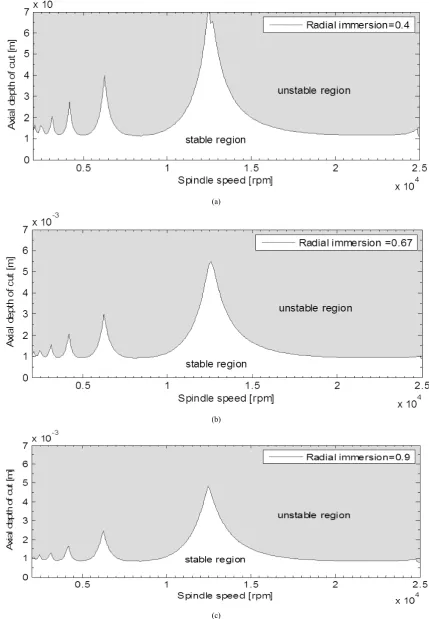
Using parameters above and following algorithm 1 gives stability limits of milling on the plane of spindle speed and axial depth of cut at selected fixed radial immersions seen in figure 4 bellow.
It can be deduced from above figure that rise in radial immersion enhances the unstable region and suppresses the stable region which is as a result of chatter. This means that there is some kind of inverse relationship between the axial and radial depths of cut highlighting the need to determine the maximum value of their product for achieving maximized MRR thereby reducing the chatter in the milling process. The other important observation is that the peak axial depths of cut occasioned by the lobbing effects occur as fixed spindle speeds irrespective of value of the radial immersion. This observation is very useful for implementation of algorithm 3. It must be noted that figure 5b is validated by the figure generated with identical set of parameters in [24] meaning that algorithm 1 which is based on theoretical development in this work provides reliable stability limit of milling process.
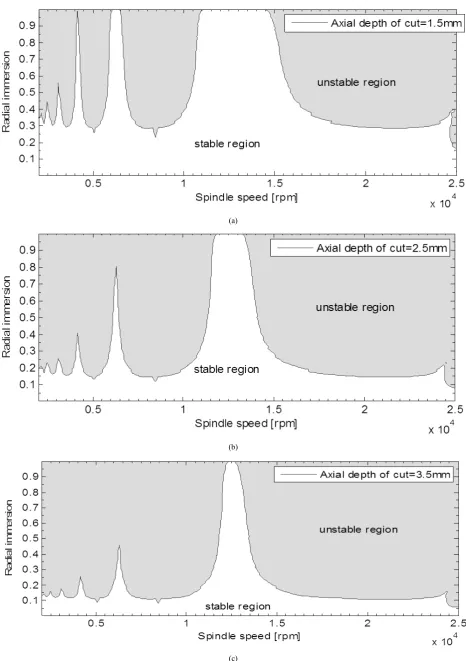
When the same parameters are used in algorithm 2, it gives stability limits of milling on the plane of spindle speed and radial depth of cut at selected fixed axial depth of cut seen in Figure 5.
productive stability limits of milling on the plane of axial depth of cut and radial depth of cut. It must be noted that figure 5a is validated by the figure generated with identical
set of parameters in [24] meaning that algorithm 2 which is based on theoretical development in previous sections of this work provides reliable stability limit of milling process.
(a)
(b)
(c)
(a)
(b)
(c)
(a)
(b)
(c)
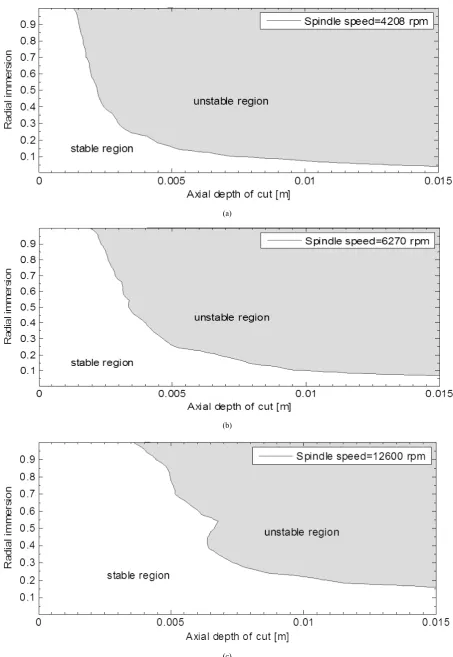
Using the same parameters above in algorithm 3, stability limits of milling on the plane of axial depth of cut and radial depth of cut at the selected productive spindle speeds 4208, 6270, 12600 were generated as seen in Figure 6.
The inverse relationship between limiting axial depth of cut and limiting radial depth of cut suggested by figures 4 and 5 is actually true looking at figure 6. It is seen in figure 6 that rise in spindle speed enhances the stable region and suppresses the unstable region. This means that for us to have chatter-free milling process, parameters like axial and radial depths of cut should be carefully selected together at high machining speed. It must be noted that figure 6c agrees closely with the figure generated with identical set of parameters in [24] meaning that algorithm 3 for the first order least squares approximated map of the work [18] provides reliable stability limit of milling process on the plane of depths of cut.
7. Conclusions
Regenerative chatter poses serious challenge to machine operator this days in achieving high accuracy and acceptable surface finish. Various methods are available for the control of chatter. Some are analytical, semi-analytical while others are experimental. Some of the results of this work can be identified to be new in the field optimal machining. The work lays the foundation for use of the least squares approximated full-discretization method in stability analysis on the plane of axial depth of cut and radial depth of cut using analytical method. A detailed computational algorithm was presented for the purpose of delineating stability lobe diagram into stable and unstable regions. The stability lobe diagram if well understood, will be a guide to operators in selecting a chatter free spindle speed and depths of cut knowing that there are some spindle speed that are not productive and also the proper combination of the depths of cut so as to boost surface finish and greater accuracy.
REFERENCES
[1] Osueke C.O, Ezugwu C.A.K, Adeoye A.O (2015) Dynamic approach to optimization of material removal rate through programmed optimal choice of milling process parameters, part 1: validation of result with CNC simulation. International Journal of innovative research in Advanced Engineering, 2(5), 118-129.
[2] Okokpujie Imhade P., Okonkwo Ugochukwu C., Okwudibe Chinenye D. (2015) Cutting parameters effects on surface roughness during end milling of aluminium 6061 alloy under dry machining operation. International Journal of Science and Research, 4(7), 2030-2036.
[3] Altintas, Y., "Manufacturing Automation: Metal Cutting Mechanics, Machine Tool Vibrations, and CNC Design", 1st ed., Ed. Cambridge University Press, NY, USA, 2000.
[4] Okokpujie Imhade P., Okonkwo Ugochukwu C. (2015). Effects of cutting parameters on surface roughness during end Milling of aluminium under minimum quantity lubrication (MQL). International Journal of Science and Research, 4(5), 2937-2942.
[5] Tobias, S.A. (1965). Machine Tool Vibration. Blackie and Sons Ltd, 340-364.
[6] Tlusty, J. and Ismail, F. (1981). Basic Nonlinearity in Machining Chatter. Annals of the CIRP, 30:21–25.
[7] F. W. Taylor, “On the art of cutting metals”, Transactions of the American Society of Mechanical Engineers, pp. 31–35, 1907.
[8] S.A. Tobias, Vibraciones en Maquinas-Herramientas, URMO, Spain, 1961
[9] J. Tlusty, M. Polacek, “The stability of machine tools against self-excited vibrations in machining”, International Research in Production Engineering, pp.465–474. 1963.
[10] Ozoegwu C.G. & Ezugwu C. (2015). Minimizing pocketing time by selecting most optimized chronology of tool passes. International journal of advanced manufacturing technology, 79(1-4).
[11] Budak, E., & Altintas, Y. (1994). Peripheral millingconditions for improved dimensional accuracy. Int. J. Mach. Tools Manufact. 34 (7) 907–918.
[12] Quintana, G. and Ciurana, J. (2011). Chatter in machining processes: a review, International Journal of Machine Tools and Manufacture. International Journal of Machine tools and manufacture, 51 (5) 363–376.
[13] Budak, E., and Altintas, Y. (1998). Analytical Prediction of Chatter Stability in Milling - Part I: General Formulation, Part II: Application To Common Milling Systems. Trans. ASME Journal of Dynamic Systems, Measurement and Control, 20:22–36.
[14] Hashimoto, M., Marui, E., and Kato, S. (1996). Experimental research on cutting force variation during regenerative chatter vibration in a plain milling operation. International Journal of Machine Tools and Manufacture, 36 (10) 1073–1092. [15] Sridhar R, Hohn RE and Long GW. (1968). General
Formulation of the Milling Process Equation, ASME J. of Eng. for Ind, 90: 317-324.
[16] Ozoegwu, C. G., Omenyi, S. N., Ofochebe, S. M., and Achebe, C. H. (2013) Comparing up and Down Milling Modes of End-Milling Using Temporal Finite Element Analysis, Applied Mathematics 3(1) 1-11.
[17] Ding Y, Zhu LM, Zhang XJ, Ding H. (2010). A full-discretization method for prediction of milling stability. International Journal of Machine Tools and Manufacture, 50:502–509.
[18] Ozoegwu, C.G. (2014). Least squares approximated stability boundaries of milling process, International Journal of Machine Tools and Manufacture, 79, 24–30.
[19] Altintas, Y., and Budak, E. (1995). Analytical Prediction of Stability Lobes in Milling. Annals of the CIRP, 44(1): 357–362.
Minimizing machining time in pocket milling based on optimal combination of the three basic prescription parameters. International Research Journal of Innovative Engineering, 1(4), pp. 12-34.
[21] Sridhar, R., Hohn, R.E., and Long, G.W. (1968). A Stability Algorithm for the General Milling Process. Trans. ASME Journal of Engineering for Industry, 90:330–334.
[22] Ezugwu, C.A.K (2015). Minimizing Pocketing Time by Programmed Optimal Choice of Stable Milling Process
Parameters: Master of Engineering Thesis, Nnamdi Azikiwe University, Awka, PP. 42- 46.
[23] Tekeli, A. and E. Budak, Maximization of chatter-free material removal rate in end milling using analytical methods, Machining Science and Technology, 9:147–167.