Enabling resource sharing in language generation: an abstract reference
architecture
L Cahill
y, C Doran
y*, R Evans
y, R Kibble
y, C Mellish
z, D Paiva
y, M Reape
z, D Scott
y, N Tipper
yy
Information Technology Research Institute, University of Brighton, Lewes Rd, Brighton, UK z
Division of Informatics, University of Edinburgh, 80 South Bridge, Edinburgh, UK [email protected]
http:/www.itri.brighton.ac.uk/projects/rags
Abstract
The RAGS project aims to develop a reference architecture for natural language generation, to facilitate modular development of NLG systams as well as evaluation of components, systems and algorithms. This paper gives an overview of the proposed framework, describ-ing an abstract data model with five levels of representation: Conceptual, Semantic, Rhetorical, Document and Syntactic. We report on a re-implementation of an existing system using the RAGS data model.
1.
The RAGS enterprise
The primary goal of the RAGS project (Cahill et al., 1999a) is to develop a ‘reference architecture’ for applied natural language generation (NLG) systems. The aim is to produce an architectural specification which reflects mainstream current practice and provides a framework for the development of new applications and new components within NLG systems. The architecture is also intended to facilitate evaluation of NLG components, algorithms and systems. To achieve these goals, such an architecture has to be sufficiently conventional to be relevant to developers of existing systems, but also sufficiently generic and detailed to be useful as a resource for novel approaches.
One of the distinctive properties of natural language generation when compared with other language engineer-ing applications is that it has to take seriously the full range of linguistic representation, from concepts through to mor-phology, or even phonetics. Any processing system is only as sophisticated as its input allows, so while a natural lan-guage understanding system might be judged by its syntac-tic prowess – even if its attention to semansyntac-tics, pragmasyntac-tics and underlying conceptual analysis is minimal – a genera-tion system is only as good as its deepest linguistic repre-sentations. This has particular implications for evaluation of NLG systems: it is hard to think of evaluation exercises along the lines of the MUC tasks (Hirschman and Chin-chor, 1997) for information extraction, for instance, where the inputs consist of naturally-occurring text and the out-puts are precisely specified by the evaluators. There is no general agreement on how inputs for NLG systems should be specified, nor on how output texts can be evaluated.
2.
Pipelines and beyond
Generation systems, especially end-to-end, applied gen-eration systems, have, unsurprisingly, much in common. Reiter (Reiter, 1994) proposed an analysis of such systems in terms of a simple three-stage pipeline:
* Now at the MITRE Corporation, Bedford, MA, USA,
Content Determination - deciding the content of a mes-sage, and organising the component propositions into a text tree;
Sentence Planning - aggregating propositions into clausal units and choosing lexical items corresponding to con-cepts in the knowledge base, including referring ex-pressions (RE);
Linguistic realisation which takes care of surface details such as agreement, orthography etc.
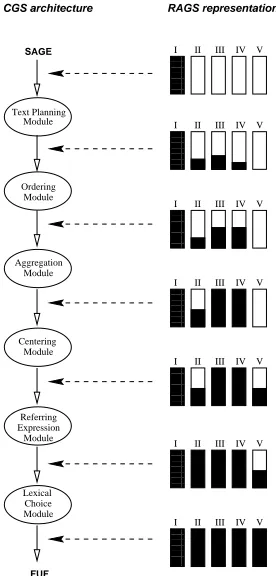
This was presented as a “consensus” model, based on a survey of 5 existing systems and partly motivated on en-gineering grounds in that a strict pipeline requires a mini-mal number of interfaces. More recently the RAGS project attempted to repeat and extend the analysis, surveying a set of 19 applied systems (Paiva, 1998; Cahill and Reape, 1998). A component tasks analysis was undertaken exam-ining where in each system each of a set of core linguis-tic tasks was situated. That set was: lexicalisation, aggre-gation, rhetorical structuring, referring expression genera-tion, ordering, segmentation and coherence1
. It was found that, while most systems did implement a pipeline archi-tecture, they did not implement the same pipeline – differ-ent functionalities occurred in differdiffer-ent places and in dif-ferent orders in difdif-ferent systems. For instance, difdif-ferent systems situate the lexicalisation task in Content Determi-nation, Sentence Planning or Realisation. Or one functional task may be distributed among different modules: in the CGS system (Mittal et al., 1998), the task of generating re-ferring expressions is distributed among the Text Planner, Lexical Choice and the Referring Expression module itself. To accomodate the results of this survey, we find it more appropriate to specify the architecture in terms of the above set of functions and a number of distinct levels of represen-tation, which between them support the range of implemen-tations observed, including pipelines as well as other more complex control regimes.
1
The central pillar of our proposed architecture is a data model, in the form of a set of declarative representations for the various levels of linguistic representation in genera-tion. That is, the functional modules are defined entirely in terms of the datatypes they manipulate and the operations they can perform on them. On top of such a model, more specific process models can be created, in terms of con-straints on the order and level of instantiation of different types of data in the data model. One might then produce a ‘rational reconstruction’ of the pipeline model, but other process models would be equally possible. We argue that by providing a common notation for the representations, it will be possible for generation systems to ultimately share both datasets and processing modules. Although it is not our intention to impose standards on anyone, we expect that the widespread adoption of (at least) an agreed set of repre-sentations will benefit the whole generation community by permitting sharing of resources as well as easier evaluation of both whole systems and modules within systems.
We assume five levels of representation: Conceptual, Semantic, Rhetorical, Document and Syntactic, each of which may have abstract (provisional) and concrete (fi-nalised) variants. These representations are intended to be theory-neutral and various different formalisms may be used, some of which are mentioned below.
I. Conceptual Structure is defined only indirectly through an API via which a knowledge base (providing the content from which generation takes place) can be viewed as if it were defined in a simple KL-ONE (Brachman and Schmolze, 1985) like system.
II. Semantic Structure may be represented using a for-malism such DRT (Kamp and Reyle, 1993) or SPL (Kasper, 1989), and is the level at which inferences may be defined. It may be useful to distinguish an Abstract Semantic level, which might include pointers to conceptual entities as argu-ments of semantic predicates in place of terms with seman-tic content.
III. Rhetorical: a rhetorical structure tree with relations in a formalism such as RST (Mann and Thompson, 1987) at the nodes and pointers to semantic representations at the leaves. Abstract Rhetorical Structure may differ from the final structure in various ways: the relations may be selected from a more restricted, generic, set, or it may be a disjunction of semantically equivalent structure.
IV. Document Structure in its concrete form will con-tain all formatting information needed to print or display a document, coded in some formatting language such as HTML or LaTeX. The RAGS scheme only considers Ab-stract Document Structure, where text-level (Nunberg, 1990), layout and position features are specified without commitment to any particular formatting system.
V. Syntactic Structure may be described in a variety of formalisms, such as HPSG, LFG etc. RAGS is only concerned with Abstract SyntacticStructure, a high level syntactic representation (largely) independent of particular syntactic theories, covering for instance head-complement relations. We believe that most current reusable realisers take as their input some combination of semantic and ab-stract syntactic representations.
Note that Abstract Conceptual, Concrete Syntactic and Concrete Document levels of representation are considered outside the remit of the current enterprise. Note also that this model is intended to be permissive rather than prescrip-tive: there is no implication that the structures should be built in the order listed above, that one structure should be complete before another one can be initiated, or even that all levels should be instantiated in any particular system. To the contrary, we envisage that systems will make use of mixed and partial representations.
Given the above set of representations, we have defined the syntactic and semantic requirements of the formalisms, XML DTDs to aid the representation of the formalisms in an easily sharable format and example implementations of the representations. We anticipate being able to define the functionality of existing systems in terms of these represen-tations. For example, a lexicalisation module might receive as input (at least) a set of abstract semantic structures and return a set of lexicalised abstract syntactic structures. The input/output requirements of operations impose some lim-its on how these can be ordered, but the intention is that the data model should reflect fairly uncontentious minimal constraints. It should be possible to derive most existing architectures by further specialising the data model and im-posing extra ordering constraints. For instance, many sys-tems do not clearly distinguish conceptual from semantic information. For these systems one simply assumes addi-tionally that conceptual structures and semantic structures are one and the same thing. Such a data model allows the definition of a network of possible operations that take us from an initial input to a final output.
3.
Inter-module communication
Systems using the RAGS model will communicate with one another by sending RAGS representations, possibly in-volving mixed and partial structures, to one another. The most straightforward way that two modules can commu-nicate is if they are written in the same programming lan-guage and they agree on how RAGS representations are im-plemented in that programming language. In that case, the two modules can operate in the same address space and one can simply pass pointers to the other. If the two modules are implemented in different languages, or if they are run-ning on different machines, then it is possible to communi-cate by sending representations in a textual form via some communication medium. The RAGS project is producing code code that supports sending data in XML using sockets, together with code for parsing and generating XML from standard programming language representations.et al., 2000). A whiteboard is a cumulative typed relational
blackboard:
typed and relational: because it is based on using a representation scheme consisting of
– a set of objects, organised into types: objects may be tree structures at one of the five levels of rep-resentation, sub-trees or individual nodes; – a set of binary relations, organised into types:
relations include realises, linking a more abstract structure to a less abstract version, revises(see below) andcoreference;
– a set of arrows, each indicating that a relation holds between one object and another object.
a blackboard: a control architecture and data store shared between processing modules; typically, mod-ules add/change/remove objects in the data store, examine its contents, and/or ask to be notified of changes;
cumulative: unlike standard blackboards, once data is added, it can’t be changed or removed. So a structure is built incrementally by making successive copies of it (or of constituents of it) linked byreviseslinks.
The use of a central server is just one option for inter-module communication and is not an essential part of the RAGS architecture. The RAGS project has implemented a “whiteboard” server as part of the case study reported in Section 5.
4.
Examples of data structures
In this section we show examples of the types of data structures referred to above. We concentrate on the re-sources needed to generate Rhetorical Representations, (RhetReps), and for purposes of exposition we disregard the distinction between abstract and concrete variants2
.
<?xml version="1.0"?> <!-- RhetRep DTD -->
<!ELEMENT RhetRel EMPTY>
<!ATTLIST RhetRel name CDATA #REQUIRED>
<!ELEMENT RhetRep
(SemRep | (RhetRep RhetRep+))>
<!ATTLIST RhetRep relation CDATA #REQUIRED>
<!ELEMENT SemRep ANY>
The above is a complete XML document specifying a DTD called RhetRep. The first line identifies the docu-ment as an XML docudocu-ment. RhetRep defines the eledocu-ment RhetRel for declaring rhetorical relations. It is an empty element with a required name attribute. The main body de-fines RhetRep as containing either a Semantic Representa-tion (SemRep) or at least two RhetReps.
2
Note that the DTD presented does not handle multiple or mixed or partial representations and that the representation of se-mantics is over- simplified for expository purposes.
The example shown below represents a sample of text from a museum domain (example (1)) using this DTD. Note here the DOCTYPE specification references the above DTD assumed to be stored in the file “RhetRep.dtd”.
(1) Jessie M. King, who lived and worked in London, de-signed this Arts and Crafts brooch. She also dede-signed the necklace we saw in Case 14.
<?xml version="1.0"?>
<!DOCTYPE RhetRep SYSTEM "RhetRep.dtd">
<RhetRel name="background"/>
<RhetRep relation="background"> <RhetRep relation="background">
<RhetRep>
<SemRep prop="designer(j-9999,King01)"/> </RhetRep>
<RhetRep>
<SemRep prop="workplace(King01,London)"/> </RhetRep>
</RhetRep> <RhetRep>
<SemRep prop="designer(j-8888,King01)"/> </RhetRep>
</RhetRep>
The example representations shown above might be au-tomatically transformed from XML into a simple Prolog clause form, resulting in structures such as:
RhetRep:
background( background(
designer(j_9999, king01), workplace(king01, london) ),
designer(j_8888, king01) ).
5.
A case study: Caption Generation System
As a proof of concept, we have chosen an existing ap-plied NLG system and reimplemented it according to the RAGS data model and whiteboard. (The reimplementation is reported more fully in (Mellish et al., 2000).) This reim-plementation involved two stages: a reinterpretation of the system in terms of the data model and a reimplementation of the system using a whiteboard implementation in which the aim was to attempt to reuse the existing code wherever possible. The system chosen for this exercise was the Cap-tion GeneraCap-tion System (CGS) (Mittal et al., 1998). CGS is a system developed at the University of Pittsburgh, which takes input from a graphics presentation system and gen-erates captions for the graphics. A specimen of generated text is shown below:Elhadad, M. and J. Robin, 1992. Controlling content real-ization with functional unification grammars. In Aspects
of Automated Natural Language Generation, Lecture
Notes in Artificial Intelligence, 587. Berlin: Springer-Verlag, pages 89–104.
Hirschman, Lynette and Nancy Chinchor (eds.), 1997.
MUC-7 Proceedings. Science Applications International
Corporation. See www.muc.saic.com.
Kamp, H. and U. Reyle, 1993. From discourse to logic:
Introduction to model theoretic semantics of natural lan-guage, formal logic and discourse representation theory.
Dordrecht; London: Kluwer.
Kasper, Robert T., 1989. A flexible interface for linking applications to PENMAN’s sentence generator. In Proceedings of the DARPA Workshop on Speech
and Natural Language. Philadelphia. Available from
USC/Information Sciences Institute, Marina del Rey, CA.
Mann, William C. and Sandra A. Thompson, 1987. Rhetor-ical structure theory: A theory of text organization. Technical Report RS-87-190, USC Information Sciences Institute, Marina Del Rey, CA. Also appears in Livia Polanyi, editor, The Structure of Discourse, Ablex, Nor-wood, NJ, 1987.
Mellish, Chris, Roger Evans, Lynne Cahill, Christy Doran, Roger Evans, Daniel Paiva, Mike Reape, Donia Scott, and Neil Tipper, 2000. A Representation for Complex and Evolving Data Dependencies in Generation. In
Pro-ceedings of ANLP-NAACL2000. Seattle.
Mittal, V. O., J. D. Moore, G. Carenini, and S. Roth, 1998. Describing complex charts in natural language: A caption generation system. Computational Linguistics, 24(3):431–468.
Nunberg, Geoffrey, 1990. The Linguistics of Punctuation. CSLI Lecture Notes, No. 18. Stanford: Center for the Study of Language and Information.
Paiva, Daniel, 1998. A survey of applied natu-ral language generation systems. Technical Report ITRI-98-03, Information Technology Research Insti-tute (ITRI), University of Brighton. Available at http://www.itri.brighton.ac.uk/techreports.
Reiter, Ehud, 1994. Has a consensus NL generation archi-tecture appeared and is it psycholinguistically plausible? In Proceedings of the Seventh International Workshop on