SCITECH
Volume 13, Issue 3RESEARCH ORGANISATION
October 24, 2019Journal of Research in Business, Economics and Management
www.scitecresearch.com
Effect of Logistic Information Integration Capability on
Performance of Manufacturing Firms: The Moderating
Role of Supply Chain Linkages
Edwin Kimitei1*, Charles Lagat2, Joel Chepkwony3, Nicole Harggerty4 1
Department of Marketing & Logistics, Moi University, PO Box 3900, Eldoret, Kenya (Email: [email protected])
2
Department of Marketing & Logistics, Moi University, PO Box 3900, Eldoret, Kenya (Email: [email protected])
3
Department of Marketing & Logistics, Moi University, PO Box 3900, Eldoret, Kenya (Email: [email protected])
4
Department of Information Systems, Western University, Ontario, Canada (Email: [email protected])
Abstract
Several studies content that firms may improve their performance by integrating their logistic capabilities. But such relationships may be affected by other externalities. Therefore, this study determined the role of supply chain linkages as a moderator on the relationship between logistic information integration capability and firm performance of manufacturing firms. The study adopted explanatory research design of cross-sectional nature. The target population comprised of 750 manufacturing firms registered under Kenya Association of Manufacturers. Sample size of 442 firms was selected using stratified and simple random sampling approaches. The findings of the study demonstrated that logistic information integration capability positively and significantly affects firm performance, subject to moderation effect of supply chain linkages. The implication of the study emphasizes the need for firm managers to understand and find ways to effectively manage the interactions between logistic information integration capability and supply chain linkages in order to improve performance and meet the customer requirements satisfactorily. Therefore, this study provides empirical evidence in manufacturing firms that supply chain moderates the relationship between logistic information integration capability and firm performance.
Keywords:
Performance; Logistic Information Integration Capability; Supply Chain Linkages; Manufacturingfirms, Kenya
1. Introduction
In every business organization, better performance through improved profits margins, return on assets (ROA), return on investment (ROI), shareholder returns, market share, customer service, social responsibility, employee stewardship etc remains key concern (Kristjansdottir et al., 2016; Torres et al., 2018; Owens et al., 2019). Most of the research that focus on improving firm performance, lay out numerous strategies that should be deployed by the business managers in attempting to improve the firm’s performance (Yang et al., 2011; Painter et al., 2018; Cegarra-Navarro et al., 2019; Kolade et al., 2019). In an endeavor to optimize performance, organizations are increasingly considering the logistics of the firm.
Logistics entails the procedural activities supporting production thrust to build company’s effectiveness, and facilitate profitability in the business environment (Durst & Evangelista, 2018). Firms use logistics to help in morbidity from the point of origin to the point of consumption (Zijm & Klumpp, 2016; Fosso Wamba et al., 2018). Meanwhile logistic capability of the firm is a component of the firm’s resources (including assets, competencies, processes, firm attributes, information, etc) that permit them to implement plans that improve business efficiency and effectiveness (Najafizadeh & Kazemi, 2019). Logistic capabilities take several forms unique to each
organizations including coordinating assets,
capabilities, the importance of information has long
been recognized and advocated in business
environment. Accurate flow of information in a business organization ensure proper coordination of activities (Radhakrishnan et al., 2018; Wang et al., 2019). Therefore firms that are able to implement proper logistic information integration capability have been established to have better firm performance (Prajogo et al., 2018; Salehi et al., 2018; Shou et al., 2018). Nevertheless, the operational success of logistic information integration capabilities of firms may be affected by other external factors that merit investigation.
Supply chain linkage allows the explicit and implicit connections that a firm creates with other entities within the supply chain (Morioka et al., 2018; Tokito, 2018; Khan et al., 2019). Firms undertake supply chain linkages by involving connected network of individuals, organizations, resources, and technologies (Nallusamy et al., 2016). The pointers of supply chain linkages encompass trust, adaptation, communication and cooperation between stakeholders actively involved in the supply chain. Although there are a number of studies that have indicated that firms
experienced positive outcomes through
implementation supply chain linkages
(Rungtusanatham et al., 2003; Cagliano et al., 2006; Won Lee et al., 2007; Klassen & Vereecke, 2012), there is less attention and empirical studies on the moderating role of supply chain linkages on logistic
information integration capability and firm
performance. Therefore, the aim of this paper was to evaluate the role of supply chain linkages as a moderator of logistic information integration capability and performance of manufacturing firms, in the process testing the following hypotheses:
H01: There is an association between firms’ logistic information integration capabilities and firm performance
H02: There is a moderating effect of supply chain linkages on the association between the firms’ logistic information integration capability and firm performance.
2. Literature Review
2.1 Firm Performance
There is vast amount of literature on firm performance and the extent to which performance allow firms to achieve their set of targets (Wamba et al., 2017; Erhardt, 2018; Juhn et al., 2018). Firm performance targets vary greatly but are generally categorized as objective (numerical) and subjective (judgmental) metric indicators. Performance can also be construed in the form of quality, flexibility, and time delivery (Lomberg et al., 2017). In some instance, performance may be examined through services and or costs
dimensions (Jayaram & Xu, 2016). Whenever using costs in the trying to understand performance measures, price related to the firm becomes significant while service aspect of the performance focuses on flexibility of service delivery, and timely delivery of services (Jayaram & Xu, 2016). On the basis of cost, performance can also be viewed as financial or non-financial (Oztekin et al., 2015).
2.2 Logistics Information Integration Capability
Logistics capability encompass part of a firm’s resources including assets, competencies, firm attributes, organizational processes, and information that allow for the implementation of strategies intended at improving efficiency and effectiveness (Zawawi et al., 2017; Rajagopal et al., 2018; Wen & Min, 2018). In attempting to achieve effectiveness of the logistics capabilities, firms pay more attention to process capability, learning capability, service reliability capability, flexibility capability and information integration capability (Sandberg & Abrahamsson, 2011; Wilding et al., 2012). Firms are aware that information can be lifeblood when it comes to operational success, thus logistic information integration capabilities remains one of the key dimensions of logistic capabilities.
Logistic information integration capabilities link different levels in the system such as information sources, such as order information, purchasing in order, production information plan, the packaging information schedule, the transport information, distribution information, financial disbursement information etc (Neubert et al., 2018). Logistic information integration capability also foster timely information interchange which is essential in handling changes within the organizational processes to meet up to the customer requirement (Ketikidis et al., 2008; Voronkova et al., 2017). Accordingly, logistic information integration capability plays a crucial role in enhancing morbidity of goods and services, which relies on logistics capability of the firm. Logistics information integration capabilities of a firm ensures that crucial documents that can be used to assess and manage supply chain (Gunasekaran et al., 2017b). For most firms, logistics information integration systems are used to enhance inventory control, track orders and materials and monitor resource utilization (Neubert et al., 2018; Yu et al.,
2018). Subsequently, well-articulated logistic
information integration capabilities guides the entire organization and help it to coordinate logistics
operations process. Therefore, studies on
logistics information integration capabilities remain relevant to date.
2.3 Supply Chain Linkages
In business environment, there exist system of individuals, organizations, resources, information and resources who perform a crucial role of helping the
organization to move their
product or service from supplier to customer
(Nallusamy et al., 2016). These linkages have therefore received considerable attention in supply management literature to increase firm responsiveness and synchronize their efforts with suppliers (Stevens & Johnson, 2016). These studies indicate that firms are aware of the interdependencies existing between internal operational processes with suppliers and
customers (Prajogo et al., 2018). Firms therefore attempt to coordinate their operations by developing inter-organizational linkages with customers and suppliers. Therefore information that will enhance the quality of the linkages (i.e. supply chain linkages) are important to the firm, suppliers and customers (Prajogo et al., 2018). Since activities that allow for explicit and/or implicit connections between the firm to facilitate flow of inputs from suppliers into the firm and of outputs from the firm to customers are important (Mangan & Lalwani, 2016), supply chain linkages have crucial role to play in the business of manufacturing sector.
2.4 Logistic Information Integration Capability and Firm Performance
Many researchers content that timely and accurate information flow is crucial for the firm and can directly affect the overall firm performance (Graca et al., 2017; Kembro et al., 2017; Prajogo et al., 2018) including reducing costs and improving customer service. Logistic information integration capability in an organizational element of satisfying customers’ perceived information about order status, product availability, delivery schedule and invoices as well as increase the flexibility with regard to methodologies of resources utilization. As such, there are direct effects of logistic information integration capability and overall performance of the firm (Sabherwal & Jeyaraj, 2015; Gu et al., 2017).
Proper communication of information along the supply chain enables the combination of operational and information flow, which provides transparent, networks for suppliers and customers thus creating effective firm management. According to Zhang et al., (2011), logistic information integration capability increases supply chain visibility through collaboration among supply chain members via real-time data sharing and enhance time-based delivery thus
increasing firm performance. With sufficient
information and with increased visibility and communication between various logistics operations and shareholders, different parties along the supply chain can promptly make appropriate decisions which in turn improve efficiency in logistics management. In fact, the recent advanced in technology have assisted in improving firm performance through improved accuracy in information management (Inkinen, 2016).
tools, such as the web sites, organizations are capable of enhancing the capacity of their values chains. A study on information technology and logistics management in Finland confirmed that information when applied to logistics/supply chain management was beneficial to firm through customers relations (Hyvönen, 2007).
2.6 Moderating Role of Supply Chain Linkages on the Relationship between Logistic Information Integration Capability and Firm Performance
It is clear that logistic information integration capability between the firm and customers brings about a well-coordinated flow of materials from the key suppliers to the production site and eventually distributing the goods to customers (Li et al., 2019). Subsequently firms are developing explicit linkages with suppliers and customers to improve the firm performance (Rungtusanatham et al., 2003; Gimenez et al., 2012; Leuschner et al., 2013; Duarte & Cruz-Machado, 2015; Li et al., 2015; Prajogo et al., 2016; Jajja et al., 2017). Supply chain linkages improve the firm performance due to information improvement in information system (Gunasekaran & Ngai, 2004; Patnayakuni et al., 2006; Prajogo & Olhager, 2012). Better performance of the firm employment supply chain linkage occur due improved consistency, delivery time and volume changes (Handfield et al., 2015). Meanwhile there are also studies relating supply chain linkages with improved the firm’s operational performance, through improvement of cost, dependability, flexibility, quality (Lin & Tseng, 2016; Prajogo, 2016) and efficiency (Wu et al., 2006). If properly executed, then supply chain linkages may diminish demand amplification effects along the supply chain, thus reducing inventory-carrying costs and enhance the overall firm performances (Stadtler, 2015; Flynn et al., 2016). These results indicate that supply chain linkages can affect the firms’ performance but very few studies have actually
investigated their mediating role on the logistic
information integration capability and firm
performance. Nevertheless, the role of supply chain linkage as a moderating variable has not been extensively been investigated. In view of the above therefore, this study determined the moderating role of supply chain linkages on the relationship between logistic information integration capability.
2.7 Theoretical Perspective
This study used the resource-based view which asserts that firms can gain and sustain competitive advantages by developing and positioning valuable resources and capabilities or through acquiring and controlling the resources (Barney, 2001; Schroeder et al., 2002; Kraaijenbrink et al., 2010). In the context of RBV, organizations are viewed on how their assets, systems and capabilities are used in creating value. In most cases, the firms that gain advantage are those capable of accumulating resources and capabilities that are rare, valuable, non-substitutable and difficult to imitate. Capabilities of the firms take diverse forms such as innovation, organizational learning, and stakeholder integration (Siguaw et al., 2006). Importance of the resources of the form, the original form of RVB predict that competitive advantage results from those resources and capabilities that are possessed and controlled by a single firm. Accordingly, the focus has been on those capabilities and resources contained within the organization. Nevertheless, a firm's resources extending beyond their boundaries, is also capable of creating a competitive advantage and should also be considered. There is a relatively large literature in logistics services reliability capability considering the realm of RBV. The RBV therefore can present a theoretical foundation for this study to examine the relationships between logistic information integration capability, supply chain linkages and firm performance.
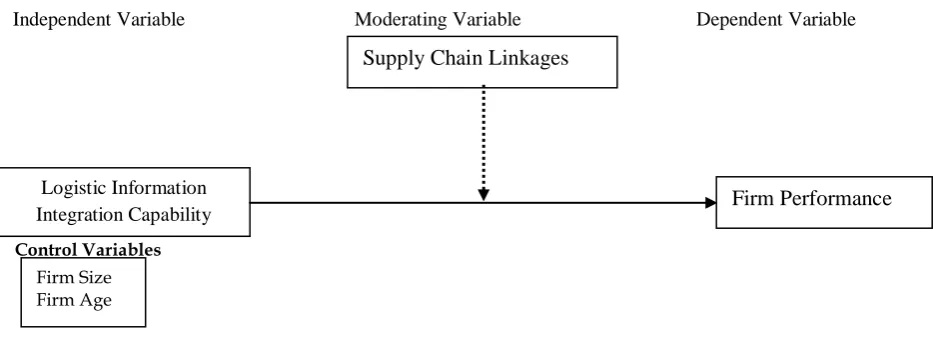
2.8 Conceptual Model of the study
Fig 1: Conceptual Framework Control Variables
Independent Variable Moderating Variable Dependent Variable
Logistic Information
Integration Capability Firm Performance
Supply Chain Linkages
3. Methodology
This study is in line with positivism approach, which seeks to use existing theory to deduce and formulate variables. The study adopted explanatory research design of a cross sectional nature. Explanatory research design analyses the cause-effect relationship between two or more variables (Leavy, 2017; Rahi, 2017). Hence the design was appropriate to the study because the research sought to establish a cause-effect relationship on the three constraints which is logistic information integration capability, supply chain linkages and firm performance. The unit of analysis was 750 manufacturing firms registered with Kenya Association of Manufacturers (KAM, 2018). The targeted respondents were purchasing and logistic managers. Stratified sampling combined with simple random sampling technique was used to select sample size. Structured questionnaires used to collect data for dependent, moderating and independent variables, where each item was subjected to Five-point Likert scale ranging from SD to SA.
The dependent variable was firm performance measured using subjective measures of sales volume, profits, market share, customer satisfaction, customer loyalty and new products over the past three years as described in previous research studies (Farris et al., 2010; Santos & Brito, 2012; Hill & Alexander, 2017). The independent variable was logistic information integration capability was measured based on literature from previously published methods (Lu & Yang, 2010; Wiengarten et al., 2014). The moderating variable, supply chain linkages measurements also followed previous protocols (Shepherd & Günter, 2010; de Souza Miguel & Brito, 2011; Gopal & Thakkar, 2012). To reduce the effects of confounding variables, the study included two control variables vis: firm size quantified by the number of employees and firm age (number of years in operation).
The reliability of the research instrument was tested using the internal consistency technique by employing Cronbach Alpha value of 0.7. Internal and external validity was assessed to establish whether the research instrument truly measures what it is intended to (Patino & Ferreira, 2018). Descriptive statistics used were the mean, standard deviation, frequencies and percentages; inferential statistics was Pearson correlation coefficient to test the relationship and strength between the variables. Multiple regression models were used to test the hypotheses.
For Direct effect with Control Variables
FS FA LIIC
FP 0 1 2 3
For Moderating Role
0 1FS 2FA 3LIIC 4(LIIC *SCL ) FP
4. Results/Findings
4.1 Socio-Demographic Profiles of the Respondents
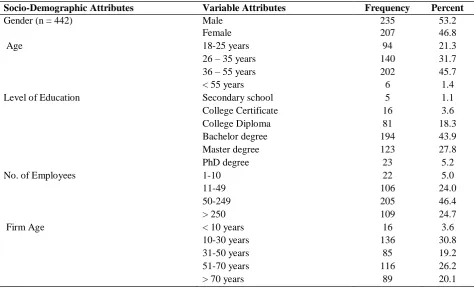
The overall results of the socio-demographic background of the respondents are presented in Table 1. There were a higher proportion of the males compared with females suggesting more male employees in the firms with male (53.2%, n = 235) and female (46.8%, n = 207). Most of the employees (45.7%, n = 202) were aged 36 to 55 years followed by 26–35 years. The least but not last is 21.3% (94) are above 18 to 32 years; lastly, 1.4% (6) is above 63 years. In terms of educational status, 43.9% attained Bachelor degree, 27.9% Master degree, 18.3% Diploma, 3.6% (16) of the respondents have Certificate level of education. Majority of firms employed between 50 and 249 employees (46.4%) followed by > 250 employees (24.7%) while 5% had less than 10 employees. Finally, overall age of the firm indicated that most had been operational operation from 10 to 30 years followed by those operating between 51-70 years. 26.2% had operated for a period ranging from 51 to 70 years while 3.6% (16) were in operation for less than 10 years.
4.2 Test of Relationships
Results showing correlations between firm
performance, Logistic Information Integration
Capability, Supply Chain Linkages and control variables are shown in Table 3. Logistic information integration capability had a positive and significantly association with firm performance (r = 0.665, p < 0.05). Also, the supply chain linkage was positively and significantly correlated with firm performance (r = 0.663, p < 0.05). The two controls variables were significantly related with firm performance (P < 0.05).
4.3 Test for the Direct Effect
The regression test for both the control and the independent variables (direct effect) were done. The coefficient of determination explained the extent of
the variation change of predictor variables
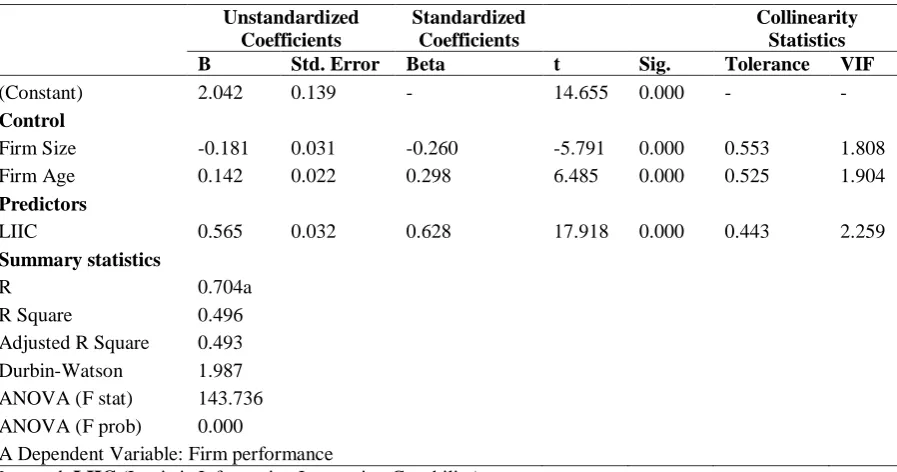
(Independent variables) against the dependent variable (firm performance). The results are shown in Table 4 projected that all the predictors explain 49.6% of the variation on firm performance, where (R-squared = 0.496, Adjusted R-(R-squared = 0.493). The findings also indicated that the coefficient of determination was significant as indicated by F = 143.736 (P < 0.05). For the control variables, both firm size (β = -0.260 and p-value <0.05) and firm age (β = 0.298 and p-value <0.05) which significantly influenced the firm performance.
effect on performance of the firms. The findings reveal that logistic information integration capability
positively affected firm performance (R2 = 0.496, β = 0.628, P = 0.000; Table 4).
Table 1: Socio-Demographic Information (n = 442)
Socio-Demographic Attributes Variable Attributes Frequency Percent
Gender (n = 442) Male 235 53.2
Female 207 46.8
Age 18-25 years 94 21.3
26 – 35 years 140 31.7
36 – 55 years 202 45.7
< 55 years 6 1.4
Level of Education Secondary school 5 1.1
College Certificate 16 3.6
College Diploma 81 18.3
Bachelor degree 194 43.9
Master degree 123 27.8
PhD degree 23 5.2
No. of Employees 1-10 22 5.0
11-49 106 24.0
50-249 205 46.4
> 250 109 24.7
Firm Age < 10 years 16 3.6
10-30 years 136 30.8
31-50 years 85 19.2
51-70 years 116 26.2
> 70 years 89 20.1
Table 2: Reliability of the Research Variables Measured by the Research Instruments
Variable
Cronbach's Alpha
Cronbach's Alpha Based on Standardized Items N
Logistic Information Integration capability 0.802 0.802 7
Supply Chain Linkages 0.819 0.814 11
Firm Performance 0.757 0.757 6
Table 3: Summary of Correlation Results of Study Variables
FP LIIC SCL FS FA
FP 1
LIIC 0.665** 1
SCL 0.663** 0.613** 1
FS 0.023** 0.141** 0.052** 1
FA 0.284** 0.249** 0.084** 0.655** 1
** Correlation is significant at the 0.01 level (2-tailed) * Correlation is significant at the 0.05 level (2-tailed).
Keywords: FP (Firm Performance); LIIC (Logistic Information Integration Capability); SCL (Supply Chain Linkages); FS (Firm Size); and FA (Firm Age).
Unstandardized Coefficients
Standardized Coefficients
Collinearity Statistics B Std. Error Beta t Sig. Tolerance VIF
(Constant) 2.042 0.139 - 14.655 0.000 - -
Control
Firm Size -0.181 0.031 -0.260 -5.791 0.000 0.553 1.808
Firm Age 0.142 0.022 0.298 6.485 0.000 0.525 1.904
Predictors
LIIC 0.565 0.032 0.628 17.918 0.000 0.443 2.259
Summary statistics
R 0.704a
R Square 0.496
Adjusted R Square 0.493
Durbin-Watson 1.987
ANOVA (F stat) 143.736
ANOVA (F prob) 0.000
A Dependent Variable: Firm performance
Keyword: LIIC (Logistic Information Integration Capability)
During the study, the null hypothesis for the indirect effect predicted that there is no significant moderating effect of supply chain linkages on the relationship between logistic information integration capability on firm performance. The results of the effect are
presented in Table 5. The results indicate a negative relationship of beta coefficient with (β = -0.1652), P -value =<0.000). Thus, the null hypothesis was therefore rejected.
Table 5: Moderating Effect of Supply Chain Linkages on the Relationship between Logistic Information Integration Capability and Performance
Predictors Model (FP) b1C’
β P-value
Firm Size -0.1417 0.000
Firm Age 0.1227 0.000
LIIC 0.1226 0.000
SCL 0.1663 0.000
LIIC×SCL -0.1652 0.000
R2 0.6910
F 162.1032 0.000
Number of bootstrap samples for percentile bootstrap confidence intervals: 5000
Keywords: LIIC (Logistic Information Integration Capability); and SCL (Supply Chain Linkages).
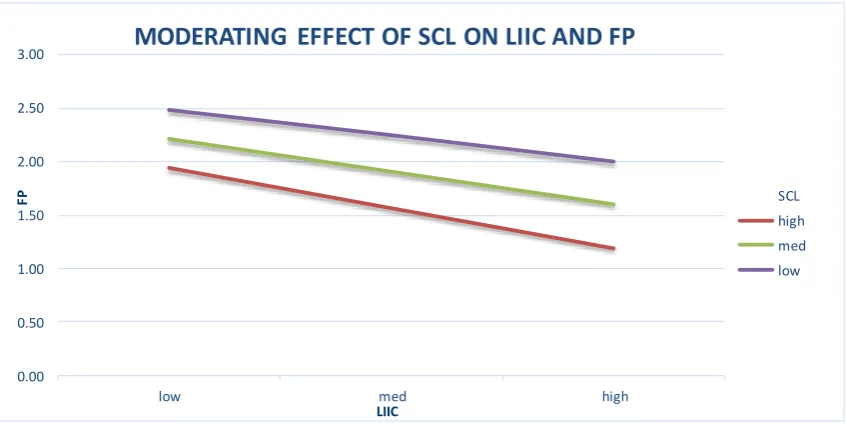
Figure 2, predicts the nature of moderating effect of supply chain linkages on the relationship between logistic information integration capability and performance. At the lower levels of logistic information integration capabilities in the mod graph, performance of manufacturing firms with low supply chain linkages is higher than those firms with high supply chain linkages. However, at higher levels of
logistic information integration capability,
Fig 2: Moderating Effect of Supply Chain Linkages (SCL) on the Relationship between Logistic Information Integration Capability (LIIC) and Firm Performance (FP)
5. Discussion
Logistic information integration capability
significantly affected the firm performance indicating further that each unit increase in logistic integration capability, firm performance increases by 0.628 units. These results concur with several previous studies (Klein & Rai, 2009; Pereira, 2009; Wong, 2013; Huo et al., 2016) most of who observed that logistic information integration capability increases the firms capacity to respond to threats and contingencies hence able to improve the positive attributes of firm performance. It is thus sensible therefore to postulate that logistic information integration enabled the firms to coordinate flow of materials along the value chain hence enabling the supply chain entities to prepare well for contingencies. The positive relationships may also be related to reduced transaction costs (Maiga et al., 2015; de Camargo Fiorini & Jabbour, 2017; Gunasekaran et al., 2017a).
The second hypothesis of the studywhich postulated that there is no significant moderating effect of supply chain linkages on the relationship between logistic
information integration capabilities on firm
performance was also rejected implying that supply chain linkage is a significant moderator on the relationship between logistic information integration capabilities on firm performance. This suggests that performance of the firm was affected by logistic information integration capability but supply chain linkage generally dictated the possible outcomes. This implies that, the lower the emphasis on supply chain linkages, the lower the effect of logistic information integration capability on supply chain linkages and firm performance. The present findings concur with those reported by Lee, (2000) who established that supply chain linkage is important for redesigning
decision rights, workflow, and resources between supply chain members to leverage improved performance. Supply chain linkages could also have
improved the relationship between logistic
information integration capabilities with firm
performance through improvement of cost,
dependability, flexibility and quality as outlined in previous studies (Lin & Tseng, 2016; Prajogo, 2016) and efficiency (Wu et al., 2006). Similarly, Lee et al., (2007) explicitly established that supplier linkages had a positive effect on the reliability of supply chain partners and cost. The results also conform with that of Simatupang et al., (2004) which indicated that good co-ordination in the supply chain reduces uncertainty in manufacturing networks which in turn translates into improved firm performance. It is also probable that supply chain linkages may diminish demand amplification effects along the supply chain (Stadtler, 2015; Flynn et al., 2016).
6. Conclusion
This study tested a null hypothesis that there no significant empirical relationship between Logistic
information integration capability and firm
performance (H01: There is no significant association between firms’ logistic information integration capability and firm performance). Moreover, we further postulated that the assumed relationship is not moderated by supply chain linkage (H02: There is no moderation effect of supply chain linkages on the association between the firms’ logistic information integration capability and firm performance). Whereas the study provided evidence logistic information integration capability positively and significant affected firm performance, subject to moderation by supply chain linkages. For a long-term development, 0.00
0.50 1.00 1.50 2.00 2.50 3.00
low med high
FP
LIIC
MODERATING EFFECT OF SCL ON LIIC AND FP
SCL
high med
manufacturing firms should understand that the interplay between information integration capabilities and supply chain linkages are massively important in determining the performance of a firm.
Moreover, this paper argues that the market characteristics of the firm are determined by the optimal strength of the supply chain linkages amongst partners in the supply chain. In highly competitive markets where differentiation is the key competitive advantage, strong linkages are required to deliver innovative products through proper utilization of logistic capabilities and supply chain linkages models. Manufacturing firms have integrated systems for simplifying a physical flow of the product among warehousing, production, packing and transport department. Looking at the contributions by various scholars based on available information from literature, if the firm is economically linked to suppliers for inputs and to customers for sales, significant events at one firm can influence the firm performance of its directly linked with suppliers and commercial customers.
7. Managerial and Theoretical
Implications
The study findings established that better performing manufacturing firms exhibit a higher level of logistic information integration capabilities. Therefore, there is need for manufacturing firms to adopt integrated logistic information capabilities to that enables them to benefit from reliable order cycles and reduce various inventory costs. Besides, exhibiting superior performance, they need to collect and process logistic information and share related logistic information with other departments. This will aid firm in planning and dedicating sufficient resources towards attaining firm effectiveness in terms of operations and improve the overall performance. Manufacturing firms should invest only on those capabilities that can create a competitive differentiation strategy for sustainable performance. Firm management must should develop unique capabilities internally, as well as recognizing the additivity of supply chain linkages in the firm performance path to achieve best outcomes.
The research findings of this paper have several implications for academics and other stakeholders involved in theory building. First, this study extends previous logistic capabilities and firm performance frameworks in developing countries by considering different key dimensions of logistic information
integration capability practices in Kenyan
manufacturing firms and moderating relationship of supply chain linkages and performance respectively. This paper is one of its kind in emerging economies, examining the moderating role of supply chain linkages on the relationship between logistic
information integration capability and firm
performance using the highly rigorous method of process macro and mod graph representation.
In emphasizing the importance of Resource Based view theory, firms should evaluate potential factors that can be deployed to confer to firm performance including using available resources to add value to their products. It also encourages firms to produce their products in a way that they cannot be imitated or substituted to increase their performance. Therefore, the contribution of this theory is validated by this study since it encourages the management of manufacturing firms to invest in improving supply chain linkages to develop, nurture and maintain key resources and competencies in order to improve the performance of the firm.
8. Recommendation for further Research
The study used a single moderating variable, therefore future studies should look out how other moderating variables could potentially affect the relationship. Secondly future studies should investigate how the moderating variable could be affected by other mediating variables. The study included only one constraints of logistic capabilities, there could be other relevant factors that may be perceived as important constructs by supply chain partners but were excluded from this study. Future researches,
therefore, may consider more factors, like,
competitive advantage, logistic learning capabilities, logistic process capabilities, logistic flexibility and logistic process capabilities.
Acknowledgement
I am grateful to Prof. Charles Lagat, Dr. Joel Chepkwony and Dr. Nicole Harggerty for their professional guidance, inspiration, patience, support and advice throughout the entire process of developing this research paper. Our special thanks go to Moi University for their administrative and technical support.
References
Arena, M., Azzone, G., Bengo, I. (2015). Performance
measurement for social enterprises.
VOLUNTAS: International Journal of Voluntary and Nonprofit Organizations. 26, 649-672.
Aydiner, A.S., Tatoglu, E., Bayraktar, E., Zaim, S. (2019). Information system capabilities and firm performance: Opening the black box through decision-making performance and business-process performance. International Journal of Information Management. 47, 168-182.
Barney, J.B. (2001). Resource-based theories of
retrospective on the resource-based view. Journal of management. 27, 643-650. Barth, M.E., Schipper, K. (2008). Financial reporting
transparency. Journal of Accounting,
Auditing & Finance. 23, 173-190.
Cagliano, R., Caniato, F., Spina, G. (2006). The linkage between supply chain integration and manufacturing improvement programmes. International Journal of Operations & Production Management. 26, 282-299. Cai, Z., Huang, Q., Liu, H., Liang, L. (2016). The
moderating role of information technology capability in the relationship between supply chain collaboration and organizational
responsiveness: evidence from China.
International Journal of Operations & Production Management. 36, 1247-1271. Cegarra-Navarro, J.-G., Jiménez-Jiménez, D.,
Garcia-Perez, A. (2019). An integrative view of knowledge processes and a learning culture
for ambidexterity: Towards improved
organisational performance in the banking sector. IEEE Transactions on Engineering Management. (In-press).
de Camargo Fiorini, P., Jabbour, C.J.C. (2017). Information systems and sustainable supply
chain management towards a more
sustainable society: Where we are and where we are going. International Journal of Information Management. 37, 241-249. de Souza Miguel, P.L., Brito, L.A.L. (2011). Supply
chain management measurement and its influence on operational performance. Journal of Operations and Supply Chain Management. 4, 56-70.
Duarte, S., Cruz-Machado, V. (2015). Investigating lean and green supply chain linkages through
a balanced scorecard framework.
International Journal of Management Science and Engineering Management. 10, 20-29.
Durst, S., Evangelista, P. (2018). Logistics knowledge management: state of the art and future
perspectives. Knowledge Management
Research & Practice. 16, 427-434.
Erhardt, E.C. (2018). Firm performance after high growth: A comparison of absolute and relative growth measures.
Farris, P.W., Bendle, N., Pfeifer, P., Reibstein, D. (2010). Marketing metrics: The definitive guide to measuring marketing performance. Pearson Education.
Flynn, B.B., Koufteros, X., Lu, G. (2016). On theory
in supply chain uncertainty and its
implications for supply chain integration. Journal of Supply Chain Management. 52, 3-27.
Fosso Wamba, S., Gunasekaran, A., Papadopoulos, T., Ngai, E. (2018). Big data analytics in logistics and supply chain management. The
International Journal of Logistics Management. 29, 478-484.
Gimenez, C., van der Vaart, T., Pieter van Donk, D. (2012). Supply chain integration and performance: the moderating effect of supply
complexity. International Journal of
Operations & Production Management. 32, 583-610.
Goel, P. (2017). Antecedents of Non-Financial Parameters of Corporate Performance on Financial Performance. Available at SSRN 2993002.
Gonzálvez-Gallego, N., Molina-Castillo, F.-J., Soto-Acosta, P., Varajao, J., Trigo, A. (2015). Using integrated information systems in
supply chain management. Enterprise
Information Systems. 9, 210-232.
Gopal, P., Thakkar, J. (2012). A review on supply chain performance measures and metrics:
2000-2011. International Journal of
Productivity and Performance Management.
61, 518-547.
Graca, S.S., Doney, P.M., Barry, J.M. (2017). An institutional view of the communication flows between relation-based and rule-based countries. International Journal of Emerging Markets. 12, 79-92.
Gu, Q., Jitpaipoon, T., Yang, J. (2017). The impact of
information integration on financial
performance: A knowledge-based view. International Journal of Production Economics. 191, 221-232.
Gunasekaran, A., Ngai, E.W. (2004). Information systems in supply chain integration and
management. European journal of
operational research. 159, 269-295.
Gunasekaran, A., Subramanian, N., Papadopoulos, T.
(2017a). Information technology for
competitive advantage within logistics and supply chains: A review. Transportation Research Part E: Logistics and Transportation Review. 99, 14-33.
Gunasekaran, A., Papadopoulos, T., Dubey, R., Wamba, S.F., Childe, S.J., Hazen, B., Akter, S. (2017b). Big data and predictive analytics
for supply chain and organizational
performance. Journal of Business Research.
70, 308-317.
Handfield, R.B., Cousins, P.D., Lawson, B., Petersen, K.J. (2015). How can supply management
really improve performance? A
knowledge‐ based model of alignment
capabilities. Journal of Supply Chain Management. 51, 3-17.
Hill, N., Alexander, J. (2017). The handbook of
customer satisfaction and loyalty
measurement. Routledge.
public firms. The Accounting Review. 88, 1715-1742.
Huo, B., Han, Z., Prajogo, D. (2016). Antecedents and consequences of supply chain information integration: a resource-based view. Supply Chain Management: An International Journal. 21, 661-677.
Hyvönen, J. (2007). Strategy, performance
measurement techniques and information technology of the firm and their links to
organizational performance. Management
Accounting Research. 18, 343-366.
Inkinen, H. (2016). Review of empirical research on knowledge management practices and firm
performance. Journal of knowledge
management. 20, 230-257.
Jajja, M.S.S., Kannan, V.R., Brah, S.A., Hassan, S.Z. (2017). Linkages between firm innovation strategy, suppliers, product innovation, and business performance: insights from resource dependence theory. International Journal of Operations & Production Management. 37, 1054-1075.
Jayaram, J., Xu, K. (2016). Determinants of quality and efficiency performance in service
operations. International Journal of
Operations & Production Management. 36, 265-285.
Juhn, C., McCue, K., Monti, H., Pierce, B. (2018). Firm performance and the volatility of
worker earnings. Journal of Labor
Economics. 36, S99-S131.
Kembro, J., Näslund, D., Olhager, J. (2017). Information sharing across multiple supply chain tiers: A Delphi study on antecedents. International Journal of Production Economics. 193, 77-86.
Ketikidis, P., Koh, S., Dimitriadis, N., Gunasekaran, A., Kehajova, M. (2008). The use of information systems for logistics and supply chain management in South East Europe: Current status and future direction. Omega.
36, 592-599.
Khan, S.A.R., Yu, Z., Qianli, D. (2019). Study on the supply chain integration: In the perspective of Pakistan, Computational intelligence and sustainable systems. Springer, pp. 255-265. Kim, M., Chai, S. (2017). The impact of supplier
innovativeness, information sharing and strategic sourcing on improving supply chain agility: Global supply chain perspective. International Journal of Production Economics. 187, 42-52.
Klassen, R.D., Vereecke, A. (2012). Social issues in
supply chains: Capabilities link
responsibility, risk (opportunity), and performance. International Journal of Production Economics. 140, 103-115.
Klein, R., Rai, A. (2009). Interfirm strategic information flows in logistics supply chain relationships. Mis quarterly. 735-762. Kolade, O., Obembe, D., Salia, S. (2019).
Technological constraints to firm
performance: the moderating effects of firm linkages and cooperation. Journal of Small Business and Enterprise Development. 26, 85-104.
Kraaijenbrink, J., Spender, J.-C., Groen, A.J. (2010). The resource-based view: a review and assessment of its critiques. Journal of management. 36, 349-372.
Kristjansdottir, K., Shafiee, S., Bonev, M., Hvam, L., Bennick, M.H., Andersen, C.S. (2016). Improved Performance and Quality of Configurators by Receiving Real-Time Information from Suppliers, Configuration Workshop.
Leavy, P. (2017). Research design: Quantitative, qualitative, mixed methods, arts-based, and
community-based participatory research
approaches. Guilford Publications.
Leuschner, R., Rogers, D.S., Charvet, F.F. (2013). A meta‐ analysis of supply chain integration and firm performance. Journal of Supply Chain Management. 49, 34-57.
Li, X., Wu, Q., Holsapple, C.W. (2015). Best-value supply chains and firms’ competitive performance: empirical studies of their linkage. International Journal of Operations & Production Management. 35, 1688-1709. Li, X., Holsapple, C.W., Goldsby, T.J. (2019). The
structural impact of supply chain
management teams: Supply chain agility development in multidivisional firms. Management Research Review. 42, 290-310. Lin, Y.-H., Tseng, M.-L. (2016). Assessing the
competitive priorities within sustainable supply chain management under uncertainty. Journal of Cleaner Production. 112, 2133-2144.
Lomberg, C., Urbig, D., Stöckmann, C., Marino, L.D.,
Dickson, P.H. (2017). Entrepreneurial
orientation: The dimensions’ shared effects
in explaining firm performance.
Entrepreneurship Theory and Practice. 41, 973-998.
Lu, C.-S., Yang, C.-C. (2010). Logistics service capabilities and firm performance of international distribution center operators. The Service industries journal. 30, 281-298.
Maiga, A.S., Nilsson, A., Ax, C. (2015).
Mangan, J., Lalwani, C.L. (2016). Global logistics and supply chain management. John Wiley & Sons.
Morioka, R., Nansai, K., Tsuda, K. (2018). Role of linkage structures in supply chain for managing greenhouse gas emissions. Journal of Economic Structures. 7, 7.
Najafizadeh, A., Kazemi, F. (2019). The Impact of Reverse Logistics Capabilities on Firm Performance with Mediating Role of
Business Strategy. Journal of System
Management. 225-240.
Nallusamy, S., Muhammad Umarmukdhar, A., Suganthini Rekha, R. (2016). A proposed
supply chain model for productivity
enhancement in medium scale foundry
industries, International Journal of
Engineering Research in Africa. Trans Tech Publ, pp. 248-258.
Neubert, G., Ouzrout, Y., Bouras, A. (2018).
Collaboration and integration through
information technologies in supply chains. arXiv preprint arXiv:1811.01688.
Omran, M., Khallaf, A., Gleason, K., Tahat, Y. (2019). Non-financial performance measures
disclosure, quality strategy, and
organizational financial performance: a mediating model. Total Quality Management & Business Excellence. 1-24.
Owens, I., Wilson, T., Abell, A. (2019). Information and Business Performance: A Study of Information Systems and Services in High-Performing Companies. Walter de Gruyter GmbH & Co KG.
Oztekin, A., Delen, D., Zaim, H., Turkyilmaz, A., Zaim, S. (2015). The influence of knowledge management on financial and non-financial performance. Journal of Information & Knowledge Management. 14, 1550013. Painter, M., Hibbert, S., Cooper, T. (2018). The
development of responsible and sustainable
business practice: Value, mind-sets,
business-models. Springer.
Patino, C.M., Ferreira, J.C. (2018). Internal and external validity: can you apply research study results to your patients? Jornal Brasileiro de Pneumologia. 44, 183-183. Patnayakuni, R., Rai, A., Seth, N. (2006). Relational
antecedents of information flow integration for supply chain coordination. Journal of Management Information Systems. 23, 13-49.
Pekkola, S., Saunila, M., Rantanen, H. (2016).
Performance measurement system
implementation in a turbulent operating
environment. International Journal of
Productivity and Performance Management.
65, 947-958.
Pereira, J.V. (2009). The new supply chain's frontier:
Information management. International
Journal of Information Management. 29, 372-379.
Prajogo, D., Olhager, J. (2012). Supply chain integration and performance: The effects of
long-term relationships, information
technology and sharing, and logistics integration. International Journal of Production Economics. 135, 514-522. Prajogo, D., Oke, A., Olhager, J. (2016). Supply chain
processes: Linking supply logistics
integration, supply performance, lean
processes and competitive performance. International Journal of Operations & Production Management. 36, 220-238. Prajogo, D., Toy, J., Bhattacharya, A., Oke, A.,
Cheng, T. (2018). The relationships between
information management, process
management and operational performance: Internal and external contexts. International Journal of Production Economics. 199, 95-103.
Prajogo, D.I. (2016). The strategic fit between
innovation strategies and business
environment in delivering business
performance. International Journal of Production Economics. 171, 241-249. Radhakrishnan, A., Davis, J.S., Sridharan, S.V.,
Moore, D.W., David, D. (2018). The impact of inter-organizational information systems-enabled external integration on capabilities
of buyer–supplier dyads. European
Management Journal. 36, 558-572.
Rahi, S. (2017). Research design and methods: A systematic review of research paradigms,
sampling issues and instruments
development. International Journal of Economics & Management Sciences. 6, 1-5. Rajagopal, S., Krishnamoorthy, B., Khanapuri, V.
(2018). Competitive logistics capability for sustainable organisational performance: a study of the textile industry in India. International Journal of Logistics Economics and Globalisation. 7, 105-124.
Rungtusanatham, M., Salvador, F., Forza, C., Choi, T.Y. (2003). Supply-chain linkages and operational performance: a resource-based-view perspective. International Journal of Operations & Production Management. 23, 1084-1099.
Sabherwal, R., Jeyaraj, A. (2015). Information Technology Impacts on Firm Performance: An Extension of Kohli and Devaraj (2003). MIS quarterly. 39, 809-836.
Salehi, M., Majbouri Yazdi, H., Nekoei, M. (2018). The effect of communication capabilities of suppliers and external green integration on the green and financial performance in Iran. Qualitative Research in Financial Markets.
Sandberg, E., Abrahamsson, M. (2011). Logistics capabilities for sustainable competitive advantage. International Journal of Logistics Research and Applications. 14, 61-75. Santos, J.B., Brito, L.A.L. (2012). Toward a
subjective measurement model for firm performance. BAR-Brazilian Administration Review. 9, 95-117.
Schönsleben, P. (2018). Integral logistics
management: operations and supply chain management within and across companies. CRC Press.
Schroeder, R.G., Bates, K.A., Junttila, M.A. (2002). A resource‐based view of manufacturing
strategy and the relationship to
manufacturing performance. Strategic
management journal. 23, 105-117.
Shepherd, C., Günter, H. (2010). Measuring supply chain performance: current research and future directions, Behavioral Operations in Planning and Scheduling. Springer, pp. 105-121.
Shou, Y., Li, Y., Park, Y., Kang, M. (2018). Supply
chain integration and operational
performance: the contingency effects of production systems. Journal of Purchasing and Supply Management. 24, 352-360. Siguaw, J.A., Simpson, P.M., Enz, C.A. (2006).
Conceptualizing innovation orientation: A framework for study and integration of innovation research. Journal of product innovation management. 23, 556-574. Singh, A., Teng, J.T. (2016). Enhancing supply chain
outcomes through Information Technology and Trust. Computers in human behavior.
54, 290-300.
Singh, S., Darwish, T.K., Potočnik, K. (2016). Measuring organizational performance: A case for subjective measures. British Journal of Management. 27, 214-224.
Stadtler, H. (2015). Supply chain management: An overview, Supply chain management and advanced planning. Springer, pp. 3-28. Stevens, G.C., Johnson, M. (2016). Integrating the
supply chain… 25 years on. International Journal of Physical Distribution & Logistics Management. 46, 19-42.
Strouhal, J., Štamfestová, P., Ključnikov, A., Vincúrová, Z. (2018). Different Approaches to the EBIT Construction and their Impact on Corporate Financial Performance Based on the Return on Assets: Some Evidence from
Czech TOP100 Companies. Journal of
Competitiveness. 10, 144.
Sunder, S. (2016). Better financial reporting: Meanings and means. Journal of Accounting and Public Policy. 35, 211-223.
Tokito, S. (2018). Environmentally-Targeted Sectors and Linkages in the Global Supply-Chain
Complexity of Transport Equipment.
Ecological economics. 150, 177-183. Torres, R., Sidorova, A., Jones, M.C. (2018).
Enabling firm performance through business intelligence and analytics: A dynamic capabilities perspective. Information & Management. 55, 822-839.
Vij, S., Bedi, H.S. (2016). Are subjective business
performance measures justified?
International Journal of Productivity and Performance Management. 65, 603-621. Voronkova, O.V., Kurochkina, A.A., Firova, I.P.,
Bikezina, T.V. (2017). Implementation of an
information management system for
industrial enterprise resource planning. Revista Espacios. 38.
Wamba, S.F., Gunasekaran, A., Akter, S., Ren, S.J.-f., Dubey, R., Childe, S.J. (2017). Big data analytics and firm performance: Effects of dynamic capabilities. Journal of Business Research. 70, 356-365.
Wang, Y., Gosling, J., Naim, M.M. (2019). Assessing supplier capabilities to exploit building
information modelling. Construction
Innovation.
Wen, L., Min, S. (2018). Research on Logistics Capability Evaluation Based on Factor Analysis. Journal of Langfang Normal University (Natural Science Edition). 15. Wiengarten, F., Pagell, M., Ahmed, M.U., Gimenez,
C. (2014). Do a country's logistical capabilities moderate the external integration
performance relationship? Journal of
Operations Management. 32, 51-63.
Wilding, R., Wagner, B., Gligor, D.M., Holcomb, M.C. (2012). Understanding the role of logistics capabilities in achieving supply chain agility: a systematic literature review. Supply Chain Management: An International Journal.
Won Lee, C., Kwon, I.-W.G., Severance, D. (2007).
Relationship between supply chain
performance and degree of linkage among supplier, internal integration, and customer. Supply chain management: an International journal. 12, 444-452.
Wong, C.W. (2013). Leveraging environmental
information integration to enable
environmental management capability and
performance. Journal of Supply Chain
Management. 49, 114-136.
Wong, C.W., Lai, K.-h., Bernroider, E.W. (2015). The performance of contingencies of supply chain information integration: The roles of
product and market complexity.
International Journal of Production Economics. 165, 1-11.
Wu, F., Yeniyurt, S., Kim, D., Cavusgil, S.T. (2006). The impact of information technology on
performance: A resource-based view. Industrial Marketing Management. 35, 493-504.
Yang, M.G.M., Hong, P., Modi, S.B. (2011). Impact of lean manufacturing and environmental management on business performance: An empirical study of manufacturing firms. International Journal of Production Economics. 129, 251-261.
Yu, K., Luo, B.N., Feng, X., Liu, J. (2018). Supply chain information integration, flexibility, and operational performance: An archival search and content analysis. The International Journal of Logistics Management. 29, 340-364.
Zawawi, N.F.B.M., Wahab, S.A., Al Mamun, A., Ahmad, G.B., Fazal, S.A. (2017). Logistics capability, information technology, and innovation capability of logistics service providers: Empirical evidence from east coast Malaysia. International Review of Management and Marketing. 7, 326-336. Zijm, H., Klumpp, M. (2016). Logistics and supply
chain management: developments and trends, Logistics and Supply Chain Innovation. Springer, pp. 1-20.
Zijm, H., Klumpp, M., Heragu, S., Regattieri, A. (2019). Operations, Logistics and Supply
Chain Management: Definitions and