Iran J Public Health, Vol. 45, No.10, Oct 2016, pp.1276-1287
Original Article
A Bio Medical Waste Identification and Classification Algorithm
Using Mltrp and Rvm
*Aravindan ACHUTHAN
1, Vasumathi AYYALLU MADANGOPAL
21. Dept. of Civil Engineering, Latha Mathavan Engineering College, Madurai, Tamil Nadu, India 2. Dept. of Civil Engineering, Sethu Institute of Technology, Kariyapatti, Tamil Nadu, India
*Corresponding Author: Email: [email protected]
(Received 22 Mar 2016; accepted 10 Aug 2016)
Introduction
Bio Medical Waste (BMW) originates from hu-man, animal health care, medical teaching facili-tates, medical research, biological laboratory waste and other facilities. A part of that waste stream is infectious or potentially infectious and it must be appropriately managed to defend the sanitation and healthcare personnel. Normally, the BMWs (1-3) are regulated and managed ac-cording to various standards and protocols in different countries. In health care facilities, the wastes are generated during improper manage-ment, which causes a direct health impact in the community, the environment and the health care workers. BMW is a dangerous health hazard to the public, hospital, health care units, flora and
fauna of the area. BMW must be stored in a se-cure environment at all times, whenever possible, BMW should not be mixed with chemical, radio-active or other laboratory trash. Containers for BMW must be appropriate for its contents, there are different kinds of containers, and bags are available for the containment and disposal of BMW (4). The Government of India specifies that BMW is a part of hospital hygiene and maintenance activities. The World Health Organ-ization (WHO) has categorized the BMW into eight categories, includes,
General Waste
Infectious or dangerous waste
Abstract
Background: We aimed to extract the histogram features for text analysis and, to classify the types of Bio Medical Waste (BMW) for garbage disposal and management.
Methods: The given BMW was preprocessed by using the median filtering technique that efficiently reduced the noise in the image. After that, the histogram features of the filtered image were extracted with the help of proposed Modi-fied Local Tetra Pattern (MLTrP) technique. Finally, the Relevance Vector Machine (RVM) was used to classify the BMW into human body parts, plastics, cotton and liquids.
Results: The BMW image was collected from the garbage image dataset for analysis. The performance of the pro-posed BMW identification and classification system was evaluated in terms of sensitivity, specificity, classification rate and accuracy with the help of MATLAB. When compared to the existing techniques, the proposed techniques provid-ed the better results.
Conclusion: This work proposes a new texture analysis and classification technique for BMW management and dis-posal. It can be used in many real time applications such as hospital and healthcare management systems for proper BMW disposal.
Radioactive Chemical Pathological
Pressurized containers Pharmaceuticals
Preprocessing is an essential step in image pro-cessing applications, which eliminates the irrele-vant noises in the given input image. Median fil-ters are widely used in many images processing application, because it provides excellent noise reduction capabilities for noise removal. In this paper, an improved median filtering technique is applied to remove the noises in the given BMW image. After denoising, the texture features of the preprocessed BMW image is extracted based on the histogram value by using the MLTrP.
In this research, the type of BMW is identified and classified with the help of MLTrP and the RVM classifier. Image processing algorithms ap-ply local and global operations on an input image for some particular reasons, such as, noise elimi-nation, edge detection and contrast stretching. The Local Binary Pattern (LBP), Local Derivative Pattern (LDP) and Local Tetra Pattern (LTP) are the existing feature extraction approaches. These techniques are mainly used to extract the infor-mation based on the distribution of edges, coded using only two directions such as, positive and negative directions. The performance of these methods can be enhanced by differentiating the edges in more than two directions. In order to overcome this limitation, the MLTrP extraction method is used in this work. The MLTrP is a three direction code that illustrates the spatial structure of the local texture by using the direc-tion of the central gray pixel. BMW should be classified according to their source, type and risk factors (5). In this paper, MLTrP for BMW clas-sification is proposed based on a diagonal, hori-zontal and vertical direction. The text on is an essential concept in texture analysis, applied to develop effectual models in texture recognition. Moreover, the extraction of pattern is used to classify each pixel using tetra direction and the extraction of magnitude pattern is collected using the magnitude of derivatives. There are different
classification techniques are available for an effi-cient image classification. Some of the existing classification techniques compared in this paper is, Artificial Neural Network (ANN) (6), decision tree (7), Support Vector Machine (SVM) (8) and fuzzy measure (9). ANN is a non-parametric uni-versal classifier and it efficiently handles the noise input. The disadvantages of this technique are, its computational rate is high, it is semantically poor, it has the over fitting problem and it consumes more time for training. Decision tree is a non-parametric training data that provides hierarchical associations between input variables to forecast class membership. It is simple and the computa-tional efficiency is good, which are major ad-vantages of this technique. It becomes more complex, when various values are correlated that is the main limitation of this approach.
SVM is an unsupervised learning classifier that gains the flexibility in the form of threshold and contains a non-linear transformation. The ad-vantages of this method are, it has lesser compu-tational complexity and it is simple to manage the decision rule complexity. The disadvantages of this technique are, the resultant transparency of SVM is low, it consumes less time for training, the structure of this technique is not easy to un-derstand and the determination of optimal pa-rameters are is more complex. In order to over-whelm these drawbacks, the RVM classification technique is used in this paper.
We aimed to extract the histogram features for text analysis and, to classify the types of BMW for garbage disposal and management.
Methods
Here, the MLTrP and RVM were used to effi-ciently extract and classify the histogram features of BMW image. The main aim of this work was to extract the histogram features from the BMW image and to classify the type of BMW as plastic, cotton, liquid or human body parts. The pro-posed BMW image classification system was de-signed at the year of 2014 using the MATLAB tool with certain Garbage images. This paper in-troduced a new framework for proper garbage disposal and management.
Preprocessing
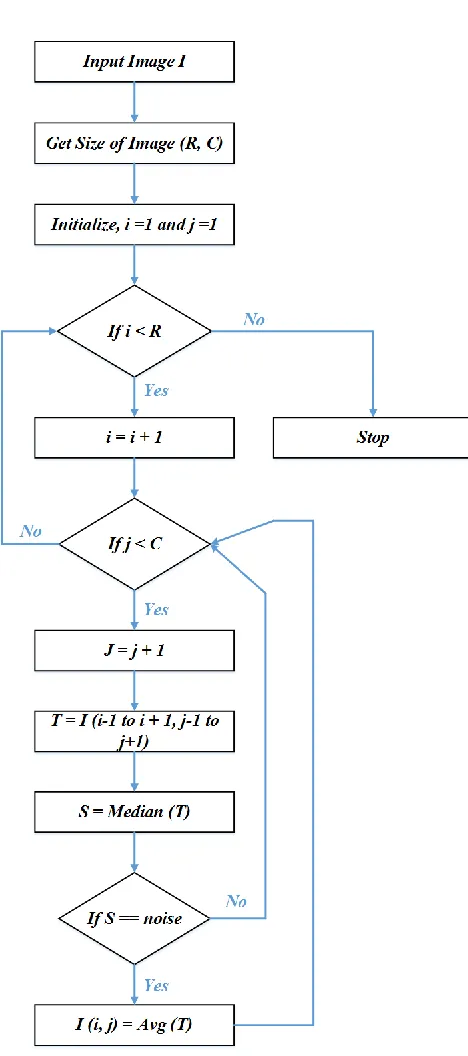
Preprocessing images generally involves eliminat-ing background noise, stabilizeliminat-ing the intensity of the specific particle images, eliminating reflec-tions and masking porreflec-tions of images. Image preprocessing is the method of increasing data, images proceeding to computational processing. The preprocessing of BMW at the source of gen-eration is the initial step, but is an essential step in health care waste management. In this re-search, the median filter is used to preprocess the BMW image. Median filtering is a nonlinear method, mainly used to remove the noise from images. It is very effective and extensively used technique in noise removing while preserving edges. Median filter is one of the main building blocks in image processing applications, which adequately removes the salt and pepper type of noises. It removes the noises in the BMW image by moving through the image pixel by pixel. The pattern of neighbors is referred as window, which slides pixel by pixel over the entire BMW image. Initially, the median is calculated by arranging all pixel values from the window into numerical or-der. After that, it replaces each value as the medi-an value of the neighboring pixels. Fig. 1 shows the process of median filtering based BMW im-age preprocessing.
Fig. 1: Process of Median filtering
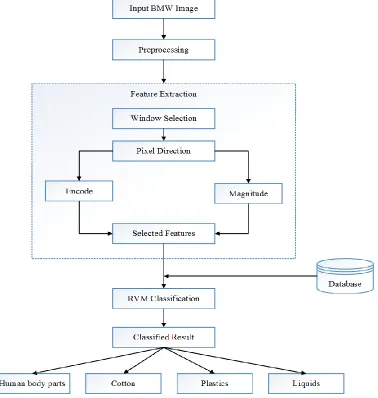
encoded-magnitude patterns are calculated based on the pixel directions (0°, 45° and 90°). Hence, the his-togram features are selected and given to the in-put of RVM classifier. Finally, it classifies the BMW image into human body parts, cotton, plas-tics and liquid wastages.
Feature Extraction
Feature extraction is the process of capturing the visual content of images for indexing and retriev-al. Feature extraction involves facilitating the amount of resources needed to represent a large set of data exactly. The aim of feature extraction is to represent the raw image in its reduced form
to facilitate decision-making process such as pat-tern classification. Feature extraction is an essen-tial step to get high classification rate. A set of features are extracted in order to allow a classifier to identify the normal and abnormal pattern. The BMW image region is determined by the way of gray levels are distributed over the pixels in the region. The properties of the BMW image region are quantified by exploiting space relations under-lying the gray level distribution. In this paper, the features of the input BMW image are extracted by using the MLTrP. Fig. 2 shows the overall flow of the proposed MLTrP based feature ex-traction and RVM based classification.
MLTrP
In the field of texture feature extraction and clas-sification, the MLTrP is a stepping stone. It is mainly used to build the relationship between the central pixel and the neighboring pixels by calcu-lating the gray level difference. The MLTrP en-codes the input BMW image by calculating the horizontal and vertical directions of each pixel. It codes the relationship based on the direction of the central pixel pcand neighbors. The directions are calculated by combining (n-1)th – order deriv-atives of the 0°, 45° and 90°directions. The first order derivatives along 0°, 45° and 90° directions are denoted as,
Let denotes the central pixel in image D, indicates the horizontal neighborhood, indi-cates the vertical neighborhood and repre-sents the diagonal neighborhoods of respec-tively. Then the first order derivatives at the cen-ter pixel is calculated as,
[1]
[2]
[3]
The center pixel’s direction is calculated as,
[4]
From equation [4], it is apparent that the possible direction for each center pixel can be 1, 2, 3, 4, 5, 6, 7 or 8 and eventually, the image is converted into eight directions. The sec order is defined as follows,
{ ( ) ( )
( ( ))
} [5]
(
(
)) {
( )( )
[6]
The 8-bit tetra pattern for each central pixel is obtained from equations [5] and [6]. Then, all patterns are separated into 8 parts based on the direction of center pixel. Where, the direction of
the center pixel is obtained from equation [4]. Hence,
∑
[7]
[8]
Where, similarly, the other
tetra patterns for remaining 8 directions of center pixels are converted to binary patterns. Finally, 56
Fig 3: Process of MLTrP based feature extraction
The magnitude component of the MLTrP pro-vides more useful information for texture feature classification. Exploiting the combination these patterns provides better indications, which are not apparent in any of the individual component. The magnitude pattern of MLTrP feature extrac-tion is shown in Fig. 4.
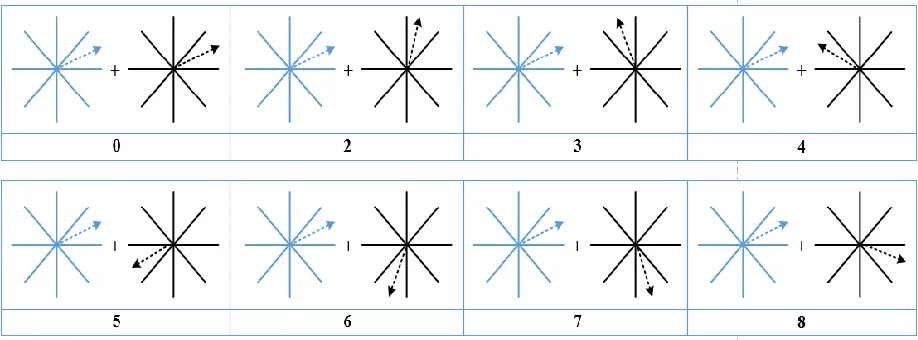
Fig. 5 illustrates tetra pattern calculation for the center pixel direction 1 by using the direction of
neighbors. The direction of blue arrows sents the center pixel and the black arrows repre-sent the neighboring pixels. Here, we take 57 pat-terns (i.e. 8 X 7), 56 tetra patpat-terns and 1 magni-tude pattern. Hence, we increase the number of patterns for texture feature extraction. The tradi-tional algorithms find the tetra pattern in 4 direc-tions, but in this work we take 8 directions.
Fig. 5: Phasor diagram for tetra pattern calculation
RVM Classification
RVM is a sparse learning algorithm that is similar to SVM, which is capable of delivering a fully probabilistic output. The advantages of RVM yield a decision function that is much sparser than SVM, while maintaining its classification accuracy. RVM is a convex quadratic program, which provides a probabilistic interpretation of the output vector machine. The idea of RVM is that the input data are mapped to a high dimen-sional feature space by kernel function.
Given a set of data , where is the input vector and are their corresponding out-puts. The output of RVM is illustrated as follows,
∑
[9]
Where, [ ] represents the weight vector, ) represents the kernel function. In RVM, Gaussian kernel is used as the encountered kernel, expressed as follows,
[10]
Where, represents the width of Gaussian ker-nel. The likelihood of the dataset can be ex-pressed by using,
[11]
Where,
[12]
An explicit prior probability distribution over the weights to improve the generalization ability of RVM model, defined as follows,
∏ [13]
Where, x represents a hyper-parameter vector. Thus, a classifier function of relevance vector machine can be expressed by,
[14]
In this analysis, the RVM classifier is mainly used to classify the types of wastages such as, human body parts, cotton, plastics and liquids. The mer-its of RVM classifier over SVM are,
RVM classifier requires a small amount of relevance vector than the SVM.
When compared to SVM, it needs less testing time.
The computational cost and the complex-ity are low, when compared to SVM.
Results
identification and classification. In this analysis, the MLTrP feature extraction method is used to histogram features of BMW image and RVM classifier is used to classify the types of wastages such as, human body parts, plastics, cotton and liquids.
Filtered Image
Initially, the BMW image is given to the input shown in Fig. 6. It contains irrelevant and highly corrupted noises, removed by using median filter. It is mainly used to eliminate salt and pepper noises from the image and the filtered image is shown in Fig. 7. The pattern of neighbors is named as window, which slides the entire image pixel by pixel. Here, the median is calculated by sorting all pixel values from the window into numerical order. Then, the pixel value is replaced as the median value (middle pixel value).
Fig. 6: Input BMW Image
Fig. 7: Filtered Image
Texture Extraction
After denoising, the texture features of the de-noised image are extracted by using the MLTrP
technique, shown in Fig. 8. The MLTrP illtrates the spatial structure of the local texture us-ing the direction of the central gray pixel. The tetra pattern is calculated based on the direction of pixels using horizontal, diagonal and vertical derivatives (0°, 45° and 90°).
Confusion Matrix
Fig. 9 illustrates the confusion matrix for actual and predicted classes of BMW image. In this graph, the x-axis represents the predicted classes, y- axis represents the data samples and z-axis rep-resents the actual classes. Confusion matrix con-tains information about actual and predicted clas-sifications done by RVM classification system. The performance of this system is evaluated by using the data in the matrix.
Fig. 8: Texture Feature Extraction
Fig. 9: Confusion Matrix for actual and predicted
Sensitivity and Specificity
Sensitivity is the proportion of true positives that are correctly identified by RVM classifier, ex-pressed in percentage. Sensitivity is defined as the probability of getting a positive test result in
sub-jects. The specificity is the number of true nega-tive results divided by the sum of the numbers of true negative plus false positive results. The sensi-tivity is calculated by using,
[15]
[16]
The means of the formula 15 and 16 are: TP - True Positive, TN – True Negative, FP – False Positive, FN – False Negative. In this analysis, the sensitivity rate is increased by 100% and the specificity rate is increased by 91%.
Classification Rate
RVM is one of the best-known methods in pat-tern classification and recognition. It provides the better classification results compared with the SVM classifier. The classification rate is the per-fect prediction rate increased by 100%. Error rate is the misclassification rate that reduces the per-formance of the classification rate, reduced by 43%. Correct rate is the accurate classification
rate, increased by 95.65%. By increasing correct rate, the overall performance and the accuracy rate is also increased.
Accuracy
From this analysis, it is observed that the level of accuracy is increased by 95.65% by using the RVM classification. The results of the BMW im-age processing returns a result with accuracy commensurate to the sub pixel resolution, whose reproducibility can be deducted from the fre-quency of occurrences. Accuracy of RVM classi-fier can be determined from sensitivity and speci-ficity with the presence of prevalence. The accu-racy level is calculated by using,
[17]
Where, PL represents the positive likelihood and NL represents the negative likelihood. PL is the positive score, also termed as predictive value of a positive test result. NL is the negative score, also termed as predictive value of a negative test result.
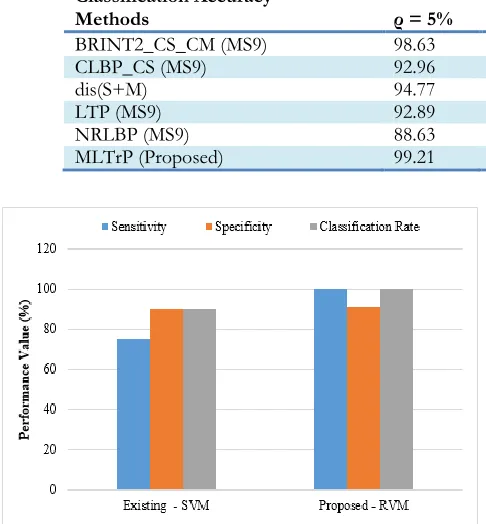
Here, the classification accuracy of training level and training feature points is calculated for exist-ing and proposed texture feature extraction tech-niques shown in Table 1. Where, represents the noise density ratio.
[18] [19]
Comparative Analysis between existing SVM and proposed RVM Classifiers
In this graph, the x-axis represents the classifiers and the y-axis represents the values of sensitivity, specificity and classification rate. From this
Table 1: Classification accuracy for existing and proposed texture feature extraction techniques (24)
Classification Accuracy
Methods ρ = 5% ρ = 10% ρ = 20% ρ = 30% ρ = 40%
BRINT2_CS_CM (MS9) 98.63 96.55 92.64 84.54 74.26
CLBP_CS (MS9) 92.96 90.53 82.2 69.77 50.88
dis(S+M) 94.77 93.22 76.67 54.81 43.33
LTP (MS9) 92.89 91.99 86.11 77.71 64.19
NRLBP (MS9) 88.63 88.96 83.87 78.98 67.11
MLTrP (Proposed) 99.21 98.44 95.65 92.86 91.3
Fig. 10: Comparative analysis graph for existing SVM
and proposed RVM classifiers.
Table 2: Performance Measure of RVM
Classification
Performance Metrics Value
Correct Rate 0.9565
Error Rate 0.0435
Last Correct Rate 0.9565
Last Error Rate 0.0435
Classified Rate 1
Sensitivity 1
Specificity 0.9196
Positive Predictive Value 0.9167
Negative Predictive Value 1
Positive Likelihood (PL) 12
Negative Likelihood (NL) 0
Prevalence 0.4783
Accuracy 95.6522%
Performance Measure
Table 2 shows the performance measure of RVM classification. The performance metrics such as, correct rate, error rate, sensitivity, specificity, ac-curacy and prevalence of the proposed BMW
identification and classification system is evaluat-ed by using the RVM classifier.
Discussion
The task has been carried out in this paper is to provide the information about the identification and classification of BMW. Several related works of BMW classification is proposed in the last decades. Classification (10) and identification of BMW is not an easy problem so, more work is needed for the task of waste stream identifica-tion. The Median Filtering technique (11-13), MLTrP (14-19) and RVM (20-23) are used to ef-ficiently extract and verify the histogram features of BMW image. In this research, four types of wastages such as, human body parts, plastics, cot-tons and liquids are properly identified and classi-fied.
di-agonal and vertical directions (0°, 45° and 90°). Additionally, the RVM classification mechanism is also employed to classify accurately the waste stream into human body parts, plastics, cotton and liquids.
In future, the classification system can be im-proved for further systematic segregation and proper disposal of BMW.
Conclusion
BMW should be classified according to their source, type and risk factors associated with their management, handling, separation, treatment and disposal. BMW must be handled and stored in a secure environment, because it causes serious health issues to environment. In this paper, the BMW are identified and classified by using MLTrP technique and RVM classifier. Initially, the input BMW image is preprocessed by using the median filtering technique. In this stage, the irrelevant and highly corrupted noises are re-moved and filtered. After that, the MLTrP is used to extract the histogram features of the BMW image. Hence, the histogram pattern fea-tures are given to the input of RVM, which is a multi-class classifier mainly used for pattern clas-sification. Finally, it classifies the BMW image into human body parts, cotton, plastics and liquid wastages.
Ethical considerations
Ethical issues (Including plagiarism, informed consent, misconduct, data fabrication and/or fal-sification, double publication and/or submission, redundancy, etc.) have been completely observed by the authors.
Acknowledgement
The authors declare that there is no conflict of interests.
References
1. Chauhan A, Singh A (2016). A hybrid multi-criteria decision making method approach
for selecting a sustainable location of healthcare waste disposal facility. J Clean Prod, 139: 1001-1010.
2. Lakshmi, Refonaa J, Vivek J (2015). Tracking of bio medical waste using global positioning system. 2015. International Conference on Circuit, Power and Computing Technologies (ICCPCT).
3. Kumar R, Gupta AK, Aggarwal AK, Kumar A (2014). A descriptive study on evaluation of bio-medical waste management in a tertiary care public hospital of North India. J Environ Health Sci Eng, 12:69.
4. Moreira AMM and Günther WMR (2013). Assessment of medical waste management at a primary health-care center in São Paulo, Brazil.Waste Manag, 33(1):162-167. 5. Kalaivani K, Anjalipriya V, Sivakumar R,
Srimeena R (2015). An efficient Bio-key Management scheme for telemedicine applications. in Technological Innovation in ICT for Agriculture and Rural Development (TIAR), 2015 IEEE.
6. Naik B, Nayak J, Behera HS, Abraham A (2016). A self adaptive harmony search based functional link higher order ANN for non-linear data classification. Neurocomputing, 179: 69-87.
7. Farid DM, Zhang L, Rahman CM, Hossain MA, Strachan R (2014). Hybrid decision tree and naïve Bayes classifiers for multi-class multi-classification tasks. Expert Syst Appl, 41(4):1937-1946.
8. Wang D, Zhang X, Fan M, Ye X (2016). Hierarchical mixing linear support vector machines for nonlinear classification. Pattern Recogn, 59: 255-267.
9. Korytkowski M, Rutkowski L, Scherer R (2016). Fast image classification by boosting fuzzy classifiers. Inform Sci, 327: 175-182.
10. Rosen GL, Reichenberger ER, Rosenfeld AM (2011). NBC: the Naive Bayes Classification tool webserver for taxonomic classification of metagenomic reads. Bioinformatics, 27(1): 127-129.
12. Lu CT (2014). Noise reduction using three-step gain factor and iterative-directional-median filter.Appl Acoust, 76: 249-261. 13. Meher SK (2014). Recursive and
noise-exclusive fuzzy switching median filter for impulse noise reduction. Eng Appl Artif Intell, 30:145-154.
14. Murala S, Maheshwari R, Balasubramanian R (2012). Local tetra patterns: a new feature descriptor for content-based image retrieval. IEEE Trans Image Process, 21(5): 2874-2886.
15. Shrivastava N, Tyagi V (2014). An effective scheme for image texture classification based on binary local structure pattern. Visual Comput, 30(11): 1223-1232.
16. Murala S, Wu (2014). Local mesh patterns versus local binary patterns: biomedical image indexing and retrieval. IEEE J Biomed Health Inform, 18(3): 929-938. 17. Yuan, F (2014). Rotation and scale invariant
local binary pattern based on high order directional derivatives for texture classification. Digit Signal Process, 26: 142-152.
18. Yuan F, Shi J, Xia X, Fang Y, Fang Z, Mei T (2016). High-order local ternary patterns with locality preserving projection for smoke detection and image classification. Inform Sci, 372: 225-240.
19. Huanga M, Mu Z, Zenga H, Huangb S (2015). Local image region description using orthogonal symmetric local ternary pattern.Pattern Recognit Lett, 54: 56-62. 20. Wang K, Jia H (2009). Image Classification
Using No-balance Binary Tree Relevance Vector Machine. in ASIA '09. International Asia Symposium on Intelligent Interaction and Affective Computing.
21. Raju J, Durai CAD (2013). A survey on texture classification techniques. 2013 International Conference on Information Communication and Embedded Systems (ICICES).
22. Pal M, Foody GM (2012). Evaluation of SVM, RVM and SMLR for accurate image classification with limited ground data. IEEE J Sel Topics Appl Earth Observ, 5(5): 1344-1355.
23. Braun, AC, Weidner U, Hinz S (2012). Classification in high-dimensional feature spaces—Assessment using SVM, IVM and RVM with focus on simulated EnMAP data.IEEE J Sel Topics Appl Earth Observ , 5(2): 436-443.