nkanyiso, Jnl Hum & Soc Sci 2019, 11(1)
The application of the social model of disability and Wilson’s model of
information behaviour towards effective service delivery for students
with disabilities within an academic library context
Dorothy Eneya1and B.J. Mostert2
Department of Information Studies
University of Zululand
[email protected]; [email protected]
Abstract
This paper explores the applicability of the social model of disability and Wilson’s model of information seeking behaviour for effective service delivery to students with disabilities in the context of academic libraries.
The paper is based on a literature review based on Oliver’’s social model of disability and Wilson’s model of information seeking behaviour in relation to service provision to students with disabilities in academic libraries. The literature review provided a background to the two models and their criticisms and implications to academic libraries.
This paper shows that despite their respective weaknesses, using the social model of disability and Wilson’s model of information seeking behaviour in the academic library context offers an opportunity for academic libraries to re-look at their systems and services in order to address the different barriers faced by students with disabilities in their day to day information seeking. As libraries acquire and organise their resources, the needs of students with disabilities should always be prioritised. Academic libraries as a key information source in any academic setting have a responsibility to provide information in various formats using various facilities for easy accessibility and use by their diverse users.
Access to any form of information is a fundamental human right. Academic libraries must identify and remove barriers that may inhibit information seeking for students with disabilities. Additionally, academic libraries should use multiple facilities to provide information. This will ensure that information needs for users with disabilities are catered for.
Keywords: Social model of disability, Wilson’s model of information seeking behaviour, students with disabilities, academic libraries
1 Introduction and background
Information helps people to flourish. For students in higher education, academic information is key to their success. Academic libraries are key providers of academic information in higher education. It is for this reason that they have been described as the heart of the university and the hub of teaching and learning (Nawe 2004: 381). Research has shown that library use increases student success (Association of College and Research Libraries (ACRL) 2016: 1), and all students, including those with disabilities have the same academic goals (Mutula and Majinge 2016). Therefore, academic libraries should provide services that are accessible for all users, including those with disabilities.
Disability models are key to the understanding of disability as they provide a basis for particular attitudes displayed by society (Sullivan 2011). It is important that library staff should be
1. PhD student, Department of Information Studies ,University of Zululand, South Africa and Director Library Services, Uni-versity of Malawi.
acquainted with disability models in order for them to develop positive attitudes and perceptions about library users with disabilities in order to create an enabling environment for such users. Herriot (2006: 53) emphasizes that services quality and satisfaction should also apply to users with disabilities. Similarly, librarians’ knowledge of information seeking behaviour of persons with disabilities is critical to the development of accessible library systems and services.
This paper discusses Wilson’s model of information seeking behaviour and the Social model of disability, which are instrumental to the understanding of information seeking behaviour of students with disabilities and how academic libraries can identify and remove barriers that may hinder them in accessing library and information services. Our motivation for using the two models in combination lies in our understanding that while it is important to understand and explain information behaviour for students with disabilities, we also need to identify barriers to information access.
2 Disability models
There are a number of disability models discussed in literature. These include, but are not limited to the moral/religious model, medical model, welfare/charity model and social model (Durham and Ramcharan 2018; Retief and Letsosa 2018). Moral/religious model conceives disability as punishment from God for lack of adherence to his principles, or a test of faith. This model leads to a feeling of shame in the person with a disability. The Medical model views disability as a sickness and a tragedy. It leads to perceiving persons with a disability as pitiable and their condition as a tragedy, with no expectation of them making a valuable contribution to society. The welfare/charity model views persons with a disability as victims for their impairment who require special assistance, services and institutions. This model differs from the moral model because it aims at benefiting persons with disabilities by encouraging compassionate treatment towards them (Retief and Letsosa 2018: 6). The social model, being the model of choice for this study, is discussed in more detail below.
2.1 Social model of disability
The social model was developed in reaction to the medical model which had become firmly rooted in society. The fight for emancipation by disabled people through disability organisations such as the Union for the Physically Impaired Against Segregation (UPIAS) (1976) in Great Britain in the 1900s led to the shift in focus of disability focusing on the individual to societal barriers that prevent full participation of disabled people, from which Oliver (1990) developed the concept of the social model of disability. UPIAS defined disability as:
“… A disadvantage or restriction of activity caused by a contemporary social organisation which takes no or little account of people who have physical impairments and thus excludes them from participation in the mainstream of social activities” (Union of the Physically Impaired Against Segregation 1976: 20).
From the above definition, it is clear that the Social model separates impairment from disability and that impairment is considered as an attribute which results from injury, genetic make-up or disease; while disability is a socially constructed phenomenon. The Social model argues that people are disabled by society which was designed for able-bodied people, without any consideration for persons with disabilities hence it discriminates against them (Oliver 1990). Societal attitudes and culture create a disadvantage for persons with disabilities as they are labelled as incapable and nobody questions the societal barriers which hugely discriminate against them. Such barriers, being socially created require social solutions.
2.2 Criticisms of the social model of disability
nkanyiso, Jnl Hum & Soc Sci 2019, 11(1)
increased the emphasis on addressing disability as a social issue. This view is shared by Lourens (2015:29) who argues that the social model “over-socialises” disability by placing too much emphasis on barrier removal. Lourens argues that a change in attitude does not translate to the disappearance of an impairment. No matter how much reconstruction can be done to society, elements of “biologically informed” disability will still be visible. People would still experience considerable effects of impairment.
Watermeyer (2006) argues that in an attempt to put up a unified political front against oppression, the social model divorced disability from the impaired body. As a result, individuals lost their unique lives. Some disabled feminists (Wendell 1996; Thomas 1999) have also questioned the social model’s disregard for unique and diverse lives, which has resulted in some theoretically oppressive identities being invisible and unacknowledged. The two authors argue that the model should have included other oppressing identities such as class, gender and race to make them visible. In the same vein, Goggin (2008) states that a disabled body or mind is also one that is raced, gendered, aged, sexualised and classed, hence disability is intertwined with other sets of different experiences of peculiarity and forms of political engagement. However, Oliver (2009) asserts that the fact that the divisions have not been incorporated does not signify the incapability of the social model, but is due to the non-use of the model by analysts in those divisions.
In his analysis of the social model, Woods (2017) points out that the social model of disability excludes neurodivergent labels, as evidenced by the wide use of the medical model of disability in autistic studies, leading to harsh treatment of autistic individuals, resulting mainly from the language used to describe autism, among the numerous reasons. For this reason, Woods (2017: 78) argues for the wide application of the social model to cover neurodivergent labels in order to delink autism research from causes and biological effects on services and social issues, subsequently enabling autistic individuals to explore the impact of living in a predominantly neurotype society.
2.3 Application of the social model of disability in related studies
Despite the criticisms levelled against the social model, its use is still dominant in the subject literature.
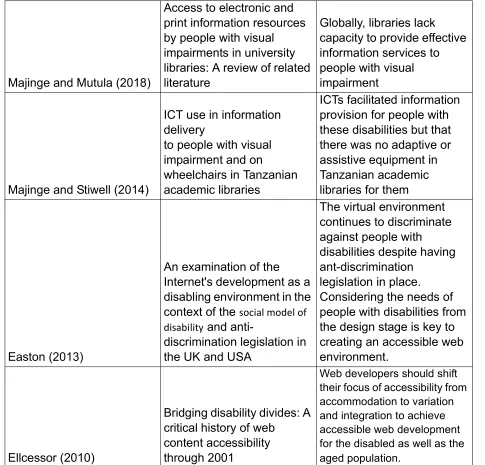
Table 1 below shows an analysis of social model application to studies related to the current one obtained from SCOPUS database over a 10-year period, 2008-2018.
Table 1 Application of social model in related studies (2008-2018)
Author(s) Title Findings
Anderson (2018)
Autism and the academic library: A study of online communication
Autistic students are underserved by academic libraries. Their needs which are complex, are usually ignored.
Kavishe and Isibika (2018)
Provision of library services to users on wheelchairs at Ardhi University and
University of Dar es Salaam libraries
Table 1 above shows that social model of disability is widely used in studies on library service provision to people with disabilities. It is noteworthy that other similar studies exist in the database but did not use social model. SCOPUS database (Elsevier B.V 2019) was used based on Tabacaru’s (2019:7) finding that SCOPUS is the largest database in social sciences, biomedical research, natural science and engineering. The first two fields are the major contributors to the social model. Table 2 below shows number of publications per publication type, country and subject, as presented by SCOPUS database, over a 10-year period.
Majinge and Mutula (2018)
Access to electronic and print information resources by people with visual impairments in university libraries: A review of related literature
Globally, libraries lack capacity to provide effective information services to people with visual impairment
Majinge and Stiwell (2014)
ICT use in information delivery
to people with visual impairment and on
wheelchairs in Tanzanian academic libraries
ICTs facilitated information provision for people with these disabilities but that there was no adaptive or assistive equipment in Tanzanian academic libraries for them
Easton (2013)
An examination of the Internet's development as a disabling environment in the context of the social model of disability and
anti-discrimination legislation in the UK and USA
The virtual environment continues to discriminate against people with disabilities despite having ant-discrimination
legislation in place. Considering the needs of people with disabilities from the design stage is key to creating an accessible web environment.
Ellcessor (2010)
Bridging disability divides: A critical history of web
content accessibility through 2001
Web developers should shift their focus of accessibility from accommodation to variation and integration to achieve accessible web development for the disabled as well as the aged population.
Table 2 Number of publications per type, country and subject Publication Type No. of publications Country No. of publications Subject No. of Publications
Article 308 UK 141 Soc. Science 290
Book
Chapter 55 USA 99 Medicine 114
nkanyiso, Jnl Hum & Soc Sci 2019, 11(1)
Table 2 above shows that social model of disability is used across disciplines. Social sciences and medicine are the disciplines that make the most use of the model.
2.4 Application of the social model of disability to academic libraries
The strength of the social model lies in its focus on the removal of barriers in society which prevent access to services by people with disabilities. As an integral part of society, libraries should remove barriers that hinder access to information. Library buildings and websites must be accessible to people with disabilities.
According to Albert and Hurst (2004: 2), the social model offers an analytical framework for understanding why and how discrimination occurs. Albert and Hurst (2004: 4) further state that from a human rights perspective of the social model, continued exclusion of people with disabilities from mainstream services promotes discrimination, which is an ultimate violation of human rights. Hence, from a human rights perspective, academic libraries have a legal obligation not to exclude students with disabilities in the way they provide services.
Ellcessor (2010:292) contends that the social model acknowledges the physical differences in individuals; however, individuals experience a disability in the context where society does not accommodate their needs. In the same vein, academic libraries have a social responsibility to remove barriers that may stand in the way of users with disabilities. Ellcessor further states that conceptualising disability in terms of rights assists in the formulation of legislation and policies that incorporate a rights-based approach to disability and promotes the use of language that depicts social construction. This approach can help academic libraries to address accessibility requirements for students with disabilities.
This view is shared by Croft (2010: 4) who states that the social model helps governments to formulate policies that focus on removing barriers that prevent people with disabilities from participating fully in society.
By viewing people with disabilities as valuable members of the society, the social model of disability recognises them as being capable of making meaningful contributions to social and economic development; and accepts that society is responsible for imposing cultural, structural and attitudinal barriers that prevent them from realising their full potential. This model therefore promotes equal rights and opportunities for people with disabilities in terms of access to such public services as education, health, employment, libraries and others (Babalola and Haliso 2011: 143).
Again, in the light of the social model and in the higher education perspective, academic libraries should remove all obstacles that hinder access to information and create an environment that enables equal access to information in physical libraries as well as that
Book 9 Canada 22
Arts &
Humanities 69 Conference
Paper 6 Israel 15 Psychology 64
Note 3 Spain 14 Nursing 38
Editorial 1 Ireland 12
Business Management Accounting 13
Letter 1
New
Zealand 10
Computer
Science 10
Undefined 5 South Africa 10
Environmenta
l Science 9
contained in library websites. To achieve this, libraries should provide lifts and other assistive devices, modify library buildings to allow people with disabilities to navigate easily, provide information in alternative formats and ensure that library websites are accessible.
2.5 Implications of the social model to academic libraries
The social model of disability has several implications for academic libraries. First, an individual’s experience of disability is influenced by his or her environment, and an inaccessible environment is a barrier to participation and inclusion. Access to academic libraries is critical for students with disabilities, more especially those with mobility and visual impairment. Inaccessible library facilities exclude students with disabilities from full academic participation.
Second, the unavailability and inaccessibility of information materials restrict educational opportunities for students with disabilities. Information and communication technologies play a significant role in breaking information access barriers for students with disabilities.
Third, stigmatising attitudes towards students with disabilities, perceiving them as incapable, creates a loss of sense of achievement. The availability and awareness of support services and reasonable accommodations increases participation and creates a sense of belonging (Tugli, Klu and Morwe 2014: 334).
Fourth, overdependence reduces one’s dignity and is counterproductive. Academic libraries should address access issues, adapt their facilities and provide assistive technologies for independent access by students with disabilities.
Fifth, the social model implies that university libraries should develop policies that address information services for students with disabilities, including the acquisition of information resources in alternative formats, assistive technologies and adaptive equipment for use by students with disabilities as well as staff training. A lack of policy impacts negatively on library service provision (Mutula and Majinge 2016). In addition, policies are vital in emphasising the recognition of students with disabilities as potential users of the library services.
3 Wilson’s (1981) model of information seeking behaviour
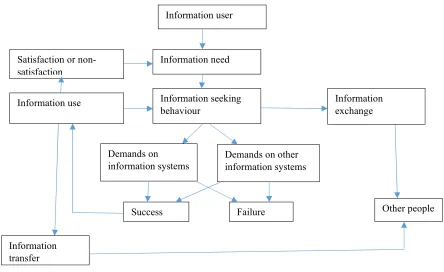
Wilson’s (1981) model was the first to recognise informal channels of information transfer by acknowledging that other people are also involved in information seeking behaviour through information exchange (Case and Given 2016: 139). The model presents a triple view of information seeking: the context of an individual seeking information, an information system which can be either manual or electronic, and information resources that might be consulted. Academic libraries exist to meet the needs of users by acquiring, organising and providing relevant information sources supported by suitable and familiar facilities (Oladunjoye, Omiunu and Yomi-Owojori 2018). We chose Wilson’s model of 1981 for this study because its focus on information need, the person seeking information and the context in which information is sought complement the social model of disability, whose main focus is barrier identification and removal. Figure 1 below shows Wilson’s 1981 model.
nkanyiso, Jnl Hum & Soc Sci 2019, 11(1)
We used Wilson’s model to illuminate information seeking behavior of students with disabilities in the context of academic libraries both from an individual perspective as well as socially constructed barriers. Students with disabilities as the user in context, are confronted with numerous barriers in their information seeking efforts (Šehi and Tanackovic 2014: 4). These barriers can be classified as personal, interpersonal and environmental (Babalola and Haliso 2011: 142). Personal barriers include unawareness of existing information services and type of disability which influences information seeking preferences. Secondly, students with disabilities in higher education rely on interpersonal sources more than institutional play a significant role in information seeking behaviour for students with disabilities in higher education. Studies have shown that students with disabilities depend on interpersonal sources that they do on institutional sources. In their study on inclusive education at tertiary level, Strnadová, Hájková and Kvtoová (2015) found that students with disabilities mostly counted on support from their peers in accessing library information services, which is informal, with little or no formal support from academic libraries. Similarly, Seale (2015: 127) affirms that students with disabilities value formal sources of information, however, they are not conveniently available to them and instead they turn to their able-bodied peers to fill the gap.
The social, political and economic environment of students with disabilities also presents barriers to their access to library information services. Students with disabilities face social discrimination and cultural bias which can potentially impact on their information seeking behaviour. Ingstad and Eide (2011: 8) concur that students with disabilities are disadvantaged from the outset and they need more assistance for equality to be achieved.
3.1 Criticisms of Wilson’s model
There have been both negative and positive viewpoints regarding the model. Case and Given's (2016: 173) argue that Wilson’s model is too general and its components such as context of the person and information need are not specified. Similarly, Knight and Spink (2008) and Garg
#'#()# +,'#(((,!-#%
&
&
& &
* +/
&
0
0
+ 1
&
(2016) fault the model for its lack of clarity as to how the person seeking information interacts with an information retrieval system in order to find and retrieve information
Potnis (2015:103) states that Wilson’s model does nothing more than define and solve a problem. Perhaps Potnis draws this from Wilson’s (1999:251) own confession about the limitation of the model that “it only provides a map of the research area” and illuminates research gaps without suggesting factors that cause information behaviour.
Nevertheless, the strengths of the model have also been identified.
Wilson (1999: 251) mentions that the 1981 model raised awareness about the little attention that has been given to information use. Wilson further states that the same applies to informal transfer of information between individuals.
Secondly, Potnis (2015: 103) states that Wilson’s model clearly depicts the inter-relationship between information behaviour, information seeking and information retrieval. In addition, Potnis states that the model gives a framework for explaining “goal oriented information seeking.”
Finally, Potnis (2015: 106) asserts that the fact that Wilson’s models continue to be adapted and used as theoretical frameworks to explain the information behaviour of a broad range of groups of users across the world speaks volumes about their consistency, applicability and usefulness. Further to this, the application of Wilson’s model to study the information behaviour of disadvantaged populations and different professions from developing countries is encouraged for the diversity of information behaviour research.
3.3 Implications of Wilson’s model to academic libraries
Wilson’s model has several implications to academic libraries. Firstly, marketing and promotion of library resources and services to students with disabilities have a significant impact on information seeking behaviour for students with disabilities. Library promotional materials should include information on disability services. They should also be available in different formats to ensure accessibility to all students, including those with disabilities. Furthermore, academic libraries should design information literacy programmes that do not discriminate students with disabilities. Secondly, interpersonal relationships influence information seeking behaviour of students with disabilities. Wang and Yu (2017: 14) state that interpersonal networks for marginalized communities such as students with disabilities are usually small and unconnected as they are restricted to the disabled community. Therefore, academic libraries should rise up to break interpersonal barriers as per their professional ethos. Providing them with accessible internet facilities is a sure way of opening them up to the outside world. In addition, academic libraries should stock information in different formats to cater for the diverse preferences of students with disabilities as dictated by their disability types and degree of impairment. Academic libraries should also provide assistive technologies for students with disabilities to access information. Šehi and Tanackovic (2014:5) affirm that assistive technologies play a significant role in facilitating information seeking for students with disabilities.
nkanyiso, Jnl Hum & Soc Sci 2019, 11(1)
4 Conclusions
In the earlier sections, we have demonstrated how academic libraries can apply the social model to identify and remove barriers to information access for students with disabilities. Similarly, Wilson’s model of information seeking behaviour predicts the information needs and information seeking behaviour of students with disabilities. Academic libraries’ understanding of such information needs and seeking behaviour is critical to identification and removal of access barriers and development of information systems and services that reflect the various information media preferences of students with disabilities.
Academic libraries play a critical role in teaching, learning and research. The social model provides a framework for academic libraries to examine their services, facilities and systems for accessibility to students with disabilities. Furthermore, the social model stimulates academic libraries to start thinking of non-discriminating policies aimed at enhancing participation of students with disabilities in higher education.
Wilson’s model of information seeking behaviour presents academic libraries with an essential tool for designing and implementing accessible library systems and services for students with disabilities.
References
Albert, B. and Hurst, R. 2004 Disability and a human rights approach to development. Disability Knowledge and Research. Viewed 27 July, 2017 from www.disabilitykar.net.
Anderson, A. 2018 Autism and the academic library: A study of online communication, College and Research Libraries, 79(5), pp. 645–658. doi: 10.5860/crl.79.5.645.
Association of College and Research Libraries (ACRL) 2016 Documented library contributions to student learning and success: Building evidence with team-based assessment in action groups. Edited by K. Brown and K. J. Malenfant. Chicago: Association of College and Research Libraries. Viewed 15 March, 2017 from http://www.ala.org/acrl/sites/ala.org.acrl/ files/content/issues/value/contributions_y2.pdf.
Babalola, Y. T. and Haliso, Y. 2011 Library and Information Services to the Visually Impaired - The Role of Academic Libraries, Canadian Social Science, 7(1), pp. 140–147. doi: http:// dx.doi.org/10.3968/j.css.1923669720110701.015.
Case, D. O. and Given, L. M. 2016 Looking for information: A survey of research on information seeking, needs, and behavior. 4th ed. Bingley, UK: Emerald Group Publishing Limited. Croft, A. 2010 Including disabled children in learning: Challenges in developing countries.
Brighton, UK: Centre for Research on Educational Access, Transitions and Equity (CREATE Pathways to Access).
Durham, C. and Ramcharan, P. 2018 Understanding the Assumptions of Major Models of Disability Theory, in Durham, C. and Ramcharan, P. (eds) Insight into acquired brain injury: Factors for feeling and faring better. Singapore: Springer, pp. 31–52. doi: 10.1007/978-981-10-5666-6.
Easton, C. 2013 An examination of the Internet ’ s development as a disabling environment in the context of the social model of disability and anti-discrimination legislation in the UK and USA, Universal Access in the Information Society, 12(1), pp. 105–114. doi: 10.1007/s10209-011-0268-2.
Ellcessor, E. 2010 Bridging disability divide: A critical history of web content accessibility through 2001, Information Communication & Society, 13(3), pp. 289–308. doi: 10.1080/
13691180903456546.
Garg, M. 2016 Information seeking behaviour models: A brief introduction, International Journal of Library and Information Studies, 6(1), pp. 161–168.
Goggin, G. 2008 Innovation and disability, Media and Culture Journal, 11(2), pp. 1–12. Viewed 31 July, 2017 from http://journal.media-culture.org.au/index.php/mcjournal/article/viewArticle/ 56%0AGoode
Herriott, T. K. 2006 An increasingly diverse student population: A rationale for consideration of universal access at postsecondary institutions, in Hernon, P. and Calvert, P. (eds) Improving the quality of library services for students with disabilities. London: Libraries Unlimited, pp. 45–55.
Kavishe, G. F. and Isibika, I. S. 2018 Provision of Library Services for Users in Wheelchairs at Ardhi University and University of Dar es Salaam Libraries, Library Philosophy and Practice (e-journal), 1672, pp. 1-12. Viewed 1 March, 2018 from http://digitalcommons.unl.edu/ libphilprac/1672.
Knight, S. and Spink, A. 2008 Toward a Web Search Information Behavior Model Toward a Web Search Information, in Spink, A. and Zimmer, M. (eds) Web Search: Multidisciplinary
Perspectives. Berlin: Springer, pp. 209-234. doi: 10.1007/978-3-540-75829-7. Lourens, H. 201) The lived experiences of higher education for students with a visual
impairment: A phenomenological study. Viewed 25 June, 2017 from https:// www.researchgate.net/publication/312612286.
Mutula, S.M. and Majinge, R.M. 2016 Information behaviour of students living with visual impairments in university libraries: A review of related literature, The Journal of Academic Librarianship, 42(5), pp. 522–528. doi: 10.1016/j.acalib.2016.06.019.
Nawe, J. 2004 Strategizing financing of public university libraries in East Africa, Library Management, 25(8/9), pp. 381–385. doi: 10.1108/01435120410562871.
Oladunjoye, M.T., Omiunu, O.G. and Yomi-Owojori, T. O. 2018 Information behavior of students towards the use of library information resources in universities in Oyo, Library Philosophy and Practice (e-journal), 1834, pp. 1–14. Viewed 25 June, 2019 from https://
digitalcommons.unl.edu/cgi/viewcontent.cgi?article=5116&context=libphilprac Oliver, M. 1990 The politics of disablement. London: MacMillan.
Oliver, M. 2009 Understanding disability: From theory to practice. 2nd ed. Basingstoke: Palgrave Macmillan.
Retief, M. and Letsosa, R. 2018 Models of disability: A brief overview, HTS Teologiese Studies/ Theological Studies, 74(1), pp. 1-8. Viewed 7 October, 2019 from https://doi.org/ 10.4102/ hts.v74i1.4738
Seale, J. et al. 2015 Not the right kind of “digital capital”? An examination of the complex
relationship between disabled students, their technologies and higher education institutions, Computers and Education, 82, pp. 118-128. doi: 10.1016/j.compedu.2014.11.007.
Šehi, S. and Tanackovic, S. F. 2014 Exploration of Academic Information Seeking and Library Use of the Blind and Visually Impaired Students in Croatia. Viewed 6 July, 2019 from ozk.unizd.hr/proceedings/index.php/lida/article/download/158/156
nkanyiso, Jnl Hum & Soc Sci 2019, 11(1)
Sullivan, K. 2011 The prevalence of the medical model of disability in society. AHS Capstone Projects. Viewed 27 February, 2017 from http://digitalcommons.olin.edu/
ahs_capstone_2011/13
Tabacaru, S. 2019. Web of Science versus Scopus: Journal Coverage Overlap Analysis. Viewed 27 November 2019 from https://oaktrust.library.tamu.edu/bitstream/handle/1969.1/175137/ Web of Science versus Scopus Report 2019.pdf?sequence=4&isAllowed=y
Thomas, C. 1999 Female forms: Experiencing and understanding disability. Buckingham: Open Press.
Tugli, A. K., Klu, E. K. and Morwe, K. 2014 Critical Elements of the Social Model of Disability: Implications for Students with Disabilities in a South African Institution of Higher Education, Journal of Social Sciences, 39(3), pp. 331–336. Viewed 6 July, 2019 from https://
pdfs.semanticscholar.org/4539/646f99b88f7f42310350e0804a3c390ad116.pdf.
Union of the Physically Impaired Against Segregation 1976 Fundamental Principles of Disability. London: UPIAS. Viewed 23 February 2017 from http://www.disability.co.uk/fundamental-principles-disability.
Wang, S. and Yu, J. 2017 Everyday information behaviour of the visually impaired in China, Information Research, 22(1), pp. 1–19. Viewed 17 March 2018 from https://files.eric.ed.gov/ fulltext/EJ1138643.pdf%0A.
Watermeyer, B. 2006 Disability and psychoanalysis’, in Watermeyer, B. et al. (eds) Disability and social change: A South African agenda. Pretoria, South Africa: HSRC Press, pp. 31–43. Watson, N. 2004 The Dialectics of Disability, in Barnes, C. and Mercer, G. (eds) Implementing the
Social Model of Disability: Theory and Research. Leeds: The Disability Press, pp. 101–117. Viewed 24 April 2017 from
http://disability-studies.leeds.ac.uk/files/library/Barnes-implementing-the-social-model-chapter-7.pdf.
Wazakili, M. et al. 2011 The social inclusion of people with disabilities in poverty reduction policies and instruments: Initial impressions from Malawi and Uganda, in Eide, A. and Ingstad, B. (eds) Disability and poverty: A global challenge. Bristol, UK: The Policy Press, pp. 15–29.
Wendell, S. 1996 The rejected body: Feminist philosophical reflections on disability. New York: Routledge.
Wilson, T.D. 1999 Models in information behaviour research, The Journal of Documentation, 55(3), pp. 249-270. doi: 10.1108/eb026404.
Woods, R. 2017 Exploring how the social model of disability can be re-invigorated for autism: In response to Jonathan Levitt, Disability & Society, 32(7), pp. 1090-1095. doi: 10.1080/
09687599.2017.1328157.