An interdisciplinary project using
recycled glass as an aesthetically pleasing
architectural material
by Dr Tyra Oseng-Rees, Swansea College of Art at University of Wales Trinity Saint David, Ian Standen, Swansea School of Architecture at University of Wales Trinity Saint David, Dr Juan Ferriz-Papi, Computing and
Engineering, at University of Wales Trinity Saint David
Abstract
This paper is exploring how a waste material, in this case recycled glass, can be up-cycled and used as an aesthetically pleasing architectural material. The project has been undertaken as an interdisciplinary project between staff and students at University of Wales Trinity Saint David, Swansea in Wales UK. Sustainability is of a significant importance for the University with its multi-million pound development at Swansea Waterfront Innovation Quarter. The university is emphasising the use of locally sourced materials in the building to create a neighbourhood of academic activity at its core and to attract companies to co-locate with the University to exploit knowledge, develop skills, support existing companies and attract new investment into the region. The aim of the project is the use and application of fused recycled glass as a material in a wider context in the construction industry and the application to interior design.
A reception desk for the new university campus at the SA1 Waterfront Innovation Quarter has been proposed as a test bed for the new low temperature fused recycled glass product. This is a research active field carried out by Dr Tyra Oseng-Rees at Swansea College of Art and who successfully developed and installed 100% recycled glass interior tiles in a new build in 2008 only a short distance from the new campus that are being built (Oseng, Donne, & Bender, 2009)).
The added benefit of this project is cross disciplinary with staff and students from art, design, engineering, construction, architecture and environmental conservation involved in a live case study. And lastly; exploration and application of a commercially viable product both with material integrity and aesthetic attributes.
The circular economy is very much at the heart of this project underpinned by the ‘five-ways-of-working’ from the ‘The Well-being of Future Generation (Wales) Act (2015)’. Involvement and integration with industry was also vital and in this instance with the ‘buy-in’ from the construction company KIER Group and the architect company Stride Treglown was instrumental for this development in the design and manufacture of the reception desk.
Prevention and long-term thinking is at the heart of all decision making, enabling the consideration to both end-of-life of the product and demonstration how a waste material can be up-cycled and reintroduced into the circular economy for future design and purpose use of the material.
Introduction: Recycled glass and circular economy
In recent years, the issue of sustainability particularly that related to circular economy has become a major concern. The problem of recovered waste being down-cycled rather than returned back into the closed-loop cycle is a major factor in the discussions of circular economy. The problem of waste glass is a particular case, even though it is known that glass bottles can be recycled ‘ad infinitum’ without severe degradation of physical properties (British Glass, 2008), a major part of the collected glass is being down-cycled to use as bulk for aggregate, for example mixed with concrete or asphalt (Aggregain, 2003), used in fibreglass or foam glass manufacturing (WRAP, 2004) (Aabøe, Oyseth, & Hägglund, 2005) (Brusatin, Bernardo, & Scarinci, 2004). This is something that the new paradigm shift towards a circular economy is trying to change (Pomponi &
Moncaster, 2016) ( Kobza & Schuster, 2016) (Ellen MacArthur Foundation, 29th August 2017) and something the authors of this papers have investigated in details (Oseng-Rees & Donne, Innovation and development of a new recycled glass material, 2015) and (Oseng-Rees, Donne, Bender, & Brown, 2014).
The Welsh assembly government also set themselves ambitious targets in the report ‘Towards zero waste; one planet; one Wales’ (Towards Zero Waste, One Wales: One Planet, 2009) with circular economy now making a leap from linear manufacturing and towards achieving the milestones of seventy percent recycling by 2025 and hundred percent recycling by 2050. The estimation of growth of jobs within circular economy is estimated to be up to thirty thousand new jobs (McWolf, 2017), and it has the potential to create over two hundred thousand gross jobs and reduce unemployment by about fifty-four thousand by 2030 UK wide (Morgan & Mitchell, 2015).
Wellbeing of Future Generation (Wales) Act (2015)
Following the report published in 2009 Wales also got a new legislation called ‘The wellbeing of future generation (Wales) act (2015)’ (also referred to as ‘the act’). This was something the former minister for environment, sustainability and housing in the Welsh assembly government, Jane Davidson, was developing during her post. After leaving the ministerial post she was appointed as a Pro-Vice Chancellor at University of Wales Trinity Saint David (UWTSD). In 2011 she established ‘The Institute of Sustainable Practice, Innovation and Resource Effectiveness’ (INSPIRE) and succeeded to get the university to commit to embed sustainability as a core principle across all aspects of the university. The act is putting all public bodies under duty to comply with seven different well-being goals, and to think about the long-term impact of their decisions, to work better with people, communities and each other, and to prevent persistent problems such as poverty, health
inequalities and climate change.
As a direct influence of this act, Jane Davidson encouraged the five-ways-of-working particularly in terms of collaboration, integration and involvement within the whole of university. After a presentation of a proposed interdisciplinary research project by Dr Oseng-Rees in June 2015, amendments occurred to the Sustainability Principles of the multimillion pound Swansea Waterfront Innovation Quarter. The amendment read as follow ‘to established opportunities to use the creative, design and environmental skills of staff and learners within UWTSD for the development of the new academic building at SA1’ Jane Davidson, pro-vice chancellor, UWTSD
This project however, was far more ambitions in terms of its aim and objectives. It intended to;
• Progress in a research active field and develop a sustainable recycled glass material for architectural use;
• Deliver a commercial product with its material integrity tested;
• Piloting a new way of working in terms of interdisciplinary work, being inspired by the new five ways of
working of the act;
The project aimed to develop a new reception desk using fused recycled glass, including development of a bespoke glass crusher and establishing the carbon footprint of the manufacturing process. Staff from various discipline backgrounds got together and formed a research cluster consisting of expertise in engineering, glass, architecture, construction and environmental preservation. Students were then subsequently invited to a presentation of the overall research project led by Dr Oseng-Rees, and invited to join and participate through their last year dissertation within their discipline of study. Each member of research staff was then allocated as a supervisor to the student project with the project lead acting as second supervisor and industrial liaison.
The project manager of the research cluster with the expert knowledge in the recycled glass material were also invited along with other members of research staff to a monthly meeting of a ‘FF&E Work and Task Group’ (fixed furniture and equipment) of the new build at Swansea Waterfront Innovation Quarter (SA1) which consisted of SA1 project managers, director of architects, interior architect, head of IT, INSPIRE, and project manager of KIER Construction. The development of the recycled glass reception desk was then amongst one of many items discussed at a regular basis and results were fed into the building project.
By bringing together different disciplines such as art, engineering, construction, architecture and environmental conservation, the proposed project sought to bridge these disciplines together to an
amalgamation of art practice and manufacturing processes with the potential of making a positive impacts on the advanced engineering and manufacturing industry. It is a unique and timely opportunity to develop an interdisciplinary approach with a focus to explore how the ‘Five-ways-of-working’ from the Wellbeing of Future Generation (Wales) Act (2016) can be used as a catalyst for new thinking within circular economy in the industry. The five ways of working is; long term, integration, involvement, collaboration and prevention.
Aims and Objectives of the project
Aim
Design and manufacture a bespoke reception desk for the new academic building at SA1 using fused recycled glass as main component.
Objectives:
• Design of the reception desk to fit the functionality brief set by the SA1 team
• Low temperature fused recycled glass to be the main component of the reception desk
• The recycled glass material will be used as cladding onto a structural carcass made from timber
• Provide/develop aesthetic requirements for the application: such as colour, texture, patterns etc.
• Analysis of characteristics of the material and possible variations according to composition, such as
• Analysis of environmental performance (carbon footprint)
• Design and manufacture of a bespoke glass crusher
• Manufacturing of final material
• Publication of results
Method
The first goal of the Wellbeing of Future Generation Act is called ‘A prosperous Wales’ and it aims to:
‘Create an innovative, productive and low carbon society which recognises the limits of the global environment and therefore uses resources efficiently and proportionately (including acting on climate change); and which develops a skilled and well-educated population in an economy which generates wealth and provides employment opportunities, allowing people to take advantage of the wealth generated through securing decent work’.
The research cluster highlighted parts of the goal which were at in focus throughout the delivery for the project. The highlighted words and phrases (innovative, productive, low carbon society, uses resources efficiently and proportionately, develops a skilled and well-educated population, and provides employment opportunities) were subsequently translated into tangible key performance indicators for this project, and paired up with subject specific knowledge held within the university’s learning and teaching portfolio. The key performance indicators is listed below and paired with teaching and research capacity within members of the research cluster:
• Aesthetically pleasing glass product to market- school of glass and industrial design (Dr. Oseng-Rees, Lisa
Burkl, Ian Standen)
• Architectural design – architecture (Ian Standen)
• Low carbon manufacturing- applied engineering, construction (Dr Greg Owen, Dr Juan Ferriz-Papi)
• Circular economy- environmental conservation (Lara Hopkinson)
• Industrial collaboration – (all members within their discipline of teaching/learning/research)
• Cradle-to-grave design approach – industrial design, construction (Dr Oseng-Rees, Dr Juan Ferriz-Papi)
• Up-cycle waste – (Dr Oseng-Rees, Lara Hopkinson)
• Recycled glass - (Dr Oseng-Rees)
• Locally sourced material - (Dr Oseng-Rees)
• Learning/teaching in interdisciplinary projects and sustainable development and employability skills - (all
members within their discipline of teaching/learning/research)
Results: Students end-of-year-dissertation/project
The students end-of-year project were tailored to fit the overall project’s aim and objectives and to fit within the students of discipline of study and timetabling. Each project were develop in line with their supervisor and is described below:
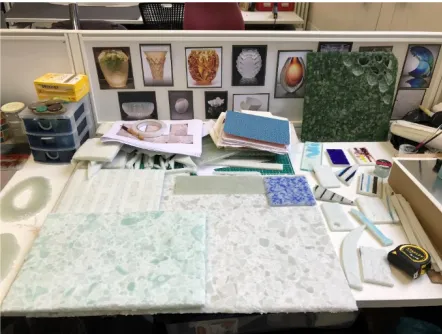
project brief from the external group in terms of texture, colour and reproducibility. Figure 1 below illustrate samples of the exploration of the fused recycled glass.
Figure 1, aesthetic exploration of fused recycled glass, by art student
Mechanical engineering student: Design and manufacture of a bespoke glass crusher. The student was tasked to design/re-design a glass crusher that would meet the needs of crushing bottle glass in a small scale production run. The student were to look into products on the market, find best crushing mechanism which also avoided any metal contaminations that arise from the use of soft steel for crushing bottles. Figure 2 below illustrate the engineering drawing for the crushing mechanism designed by the engineering student.
Figure 2, engineering drawing, hammer configuration by engineering student
Environmental conservation student: Carbon footprint of recycle glass manufacturing. The student were to analyse the carbon footprint on manufacturing of the recycled glass material from a small scale production to a large scale manufacturing. Due to personal reasons the student had to delay the submission of the
Project and Construction Management student: Impact resistance with/without Recyclamine recyclable epoxy coating. The student was tasked to explore the impact resistance of the fused recycled glass and to compare this to other known materials. This project arose at the request of the architect and additionally required the design and fabrication of a test rig as seen in figure 3 below. The research from the student dissertation was
subsequently published at the 19th International Conference on Advanced Architectural Engineering and
Construction Materials, Paris 2017 (Halley, Oseng-Rees, Pagano, & Ferriz-Papi, 2017).
Figure 3, Impact testing jig designed and manufactured by Luca Pagano
Architecture: as a late onset to the project a first year mature architectural student got involved as a
Figure 4, Technical drawing for dry fixing of recycled glass panels. Design by Ian Standen
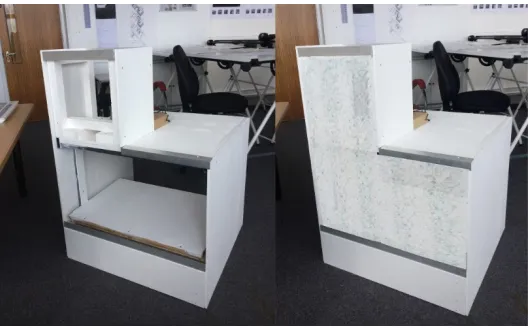
Figure 5, Full size carcass mock-up model made to hold the recycled glass panels,
designed and made by the student
Three students who started this project did not complete in June 2017. One student deferred and is due to complete June 2018. The following two student projects withdrew at a late stage for personal reasons. These two projects were; cost analysis and materials quality certification. One project were to analyse the process for a new material to be introduced to the market, and certify the manufacturing process quality, and the other project were to analyse the transition of the recycled glass material from small scale production to large scale manufacturing.
Discussion
This project was particularly driven by the research active field of aesthetic development of fused recycled glass within the art and design discipline. The pilot project aimed therefore to communicate the story about how waste bottles from domestic households and local pubs and restaurants can be up-cycled to an
aesthetically pleasing material, which again can cultivate a behaviour change of recycling waste and utilising the recycled material in the construction and architectural industry. By involving staff and students across various schools of disciplines to participate in a project that aims to develop new ways of thinking within ‘circular economy’, ‘future generation’ and ‘sustainability’, we can demonstrate to the industry and to the public that ‘collaboration’, ‘involvement’ and ‘long-term-thinking’ can be productive and fruitful for innovation and sustainable development. The industry also get demonstrated that a waste material can be used to create a new and aesthetically pleasing materials for architectural use.
Five ways of Working
The project was measured up against the five ways of working which were interpreted into the following;
Prevention; Close supervision and project flexibility helped detecting problems and change the student’s topics or adapt to new circumstances.
Long term view; the pilot project provided a lifelong learning skills within an interdisciplinary approach for the future generations of employers and entrepreneurs.
Integration; Students had the opportunity to be supervised from staff with different expertise areas, as well as had the opportunity to learn from each other.
Collaboration; staff from various disciplines was involved allowing a space to share common practise and learn from various schools of thoughts (or intellectual tradition). It was especially valuable to break boundaries in fields teaching experience and professional linguistics between engineering and arts & design. Similarly, collaboration between students across different disciplines allowed for an open minded learning approach. Involvement; It was beneficial for all parts (staff and students), to participate in a live project with a real end-product in mind (the reception desk), and the students’ contribution was imperative to drive the project
forward in a university that is learning and teaching focused rather than research focused. This formed a better understanding between aesthetical and engineering aspects as well as an enhanced learner aspects.
End of phase 1
The first part of the project, which was focused on developing the aesthetic features and complying with the technical requests of the material, was finished with the student’s completion of dissertation June 2017. The second part of the project is on-going with manufacture and installation of the reception desk and due to completion June 2018.
Conclusion
The staff found the project very positive in terms of teaching and enhanced learner experience as well as developing an innovative interdisciplinary approach to research within an environment that is constraint with time dedicated to research. As a result, first research paper have been published with the title Procedure for impact testing of fused recycled glass as mentioned above, and another paper entitled Using interdisciplinary research project collaborations as a pedagogic tool to enhance learning and teaching is pending due to publication. Below is a list of following results:
• Design of a new bespoke glass crusher
• Encourage industry collaborations
• Development of a range of new aesthetics and textures of the recycled glass material
• Demonstrate the five ways of working according to the Wellbeing of Future Generation Act
• Deliver on the first goal of the Wellbeing of Future Generation Act, a prosperous Wales
• Demonstrate material characterisations in terms of strength, stability and impact resistance
• Enhance learners’ experience with a real case study and the application of their research to industry.
Phase one was completed with the delivery of the end-of-year projects and student graduation in 2017. Phase two is currently being delivered and due to complete September 2018 when the academic building will be open for new students.
‘We found the process of developing the reception desk with Tyra to be a collaboration in the true sense of the word. She and her team became an integrated part of the design team, and brought an inspiring, fresh approach to the work’
Pierre Wassenaar
Acknowledgements
A great thanks to all participating members of the interdisciplinary group:
Dr Gregory Owen, School of Engineering. University of Wales Trinity Saint David, Mount Pleasant campus, Swansea
Lara Hopkinson, School of Architecture, Built and Natural Environments. University of Wales Trinity Saint David. Mount Pleasant campus, Swansea
Lisa Burkl, Swansea College of Arts, University of Wales Trinity Saint David. Mount Pleasant campus, Swansea
Allan Nantel, School of Architecture, Built and Natural Environments, University of Wales Trinity Saint David, Mount Pleasant campus, Swansea
Luca Pagano, School of Engineering, University of Wales Trinity Saint David, Mount Pleasant campus, Swansea
Michael Bessel, SA1 Project Manager, University of Wales Trinity Saint David, Mount Pleasant campus, Swansea
Pierre Wassenaar, Director, Head of Technology and Innovation, Stride Treglown
Kenton Simons, Interior Architect, Story Design and Photography
References:
Kobza, Natalia, & Schuster, Anna, (2016), Building a responsible Europe - the value of circular economy, Madrid, Elsevier.
Aabøe, R, Oyseth, E. & Hägglund, J., (2005), Granulated foamed glass for civil engineering application, Trondheim, Norway: Norwegian Public Roads Administration, SINTEF & HAS Consult AS.
Aggregain, (2003), Using recycled glass and recycled asphalt for the M6 refurbishment, Junctions 18 to 19, Oxton: The Waste and Resources Action Programme (WRAP).
British Glass, (2008), Closed loop recycling drops in 2007. The Looking Glass, Summer/Autumn.
Brusatin, Giovanna, Bernardo, Enrico, Scarinci, Giovanni, (2004), Production of foam glass from glass waste, Glass Waste. London, Thomas Telford Publishing, pp. 67-82.
Ellen MacArthur Foundation, (29th August 2017), Cities in the cirular economy: An initial Exploration, s.l.: s.n.
Halley, David, Oseng-Rees, Tyra, Pagano, Luca, & Ferriz-Papi, Juan, (2017), Procedure for Impact Testing of Fused Recycled Glass, World Academy of Science, Engineering and Technology, International Science Index, Architectural and Environmental Engineering, 10, Volume 4, pp. 1127.
McWolf, H., 2017. Wales moves towards a circular economy, [Online]
Available at: http://www.thebiojournal.com/wales-moves-towards-a-circular-economy/ [Accessed November 2017].
Morgan, Julian, Mitchell, Peter, (2015), Opportunities to tackle Britain’s labour market challenges through growth in the circular economy, s.l.: Green Alliance.
Oseng-Rees, Tyra, & Donne, Kelvin, (2015), Innovation and development of a new recycled glass material, s.l.:Glass Technology: European Journal of Glass Science and Technology Part A.
Oseng-Rees, Tyra, Donne, Kelvin, Bender, Rodney, & Brown, Raymond, (2014), Developing design criteria for fused recycled glass tiles, s.l.:Craft Research, Intellect Journals.
Oseng, Tyra, Donne, Kelvin, & Bender, Rodney, (2009), Physical and Aesthetic Properties of Fused Recycled Bottle Glass, Plymoth, Plymoth College of Art.
Pomponi, Francesco, Moncaster, Alice (2016), Circular economy for the built environment: A research framework, Journal of Cleaner Production.
Welsh Assembly Government, (2009), Towards Zero Waste, One Wales: One Planet, s.l.: Crown Copyright.
Welsh Assembly Government, (2016), Well-being of Future Generations (Wales) Act 2015. [Online] Available at: http://gov.wales/topics/people-and-communities/people/future-generations-act/?lang=en [Accessed March 2017].