http://www.sciencepublishinggroup.com/j/ajce doi: 10.11648/j.ajce.20190706.12
ISSN: 2330-8729 (Print); ISSN: 2330-8737 (Online)
Determination of Grouped Piles’ Effective Length Based on
Numerical Analysis Solution
Zhongkun Zhang, Linlin Wang, Xueyang Xing
College of Architecture Engineering, Binzhou University, Binzhou, China
Email address:
To cite this article:
Zhongkun Zhang, Linlin Wang, Xueyang Xing. Determination of Grouped Piles’ Effective Length Based on Numerical Analysis Solution. American Journal of Civil Engineering. Vol. 7, No. 6, 2019, pp. 152-156. doi: 10.11648/j.ajce.20190706.12
Received: November 3, 2019; Accepted: December 24, 2019; Published: December 26, 2019
Abstract:
In recent years, there has been an increasing amount of literature on pile’s effective length. A number of studies have found that the single pile’s effective length could be computed by means of different methods which are unsuitable for grouped piles’ computation. In order to understand how the effective length of piles should be calculated, a series of studies was performed in this paper. On the basis of numerical analysis for grouped piles foundation, the computed results indicate the existence of piles’ effective length. Taking an engineering example as a case, both the finite element analysis and the semi-analytical element analysis are used for analyzing. It is revealed that the influencing factors of grouped piles’ effective length are as follows: the pile-soil modulus ratio, top load distribution area, pile diameter, etc. The grouped piles’ effective length increases gradually with the increasing top load distribution area. Although it is difficult to use an appropriate formula to reflect the influence of various factors on the grouped piles length, different various factors can be considered in the numerical simulation analysis. The influencing factors on the grouped piles’ effective length should be considered synthetically. An example of highway in-situ study makes the grouped piles’ effective length be understood deeply both in theory and practice.Keywords: Grouped Piles’ Effective Length, Composite Foundation, Modulus Ratio, Top Load Distribution
1. Introduction
In order to satisfy the requirement of bearing capacity, the design of foundation usually chooses grouped piles with a larger length, which would cause a certain waste. A larger number of theoretical and experimental studies show the piles’ effective length is controlled by many factors [1]. In recent years, numerous studies have attempted to explain the pile’s effective length in many kinds of conditions by means of theoretical analysis and experimental research mostly based on the single pile case [2-18]. Under the piles’ top load, piles can be compressed together with the surrounding soils. In the process of load transferring and spreading, both the bearing capacity and the top settlement of grouped piles would not increase again after a certain pile-length. At this point, the length of piles is called a kind of effective length. There are three kinds of pile’s effective length. The first one is controlled by ultimate bearing capacity. The second one is controlled by top settlement. The third one is controlled by stiffness of pile. Aimed at the top settlement, we should study pile’s effective length by means of considering comprehensive
factors which are associated with pile’s length and pile’s plan distribution as well as the pile’s surrounding soil, etc.
2. Study Progress on the Effective Pile
Length
There are many factors affecting the effective length of piles. On the basis of pile bearing capacity, Y. Z. Gu and H. Q. Zhou derived the formula for calculating the effective length for a single pile [2].
(
)
(
)
3 1 1.5
2 p
c
s E
l D
E
λ
ν
λ
+ ≥+ (1)
Where:
c
l = effective pile length
D= diameter of pile
p
E = elastic modulus of pile
s
λ= influence range of the soil around the pile ν= Poisson ratio of the soil around the pile
The effective pile length is directly proportional to the square root of the elastic modulus ratio between pile and soil. The parameter λ in the formula is difficult to determine.
S. X. Chen derives the formula for calculating the effective pile length by the method of load transferring function [3]:
2 m c u DES l C
α
= (2)
Where:
c
l = effective pile length
D= diameter of pile
E= elastic modulus of pile
u
C = undrained shear strength of soils α = coefficient of bond force
m
S = effective displacement value of pile side friction This formula is still based on the concept of bearing capacity of a single pile. The α and Sm are also difficult to be determined.
J. W. Duan borrowed Randolph Wroth (1978) concentric cylinder method which is suitable for the flexible pile settlement analysis. The calculation formula of effective pile length is as follows [4]:
2
c
l = ξλ ⋅d (3)
Where: 0 m n r l r ξ =
2.5 (1 )
m c s
r = l −ν
0
r = radius of pile
s
ν = Poisson ratio of soil around pile
p s E E λ= p
E = elastic modulus of pile
p
E = elastic modulus pile
s
E = elastic modulus of soil around pile
d diameter of pile.
This formula shows the effective pile length is related to the elastic modulus, the Poisson ratio, pile diameter.
The above three formulas are derived only for a single pile. They are not suitable for grouped piles because of the interaction among piles and soils.
3. Finite Element Analysis on Grouped
Piles Foundation
Grouped piles are often used in foundation engineering,
such as: Cemented soil piles and lime-ash cemented piles in composite foundation, etc. The foundation of grouped piles is different from the homogeneous foundation in many aspects.
Each row of piles in foundation can be implicitly incorporated as a wall which can be divided into elements.
B=foundation top load width D=pile diameter
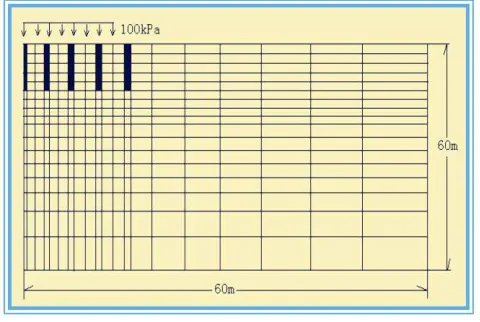
Considering the symmetry, only half of the section of foundation is needed for calculation. The finite element mesh is shown in Figure 1 with 399 nodes and 378 elements.
Figure 1. Plane finite element mesh.
L=pile length
S(L)=settlement value
EP/ES=Modulus ratio of pile/soil
S0=settlement value when the pile length is 0
Figure 2. Grouped piles composite foundation S (L) /S0 ~ L/B.
The relationship of S(L)/S0∼L/B in the grouped piles composite foundation is shown in Figure 2.
S′(L/B)=slope of S(L)/S0∼L/B curve. S′(L/B)∼L/B is shown in Figure 3. LE=piles’ effective length
By means of numerical simulation analysis, it is revealed that the grouped piles’ effective length has close relationship with top load distribution area. The effective pile length increases with the increasing of top load area width.
LE/B~EP/ES is shown in Figure 4 which indicates that the effective length increases with the increasing of EP/ES value.
Figure 3. Grouped piles composite foundation S′(L/B)∼ L/B.
Figure 4. Grouped piles composite foundation LE/B~EP/ES.
4. Example of Grouped Piles in Highway
Foundation
4.1. Engineering Brief Introduction
Ning–Tong highway of China is studied as an example. The project ground is of high compressible saturated soil with low bearing capacity. On such a soft soil foundation, the most difficult problem is how to control the settlement of the roadbed strictly. According to the design requirements, during the service life period of highway, the settlement is required less than 0.3 m, and the settlement after the transition is no more than 0.2 m. According to the construction plan, grouped Lime-flyash-soil cemented piles are adopted. With the ratio of lime: flyash: soil = 1: 4.5: 4.5.
4.2. Engineering Geological Condition
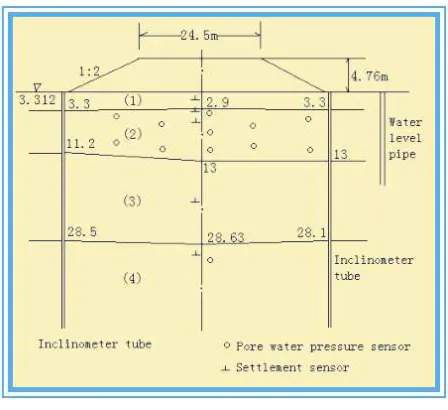
The site investigation is as follows:
(1)Silty clay. The thickness of the layer is about 3m, the density of the soil layer is larger.
(2)Silt–silty clay. The thickness of the layer is about 10.1m. The soil layer has high water content, the liquid limit is less than water content. Due to the high pressure shrinkage of the soil layer, it is the main soil layer for stability and settlement.
(3)Silt and silty clay inter-bed. The thickness of the layer is about 15.4m, containing mica and shell fragments, forming layered.
(4)Silty clay and sandy silt inter-bed. No bottom determined, soft plastic to plastic state.
The in-situ test section is shown in Figure 5.
Figure 5. In-situ testing section.
4.3. Numerical Analysis on the Top Settlement of Grouped Piles Foundation
Figure 6. Finite element dissecting grid.
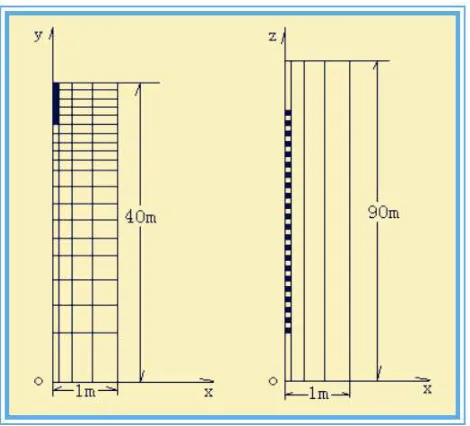
The width of the grouped piles foundation at in-situ testing section is 46m. According to symmetry, the finite element mesh is shown in Figure 6 with 837 units and 893 nodes.
settlement and the piles’ length is shown in Figure 8.
Figure 7. Semi analytical units of section K102+990.
It is shown that the calculated results by both the semi element method and the finite element method are adjacently parallel. The result of semi analytical method shows that the grouped piles’ effective length is 13-14m. The result finite element method shows that the grouped piles’ effective length is 12 to 13m.
Figure 8. The relationship S(m) and grouped piles length L(m).
5. Conclusion
The grouped piles’ effective length is associated with many factors, such as: the pile-soil modulus ratio, pile diameter, piles spacing etc.
The grouped piles’ effective length is also influenced by the top load distribution. The grouped piles’ effective length does not exist under the ideal infinite area top load. The grouped piles’ effective length depends on the top load distributing area to some extent.
Although it is difficult to use an formula to reflect all the
various factors, many various factors can be considered in numerical simulation analysis. By the method of numerical simulation, the influence of various factors on the grouped piles’ length can be considered synthetically. On the basis of numerical simulation with most factors considered, the calculated results of the grouped piles’ effective length is reasonable.
References
[1] X. Shu, F. Z. Wang, 2001, A simplified method determining the effective length of flexible pile in composite foundation, Industrial Construction, 31 (11), 16-17.
[2] Y. Z. Gu, H. Q. Zhou, 1992, Cement mixing pile bearing capacityandcriticalpilelength,ThethirdNationalConference onfoundationtreatmentsymposium,ZhejiangUniversityPress, 170~173.
[3] S. X. Chen, 1995, Discussion on load transfer performance of flexible pile, Geotechnical engineer, 3 (3) 16-19.
[4] J. W. Duan, 1993, Numerical analysis of flexible pile composite foundation, Doctorate Thesis of Zhejiang University, Hangzhou, 150 p.
[5] Y. F. Leung, A. Klar, et al., 2010, Theoretical study on pile length optimization of pile groups and piled rafts, Journal of Geotechnical and Geoenvironmental Engineering, 136 (2), 319-330.
[6] Y. Liu, Z. R. Xiao, et al., 2019, Model Test on Influence of Pile Length on Pile Resistance and Bearing Capacity Characteristics, Science Technology and Engineering, 19 (7), 215-219.
[7] W. D. Luo, 1990, Analysis of bearing mechanism of single pile and theoretical deduction of load and settlement curve, Journal of geotechnical engineering, 12 (1), 36-44.
[8] M. F. Randoph, C. P. Wroth, 1978, An Analysis of Deformation of Vertical Loaded Piles, ASCE, 104 (12), 1465-1488.
[9] B. J. Zhang, X. D. Fu, et al., 2014, The application of Mindlin-Geddes method in the calculation of piled foundation settlement, Industrial Construction, 44 (S), 862-865. 887.
[10] T. W. Lai, Yang Y. H., 2007, Study on load transfer mechanism and effective length of super-long pile, Journal of Lanzhou Jiaotong University: Natural Sciences, 26 (6), 16-19.
[11] C. Wang, X. Y. Chen, 2011, Study of effective length of piles based on parabolic frictional resistance, Chinese Journal of Underground Space and Engineering, 7 (3), 509-512. 613.
[12] J. X. Tong, M. L. Yan, et al., 2012, Experimental study of relationship between effective pile length and pile strength for rammed soil cement pile composite foundation, Rock and Soil Mechanics, 33 (S), 30-36.
[13] K. Yang, R. Liang, 2006, Numerical solution for laterally loaded piles in a two-layer soil profile, Journal of Geotechnical and Geoenvironmental Engineering, 132 (11), 1436-1443.
[15] P. Z. Yang, Y. T. Zhou, W. J. Sun, et al. 2014, Improved algorithm for effective length of deformable pile in compound foundation, Journal of Lanzhou University of Technology, 40 (4), 120-123.
[16] B. Zhou, Q. G. Yang, K. N. Zhang, 2007, Calculation method for effective length of flexible piles for composite foundation with rigid foundation, Journal of Central South University: Natural Sciences, 38 (1), 175-179.
[17] N. Wang, K. H. Wang, W. B. Wu, 2013, Analytical model of vertical vibrations in piles for different tip boundary conditions: parametric study and applications, Journal of Zhejiang University: Science A, 14 (2), 79-93.