Article
Was school closure effective in mitigating
coronavirus disease 2019 (COVID-19)? Time series
analysis using Bayesian inference
Kentaro Iwata 1*, Asako Doi 2, and Chisato Miyakoshi 2
1 Division of Infectious Diseases. Kobe University Hospital; [email protected]
2 Department of Infectious Diseases. Kobe City Medical Center General Hospital; [email protected] 3 Department of Research Support, Center for Clinical Research and Innovation. Kobe City Medical Center
General Hospital; [email protected]
* Correspondence: [email protected] ; Tel.: (+81-78-382-6296)
Abstract: Background: Coronavirus disease 2019 (COVID-19) pandemic are causing significant damages to many nations. For mitigating its risk, Japan’s Prime Minister called on all elementary, junior high and high schools nationwide to close beginning March 1, 2020. However, its
effectiveness in decreasing disease burden has not been investigated. Methods: We used daily data on the report of COVID-19 and coronavirus infection incidence in Japan until March 31, 2020. Time series analysis were conducted using Bayesian method. Local linear trend models with interventional effect were constructed for number of newly reported cases of COVID-19, including asymptomatic infections. We considered that the effects of intervention start to appear 9 days after the school closure; i.e., on March 9. Results: The intervention of school closure did not appear to decrease the incidence of coronavirus infection. If the effectiveness of school closure began on March 9, mean coefficient α for effectiveness of the measure was calculated to be 0.08 (95% credible interval -0.36 to 0.65), and the actual reported cases were more than predicted, yet with rather wide credible interval. Sensitivity analyses using different dates also showed similar results. Conclusions: School closure carried out in Japan did not show the effectiveness to mitigate the transmission of novel coronavirus infection.
Keywords: coronavirus disease 2019 (COVID-19), school closure, Japan, time series analysis
1. Introduction
With widespread incidence of coronavirus disease 2019 (COVID-19), many countries including Japan chose to restrict movement of people. On February 27, 2020, Japan’s Prime Minister Shinzo Abe called on all elementary, junior high and high schools nationwide (from age 6 to 18-year-old) to close until the end of a spring break through early April for “children’s health and safety” [1]. Although it was a request, not an order, most followed the request, with closure rate of 98.8 % among municipal elementary schools, and with closure of high schools at 46 out of 47 prefectures [2]. School closure occurred in other nations as well, such in parts of China, Hong Kong, and Italy [3, 4]. However, measures taken in these countries were different from one taken in Japan. For example, Italy closed all universities in addition to other schools, since people in their twenties may spread the disease readily [5]. There is little evidence on school closure to mitigate the spread of COVID-19. Therefore, we conducted a time series analysis with Bayesian statistics to infer the effectiveness of school closure for decreasing the incidence of coronavirus infection in Japan.
2. Methods
We used daily data on the report of COVID-19 and coronavirus infection incidence in Japan, provided by Ministry of Health and Labor of Japan from the inception until March 31, 2020
(https://www.mhlw.go.jp/stf/houdou/houdou_list_202003.html). Time series analysis were
conducted using Bayesian method. Local linear trend models with interventional effect were constructed for number of newly reported cases of COVID-19, including asymptomatic infections.
W
e set the intervention practically started on February 29, Saturday, since the Prime Minister called for the closure on the following Monday. With the estimated median incubation period of about 5 days, and consideration of Japan’s policy to test for COVID-19 only for those having symptoms for 4 days, or 2 days for elderly, we considered that the effects of intervention start to appear 9 days after the school closure; i.e., on March 9 [6, 7]. Predictions until the end of March were made. Because the situation regarding the reopening of school remain unclear and many schools remain closed as of this writing (April 4), we were not able to evaluate the effectiveness of reopening of schools.The precise expressions of our model are as follows: 𝜆!"#= 𝜆!+ 𝛿!+ 𝛼𝑍!+ 𝜀!
𝛿!"#= 𝛿!+ 𝜉! 𝜀! ~ 𝑁𝑜𝑟𝑚𝑎𝑙(0, 𝜎$) 𝜉! ~ 𝑁𝑜𝑟𝑚𝑎𝑙(0, 𝜎%) 𝑌! ~ 𝑃𝑜𝑖𝑠𝑠𝑜𝑛(exp (𝜆!))
The numbers of newly reported patients, Y, are assumed to have a Poisson distribution with the intensity of exp(λ). At each time, λ is mainly determined by the previous state of λ, and drift component δ. Z is dichotomous variable which takes 0 before the effect of intervention is assumed to appear, and 1 afterwards. The coefficient α is expected daily decrease of λ after the intervention assumed to be effective. Therefore, we considered the intervention would have an effect of suppressing cases if α was negative. Estimations were calculated using data until March 17 for all analyses.
We set 4 separate sampling sequences, each consisting of 1000 random samples (including 500 samples discarded for convergence). Estimated numbers newly reported patients, i.e., E(exp(λ)), were provided with 80% credible intervals (CrI).Sampling convergence was evaluated by Gelman-Rubin statistics and by visually inspecting a trace plot. We used the R software program, version 3.5.1 (R Foundation for Statistical Computing, Vienna, Austria) with a probabilistic programming language Stan (Stan development team) for all Bayesian analyses. Sensitivity analyses were also conducted daily for 2 days before and up to 7 days after March 9 (from March 7 to 16).
This study was exempted from approval by the ethics committee of Kobe University Graduate School of Medicine as the study used only data on public domain.
3. Results
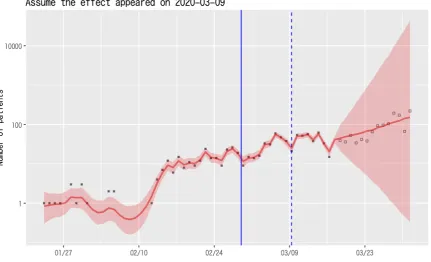
number of newly reported infections continues to increase, although predicted 80% credible intervals were wide (Figure 1).
Similar results were shown when we conducted sensitivity analyses with different dates of inception of the effectiveness. For example, if the effectiveness of intervention began on March 7, mean α was calculated to be -0.07, and newly reported cases thereafter were calculated to remain largely stable (Figure 2). However, the reported cases actually by March 31 were more than predicted median. If the effectiveness appeared far later, on March 16, calculated mean α was 0.20 and the number of cases were rather predicted to increase (Figure 3). Rest of the results of the sensitivity analyses are shown on Appendix.
Figure 2. Local linear trend model showing the number of predicted cases of coronavirus infection in Japan until March 31 (red line for predicted median with red area for 80%). The assumption is that the intervention began on February 29 (blue solid line), and the effectiveness started to appear on March 7. Black and white dots denote reported cases actually. Black dots are data until March 17 and used in our estimation.
March 16 (blue dotted line). Black and white dots denote reported cases actually. Black dots are data until March 17 and used in our estimation.
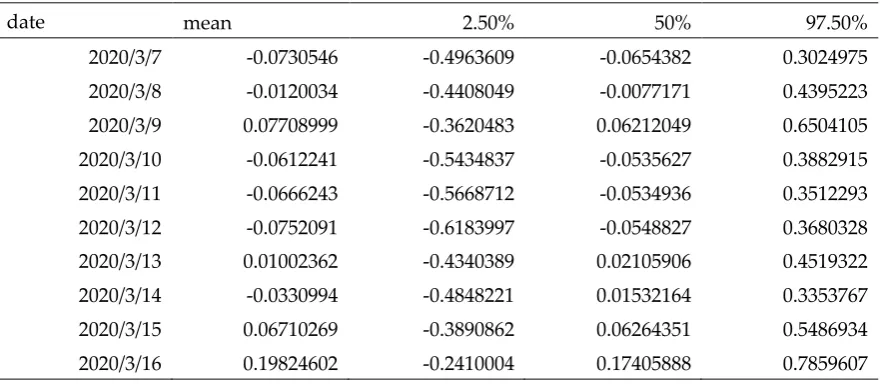
Table 1. Estimated α(coefficient for intervention effects)using our model with 95% credible intervals. Note if α is less than zero, the intervention is presumed to be effective in decreasing the number of newly reported cases, and if α is more than zero, the number continues to increase.
date mean 2.50% 50% 97.50%
2020/3/7 -0.0730546 -0.4963609 -0.0654382 0.3024975 2020/3/8 -0.0120034 -0.4408049 -0.0077171 0.4395223 2020/3/9 0.07708999 -0.3620483 0.06212049 0.6504105 2020/3/10 -0.0612241 -0.5434837 -0.0535627 0.3882915 2020/3/11 -0.0666243 -0.5668712 -0.0534936 0.3512293 2020/3/12 -0.0752091 -0.6183997 -0.0548827 0.3680328 2020/3/13 0.01002362 -0.4340389 0.02105906 0.4519322 2020/3/14 -0.0330994 -0.4848221 0.01532164 0.3353767 2020/3/15 0.06710269 -0.3890862 0.06264351 0.5486934 2020/3/16 0.19824602 -0.2410004 0.17405888 0.7859607
4. Discussion
Our analysis did not demonstrated the effectiveness of the school closure occurred in Japan in mitigating the risk of coronavirus infection in the nation. Although the effectiveness could have occurred in some scenario on sensitivity analyses (see March 14 scenario in Appendix Figure E), most scenarios in our sensitivity analyses also did not demonstrated its effectiveness.
The effectiveness of school closure has been studied for other infections such as influenza, and these studies have suggested that school closure may be effective in reducing or delaying the epidemic peak. However, there were large heterogeneity in data and generalization of the findings remains difficult. Reopening of schools sometimes reversed the effects, and the optimal timing and duration of school closure, as well as the target age range and the ideal scale of closure remain unknown [8,9]. Furthermore, school children are liable to suffer from influenza every year, and rationale for school closure to mitigate its epidemic appears sound. Decreasing influenza in
children by vaccination could even decrease disease burden among elderly [10]. However, children are not major population to suffer from COVID-19, and young children less than 20-year-old comprised only about 2% of all infected according to a large-scale epidemiological study in China [11]. While it is theoretically possible that school closure among children could reduce transmission among them and potentially to other generations, its impact is likely to be much less than one conducted for influenza. Therefore, our findings that school closure in Japan did not demonstrated its effectiveness to mitigate transmission of coronavirus infection are not surprising.
closure in Japan. When school closure was to be implemented to prevent the spread of COVID-19, those who are vulnerable to this disease and those who are likely to spread it should be included.
Our study has several limitations. First, our local linear trend model might not be an appropriate model for the current epidemic of COVID-19 in Japan. One might argue that the school closure could have prevented rather stochastic clusters or outbreaks among school children, which could have not happened thanks to the measure. However, if we accept such theory of stochasticity in justifying the school closure, we will end up with carrying on the measure until coronavirus pandemic comes to end, since we will never know when we can discontinue the measure while fearing unpredictable stochastic outbreak to occur. Second, estimated α value using data by the time of intervention effectiveness might not be accurately predicting α value afterwards, i.e., α value after March 18. Third, our estimations resulted in rather wide credible intervals, and the results should be interpreted cautiously. Forth, school closures in other forms might be effective in mitigating the epidemic, such as ones including infants and small children, or university students. Fifth, school closures combined with other measures such as traffic limitations or even city lock down might be effective. Therefore, we are not claiming that school closures overall are ineffective in mitigating COVID-19 epidemic in a nation. However, we would like to suggest that the school closure carried out in Japan in March did not demonstrate meaningful effectiveness in controlling the COVID-19 epidemic. Further studies will be necessary to investigate the effectiveness of school closures in other forms at different settings.
5. Conclusions
According to our time series analyses, school closure carried out in Japan did not demonstrate the effectiveness to mitigate the transmission of novel coronavirus infection.
Supplementary Materials: The following are available online at www.mdpi.com/xxx/s1.
Author Contributions: Conceptualization, K.I., A.D.; methodology, K.I., A.D. and C.M.; software, C.M.; validation, K.I.; writing–original draft preparation, K.I.; writing—review and editing, All authors. All authors have read and agreed to the published version of the manuscript.
Funding: This research received no external funding
Acknowledgments: We appreciate Ms. Mako Miyawaki for aiding in data collection from Ministry of Health and Labor website.
References
1. Abe asks all schools in Japan to temporarily close over coronavirus. Mainichi Daily News [Internet].
2020 Feb 27 [cited 2020 Mar 17]; Available from:
https://mainichi.jp/english/articles/20200227/p2g/00m/0na/101000c
2. Almost 99% of Japan’s public elementary schools shut as COVID-19 spreads. The Japan Times Online [Internet]. 2020 Mar 5 [cited 2020 Mar 17]; Available from:
https://www.japantimes.co.jp/news/2020/03/05/national/99-japan-elementary-schools-close-doors-coronavirus/
3. Davidson H, Kuo L, McCurry J. The longest holiday: parents coping with coronavirus school closures in east Asia. The Guardian [Internet]. 2020 Mar 3 [cited 2020 Mar 17]; Available from:
https://www.theguardian.com/world/2020/mar/03/the-longest-holiday-parents-coping-with-coronavirus-school-closures-in-east-asia
4. Couzin-FrankelMar. 10 J, 2020, Am 11:55. Does closing schools slow the spread of coronavirus? Past outbreaks provide clues [Internet]. Science | AAAS. 2020 [cited 2020 Mar 17]. Available from:
https://www.sciencemag.org/news/2020/03/does-closing-schools-slow-spread-novel-coronavirus
5. Palermo AGLT in, Beaumont P. Italy orders closure of all schools and universities due to coronavirus. The Guardian [Internet]. 2020 Mar 4 [cited 2020 Mar 17]; Available from:
https://www.theguardian.com/world/2020/mar/04/italy-orders-closure-of-schools-and-universities-due-to-coronavirus
6. Lauer SA, Grantz KH, Bi Q, Jones FK, Zheng Q, Meredith HR, et al. The Incubation Period of Coronavirus Disease 2019 (COVID-19) From Publicly Reported Confirmed Cases: Estimation and Application. Ann Intern Med [Internet]. 2020 Mar 10 [cited 2020 Mar 17]; Available from:
https://annals.org/aim/fullarticle/2762808/incubation-period-coronavirus-disease-2019-covid-19-from-publicly-reported
7. Coronavirus testing gaps put Asian governments under microscope [Internet]. Nikkei Asian
Review. [cited 2020 Mar 17]. Available from:
https://asia.nikkei.com/Spotlight/Coronavirus/Coronavirus-testing-gaps-put-Asian-governments-under-microscope
8. Jackson C, Vynnycky E, Hawker J, Olowokure B, Mangtani P. School closures and influenza: systematic review of epidemiological studies. BMJ Open. 2013;3:e002149.
9. Bin Nafisah S, Alamery AH, Al Nafesa A, Aleid B, Brazanji NA. School closure during novel influenza: A systematic review. Journal of Infection and Public Health. 2018;11:657–61.
10. Reichert TA, Sugaya N, Fedson DS, Glezen WP, Simonsen L, Tashiro M. The Japanese Experience with Vaccinating Schoolchildren against Influenza. New England Journal of Medicine. 2001;344:889– 96.
11. Novel Coronavirus Pneumonia Emergency Response Epidemiology Team. [The epidemiological characteristics of an outbreak of 2019 novel coronavirus diseases (COVID-19) in China]. Zhonghua Liu Xing Bing Xue Za Zhi. 2020;41:145–51.