Development of the
Leonardo da Vinci
Accessible World for all
Respecting Differences –
AWARD project
Mateja DoVjAK
1*, Živa KRIsTL
1ABsTRACT
In the framework of the EU Lifelong Learning Programme 2007-2013, Leonardo da Vinci, Project Accessible World for All, Respecting the Differences (AWARD) is currently underway. The aim of the project is to raise the awareness of need for accessible built environment, particularly in the population of vocational students who are faced with their professional advancements for the first time. The project is introducing relevant teaching materials into the curricula of the existing educational programs. The training involves all those vocations which are responsible for the built environment and health issues, from the design stage, execution of environment, to maintenance, supervision and use. The material is electronic and can be presented in the traditional form, as a distance learning tool or as individual learning material. The project group involves field experts of Universal design, vocational training and health issues from five EU countries. The preliminary testing of the material was performed at several schools in partner countries; in Slovenia the testing was done at the Departments of the Sanitary Engineering, Physiotherapy and Occupational Therapy at the Faculty of the Health Studies, University of Ljubljana. Results of feed-back evaluation will be included into the final version of the teaching material which will be available to the interested users by the October 2009. It is expected that as a consequence of better education, the result will be improved level of planning and execution of barrier free environment.
KEY WoRDs:
Universal design, Life long distance learning, Barrier-free environment. Received: 30. 9. 2009
Accepted: 28. 10. 2009
1 University of Ljubljana,
Faculty of Civil and Geodetic Engineering, Chair for Buildings and Constructional Complexes, Jamova cesta 2, 1000 Ljubljana, Slovenia
* corresponding author:
INTRoDUCTIoN
Across Europe, human diversity in age, culture and ability is greater than ever. We now survive illnesses and injuries and live with disabili-ties as never before. Although today’s world is a complex place, it is one of our own making, one in which we therefore have the possibility – and the responsibility – to base our designs on the principle of inclu-sion [1].
The disability community is large – much larger than most people think. The definition of disability was put forward in December 2006 by the United Nations Convention on the Rights of Persons with Disabilities. It means any physical or mental impairment that substantially limits one or more of the major life activities of an individual, a record of such im-pairment, or being regarded as having such an impairment [2]. It in-cludes not just people in wheelchairs, but also people with other mobil-ity problems related to diseases such as polio or rheumatism, people with low levels of vision, people with speech or hearing impairments, people with cognitive disabilities, people with heart disease and severe-ly disabled people who may be confined to bed. Disability can also be temporary, for example sprained ankles, consequences of automobile accidents, or difficult pregnancies [3].
Social problems connected to barrier unfree environment and lack of ethnical approach arise from our youth ages. Knowledge and under-standing of basic principles of Universal design should be introduced in early stage education, starting from school ages, and should be includ-ed in every includ-educational process. This could be achievinclud-ed by introducing relevant teaching materials in education programs. Steps in this direc-tion have been made in the Resoludirec-tion ResAP(2001)1 on the Introduc-tion of the Principles of Universal design Into the Curricula of All Occu-pations Working on the Built Environment – Council of Europe, adopted by the Committee of Ministers on 15 February 2001, at the 2nd meeting
of the Ministers Deputies. The main conclusion of Resolution Re-sAP(2001)1 was “to take a proactive approach by recommending the incorporation of the universal design principles into the curricula of ar-chitects, engineers and town planners, and, by and large, into the train-ing of all vocations worktrain-ing on the built environment” [4]. Regrettably this recommendation has not been met yet. Many buildings can not be used by people with disabilities. Either their needs have simply been forgotten, or they have been misunderstood or have been knowingly disregarded by designers and/or constructors and decision makers [4]. Despite numerous existing guidelines and regulations, their final realiza-tion is still insufficient. Moreover, the importance of universal design by manufacturers or designers is not clear enough. They usually know how to design barrier-free environment for a disabled person, but not why or how it will be used. Field regulation in Slovenia is being put into effect step-by step. New buildings are designed according to regulation de-mands. More problematic is the existing building stock which in most cases does not conform to the principles of universal design. From eve-ryday practice it can be noticed that the environment is usually adapted
The disability community is
mainly to wheelchair users, i.e. curb ramps, barrier-free public toilets can be found everywhere. But persons with visual, hearing or cognitive impairments are often forgotten (i.e. tactile markings, contrast mark-ings, visual alarms are still very rare).
Because of serious lack of knowledge and awareness, adequate infor-mation should be included into the existing curricula as part of standard teaching process. Considering that the main idea of the project is the application of basic principles of universal design into everyday prac-tice, designers and contractors have to know what to do, but also why and how the element will be used by a disabled person. This kind of approach was successfully used in the project Vocational Education
Training in Building Observation, Operation and Maintenance (Pilot
Project No. HU 170003 – 2003) [5], but the subject area of accessible design was touched only briefly.
In the framework of the Lifelong Learning Programme 2007-2013, Le-onardo da Vinci the EU project Accessible World for All, Respecting the
Differences (acronym AWARD) is running. The project AWARD started
in September 2007 and ended in September 2009. It involves six part-ners from five EU countries: Budapest University of Technology and Economics from Hungary (BUTE), Motivacio Foundation for Helping Disabled People from Hungary (MFHDP), Dundalk Institute of Technol-ogy from Ireland (DIT), University of Trento from Italy (ULT), Technical University of Cluj – Napoca from Romania (TUCN) and University of Ljubljana, Faculty of Civil and Geodetic Engineering from Slovenia (UL FGG). In joint work it combines field experts of Universal design, voca-tional education techniques, health issues and funcvoca-tional disabilities [6].
With respect to the above stated problems the project aims at creating teaching material in e-learning interactive form, attractive to young pop-ulation. The target groups are vocational schools, high schools and oth-er study programs, particularly those that are responsible for the built environment and health issues, from the design and execution stage to the maintenance and supervision. It will cover the complexities of voca-tions and will be applicable not only to traditional, but also to distance and individual learning [6]. The paper presents the application of teach-ing material at the Faculty for Health Sciences, University of Ljubljana, the results of their testing and the final results evaluation.
LEGAL BACKGRoUND
There are approximately 650 million persons with disabilities in the world, or 10 per cent of the global population. An estimated 80 per cent of these persons live in developing countries, many in conditions of poverty [7]. Disabled people, older people and other persons with tem-porary reduced mobility together make up 40 % of the European popu-lation. Moreover, people live longer, greatly extending the period of ag-ing that is one of the primary causes of disablag-ing conditions. DeJong and Lifchez [8] report that 46 % of the population aged 65+ have ei-ther limited or severe disabilities According to studies by the
Commis-In the framework of the
Lifelong Learning Programme
2007-2013, Leonardo da
Vinci the EU project
Accessible World for All,
Respecting the Differences
sion for Social Development carried out in 2008, 34.5 % of the Euro-pean population will be aged 60+ in 2050 compared to 20.3 % in 2000 [7]. The demographic data of Europe as well as those in the countries of the consortium members show the 6 % to 8 % increasing ratio of elderly people in the forthcoming years. By this measure, it is likely that most people will have some disabling condition, if they live long enough [3].
technical requirements for spaces and equipment of nursery schools [24].
On December 13, 2006, the United Nations formally agreed on the Convention on the Rights of Persons with Disabilities, the first human rights treaty of the 21st century, to protect and enhance the rights and
opportunities of the world’s estimated 650 million disabled people [2,7]. Nevertheless, the implementation of these rights is far from ideal, partly due to lack of ethical approach and empathy, partly due to lack of knowledge. This is reflected in inaccessible build environment that enables, disables or even injures not only people with disability but also healthy ones. To prevent that, built environments have to be created or modified by people so that people may live in and/or develop various activities. The environment should be modified that everybody can en-joy it. The designer, then, has a responsibility to consider the entire life span of the individual. Disability is a normal condition of life that should be taken into account in all that is designed and produced, including housing [3].
The goal of accessibility to the built environment was recognised inter-nationally in 1993 in the United Nations Standard Rules on the Equali-sation of Opportunities for Disabled Persons [19]. The universal design or design for all is design for human diversity, social inclusion and equality. This holistic and innovative approach constitutes a creative and ethical challenge for all planners, designers, entrepreneurs, admin-istrators and political leaders. Design for all aims to enable all people to have equal opportunities to participate in every aspect of society. To achieve this, the built environment, everyday objects, services, culture and information – in short, everything that is designed and made by people to be used by people – must be accessible, convenient for every-one in society to use and responsive to evolving human diversity [25].
TEACHING MATERIAL sTRUCTURE
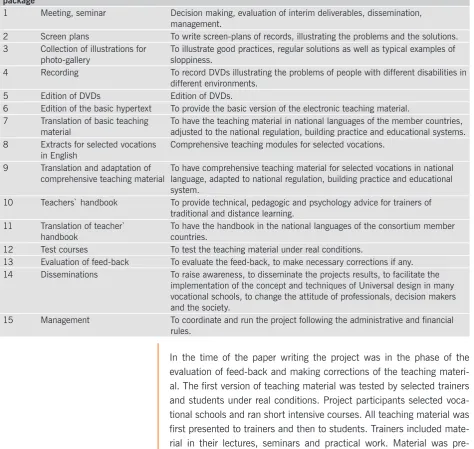
Table 1:
The project work programme.
Work package
Title Aims
1 Meeting, seminar Decision making, evaluation of interim deliverables, dissemination, management.
2 Screen plans To write screen-plans of records, illustrating the problems and the solutions. 3 Collection of illustrations for
photo-gallery
To illustrate good practices, regular solutions as well as typical examples of sloppiness.
4 Recording To record DVDs illustrating the problems of people with different disabilities in different environments.
5 Edition of DVDs Edition of DVDs.
6 Edition of the basic hypertext To provide the basic version of the electronic teaching material. 7 Translation of basic teaching
material To have the teaching material in national languages of the member countries, adjusted to the national regulation, building practice and educational systems. 8 Extracts for selected vocations
in English Comprehensive teaching modules for selected vocations. 9 Translation and adaptation of
comprehensive teaching material
To have comprehensive teaching material for selected vocations in national language, adapted to national regulation, building practice and educational system.
10 Teachers` handbook To provide technical, pedagogic and psychology advice for trainers of traditional and distance learning.
11 Translation of teacher` handbook
To have the handbook in the national languages of the consortium member countries.
12 Test courses To test the teaching material under real conditions.
13 Evaluation of feed-back To evaluate the feed-back, to make necessary corrections if any. 14 Disseminations To raise awareness, to disseminate the projects results, to facilitate the
implementation of the concept and techniques of Universal design in many vocational schools, to change the attitude of professionals, decision makers and the society.
15 Management To coordinate and run the project following the administrative and financial rules.
In the time of the paper writing the project was in the phase of the evaluation of feed-back and making corrections of the teaching materi-al. The first version of teaching material was tested by selected trainers and students under real conditions. Project participants selected voca-tional schools and ran short intensive courses. All teaching material was first presented to trainers and then to students. Trainers included mate-rial in their lectures, seminars and practical work. Matemate-rial was pre-sented via traditional learning process and also put on the www for a distance learning process. After the courses questioners for trainers and students were given out. Results and suggestions were collected and are being evaluated.
In Slovenia the material was tested at the Faculty for Health Studies, University of Ljubljana, the Department for Sanitary Engineering, the Department of Physiotherapy and Department of Occupational Therapy. Sanitary engineers were selected as target group because knowledge about the Universal design presents an important part of their future work. They will be professionally involved in the process of design, ad-vice and supervision of build environment. During their study program they learn about some aspects of the Universal design, but not all. The 1st year of Physiotherapy was selected because the students are
in-volved in the process of healing and rehabilitation, but they are not yet
Sanitary engineers were
familiar with the aspects of the Universal design. The Occupational therapy was selected, because the students work with disabled per-sons, help them to perform everyday activities and within their work come across many problems that arise from inaccessible built environ-ment [6].
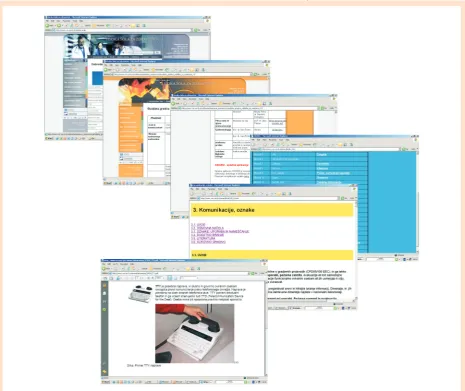
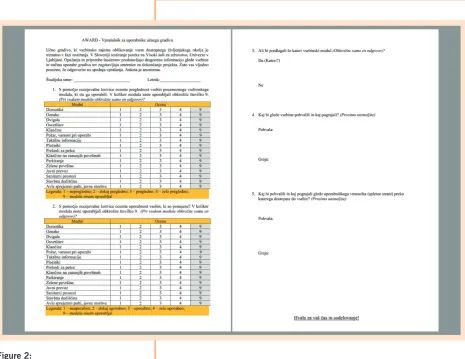
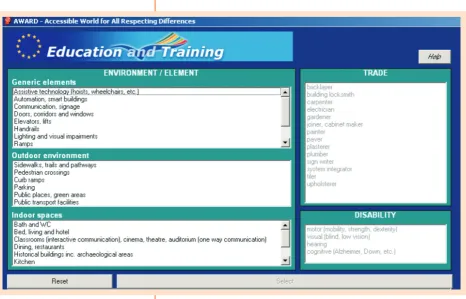
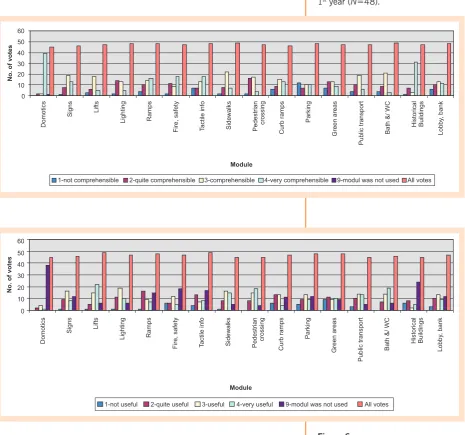
The teaching material was uploaded on the school server, where stu-dents were able to use it as a study literature (Figure 1). The material was used in various courses, partly as lecture material and partly as distance learning material for practical work during spring semester of 2008/2009. After finished courses students were asked to evaluate the comprehensibility of modules, usefulness of modules and other experi-ences with the tool via questionnaire (Figure 2). The questionnaire was divided into two main parts. The first part of the questionnaire was used for qualitative analysis of data and second part for quantitative analysis. In the first part, students were asked to validate comprehensi-bility of modules with prepared validation scale: 1-not comprehensible, 2-quite compressible, 3-comprehensible, 4-very compressible, 9-not used module. Usefulness was validated with scale: 1-not useful, 2-quite useful, 3-useful, 4-very useful, 9-not used module. In the second part students were asked to write their proposals and reprimands. They
Figure 1:
were very active in giving comments about modules and temporary in-terface uploaded on www site. According to first responses we assume that teaching material presents attractive, useful and comprehensive tool for students of Sanitary Engineering, Physiotherapy and Occupa-tional Therapy. Validated usefulness of modules differs among the study programs. Modules that are closely related to the mission of study pro-gram are mostly validated as the most useful modules and vice versa. Feedback will be used for the improvement of teaching material. In the next phase of the project extracts for selected vocations will be pre-pared. The final versions of complete suit of teaching material will be prepared and disseminated [6].
REsULTs AND DIsCUssIoN
The main output of the project is a complete suit of electronic teaching material that is accessible in the DVD format. DVD format was selected because of its attractiveness, especially for young generations. It also includes videos, pictures and hypertexts that enable better presentation of selected topic.
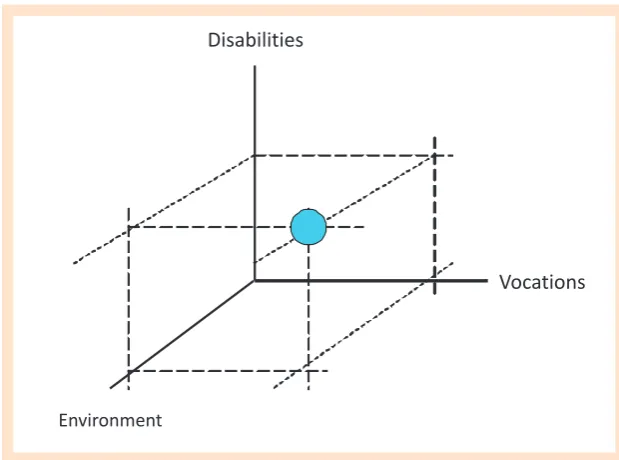
At the end of the project the teaching material will be structured into three main axes (triple matrix system), i.e. environment, disability and vocation (Figure 3). The matrix system facilitates the search of informa-tion either via cross-secinforma-tions on the basis of a relevant vocainforma-tion and/or on the basis of disability and/or on the basis of a defined part of the environment [6]. Environment is divided into three main fields: the
in-Figure 2:
door environments, the outdoor environments and the generic elements. The indoor spaces include specific information relevant for public build-ings (such as hotels, restaurants, historical buildbuild-ings) and also their ac-tive spaces (for example dining, kitchen, toilets). Outdoor environment includes the whole information that has to be considered for the design of buried free outside environment (i.e. public transport facilities, park-ing lots, pathways, sidewalks, curb ramps, pedestrian crosspark-ing, green areas). In the field of generic element all building elements (i.e. doors, corridors, windows) and building systems (i.e. assistive technology, au-tomation, smart buildings, communication, signage) are included. Re-garding to the International Classification of Functioning, Disability and Health produced by the World Health Organization [26] disabilities are classified as motor, visual, hearing and cognitive. In the field of vocation the trades that are responsible for design and execution of barrier free environment are included (for example bricklayer, locksmith, electrician, joiner, etc.).
Figure 3:
Triple matrix system of environment, vocation and disability.
Figure 4 presents application interface for the navigation through the teaching material on a PC. On the basis of element or environment the information could be further searched through generic elements, out-door environment and inout-door spaces [6].
Teaching material is enriched with various illustrations, animations and video-clips where active participation of people with disabilities is re-corded in various environments and situations. In such way the best practice, problems and standard solutions are clearly presented to the user [6]. Moreover, student ethnical approach and empathy are raised. Examples show manoeuvres with wheelchair user from different direc-tions and from wheel-chair user’s perspective to illustrate the problems of visual impairments, etc.
The teaching material is complemented by a handbook that is prepared as a guide. The handbook is meant to be used by teachers in the sec-ondary schools for construction, building services, transports or/and other professional profiles involved in activities related to the built envi-ronment. The handbook enables the teacher to make his/her own teaching plan and also fulfil teaching goals. Beside teachers it may be used by any professional wishing to get basic information in universal design and also by people involved in activities related to the aspects deriving from these fields. It provides additional information about the design of built environment, further reading, regulation field and health considerations [6].
The teacher’s handbook is divided into the two parts. The part one is a compendium of recommendations, results of research activities and na-tional regulations acquired from the most advanced European, Ameri-can and Asian authorities concerned with design and legislation in the above-mentioned domains. The part two presents the structure of the “AWARD” programme, the way it can be used and the results which may be obtained by the users.
Figure 4:
User guide as additional part of teaching material presents a user’s manual where the whole basic information about the use of material, its structure, directories and files are presented. It includes step-by step procedure that is clearly presented with active sheets.
Evaluation
In this section the main results of questionnaire analysis are presented. Figure 5 presents an example of analysis of comprehensibility and Fig-ure 6 of usefulness and quality of information of various modules vali-dated by students of physiotherapy, 1st year.
Students of physiotherapy were mostly observing and appreciating the modules that deal with problems they meet during their practical work and everyday life: Bath & WC and Lifts in indoor environment and Pub-lic transport and Pedestrian crossings in outdoor environment. It was
expected that knowledge and interest of students in the first year of Figure 5: Validated comprehensibility of modules by physiotherapists, 1st year (N=48).
Figure 6:
their study would not be oriented toward special issues, like Domotics or Fire safety, but on common and basic fields.
Students of the 3rd year of sanitary engineering were mostly observing
and appreciating the modules that deal with problems they meet during their lesions and practical work: they were mainly concerned with ac-cessibility of indoor and outdoor environment. Students of the 4th year
of sanitary engineering were mostly observing and appreciating the modules that deal with problems they meet during their lesions and practical work: they are mainly concerned with accessibility of indoor and outdoor environment and living and working conditions (safety, fire evacuation, lighting, noise, thermal conditions, health impacts, etc.). Students of occupational therapy were mostly observing and appreciating the modules that deal with problems they meet during their practical work: Ramps, Sidewalks, Pedestrian Crossing, Bath & WC. Moreover, even the less used modules were quite highly evaluated (3.1-3.3). Re-garding their knowledge and skills, it was expected that most of the mod-ules would be very interesting for them. Students realized the importance of the presented material. However, occupational therapy presents a field of experts that work with disabled persons. During their study they evolve the empathy for their clients and in such way they can see the surround-ing environment through the eyes of disabled persons.
It has to be emphasized that variations between the rated modules are very small and that they have to be observed in the context of study program, study year and course into which the students are involved. At the beginning of their study students are more interested in basic knowledge and students of senior years deal with more specialised knowledge. This is why some modules were used by most of the stu-dents and some only by a few of them.
The evaluations by particular groups of students are quite level. None of the evaluated modules differentiates from the average by more than 0.4 points. Between the highest and the lowest rated module the difference in a specific group is never larger than 1.0 point. This is partly due to their interest and partly due to their level of knowledge. We can also observe that students of physiotherapy and occupational therapy evalu-ated the teaching material through the eyes of user (disabled person), while the students of sanitary engineering evaluated it through designer/ execution/control approach.
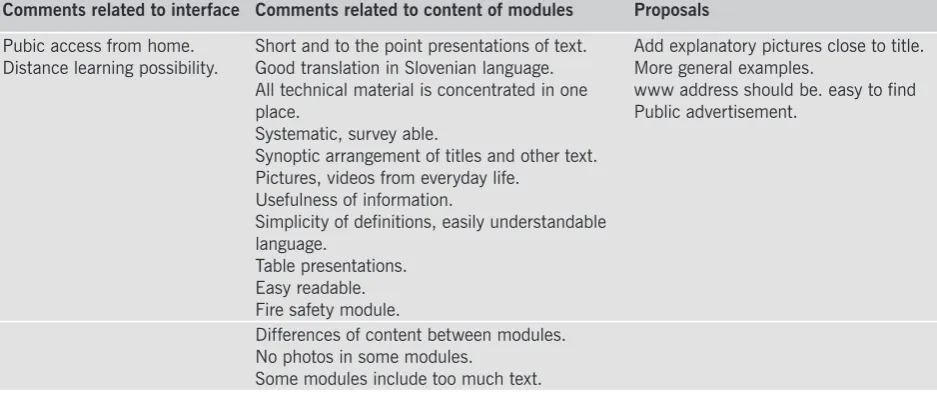
Students were quite active in the commenting of the modules. Individu-al comments (observations/suggestions) and opinions concerning the content and intermediate tool (commends/reprimands) can be organized into the following groups that re summarized in the Table 2.
After testing, the teaching material will be introduced to the regular courses of Sanitary Engineering. The assistant and professors will select the important modules from teaching material and include them into their lectures and practical training. In the 2nd year of Sanitary
Engineer-ing the material will be introduced into the course General and Commu-nal Hygiene, where students will become familiar with basic terminolo-gy, principles and regulation field. In the 3rd year the material will be
It has to be emphasized that
introduced into lectures and seminars of Sanitary techniques, Urbaniza-tion and Design. Students will become familiar with naUrbaniza-tional and inter-national legislation on the level of universal design. In the 4th year the
material will be included in the Methods of Sanitary Engineering course and Bioclimatic Design course. Both courses present the application of their knowledge about Universal design. The practical training of Meth-ods of Sanitary Engineering course is carried out as a field work in dif-ferent public places such as public toilets, market halls, public transport facilities, heath care buildings, etc.
Different countries, different schools place emphasis either on the first or on the last approach. The aim of the consortium is to collect informa-tion on both philosophies and to alloy them in a form which fits best the conditions of the participants [6]. Observations and suggestions made by teachers and students will present valuable information re-garding the content and the use of the material and will provide guide-lines for the finalization of work. After evaluation the final material will be available on a DVD.
Because of the electronic form, the teaching material can also be used for individual learning. Education of all society (from developer, design-er, building manager to the central government and local authorities) about universal design and raising the awareness of accessibility is im-portant for opening minds and stimulating empathy concerning the cre-ation of an accessible world for all [6].
The integration of people with disabilities into education, employment and everyday life is in the fundamental interest of the whole communi-ty. Safe and independent participation of people with disabilities in so-cial, economic and cultural activities, rather than confinement in their homes, or institutional care, improves not only their quality of life, but also the general economic conditions of their families and of society as a whole [6].
Table 2:
Results of qualitative analysis of modules by sanitary engineers, 3rd year, 4th year, physiotherapists, 1st year, occupational
therapists, 3rd year (N=21, 19, 48, 11).
Comments related to interface Comments related to content of modules Proposals
Pubic access from home.
Distance learning possibility. Short and to the point presentations of text.Good translation in Slovenian language. All technical material is concentrated in one place.
Systematic, survey able.
Synoptic arrangement of titles and other text. Pictures, videos from everyday life.
Usefulness of information.
Simplicity of definitions, easily understandable language.
Table presentations. Easy readable. Fire safety module.
Add explanatory pictures close to title. More general examples.
www address should be. easy to find Public advertisement.
Differences of content between modules. No photos in some modules.
Some modules include too much text.
The integration of people
with disabilities into
CoNCLUsIoNs
Teaching material in DVD format presents modern and attractive way of learning, especially for young generations. Good and bad practical ex-amples presented by animations, video-clips and drawings help to get better and clear image about disability in build environment. All teach-ing material enriches the student’s knowledge about the Universal de-sign, they could realize the problem of buried un-free environment, and lost but not least, it enables to transform the theory into practise. Education approach with distance learning process that is already in progress at the Faculty for Health Studies, University of Ljubljana, presents part of lifelong learning process. The main goal is to include all groups of people, without any discrimination based on sex, racial or eth-nic origin, religion or belief, disability, age or sexual orientation. However, sanitary engineers present very important part in the process of design, advice and supervision that helps raising the awareness in society, in-creasing the importance of the Universal design and leading to barrier free environment for all. Modules were validated as useful tool for broad-ening the knowledge about the Universal design not only of sanitary engi-neers, but also of physiotherapists and occupational therapists.
Observations and suggestions made by teachers and students present valuable information regarding the content and the use of the material and provide guidelines for the finalization of work. The AWARD project was completed in September 2009 [6].
The main output of the project is teaching material in national languag-es that includlanguag-es a DVD and teacher’s handbook. The published material will be freely available for students and also for the interested public. The teaching material is considered as a starting platform which can be further upgraded and developed according to new findings, technical solutions and regulative requirements.
It is expected that as a consequence of better education the result will be improved level of planning and execution of barrier free environment.
REFERENCEs
[1] European Institute for Design and Disability. Declaration adopted on the occasion of the Annual General Meeting in Stockholm on 9 May 2004: http://www.designforalleurope.org/Design-for-All/EIDD-Documents/ Stockholm-Declaration/ (1.8.2009).
[2] The United Nations Economic and Social Commission for Western Asia Accessibility for the Disabled. Convention on the Rights of Persons with Disabilitie. United Nations General Assembly on 13 December 2006: http://www.un.org /disabilities/convention/conventionfull.shtml (1.8.2009).
[3] Mace RL, Hardie G J, Place JP. Accessible Environments: Towards Uni-versal Design. New York: Van Nostrand Reinhold, 1991: 44.
[4] Resolution on the Introduction of the Principles of Universal design Into the Curricula of All Occupations Working on the Built Environment – Council of Europe. Committee of Ministers. Adopted by the Commit-tee of Ministers on 15 February 2001, at the 2nd meeting of the Minis-ters Deputies.
[5] Leonardo Da Vinci Vocational Education Training In Building Observa-tion, Operation And Maintenance: http://www.utcluj.ro/utcn/civeng/leon-ardo/training/en_training.html. (1.8.2009).
[6] Application Form Multilateral Projects Transfer of Innovation Lifelong Learning Programme 2007-2013. Leonardo da Vinci. Accessible World for All Respecting Differences.
[7] Commission for Social Development Economic and Social Council. UN re-port “Mainstreaming disability in the development agenda” (E/CN. 5/2008/6): http://www.un.org/disabilities/default.asp?id=358 (1.8.2009). [8] DeJong G, Lifchez R. Physical disability and public policy. Sci Am 1983;
248(6):40–49.
[9] Statistical Office of the republic of Slovenia. Report 2007. Population by age groups and sex, statistical regions, Slovenia, annually: http://www. stat.si/pxweb/Dialog/varval.asp?ma=0520300E&ti=Population+by+ag e+groups+and+sex%2C+statistical+regions%2C+Slovenia%2C+annu ally&path=../Database/Demographics/05_population/02_05007_ numb_struct/01_05203_age_sex/&lang=1 (1.8.2009).
[10] European health for all database (HFA-DB), WHO/Europe: http://data. euro.who.int/hfadb/ (1.8.2009).
[11] Statistical Office of the republic of Slovenia. Disability Data. Persons employed in enterprises employing the disabled by age groups: http://www.stat.si/ (1.8.2009)
[12] Paraplegics association of Slovenia: http://www.drustvo-paralitikov.si/ about.html (1.8.2009).
[13] Constitution of Republik Slovenia (Ur.l. RS, No. 69/04). [14] Spatial Planning Act (O.J.RS, No.33/2007).
[15] Construction Act (O.J. RS, No. 110/02, 97/03, 47/04, 62/04, 102/04). [16] Rules on the requirements for free access to, entry to and use of public
buildings and facilities and multi-apartment buildings (O.J. RS, No. 97/2003).
[17] Rules on minimum technical conditions for the construction of apart-ment buildings and apartapart-ments (O.J. RS, No. 125/2003, 110/2005). [18] Rules on minimum technical requirements for residential units intended
for temporary solving of housing needs of socially deprived persons (O.J. RS, No. 123/2004).
[19] Rules on minimum technical requirements for the construction of resi-dential care homes for elderly and on ensuring conditions for their opera-tion (O.J. RS, No. 110/2004).
[20] Guidelines of about construction and needs of functionally disabled per-sons in the built environment are edited by Slovenian national standard SIST ISO/TR 9527.
[21] Rules on minimum technical requirements for social services providers (O.J. RS, No. 67/2006).
[22] Rules on requirements for ensuring safety and health of workers at workplaces (O.J. RS, No. 89/1999, 39/2005).
[23] Placement of Children with Special Needs Act (O.J. RS, No. 54/2000, 118/2006).
[24] Rules on norms and minimum technical requirements for spaces and equipment of nursery schools (O.J. RS, No. 73/2000, 75/2005). [25] The United Nations Economic and Social Commission for Western Asia
Accessibility for the Disabled. A Design Manual for a Barrier Free Envi-ronment: http://www.un.org/esa/socdev/enable/designm/ (1.8.2009). [26] World Health Organization. International Classification of Functioning,