1
School Effectiveness Embedded In Intellectual Capital Development: A Case Study
Keberkesanan Sekolah Tersemai Dalam Pembangunan Model Intelektual
Muhammad Niqab Sailesh Sharma Sathiamoorthy Kannan Email: [email protected]
Abstract
The paper aims to provide assistance to secondary schools in Pakistan in the process of developing their ability to identify gauge and manage and value their intangible assets i.e. intellectual capital. This study used structured survey instrument to collect data from 31 secondary school teachers working in schools being operated under Federal Government, Pakistan Army and Air force (Fizaia) and affiliated with FBISE Islamabad, situated in Khyber Pakhtunkhwa province of Pakistan. Results of the study illustrate that human capital is ranked highest among indicators of intellectual capital. Interestingly skills and abilities are found at lowest level. The study suggests training need analysis (TNA) for effective training which can enhance the skills and abilities of the teachers.
Keywords: Intellectual capital, human capital, social capital, structural capital, school effectiveness.
Introduction
Education is considered to be a vital constituent of socioeconomic development (Riaz, 2008). The national governments, private institutions and non-government organizations (NGO) allocate huge budgets to it. The prime objective of the institutions, while spending considerable resources, is to achieve resonate return from their investments. This phenomenon leads to the ambitions to optimize the quality of education. It is, however, argued that enhancing the quality of education certainly requires well-developed human capital i.e. leadership and teachers having vision, exposure, knowledge and skills. Thus, the aim of human capital development and high performance of the education sector is only possible with creation and management of intangible assets (Bontis, Bart, Ramírez, Lorduy, & Rojas, 2007), i.e. “knowledge” or intellectual capital. According to Bontis (2001) the term “Intellectual Capital” is used to cover all of the immaterial or non-physical assets of an organization, comprising processes, innovation capacity, patents and the implicit knowledge of its employees and their network of collaborators and contacts.
The current era is attributed with the emergence of knowledge economy and thus leadership, both in higher and secondary level education, would be required to develop intangible assets of the schools i.e. the development of intellectual capital (Mumtaz & Abbas, 2014). Tangible and intangible assets both affect the performance of any educational institute; however, most prominent among them is the intellectual capital that positively affects the performance. Therefore, in order to achieve the desired objectivities of high performance and creation of knowledge that prosper a society, a leader and principal of the school need to be highly qualified and well aware of the practices, to develop and enhance human capital among the teachers in particular and overall intellectual capital development of the schools in general (Niazi, 2012).
2 Literature review
Employees working in different organizations use various terms for the same purpose, like in accounting intangible assets is used, knowledge assets is used by economist while people in management or in legal affairs use the term intellectual capital. All these terms are used for the same entity that is Intellectual Capital (Fazlagic, 2005). Sharabati et al. (2013) describes Intellectual Capital as the difference between institute’s market value and book value. Further, Sharabati et al. (2013) reports that Intellectual Capital is the combination of everything and everyone working in organization which provide an edge to organization to have a competitive advantage. Charted Institute of Management Accounts (CIMA, 2001): defines Intellectual Capital as, “The possession of knowledge and experience, professional knowledge and skills, good relationships and technological capacities, which when applied will grow organization competitive advantage” (Bhasin, 2012, p. 64). Intellectual Capital comprises a vast range of ideas and insights related with non-physical constituents of institutional assets. Intellectual capital is actually linked with “human capital” or “knowledge”(Fazlagic, 2005). Bontis (2001) and Sharabati et al. (2013) classified Intellectual Capital into three parts, i) Human capital: the implicit knowledge possessed by a person. ii) Structural capital: norms, procedures of an organization. (iii) Relational Capital: relationship established among various stakes holders. Human capital is composed of knowledge competencies, skills, individual and collective experience and training (Bhasin, 2012).
Rehman, Ilyas, and Rehman (2011) expresses the view that human capital plays a vital role in Intellectual Capital performance in both life and non-life insurance sector of Pakistan. Human capital is useful only when it is channelled along with the social capital (Carmona-Lavado, Cuevas-Rodríguez, & Cabello-Medina, 2010). Social capital is a societal characteristic which includes trust, associational activity and norms of civic behaviour, which collectively facilitate ordination and co-operation for collective advantage (Dakhli & De Clercq, 2004). Social capital, developed in virtual communities, plays an important role in knowledge sharing. Especially the members, who have the same language, experience and interest share more knowledge (Chang & Chuang, 2011). Literature proposes that human capital channelled through social capital becomes an integral part of organizational capital (Youndt, Subramaniam, & Snell, 2004). Organizational capital may have an influence on the social capital in those companies in which there are R & D departments (Carmona-Lavado et al., 2010).
Hallinger and Heck (1998) suggests a link between leadership and school effectiveness. Similarly David (2001) describes that when there will be quality leadership, it will increase teaching and learning effectively. Leaders will concentrate on the capacity building like improving knowledge and skills and motivate their staff by giving honour to them and providing encouraging environment to work efficiently (Leithwood, Harris, & Hopkins, 2008). Effective leaders can understand the value of the staff development necessary for bringing change in school. A Principal should be more updated with professional skills, in order to apply it for the development of staff and introducing new techniques to provide a healthy environment for teaching-learning process (Niazi, 2012).
Malhotra [Malhotra (2003) cited in (Sharabati et al., 2013)] states that measuring and Intellectual Capital is actually to determine the value possessed by an institute. Marr and Chatzkel (2004) categorize three main reasons for Intellectual Capital measurement and evaluation. These are strategy, behaviour and external validation. Vashishtha, Vashishta and Sharma (2012) add that IC cannot be managed without measuring it.
3 organizational performance. This study will analyze the level of intellectual capital of the secondary schools in Khyber Pakhtunkhwa Province, Pakistan.
Methodology
Procedure
A close ended questionnaire comprising two parts; Part-A: Demographic Data; Part-B: construct for Intellectual Capital measurement and Intellectual Capital (IC) composed of two main parts: human capital and social capital, was developed. A total of 23 items were included in the instrument. A five point Likert scale was used for measuring intellectual capital such that for items 10 -13, the scale was 1- very low, 2- low, 3- somewhat low, 4- High, and 5- Very High, while for therest of the items 1 –
23, it was 1- Strongly disagree, 2- Disagree, 3- somewhat agree, 4- Agree, and 5- Strongly Agree.
Participants
Population of the study are the 408 secondary school teachers working in 31 schools operating by different organizations: Federal Government, Pakistan Army and Air force (Fizaia) affiliated with FBISE Islamabad, situated in Khyber Pakhtunkhwa, province of Pakistan.
Analytical approach
The data was analyzed with the help of SPSS, V-22. Percentage distribution technique was applied to display results category-wise on the basis of gender. Since the data in hand was Likert scale data, so means of the Intellectual capital was determined and percentage distribution technique was adopted to report it. Pearson correlation technique was applied to check correlation between IC and its sub-dimensions (Human capital and social capital).
Polat (2009) conducted a study in Turkey to measure the level of organizational citizenship behaviour (OCB) through the perception of principals. Similarly, Dikshit & Dikshit (2014) conducted another study in India to measure the level of OCB perceived by senior officers. The average of arithmetic means given by these studies are as follows: 1.00-1.79 quite low, 1.80-2.59 low, 2.60-3.39 medium, 3.40-4.19 high, 4.20-5.00 quite high.
Since Pakistan has a different environment and different educational system than Turkey and India, therefore slight changes have been made by dividing the average arithmetic means in three categories as low, medium and high and an equidistant interval (1.33) has been kept for the interpretation of these three arithmetic averages to measure the level of the intellectual capital and its sub-dimensions as follows: 1.00-2.33 as low; 2.34-3.67 as moderate; 3.68- 5.00 as high.
To check the correlation between IC and its sub-dimensions rules of thumb given by Pallant (2005) are, a correlation(r) ranges between ±0.01 to ±0.29 is considered as small; while r = ± 0.30 to ±0.49 is considered as medium; and r = ±0.50 to ±1.00 is considered as large.
Results
Demographic profile of the respondents
4 their Masters, and the rest sixty three (15.40%) teachers possessed other professional qualifications such as M. Phil., Diploma, etc.
With regards to experience, 2.20% teachers had less than 5 years’ experience, while 20% possessed experience between 6 to 10 years. Majority (61%) of the teachers possessed experience between 11 to 15 years. The remaining 17% had more than 15 years of experience. In particular, none of the sample had more than 20 years of experience as teacher. As for the academic qualifications, it can be noted that less than 1% teachers were undergraduates, while 17.40% of the sample were graduates. Majority of the sample (78.40%) had Master’s degree with another 3.70% having even higher degrees.
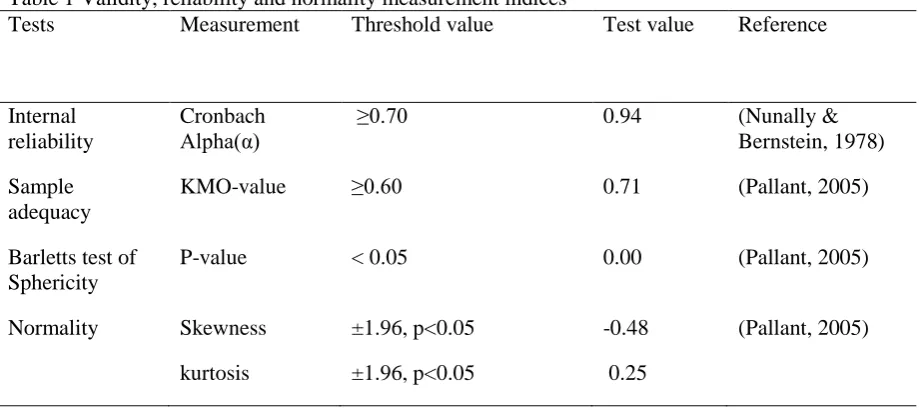
Table 1 Validity, reliability and normality measurement indices
Tests Measurement Threshold value Test value Reference
Internal reliability
Cronbach
Alpha(α) ≥0.70 0.94 (Nunally & Bernstein, 1978)
Sample adequacy
KMO-value ≥0.60 0.71 (Pallant, 2005)
Barletts test of Sphericity
P-value < 0.05 0.00 (Pallant, 2005)
Normality Skewness
kurtosis
±1.96, p<0.05
±1.96, p<0.05
-0.48
0.25
(Pallant, 2005)
For face validity instrument was sent to experts of the field, instrument was finalized after their expert opinion. Results of Table 1 shows that values of the measurement indices for validity, reliability and
normality are according to the threshold values.
Results of Table 2, reveal that the overall level of the Intellectual Capital of the secondary schools is high (98%). From in-depth analysis we found that all the sub-dimensions of intellectual capital are high among which skills and abilities stand at last position (67%).
Table 2: Percentage distribution of level of Intellectual Capital (overall)
Variable/ Sub-dimensions Level of Intellectual Capital
Low (%) Moderate (%) High (%)
Education (Edu) 0.00 2.00 97.80
Experience (Exph) 0.00 1.70 98.00
Training (Trg) 0.70 6.60 92.60
Skills & Abilities(SAA) 8.60 0.20 66.70
Human Capital (HC) 0.20 0.20 97.10
Social Capital (SC) 0.10 2.70 97.30
Intellectual capital (IC) 0.10 2.20 97.70
5 Table 3: Percentage distribution of level of Intellectual Capital according to gender within the
Pakistan Army Category
Category Gender
Variable/Sub-dimensions
Level of Intellectual Capital
Low (%) Moderate (%) High (%)
Pak. Army Male Education(Edu) 0.00 5.70 94.30
Experience(Exph) 0.00 8.60 91.40
Training(Trg) 2.90 25.70 71.40
Skills & Abilities(SAA)
14.30 31.40 54.30
Human Capital(HC) 0.00 20.00 80.00
Social Capital(SC) 0.00 8.60 91.40
Intellectual Capital(IC)
0.00 17.00 82.90
Female Education(Edu) 1.30 6.30 92.50
Experience(Exph) 1.30 5.00 93.80
Training(Trg) 1.30 8.80 90.00
Skills & Abilities(SAA)
5.00 36.30 58.80
Human Capital(HC) 1.30 2.50 96.30
Social Capital(SC) 0.00 2.50 97.50
Intellectual Capital(IC)
0.00 3.80 96.30
Table 4: Percentage distribution of level of Intellectual Capital according to gender within the Federal Government Category
Category Gender Variable/
Sub-dimensions
Level of Intellectual Capital
Low (%) Moderate
(%)
High (%)
Federal Government
Male Education(Edu) 0.00 1.00 99.00
Experience(Exph) 0.00 0.00 100.00
Training(Trg) 0.00 6.70 93.30
Skills & Abilities(SAA)
10.60 29.80 59.60
Human Capital(HC) 0.00 0.00 100.00
Social Capital(SC) 0.00 1.90 98.10
Intellectual Capital(IC) 0.00 0.00 100.00
Female Education(Edu) 0.00 0.00 100.00
Experience(Exph) 0.00 0.00 100.00
Training(Trg) 0.00 3.30 96.70
Skills & Abilities(SAA)
10.00 19.20 70.80
Human Capital(HC) 0.00 1.70 98.30
Social Capital(SC) 0.00 3.30 96.70
Intellectual Capital(IC) 0.00 0.00 100.00
6 Results of Table 5 highlights that male and female teachers perceive that the schools in which they are working possess high level of Intellectual Capital and again it is the skills and abilities sub-dimension which stands at the last position (84-87%) and this is the highest when compared with other organizations followed by Federal Government schools and Pakistan Army schools.
Table 5: Percentage distribution of level of Intellectual Capital according to gender within the Fizaia category
Category Gender Variable/
Sub-dimensions
Level of Intellectual Capital
Low (%) Moderate (%) High (%)
Fizaia (Air force)
Male Education(Edu) 0.00 0.00 100.00
Experience(Exph) 0.00 0.00 100.00
Training(Trg) 2.60 0.00 97.40
Skills & Abilities(SAA)
7.90 7.90 84.20
Human Capital(HC)
0.00 0.00 100.00
Social Capital(SC) 0.00 0.00 100.00
Intellectual Capital(IC)
0.00 0.00 100.00
Female Education(Edu) 0.00 0.00 100.00
Experience(Exph) 0.00 0.00 100.00
Training(Trg) 0.00 0.00 100.00
Skills & Abilities(SAA)
0.00 12.90 87.10
Human Capital(HC)
0.00 0.00 100.00
Social Capital(SC) 0.00 0.00 100.00
Intellectual Capital(IC)
0.00 0.00 100.00
Table 6: Pearson correlation between IC and its sub-dimensions
Edu Trg Exph SAA HC SC
IC 0.76** 0.76** 0.83** 0.69** 0.94** 0.90**
**Correlation is significant at the p level (2-tailed).
Table 6 expounds the correlation between IC and its sub-dimensions. These results show that there is a high correlation between IC and its sub-dimensions. The effect size(r=.941, n=408, p<0.01) found is highest between IC and its sub-dimension human capital, followed by a high correlation (r=.903, n=408, p<0.01) between IC and social capital. These results highlight the importance of human capital and social capital for the enhancement of intellectual capital.
Discussion
7 work-related experience. While teachers in federal government school work on regular basis without any fear of service termination, due to which they possess rich teaching experience.
Barber and Mourshed (2007) contend that the level of performance of any education system can be judged by the quality of teachers. This study shows that the majority of teachers possess high level of human capital and therefore high achievements are expected from these teachers. Intellectual Capital, consisting of knowledge, experience, skills and good relationship, is causing competitive advantage for an organization (Ghosh & Mondal, 2009). Arriving at the conclusion, this study argues that IC provides a clear picture, about the performance of an organization, to the stake-holders. Presently, various organizations are trying to shift their focus towards building the Intellectual Capital. Intellectual Capital of the staff creates wealth for the organization. Therefore organizations are now found to monitor, disclose and report its Intellectual Capital (Bhasin, 2012).
Putting together, we found that there is a high correlation between intellectual capital and its sub-dimensions, especially human capital is very necessary for any organization. School is also an organization having the same pre-requisites for its success; its success can be judged from student’s achievements through human capital and dealings (social capital). Social capital is what combines different forms of human capital (Salajegheh & Pirmoradi, 2013). The results of this study reveal that although there is an overall high level of Intellectual Capital possessed by these schools, but individually they differ in these level. At the highest level we can see that female staff of the Fizaia schools perceive that they possess high level of Intellectual Capital (100%) and they show high level of skills and abilities (87%) and high level of human and social capital (100%), while male staff of Pakistan Army schools show an overall (83%) Intellectual Capital, whereas their level of skills is only 54%.
Similarly, a difference is found in the level of skills and abilities between male and female staff of federal government schools. These results are worthy to note in the sense that there is a difference in the level of Intellectual Capital found between the male teachers and female teachers of the same organizations. The reason for this situation may either be the gender discrimination in these organizations, or that some teachers have more opportunities of training which improve their skills. Similarly, it may also be the leadership behavior problem. It is also noted that in Pakistani culture females are treated more politely than male employees. Hence, leaders are found more polite with female staff. Staff development is considered as the key aspect of leadership. Leadership comprises leadership skills that an educational leader possesses. The only difference between effective and ineffective schools is the leadership skills of the school principals (Blackburn, 2009; Piaw, Hee, Ismail, & Ying, 2014). People who do not possess leadership skills will not be accepted as leaders by any group in any circumstances (Silva, 2014).
Leaders know that their journey of school effectiveness is not a solo flight, so they have to develop their faculty. But it is also found from literature that school leaders in Pakistan have rarely found any opportunity of their self-development. Now it is astonishing that leaders in Pakistan do not possess leadership skills which are the pre-requisite for Intellectual Capital development, then this means that there are some other antecedent variables which affect Intellectual Capital development. West and Sacramento (2004) state that effective leaders develop professional skills, sovereignty and social interaction with and among staff. High quality of teaching and leadership is most necessary for a successful education system (Peleg, 2012). Intellectual Capital generates a value for organization (Sharabati, Naji Jawad, & Bontis, 2010). Structural capital also affects Intellectual Capital of the schools. Structural capital is also known as organizational capital and it includes programming, records, schedule and process and deliverance system (Hang Chan, 2009). These schools are operated by different organizations, possessing their own structural capital. Structural capital provides a conducive environment, increases knowledge facilities and helps in the productivity of the organization and employee (Awan & Saeed, 2014).
8 especially skills and abilities. Semi-Government organizations that operate these schools have their own rules, policies, and selection and promotion criteria and besides this experienced people are working in these organizations. This is the main reason that teachers perceive that they possess high level of Intellectual Capital.
Conclusion
From the results of this study and fruitful discussion through support of the literature, it is suggested that only tangible assets of an institute are not the guarantee of success for organizations like schools. An organization has now to focus more on intangible assets than tangible assets and it needs to allocate more time and funds for Intellectual Capital development to get a competitive advantage. The main reason behind the development and measurement of Intellectual Capital is that institutes, whether they are public or private, profitable or non-profitable, ought to measure, evaluate, manage and develop Intellectual Capital to sustain long-term survival (Sharabati et al., 2013).
Implications of the study
This study will draw the inclination of the policy makers and educational leaders towards the importance of the Intellectual Capital. Mere tangible (physical) assets are not the only key elements to make an organization more effective. Intellectual Capital development, monitoring and evaluation are the foremost requirements for organizational success and repute.
Limitations
The regional directors of the target population did not permit the researcher to conduct interview of the teachers and principals and even distribution of questionnaire was not allowed to the principals, so the qualitative aspect of the research is not a part of this study. Due to time constraints private schools have not been included in this study, for which another study may be conducted in future and the results can be compared with the results of this study.
Future research
In literature it has been found that for quality education quality teaching is necessary. If schools possess a high level of Intellectual Capital, then its effects can be seen in students’ achievements. A longitudinal study is required in these schools to assess the quality of education and students achievements.
Acknowledgement
The authors would like to thank Higher Education commission (HEC) of Pakistan and Shaheed Benazir Bhutto University Sheringal Dir (U), Khyber Pakhtunkhwa, Pakistan for moral support and encouragement.
References
Andrabi, T., et al. (2006). "A Dime a Day: The Possibilities and Limits of Private Schooling in Pakistan." World Bank Policy Research Working Paper (4066).
Awan, A. G., & Saeed, K. (2014). intellectual capital and research performance of universities in
southern punjab-pakistan. European Journal of Business and Innovation Research, 2(6),
21-39.
Barber, M. and M. Mourshed (2007). How the world's best-performing schools systems come out on top, McKinsey & Company.
Bhasin, M. L. (2012). Measurement and disclosure of intellectual capital in a developing country: An
9
Blackburn, D. (2009). Socio-Cultural Leadership: The Art of Restructuring Schools Through
Research-Based Principal Leadership: iUniverse.
Bontis, N. (2001). Assessing knowledge assets: a review of the models used to measure intellectual
capital. International Journal of Management Reviews, 3(1), 41-60.
Bontis, N., Bart, C. K., Ramírez, Y., Lorduy, C., & Rojas, J. A. (2007). Intellectual capital
management in Spanish universities. Journal of Intellectual capital, 8(4), 732-748.
Carmona-Lavado, A., Cuevas-Rodríguez, G., & Cabello-Medina, C. (2010). Social and organizational
capital: Building the context for innovation. Industrial Marketing Management, 39(4),
681-690.
Chang, H. H., & Chuang, S.-S. (2011). Social capital and individual motivations on knowledge
sharing: Participant involvement as a moderator. Information & management, 48(1), 9-18.
Dakhli, M., & De Clercq, D. (2004). Human capital, social capital, and innovation: a multi-country
study. Entrepreneurship & Regional Development, 16(2), 107-128.
David, H. (2001). School Improvement for real: London: Routledge Farmer.
Dikshit, A. Y., & Dikshit, P. A. (2014). An Investigation in Organizational Citizenship Behavior of Managers As Perceived By Senior Officers with Leadership Roles & Responsibilities. International Journal, 2(2).
Fazlagic, A. (2005). Measuring the intellectual capital of a university. Proc. of Trends in the
Management of Human Resources in Higher Education, Poznan University of Economics, Poznan. Print.
Ghosh, S. and A. Mondal (2009). "Indian software and pharmaceutical sector IC and financial performance." Journal of Intellectual Capital 10(3): 369-388.
Hallinger, P., & Heck, R. H. (1998). Exploring the Principal's Contribution to School Effectiveness: 1980‐1995∗. School Effectiveness and School Improvement, 9(2), 157-191.
Hallinger, P., & Heck, R. H. (2011). Exploring the journey of school improvement: Classifying and
analyzing patterns of change in school improvement processes and learning outcomes. School
Effectiveness and School Improvement, 22(1), 1-27.
Hang Chan, K. (2009). Impact of intellectual capital on organisational performance: An empirical
study of companies in the Hang Seng Index (Part 1). The Learning Organization, 16(1), 4-21.
Hunter, L., Webster, E., & Wyatt, A. (2005). Measuring intangible capital: a review of current
practice. Australian Accounting Review, 15(36), 4-21.
Leithwood, K., Harris, A., & Hopkins, D. (2008). Seven strong claims about successful school
leadership. School leadership and management, 28(1), 27-42.
Manzari, M., Kazemi, M., Nazemi, S., & Pooya, A. (2012). Intellectual capital: Concepts,
components and indicators: A literature review. Management Science Letters, 2(7),
2255-2270.
María Díez, J., Lizet Ochoa, M., Begona Prieto, M., & Santidrián, A. (2010). Intellectual capital and
value creation in Spanish firms. Journal of intellectual capital, 11(3), 348-367.
Marr, B., & Chatzkel, J. (2004). Intellectual capital at the crossroads: managing, measuring, and
reporting of IC. Journal of Intellectual Capital, 5(2), 224-229.
Mumtaz, S., & Abbas, Q. (2014). An Empirical Investigation of Intellectual Capital Affecting the
Performance: A Case of Private Universities in Pakistan. World Applied Sciences Journal,
32(7), 1460-1467.
Niazi, S. (2012). School leadership and educational practices in pakistan. Dimensions, 1, 5.
Nunally, J. C., & Bernstein, I. H. (1978). Psychometric theory. New York: McGraw-Hill.
Pallant, J. (2005). SPSS survival manual: A step by step guide to data analysis using SPSS Allen &
Unwin. NSW.
Peleg, S. (2012). The Role of Leadership in the Education System. Education Journal, 1(1), 5-8.
Piaw, C. Y., Hee, T. F., Ismail, N. R., & Ying, L. H. (2014). Factors of Leadership Skills of
Secondary School Principals. Procedia-Social and Behavioral Sciences, 116, 5125-5129.
Polat, S. (2009). Organizational citizenship behavior (OCB) display levels of the teachers at
secondary schools according to the perceptions of the school administrators. Procedia-Social
10 Rahman, S. (2012). The role of intellectual capital in determining differences between stock market
and financial performance. International Research Journal of Finance and Economics, 89(1),
46-77.
Rehman, W., Ilyas, M., & Rehman, H. (2011). Intellectual capital performance and its impact on
financial returns of companies: An empirical study from insurance sector of Pakistan. African
Journal of Business Management, 5(20), 8041-8049.
Riaz, I. (2008). Schools for change: a perspective on school improvement in Pakistan. Improving
Schools, 11(2), 143-156.
Salajegheh, S., & Pirmoradi, N. (2013). Social Capital of the Organization. Social Capital, 7(12),
40-52.
Sharabati, A.-A. A., Naji Jawad, S., & Bontis, N. (2010). Intellectual capital and business
performance in the pharmaceutical sector of Jordan. Management decision, 48(1), 105-131.
Sharabati, A.-A. A., Nour, A.-N. I., & Naser Eddin, Y. A. (2013). Intellectual Capital Development:
A Case Study of Middle East University. Jordan Journal of Business Administration, 9(3).
Silva, A. (2014). What Do We Really Know About Leadership? Journal of Business Studies
Quarterly, 5(4), 1-4.
Vashishtha, S., Vashishtha, S., & Sharma, P. (2012). Towards Assessing True Worth of Intellectual Capital. International Journal of Social Science & Interdisciplinary Research, 1(8), 1-7.
West, M., & Sacramento, C. (2004). Meeting Human Needs at Work. Strategic Communication
Management, 5.
Youndt, M. A., Subramaniam, M., & Snell, S. A. (2004). Intellectual Capital Profiles: An