REVIEW
STEADY STATE VISUAL EVOKED POTENTIAL BASED BCI AS CONTROL
METHOD FOR EXOSKELETON: A REVIEW
Norhafizan Ahmad, Raja Ariffin Raja Ghazilla, Muhammad Zikril Hakim MD Azizi
Center for Product Design and Manufacturing University Of Malaya, Malaysia
ABSTRACT
Brain Computer Interfaces (BCI) provide a vast possibility in enabling the brain to communicate directly with the computer, hence providing an alternative in controlling the machines without much effort. In fields of rehabilitations robotics, the applications of an exoskeletons in assisting a spinal cord injured (SCI) patients were growing. Steady state visually evoked potentials (SSVEP) based BCIs that utilizes the human visual reactions to the constant flickered stimulus quickly showed its potentials among the BCIs used in rehabilitations devices because of its advantages such as a higher immunity to noises and artefacts and also its robustness compared to other BCIs. Rehabilitation exoskeletons demands an approach that are more user friendly and the aspects of control scheme and mechanical parts that are more focused on assisting the patients in rehabilitations and providing a SCI patients an alternatives to explore their surroundings in a more intuitive ways. This paper highlights the current development trends in SSVEP based BCIs for rehabilitation exoskeletons and proposed the potential research scopes in the future that can improve the effectiveness, and its potential applications in rehabilitations.
Keywords: SSVEP, Exoskeleton, Brain Computer Interface
INTRODUCTION
Brain Computer Interfaces (BCI) provide a vast possibilities in enabling the brain to communicate directly with the computer, hence providing an alternatives in controlling the machines without much efforts. The BCIs relies on the concept that every mental states and activities will generates a different kind of bioelectrical signals that can be acquired by the electrodes sensors, in both invasive or non-invasive methods, and can be used to control a devices according to users electroencephalography (EEG) signal detections.
Invasive EEG methods require surgery that will implant the electrode directly in the skull or even the brain itself. Even though this method can be more effective and accurate, provide a higher signal quality and can precisely localize the brain EEG signals, this methods are particularly dangerous and require proper surgical procedures. Potential risk of cancer with the use of invasive BCI makes the methods not very practical in a modern application. With the development of current BCI application that demands the need for a more practical approach, a non-invasive method will certainly be a better choice. Non-invasive EEG methods were more practical and does not require any surgical procedure prior to the experiments. EEG signals were obtained from the bioelectrical signals at the scalp rather than the electrodes that were implanted directly into the brain area.
Neuropsychological signals obtained from the brain activities were known as potentials and depends on the locations of the electrodes. This potential signals make up the raw EEG data
obtained by the EEG sensors electrodes. The signals differ in frequency, amplitude, duration and locations of the electrodes. Different parts of the brains will provide a different type of potentials depending on which stimulus being applied to the users. Non-invasive BCI methods can utilize several approaches of event related potentials (ERP) such as visual evoked potential (SSVEP), movement related potential (MRP), and P300 based potential.
Event related potentials is the measured response of the brain EEG signals by non-invasive electrodes that resulted from the direct stimulus that can be triggered from the cognitive, sensory or motor stimulus events. One of the ERP that commonly used were steady state visually evoked potentials. The SSVEP signals are the sinusoidal oscillatory waveform electrical signals that have the same frequency as the flickered stimulus frequency or its harmonics that can be obtained by placing the electrodes at the head area where primary visual cortex was located.
impaired people with disabilities that inhibit their motor movements to operate a devices, particularly an exoskeletons.
This paper intend to address the current development and implementations in an SSVEP based BCI that were used in the current research projects for exoskeletons.
CURRENT DEVELOPMENTS IN SSVEP BASED BCI FOR EXOSKELETONS
In experimental procedure, there had been numerous experiment and research that already been conducted, but in real time environments where the systems need to be mobile and able to adapt to the environments, there were few solutions available in research. In context of exoskeleton, several key factors need to be taken into considerations when designing a SSVEP based BCIs that can be used optimally for exoskeleton applications.
While many SSVEP based BCI had been applied to numerous applications in previous research and had proven to control many robotics devices such as robotic hands, prosthesis, humanoid robots and motorized wheelchair, not many SSVEP based BCIs that can be optimally applied to an exoskeletons, particularly a lower limb exoskeleton. Many researchers already ventured the possibilities of SSVEP based BCIs for exoskeletons that works with offline procedures. Some of that successfully demonstrated a methods that works perfectly with almost 100% accuracy such as methods demonstrated by Kwaket al.1 and McDaid2, both with a lower limb
exoskeletons.
Gancet et al.3 had presented a MINDWALKER as
shown in Figure 1 and Figure 2, an EC funded exoskeletons projects that coordinated by Space Applications Services that aim at the development of novel Brain Neural Computer Interfaces (BNCI) that usea non-invasive BCIs
approach as its main strategy and Spinal Cord Injured (SCI) patients as target users. Interestingly, MINDWALKER expressed their opinions on how Virtual Reality (VR) technologies integrations with the rehabilitation process that can prepare the patients in a safe and fully controlled environments before using the assistive robots in their daily life. They also admit the potential of SSVEP or P300 based BCIs that does not require intensive training but they also stated that this methods may not always properly fit the requirements of specific applications. They opted for a more detail approach where they expect the motor cortex.
EEG signal can be exploited and translated to generate real time legs kinematics angles that corresponds to the walking pattern and pace as imagined by the users.
Sakurada et al.4 had demonstrated a BMI-based
Occupational Therapy Suit (BOTAS) as shown in Figure 3that utilizes an asynchronous control for upper hand exoskeletons using SSVEP based BCI. This hybrid BCI based systems incorporates a set of pre-recorded movements that can be trigger by the P300 and SSVEP signals. Sakurada et al.4
suggested that the use of robot assisted rehabilitation such as exoskeletons can be
Figure 2 - Preliminary protocol for MINDWALKER using SSVEP in recordings in the occipital cortex. In the left screen the green button flickers at 5Hz, on the right screen the red button flickers at 10Hz.
Figure 1 - The Virtual Reality Training Environments (VRTE) hardware setup for MINDWALKERs – left: care-giver training authoring and monitoring. Right: patient training environment. The upper body of this virtual human representation is controlled via the tracking data, and its legs are actuated by the Virtual Exoskeleton’s controller, using BCI inputs.
improved if the control scheme and the systems supported goal directed actions involving multiple body parts such as whole arm. Optimally for rehabilitation, user friendly BCI systems should using as few electrodes as possible without affecting the detection of EEG signals and its classification accuracy as stated by Luo and Sullivan5as shown in Figure 4. This
also helps the users to use the systems without considerable times for preparations, which is quite important in rehabilitations. Sukaradaet al.4 also stated that the locations of the LED
stimulus used in their systems affects the SSVEP responses.
McDaid et al.2 presented an interesting approach
that had two different training protocols. One of it was Initiated intent where the users only triggers the task without the needs to continually focusing on the task. This means the processing algorithm can proceed to another command once the last command were executed. Another training protocol were Continuous intent where the user has to concentrate on executing the command continuously, otherwise the task will be stopped. This was useful for a command that need precise or individual control, where the motions can be stopped immediately which was good for safety and control. Continuous concentration that were needed can help the users in rehabilitations. Because of this approach, there was a notable delay to recognize the users intent hence inhibit the systems effectiveness in real time applications. They were convinced that this approach using SSVEP were better than motor imagination approach that have lower accuracy and effectiveness.
Kwaket al.1also presented an interesting
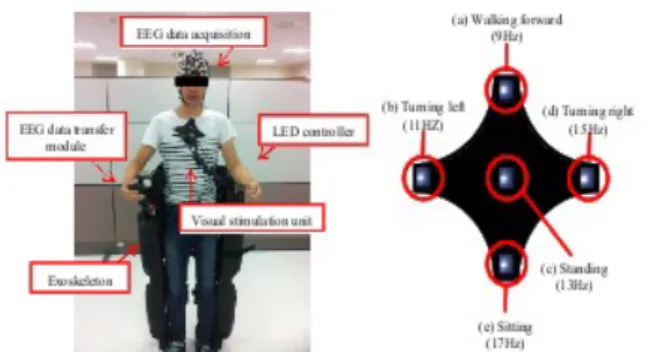
approach to SSVEP based BCIsas shown in Figure 6. With their lower limb exoskeletons, they used LED systems rather than a monitor because it can be easily mounted in front of their exoskeletons. The exoskeletons from REX Bionics were used and it have a pre-programmed motions such as walking, turning, standing and sitting and can balance itself. They only demonstrated their
offline SSVEP based BCIsystems using only the SSVEP classification. Nonetheless, their systems were effective and robust enough with high accuracy and can be easily be integrated into any exoskeletons.
Bevilacqua et al.6as shown in Figure 7had
proposed and developed a novel BCI-SSVEP based approach for control of walking in Virtual Environment using a Convolutional Neural Network. This approach integrates the SSVEP based BCIs method with a virtual reality (VR) environments module with a head mounted display (HMD) to facilitate the users perception of the systems. The SSVEP stimulator were included in the VR environments and users did
Figu re 4 - Dual training protocol for SSVEP based robotic exoskeletons – left: schematics of flickering panel where 12 green flickering LEDs with different frequencies for 12 possible commands. Right: Neurorehabilitation exoskeleton setup includes the EEg cap, lower limb knee joint exoskeletons, a flickering panel and user interface.
Figure 5 - Left: Components of BMI SSVEP based exoskeleton systems. Right: visual stimulation unit with intuitive interface: walking (9Hz), turning left (11Hz), standing (13Hz), turning right (15Hz) and sitting (17Hz).
Figure 6 - The block diagram for proposed BCIs SSVEP based approach using virtual reality.
not have to wear the exoskeletons physically at all. This approach provides users with a sense of confidence of their safety. While the neural network approach itself was accurate and effective, however, they stated that their VR approach rely on a reduced number of control commands and the selection needs to be reliable and rapid in order to achieve usability of the interface itself.
POTENTIAL FUTURE RESEARCH SCOPES
In general, SSVEP can be assume as the continuous evoked response obtained from the visual cortex of the brains that resulted from the continuous constant frequency stimulus to the eye retina. When the subjects gazed the flickered targets, the different flickered stimulus frequencies will yield a different evoked EEG signals from the primary visual cortex that can be distinguish based on the matching fundamental stimulus frequency or its harmonic frequencies.
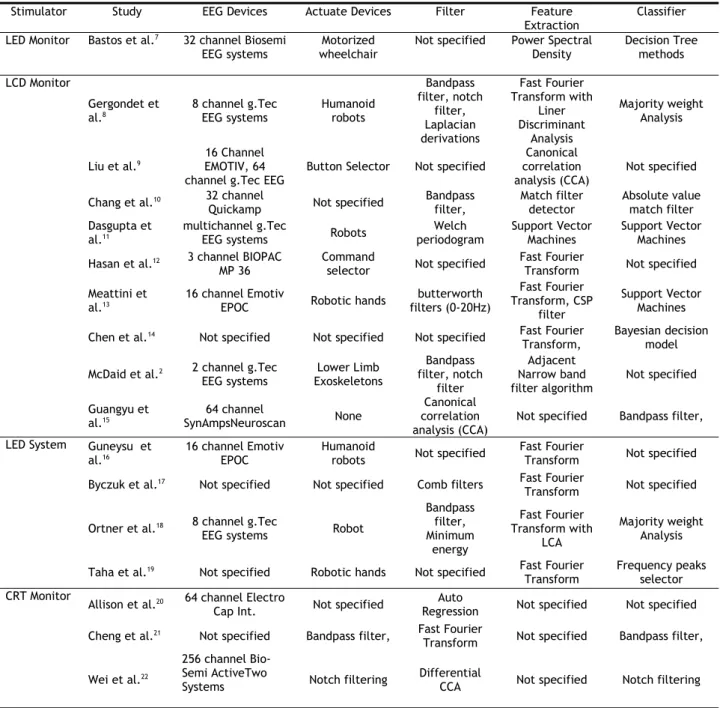
Table 1 - Characteristics of SSVEP Study Based On Stimulator
Stimulator Study EEG Devices Actuate Devices Filter Feature
Extraction Classifier LED Monitor Bastos et al.7 32 channel Biosemi
EEG systems wheelchairMotorized Not specified Power SpectralDensity Decision Treemethods
LCD Monitor
Gergondet et
al.8 8 channel g.TecEEG systems Humanoidrobots
Bandpass filter, notch filter, Laplacian derivations Fast Fourier Transform with Liner Discriminant Analysis Majority weight Analysis
Liu et al.9 16 ChannelEMOTIV, 64
channel g.Tec EEG Button Selector Not specified
Canonical correlation
analysis (CCA) Not specified Chang et al.10 32 channel
Quickamp Not specified Bandpassfilter, Match filterdetector Absolute valuematch filter Dasgupta et
al.11 multichannel g.TecEEG systems Robots periodogramWelch Support VectorMachines Support VectorMachines
Hasan et al.12 3 channel BIOPAC
MP 36 Commandselector Not specified Fast FourierTransform Not specified Meattini et
al.13 16 channel EmotivEPOC Robotic hands filters (0-20Hz)butterworth
Fast Fourier Transform, CSP
filter
Support Vector Machines
Chen et al.14 Not specified Not specified Not specified Fast Fourier
Transform, Bayesian decisionmodel
McDaid et al.2 2 channel g.Tec
EEG systems ExoskeletonsLower Limb
Bandpass filter, notch
filter
Adjacent Narrow band
filter algorithm Not specified Guangyu et
al.15 SynAmpsNeuroscan64 channel None
Canonical correlation
analysis (CCA) Not specified Bandpass filter, LED System Guneysu et
al.16 16 channel EmotivEPOC Humanoidrobots Not specified Fast FourierTransform Not specified
Byczuk et al.17 Not specified Not specified Comb filters Fast Fourier
Transform Not specified
Ortner et al.18 8 channel g.Tec
EEG systems Robot
Bandpass filter, Minimum energy Fast Fourier Transform with LCA Majority weight Analysis
Taha et al.19 Not specified Robotic hands Not specified Fast Fourier
Transform Frequency peaksselector CRT Monitor
Allison et al.20 64 channel Electro
Cap Int. Not specified RegressionAuto Not specified Not specified Cheng et al.21 Not specified Bandpass filter, Fast Fourier
Transform Not specified Bandpass filter,
Wei et al.22
256 channel Bio-Semi ActiveTwo
STIMULATOR
Because of the nature of SSVEP method that requires a source of constant flickered stimulus, many variety of methods to generate the stimulus had been proposed by many researchers. In the early days, cathode ray tube (CRT) monitor were used. Now, among the most commonly used stimulus generator were Light emitting diode (LED) systems and liquid crystal displays (LCD) and LED monitorsas shown in Table 1. According to Wu et al.23, different type
of stimulator selections will give a different SSVEPs because it strongly related to the frequency spectrum differences of the flickers. By far, the LED systems consist of high luminescence LED, particularly a white colored ones, have the most simplest frequency spectrum that only consist of the fundamental stimulus frequency and its harmonics. Because of this, the SSVEP evoked by the LED flicker was stronger than LCD and CRT flicker while SSVEP that evoked by LCD displays and CRT monitors was quite similar.The fundamental frequencies amplitude in the averaged SSVEP evoked by LED was significantly larger than that evoked CRT or LCD flickers in all stimulus frequency23 even
though it was not same for the second harmonics frequency where the difference was not significant among three stimulators in high frequencyas shown in Figure 8.
Hence, LED with shorter rising and descending edge time was better as it can help boost the fundamental components of the SSVEP evoked by this stimulator.
For the LCD monitors, the luminance or the photometric measure of the luminous intensity per unit area of light travelling in a given direction and the refresh rate of the monitors really does affect the SSVEP performances. LCD have higher luminance that CRT monitors, hence it will not be affected by the refresh rates or other high frequency components. But LCD does have longer rising and descending edge of flickers. These low frequency components of the flickers does gave some problems to the accuracy of decoding the SSVEPs.CRT monitors, apart from having lower luminance that LCD, it also can be affected by the refresh rates of the monitors. Hence, the evoked SSVEP will also contain refreshing frequencies when operating in low frequency bands. This will have a huge effects on the overall decoding accuracy ofthe systems.
When building low complexity SSVEP based BCIs, the LCD and CRT flickers are better than LED flickers because it doesn’t need much processing power and stimulator. Computer systems can provide both computing power and stimulator systems simultaneously. In medium complexity SSVEP based BCIs where the choices was more than 10 types, the processing power and stimulator can still be operated by a single unit of computers. Hence using LED with all the equipment’s needed was not an optimal choice. While high complexity SSVEP based BCIs system does need a low rising and ascending time to reduce the harmonics components of the frequency spectrum, LED can be a better stimulator that can provide a higher fundamental frequency and does not affected by the harmonics too much.
Even though SSVEP based exoskeletons does not need many inputs like a QWERTY keyboard inputs or keypad inputs, it still need a stimulator that will always be in the user field of view and did not inhibit their movements. Wearable and mobile SSVEP approach for exoskeletons were more appropriates than a monitor based stimulator method. Hence LED systems will works better for SSVEP based BCIs as shown by some researchers such as Kwaket al.1, McDaid2 and
Sakurada4.
Optimization of the SSVEP accuracy and effectiveness can be achieved with several methods. The distribution and arrangements of the flickered stimulus can improve the EEG signals and directly boost the SSVEP performances. Frequency pairs and inter sources distances also plays an important parts in the detection accuracy of the systems. As concluded by Resalatet al.24 stated that when designing a Figure 8 - Signal waveforms and frequency spectra of the
bi-command BCI system, the frequency pair of 10-15 Hz were more suitable among the other pairs with inter-sources distance of 14 cm or 24 cm where the sweep length was 0.5 second. They also concluded that when designing a multi-command BCI system requires the volume of the stimulus area to be as small as possible; therefore, inter-sources distance of 14 cm could be more practical based on their findings.
The colour of the flickered stimulator also plays an important role in effective implementation of SSVEP. Takanoet al.25 stated that blue/green
flicker can improved the EEG signals classification accuracy and effectiveness of P300 based BCIs when compared to grey/white stimulus. Because of the P300 concept that almost similar with SSVEP based BCIs, the concept should works too in theory even though future research were needed to validate this statements. Coloured flickered stimulus methods were better implemented in real time environments because of its higher visibility and will be easier to be detected by the users. Future research works were needed to find the effect of parameters such as stimulus distances and viewing angles in the SSVEP signal performances. The research on the effect of stimulator parameters in the SSVEP performance such as colours, shapes, orientations, distances and locations, flicker intensity and newer type of approach such as stimulus in Virtual Environments (VR) need to be given more attentions in future research.
SIGNAL ACQUISITIONS AND PROCESSING.
When dealing with the signal processing parts of the SSVEP, some factors were more important than others that is the processing speed and detection accuracy. Many researchers had done numerous methods to filter the raw SSVEP signals, do feature extractions and then classify the SSVEP according to the certain class and assigns appropriate commands based on the analysis. Some of the commonly used methods were canonical correlation analysis (CCA)9,15,
differential CCA22, Linear Discriminant Analysis18,
and Fast Fourier transform14,17,19,21,26. Because of
this numerous methods and its effectiveness that depends on the specific application, this paper will not focus on the difference and advantages of each systems, rather more on the main challenges that signal processing needs to be solved when dealing with SSVEP based BCIs for robotics control.
Signals processing for SSVEP consist of several common stages such as signal filtering, feature detection and extraction and classifier. Many researcher already try and compare different types of filters to enhance SSVEP performances such as comb filter17, Detection of idle mode, a
duration which a user did not gaze at any stimulus can helps to increase the detection
accuracy of the offline systems as suggested by Ren et al.27 that use a method called Principal
Component Complexity. This method can be used to reduce a false positive detections hence increase the effectiveness of detections.
Feature extractions techniques also varies depends on the windows lengths, visual stimulator, and number of subjects. Tello et al.28
compares 7 different feature extractions techniques such as Power Spectral Density (PSD), Spectral F-Test, Empirical Mode Decomposition (EMD), Minimum energy Combination (MCE), Canonical Correlation Analysis (CCA), Least Absolute Shrinkage and Selection Operator (LASSO), and Multivariate Synchronization Index (MSI) and concludes that the technique based on MSI produced highest success rates in both types of visual stimulator (LCD and LED). The accuracy and ITR were more significant when the windows sizes were increased from 1, 2, 4, 5 and 10 seconds.
COMPLEXITY OF THE SYSTEMS
Most of the SSVEP based BCIs systems use a computers to do the processing works and to provide SSVEP stimulus to the users. This was acceptable if the SSVEP systems were used to operate a wheelchair or a spelling and input systems. But for exoskeletons, the systems need to be simple and small enough to be mounted on the exoskeletons unless the exoskeletons can operate wirelessly. This demands for the need for a dedicated and more compact hardware for BCIs. Yu et al.29had proposed a hardware
architecture using hierarchical systolic arrays to reconstruct the correlation neural network in real time. They concluded that based on the results obtained, the method of a dedicated hardware for brain machine interfaces provide as much as three orders of magnitude faster that the software approach using desktop computer. This proves the possibilities of a compact and optimal SSVEP based BCIS systems. The ideal ideas of a single, central dedicated processing unit that need to be able to handle the SSVEP acquisition systems, signal processing and the control scheme based on the users SSVEP simultaneously will leads to a future novel rehabilitation exoskeleton devices.
This ideas were based on the concepts that the ideal SSVEP BCIs systems need to have a minimal computational and communication delays, wide system and devices integrations flexibility, a robust SSVEP signals processing and acquisition methods with minimal or no training time that can adapt to the users and the surroundings, and more importantly will assist and augments the rehabilitation process of users normal gait pattern or motions. Hybrid systems using SSVEP based BCIs and another methods can also proves to be useful in making the BCIS faster and more reliable in real time.
Tomita30 proposed a bimodal near infrared
spectroscopy (NIRS) and EEG approach where SSVEP were measured using one channel of NIRS and one channel of EEG acquisitions method to optimize the detection accuracy. NIRS signals were used to detect whether the users in an active or idle mode. Then SSVEP EEG obtained were used to detect one of the commands or an idle state also. Combining another BCIs method can also improve the detection accuracy by limiting the false positive detections.
SYSTEM FEEDBACKS AND ADAPTABILITY IN REAL TIME
According to Pons31 exoskeleton are wearable
robots that exhibit a close cognitive and physical interaction with the human user because it operates alongside human limbs. Because of the nature of rehabilitation exoskeletons operations that need to assist in user rehabilitation process
and optimally augment the users physical gaits in real time, the control scheme need to include mutual feedbacks with the users. Pons31 also
expressed his opinions on the brain controlled exoskeletons and divided the demonstrations of Brain–machine interface into 2 larger groups, either continuous control of positions or velocity or discrete control of more complex information such as intended targets, actions and onset of movements. While a single and multiple unit recording interfaces were only attainable through invasive implantable microarray electrodes and poses a numbers of limitation even though it provides a large data throughput, it makes the surface and noninvasive based BMIs a much viable and practical methods.
In terms of system feedback in real time for SSVEP BCIs based exoskeletons, visual feedback of users surrounding were important. While most of the current research in SSVEP based BCIs employed the usage of LED systems or LCD monitors, the stimulators used were mostly fixated in front of the users. If the exoskeletons need to operate in real time, this will not be the optimal approach. While the users may looks at the stimulator and the surroundings freely, the stimulator needs to be in the user field of view constantly. This can be achieve by a head mounted display (HMD) like the one proposed by Bevilacquaet al.6.
CONCLUSION
A successful SSVEP based BCIs for rehabilitation exoskeletons need to emphasize several key aspects such as able to optimally conveys the users gazing actions according to their intentions. The delays between the time of users action and the actual exoskeletons motions need to be as minimal as possible so that the systems can works seamlessly in real time environments. A more advance approach to the users perception need to be used such as Virtual Environments (VR) or a head mounted displays (HMD) systems that can adapt to the users visual field and the surrounding environments. The milestone in the SSVEP based exoskeletons will be the clinical evaluations of the systems that can successfully assist the SCI patients in real time environments without the hesitations of a malfunction or limited functions of exoskeleton control scheme.
ACKNOWLEDGEMENTS
The authors wish to thank the staffs in the Centre for Product Design and Manufacturing (CPDM), University of Malaya, and everyone that involved in this study.
1. Gancet, J., Ilzkovitz, M., Cheron, G., Ivanenko, Y., van der Kooij, H., van der Helm, F., Zanow, F. and Thorsteinsson, F., MINDWALKER: a brain controlled lower limbs exoskeleton for rehabilitation. Potential applications to space. in 11th Symposium on Advanced Space Technologies in Robotics and Automation. 2011:12-14.
2. Sakurada, T., Kawase, T., Takano, K., Komatsu, T. and Kansaku, K. A BMI-based occupational therapy assist suit: asynchronous control by SVEP. Frontiers
in neuroscience, 2013.7.
3. Luo, A. and Sullivan, T.J.A user-friendly SSVEP-based brain–computer interface using a time-domain classifier. Journal of
neural engineering, 2010. 7(2): p.
026010.
4. McDaid, A.J., S. Xing, and S.Q. Xie. Brain controlled robotic exoskeleton for
neurorehabilitation. in Advanced
Intelligent Mechatronics (AIM), 2013
IEEE/ASME International Conference on.
2013. IEEE.
5. Kwak, N.-S., K.-R. Muller, and S.-W. Lee.
Toward exoskeleton control based on
steady state visual evoked potentials. in
Brain-Computer Interface (BCI), 2014
International Winter Workshop on. 2014.
IEEE.
6. Bevilacqua, V., Tattoli, G., Buongiorno, D., Loconsole, C., Leonardis, D., Barsotti, M., Frisoli, A. and Bergamasco,
M. A novel BCI-SSVEP based approach for
control of walking in Virtual Environment using a Convolutional
Neural Network. in Neural Networks
(IJCNN), 2014 International Joint
Conference on. 2014. IEEE.
7. Bastos, T.F., Muller, S.M., Benevides, A.S.B. and Sarcinelli-Filho, M.Robotic wheelchair commanded by SSVEP, motor
imagery and word generation. in
Engineering in Medicine and Biology Society, EMBC, 2011 Annual
International Conference of the IEEE.
2011: 4753-4756. IEEE.
8. Gergondet, P., Druon, S., Kheddar, A., Hintermüller, C., Guger, C. and Slater, M., Using brain-computer interface to
steer a humanoid robot. in Robotics and
Biomimetics (ROBIO), 2011 IEEE
International Conference on. 2011:
192-197. IEEE.
9. Liu, Y., Jiang, X., Cao, T., Wan, F., Mak, P.U., Mak, P.I. and Vai,
M.Implementation of SSVEP based BCI
with Emotiv EPOC. in Virtual
Environments Human-Computer
Interfaces and Measurement Systems (VECIMS), 2012 IEEE International
Conference on. 2012: 34-37. IEEE.
10. Chang, H.C., Deng, H.T., Lee, P.L., Wu, C.H. and Shyu, K.K.Real-time control of an SSVEP-actuated remote-controlled car. in SICE Annual Conference 2010,
Proceedings of. 2010: 1884-1887. IEEE.
11. Dasgupta, S., Fanton, M., Pham, J., Willard, M., Nezamfar, H., Shafai, B. and Erdogmus, D.Brain controlled robotic platform using steady state visual
evoked potentials acquired by EEG. in
Signals, Systems and Computers (ASILOMAR), 2010 Conference Record of the Forty Fourth Asilomar Conference on. 2010:1371-1374. IEEE.
12. Hasan, M.K., Rusho, R.Z. and Ahmad,
M.A direct noninvasive brain interface
with computer based on steady-state visual-evoked potential (SSVEP) with
high transfer rates. in Advances in
Electrical Engineering (ICAEE), 2013
International Conference on.
2013:341-346. IEEE.
13. Meattini, R., Scarcia, U., Melchiorri, C. and Belpaeme, T.Gestural art: A Steady State Visual Evoked Potential (SSVEP) based Brain Computer Interface to express intentions through a robotic hand. in Robot and Human Interactive Communication, 2014 RO-MAN: The 23rd
IEEE International Symposium on.
2014:211-216. IEEE.
14. Chen, Y.J., See, A.R.A. and Chen, S.C., SSVEP-based BCI classification using power cepstrum analysis. Electronics
Letters, 2014; 50(10): 735-737.
15. Bin, G., Gao, X., Yan, Z., Hong, B. and Gao, S. An online multi-channel SSVEP-based brain–computer interface using a canonical correlation analysis method.
Journal of neural engineering, 2009.
6(4): p. 046002.
16. Guneysu, A. and H.L. Akin. An SSVEP based BCI to control a humanoid robot
by using portable EEG device. in
Engineering in Medicine and Biology Society (EMBC), 2013 35th Annual
International Conference of the IEEE.
2013: 6905-6908. IEEE.
17. Byczuk, M., P. Poryzała, and A. Materka,
VEPs spectral characteristics, in Human–
Computer Systems Interaction:
Backgrounds and Applications 2.
2012:3-14. Springer.
18. Ortner, R., Guger, C., Prueckl, R., Grünbacher, E. and Edlinger, G.Ssvep based brain-computer interface for
robot control, in Computers Helping
People with Special Needs. 2010: 85-90.
Springer.
19. Al-maqtari, M.T., Taha, Z. and Moghavvemi, M.Steady state-VEP based BCI for control gripping of a robotic hand. in Technical Postgraduates
(TECHPOS), 2009 International
Conference for. 2009: 1-3. IEEE.
20. Allison, B.Z., McFarland, D.J., Schalk, G., Zheng, S.D., Jackson, M.M. and Wolpaw, J.R. Towards an independent brain–computer interface using steady state visual evoked potentials. Clinical
neurophysiology, 2008; 119(2): 399-408.
21. Cheng, M., Gao, X., Gao, S. and Xu, D., Design and implementation of a brain-computer interface with high transfer rates. Biomedical Engineering, IEEE Transactions on, 2002; 49(10): 1181-1186.
22. Wei, C.S., Lin, Y.P., Wang, Y., Wang, Y.T. and Jung, T.P.Detection of steady-state visual-evoked potential using differential canonical correlation
analysis. in Neural Engineering (NER),
2013 6th International IEEE/EMBS
Conference on. 2013: 57-60. IEEE.
23. Wu, Z., Lai, Y., Xia, Y., Wu, D., & Yao, D. Stimulator selection in SSVEP-based BCI. Medical engineering & physics, 2008; 30(8): 1079-1088.
24. Resalat, S. N., Saba, V., Afdideh, F., & Heidarnejad, A.High-speed SSVEP-based BCI: study of various frequency pairs and
inter-sources distances. in Biomedical
and Health Informatics (BHI), 2012
IEEE-EMBS International Conference on. 2012:
220-223. IEEE.
25. Takano, K., Komatsu, T., Hata, N., Nakajima, Y., & Kansaku, K. Visual stimuli for the P300 brain–computer interface: a comparison of white/gray and green/blue flicker matrices. Clinical
neurophysiology, 2009;
120(8):1562-1566.
26. Hwang, H. J., Lim, J. H., Jung, Y. J., Choi, H., Lee, S. W., & Im, C. H. Development of an SSVEP-based BCI
spelling system adopting a QWERTY-style LED keyboard. Journal of neuroscience
methods, 2012; 208(1):59-65.
27. Ren, R., Bin, G., & Gao, X.Idle state detection in SSVEP-based brain-computer
interfaces. in Bioinformatics and
Biomedical Engineering, 2008. ICBBE 2008. The 2nd International Conference on. 2008; 2012-2015. IEEE.
28. Tello, R. M., Muller, S. M., Bastos-Filho, T., & Ferreira, A.A comparison of techniques and technologies for SSVEP
classification. in Biosignals and
Biorobotics Conference (2014): Biosignals and Robotics for Better and Safer Living
(BRC), 5th ISSNIP-IEEE; 2014: 1-6. IEEE.
29. Yu, B., Mak, T., Sun, Y., & Poon, C.
S.Real-time neuronal networks
reconstruction using hierarchical systolic
arrays. in Engineering in Medicine and
Biology Society, EMBC, 2011 Annual
International Conference of the IEEE.
2011: 7298-7301. IEEE.
30. Tomita, Y., Vialatte, F. B., Dreyfus, G., Mitsukura, Y., Bakardjian, H., & Cichocki, A. Bimodal BCI using simultaneously NIRS and EEG. Biomedical
Engineering, IEEE Transactions on, 2014;
61(4): 1274-1284.
31. Pons, J.L. Rehabilitation exoskeletal robotics. Engineering in Medicine and
Biology Magazine, IEEE, 2010; 29(3):