EFFICIENT OPTIMAL PACKET
MANAGEMENT IN DISTRIBUTED
WIRELESS AD-HOC ENVIRONEMENTS
USING DST
J. AMUDHAVEL* M.S. SALEEM BASHA* P. DHAVACHELVAN* R. BASKARAN# *
Department of Computer Science, Pondicherry University, Puducherry, India. #
Department of Computer Science and Engineering, Anna University, Chennai, India.
{amudhavel86, smartsaleem, dhavachelvan, baskaran.ramachandran}@gmail.com
Abstract
Effective Packet Management (PM) is widely used in distributed wireless environments to reduce the access costs and improve data availability. Therefore, packet transmission in wireless environment becomes one of the important challenges for effective data transfer and maintaining the reliability of data . This paper addresses the issues in maintaining the effective packet management in the wireless ad hoc network environments and proposes an effective solution for the same using an optimization technique. The proposed approach concentrates on effective packet management in the dynamic environment and maintaining local consistency issues which occur in the Distributed Wireless Ad-Hoc network environment. Therefore, this paper evaluates the efficiency of existing techniques, and proposes a more efficient local packet management algorithm. The new algorithm leverages existing techniques which are shown to be efficient. This paper also addresses the advantages and disadvantages of various packet management and its issues.
KeywordsPacket Management, Local Packet, Distributed Spanning Tree, Wireless Application, QoS Parameters, Performance Evaluation, Ad-Hoc Networks
1. Introduction
Y. Chang[1], addresses the interoperability issues in terms of network performance and fairness of bandwidth allocation when an ATM network consists of switches using different rate control mechanisms, namely, the Explicit Forward Congestion Indication (EFCI) mode and the Explicit Rate (ER) mechanism. Simulation results show that these algorithms will interoperate as long as the switch implementation conforms to the end system.
Andrea Borella[2], proposed dynamic management of DQDB Multiple Access Control. It is based on the opportune activation of the Increasing Counter Priority Controlled mechanism, driven by the traffic levels present at the user interfaces. The main goal of that paper is to make the operation of the Metropolitan Area Networks clear and effective for multipriority interworking between remote computers. They compared the results with the results provided by a DQDB network simulator.
J.W.K. Hong[3] proposed the design and implementation of a portable, Web-based network traffic monitoring and analysis system called WebTrafMon. It provides monitoring and analysis capabilities not only for traffic loads but also for traffic types, sources and destinations. The probe extracts raw traffic information from the network, and the viewer provides the user with analyzed traffic information via Web browsers.
Intae Ryoo[4] proposed a new RTM (real-time traffic management) scheme that can effectively manage VBR (variable bit rate) traffic having unpredictable characteristics in ATM (asynchronous transfer mode) networks. In addition to its precise cell control capability, the proposed scheme intends to efficiently use the resources of high-speed, high-performance broadband networks without any deterioration in QoS (quality of service) of the accepted connections.
Vincenzo Catania [12] proposed the correction required by the CAC algorithm to avoid this risk. They compare two different policing mechanisms, one based on conventional logic and another on fuzzy logic, assessing the influence of their degree of selectivity on the additional bandwidth the CAC algorithm needs to reserve in order to guarantee the QoS requirements of all connections. Moises R. N Ribero[13] proposed reactive method of packet management to an optical packet switching node.
G. Chiruvolu [14] VBR video traffic that exhibits Long-Range Dependence (LRD) based on a fractional ARIMA (1,d,0) model. The Short-Range Dependent (SRD) Auto Regressive (AR) model for prediction of VBR video traffic has also been considered for evaluation of the proposed dynamic bandwidth allocation scheme and the performance has been compared to that of LRD-based prediction.
In summary, though many of the proposals dealt the issues in the packet Management management, some of the open issues are not yet addressed; no mechanism for controlling the time based models, no suitable model for maintaining effective traffic management in the network environment. Hence from these perspectives, in this paper, we proposed an integrated Optimal DST approach for local packet management in the network environments. This model addresses the specific issues of dynamic transfer of packets management in intra circle environments. 2. Proposed System
2.1 Distributed Spanning Tree
A DST structure can be described with three perspectives; logical level, interconnection level and the physical level. The logical level is useful to understand the basics concepts of a DST and its organization. The interconnection level is used by software to run a distributed tree and it is responsible of linking the nodes together. Finally, the physical level is the mapping of the interconnection level on a physical network layer. Here we considered the logical and interconnection levels for the work presented in this paper.
Logical Level: In the logical level of the DST, nodes are called subject. Subjects have a virtual name which has 3 digits number. The nodes are organized into a hierarchy of groups. Groups are represented with dashed line rectangles. Groups also have a virtual name. All the elements of a group must have a unique index. The index which represents an integer that is bounded by 1 and the number of elements in the group.
There is only one top level group. The subjects are put together to form groups of level 1. If i is not the top level, the groups of level i are put together to form groups of level i +1. Every element of a group must know all the other elements of its group. The hierarchical structure of the DST is the same as a tree where groups act as fathers and elements act as children.
Interconnection Level: This is a recursive process and finally, it is the subjects that do all the works. In the interconnection level subjects and groups are abstract elements. Nodes are the real entities which act as subjects and groups. The DST[16] is linked by routing tables shared by all the nodes. The routing table has one row by DST level. Each row stores the addresses of the elements of a group. But it is not possible to have the address of a group, because groups are abstract entities in the interconnection level. Instead, it stores the address of a node for each element of the group.
2.2. Distributed spanning Trees in Message Passing
The spanning tree is to be computed in a distributed manner. This is done by attaching to every node in the graph a communicating program that exchanges messages with the programs at its neighbor nodes. Every program in node d maintains two variables containing its father and the length of the minimal path found so far. In particular the state of each program is uniquely determined by these program variables.
Accordingly a message is a triple that can be selected by the selector functions src ("source"), des ("destination"), lgt ("length"). By a message a node src that has got information (by some message from some neighbour node) about a better approximation for a shortest path sends all its neighbours des the information of the existence of a path with some length lgt.
The following section describes the distributed algorithm for constructing spanning tree: ALGORITHM (Distributed Spanning Tree Algorithm)
Step-1: Every node sets its state to Inactive.
Step-2: Construct a spanning tree, T of the underlying un weighted graph. Any node with more than one neighbor in the tree (an interior node) must change its state to Receiving.
The above algorithm represents the behavior and state of the node. It determines whether the node is going to involve in which operation.
Step-4: Transmit the final to every node from a saturated node. Any node contains the final all pairs shortest distance. The node(s) will create a final message consisting of D and send this message to all its neighbors in the spanning tree T.
Definition 1: Let S be the proposed DST for PM providing Local packet Management (LCM) of testing environment consisting of level up to 4 and it can be defined as,
)
1
(
)
,....
,
,
,
(
)
,....
,
,
,
(
)
,....
,
,
,
(
)
,....
,
,
,
(
4 3 2 1 4 3 2 1 4 3 2 1 4 3 2 1
n n n nP
P
P
P
P
Q
Q
Q
Q
Q
R
R
R
R
R
T
T
T
T
T
S
)
2
(
1
i ni
Pi
S
where,
‘T’ indicates the node in the Ad-Hoc Network(AHN) and ‘n’ is the number of nodes in DST in PM.
‘R’ is the group formed by the interconnection between the interconnection nodes and ‘n’ is the number of Preliminary Group(PG) formed in the proposed DST where ‘n’ is defined as n>0.
‘Q’ is the Level1 Group (L1G) formed by the interconnection between the groups and ‘n’ is the number of groups formed the next level (i.e. level1) of DST where ‘n’ is defined as n>0.
‘P’ is the Level2 Group (L2G) formed from the interconnection of the level1 groups of the DST and ‘n’ is the number of groups formed in the level2 of the DST where ‘n’ is defined as y>0.
Any node in the spanning tree that receives D will store it locally and send D to all its tree neighbors except the tree neighbor which it was connected from which it received D. Hence the node which passing the information or writing the information from the other nodes are is called the LH’s of the DST.
2.3 Algorithm to Construct Optimal DST
The following algorithm defines the construction of optimal DST for PM in AHN. This algorithm defines how the LH’s are created and defines the way it done with their operations.
Fig.1: Step by Step group formations and interconnections between the groups and nodes in Wireless AHN
3. Mechanism of Local Packet Management in DST (LPMDST)
The concept of LPM can be described in terms of two primary operations of replication management; read and write operations. The sequences of operations are explained as follows:
Read Operation: It refers the process of reading the recently updated documents for further processes and it can be briefly described in four different phases.
Phase 1: The LH which wants to read the latest updated packet send a read request message to its overall HN. If the HN is concerned with other operation it will sent wait message to the requested LH. The read requested node which receives the wait message understands that the HN is locked with some task. Here HN sends the message when it is. The node which is free
Phase 2: The read requested LH which is acknowledged by its HN waits to receive the requested data item. HN sends a reply message which contains the latest packet of the data item.
Phase 3: Since each HN having is the latest packet of data so there no need by the requester LH to check for the latest version of received data item.
Phase4: Since the LH’s are updated with latest packets, there is no need for the other nodes to get the latest packet to read from the HN. They get their updates from the LH’s itself. Hence by read operation is done faster when compared to traditional method. Therefore all the connected nodes and groups are updated at the same time and the new data is overwritten.
Write Operation: It refers the process of writing the recently updated documents for further processes and it can be briefly described in four different phases.
Phase 1: The LH which wants to write the latest updated packet send a write request message to its overall HN. If the HN is concerned with other operation it will sent wait message to the requested LH. The write requested node which receives the wait message understands that the HN is locked with some uncompleted task and request whenever the HN becomes free.
Phase 2: The write requested LH which is acknowledged by its HN waits to receive the requested data item. HN sends a reply message which contains the latest packet of the data item if it is free from any other operations. Phase 3: Since each HN having is the latest packet of data so there no need by the requester LH to check for the latest version of received data item.
Phase4: Since the LH’s are updated with latest packets, there is no need for the other nodes to get the latest packet to write from the HN. They get their updates from the LH’s itself. Hence by write operation is done faster when compared to traditional method.
4. Simulation and Analysis
Operations performed by nodes. Thus by using DST as a interconnection structure we are reducing the message pass for Read Operation at high level which makes the operation fast and consistent. In simulated DST for TM in networking environment contains LH’s comp2, comp3, comp4, and comp5, respectively other nodes are connected to the LH (Level Heads) which they are connected with. Values of i, j, k, l, m and n in our simulation values shows that the LHs are not uniformly distributed among the HNs which implies that the number of LHs under the interconnection made by the nodes in the runtime. With this formulation of nodes by DST increases performance in message passing, updating the packet in consistent and constant manner.
The overall interpretation of the DST based Networking environment is that the total number of Message Pass required single Read Operation in DST is greater than or equal to number of message pass between LH, HN and the number of nodes.
Our DST based simulation deals with 59 write operations are performed by nearly 19 nodes in 400 seconds (making 10 ms delay can reduce time to 40 seconds). Thus by using or implementing DST in the Networking environment we are reducing the no. of message pass for Read Operation and number of write operations which makes the operation fast and consistent. Table 1 show Number of Read and write operations performed by nodes of the Networking environment.
The priority of write operations is high when compared to read operations to have the latest packet to be updated in all the nodes. Hence the latest write and read operations is not stored in the traditional HN whereas in this, the update is stored in the HN. Hence by applying the concept of DST in that, the operations such as read and write operations are accessed faster when compared to the traditional Networking environment topology.
Table: 1 Performance comparison of No. of Read and Write operations without and with DST in TM
Computer Name No. of Read
Operations without DST
No. of Read Operations with
DST
No. of Write Operations without DST
No. of Write Operations with
DST
Comp1 7 6 6 4
Comp2 5 4 5 2
Comp3 7 5 4 3
Comp4 4 3 7 4
Comp5 6 5 4 2
Comp6 9 6 9 4
Comp7 6 5 6 3
Comp8 3 4 5 1
Comp9 5 4 3 3
Comp10 3 4 7 4
Comp11 6 5 3 4
Comp12 3 2 4 2
Comp13 2 3 6 4
Comp14 5 3 5 3
Comp15 3 2 4 2
Comp16 4 3 2 3
Comp17 2 5 5 4
Comp18 5 3 9 3
Comp19 6 3 6 4
The above value in the table shows the no. of read and write operations which shows the higher priority with minimal number of message passing. Through maintaining effective traffic in packet management deals with the updating of the packet at the right time that is achieved in the graph. Hence in the DST operations also the read and write operations takes place simultaneously to avoid congestion. Below Table no: 1 shows the no. of Read and Write operations performed with and without DST. The Total numbers of Operations are summed to give clear visibility of comparison.
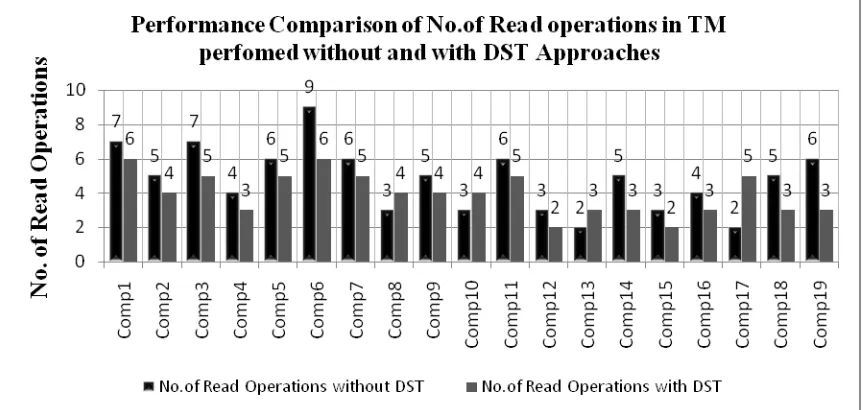
Fig. 2. Performance Comparison of No. of Read operations in TM performed without and with DST Approaches
Fig no.2 show the no. of read operations which is carried out without and with DST while read operations take place. The above graph shows the performance of operations which is done with the 19 computers. It shows that the higher performance in read operations. Here we get the decrease in the message passes when compared to the ordinary read methods.
Fig no.3 shows the no. of write operations which is carried out without and with DST while write operations take place. The above graph shows the performance of operations which is done with the 19 computers. It shows that the higher performance in read operations. Here we get the decrease in the write operations when compared to the ordinary write methods. It shows that the higher performance in write operations with congestion free traffic. When we closely observe the above graph write operations have the higher priority when compared to the read operations with less no. of operations to maintain the updated packet in every LH’s.
Table 2
Operations Without DST Optimized using DST
Time taken (in sec) 227 168
No. of read operations performed in 300ms with
response delay of 100ms 8.54 6.77
No. of nodes involved in read operation in 300ms
with response delay of 100ms 27 31
No. of write operations performed in 300ms with
response delay of 100ms 18 24
No. of nodes involved in write Operation 16 21
The above Table no 1 figures out the comparison between the two approaches and by the DST optimized Ad-Hoc Network (AHN) it performs well in maintaining effective packet management when compared to the ordinary Ad-Hoc Network (AHN) without DST.
4. Conclusion and future work
In this paper, we have presented the way for effective PM using DST for AHN as an interconnection structure. DST in PM increases the availability, reliability of data, updating frequency, Number of Message operations and Bottle neck problems. From the simulation analysis it is shown that AHN[11] with DST shows high performance PM typical network architecture. By employing DST in AHN with cost of few message pass we can assure consistency of Data item, easy recovery of Data on occurrence of crash, load balancing among the wireless nodes.
DST also provides concurrent read operation of latest packet and dynamically AHN [7], [9] creation makes the system Fault-tolerant. We simulated Dynamic routing simulation can make solution for many bottleneck issues in Internet. Our work can also be extended for many packet management types like global, peer etc. to achieve PM as required by the application. More simulation results will be carried out from the practical viewpoint. Furthermore, theoretical modeling for consistency control should be expanded and sophisticated.
References
[1] Y. Chang, N. Golmie, David Su, Interoperability between EFCI and ER switch mechanisms forABR traffic in an ATM network,
Computer Communications 19 (1996) 653-658.
[2] Andrea Borella, Paolo Micucci b, Dynamic management of non-isochronous multi-priority traffic in DQDBmetropolitan area networks,
Computer Communications 20 (1997) 7 15-72.
[3] J.W.-K. Hong, S.-S. Kwon, WebTrafMon: Web-based Internet/Intranet network traffic monitoring and analysis system, Computer
Communications 22 (1999) 1333–1342.
[4] Intae Ryoo, Hitoshi Aida, Tadao Saito, Design and performance analysis of a new RTM in ATM networks, Computer Communications
19 (1996) 205-215.
[5] T. Hara, “Effective Replica Allocation in Ad Hoc Networks for Improving Data Accessibility,” Proc. IEEE INFOCOM, pp. 1568-1576,
2001.
[6] T. Hara, “Replica Allocation Methods in Ad Hoc Networks with Data Update,” ACM-Kluwer J. Mobile Networks and Applications, vol.
[7] T. Hara and S.K. Madria, “Consistency Management among Replicas in Peer-to-Peer Mobile Ad Hoc Networks,” Proceedings IEEE Symposium Reliable Distributed Systems (SRDS ’05), pp. 3-12, 2005.
[8] Saroja Kanchi and David Vineyard, AN OPTIMAL DISTRIBUTED ALGORITHM FOR ALL-PAIRS SHORTEST-PATH, International
Journal "Information Theories & Applications" Vol.11, 141-146.
[9] T. Hara and S.K. Madria, “Data Replication for Improving Data Accessibility in Ad Hoc Networks,” IEEE Trans. Mobile Computing,vol.
5, no. 11, pp. 1515-1532, Nov. 2006.
[10] Zhou SU, Jiro KATTO, Yasuhiko YASUDA, and Yu CHEN, Members, IEEE, Consistency and Update in Mobile Overlay
Networks,2006
[11] Awerbuch, Y. Bartal, and A. Fiat, “Heat and Dump:Competitive Distributed Paging,” Proc. IEEE Symposium. Foundations of Computer
Science (FOCS ’93), 1993.
[12] Vincenzo Catania, Giuseppe Ficili, Daniela Panno, On the impact of traffic control algorithms on resource management in ATM
networks, Computer Communications 22 (1999) 258–265.
[13] Moises R.N Riberio, packet management in photonic packets switching nodes by priority assignments and selective discarding, Computer
Communications 24 (2001) 1689–1701.
[14] G. Chiruvolua, R. Sankarb, N. Ranganathan, VBR video traffic management using a predictor-based architecture, Computer
Communications 23 (2000) 62–70.
[15] Sylvain Dahan, Jean-Marc Nicod and Laurent Philippe, The Distributed Spanning Tree:A Scalable Interconnection Topology for Efficient
and Equitable Traversal, International Symposium on Cluster Computing and the Grid, 2005 IEEE.
[16] Sylvain Dahan, Distributed Spanning Tree Algorithms for Large Scale Traversals, 11th International Conference on Parallel and
Distributed Systems (ICPADS'05), 2005 IEEE.
[17] Lei Xiao, Liangzhong Shen, ZhongYi Hu, Fei Zhou, "Improving Search in P2P by Location Identification," Environmental Science and
Information Application Technology, International Conference on, vol. 1, pp. 519-522, 2009.
[18] Sylvain Dahan, Laurent Philippe, and Jean-Marc Nicod, The Distributed Spanning Tree Structure, IEEE Transanctions on parallel and
Distributed Systems,Vol no.20, No.12,December 2009.