ARTICLE
Development and Prediction of Hyperactive
Symptoms From 2 to 7 Years in a Population-Based
Sample
Elisa Romano, PhDa, Richard E. Tremblay, PhDb, Abdeljelil Farhat, PhDb, Sylvana Coˆte´, PhDb
aSchool of Psychology, University of Ottawa, Ottawa, Ontario, Canada;bResearch Unit on Children’s Psychosocial Maladjustment, University of Montreal, Montreal,
Quebec, Canada
The authors have indicated they have no financial relationships relevant to this article to disclose.
ABSTRACT
OBJECTIVES.Children with hyperactive symptoms are often referred to mental health services. Given the frequency and persistent nature of hyperactivity, it is important to better understand its developmental course. This study identified the different developmental trajectories of hyperactive symptoms from 2 to 7 years and tested early predictors of high-level and persistent hyperactivity. These data may lead to earlier detection of at-risk children and to more effective interventions that take into account developmental considerations.
PARTICIPANTS.Four data-collection cycles of a nationwide survey of Canadian chil-dren were used to track the early development of hyperactivity. Chilchil-dren were 0 to 23 months at the first cycle in 1994 and 6 to 7 years at the fourth cycle in 2000.
OUTCOME MEASURES.Hyperactivity data were gathered from mothers on a biennial basis beginning when children were 24 months old. Information on potential prenatal and postnatal predictors was gathered from mothers at the first cycle.
DESIGN.Group-based semiparametric mixture modeling was used to estimate devel-opmental trajectories, and logistic-regression analysis identified predictors of hy-peractivity.
RESULTS.Four trajectories of hyperactive symptoms were identified: very low, low, moderate, and high. Statistically significant predictors for high and persistent hyperactivity, after controlling for all other factors, were maternal prenatal smok-ing, child male gender, maternal depression, and hostile parenting.
CONCLUSIONS.For the majority of children, the frequency of hyperactive symptoms decreased or remained low from 2 to 7 years. However, 7 children in 100 were classified as having high initial levels of hyperactive symptoms that persisted over time. Several prenatal and early postnatal risk factors identified these children, although additional variables will need to be identified to accurately predict high and persistent hyperactivity. Findings suggest that preventive interventions could target high-risk families during pregnancy and early childhood.
www.pediatrics.org/cgi/doi/10.1542/ peds.2005-0651
doi:10.1542/peds.2005-0651
Key Words
developmental, early childhood, hyperactivity, predictors
Abbreviations
ADHD—attention-deficit/hyperactivity disorder
NLSCY—National Longitudinal Survey of Children and Youth
OR— odds ratio
Accepted for publication Oct 31, 2005
Address correspondence to Elisa Romano, PhD, University of Ottawa, School of Psychology, 11 Marie Curie St, Ottawa, Ontario, Canada K1N 6N5. E-mail: eromano@ uottawa.ca
C
HILDREN WHO EXHIBIT hyperactive symptoms are often referred for mental health services because of problems functioning at school, at home, and with peers. Because hyperactivity is a frequent childhood behavior problem of chronic duration, it is important to better understand its developmental course. A longitudinal study of 1000 at-risk boys found that 6% scored high on teacher-reported hyperactivity at 6 years old, and these boys continued to score high over time until midadoles-cence. The remaining boys exhibited either very low levels of hyperactivity or moderate to high levels that decreased over time.1This type of information isimpor-tant for distinguishing normative from problematic lev-els of hyperactivity and, more specifically, persistent problematic hyperactivity levels. Unfortunately, longitu-dinal studies on hyperactive symptoms during early childhood are limited. A recent review identified only 6 studies on hyperactivity during the preschool period, with all of the studies using a cross-sectional design and only 1 of the studies using data from a national sample.2
The first objective of the study, therefore, was to model the early development of hyperactive symptoms in a national population sample of children from 2 to 7 years of age. Studying early development means that effective interventions for high and chronic hyperactivity can be introduced at a young age and that they can be better tailored to meet developmental changes over time.3
The second study objective was to examine early predictors of high-level hyperactive symptoms as a way to better target prevention and intervention efforts. Past studies have identified a number of predictors of hyperactivity and, more specifically, attention-deficit/ hyperactivity disorder (ADHD), including family history of ADHD, negative parenting behaviors, maternal de-pression, childhood oppositional/aggressive symptoms, and childhood difficult temperament.4–6 These studies,
however, have tended to focus on boys or older children or have relied on nonrepresentative samples of children. Moreover, few studies have focused on early predictors that occur during pregnancy or early infancy. A review of pregnancy lifestyle habits indicated that maternal prenatal smoking and drinking generally increased the risk of hyperactivity in children and adolescents.7
How-ever, only a few of the reviewed studies were based on national samples. A more recent study found that ma-ternal prenatal smoking remained a significant predictor of childhood hyperactivity after controlling for genetic influences, social adversity, child low birth weight, and child comorbid conduct disorder.8The study, however,
was limited by its cross-sectional design. Our study tested child (eg, temperament) and maternal (eg, de-pression) characteristics present at birth, as well as post-natal factors (eg, parenting behaviors) before the child’s second birthday. We included a number of variables of practical importance that could be modified or pre-vented.
METHODS
Sample and Procedure
The National Longitudinal Survey of Children and Youth (NLSCY) is a household survey of which the primary objective is to develop a national database on Canadian children’s life experiences from infancy into adulthood by covering a 10-year period over 5 biennial data-col-lection cycles. We currently have access to 4 data-collec-tion cycles (1994, 1996, 1998, and 2000). In cycle 1, 22 831 children aged 0 to 11 years from 13 439 house-holds participated in the survey, with an overall re-sponse rate of 86.3%.9One child between 0 and 11 years
was randomly selected to participate, with a maximum of 4 children per household. The households were se-lected from the Statistics Canada Labor Force Survey, which uses a stratified, multistage probability sample design to conduct monthly surveys of ⬃59 000 Cana-dian households that are representative of the popula-tion of Canada. The NLSCY excluded children living in institutional facilities (⬃0.5% of 0- to 11-year-old chil-dren), on Aboriginal reserves, and in the 2 Canadian territories, because they are not targeted by the Labor Force Survey. NLSCY budgetary constraints and attrition have led to loss of data over time. For example, cycle 2 eliminated certain cycle 1 responding households and reduced the maximum number of children surveyed per household from 4 to 2. In the end, there was a high overall response rate (91.6%), which resulted in a re-sponding sample of 15 468 children ages 2 to 13 years from 10 261 households.10 The NLSCY includes both
cross-sectional and longitudinal weights to adjust for possible bias resulting from attrition and to maintain sample representation.
At cycle 1, information was collected from the person most knowledgeable about the child (ie, biological mother in ⬃90% of cases). Mothers participated in a personal home interview with a trained interviewer. Data also were collected from older children and from teachers of school-aged children.9We selected children 0
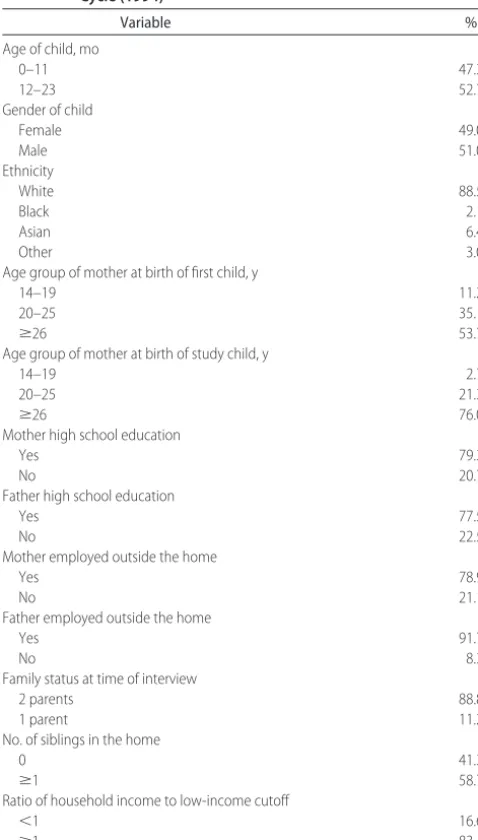
com-plete high school, and 1 (21.1%) in 4 mothers and 1 (8.3%) in 10 fathers were unemployed. Approximately 1 (11.2%) in 10 children were living in a single-parent household where other siblings were present (58.7%). Close to 17% of households in our sample were substan-tially worse off than the average Canadian household, as defined by the low-income cutoff, which estimates the minimum income required by a family to meet its basic needs for food, shelter, and clothing. Different cutoffs are established according to family size and the size of the community in which the family lives. Given the stratified, multistage probability sampling strategy of the NLSCY, it should be noted that these sample demo-graphics are representative of Canadian families with children aged 0 to 23 months in 1994.
Measures
Predictor Variables
Socioeconomic and Family Background Information
At cycle 1, mothers responded to interview questions about age at the birth of their first child, age at the birth of additional children, family status and composition, educational level, employment status, and household income. Mothers also provided information on the edu-cation and employment of their spouse.
Maternal Depression
At cycle 1, mothers provided information on current symptoms of depression (ie, over the past week) by rating 12 items from the Center for Epidemiologic Stud-ies Depression Scale11 along a 4-point scale from 1
(rarely or none of the time;⬍1 day) to 4 (most or all of the time; 5–7 days). Higher scores indicated greater de-pressive symptoms. The Cronbach ␣reliability was .82 for 0- to 11-year-old children at cycle 1.
Perinatal Information
At cycle 1, mothers provided information on tobacco and alcohol use during pregnancy. They also answered questions about the infant’s status (eg, birth weight). We focused exclusively on the presence/absence of prenatal smoking and drinking (and not on frequency and timing during pregnancy), because findings suggest, for exam-ple, that the majority of pregnant smokers continue to smoke throughout their pregnancy.12,13
Parenting Practices
At cycle 1, mothers rated 7 items from the Parent Practices Scale14along a 5-point scale from 0 (never) to
4 (many times each day). The measure yields 2 types of parenting practices, namely positive interaction (5 items with a Cronbach␣reliability of .73 for 0- to 23-month-old children at cycle 1) and hostility (2 items with a Cronbach ␣ reliability of .40 for 0- to 23-month-old children at cycle 1). Higher scores indicated greater use of the parenting practice. Sample positive interaction items include, “How often do you do something special with the child that he/she enjoys?” and “How often do you and your child talk or play with each other, focusing attention on each other for five minutes or more, just for fun?” Sample hostility items include, “How often do you get annoyed with your child for saying or doing some-thing that he/she is not supposed to do?” and “How often do you tell your child that he/she is bad or not as good as others?”
Family Dysfunction
At cycle 1, mothers rated 12 items from the McMaster Family Assessment Device15along a 4-point scale from 0
(strongly agree) to 3 (strongly disagree). Higher scores indicated greater family dysfunction. The Cronbach ␣ reliability was .88 for 0- to 11-year-old children at cycle 1. Sample items include, “We express feelings to each
TABLE 1 Sample Description at the First NLSCY Data-Collection Cycle (1994)
Variable %
Age of child, mo
0–11 47.3
12–23 52.7
Gender of child
Female 49.0
Male 51.0
Ethnicity
White 88.5
Black 2.1
Asian 6.4
Other 3.0
Age group of mother at birth of first child, y
14–19 11.2
20–25 35.1
ⱖ26 53.7
Age group of mother at birth of study child, y
14–19 2.7
20–25 21.3
ⱖ26 76.0
Mother high school education
Yes 79.3
No 20.7
Father high school education
Yes 77.5
No 22.5
Mother employed outside the home
Yes 78.9
No 21.1
Father employed outside the home
Yes 91.7
No 8.3
Family status at time of interview
2 parents 88.8
1 parent 11.2
No. of siblings in the home
0 41.3
ⱖ1 58.7
Ratio of household income to low-income cutoff
⬍1 16.6
ⱖ1 83.4
other” and “We are able to make decisions about how to solve problems.”
Child Temperament
At cycle 1, mothers rated 7 items from the Infant Characteristics Questionnaire16 along a 7-point scale
from 1 (very little; very easy) to 7 (a lot; very difficult). Higher scores indicated a more difficult temperament. The Cronbach␣reliability was .77 for 0- to 11-month-old children and .79 for 12- to 23-month-11-month-old children at cycle 1. Sample items include, “How much does your child cry and fuss in general?” and “How easy or difficult is it for you to calm or soothe your child when he or she is upset?”
Child Outcome Variable
Hyperactive Symptoms
The items on hyperactive symptoms were adapted from the widely used Child Behavior Checklist17 and
have been used in 2 Canadian longitudinal studies.18,19
At each data-collection cycle, mothers rated hyperactive symptoms along a 3-point scale from 0 (never or not true) to 2 (often or very true). Note that mothers did not rate the amount of impairment arising from these symp-toms. Child behavior assessments began at 24 months of age, so data in our study were only available for cycles 2, 3, and 4 (because children were 0 –23 months at cycle 1). The 3 hyperactivity items were, “Can’t sit still, is restless, or hyperactive”; “Has difficulty awaiting turn in games or groups”; and “Cannot settle to anything for more than a few moments.” Higher scores indicated greater hyper-active symptoms. The Cronbach ␣reliability coefficient was .80 for 2 to 35-month-old children and .84 for 4-to 11-year-old children at cycle 1.
Statistical Analyses
The first step was to identify distinctive groups of devel-opmental trajectories for hyperactive symptoms in chil-dren from ages 24 to 95 months (ie, 2–7 years, corre-sponding with NLSCY cycles 2– 4). To estimate the trajectories, we used an accelerated longitudinal design with 2 age cohorts, specifically children who, at cycle 1, were between 0 and 11 months and 12 and 23 months. We also grouped the ages in 3-month intervals (eg, 24 –26, 27–29, 30 –32, etc). The Appendix illustrates the accelerated longitudinal design by cohort over time. By combining the data from the 2 different age cohorts (each of which covers only a segment of the total time period of interest), we are able to study the progression of hyperactive symptoms over the entire developmental period from 24 to 95 months. Note that this design does not impact on the predictor variables, which were col-lected at cycle 1 for the entire sample of 2946 children aged 0 to 23 months.
We focused on hyperactivity because the DSM-IV20
distinguishes between symptoms that are predominantly hyperactive or inattentive in nature. Furthermore, few
studies have examined these symptoms separately de-spite findings that prevalence rates differ and that there are gender and age differences.21–24We estimated
trajec-tories using a semiparametric group mixture model.25
Models essentially define the shape of trajectories (ie, ascending, descending, or stable), estimate the propor-tion of the populapropor-tion belonging to each trajectory group, estimate the probability of each child belonging to each trajectory group (ie, posterior probabilities of group membership), and assign the child to the group for which he/she has the largest posterior probability. We estimated models with 2 to 5 trajectory groups and relied on the Bayesian Information Criterion for model selec-tion. All of the analyses included longitudinal sampling weights provided by Statistics Canada to adjust for pos-sible nonresponse bias.
The second step was to use logistic regressions to identify predictors of children in the high hyperactivity group compared with those who did not exhibit high levels of hyperactive symptoms. Note again that data on the predictors were derived from cycle 1 of the NLSCY. The first regression model focused on variables present before or at the birth of the child, and the second added postnatal parenting and family functioning variables. In addition to the NLSCY longitudinal weights, we also incorporated additional weighting procedures using the posterior probabilities of group membership from the trajectory analyses. This was done to take into account the ambiguity that can exist in assigning children to the different trajectory groups. All of the predictor variables were categorized as follows: maternal age was coded as 14 to 19 years, 20 to 25 years, andⱖ26 years; maternal depression was scored using established clinical cut-offs11,26; and parenting practices, family dysfunction, and
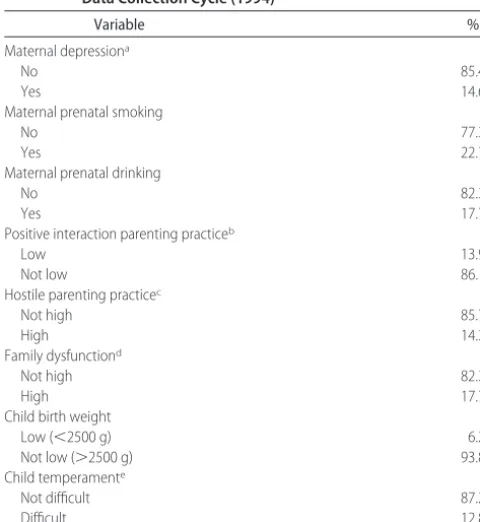
child temperament were scored using cutoffs of 1 SD above or below the mean score for our sample. Table 2 indicates that 14.6% of mothers in the sample reported experiencing depression. Approximately 1 (22.7%) in 5 mothers reported smoking while pregnant, and close to 1 (17.7%) in 5 reported prenatal drinking. Low mother-child positive interaction was reported by 13.9% of mothers, and 14.3% reported high hostile interactions with their child. Close to 1 (17.7%) in 5 mothers indi-cated high family dysfunction. Low birth weight charac-terized 6.2% of our sample, and 12.8% of mothers re-ported a difficult temperament in their child.
RESULTS
Developmental Trajectories of Hyperactive Symptoms
ex-hibited very few initial hyperactive symptoms, but this low level remained stable over time. An equally substan-tial proportion of the children (46.3%;n⫽1365) exhib-ited moderate initial levels of hyperactivity that declined slightly over time. Finally, 7.2% of the children (n ⫽
212) exhibited high initial levels of hyperactivity that increased slightly over time.
Predictors of Hyperactive Trajectories
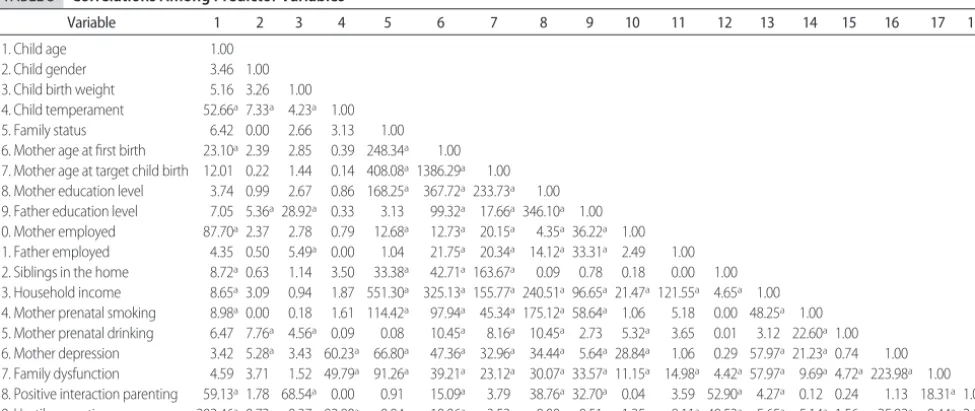
Before conducting the logistic regression, we calculated the simple bivariate correlations among all of the pre-dictor variables (Table 3). There were a number of sta-tistically significant associations, especially for certain family background characteristics (eg, maternal age, pa-rental education, and papa-rental employment), prenatal smoking, maternal depression, family dysfunction, and parenting practices. Given the number of statistically significant correlations, regression analyses controlled for the effects of all other variables included in the models.
For the logistic-regression analysis, we dichotomized the outcome variable by combining children on the very low, low, and moderate trajectories to form the refer-ence group of normative hyperactive symptoms. Chil-dren on the high trajectory (7.2%) formed our group of high and persistent hyperactive symptoms. The first
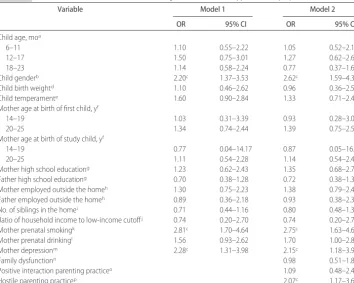
logistic-regression model examined predictors of hyper-active symptoms that were present at or before the birth of the child, while controlling for all of the other vari-ables in the model (see Table 4). The largest risk factor was maternal prenatal smoking. Children whose moth-ers smoked while pregnant were⬎2.5 times (odds ratio [OR]: 2.81) more likely to have high and persistent hyperactive symptoms compared with children whose mothers did not smoke during pregnancy. Maternal de-pression increased the risk of high and persistent hyper-activity by twofold (OR: 2.28). Boys were 2 times more likely than girls to be in the high and persistent hyper-activity trajectory group (OR: 2.20). In the second re-gression model, we added parenting and family func-tioning variables measured before the child’s second birthday. Findings showed that children whose mothers reported using hostile parenting practices were 2 times more likely to have high and persistent hyperactive symptoms compared with children whose mothers were not hostile (OR: 2.07). Child’s gender, maternal prenatal smoking, and maternal depression remained significant risk factors. In sum, 3 early and easily measured vari-ables (prenatal smoking, maternal depression, and hos-tile parenting) significantly increased the risk of high-level persistent hyperactivity.
Additional analyses indicated that 67% of children who scored positive onⱖ1 of these 3 risk factors were in the high and persistent hyperactivity trajectory group. This sensitivity rating suggests that high-level persistent hyperactivity in children would be accurately identified 2 of 3 times with a scale composed of prenatal smoking, maternal depression, and hostile parenting. The positive predictive value of such a scale, however, was low (11%). This finding suggests that a scale composed only of prenatal smoking, maternal depression, and hostile parenting would not have much predictive use, because it would result in a large number of false positives (ie, children being wrongly labeled as exhibiting high and persistent hyperactive symptoms).
DISCUSSION
This study used longitudinal data from a national sample to identify developmental trajectories of hyperactive symptoms from 2 to 7 years of age and the predictors of a high-level and persistent trajectory during that period. Four hyperactivity trajectories were identified: very low (4.5%), low (42.0%), moderate (46.4%), and high (7.2%). For the majority of children, the frequency of hyperactive symptoms decreased or remained low from 2 to 7 years. However,⬃7 children in 100 were classified as having high initial levels of hyperactive symptoms that persisted over time. Children with these atypical levels of hyperactivity could be those that meet diagnos-tic criteria for ADHD given previous research showing that behavior problems, in particular at high levels, are stable from early to late childhood.27–29In any case, the findings
TABLE 2 Frequencies of Predictor Variables From the First NLSCY Data Collection Cycle (1994)
Variable %
Maternal depressiona
No 85.4
Yes 14.6
Maternal prenatal smoking
No 77.3
Yes 22.7
Maternal prenatal drinking
No 82.3
Yes 17.7
Positive interaction parenting practiceb
Low 13.9
Not low 86.1
Hostile parenting practicec
Not high 85.7
High 14.3
Family dysfunctiond
Not high 82.3
High 17.7
Child birth weight
Low (⬍2500 g) 6.2
Not low (⬎2500 g) 93.8
Child temperamente
Not difficult 87.2
Difficult 12.8
Frequencies are based on data that incorporated the NLSCY cross-sectional weights.
aItems were scaled along a 10-point scale, and a cutoff of 2.5 was used to classify mothers as
nondepressed (score⬍2.5) or depressed (score ofⱖ2.5).
Scores that were⬎1 SD below the mean were classified asblow positive interaction; scores
that were⬎1 SD above the mean were classified aschigh hostility;dhigh family dysfunction;
suggest that as early as 2 years of age, there is a small proportion of children that could be targeted for interven-tions that help them (and their parents) better manage problematic symptoms that could escalate over time.
The study also tested a number of potential predictors of hyperactivity present early in the child’s life. There were 3 significant predictors: maternal prenatal smok-ing, maternal depression, and maternal hostile parent-ing. Smoking during pregnancy increased children’s risk for high-level and persistent hyperactive symptoms by ⬎2.5 times, after having controlled for a number of other possible risk factors. These results confirm previ-ous studies7but also show that the impact of prenatal
smoking can be observed in early childhood and in-creases up to 7 years of age. Several authors have pro-posed that compounds found in tobacco smoke (espe-cially nicotine) may damage brain structure and/or functioning at critical times during the development of the fetus or that tobacco smoke may alter maternal physiology in such a way that there is a decrease in the flow of oxygen and nutrients and/or an increase in the flow of harmful tobacco smoke components to the fe-tus.30,31
A common finding is the association between ma-ternal depression and children’s symptoms. However, only a few studies have focused specifically on hyper-FIGURE 1
Developmental trajectories of hyperactive symp-toms in 2- to 7-year-old children.■indicates very low (4.5%), accompanying line, very low predicted;
Œ, low (42.0%), accompanying line, low predicted; ⽧, moderate (46.3%), accompanying line, moder-ate predicted;F, high (7.2%), accompanying line, high predicted.
TABLE 3 Correlations Among Predictor Variables
Variable 1 2 3 4 5 6 7 8 9 10 11 12 13 14 15 16 17 18
1. Child age 1.00
2. Child gender 3.46 1.00 3. Child birth weight 5.16 3.26 1.00 4. Child temperament 52.66a7.33a 4.23a 1.00
5. Family status 6.42 0.00 2.66 3.13 1.00 6. Mother age at first birth 23.10a2.39 2.85 0.39 248.34a 1.00
7. Mother age at target child birth 12.01 0.22 1.44 0.14 408.08a1386.29a 1.00
8. Mother education level 3.74 0.99 2.67 0.86 168.25a 367.72a233.73a 1.00
9. Father education level 7.05 5.36a28.92a 0.33 3.13 99.32a 17.66a346.10a 1.00
10. Mother employed 87.70a2.37 2.78 0.79 12.68a 12.73a 20.15a 4.35a36.22a 1.00
11. Father employed 4.35 0.50 5.49a 0.00 1.04 21.75a 20.34a 14.12a33.31a 2.49 1.00
12. Siblings in the home 8.72a0.63 1.14 3.50 33.38a 42.71a163.67a 0.09 0.78 0.18 0.00 1.00
13. Household income 8.65a3.09 0.94 1.87 551.30a 325.13a155.77a240.51a96.65a21.47a121.55a 4.65a 1.00
14. Mother prenatal smoking 8.98a0.00 0.18 1.61 114.42a 97.94a 45.34a175.12a58.64a 1.06 5.18 0.00 48.25a 1.00
15. Mother prenatal drinking 6.47 7.76a 4.56a 0.09 0.08 10.45a 8.16a 10.45a 2.73 5.32a 3.65 0.01 3.12 22.60a1.00
16. Mother depression 3.42 5.28a 3.43 60.23a 66.80a 47.36a 32.96a 34.44a 5.64a28.84a 1.06 0.29 57.97a21.23a0.74 1.00
17. Family dysfunction 4.59 3.71 1.52 49.79a 91.26a 39.21a 23.12a 30.07a33.57a11.15a 14.98a 4.42a57.97a 9.69a4.72a223.98a 1.00
18. Positive interaction parenting 59.13a1.78 68.54a 0.00 0.91 15.09a 3.79 38.76a32.70a 0.04 3.59 52.90a 4.27a 0.12 0.24 1.13 18.31a1.00
19. Hostile parenting 202.46a0.72 0.37 92.80a 0.04 10.06a 3.53 0.00 0.51 1.25 8.11a40.53a 5.65a 5.14a1.56 25.92a 9.44a2.13
activity.4–6 Children with a depressed mother were⬎2
times more likely to have high and persistent levels of hyperactive symptoms than children with a nonde-pressed mother, after having controlled for a number of other potential risk factors. Although there is concern that depressed mothers are biased toward overreporting symptoms in their children, several studies have found evidence against this hypothesis and have shown moth-ers (regardless of depression status) to be reliable and accurate reporters of their children’s symptoms.32–34 In
addition, we did not assess maternal depression and child hyperactivity during the same time period to help guard against this possible confound (ie, maternal de-pression was assessed 2 years before the maternal assess-ments of hyperactivity).
Contrary to a number of previous studies that place maternal depression within the context of impaired par-enting practices,5,35–40we found the impact of maternal
depression on children’s hyperactivity to be unaffected by negative parenting practices. In other words, negative mother-child interactions and hostile parenting did not seem to mediate the impact of maternal depression on childhood hyperactivity. There is a need for additional longitudinal studies that examine maternal depression
specifically in relation to children’s hyperactivity. Fi-nally, results showed that mothers’ hostile parenting significantly increased children’s risk for hyperactivity. Although previous research has linked negative parent-ing practices to childhood behavior problems, there are virtually no studies that focused specifically on parenting practices and children’s hyperactivity.6Again, more
re-search is needed on parenting practices specifically in relation to hyperactivity in children.
Contrary to past studies,4–8we did not find low birth
weight, difficult temperament, or prenatal drinking to be statistically significant predictors of childhood hyperac-tive symptoms. The prevalence of low birth weight was only 6.2% in our sample, which may have limited the statistical power to detect significant findings. Low sta-tistical power is a plausible explanation, given that low birth weight was not significantly correlated with ternal prenatal smoking, maternal depression, and ma-ternal hostile parenting. Child temperament showed strong statistical associations with child gender, maternal depression, and maternal hostile parenting (all of which were significant predictors of hyperactivity), and so the effects of temperament may have been attenuated by these other variables. A similar explanation might
ac-TABLE 4 Prenatal and Postnatal Predictors of High and Persistent Hyperactive Symptoms
Variable Model 1 Model 2
OR 95% CI OR 95% CI
Child age, moa
6–11 1.10 0.55–2.22 1.05 0.52–2.12
12–17 1.50 0.75–3.01 1.27 0.62–2.62
18–23 1.14 0.58–2.24 0.77 0.37–1.62
Child genderb 2.20c 1.37–3.53 2.62c 1.59–4.31
Child birth weightd 1.10 0.46–2.62 0.96 0.36–2.50
Child temperamente 1.60 0.90–2.84 1.33 0.71–2.48
Mother age at birth of first child, yf
14–19 1.03 0.31–3.39 0.93 0.28–3.09
20–25 1.34 0.74–2.44 1.39 0.75–2.58
Mother age at birth of study child, yf
14–19 0.77 0.04–14.17 0.87 0.05–16.03
20–25 1.11 0.54–2.28 1.14 0.54–2.41
Mother high school educationg 1.23 0.62–2.43 1.35 0.68–2.70
Father high school educationg 0.70 0.38–1.28 0.72 0.38–1.35
Mother employed outside the homeh 1.30 0.75–2.23 1.38 0.79–2.40
Father employed outside the homeh 0.89 0.36–2.18 0.93 0.38–2.31
No. of siblings in the homei 0.71 0.44–1.16 0.80 0.48–1.32
Ratio of household income to low-income cutoffj 0.74 0.20–2.70 0.74 0.20–2.73
Mother prenatal smokingk 2.81c 1.70–4.64 2.75c 1.63–4.64
Mother prenatal drinkingl 1.56 0.93–2.62 1.70 1.00–2.89
Mother depressionm 2.28c 1.31–3.98 2.15c 1.18–3.92
Family dysfunctionn 0.98 0.51–1.89
Positive interaction parenting practiceo 1.09 0.48–2.47
Hostile parenting practicep 2.07c 1.17–3.69
CI indicates confidence interval. Estimates are adjusted for all other variables included in the model. Family status was not included because of estimation problems when this variable was included with father education and parental employment. However, a regression model including the family status variable (but not father education and parental employment) did not show family status to be a statistically significant predictor. The reference groups area0 to 5 months;bgirls;dbirth weight that is not low;etemperament that is not difficult;fⱖ26 years;ghigh school
completion;hemployed outside the home;ino siblings;jisⱖ1;kno prenatal smoking;lno prenatal drinking;mno maternal depression;nfamily
count for the lack of statistical significance for maternal prenatal drinking, which was significantly correlated with child gender and maternal smoking during preg-nancy. These findings also suggest that adding the vari-ables of low birth weight, difficult temperament, and maternal prenatal drinking to a scale composed of pre-natal smoking, maternal depression, and hostile parent-ing might increase the predictive use of identifyparent-ing chil-dren at risk for high and persistent hyperactivity.
IMPLICATIONS AND LIMITATIONS
The most significant contributions of this study are that we show, with a national population sample, that chil-dren with high-level and persistent hyperactivity begin exhibiting these symptoms at an early age, and they can be identified through risk factors that exist before their second birthday. The key, therefore, to reducing the risk of hyperactivity is early detection and preventive inter-ventions. The most at-risk children seem to be boys whose mothers smoked while pregnant, were depressed, and used hostile parenting practices. In fact, we found that hyperactive children scored positive onⱖ1 of these 3 easily identifiable and amenable factors 2 of 3 times. Therefore, family planning services are needed to inform women about the dangers of smoking during pregnancy and to assist pregnant women to stop smoking. Inter-vention programs that address mental health problems, such as depression, and that improve parenting practices should be available and readily accessible by members of a community. Although it seems important to introduce such interventions, we also found that these 3 factors alone did not accurately predict hyperactivity, suggest-ing that they are necessary but not sufficient. Therefore, more research is needed to identify additional factors that, in conjunction with prenatal smoking, maternal depression, and hostile parenting, could be used to de-velop a scale that predicts early childhood hyperactivity. In terms of interventions for young children who exhibit hyperactive symptoms, a recent study41 offers
pharma-cologic and psychosocial guidelines.
CONCLUSIONS
This study is the only national population sample to study the developmental trajectories and risk factors of hyperactive symptoms throughout early childhood and into the early school years. However, there were limita-tions in this study that we plan to address in future work. We focused exclusively on hyperactivity to better iden-tify predictors of this specific and common childhood behavior problem. Because children with hyperactive symptoms often also have problems of inattention and oppositional behavior, we plan to examine joint devel-opmental trajectories and to identify predictors of these co-occurring developmental problems in children. Our sole reliance on maternal reports could have biased find-ings. Although the NLSCY has teacher reports of
chil-dren’s symptoms, these assessments only begin on school entry, and our primary focus is to better identify the beginnings of children’s behavior problems. Further-more, there is a problem with numerous missing data (eg, about half of teachers did not answer the symptoms questions at cycle 1). The hostile parenting measure had limited internal reliability. Our decision to use the hos-tile parenting measure was based on the limited parent-ing variables available in the NLSCY for children aged 0 to 23 months at the first data-collection cycle. Other than hostility, the only other available parenting vari-able is positive interaction (which we have also in-cluded). However, we acknowledge that results for the hostile parenting measure should be interpreted as pre-liminary. Finally, some of the children in the study may have been taking medication for their hyperactive be-haviors, which could influence the estimation of devel-opmental trajectories and the identification of predic-tors. We did not assess medication use during the study time period for the cohort of sampled children. How-ever, previous findings from cycle 1 of the NLSCY indi-cated that the prevalence of methylphenidate use among 2- to 7-year-old girls and boys was low, ranging from 0.09% to 2.25%.42
ACKNOWLEDGMENTS
This work was supported in part by a grant from the Social Sciences and Humanities Research Council of Canada, Initiatives on the New Economy: Raising and Leveling the Bar (512-2003-1016), in which Drs Ro-mano and Coˆte´ are co-investigators.
We thank Danielle Forest and Alain Girard for statis-tical assistance and Mark Zoccolillo for comments on previous drafts.
REFERENCES
1. Nagin D, Tremblay RE. Trajectories of boys’ physical aggres-sion, opposition, and hyperactivity on the path to physically violent and nonviolent juvenile delinquency.Child Dev.1999; 70:1181–1196
2. Connor DF. Preschool attention deficit hyperactivity disorder: a review of prevalence, diagnosis, neurobiology, and stimulant treatment.J Dev Behav Pediatr.2002;23(1 suppl):S1–S9 3. Owens EB, Shaw DS. Predicting growth curves of externalizing
symptoms across the preschool years.J Abnorm Child Psychol. 2003;31:575–590
4. Biederman J, Faraone S, Milberger S, et al. Predictors of per-sistence and remission of ADHD into adolescence: results from a four-year prospective follow-up study.J Am Acad Child Adolesc Psychiatry.1996;35:343–351
5. Elgar FJ, Curtis LJ, McGrath PJ, Waschbusch DA, Stewart SH. Antecedent-consequence conditions in maternal mood and child adjustment: a four-year cross-lagged study. J Clin Child Adolesc Psychol.2003;32:362–374
6. Shaw DS, Owens EB, Giovannelli J, Winslow EB. Infant and toddler pathways leading to early externalizing disorders.J Am Acad Child Adolesc Psychiatry.2001;40:36 – 43
associated symptoms: review of the current evidence. Am J Psychiatry.2003;160:1028 –1040
8. Thapar A, Fowler T, Rice F, et al. Maternal smoking during pregnancy and attention deficit hyperactivity disorder symp-toms in offspring.Am J Psychiatry.2003;160:1985–1989 9. Statistics Canada and Human Resources Development Canada.
National Longitudinal Survey of Children and Youth: Overview of Survey Instruments for 1994 –1995 Data Collection Cycle 1. Ottawa, Ontario, Canada: Statistics Canada and Human Resources De-velopment Canada; 1995
10. Statistics Canada and Human Resources Development Canada. National Longitudinal Survey of Children and Youth: Overview of Survey Instruments for 1996 –1997 Data Collection Cycle 2. Ottawa, Ontario, Canada: Statistics Canada and Human Resources De-velopment Canada; 1997
11. Radloff LS. The CES-D Scale: a self-report depression scale for research in the general population.Appl Psychol Meas.1977;1: 385– 401
12. Madeley RJ, Gilles PA, Power FL, Symonds EM. Nottingham mothers stop smoking project: baseline survey of smoking in pregnancy.Community Med.1989;11:124 –130
13. Stewart PJ, Dunkley GC. Smoking and health care patterns among pregnant women.CMAJ.1985;133:989 –994
14. Strayhorn JM, Weidman CS. A Parent Practices Scale and its relation to parent and child mental health.J Am Acad Child Adolesc Psychiatry.1988;27:613– 618
15. Byles J, Byrne C, Boyle MH, Offord DR. Ontario Child Health Study: reliability and validity of the General Functioning sub-scale of the McMaster Family Assessment Device.Fam Process. 1988;27:97–104
16. Bates JE, Freeland CAB, Lounsbury ML. Measures of infant difficultness.Child Dev.1979;50:794 – 803
17. Achenbach TM.Manual for the Revised Child Behavior Checklist and the Child Behavior Profile. Burlington, VT: Department of Psychiatry, University of Vermont; 1991
18. Tremblay RE, Loeber R, Gagnon C, Charlebois S, Larive´e S, LeBlanc M. Disruptive boys with stable and unstable high fighting symptoms patterns during junior elementary school. J Abnorm Child Psychol.1991;19:285–300
19. Boyle MH, Offord DR, Hofmann HG, et al. Ontario Child Health Study: I. methodology. Arch Gen Psychiatry.1987;44: 826 – 831
20. American Psychiatric Association.Diagnostic and Statistical Man-ual of Mental Disorders. 4th ed. Washington, DC: American Psychiatric Association; 1994
21. Gomez R, Harvey J, Quick C, Scharer I, Harris G. DSM-IV AD/HD: confirmatory factor models, prevalence, and gender and age differences based on parent and teacher ratings of Australian primary school children.J Child Psychol Psychiatry. 1999;40:265–274
22. Nolan EE, Gadow KD, Sprafkin J. Teacher reports of DSM-IV ADHD, ODD, and CD symptoms in school children.J Am Acad Child Adolesc Psychiatry.2001;40:241–249
23. Pineda D, Ardila A, Rosselli M, et al. Prevalence of attention-deficit/hyperactivity disorder symptoms in 4- to 17-year-old children in the general population. J Abnorm Child Psychol. 1999;27:455– 462
24. Wolraich ML, Hannah JN, Pinnock TY, Baumgaertel A, Brown J. Comparison of diagnostic criteria for attention-deficit hyper-activity disorder in a county-wide sample.J Am Acad Child Adolesc Psychiatry.1996;35:319 –324
25. Nagin D. Analyzing developmental trajectories: a
semi-parametric, group-based approach. Psychol Methods. 1999;4: 139 –157
26. Somers M, Willms JD. Maternal depression and childhood vulnerability. In: Willms JD, ed.Vulnerable Children: Findings From Canada’s National Longitudinal Survey of Children and Youth. Edmonton, Alberta, Canada: University of Alberta Press; 2002: 211–228
27. Campbell SB, Ewing LJ, Breaux AM, Szumowski EK. Parent-referred problem 3-year-olds: follow-up at school entry.J Child Psychol Psychiatry.1986;27:473– 488
28. Marakovitz SE, Campbell SB. Inattention, impulsivity, and hyperactivity from preschool to school age: performance of hard-to-manage boys on laboratory measures.J Child Psychol Psychiatry.1998;39:841– 851
29. McGee R, Partridge F, Williams S, Silva PA. A 12-year fol-low-up of preschool hyperactive children. J Am Acad Child Adolesc Psychiatry.1991;30:224 –232
30. Milberger S, Biederman J, Faraone SV, Chen L, Jones J. Is maternal smoking during pregnancy a risk factor for attention deficit hyperactivity disorder in children?Am J Psychiatry.1996; 153:1138 –1142
31. Weitzman M, Gortmaker S, Sobol A. Maternal smoking and symptoms problems of children.Pediatrics.1992;90:342–349 32. Arseneault L, Moffitt TE, Caspi A, et al. Strong genetic effects
on cross-situational antisocial behaviour among 5-year old children according to mothers, teachers, examiner-observers, and twin self-reports. J Child Psychol Psychiatry. 2003;44: 832– 848
33. Faraone SV, Biederman J, Milberger S. How reliable are ma-ternal reports of their children’s psychopathology? One-year recall of psychiatric diagnoses of ADHD children.J Am Acad Child Adolesc Psychiatry.1995;34:1001–1008
34. Richters JE. Depressed mothers as informants about their children: a critical review of the evidence for distortion.Psychol Bull.1992;112:485– 499
35. Billings AG, Moos RH. Comparisons of children of depressed and nondepressed parents: a social-environmental perspective. J Abnorm Child Psychol.1983;11:463– 486
36. Cunningham CE, Benness BB, Siegel LS. Family functioning, time allocation, and parental depression in the families of normal and ADHD children. J Clin Child Psychol. 1988;17: 160 –177
37. Harnish JD, Dodge KA, Valente E. Mother-child interaction quality as a partial mediator of the roles of maternal depressive symptomatology and socioeconomic status in the development of child symptoms problems.Child Dev.1995;66:739 –753 38. Lesesne CA, Visser SN, White CP. Attention-deficit/hyperactivity
disorder in school-aged children: association with maternal men-tal health and use of health care resources.Pediatrics.2003;111: 1232–1237
39. Murray L, Cooper PJ. The impact of postpartum depression on child development.Int Rev Psychiatry.1996;8:55– 63
40. Spieker SJ, Larson NC, Lewis SM, Keller TE, Gilchrist L. De-velopmental trajectories of disruptive symptoms problems in preschool children of adolescent mothers.Child Dev.1999;70: 443– 458
41. Fewell RR, Deutscher B. Attention deficit hyperactivity disor-der in very young children: early signs and intervention.Inf Young Children.2002;14:24 –32
TRANSITION FROM MEETING ABSTRACT TO FULL-LENGTH JOURNAL ARTICLE FOR RANDOMIZED CONTROLLED TRIALS
Context: Not all research presented at scientific meetings is subsequently published and, even when it is, there may be inconsistencies between these results and what is ultimately printed. Although late-breaking trials sessions are now integrated into several major scientific meetings and the results are often promptly and prominently communicated, no studies have examined the publication fate and degree of consistency between meeting abstracts or presentations and subsequent full-length article publications for randomized controlled trials (RCTs) presented at these sessions.
Objective: To compare RCT abstracts presented in the late-breaking trials session vs other sessions at a major scientific meeting and subsequent full-length publications. . . .
Conclusions: Late-breaking trials were larger, more likely to be preceded by a design paper, and less likely to report positive results than RCTs presented at other sessions, but discrepancies between the meeting abstract results and subsequent full-length publication results were common even for late-break-ing trials.
Toma M, McAlister FA, Bialy L, Adams D, Vandermeer B, Armstrong PW.JAMA. 2006;295:1281
Noted by JFL, MD
APPENDIX The Accelerated Longitudinal Design According to Age Cohort Over Time
Cohort Age, mo
24–26 27–29 30–32 33–35 36–38 39–41 42–44 45–47 48–50 51–53 54–56 57–59 60–62 63–65 66–68 69–71 72–74 75–77 78–81 81–83 84–86 87–89 90–92 93–95
Cohort 1 C2 C2 C2 C2 C3 C3 C3 C3 C4 C4 C4 C4
Cohort 2 C2 C2 C2 C2 C3 C3 C3 C3 C4 C4 C4 C4
DOI: 10.1542/peds.2005-0651
2006;117;2101
Pediatrics
Elisa Romano, Richard E. Tremblay, Abdeljelil Farhat and Sylvana Côté
Population-Based Sample
Development and Prediction of Hyperactive Symptoms From 2 to 7 Years in a
Services
Updated Information &
http://pediatrics.aappublications.org/content/117/6/2101
including high resolution figures, can be found at:
References
http://pediatrics.aappublications.org/content/117/6/2101#BIBL
This article cites 37 articles, 2 of which you can access for free at:
Subspecialty Collections
activity_disorder_adhd_sub
http://www.aappublications.org/cgi/collection/attention-deficit:hyper Attention-Deficit/Hyperactivity Disorder (ADHD)
al_issues_sub
http://www.aappublications.org/cgi/collection/development:behavior Developmental/Behavioral Pediatrics
following collection(s):
This article, along with others on similar topics, appears in the
Permissions & Licensing
http://www.aappublications.org/site/misc/Permissions.xhtml
in its entirety can be found online at:
Information about reproducing this article in parts (figures, tables) or
Reprints
http://www.aappublications.org/site/misc/reprints.xhtml
DOI: 10.1542/peds.2005-0651
2006;117;2101
Pediatrics
Elisa Romano, Richard E. Tremblay, Abdeljelil Farhat and Sylvana Côté
Population-Based Sample
Development and Prediction of Hyperactive Symptoms From 2 to 7 Years in a
http://pediatrics.aappublications.org/content/117/6/2101
located on the World Wide Web at:
The online version of this article, along with updated information and services, is
by the American Academy of Pediatrics. All rights reserved. Print ISSN: 1073-0397.