Pain Reduction on Insertion of a Feeding Tube in
Preterm Infants: A Randomized Controlled Trial
WHAT’S KNOWN ON THIS SUBJECT: Insertion of a feeding tube is commonly done in preterm infants, but the degree of pain and discomfort—as well any measures to reduce pain— have not been well investigated.
WHAT THIS STUDY ADDS: Insertion of a feeding tube leads to brief but measurable pain and discomfort. Pain relief was best achieved by combining a pacifier with 30% sucrose in these preterm infants.
abstract
BACKGROUND:Gavage feeding is required in preterm infants who can-not feed by themselves. Insertion of the feeding tube is painful, and reducing the discomfort in these patients is desirable.
OBJECTIVE:The aim of this study was to assess pain and discomfort during nasal insertion of a feeding tube, and to evaluate different mea-sures for pain relief.
METHODS:We included 24 preterm infants with postmenstrual age 28 to 32 weeks’ who were in stable condition. Each infant acted as his or her own control over a 3-week period during which the tube was changed 6 times. On these occasions, 6 different treatment combina-tions were given in randomized order: pacifier or no pacifier, combined with no fluid, sterile water, or 30% sucrose. Pain and discomfort were assessed by at least 2 independent and experienced observers using a pain assessment tool, the Premature Infant Pain Profile; score range: 0 to 21. In general, scores of 4 to 6 are interpreted as normal or no discomfort;ⱖ12 usually signals significant pain and distress.
RESULTS:The median Premature Infant Pain Profile score during the procedure was 9 and decreased gradually toward 4 after 5 minutes. The lowest pain score was achieved by combining a pacifier with oral sucrose. Sterile water without a pacifier gave the highest score.
CONCLUSIONS:Insertion of a feeding tube in preterm infants leads to a measurable degree of pain and discomfort, according to the Prema-ture Infant Pain Profile assessment tool. Pain relief was best achieved by combining a pacifier with 30% sucrose. Pediatrics 2011;127: e1449–e1454
AUTHORS:Laila Kristoffersen, RN,aEirik Skogvoll, MD,
PhD,b,cand Mia Hafström, MD, PhDd
aDepartment of Paediatrics andbDepartment of Anaesthesia, St
Olav’s University Hospital, Trondheim, Norway;cUnit for Applied
Clinical Research, Faculty of Medicine, Norwegian University of Science and Technology, Trondheim, Norway; anddThe Queen
Silvia Children’s Hospital, Göteborg University, Göteborg, Sweden
KEY WORDS
pain measurement, pain assessment, infant, premature, gastric feeding tube
ABBREVIATIONS
PIPP—Premature Infant Pain Profile PMA—postmenstrual age
CPAP—continuous positive airway pressure This trial has been registered at www.clinicaltrials.gov (identifier NCT00218946).
www.pediatrics.org/cgi/doi/10.1542/peds.2010-3438 doi:10.1542/peds.2010-3438
Accepted for publication Feb 4, 2011
Address correspondence to Laila Kristoffersen, Department of Paediatrics, St Olav’s University Hospital N-7006 Trondheim, Norway. E-mail: [email protected]
PEDIATRICS (ISSN Numbers: Print, 0031-4005; Online, 1098-4275). Copyright © 2011 by the American Academy of Pediatrics
FINANCIAL DISCLOSURE:The authors have indicated they have no financial relationships relevant to this article to disclose.
vage feeding in preterm infants because they are unable to properly coordinate their sucking, swallowing, and breathing.2In a study among adult
patients, insertion of a nasogastric tube resulted in a higher pain score than fracture reduction or urethral catheterization.3 Among preterm
in-fants, many studies have shown that sweet solutions given orally before painful procedures such as blood sam-pling provide good pain relief.4–8The
precise dose of sucrose given is not well defined, but in a study by John-ston et al,9 a small dose of 24%
su-crose (0.05 mL) provided significant pain relief in preterm infants. Ac-cording to Eriksson et al,10repeated
doses of sweet solutions (glucose) do not reduce their pain-relieving ef-fect. Harrison et al11 support this
view by reporting that sucrose and glucose reduce pain in infants up to 12 months of age. McCullough et al12
demonstrated that preterm infants had a pain response during nasogas-tric tube insertion, and that sucrose given orally provided good pain re-lief. Our clinical observation was that the combination of sucrose and a pacifier might provide even better pain relief during nasogastric inser-tion. Wetting the pacifier with pure water might also be beneficial by fa-cilitating swallowing.
Special observation methods are needed to quantify pain and discom-fort in preterm infants because of their immature way of expressing pain.13The Premature Infant Pain
Pro-file (PIPP) is a 7-item, 4-point scale for assessment of pain in premature in-fants.14It is a well-documented and
val-idated assessment tool.14Inclusion of a
placebo control should minimize the problem of using a partly subjective assessment scale.
pain relief during and immediately af-ter insertion of a feeding tube in pre-term infants.
METHODS
Protocol
The study was conducted at the NICU at St Olav’s University Hospital (Trond-heim, Norway) between January 2005 and June 2008. The regional committee for medical research ethics approved the study. Informed written consent was obtained in advance from the parents.
We included infants with a gestational age at time for first intervention (later called postmenstrual age [PMA]) be-tween 28 and 32 weeks, in stable con-dition, and at low risk for neurologic sequelae. Infants on a ventilator or those receiving continuous positive airway pressure (CPAP) or opioid treatment were excluded, as were in-fants with ongoing serious infections. Infants who needed to have their tube inserted by mouth were not included.
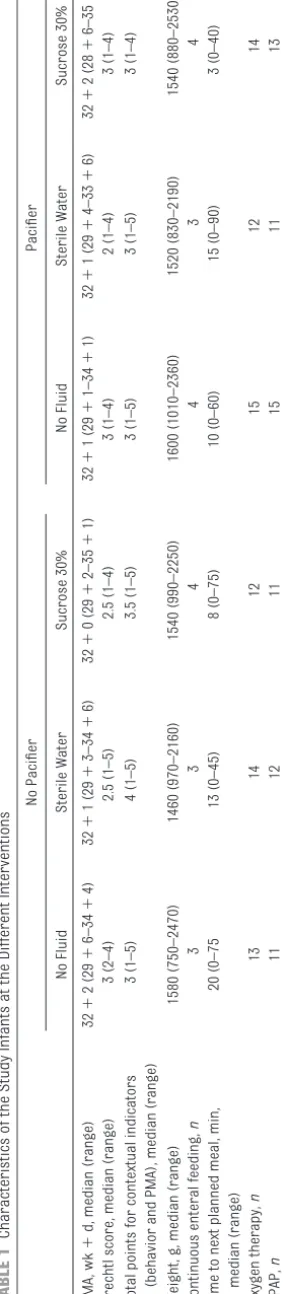
The study was designed to investigate the effect of 2 factors. The first factor (“pacifier”) had 2 levels (alternatives)— pacifier or not; the second factor (“fluid”) had 3 levels—no fluid, sterile water, or 30% sucrose. This factorial design thus requires 6 different inter-ventions to be applied to each infant, in any order: nothing, sterile water only, sucrose only, pacifier only, pacifier plus sterile water, and pacifier plus su-crose (Table 1). In this crossover de-sign, each infant thus acted as his or her own control, and the nasogastric tube was changed twice a week during the 3-week study period.
Randomization
Mathematically, the 6 interventions can be applied in a total number of 6 * 5 * 4 * 3 * 2 * 1 ⫽ 720 different se- TABLE
quences (ie, orderings). A random list of these possible sequences was pre-pared in advance using the software R (R Foundation for Statistical Comput-ing, Vienna, Austria).15On inclusion in
the study, every infant was consecu-tively assigned a (unique) sequence from the list. Only the study leader had access to the list.
Pain Score
The PIPP scale was used as a pain mea-surement tool.14 It is a
multidimen-sional score comprising 5 items re-lated to pain and discomfort, plus 2 items that adjust for gestational age and level of alertness (contextual indi-cators). Each item is scored from 0 to 3. Contextual indicator points define the total possible score: the behavioral state observed before intervention (more is needed to wake a sleeping in-fant, who therefore gets more points) and the infant’s PMA at time of inter-vention (younger infants show less re-action and thus get more points). For the 5 items related to pain and discom-fort, the score depends on the amount or duration of the following signs (more is worse): increase in heart rate, decrease in oxygen saturation, eyebrow bulging, eye squeezing, and presence of a nasolabial furrow. In re-sponse to a stimulus, the total (sum) PIPP score thus indicates the degree of pain and discomfort, with adjustment for PMA and behavioral state. The score ranges from 0 (no pain, gesta-tional age ⬎36 weeks’ and active awake state) to 21 (maximum pain in a quiet sleeping child⬍28 weeks’ gesta-tion). In general, scores of 4 to 6 are interpreted as normal or no discom-fort; ⱖ12 usually signals significant pain and distress.
Interventions
Nasogastric tubes were changed twice a week according to the recommenda-tions from the manufacturer (Uno-medical, Birkerød, Denmark). This
pro-cedure was also the standard scheme on the ward at the time of the study. Assuming a stable clinical condition, the in-dwelling nasogastric tube was removed after the last meal, with the goal to insert the new tube right before the next planned meal. A 5 French na-sogastric tube was used in neonates with weight⬍1500 g and a 6 French for those weighingⱕ1500 g. If the ne-onate was established on intermittent CPAP, the nasal prongs were removed before the procedure. All neonates were in a supine position in their bed or incubator, and their body was cov-ered with a blanket. The nasogastric tube insertion was done by 2 alternat-ing, experienced nurses. Alternating nostrils were used. The sucrose solu-tion was prepared by adding 30 g of sucrose to 100 mL of boiled spring wa-ter, and aspirated into a sterile syringe (Oral/Enteral Dispenser, 1 mL; Baxa Ltd, Bracknell, United Kingdom) by the nurse who performed the nasogastric insertion. The neonate was observed continuously for 15 seconds before the procedure to determine baseline val-ues for heart rate, oxygen saturation, and behavioral state. The Prechtl score was registered in addition to further evaluate the alertness of the neonate right before start of the procedure.16
The observers were asked to turn away for a brief period to avoid seeing if anything was given orally. As indi-cated by the randomization list, 0.2 mL of fluid was given slowly (in 2– 4 sec-onds) on the tip of the tongue either together with a pacifier or no pacifier. This was done immediately (ie, within seconds) before tube insertion. Con-cealment of pacifier use was consid-ered to be unrealistic and therefore not attempted.
Each infant underwent 6 tube changes during a 3-week period, at which each intervention was given in the specified (randomized) order. At these events, the infants were observed by at least 2
experienced neonatal nurses who re-corded the infant’s PIPP score accord-ing to protocol.14The first registration
of PIPP score (the primary outcome) was completed within 30 seconds of tube insertion, the second 1 minute later, and the last registration after 5 minutes. The mean PIPP value from the observers in each infant and interven-tion was used in the analysis, and the same contextual indicators (additional points for PMA and alertness), as well as baseline registrations of heart rate and oxygen saturation, were used at all time points. The nasogastric tube was fixed and checked for correct placement before the last observation. One nurse acted as timekeeper during the entire procedure.
Statistics
Pilot observations suggested a differ-ence between pacifier or not of 2.5 on the PIPP scale, with an SD of 1.8 (ie, a standardized difference of 1.4). With a total sample size of 18 patients and a 2-sided significance level of 5%, a 2-sample Student’sttest would detect such a difference with 80% power.17We
⬍0.05 was considered statistically significant.
RESULTS
A total of 26 neonates had to be re-cruited to meet the required sample size, because 2 infants were trans-ferred to another hospital and did not complete the study. These patients were excluded from the analysis. Com-plete observations from 24 infants (7 boys, 17 girls) at the 6 treatment com-binations resulted in 144 discrete events being observed. A total of 296 individual PIPP recordings were made, however, because there were always at least 2 observers present (range: 2– 4).
Weight at the first observation varied from 750 to 1790 g, and gestational age at birth varied from 26⫹0 (weeks⫹ days) to 31⫹5. All patients had a PMA between 28 and 32 weeks at first inter-vention. The maximum possible PIPP score at each intervention was thus 19 or 20, as the range of the infants’ PMA was between 29⫹1 and 35⫹4 weeks. Table 1 shows the characteris-tics of the infants at the different interventions.
Observed PIPP scores immediately af-ter tube insertion ranged from 3 to 18, with a median value of 9. Friedman’s test of (no) overall difference among the 6 combinations, and the maximum likelihood test of the full factorial model, were both statistically signifi-cant (P⫽.003 andP⬍.0001, respec-tively). One or more levels within the factors fluid, pacifier, and their inter-actions were statistically significant at the 0.05 level.
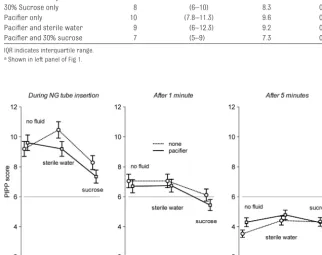
The observed median and expected (ie, mean) PIPP score at each treatment combination is given in Table 2 and shown graphically in Fig 1. The combi-nation of sucrose and pacifier during
tube insertion provided the most effec-tive pain reduction (P⬍.001 versus no treatment). Perhaps surprisingly, ster-ile water alone seemed to make things worse.
As shown in Figure 1, pain and discom-fort decreased rapidly to a median of 6 after one minute and a median of 4 five minutes after the procedure.
DISCUSSION
The main finding in this study of pain associated with nasogastric tube in-sertion in premature infants was that sucrose in combination with a pacifier yielded the best relief. If a pacifier is not suitable or available, sucrose alone is a good alternative.
To our knowledge, this is the first ran-domized study of nasogastric tube
in-sertion in preterm infants that investi-gates sucrose and/or a pacifier for pain relief in a factorial design. It is a clinically relevant problem because nasogastric tube insertion is done in virtually every preterm neonate irre-spective of disease status, in contrast to more painful procedures such as blood sampling.
The use of sucrose for pain relief has been extensively studied. A Cochrane re-view concluded that sucrose is safe and effective for reducing procedural pain such as venous puncture and heel prick in neonates. As described by Stevens et al,4there is inconsistency with respect to
the most effective dose of sucrose. Be-cause there is no recommended dose, we standardized the solution of liquid to 0.2 mL, independent of weight.
Median Value IQR Expected Value SE None 9 (7–11) 9.20 0.50 Sterile water only 11 (8–14) 10.5 0.55 30% Sucrose only 8 (6–10) 8.3 0.46 Pacifier only 10 (7.8–11.3) 9.6 0.52 Pacifier and sterile water 9 (6–12.3) 9.2 0.49 Pacifier and 30% sucrose 7 (5–9) 7.3 0.43
IQR indicates interquartile range. aShown in left panel of Fig 1.
FIGURE 1
The PIPP score was chosen as the pain measurement tool in this study be-cause it was developed to assess acute pain in preterm neonates for both re-search and clinical purposes,14and
be-cause several studies1,10,18–20have used
this instrument. Pacifiers are com-monly used to comfort neonates in NICUs. A Cochrane review conducted by Pinelli and Symington21reported no
negative outcomes in use of nonnutri-tive sucking to promoting physiologic stability and nutrition in preterm in-fants. This is consistent with the daily practice and experiences in our unit. Curtis et al22studied the effect on pain
relief of sucrose, pacifiers, and the combination of these related to blood sampling. They concluded that sucrose seemed to provide additional benefit to nonnutritive sucking when used in the age group 0 to 3 months. Our re-sults thus agree with these previ-ously published studies and further strengthen the observation that pain relief is achieved by the combination of sucrose and a pacifier. As noted by Hol-sti et al,23however, more research is
needed on the mechanism of sweet so-lutions in neonates as well as the long-term neurodevelopmental effects of repeated sucrose use.
It is difficult to explain why the addition of sterile water gave the highest pain score; this finding could, of course, be incidental. Ramenghi et al24reported a
similar result in their study. They saw a significant reduction of crying time when the infant received intraoral su-crose compared with sterile water. Greenberg7found that infants who
re-ceived water-coated pacifiers had al-most a similar duration of cry as the control group who had no intervention.
McCullough et al12did not report any
similar reaction when using water as a placebo.
In the present study, we also noted the duration of pain from insertion of a feeding tube. To determine this score, we calculated changes in heart rate and saturation from the same baseline (before the intervention) at all occa-sions. Although this calculation might not be in accordance with the original PIPP tool manual, it yielded supple-mentary information about the time course. The highest score was mea-sured during the procedure. Shortly after the procedure, the pain score had decreased to ⬃6. In contrast, Elserafy et al8 reported that the pain
score measured with PIPP is highest 1 minute after blood sampling, but this procedure is clearly a more painful stimulus. We found that the median PIPP score during the procedure was ⬃9, suggesting light-to-moderate pain. After 5 minutes, the PIPP score had decreased toward a score of⬃4 (Fig 1). The reduction in score was sim-ilar for all interventions, even when no fluid or pacifier was given. Thus, the discomfort is brief per se but not to be ignored. Duration of pain might be an important factor that needs further study. Repeated invasive procedures may contribute to long-term changes in the stress system in neonates.25
Even if we selected a strictly low-risk group of preterm infants, some patient heterogeneity is inevitable. This prob-lem is reduced with the crossover de-sign, because each infant in our study acted as his or her own control. Inter-pretation of the results must neverthe-less take into consideration that only clinically stable infants were included,
and that the observations were done over a limited interval of PMAs. Neo-nates who were in need of CPAP or ven-tilator support were excluded, be-cause such interventions make the observation of facial expression more difficult to perform, possibly leading to incorrect pain assessment. Infants re-ceiving sedation were also excluded because it was assumed that this group has different pain signals. The inclusion criteria were chosen to avoid such difficulties.
The randomized, semi-blinded, placebo-controlled design of this study strengthens our results, and ought to reduce the influence of adaptation and learning in the infant as well as among the observers. This design is well suited for studying similar repeated interventions in a population with changing maturation and expres-sions of physical parameters such as in preterm infants.
CONCLUSIONS
Insertion of a feeding tube in preterm infants causes measurable pain and discomfort as measured by the PIPP pain assessment tool. Pain relief was best achieved by combining a pacifier with 30% sucrose.
ACKNOWLEDGMENTS
The study was supported by grants from Unimed Innovation, St Olav’s Uni-versity Hospital, Trondheim, Norway.
We thank the pain group at the NICU, St Olavs Hospital for their enthusiasm and excellent work in obtaining the PIPP scores, and Dr Wendy Williams for skillful assistance with the English language.
REFERENCES
1. Stevens B, Yamada J, Beyene J, et al. Consis-tent management of repeated procedural pain with sucrose in preterm neonates: is it effective and safe for repeated use over time?Clin J Pain. 2005;21(6):543–548
2. Lau C, Smith EO, Schanler RJ. Coordination of suck-swallow and swallow respiration in preterm infants.Acta Paediatr. 2003;92(6): 721–727
3. Singer AJ, Richman PB, Kowalska A, Thode
HC Jr. Comparison of patient and practitio-ner assessments of pain from commonly performed emergency department proce-dures.Ann Emerg Med. 1999;33(6):652– 658 4. Stevens B, Yamada J, Ohlsson A. Sucrose for
5. Stevens B, Taddio A, Ohlsson A, Einarson T. The efficacy of sucrose for relieving proce-dural pain in neonates—a systematic re-view and meta-analysis.Acta Paediatr. 1997;86(8):837– 842
6. Skogsdal Y, Eriksson M, Schollin J. Analge-sia in newborns given oral glucose.Acta Paediatr. 1997;86(2):217–220
7. Greenberg CS. A sugar-coated pacifier re-duces procedural pain in newborns. Pedi-atr Nurs. 2002;28(3):271–277
8. Elserafy FA, Alsaedi SA, Louwrens J, Bin Sadiq B, Mersal AY. Oral sucrose and a pac-ifier for pain relief during simple proce-dures in preterm infants: a randomized controlled trial.Ann Saudi Med. 2009;29(3): 184 –188
9. Johnston CC, Stremler RL, Stevens BJ, Hor-ton LJ. Effectiveness of oral sucrose and simulated rocking on pain response in pre-term neonates.Pain. 1997;72(1–2):193–199 10. Eriksson M, Finnström O. Can daily repeated doses of orally administered glucose in-duce tolerance when given for neonatal pain relief? Acta Paediatr. 2004;93(2): 246 –249
11. Harrison D, Stevens B, Bueno M, et al. Effi-cacy of sweet solutions for analgesia in in-fants between 1 and 12 months of age: a
lane PI. Lingual sucrose reduces the pain response to nasogastric tube insertion: a randomised clinical trial.Arch Dis Child Fe-tal NeonaFe-tal Ed. 2008;93(2):F100 –F103 13. Johnston CC, Stevens B, Craig KD, Grunau
RV. Developmental changes in pain expres-sion in premature, full-term, two- and four-month-old infants.Pain. 1993;52(2):201–208 14. Stevens B, Johnston C, Petryshen P, Taddio A. Premature Infant Pain Profile: develop-ment and initial validation.Clin J Pain. 1996; 12(1):13–22
15. R Development Core Team. The R Project for Statistical Computing. Vienna, Austria: R Foundation for Statistical Computing; 2009. Available from: www.r-project.org. Ac-cessed April 13, 2011
16. Prechtl HF. The behavioural states of the newborn infant (a review).Brain Res. 1974; 76(2):185–212
17. Machin D, Campbell M, Fayers P, Pinol A.
Sample Size Tables for Clinical Studies. Ox-ford, United Kingdom: Blackwell Sciences; 1997
18. Stevens B, Johnston C, Franck L, Petryshen P, Jack A, Foster G. The efficacy of develop-mentally sensitive interventions and su-crose for relieving procedural pain in very low birth weight neonates.Nurs Res. 1999; 48(1):35– 43
ment in preterm infants.Clin J Pain. 2009; 25(2):138 –145
20. Codipietro L, Ceccarelli M, Ponzone A. Breastfeeding or oral sucrose solution in term neonates receiving heel lance: a ran-domized, controlled trial.Pediatrics. 2008; 122(3). Available at: www.pediatrics.org/ cgi/content/full/122/3/e716
21. Pinelli J, Symington A. Non-nutritive sucking for promoting physiologic stability and nu-trition in preterm infants.Cochrane Data-base Syst Rev. 2005;(4):CD001071 22. Curtis SJ, Jou H, Ali S, Vandermeer B,
Klas-sen T. A randomized controlled trial of su-crose and/or pacifier as analgesia for in-fants receiving venipuncture in a pediatric emergency department.BMC Pediatr. 2007; 7:27
23. Holsti L, Grunau RE. Considerations for us-ing sucrose to reduce procedural pain in preterm infants. Pediatrics. 2010;125(5): 1042–1047
24. Ramenghi LA, Evans DJ, Levene MI. “Sucrose analgesia”: absorptive mechanism or taste perception?Arch Dis Child Fetal Neonatal Ed. 1999;80(2):F146 –F147
25. Grunau RE, Holsti L, Peters JW. Long-term consequences of pain in human neonates.
DOI: 10.1542/peds.2010-3438 originally published online May 2, 2011;
2011;127;e1449
Pediatrics
Laila Kristoffersen, Eirik Skogvoll and Mia Hafström
Randomized Controlled Trial
Pain Reduction on Insertion of a Feeding Tube in Preterm Infants: A
Services
Updated Information &
http://pediatrics.aappublications.org/content/127/6/e1449
including high resolution figures, can be found at:
References
http://pediatrics.aappublications.org/content/127/6/e1449#BIBL
This article cites 20 articles, 4 of which you can access for free at:
Subspecialty Collections
sub
http://www.aappublications.org/cgi/collection/fetus:newborn_infant_
Fetus/Newborn Infant
following collection(s):
This article, along with others on similar topics, appears in the
Permissions & Licensing
http://www.aappublications.org/site/misc/Permissions.xhtml
in its entirety can be found online at:
Information about reproducing this article in parts (figures, tables) or
Reprints
http://www.aappublications.org/site/misc/reprints.xhtml
DOI: 10.1542/peds.2010-3438 originally published online May 2, 2011;
2011;127;e1449
Pediatrics
http://pediatrics.aappublications.org/content/127/6/e1449
located on the World Wide Web at:
The online version of this article, along with updated information and services, is
by the American Academy of Pediatrics. All rights reserved. Print ISSN: 1073-0397.