
METHOD DEVELOPMENT AND VALIDATION OF RP- HPLC IN THE APPLICATION OF IN-VITRO DISSOLUTION STUDY OF EMTRICITABINE IN BULK DRUG AND TABLET FORMULATION
5
0
0
Full text
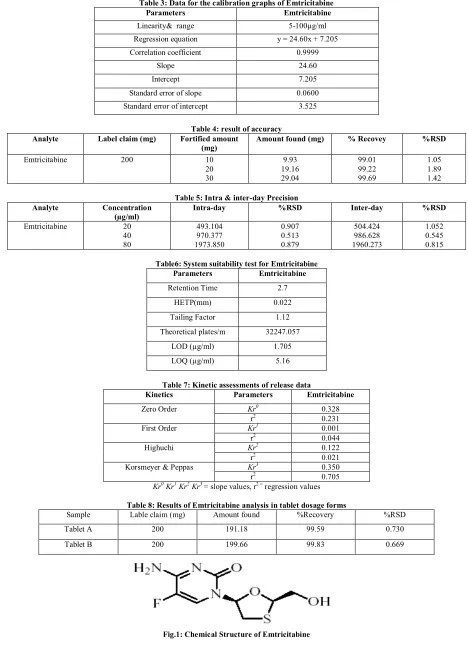
(2) Rajpoot Brajendra singh et al. IRJP 2012, 3 (2) recorded. Table 1 The operation were carried out in triplicate group was plotted between concentration vs. peak area. Selection of analytical wavelength By appropriate dilution of standard stock solution with mobile phase, various concentration of Emtricitabine was prepared accurately. The solutions were scanned between the wavelengths range 400-200 nm using the Shimadzu double beam UV visible spectrophotometer in the spectrum mode. Preparation of sample solutions For the estimation of Emtricitabine from twenty tablets were weighed separately and powder equivalent to 100 mg of the drugs were accurately weighed and transferred to separate 100 ml volumetric flasks and sonicated for 5 minutes. Volumes were made up to the mark with mobile phase and filtered through 0.45µ m filter. The concentrations of sample solution was prepared and analyzed with UV detection for Emtricitabine at 272 nm, with a flow rate of 1ml/min. In Vitro Dissolution Studies from Tablet Dosage Form Drug dissolution studies were carried out in 900 ml of 0.1N HCl (pH 1.2, simulated gastric medium) according to the USP 2000 dissolution procedures the single entity products with the use of a USP paddle type of apparatus at a stirring rate of 75 rpm. The temperature of the cell was maintained at 37 ± 0.5ºC. Aliquots of Emtricitabine were withdrawn at predetermined time intervals at 10, 20, 30, 40, 50, 60, 70, 80, 90, 100, 110 and 120 min replaced with equal volume of pre-warmed 0.1N HCL solution to maintain the sink condition. The sample solutions were diluted with methanol (HPLC grade) and it was analyzed by using methanol and water (89:11%, v/v) ratio and concentrations were determined at 272nm for Emtricitabine peaks are given in Figure-2. The retention time of Emtricitabine is 2.86 min. The cumulative percentage of drug released in the media was plotted against time in order to determine the release profile from the tablet formulations. The dissolution test data were obtained by averaging three parallel studies. Table.2 RESULTS AND DISCUSSION Method development Effect of incorporating methanol Methanol is a polar solvent being widely used in RP-HPLC. The primary effects it was found that the retention factor (k) was decreases with increases in the concentration of sample. The peak obtained was broad and showed severe tailing. However the final concentration of methanol was adjusted to achieve a good capacity factor. The chromatogram revealed that with increased in methanol concentration the retention time was reduced. The peak obtained was best acceptable at the methanol concentration of 89%. The peak was found sharp and reproducible. Effect of changing the flow rate To determine the effect of flow rate, the programmed controller was set at different flow rates 0.5 mL/min, 0.7 mL/min, 0.9 mL/min 1.0 mL/min, 1.1 mL/min, 1.2 mL/min and 1.5 mL/min. operate were performed at each flow rate. The optimum flow rate was also chosen keeping in mind the recommended flow rate for a column with a given internal diameter.. Method validation Linearity and range Under the optimized conditions, a calibration curve was used for Emtricitabine. Six standard mixtures of different concentrations were prepared. The corrected peaks were used for constructing the calibration graph. Linearity range, regression equation, correlation coefficient, slope, standard errors of slope, standard errors of intercept, are shown in Table 2 The plot of peak area of each sample against respective concentration of Emtricitabine was found to be linear in the range of 5-100 µg/ml, using regression analysis of the linear equation for Emtricitabine Y= 24.60x + 7.205 with correlation coefficient of r2 = 0.9999. Linearity data obtained from the measurements are given in Table 3. Accuracy In order to examine the accuracy of the method and to check the interference from excipients used in tablet dosage formulation, the recovery studies were carried out by standard addition method. In this method, three different amounts of Emtricitabine were added to a constant known concentration of the composite tablet solution. Each solution was injected five times and the amounts determined were compared to theoretical amounts. The results were summarized in Table 4. The recovery range was found from 99.01 to 99.69 for Emtricitabine.The relative standard deviation (% RSD) of Emtricitabine 1.42 was observed which indicates that the method gives sufficient accuracy. Precision Precision of the method was tested by performing intra-day and inter-day studies. For intra-day studies, triplicate of prepared samples were analyzed within same day. For interday validation, concentrations were determined on three separate days. The % RSD values obtained from peak area for LAM was observed. It can be seen from Table 5, a good precision was obtained for drug. Limit of Detection (LOD) and Limit of Quantification (LOQ) The limit of detection (LOD) and limit of quantification (LOQ) for Emtricitabine was found to be 1.705, 5.16 µg/ml. The typical chromatogram of Emtricitabine was shown in Figure 3. A mixture of methanol and water in the ratio of (89:11, v/v) was found to be most suitable to obtain a peak well defined and free from tailing. Specificity The effect of inactive ingredients (placebo) on the determination of the drug in tablet formulation was studied. Each tablet contains 200mg of Emtricitabine along with some inactive ingredients, such as titanium dioxide, red oxide, yellow oxide, talc and methyl cellulose. In the chromatogram, no interfering peaks were observed in the region of analytes. Ruggedness A different analyst, using a different batch of chemicals, column, tried the method. There was not much variation in results calculated by % RSD. These studies showed that the method is rugged. System suitability parameter The system suitability test was carried out on freshly prepared standard stock solution of Emtricitabine. Parameters such as efficiency, resolution, peak tailing HETP, Page 244.
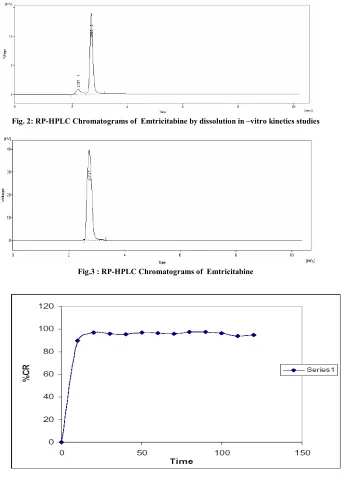
(3) Rajpoot Brajendra singh et al. IRJP 2012, 3 (2) LOD, and LOQ that were studied to evaluate the suitability of the system are given in Table 6. Applied to the dissolution studies The method was also applied to determine the release rate pattern of the drug from the tablet dosage form of Emtricitabine in dissolution rate studies. The release data were evaluated according to different models namely Zero order, First order, Higuchi and Korsmeyer& Peppas function. The regression coefficient values obtained after fitting the dissolution data to various kinetic models is shown in Table 7. The regression value of Emtricitabine was found to be following the Korsmeyer-Peppas release pattern following diffusion controlled release of the contained drug. The assay of Emtricitabine tablet was found to be 191.18, & 199.66. The results are given in Table 8 The absence of additional peaks in the chromatogram indicates non interference of the common excipients used in the tablets. Emtricitabine was found to give individual identical results when compared to their peak area and peak height when samples were collected and analyzed by developed RP-HPLC method using the same solvent system. Drug release kinetics was determined by analyzing the regression values. Fig.4 The present study indicates the possibility of using the same solvent system for quality control samples and for analyzing the drug release pattern from the tablet dosage forms. CONCLUSION Developed reverse phase high performance liquid chromatographic method is simple, reliable, linear, accurate, sensitive and reproducible as well as economical for the effective qualitative and quantitative analysis of Emtricitabine in bulk drug and tablet formulations. The method does not involve any costly sample extraction procedure in the method which highlights its usefulness in routine quality control testing. In addition, the reported method can also be used for pharmacokinetic studies.. Simultaneous ultraviolet spectrophotometric estimation of Tenofovir Disproxil Fumerate and Emtricitabine in bulk and in Tablet dosage form. International Journal of Biopharmaceutics. 2010; 1(1): 26-30. 6- A.T.Bapuji, M.Nagesh, D.Ramaraju, Syed Syedba, Ravi Kiran, S.Ravinder and D.Chandrapal reddy. A Bioequivalence Study Comparing Two Formulation of Emtricitabine Capsules Journal of Bioequivalence &Bioavailability vol.2: 011-014. doi:10.4172/jbb.1000023. 7- M Yadav, P Singhal, S Goswami, P Sharma, PS Shrivastav. Microdetermination of emtricitabine in human plasma by liquid chromatography/tandem mass spectrometry. J AOAC Int.;92(6):1681-9. 2009 Nov-Dec 8-Yadav M, Singhal P, Goswami S, Pande UC, Sanyal M, Shrivastav PS. Selective determination of antiretroviral agents tenofovir, emtricitabine, and lamivudine in human plasma by a LC-MS-MS method for a bioequivalence study in healthy Indian subjects. J Chromatogr Sci. 2010 Oct;48(9):704-13. 9- T. Delahunty, L. Bushman, C.V. Fletcher, J. Chromatogr. The simultaneous assay of tenofovir and emtricitabine in plasma using LC/MS/MS and isotopically labeled internal standards Journal of chromatography. B ISSN 1570-0232 2009, vol. 877, no20-21, pp. 19071914 10- Noel A. Gomes, , Vikas V. Vaidya, Ashutosh Pudage, Santosh S. Joshi and Sagar A. Parekh .LC–MS/MS method for simultaneous determination of tenofovir and emtricitabine in human plasma and its application to a bioequivalence study Journal of Pharmaceutical and Biomedical Analysis Volume 48, Issue 3, 4 November 2008, Pages 918-926. 11- J. A. H. Droste; R. E. Aarnoutse; D. M. Burger. Determination of Emtricitabine in Human Plasma using HPLC with Fluorometric Detection Journal of Liquid Chromatography & Related Technologies, Volume 30, Issue 18 January 2007 , pages 2769 – 2778. 12-Jian Zong, Gregory E. Chittick, Laurene H. Wang, James Hui, John A. Begley, M. Robert Blum. Pharmacokinetic Evaluation of Emtricitabine in Combination With Other Nucleoside Antivirals in Healthy Volunteers J Clin Pharmacol July 2007 vol. 47 no. 7 877-889. 13- Liu KZ, Hou W, Zumbika E, Ni Q (December 2005). "Clinical features of chronic hepatitis B patients with YMDD mutation after lamivudine therapy". J Zhejiang Univ Sci B 6 (12): 1182–7. doi:10.1631/jzus.2005.B1182. PMID 16358376. PMC 1390641. 14- AB Morrison; JA Campbell. J. Pharm Sci . 1965 , 54, 1-8. Table 1: Calibration values of Emtricitabine in standard drug Peak area (mV.s) Concentration µg/ml. REFERENCES 1-Goodmann and Gilman's, The Pharmacological Basis of Therapeutics,11 Edition.,Mc- th HILL Medical Publishing Division, New York, 2006 ; 1288-1294 2- http://en.wikipedia.org/wiki/Emtricitabine 3-. http://www.gilead.com/pdf/emtriva_pi.pdf 4-Rajesh Sharma and Pooja Gupta. A Validated RP - HPLC Method for imulataneous Estimation of Emtricitabine and Tenofovir Disoproxil Fumarate in a Tablet Dosage Form Eurasian J. Anal. Chem. 4(3): 276-284, 2009 5- T. Sudha, J. Saminathan, 1P.V. Hemalatha, V.R. Ravikumar. A Time (min.). Peak area. 10 20 30 40 50 60 70 80 90 100 110 120. 374.946 403.805 398.445 396.665 403.521 400.115 398.066 405.272 405.269 400.260 391.241 395.392. 5. 123.881. 10. 269.736. 15. 371.494. 20. 503.710. 30. 748.583. 40. 983.960. 50. 1226.043. 80. 2006.804. 100. 2448.166. Table 2: Percentage cumulative release of Emtricitabine Concentration (x) Amount in 5 ml Amount in 900 ml 14.924 16.097 15.879 15.807 16.086 15.947 15.864 16.157 16.157 15.953 15.586 15.755. 0.746 0.804 0.793 0.790 0.804 0.797 0.793 0.807 0.807 0.790 0.779 0.787. 134.316 144.873 142.911 142.263 144.774 143.523 142.776 145.413 145.413 143.577 140.274 141.795. CR. %CR. 134.316 145.619 143.715 143.056 145.564 144.327 143.573 146.206 146.22 144.384 141.071 142.574. 89.544 97.079 95.81 95.370 97.042 96.218 95.715 97.470 97.48 96.256 44.047 95.049. Page 245.
(4) Rajpoot Brajendra singh et al. IRJP 2012, 3 (2) Table 3: Data for the calibration graphs of Emtricitabine Emtricitabine Parameters Linearity& range. 5-100µg/ml. Regression equation. y = 24.60x + 7.205. Correlation coefficient. 0.9999. Slope. 24.60. Intercept. 7.205. Standard error of slope. 0.0600. Standard error of intercept. 3.525. Analyte. Label claim (mg). Emtricitabine. 200. Analyte. Concentration (µg/ml) 20 40 80. Emtricitabine. Table 4: result of accuracy Fortified amount Amount found (mg) (mg) 10 9.93 20 19.16 30 29.04 Table 5: Intra & inter-day Precision Intra-day %RSD 493.104 970.377 1973.850. 0.907 0.513 0.879. % Recovey. %RSD. 99.01 99.22 99.69. 1.05 1.89 1.42. Inter-day. %RSD. 504.424 986.628 1960.273. 1.052 0.545 0.815. Table6: System suitability test for Emtricitabine Emtricitabine Parameters Retention Time. 2.7. HETP(mm). 0.022. Tailing Factor. 1.12. Theoretical plates/m. 32247.057. LOD (µg/ml). 1.705. LOQ (µg/ml). 5.16. Table 7: Kinetic assessments of release data Kinetics Parameters Emtricitabine Kr0 0.328 r2 0.231 Kr1 0.001 First Order r2 0.044 Highuchi Kr2 0.122 r2 0.021 Korsmeyer & Peppas Kr3 0.350 r2 0.705 Kr0 Kr1 Kr2 Kr3 = slope values, r2 = regression values Zero Order. Sample. Table 8: Results of Emtricitabine analysis in tablet dosage forms Lable claim (mg) Amount found %Recovery. %RSD. Tablet A. 200. 191.18. 99.59. 0.730. Tablet B. 200. 199.66. 99.83. 0.669. Fig.1: Chemical Structure of Emtricitabine. Page 246.
(5) Rajpoot Brajendra singh et al. IRJP 2012, 3 (2). Fig. 2: RP-HPLC Chromatograms of Emtricitabine by dissolution in –vitro kinetics studies. Fig.3 : RP-HPLC Chromatograms of Emtricitabine. Fig.4: in-vitro dissolution profile of Emtricitabine. Source of support: Nil, Conflict of interest: None Declared. Page 247.
(6)
Figure

Related documents
Patients with inflammatory bowel disease (IBD) may have increased risk of developing CDI, along with worse outcomes, higher rates of colectomy and higher rates of recurrence
The generation interval is defined as the moment of infection of the contact bird relative to the moment of infection of the inoculated bird (i.e. it is given by e2j in trial j if
suis cells were detected on PAECs incubated with the negative control preparation (Figure 5d).. To assess whether the presence
AGDL: Agglomerative clustering on a directed graph; AGMFit: Affiliation graph model fitting; CD: Community discovery; CDlib: Community discovery library; CDTB: Community
Yet the story presented by Skloot had the potential to generate a broader discussion in the media and among the public about the ethical concerns related to biobanks and
attenuated virus, as it is clear from the tissue culture studies that this virus replicates well; direct comparisons in which the two isolates are used to infect a compatible cell
This study was conducted to examine the difference in shape of male and female upper and lower dental arches, as well as the difference in their transversal and longitu- dinal
Similarly, in a purposive sample of 12 written decisions of the Ontario Consent and Capacity Board (CCB) in which there were conflicts between phy- sicians and substitute
