Open Access
Research article
Treatment of malignant gastric outlet obstruction with stents: An
evaluation of the reported variables for clinical outcome
Lene Larssen*
1,2, Asle W Medhus
1,2and Truls Hauge
1Address: 1Department of Gastroenterology, Oslo University Hospital, Ullevaal, Department of Gastroenterology, Kirkeveien 166, N – 0407 Oslo,
Norway and 2University of Oslo, P.B 1078 Blindern, 0316 Oslo, Norway
Email: Lene Larssen* - [email protected]; Asle W Medhus - [email protected]; Truls Hauge - [email protected] * Corresponding author
Abstract
Background: Malignant gastric outlet obstruction (GOO) is commonly seen in patients with advanced gastric-, pancreatic-, duodenal, hepatobiliary or metastatic malignancies. Ten to 25% of patients with pancreatic cancer will develop duodenal obstruction during the course of the disease. Duodenal stenting with self-expandable metal stents is an alternative treatment to surgical bypass procedures. Our aim was to review the published literature regarding treatment of malignant GOO with stents to reveal whether the information provided is sufficient to evaluate the clinical effects of this treatment
Methods: A literature search from 2000 – 2007 was conducted in Pub Med, Embase, and Cochrane library, combining the following search terms: duodenal stent, malignant duodenal obstruction, gastric outlet obstruction, SEMS, and gastroenteroanastomosis.
All publications presenting data with ≥ 15 patients and only articles written in English were included and a review focusing on the following parameters were conducted: 1) The use of graded scoring systems evaluating clinical success; 2) Assessment of Quality of life (QoL) before and after treatment; 3) Information on stent-patency; 4) The use of objective criteria to evaluate the stent effect.
Results: 41 original papers in English were found; no RCT's. 16 out of 41 studies used some sort of graded scoring system. No studies had objectively evaluated QoL before or after stent treatment, using standardized QoL-questionnaires, 32/41 studies reported on stent patency and 9/ 41 performed an oral contrast examination after stent placement. Objective quantitative tests of gastric emptying had not been performed.
Conclusion: Available reports do not provide sufficient relevant information of the clinical outcome of duodenal stenting. In future studies, these relevant issues should be addressed to allow improved evaluation of the effect of stent treatment.
Background
Malignant gastric outlet obstruction (GOO) is commonly seen in patients with advanced gastric-, pancreatic-,
duo-denal, hepatobiliary or metastatic malignancies. Ten to 25% of patients with pancreatic cancer will develop duo-denal obstruction during the course of the disease [1,2].
Published: 17 June 2009
BMC Gastroenterology 2009, 9:45 doi:10.1186/1471-230X-9-45
Received: 11 November 2008 Accepted: 17 June 2009
This article is available from: http://www.biomedcentral.com/1471-230X/9/45 © 2009 Larssen et al; licensee BioMed Central Ltd.
GOO may result in nausea and vomiting, leading to dehy-dration and cachexia, which severely reduces the patients' Quality of Life (QoL).
Traditionally, a surgical by-pass procedure, usually a gas-trojejunoanastomosis (GEA), has been the palliative treat-ment offered, but up to 31% of the patients do not experience sufficient symptom relief following GEA [1,3]. Furthermore, GEA has a peri-operative morbidity as high as 35% and a mortality rate of about 2% in later studies [1,4-7].
Duodenal stenting with self-expandable metal stents (SEMS) is an alternative treatment to surgical bypass pro-cedures. In several studies, this treatment has been evalu-ated as safe and efficient with a technical success rate of 90–100%, a clinical success rate of 67–100%, a rate of severe complications about 7% and non-severe complica-tion rate about 20% [2,6-8,8-47]. Compared with surgery, the patients treated with stents have fewer serious compli-cations and less need for intensive care unit (ICU) [5] Fur-thermore, the hospital stay is shorter, which is essential in palliative treatment [5,9,20,32,7].
In palliative cancer treatment, improvement of QoL is a primary goal and needs to be addressed when new treat-ment strategies and procedures are impletreat-mented and eval-uated. Relief from obstructive symptoms is the most important parameter for evaluating the clinical effect or treatment outcome following duodenal stenting of GOO, but complications, stent patency and need for re-interven-tions are also parameters influencing QoL. In the availa-ble reports, objective criteria of treatment effects are often missing, which make it difficult to compare results and draw conclusions concerning effects of the treatment offered.
To review the published literature regarding treatment of malignant GOO with stents to reveal whether the infor-mation provided is sufficient to evaluate the clinical effects of this treatment, and whether QoL has been assessed.
Methods
A search for published literature for the time period Janu-ary 2000 – September 2007 was conducted in Pub Med,
Embase, and Cochrane library, combining the following search terms: duodenal stent, malignant duodenal obstruction, gastric outlet obstruction, SEMS, and gastro-enteroanastomosis. Reference lists were hand-searched for additional literature. Furthermore, reference lists of review articles and metaanalyses from the relevant time period were used to identify additional literature. Abstracts were not included. Only studies presenting data
with ≥ 15 patients and only articles written in English
were included in the present review. When studies included identical patients, the most recent study was included.(see additional file 1)
The identified studies were reviewed with regard to the following parameters:
1. The use of a graded scoring systems evaluating clinical success
2. Assessment of QoL before and after treatment
3. Information on stent-patency
Stent patency defined as the time period without need for re-intervention
4. The use of objective criteria to evaluate the stent effect
Results
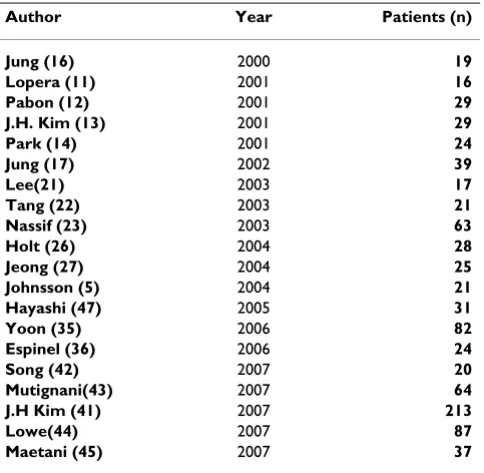
When applying the search criteria, 41 original papers and four review articles in English were found (See table 1). The number of patients included in the original papers was 15–213. Of the studies using a combined endoscopic/ fluoroscopic method for stent placement ten were pro-spective and 18 retropro-spective, corresponding numbers for the studies in which only fluoroscopy was applied were 10 and three, respectively. All prospective and retrospective studies are listed in table 2 and 3 respectively. No
rand-omized controlled trials (RTC's) treating ≥ 15 patients
with stents were found.
Clinical effect and scoring systems
To evaluate the clinical effects of stent treatment, 16 out of 41 studies used some sort of graded scoring system (see table 4). The level of oral intake before and after stent treatment was divided into four to five levels, which
Table 1: Characteristics of studies included in the review (n = 41)
Characteristics n (% of total)
Prospective studies 20 (49%)
Retrospective studies 21 (51%)
Stent deployed by fluoroscopic guidance 13 (32%)
allows some comparison of the results. The scoring sys-tems used are adapted from studies on dysphagia in esophageal cancer. One of the most frequently used is
Gastric Outlet Obstruction Scoring System (GOOSS) pre-sented by Adler in 2002 [2] (0 = no/inadequate oral intake, 1 = liquids/thickened liquids, 2 = semisolids/low residue diet, 3 = unmodified diet). This system assigns a point score based on the level of oral intake. Song et al
[48] introduced another similar scoring system (0 = able to eat normal diet, 1 = able to tolerate fragmented solid food without vomiting, 2 = able to tolerate soft food with-out vomiting, 3 = able to tolerate only liquid diet withwith-out vomiting, 4 = not able to tolerate any oral intake without vomiting, 5 = vomiting even without oral intake), mostly used in radiological literature, in which vomiting as an important symptom of obstruction is included. The GOOSS score was applied by 6/41 studies, 1/41 applied the Song score and 8/41 used similar graded scores. Fur-thermore, in 2007 Lowe et al introduced a Gut function score (0 = profuse vomiting or gut not functioning, 1 = nausea and occasional vomiting, 2 = nausea only, 3 = nor-mal gut function). This function score is used in addition to GOOSS and grades the level of nausea and vomiting. At present, the Gut Function Score has only been applied in the study, in which it was originally presented [44].
QoL in the evaluation of clinical success
No studies had objectively evaluated QoL before or after stent treatment, using standardized QoL-forms (see table 4). Seven of 41 studies used the Karnofsky performance scale before and after stent treatment (A physical perform-ance scale from 100-0, where a scoring of 100 is normal function and 0 is dead).
Stent patency
Concerning stent patency, 32/41 studies reported on this variable (see table 4), either by reporting the exact number of stent failures and time to failure after stent deployment or by calculating the patency. The rate of re-obstruction was reported in 36/41 studies, the migration rate in 34/41 studies.
Objective criteria for stent function
An oral contrast examination was performed after stent placement in 9/41 studies (see table 4). Objective quanti-tative tests of gastric emptying before and after treatment were not performed in any of the evaluated studies.
Discussion
The present review demonstrates that a graded scoring sys-tem for symptom assessment was used in 40% of the eval-uated papers. No studies provided information on QoL, although 17% of the studies used the Karnofsky scale. Table 2: Prospective studies
Author Year Patients (n) Jung (16) 2000 19 Lopera (11) 2001 16 Pabon (12) 2001 29 J.H. Kim (13) 2001 29 Park (14) 2001 24 Jung (17) 2002 39 Lee(21) 2003 17 Tang (22) 2003 21 Nassif (23) 2003 63 Holt (26) 2004 28 Jeong (27) 2004 25 Johnsson (5) 2004 21 Hayashi (47) 2005 31 Yoon (35) 2006 82 Espinel (36) 2006 24 Song (42) 2007 20 Mutignani(43) 2007 64 J.H Kim (41) 2007 213 Lowe(44) 2007 87 Maetani (45) 2007 37
Table 3: Retrospective studies
Author Year Patients (n)
Yim (9) 2001 29 Razzaq (10) 2001 23 Aviv (18) 2002 15 Maetani (15) 2002 23 Adler (2) 2002 36 M. Kaw (19) 2003 18 Mittal (6) 2003 16 Stawawy (20) 2003 24 G.H. Kim (24) 2004 49 Lindsay (25) 2004 40 Telford (29) 2004 176 Mosler (30) 2005 36 Bessoud (32) 2005 72 Del Piano (31) 2005 24 Maetani (7) 2005 22 Maire (33) 2006 24 Kazi (34) 2006 23 Kiely (37) 2007 30 T.O. Kim (40) 2007 53 J. van Hooft (38) 2007 62 Jeurnink (8) 2007 53
Table 4: Evaluation criteria applied in the reviewed studies (n = 41)
Evaluation criteria n (% of total)
Quality of Life assessment 0 Objective criteria for stent function 9 (22%) Clinical effect by graded scoring 15 (37%)
Information on stent patency was given in 80% of the studies and 22% had performed oral contrast examina-tion following stent placement to objectify the stent effect. No studies quantified the effect of stent placement on rate of gastric emptying.
The main complaints of patients suffering from malignant duodenal obstruction are often nausea, severe vomiting, bloating and abdominal pain. It is questionable whether the applied scoring systems in the papers reviewed pro-vide adequate and sufficient information about relief from these symptoms after stent placement. Improvement of symptoms estimated by a dysphagia score provides lim-ited information concerning the effect of duodenal stent-ing, and should thus be used in combination with a scoring system providing information about the more characteristic symptoms of GOO. The Gut Function Score may be a step in the right direction [44], but this scoring system needs further evaluation and validation.
In the present review, no studies were identified using standardized forms to assess QoL before and after stent treatment. One randomized study used SF-36 to evaluate the QoL in 10 patients treated with duodenal stents [49], which is a validated and frequently used QoL question-naire. This study was, however, too small for inclusion in this review. In 16% of the studies, the Karnofsky scale was used, but this scale captures only one aspect of QoL (phys-ical function) and is today considered inadequate for eval-uation of QoL [51]. Also for surgical treatment of GOO, data on the effect of QoL is limited [3]. There have been developed and validated several complex and advanced questionnaires for specific symptoms and specific diseases for the assessment of QoL [51]. EORTC C30 and the organ specific modules are now widely used for the evaluation of palliative cancer treatment. By applying these validated tools, the information about the QoL of patients is improved, and a possible discrepancy between the QoL of the patient estimated by the physician and the patient might be revealed. Studies regarding QoL in palliative cancer treatment have shown that physicians tend to over-estimate improvement in QoL of the patients [52,53].
Stent-patency related to survival is an important parameter, because the need for re-interventions and re-hospitaliza-tions most likely will reduce the patients QoL. Re-obstruc-tion of the stent by tumor in- and overgrowth is known to occur in 15–20% of the patients [28] and is probably the most important factor influencing stent patency.
The main effect of stent treatment in GOO is re-establish-ing the passage of food from the stomach to the duode-num. Evaluation of the stent effect can hence be provided by measuring the rate of gastric empting before and after stent placement. None of the reviewed studies included information on this issue. In a recent study by Maetani et
al, delayed gastric emptying of a liquid meal after stent placement was demonstrated. The patients resumed oral intake after stenting and those with a severe delay of emp-tying had a reduced survival time [54]. Rate of gastric emptying was, however, only recorded after stenting, and the quantitative effect of stenting was thus not revealed. More detailed data on the effect of stenting on rate of gas-tric emptying is thus required, and can be used to improve the knowledge on the relation between GOO and obstruc-tive symptoms. This is an important issue, since the rela-tion between gastrointestinal symptoms and gastric emptying might be rather weak [55]. Furthermore, knowl-edge concerning the effect of SEMS on gastric emptying could possibly help identifying subgroups of patients, in which stenting is particularly beneficial. Gastric emptying is a complex process involving grinding and emptying of the meal, and it is not likely that the re-establishment of passage is followed by a more rapid rate of gastric empty-ing in all subjects treated.
Conclusion
Only 40% of the studies reviewed used a graded scoring system to evaluate the clinical effect of their treatment. Furthermore, most studies using a graded scoring system applied a point score adapted from dysphagia in esopha-geal cancer and did thereby not address the symptoms more specific for GOO. The presence of obstructive symp-toms (severe vomiting, nausea and bloating) is probably severely reducing the patients QoL. In palliative cancer care, improvement of QoL is a main treatment goal, and data on this issue are missing in all the evaluated papers. Objective evaluation of gastric/duodenal function after stenting is limited and no studies have performed quanti-tative tests of gastric emptying. The present review thus indicates that the available reports do not provide suffi-cient relevant information of the clinical outcome of duo-denal stenting. In future studies, these relevant issues should be addressed to allow improved evaluation of the effect of stent treatment.
Competing interests
The authors declare that they have no competing interests.
Authors' contributions
LL performed the systematic search and drafted the man-uscript in cooperation with AWM and TH. All three authors have read and approved the final manuscript.
Additional material
Additional file 1
supplementary file including all details concerning the search.
Click here for file
References
1. Lillemoe KD, Cameron JL, Hardacre JM, Sohn TA, Sauter PK, Cole-man J, et al.: Is prophylactic gastrojejunostomy indicated for unresectable periampullary cancer? A prospective rand-omized trial. Ann Surg 1999, 230:322-328.
2. Adler DG, Baron TH: Endoscopic palliation of malignant gas-tric outlet obstruction using self-expanding metal stents: experience in 36 patients Systematic review of the efficacy and safety of colorectal stents. Am J Gastroenterol 2002, 97:72-78. 3. Van Heek NT, De Castro SM, van Eijck CH, van Geenen RC, Hes-selink EJ, Breslau PJ, et al.: The need for a prophylactic gastroje-junostomy for unresectable periampullary cancer: a prospective randomized multicenter trial with special focus on assessment of quality of life. Ann Surg 2003, 238:894-902. 4. Choi YB: Laparoscopic gatrojejunostomy for palliation of
gas-tric outlet obstruction in unresectable gasgas-tric cancer. Surg Endosc 2002, 16:1620-1626.
5. Johnsson E, Thune A, Liedman B: Palliation of malignant gas-troduodenal obstruction with open surgical bypass or endo-scopic stenting: clinical outcome and health economic evaluation. World J Surg 2004, 28:812-817.
6. Mittal A, Windsor J, Woodfield J, Casey P, Lane M: Matched study of three methods for palliation of malignant pyloroduodenal obstruction. Br J Surg 2004, 91:205-209.
7. Maetani I, Akatsuka S, Ikeda M, Tada T, Ukita T, Nakamura Y, et al.:
Self-expandable metallic stent placement for palliation in gastric outlet obstructions caused by gastric cancer: a com-parison with surgical gastrojejunostomy. J Gastroenterol 2005,
40:932-937.
8. Jeurnink SM, van Eijck CH, Steyerberg EW, Kuipers EJ, Siersema PD:
Stent versus gastrojejunostomy for the palliation of gastric outlet obstruction: a systematic review. BMC Gastroenterol
2007, 7:18.
9. Yim HB, Jacobson BC, Saltzman JR, Johannes RS, Bounds BC, Lee JH,
et al.: Clinical outcome of the use of enteral stents for pallia-tion of patients with malignant upper GI obstrucpallia-tion. Gas-trointest Endosc 2001, 53:329-332.
10. Razzaq R, Laasch HU, England R, Marriott A, Martin D: Expandable metal stents for the palliation of malignant gastroduodenal obstruction. Cardiovasc Intervent Radiol 2001, 24:313-318. 11. Lopera JE, Alvarez O, Castano R, Castaneda-Zuniga W: Initial
expe-rience with Song's covered duodenal stent in the treatment of malignant gastroduodenal obstruction. J Vasc Interv Radiol
2001, 12:1297-1303.
12. Pinto PI, Diaz LP, Ruiz De Adana JC, Lopez HJ: Gastric and duode-nal stents: follow-up and complications. Cardiovasc Intervent Radiol 2001, 24:147-153.
13. Kim JH, Yoo BM, Lee KJ, Hahm KB, Cho SW, Park JJ, et al.: Self-expanding coil stent with a long delivery system for palliation of unresectable malignant gastric outlet obstruction: a pro-spective study. Endoscopy 2001, 33:838-842.
14. Park KB, Do YS, Kang WK, Choo SW, Han YH, Suh SW, et al.: Malig-nant obstruction of gastric outlet and duodenum: palliation with flexible covered metallic stents. Radiology 2001,
219:679-683.
15. Maetani I, Tada T, Shimura J, Ukita T, Inoue H, Igarashi Y, et al.: Tech-nical modifications and strategies for stenting gastric outlet strictures using esophageal endoprostheses. Endoscopy 2002,
34:402-406.
16. Jung GS, Song HY, Kang SG, Huh JD, Park SJ, Koo JY, et al.: Malignant gastroduodenal obstructions: treatment by means of a cov-ered expandable metallic stent-initial experience. Radiology
2000, 216:758-763.
17. Jung GS, Song HY, Seo TS, Park SJ, Koo JY, Huh JD, et al.: Malignant gastric outlet obstructions: treatment by means of coaxial placement of uncovered and covered expandable nitinol stents. J Vasc Interv Radiol 2002, 13:275-283.
18. Aviv RI, Shyamalan G, Khan FH, Watkinson AF, Tibballs J, Caplin M,
et al.: Use of stents in the palliative treatment of malignant gastric outlet and duodenal obstruction. Clin Radiol 2002,
57:587-592.
19. Kaw M, Singh S, Gagneja H: Clinical outcome of simultaneous self-expandable metal stents for palliation of malignant bil-iary and duodenal obstruction. Surg Endosc 2003, 17:457-461.
20. Stawowy M, Kruse A, Mortensen FV, Funch-Jensen P: Endoscopic stenting for malignant gastric outlet obstruction. Surg Lapar-osc EndLapar-osc Percutan Tech 2007, 17:5-9.
21. Lee DW, Chan AC, Ng EK, Wong SK, Lau JY, Chung SC: Through-the-scope stent for malignant gastric outlet obstruction.
Hong Kong Med J 2003, 9:48-50.
22. Tang T, Allison M, Dunkley I, Roberts P, Dickinson R: Enteral stent-ing in 21 patients with malignant gastroduodenal obstruc-tion. J R Soc Med 2003, 96:494-496.
23. Nassif T, Prat F, Meduri B, Fritsch J, Choury AD, Dumont JL, et al.:
Endoscopic palliation of malignant gastric outlet obstruction using self-expandable metallic stents: results of a multi-center study. Endoscopy 2003, 35:483-489.
24. Kim GH, Kang DH, Lee DH, Heo J, Song GA, Cho M, et al.: Which types of stent, uncovered or covered, should be used in gas-tric outlet obstructions? Scand J Gastroenterol 2004,
39:1010-1014.
25. Lindsay JO, Andreyev HJ, Vlavianos P, Westaby D: Self-expanding metal stents for the palliation of malignant gastroduodenal obstruction in patients unsuitable for surgical bypass. Aliment Pharmacol Ther 2004, 19:901-905.
26. Holt AP, Patel M, Ahmed MM: Palliation of patients with malig-nant gastroduodenal obstruction with self-expanding metal-lic stents: the treatment of choice? Gastrointest Endosc 2004,
60:1010-1017.
27. Jeong JY, Kim YJ, Han JK, Lee JM, Lee KH, Choi BI, et al.: Palliation of anastomotic obstructions in recurrent gastric carcinoma with the use of covered metallic stents: clinical results in 25 patients. Surgery 2004, 135:171-177.
28. Dormann A, Meisner S, Verin N, Wenk LA: Self-expanding metal stents for gastroduodenal malignancies: systematic review of their clinical effectiveness. Endoscopy 2004, 36:543-550. 29. Telford JJ, Carr-Locke DL, Baron TH, Tringali A, Parsons WG,
Gab-brielli A, et al.: Palliation of patients with malignant gastric out-let obstruction with the enteral Wallstent: outcomes from a multicenter study. Gastrointest Endosc 2004, 60:916-920. 30. Mosler P, Mergener KD, Brandabur JJ, Schembre DB, Kozarek RA:
Palliation of gastric outlet obstruction and proximal small bowel obstruction with self-expandable metal stents: a single center series. J Clin Gastroenterol 2005, 39:124-128.
31. Del PM, Ballare M, Montino F, Todesco A, Orsello M, Magnani C, et al.: Endoscopy or surgery for malignant GI outlet obstruc-tion? Gastrointest Endosc 2005, 61:421-426.
32. Bessoud B, de BT, Denys A, Kuoch V, Ducreux M, Precetti S, et al.:
Malignant gastroduodenal obstruction: palliation with self-expanding metallic stents. J Vasc Interv Radiol 2005, 16:247-253. 33. Maire F, Hammel P, Ponsot P, Aubert A, O'Toole D, Hentic O, et al.:
Long-term outcome of biliary and duodenal stents in pallia-tive treatment of patients with unresectable adenocarci-noma of the head of pancreas. Am J Gastroenterol 2006,
101:735-742.
34. Kazi HA, O'Reilly DA, Satchidanand RY, Zeiderman MR: Endoscopic stent insertion for the palliation of malignant gastric outlet obstruction. Dig Surg 2006, 23:28-31.
35. Yoon CJ, Song HY, Shin JH, Bae JI, Jung GS, Kichikawa K, et al.: Malig-nant duodenal obstructions: palliative treatment using self-expandable nitinol stents. J Vasc Interv Radiol 2006, 17:319-326. 36. Espinel J, Sanz O, Vivas S, Jorquera F, Munoz F, Olcoz JL, et al.:
Malig-nant gastrointestinal obstruction: endoscopic stenting ver-sus surgical palliation. Surg Endosc 2006, 20:1083-1087. 37. Kiely JM, Dua KS, Graewin SJ, Nakeeb A, Erickson BA, Ritch PS, et al.:
Palliative stenting for late malignant gastric outlet obstruc-tion. J Gastrointest Surg 2007, 11:107-113.
38. van HJ, Mutignani M, Repici A, Messmann H, Neuhaus H, Fockens P:
First data on the palliative treatment of patients with malig-nant gastric outlet obstruction using the WallFlex enteral stent: a retrospective multicenter study. Endoscopy 2007,
39:434-439.
39. Jeurnink SM, Steyerberg EW, Hof GV, van Eijck CH, Kuipers EJ, Siersema PD: Gastrojejunostomy versus stent placement in patients with malignant gastric outlet obstruction: a com-parison in 95 patients. J Surg Oncol 2007, 96(5):389-96. 40. Kim TO, Kang DH, Kim GH, Heo J, Song GA, Cho M, et al.:
Publish with BioMed Central and every scientist can read your work free of charge "BioMed Central will be the most significant development for disseminating the results of biomedical researc h in our lifetime."
Sir Paul Nurse, Cancer Research UK
Your research papers will be:
available free of charge to the entire biomedical community
peer reviewed and published immediately upon acceptance
cited in PubMed and archived on PubMed Central
yours — you keep the copyright
Submit your manuscript here:
http://www.biomedcentral.com/info/publishing_adv.asp
BioMedcentral
41. Kim JH, Song HY, Shin JH, Choi E, Kim TW, Jung HY, et al.: Metallic stent placement in the palliative treatment of malignant gas-troduodenal obstructions: prospective evaluation of results and factors influencing outcome in 213 patients. Gastrointest Endosc 2007, 66:256-264.
42. Song GA, Kang DH, Kim TO, Heo J, Kim GH, Cho M, et al.: Endo-scopic stenting in patients with recurrent malignant obstruc-tion after gastric surgery: uncovered versus simultaneously deployed uncovered and covered (double) self-expandable metal stents. Gastrointest Endosc 2007, 65:782-787.
43. Mutignani M, Tringali A, Shah SG, Perri V, Familiari P, Iacopini F, et al.:
Combined endoscopic stent insertion in malignant biliary and duodenal obstruction. Endoscopy 2007, 39:440-447. 44. Lowe AS, Beckett CG, Jowett S, May J, Stephenson S, Scally A, et al.:
Self-expandable metal stent placement for the palliation of malignant gastroduodenal obstruction: experience in a large, single, UK centre. Clin Radiol 2007, 62:738-744.
45. Maetani I, Isayama H, Mizumoto Y: Palliation in patients with malignant gastric outlet obstruction with a newly designed enteral stent: a multicenter study. Gastrointest Endosc 2007,
66:355-360.
46. Hosono S, Ohtani H, Arimoto Y, Kanamiya Y: Endoscopic stenting versus surgical gastroenterostomy for palliation of malig-nant gastroduodenal obstruction: a meta-analysis. J Gastroen-terol 2007, 42:283-290.
47. Hayashi K, Okayama Y, Gotoh K, Ohara H, Sano H, Nakazawa T, et al.: Clinical evaluation of metallic stenting for malignant duo-denal obstruction using covered self-expandable metallic stent. Digestive Endoscopy 2005, 17(3):263-268.
48. Song HY, Shin JH, Yoon CJ, Lee GH, Kim TW, Lee SK, et al.: A dual expandable nitinol stent: experience in 102 patients with malignant gastroduodenal strictures. J Vasc Interv Radiol 2004,
15:1443-1449.
49. Mehta S, Hindmarsh A, Cheong E, Cockburn J, Saada J, Tighe R, et al.:
Prospective randomized trial of laparoscopic gastrojejunos-tomy versus duodenal stenting for malignant gastric outflow obstruction. Surg Endosc 2006, 20:239-242.
50. Kostopoulos PP, Zissis MI, Polydorou AA, Premchand PP, Hendrickse MT, Shorrock CJ, et al.: Are metal stents effective for palliation of malignant dysphagia and fistulas? Dig Liver Dis 2003,
35:275-282.
51. Fayers PM, Machin D: Quality of Life. The assessment, analysis and inter-pretation of patient reported outcomes 2nd edition. Chichester, West Sussex P019 8SQ, England: John Wiley and Sons Ltd; 2007. 52. Petersen MA, Larsen H, Pedersen L, Sonne N, Groenvold M:
Assess-ing health-related quality of life in palliative care: comparAssess-ing patient and physician assessments. Eur J Cancer 2006,
42:1159-1166.
53. McPherson CJ, ddington-Hall JM: Judging the quality of care at the end of life: can proxies provide reliable information? Soc Sci Med 2003, 56:95-109.
54. Maetani I, Ukita T, Tada T, Ikeda M, Seike M, Terada H, et al.: Gastric emptying in patients with palliative stenting for malignant gastric outlet obstruction. Hepatogastroenterology 2008,
55:298-302.
55. Abrahamsson H: Gastrointestinal motility disorders in patients with diabetes mellitus. J Intern Med 1995, 237:403-409.
Pre-publication history
The pre-publication history for this paper can be accessed here: