ECONOMIC PRICING BASED JOB
SCHEDULING ALGORITHM
V.K.MANAVALASUNDARAM
AP/CSE, Velalar College of Engineering and Technology, Erode, Tamilnadu, India.
Dr.K.DURAISWAMY,
Dean Academics, K.S.R College of Technology, Tiruchengode Tamilnadu, India.
Abstract:
The incentive approach provides a fair basis in successfully managing the decentralization and heterogeneity that is present in human economies. Competitive economic models provide algorithms/policies and tools for resource sharing or allocation in Grid systems. These models can be based on exchanging or prices. In the Demand Pricing Model, all participants need to own resources and trade resources by exchanges (e.g., storage space for CPU time). In the Best Bid Pricing Model, the resources have a price, based on the negotiation mechanism. They aim to enhance the system throughput, utilization, and complete execution at the earliest possible time rather than improving the utility of application processing. They do not take resource access cost (price) into consideration, which means that the value of processing applications at any time is treated the same. The end user does not want to pay the highest price but wants to negotiate a particular price based on the demand, value, priority, and available budget. In an economic approach, the scheduling decisions are made dynamically at runtime and they are driven and directed by the end-users requirements.
Keywords:Incentive, Best Bid, Demand Based.
1 Introduction
In Grid computing environment, resource management systems need to provide mechanisms and tools that allow resource consumers (end users) and providers (resource owners) to express their requirements and facilitate the realization of their goals. Resource consumers need a model to illustrate how consumers demand resources and their preference parameters, and a broker that supports resource discovery and strategies for application scheduling on distributed resources dynamically at runtime depending on their availability, capability, and cost along with user-defined requirements. The producers (job executers) and consumers (job owners) have different goals, objectives, strategies, and supply-and-demand patterns. More importantly both resources and end-users are geographically distributed with different time zones. In managing such complex environments, traditional approaches to resource management, that attempt to optimize system-wide measure of performance, cannot be employed. Traditional approaches use centralized policies that need complete state information and a common fabric management policy, or a decentralized consensus based policy. Due to the complexity in constructing a Grid environment, it is impossible to define an acceptable system-wide performance matrix and common fabric management policy [1]. (He concepts discussed in this chapter apply to both P2P and Grid systems although we can argue about some of their technical, social, and political differences.
2 Grid Resource Architecture for Economy Pricing (GRAEP)
Figure 1: A Generic Grid Architecture for Economic Pricing.
Grid Service Providers: The two key players in market oriented computational Grids are resource providers (hereafter referred as GSPs—Grid Service Providers) and resource consumers (hereafter referred as GRBs— Grid Resource Broker)
2.1 Grid Resource Broker (GRB)
GRB acts as a consumer’s representative or software agent). Both have their own expectations and strategies for being part of the Grid. In the Grid economy, resource consumers adopt the strategy of solving their problems within a required timeframe and budget.
Resource providers adopt the strategy of obtaining best possible return on their investment. The resource owners try to maximize their resource utilization by offering a competitive service access cost in order to attract consumers. The users (resource consumers) have an option of choosing the providers that best meet their requirements. If resource providers have local users, they will try to recoup the best possible return on “idle/leftover” resources. In order to achieve this, the Grid systems need to offer tools and mechanisms that allow both resource providers and consumers to express their requirements.
The Grid resource consumers interact with brokers to express their requirements such as the budget that they are willing to invest for solving a given problem and a deadline, a timeframe by which they need results. They also need capability to trade between these two requirements and steer the computations accordingly. The GSPs need tools for expressing their pricing policies and mechanisms that help them to maximize the profit and resource utilization. Various economic models, ranging from commodity market to auction-based, can be adopted for resource trading in Grid computing environments.
GRAEP provides services that help both resource owners and users maximize their objective functions. The resource providers can contribute their resources to the Grid and charge for services. They can use GRAEP mechanisms to define their charging and access policies and the GRAEP resource trader works according to those policies. The users interact with the Grid by defining their requirements through high-level tools such as resource brokers (also known as Grid schedulers). The resource brokers work for the consumers and attempt to maximize user utility. They can use GRAEP services for resource trading and identifying GSPs that meets its requirements.
As mentioned earlier, our goal is to realize this Grid economy architecture by leveraging existing technologies such as Globus and Legion and develop new services that are particularly missing in them. Therefore, we mainly focus on two things: first, to develop middleware services for resource trading using different economic models; second to use these services along with other middleware services in developing advanced user-centric Grid resource brokers. The remainder of this section presents how we are realizing the Grid economy vision and show co-existence of our modules with other systems.
2.2 The Resource Broker
It acts as a mediator between the user and Grid resources using middleware services. It is responsible for resource discovery, resource selection, binding of software, data, and hardware resources, initiating computations, adapting to the changes in Grid resources and presenting the Grid to the user as a single, unified resource. The resource broker consists of the following components:
2.3 Job Control Agent (JCA):
This is a persistent control engine responsible for shepherding a job through the system. It coordinates with schedule adviser for schedule generation, handles actual creation of jobs, maintenance of job status, interacting with clients/users, schedule advisor, and dispatcher.
2.4 Schedule Advisor (Scheduler):
This is responsible for resource discovery (using the Grid explorer), resource selection and job assignment (schedule generation) to ensure that the user requirements are met.
2.5 Grid Explorer (GE):
2.6 Trade Manager (TM):
This works under the direction of resource selection algorithm (the schedule advisor) to identify resource access costs. It uses market directory services and GRAEP negotiation services for trading with Grid service provides (i.e., their representative trade servers).
2.7 Deployment Agent (DA):
It is responsible for activating task execution on the selected resource as per the scheduler’s instruction and periodically updates the status of task execution to JCA.
The Nimrod-G resource broker follows this architecture and offers functionalities that are expected from economic-based grid scheduling systems. It allows the users to submit their application created using its parameter specification language; and express their requirements and objectives in the form of: deadline, budget with time or cost as the optimization parameter [value expression]. The broker uses scheduling algorithms to select resources dynamically at runtime depending on their availability, capability, and cost to meet user requirements [value translation]. It continuously adapts to changes in resource availability conditions by performance profiling (establishing job completion rate) and reschedules jobs appropriately to ensure that users requirements are met [value enforcement].
3. Grid Open Trading Protocols
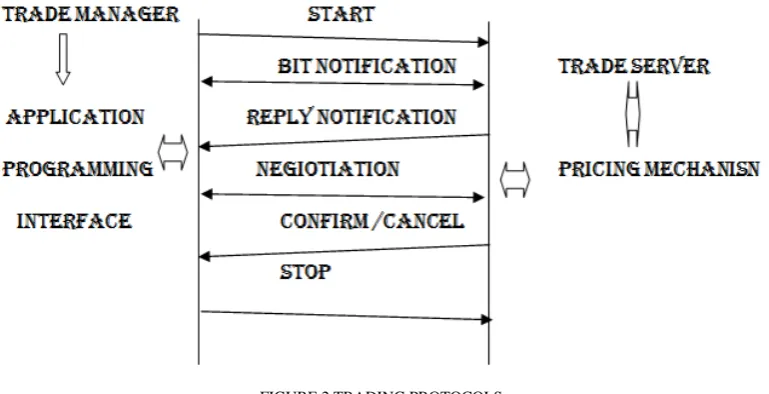
The resource trading protocols define the rules and format for exchanging commands between a GRAEP client (Trade Manager), which is part of the Grid broker and a Trade Server, which is part of the Grid service providers. Figure 2 shows a sample multilevel negotiation protocol that both client and server need to follow while trading for the cost of resource access [11]. The wire-level (low-level) details of these protocols are skipped, as they are obvious.
FIGURE 2 TRADING PROTOCOLS
A finite state machine representation of multilevel negotiation protocols that both client and server need to follow for the bargaining/tender. In this model, the broker’s Trade Manager (TMs) contacts the resource owner’s Trade Server (TS) with a request for a quote. The TM specifies resource requirements in a Deal Template (DT), which can be represented by a simple structure with its fields corresponding to deal items or by a “Deal Template Specification Language”, similar to the ClassAds mechanism employed by the Condor [12] system.
The contents of DT include expected start time, usage duration, memory, and storage requirements along with its initial offer. The TM looks into DT and updates its contents and sends back to TS. This negotiation between TM and TS continues until one of them indicates that its offer is final. Following this, the other party decides whether to accept or reject the deal. If accepted, then both work as per the agreement mentioned in the deal. The overhead introduced by the multilevel point-to-point protocol can be reduced when resource access prices are announced through Grid information services (e.g., MDS) or market directory.
protocols are also applicable for our resource trading and we have explored such models and protocols in our resource management and scheduling system.
4. Pricing, Accounting, and Payment Mechanisms
In a computational Grid economy environment, both resource owners and users want to maximize their benefits. As there will be many GSPs offering similar services, they need to have a competitive pricing structure in order to attract users, efficiently utilize resources, and maximize profit. The resources consumed by the user applications need to be accounted for and charged. Various payment mechanisms need to be supported. The users can purchase resource access credits in advance or pay-after-usage. Each GSP can maintain this by using systems like QBank or there can be global Grid-wide bank called GridBank (GBank) that mediates payment for services accessed by the user. Figure 3.5 shows various components at a GSP node and their interactions during resource trading, consumption, metering (measuring), billing, and payment handling.
5. Demand based Pricing Model.
In the commodity market model, resource owners specify their service price and charge users according to the amount of resource they consume. The pricing policy can be derived from various parameters and can be flat or variable depending on the resource supply and demand. In general, services are priced in such a way that supply and demand equilibrium is maintained. In the flat price model, once pricing is fixed for a certain period, it remains the same irrespective of service quality. It is not significantly influenced by the demand, whereas in a supply and demand model, prices change very often based on supply and demand changes. In principle, when the demand increases or supply decreases, prices are increased until there exists equilibrium between supply and demand. Pricing schemes in a Commodity Market Model can be based on:
• Flat fee
• Usage Duration (Time) • Subscription
Demand and Supply-based [18] The resource owners publish their prices and rules in the Grid market directory (GMD) service (see Figure 3) similar to publishing through yellow pages. This is accomplished by defining the price specification that GTS can use for publishing service access price in the market directory. A simple price specification may contain the following parameters.
consumer_id, which is the as same Grid-ID
peak_time_price (say, between 9am-6pm: office hours on working days) lunch_time_price , offpeak_time_price
discount_when_lightly_loaded (i.e., if the load is less than 50% at any time) raise_price_high_demand (i.e., raise in price if the average load is above 50%) price_holiday_time (i.e., during holidays and weekends)
FIG 3 DEMAND PRICING MODEL
Traditionally, computational services are priced based on their production cost and desired profit margin. However, the consumers’ perception of value is based on parameters such as supply and demand for resources, priority and service quality requirements. Therefore, the resource value in Grid economy needs to be defined as a function of many parameters as follows:
The last three parameters are difficult to capture from consumers unless they see any benefit in disclosing them as they vary with time and application. However, there are consumers who prefer regular access to resources during a particular period of the day. For example, those involved in making regular decisions on supply chain management of goods shipping from inventory to the departmental stores prefer calendar-based guaranteed access, and stable but competitive pricing to resources unlike spot-market based access to services [19].
In this case demand and preferences are clear, pricing policy can be easily negotiated in advance in a competitive and reasonable manner and resource quality of services can be guaranteed through reservation during the required period as agreed in advance.
Consumers can be charged for access to various resources including CPU cycles, storage, software, and network. The users compose their application using higher-level Grid programming languages. For example, in our Nimrod problem-solving environment we provide a declarative programming language for composing parameter sweep applications and defining application and user requirements such as deadline and budget. The resource broker (working for the user) can carry out the following steps for executing applications:
6. BEST BID PRICING MODEL (BB)
The BB auction model supports one-to-many negotiation, between a service provider (seller) and many consumers (buyers), and reduces negotiation to a single value (i.e., price). The auctioneer sets the rules of auction, acceptable for the consumers and the providers. Auctions basically use market forces to negotiate a clearing price for the service.
In the real world, auctions are used extensively, particularly for selling goods/items within a set duration. The three key players involved in auctions are: resource owners, auctioneers (mediators), and buyers (FIG 4). Many e-commerce portals such as Amazon.com and eBay.com are serving as mediators (auctioneers). Both buyers’ and sellers’ roles can also be automated. In a Grid environment, providers can use an auction protocol for deciding service value/price (see Figure 4). The steps involved in the auction process are:
a. GSPs announce their services and invite bids.
b. Brokers offer their bids (and they can see what other consumers offer if they like -depending on open/closed).
c. Step (b) goes on until no one is willing to bid higher price or auctioneer stops if the minimum price line is not met.
d. GSP offers service to the one who wins.
e. Consumer uses the resource. Auctions can be conducted as open or closed depending on whether they allow back-and-forth offers and counter offers. The consumer may update the bid and the provider may update the offered sale price.
FIGURE 4 BEST BID PRICING MODEL
highest price and moving down). Researchers have developed software-based agents mechanisms to automate a double auction for stock trading with or without human interaction [22].
The double auction model has high potential for Grid computing. The brokers can easily be enabled to issue bids depending on budget, deadline, job complexity, scheduling strategy, and resource characteristics requirements and GSPs can issue asks depending on current load and perceived demand, and price constraints. Both orders can be submitted to GMD agents that provide continuous clearance or matching services. Since bids are cleared continuously, both GRBs and GSPs can make instant decisions with less computational overhead and complexity.
All the above auctions differ in terms of whether they are performed as open or closed auctions and the offer price for the highest bidder. In open auctions, bidding agents can know the bid value of other agents and will have an opportunity to offer competitive bids. In closed auctions, the participants’ bids are not disclosed to others. Auctions can suffer from collusion (if bidders coordinate their bid prices so that the bids stay artificially low), deceptive auctioneers in the case of a Vickrey auction (auctioneer may overstate the second highest bid to the highest bidder unless that bidder can vary it), deceptive bidders, counter speculation, etc
7. Performance and Evaluation
Experiment 1:
The experiments were run twice, once during the INDIA peak time, when the US machines were in their off-peak times, and again during the US peak, when the INDIA machine was off-peak. The experiments were configured to minimize the cost, within one-hour deadline. This requirement instructs the GLOBUS to use “Cost-Optimization Scheduling” algorithm in scheduling jobs for processing on the Grid.
FIGURE: 4.8 COMPUTATIONAL SCHEDULING INDIAN PEAK (US - OFF)
FIGURE: 4.9 COMPUTATIONAL SCHEDULING US PEAK (INDIAN - OFF)
more interesting (see Figure 4.9). When the Sun machine becomes temporarily unavailable, the SP2, at the same cost, was also busy, so a more expensive SGI is used to keep the experiment on track to complete before the deadline.
The computational economies driven brokering system can be applied to peer-to-peer computing [23] The Time Optimization scheduling algorithm attempts to complete the experiment as quickly as possible, within the budget available. A description of the core of the algorithm is as follows:
• For each resource, calculate the next completion time for an assigned job, taking into account previously assigned jobs and job consumption rate.
• Sort resources by next completion time.
• Assign one job to the first resource for which the cost per job is less than or equal to the remaining budget per job.
• Repeat the above steps until all jobs are assigned.
The Cost Optimization scheduling algorithm attempts to complete the experiment as economically as possible within the deadline.
• Sort resources by increasing cost.
• For each resource in order, assign as many jobs as possible to the resource, without exceeding the deadline.
Cost Optimization Scheduling
In a competitive commodity-market economy, the resources are priced differently at different times based on the supply and demand. For example, they are priced higher during peak hours and lower during off-peak hours. In this experiment we explore their impact on the processing cost, by scheduling a resource-intensive parameter-sweep application containing a large number of jobs on the World-Wide Grid resources, during INDIA peak and off-peak hours.
The World-Wide Grid testbed resources selected for use in this experiment and their properties is shown in Table 4.5. To test the trading services provided by GTS (Grid Trade Server), we ran an experiment entirely during peak time and the same experiment entirely during off-peak time. It is important to note access price variations during peak and off-peak times and also time difference between Australia and US. The access price is expressed in Grid units (G$) per CPU second.
Resource Type & Size (No. of
nodes)
Organization & Location
Grid Services and Fabric
Price @ AU peak time
Price @ AU off peak
time. Linux cluster (60
nodes) Monash, Australia Globus/Condor 20 5
IBM SP2 (80
nodes) ANL, Chicago, USA Globus/LL 5 10
Sun (8 nodes) ANL, Chicago, USA Globus/Fork 5 10
SGI (96 nodes) ANL, Chicago, USA
Globus/Condor-G 15 15
SGI (10 nodes) ISI, Los Angeles,
USA Globus/Fork 10 20
Table 8: World-Wide Grid testbed resources used in the experiment.
8. Results and Discussions.
The number of computational nodes (CPUs) in use at different times during the execution of scheduling experimentation at INDIA peak-time is shown in Figure 8.1. It can be observed that in the beginning of the experiment (calibration phase), the scheduler had no precise information related to job consumption rate for resources, hence it tried to use as many resources as possible to ensure that it can meet deadline. After calibration phase, scheduler predicted that it could meet the deadline with fewer resources and stopped using more expensive nodes. However, whenever scheduler senses difficulty in meeting the deadline by using the resources currently in use, it includes additional resources. This process continues until deadline is met and at the same time it ensures that the cost of computation is within a given budget.
resources decreased almost linearly although the number of resources in use did not decline at the same rate. The reason for this behavior is that a large number of resources that the scheduler selected were from off-peak time zone (i.e., US was in off-peak time when Australia was in peak hours) as they were cheaper. Another reason is that the number of resources used in these experiments contains more US resources compared to INDIA resources.
FIGURE 8.1 NUMBER OF RESOURCES DURING INDIAN PEAK.
FIGURE: 8.2 COST OF RESOURCE IN USE AT INDIAN PEAK.
.
FIGURE: 8.4 COST OF RESOURCE IN USE AT INDIAN PEAK.
Similar behavior did not occur in scheduling experiments conducted during INDIA off-peak time (see Figure 8.3and Figure 8.4). The variation pattern of total number of resources in use and their total cost is similar due to the fact that the larger numbers of US resources were available cheaply. Although the scheduler has used INDIA resources throughout the experiment the scheduler had to depend on US resources to ensure that the deadline is met even if resources were expensive.
9. Conclusion
We have discussed motivations for the use of computational economy as a metaphor for the management of resources and application scheduling in Grid computing environments. We proposed the Grid Resource Architecture for economical pricing (GRAEP) framework and discussed an architecture that can be realized by leveraging existing middleware services. We have presented economic models such as demand and BB auction models along with architecture and strategies for releasing them within the GRAEP framework.
References:
[1] D. Ferguson, C. Nikolaou, J. Sairamesh, and Y. Yemini, Economic Models for Allocating `Resources in Computer Systems, In Market-based Control: A Paradigm for Distributed Resource Allocation, World Scientific Press, Singapore, 1996.
[2] R. Cocchi, S. Shanker, D. Estrin, and L. Zhang, Pricing in Computer Networks: Motivation,Formulation, and Example, IEEE/ACM Transactions on Networking, Vol. 1, No. 6, Dec. 1993.
[3] B. Chun, Market-based Cluster Resource Management, Ph.D. Dissertation, the University of California at Berkeley, USA, October 2001.
[4] I. Foster, A.. Roy, and V. Sander, A Quality of Service Architecture that Combines Resource Reservation and Application Adaptation, Proceedings of IEEE/IFIP 8th International Workshop on Quality of Service (IWQOS 2000), June 2000, Pittsburgh, USA.
[5] R. Cocchi, S. Shanker, D. Estrin, and L. Zhang, Pricing in Computer Networks: Motivation, Formulation, and Example, IEEE/ACM Transactions on Networking, Vol. 1, No. 6, Dec. 1993.
[6] A. Lazar and N. Semret, Auctions for Network Resource Sharing, TR 468-97-02, Columbia University, Feb. 1997. [7] B. Carpenter, IPv6 and the Future of the Internet, The Internet Society Member Briefing, 23 July 2001.
http://www.isoc.org/briefings/001/
[8] L. W. McKnight and J. Boroumand, Pricing Internet Services: Approaches and Challenges, IEEE Computer, Vol. 33, No. 2, pp. 128-129, IEEE CS Press, USA, Feb. 2000.
[9] I. Foster and C. Kesselman, Globus: A Metacomputing Infrastructure Toolkit, International Journal of Supercomputer Applications, 11(2): 115-128, 1997.
[10] S. Jackson, QBank: A Resource Management Package for Parallel Computers, Pacific Northwest National Laboratory, Washington, USA, 2000.
[11] R. Buyya, D. Abramson, and J. Giddy, An Economy Driven Resource Management Architecture for Global Computational Power Grids, Proceedings of the 2000 International Conference on Parallel and Distributed Processing Techniques and Applications (PDPTA 2000), June 26-29, 2000, Las Vegas, USA, CSREA Press, USA, 2000.
[12] J. Basney and M. Livny, Deploying a High Throughput Computing Cluster, High Performance Cluster Computing, R. Buyya (editor). Vol. 1, Chapter 5, Prentice Hall PTR, May 1999.
[13] M. Kumar and S. Feldman, Business negotiations on the Internet, Technical Report, IBM Institute of Advanced Commerce - March 11, 1998, http://www.ibm.com/iac/tech-paper.html
[14] G. Tesauro and J. Kephart, Foresight-based pricing algorithms in an economy of software agents, First International Conference on Information and Computation Economies, Charleston, South Carolina, October, 1998.
http://www.ibm.com/iac/papers/ice98_fs/
[17] R. Wolski, J. Plank, J. Brevik, and T. Bryan, Analyzing Market-based Resource Allocation Strategies for the Computational Grid, International Journal of High-performance Computing Applications, Volume 15, Number 3, Sage Publications, USA, Fall 2001.
[18] L. W. McKnight and J. Boroumand, Pricing Internet Services: Approaches and Challenges, IEEE Computer, Vol. 33, No. 2, pp. 128-129, IEEE CS Press, USA, Feb. 2000.
[19] L. Norskog, A Personal Communication on Economics and Grid Allocation, Enron Broadband Systems, March 14, 2001. Available at: http://www.buyya.com/ecogrid/comments/enron.txt
[20] W. Vickrey, Counter-speculation, auctions, and competitive sealed tenders, Journal of Finance, Vol. 16, No. 1, pp. 9-37, March 1961.
[21] K. Reynolds, The Double Auction, Agorics, Inc., 1996. http://www.agorics.com/Library/Auctions/auction6.html
[22] R. Das, J. Hanson, J. Kephart, and G. Tesauro, Agent-Human Interactions in the Continuous Double Auction, Proceedings of the International Joint Conferences on Artificial Intelligence (IJCAI), August 4-10, 2001, Seattle, Washington, USA. [23] B. Knighten, Peer to Peer Computing Working Group, Intel Developer's Forum, August 24, 2000,