http://www.ejfa.info/
ANIMAL SCIENCE
Performance and hematological parameters of broilers fed neem, turmeric,
vitamin e and their combinations
H. B. Shivappa Nayaka1*, B. Umakantha2, S. Wilfred Ruban3, H. N. N. Murthy4and H. D. Narayanaswamy4
1
Veterinary Officer, Veterinary Dispensary, Yelanadu, C.N. Halli, Tumkur, Karnataka, India 2
Department of Poultry Science, Veterinary College, Hebbal, Bangalore, India 3
Department of Livestock Products Technology, Veterinary College, Hassan, Karnataka, India 4
Department of Veterinary Pathology, Veterinary College, Hebbal, Bangalore, India
Abstract
An experiment was conducted to study the efficiency of inclusion of neem, turmeric, vitamin E and its combinations on performance and hematological parameters for a period of six weeks with 288 day old Raja II broiler chicks. Basal diet was supplemented with Azadirachta indica (Neem 8g/kg feed), Curcuma longa (Turmeric 2g/kg feed) and Vitamin E 0.2g/kg feed) individually and in combination to form eight test diets. Each test diet was fed ad libitum for 42 days. The result of the present stumdy identified no significant difference in body weight of chicks fed with supplemented diets. Whereas, addition of either neem alone or in combination with turmeric and vitamin E induced significant growth depression in birds compared to control birds. Supplementation of neem, turmeric, Vitamin E and their combinations in broiler diets did not exhibit any significant effect on feed intake and feed conversion ratio during all the weeks of age. The percentage livability of birds under different treatments was statistically non-significant. Hematological parameters in broilers revealed that the hemoglobin concentration in neem fed group was significantly (P<0.05) higher (10.5 g/dL) when compared to turmeric fed group (9.85 g/dL), otherwise diet containing turmeric alone recorded lowest value of hemoglobin. Feeding of neem alone and its combination with turmeric and vitamin E increases significantly PCV values as compared to control. The supplementation of turmeric or vitamin E alone to basal diet did not significantly change PCV values.
Key words: Neem, Turmeric, Humoral, Cell mediated Immunity, Broilers
Introduction
Poultry production in India has witnessed a phenomenal growth from backyard farming to scientific poultry farming involving commercial egg and meat production. In spite of numerous hurdles, there has been a perceptible rapid stride towards development and production, mainly contributed by indigenous scientific methods and advancement in the technology of poultry production (Gowda et al., 1998). Increase in the productive cost of meat is observed mainly due to the cost of broiler feed stuffs which constitute about 80 per cent of the total production cost. This has
made the researchers to focus on natural feed resources which can be used as feed additives to increase feed efficiency and growth rate of broilers.
Antibiotics are mostly used at sub therapeutic level to improve the production performance of poultry birds. However, consistent use of antibiotic will not only lead to various health issues, could be a major contributors to higher feed cost. Thus, it’s imperative to sort out alternatives that could effectively and economically substitute antibiotics (Toghyani et al., 2011). Emphasize on herbal use as growth promoter and preventive remedies for several infections in poultry birds could be the best possible sources under subtropical environment that could result in economic and healthy gains keeping in view their easy availability and effective use as medicinal plants in large animals and human beings. Several herbal sources have been effectively in poultry production for better gains and health chicken production (Guo et al., 2004).
Neem ( ) and turmeric
Received 20 April 2012; Revised 11 October 2012; Accepted 01 January 2013; Published Online 02 April 2013
*Corresponding Author H. B. Shivappa Nayaka
have demonstrated to exhibit various beneficial pharmacological properties including performance and immunomodulatory effect (Ismail et al., 2004) in broilers. Curcuma longa is an extensively used
spice, food preservative and coloring material that has biological actions and medicinal applications. The main component of turmeric is curcumin that is a a good antioxidant and an inducer of immune response in animals (Burt, 2004). Neem (Azadirachta indica) leaves contains (g/ kg) 938.9
± 0.16 Dry matter, 35.3 ± 0.08 Ether Extract, 181.6 ± 1.46 Crude Protein, 113.3 ± 0.86 Crude Fiber and 130.7 ± 0.07 Ash (Esonu et al., 2005) and has been found to exert some beneficial effects in various animals (Chand, 1987).
In addition, vitamin E along with selenium has been found to be essential for the proper growth and development (Marsh et al., 1986) and for the overall immunocompetence of growing broilers. However, use of these medicinal plants or feed additives in diets of broiler chicken with the objectives of improving their performance and hematological parameters status has not been fully addressed. Hence, the present study has been proposed to evaluate the efficiency of neem, turmeric, vitamin E and their combinations on performance and hematological parameters in broilers.
Materials and Methods Experimental birds
Two hundred and eighty eight indigenously developed Raja II colored broilers were procured from the Department of Poultry Science, Veterinary College, Bangalore. The birds were divided into 8 treatments with 3 replicates per treatment and 12 birds each replicate. Twenty four pens were made and the replicates were randomly allotted using lottery method under deep litter system and reared for 6 weeks.
Diets
Diets were formulated using maize and soybean meals. The broiler starter and finisher rations were formulated as per BIS (1992). Starter mash (12.2 MJ/kg ME, 22% CP) was fed from one to 21 days and finisher (12.2 MJ/kg ME, 20% CP) from 22 to 42 days. A practical type of broiler diet was compounded to serve itself as control (T1). Basal diet was fortified with Azadirachta indica
(Neem) powder of 8 gm/kg feed (T2), Curcuma longa (turmeric) of 2 gm/kg feed (T3)and
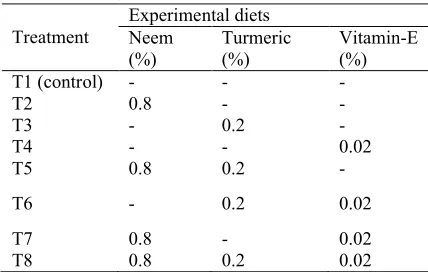
Vitamin-E of 0.2 gm/kg feed (T4) and likewise 4 experimental diets were prepared using their combination and were designated as T5, T6, T7 and T8 (Table 1).
Body weight
Individual body weights were recorded at the beginning of the experiment and further body weight were recorded at the end of each week to monitor the pattern of body weight changes. Group wise average weights under different treatments were arrived. The weighing of the birds was done in the early hours of the day before feeding.
Table 1. Experimental design.
Treatment
Experimental diets Neem
(%) Turmeric (%) Vitamin-E (%)
T1 (control) - -
-T2 0.8 -
-T3 - 0.2
-T4 - - 0.02
T5 0.8 0.2
-T6 - 0.2 0.02
T7 0.8 - 0.02
T8 0.8 0.2 0.02
Feed consumption
The daily amount of the concerned diet was weighed and offered to the 12 bird replicate group. The feed consumption in each replicate was recorded weekly by subtracting the weight of residual fed from the total quantity of feed supplied during the respective week.
Feed conversion ratio
The feed conversion ratio (FCR) was determined through the relationship between amount of feed consumed (FC) to the body weight gain (BWG) under each group of birds (FCR = FC g/BWG g).
Livability
Mortality in respective group was recorded at occurrence in starter and finisher period.
Hematological parameters
Hematological parameters including hemoglobin (Hb) concentration, packed cell volume (PCV), total leukocyte count (TLC) and differential leukocyte count (DLC) was evaluated as per the procedures outlined by Benjamin (1978).
Results and Discussion Body weight
The results of the present study indicated that addition of either neem alone or in combination with turmeric and vitamin E to broiler diets induced significant growth depression in birds as compared to birds fed with control diet (Table 2). These results are in line with the findings of Kumar and D’Mello (1995) who observed that inclusion of neem leaf meal above 0.5% significantly (P≤0.05) reduced body weight in broilers. The depression in growth upon feeding neem was attributed to the fact that neem leaf meal has imparted a bitter and unpalatability thus inhibiting feed consumption in birds resulting in poor body weight gain. Contrary to findings of present study, several workers have reported that supplementation of neem leaf meal increases body weight gain in broilers (Verma et al., 1998, Chakravarty and Prasad, 1991, Onyimonyi et al., 2009).
The body weights obtained in birds fed with diets containing turmeric, vitamin E and their combination were unisignificatly lower compared to that of birds fed with control diet. These results
are not line with Al-sultan et al. (2003) and Kumari et al. (2007) who observed a significant increase in body weight of broilers fed with turmeric powder. Further, it was noticed that combination of vitamin E and turmeric had no influence on the body weight of broilers when compared with birds fed with either vitamin E or turmeric alone.
Feed conversion ratio
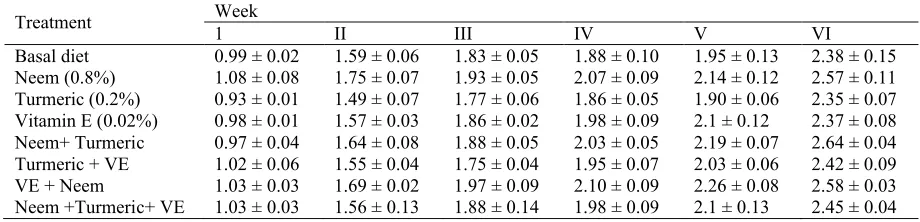
Effect of various treatments on FCR revealed statistically a non-significant difference between the control and different treatment groups (Table 3). The findings were in agreement with Adebiyi et al. (2011) and Mehala and Moorthy (2008) who reported better FCR values in birds fed with Vitamin E and Turmeric had no significant effect on the FCR in broilers. The results of the study revealed that birds fed with neem and its combinations had negative effect on FCR as compared to control and other treatment groups. The findings were in line with findings of Kumar and D’Mello (1995), Esonu et al. (2006) who observed no or negative effect of neem on FCR in broilers.
Table 2. Effect of neem, turmeric, vitamin E and their combination on body weight (mean± SE) in broilers. Treatments Week (g)
I II III IV V VI
Basal diet 115 ± 2.08a 259 ± 6.08a 452 ± 15.3ab 802 ± 13.20a 1143 ± 23.20a 1350 ± 32.37a Neem (0.8%) 103 ± 2.17bc 231 ± 5.20bc 410 ± 9.22bc 694 ± 19.20be 991 ± 29.00be 1159 ± 28.76bc Turmeric
(0.2%) 113 ± 1.97ad 258 ± 4.09ad 457 ± 7.50ae 794 ± 13.70ac 1143 ± 30.00ad 1279 ± 29.86ab Vitamin E
(0.02%) 112 ± 2.04da 258 ± 3.82da 449 ± 8.68ca 781 ± 20.30ca 1074 ± 21.60abdf 1328 ± 26.41da Neem+
Turmeric 105 ± 2.13dcb 236 ± 4.93cb 430 ± 7.28cb 728 ± 21.00abc 1003 ± 21.60bcg 1196 ± 29.31cb Turmeric +
VE 104 ± 3.47abc 251 ± 4.09abc 450 ± 8.29ba 766 ± 17.70bca 1080 ± 22.80abc 1279 ± 30.01abc VE +
Neem 105 ± 2.05bcd 240 ± 4.46bca 412 ± 10.60be 718 ± 13.80bd 977 ± 19.80dcbe 1189 ± 27.98bce Neem
+Turmeric+
VE 105 ± 2.18cdb 240 ± 4.83cab 427 ± 9.24abc 707 ± 13.20bde 996 ± 24.30efg 1190 ± 25.08cbe Means bearing atleast one common superscript within the column does not differ significantly (P≤0.05)
Table 3. Effect of neem, turmeric, vitamin E and their combination on feed conversion ratio (mean± SE) in broilers.
Treatment Week
1 II III IV V VI
Livability
The results of study revealed good livability of birds among different treatment groups and was not altered by any dietary treatments. The percentage livability of birds under different treatments was statistically non-significant ranging from as low as 94.4% in Control) and by Neem+ Turmeric to as high as 100% by Neem and byNeem + Vitamin E + Turmeric. This might be due to the anti-oxidant and antimicrobial activities of neem, turmeric and vitamin E which suppress the pathogenic bacteria and enhance immune status.
Hematological parameters
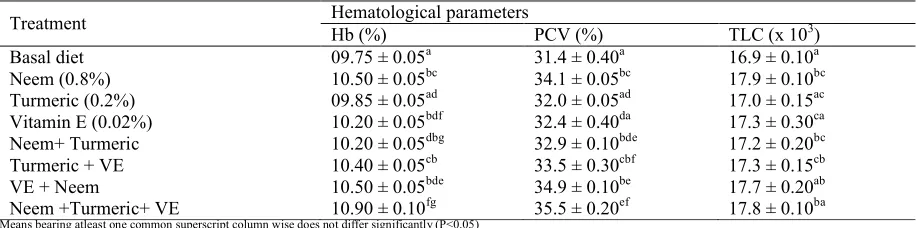
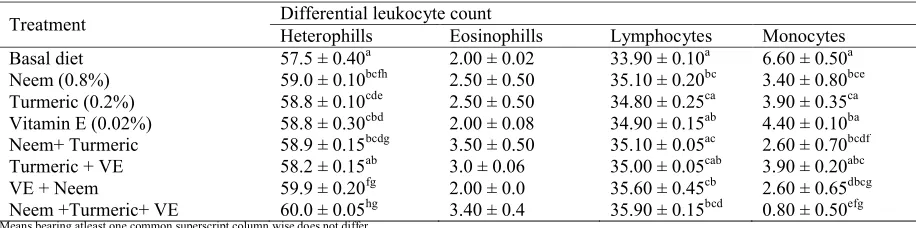
The results of various hematological parameters are presented in Table 4 and 5.
Hemoglobin
The dietary inclusion of neem, vitamin E and their combination revealed significantly (P≤0.05) higher hemoglobin concentration when compared to that of turmeric added and control group. Birds fed with combination of neem, turmeric and vitamin E recorded the highest hemoglobin value (10.90g/dl) followed by neem (10.50 g/dl) and neem + vitamin E diets (10.50 g/dl). Diets containing turmeric alone recorded lowest value of hemoglobin whereas in combination with neem and vitamin E the values were higher indicating the additive effect. These findings were in agreement with Nagalakshmi et al. (1996) who opined that neem possess strong influence on the hematological traits in broilers particularly hemoglobin. Contrary to our findings, Biu et al. (2009) and Akbari et al. (2008) opined that inclusion of neem and vitamin E at higher levels in the diets of broilers significantly decreases hemoglobin concentrations.
Packed cell volume
The results of study showed a significant (P≤0.05) difference in PCV values between treatment groups and control. Feeding of neem alone) and its combination with turmeric and
vitamin E significantly (P≤0.05) increased PCV values as compared to control. In contrast,the supplementation of turmeric and vitamin E alone did not significantly change PCV values. This was similar to the findings of Akbari et al. (2008) who reported that inclusion of vitamin E in the diet of broilers has no effect on PCV values. Similar results have been reported by Gowda et al. (1998) who observed a significant increase in PCV values at 10% inclusion levels. On the contrary Biu et al. (2009) reported decreased PCV values on inclusion of neem in broiler diets. The observed relative polycythemia may be due to reduction in the fluid component of the blood from insufficient fluid intake or due to slight hepatomegaly (Esonu et al., 2006). Neem leaf meal has high fibre content which may have resulted in dehydration due to insufficient water intake (Onyimonyi et al., 2009).
Total leukocyte count
The total leukocyte count observed in the present study across the entire treatment groups were within the normal range. The dietary inclusion of neem alone in the diet of broilers significantly (P≤0.05) increased TLC value as compared to that of other treatments and control. The present findings were in contrary to the findings of Esonu et al. (2006) who found significant reduction in circulatory leukocytes on feeding 10 % neem leaf meal layer diet and to Nagalakshmi et al. (1996) and Akbari et al. (2008) who reported no significant effect of inclusion of neem on total leukocyte count in broiler diet. The result on the effect of turmeric obtained in the present study were in line with the findings of Kumari et al. (2007) who reported no negative effect on circulating leukocytes in broilers. Whereas, Al-Sultan (2003) reported an increase in circulating total leukocyte count in broiler chicks fed on diet incorporated with turmeric.
Table 4. Effect of neem, turmeric, vitamin E and their combination on Hb, PCV and TLC (mean± SE) in broilers.
Treatment Hematological parameters
Hb (%) PCV (%) TLC (x 103)
Basal diet 09.75 ± 0.05a 31.4 ± 0.40a 16.9 ± 0.10a
Neem (0.8%) 10.50 ± 0.05bc 34.1 ± 0.05bc 17.9 ± 0.10bc
Turmeric (0.2%) 09.85 ± 0.05ad 32.0 ± 0.05ad 17.0 ± 0.15ac Vitamin E (0.02%) 10.20 ± 0.05bdf 32.4 ± 0.40da 17.3 ± 0.30ca Neem+ Turmeric 10.20 ± 0.05dbg 32.9 ± 0.10bde 17.2 ± 0.20bc Turmeric + VE 10.40 ± 0.05cb 33.5 ± 0.30cbf 17.3 ± 0.15cb
VE + Neem 10.50 ± 0.05bde 34.9 ± 0.10be 17.7 ± 0.20ab
Table 5. Effect of neem, turmeric, vitamin E and their combination on differential leukocyte count (mean± SE) in broilers.
Treatment Differential leukocyte count
Heterophills Eosinophills Lymphocytes Monocytes Basal diet 57.5 ± 0.40a 2.00 ± 0.02 33.90 ± 0.10a 6.60 ± 0.50a Neem (0.8%) 59.0 ± 0.10bcfh 2.50 ± 0.50 35.10 ± 0.20bc 3.40 ± 0.80bce Turmeric (0.2%) 58.8 ± 0.10cde 2.50 ± 0.50 34.80 ± 0.25ca 3.90 ± 0.35ca Vitamin E (0.02%) 58.8 ± 0.30cbd 2.00 ± 0.08 34.90 ± 0.15ab 4.40 ± 0.10ba Neem+ Turmeric 58.9 ± 0.15bcdg 3.50 ± 0.50 35.10 ± 0.05ac 2.60 ± 0.70bcdf Turmeric + VE 58.2 ± 0.15ab 3.0 ± 0.06 35.00 ± 0.05cab 3.90 ± 0.20abc VE + Neem 59.9 ± 0.20fg 2.00 ± 0.0 35.60 ± 0.45cb 2.60 ± 0.65dbcg Neem +Turmeric+ VE 60.0 ± 0.05hg 3.40 ± 0.4 35.90 ± 0.15bcd 0.80 ± 0.50efg Means bearing atleast one common superscript column wise does not differ
Differential leukocyte count
The WBC counts obtained in the present study revealed that feeding of neem significantly (P≤0.05) increased heterophill, lymphocytes and lowered monocytic values. Whereas, addition of turmeric and vitamin E to diets had no effect on lymphocyte and monocyte counts. The percentage of heterophills increased significantly (P≤0.05) among the birds fed ration containing neem and its combination of diets with turmeric and vitamin E. The lymphocyte count in the control group differed significantly from birds fed on ration containing neem alone or in combination.,Also there was reduction in circulating monocytes among birds placed on neem and other neem based combination of diets. Results of the study are in accordance with the findings of Akbari et al. (2008) who reported a non-significant effect of vitamin E on the percentage of lymphocytes, eoisinophills and heterophills. The increased heterophills and lymphocyte values observed in the present study due to feeding of neem confirm the finding of Esonu et al. (2006).
Conclusion:
Inclusion of neem, turmeric, Vitamin E and their combinations in diet of broilers has been found to be effective in terms of improving performance and hematological parameter. However, further studies are essential to assess the impact of these additives as immunomodulatory agents in broiler diets before drawing final conclusion.
References
Adebiyi, O. A., O. A. Adu and M. D. Olumide. 2011. Performance characteristics and carcass quality of broiler chicks under high stocking density fed vitamin E supplemented diet. Agric. Biol. J. N. Am. 2(8):1160-1165.
Akbari, M. R., H. Kermanshahi and N.
meal based diet supplementation with Vitamin A, Vitamin E and Zinc on blood cells, organ weights and humoral immune response in broiler chickens. J. Anim. Vet. Adv. 7(3):291-298.
Al-Sultan, S. I. 2003. The effect of Curcuma longa
(Tumeric) on overall performance of broiler chicken. Int. J. Poult. Sci. 2(5):325-354. Benjamin, M. M. 1978. Outline of veterinary
clinical pathology. 3rd Ed. The Iowa State
Univ. Press. Ames. Iowa., USA.
BIS. 1992. Indian standard poultry feed specifications, 4thRev. IS 1374: pp.1-3.
Biu, A. A., S. D. Yusufu and J. S. Rabo. 2009. Studies on the effects of aqueous leaf extracts of neem (Azadirachta indica A. Juss) on
hematological parameters in chicken. Afr. Sci. 10(4):189-192.
Burt, S. 2004. Essential oils: their antibacterial properties and potential applications in foods-a review. Int. J. Food Microb. 94:223-253. Chakravarty. A. and J. Prasad. 1991. Study on the
effect of Neem leaf extract and Neem cake extract on the performance of broiler chicks. Poult. Adv. 24(9):37-38.
Chand, S. 1987. Nutritional evaluation of neem seed meal in chicks. Ph.D. Thesis, Rohilkhans Univ., Bareilly, India. pp.66-106.
Durrani, F. R., I. Mohammad, S. Asad, S. M. Suhail, C. Naila, Z. Durrani. 2007. Effect of different levels of feed added turmeric (Curcuma Longa) on the performance of
broiler chicks. J. Agric. Biol. Sci. 1(2):9-11. Esonu, B. O., M. N. Opara, H. O. Obikaonu, C.
organ characteristics and hematology. Online J. Health Allied Sci. 5:1-7.
Gowda, S. K., S. V. S. Verma, A. V. Elangovanand A. D. Singh.1998. Neem (Azadirachta indica)
kernel meal in the diet of white leghorn layers. Br. Poult. Sci. 39:648-652.
Guo, F. C., R. P. Kwakkel, J. Soede, B. A. Williams and M. W. Verstegen. 2004. Effect of a Chinese herb medicine formulation,as an alternative for antibiotics, on performance of broilers. Brazil Poult. Sci. 45(6):793-797. Ismail, M., F. R. Durrani, M. Amjad, S. M. Suhail
and N. Chand. 2004. Effect of different levels of feed added Curcuma longa on overall
performance of broiler chicks. J. Agric. Biol. Sci. 1(2):1-16.
Kumar, R. and J. P. E. D’mello. 1995. Anti-nutritional factors in forage legumes. In: Tropical legumes in Animal Nutrition. (Eds). pp.95-98. CAB International, Welling ford, UK.,
Kumari, P., M. K. Gupta, R. Ranjan, K. K. Singh, R. Yadava. 2007. Curcuma longa as feed
additive in broiler birds and its patho-physiological effects. Ind. J. Poult. Sci. 40:137-141.
Marsh, J. A., G. F. Jr. Combs, M. E. Whitacre and R. R. Dietert. 1986. Effect of selenium and vitamin E dietary deficiencies on chick lymphoid organ development. Proc. Soc. Exp. Biol. Med. 182:425-436.
Mehala, C. and M. Moorthy. 2008. Production Performance of Broilers Fed with Aloe vera and Curcuma longa(Turmeric). Int. J. Poultry
Sci. 7(9):852-856.
Nagalakshmi, D., V. R. B. Sastry, D. K. Agrawal, R. C. Ketiyar, S. V. S. Verma. 1996. Performance of broiler chicks fed on alkali -treated neem (Azadirachta indica) kernel cake
as a protein supplement. Br. Poult. Sci. 37:809 - 818.
Nameghi, A. H., H. N.i Moghaddam, J. A. Tavakkol and H. Kemanshahi.2007. Effect of Vitamin E and C supplementation on performance and immune response in broiler chicks. J.Anim.Vet. Adv. 6(9):1060-1069.
Onyimonyi, A. E., O. Adeyemi and G. C. Okeke
2009. Performance and economic characteristics of broilers fed varying dietary levels of neem leaf meal (Azadirachta indica).
Int. J. Poult. Sci. 8:256-259.
Snedecor, G. W., W. G. Cochran.1994. Statistical methods. The Iowa State University Press, Iowa.
Toghyani, M., A. A. Gheisari, G. Ghalamkari and S. Eghbalsaeid. 2011. Evaluation of cinnamon and garlic as antibiotic growth promoter substitutions on performance, immune responses, serum biochemical and haematological parameters in broiler chicks. Livestock Sci. 138:167-173.