Copyright © 2013 IJECCE, All right reserved
A Joint Encryption and Watermarking System
B. Santosh Kumar
GMR Institute of Technology,Rajam, A. P., India. Email: [email protected]
T. Geetamma
Asst. Professor, Dept. of ECEGMR Institute of Technology, Rajam, A.P., India. Email: [email protected]
Abstract – Multimedia and communication technologies offers new means of sharing and remote access to data. In any information systems data confidentiality, authentication, integrity and non repudiation services are usually required. In this paper, a joint encryption/ watermarking system is for the purpose of protecting images. It merges a chaotic mapping, an encryption algorithm which is a block cipher algorithm (e.g., AES) and a substitutive blind and non-blind watermarking algorithms based on DWT & DCT.
Keywords – Chaotic Mapping-AES-DWT and DCT.
I.
I
NTRODUCTIONThe rapid evolution of multimedia and communication technologies offers new means of sharing and remote access to transmitted images. In particular, aerospace imaging is already called to play important roles in applications like satellite transmissions and so on. But at the same time, this ease of transmission and sharing of data increases security issues.
1.
Confidentiality:
which means that only authorized users can access transmitted data2.
Availability:
which guarantees access to transmitted information in the normal scheduled conditions of access and exercise3.
Reliability:
which is based on a) integrity—a proof that the information has not been altered or modified by non-authorized persons; and b) authentication—a proof of the information origins and of its attachment tone receiving station can be used confidently by the physician.In any information systems, data confidentiality, integrity, and non-repudiation services are usually achieved by cryptographic means. ASTM E2660, Standard Digital reference images for investment steel casting for Aerospace Images, allows data encryption through the triple DES , the AES, as well as digitally signing a A S T M E 2 6 6 9 by making use of the DSA. However, once decrypted or its digital signature deleted or lost, one piece of information is no longer protected and it becomes hard to verify its integrity and its origin. From this point of view, these cryptographic means, especially encryption, rather appear as an ―a priori” protection mechanisms.
Watermarking has been proposed as a complementary mechanism to improve the security of aerospace images. When it is applied to images, watermarking modifies or modulates the image pixels’ gray-level values in an imperceptible way, in order to encode or insert a message (i.e., the watermark). Thus, it allows us to intimately associate protection data with the information to be protected. Watermarking can be used for verifying the reliability of an image by asserting its integrity and its authenticity. For instance, in a transaction, patient name and
physician identity can be inserted in the image. As defined, watermarking is an ―a posteriori‖ control mechanism as the
image content is still available for interpretation while remaining protected.
Different approaches have been proposed in order to benefit from the complementarily of these two mechanisms in terms of a priori/a posteriori protection, essentially in the context of copyright protection. Technically, two categories of methods can be distinguished according to the way watermarking and encryption are merged.
1)
Joint decryption and watermarking:
wherewatermark embedding is conducted during the decryption process.2)
Joint
encryption
and
watermarking
:
where watermarking and encryption step processes are merged. In this case, the watermark can be extracted.a. In the spatial domain, i.e., after the decryption process, or
b. In the encrypted domain, or c. In both domains.
The system we propose in this paper belongs to the second category. It merges a substitutive watermarking algorithm, Chaotic Mapping followed by SIFT [2], and an encryption algorithm which can be a stream cipher algorithm (e.g., RC4) or a block cipher algorithm (e.g., AES). Our objective is to give access to embedded security attributes in the encrypted and spatial domains for the purpose of verifying the reliability of an image. The rest of this paper is organized as follows. In Section II, we independently present the watermarking and the encryption algorithms we used, before introducing their combination in Section III. We then detail our implementation in Section IV. Section V presents some experimental results and evaluation.
II.
E
NCRYPTION ANDW
ATERMARKINGP
RIMITIVESA. Encryption
Basically there exists two methods for encrypting the image, Cryptographic and Mapping.
A.1. Cryptographic Primitives:
Basically, there exist two types of encryption algorithms: block cipher algorithms and stream cipher algorithms. Block cipher algorithms, like the AES and the DES, operate on large blocks of plaintext, whereas stream cipher algorithms, like the RC4 or the SEAL, manipulate stream of bits/bytes of plaintext.
Copyright © 2013 IJECCE, All right reserved
i
operation typically. The key stream generation depends on one secret key Ke , making stream cipher algorithms as part of symmetric encryption techniques. Thus, bits/bytes of cipher text C = [c1 , . . . ci , . . . , cn ] are usually defined as block, the encrypted block, and the encryption key, respectively.
ci = ti ⊕ ki . (1)
Fig.1. Encryption/Decryption process of stream Cipher algorithm
Encryption/decryption processes of a stream cipher algorithm which secret key is Ke, ti, ci correspond to the plain text bits/bytes, the cipher text bits/bytes, and the secret key stream bits/bytes, respectively.
Some of the main advantages of this type of algorithms are that they are simple and operate at a higher speed than block cipher algorithms.
The specificity of such stream cipher algorithm resides in how the bit/byte key stream is generated by the PRNG. The RC4 PRNG is based on two steps.
1) ―Initialization,‖ where a table of 256 bytes is filled by repeating the encryption key as often as necessary until to fill this table.
2) ―Byte key stream generation‖, where the elements of the table are combined by applying permutations and additions to generate the key stream.
Fig.2.AES encryption in CBC mode
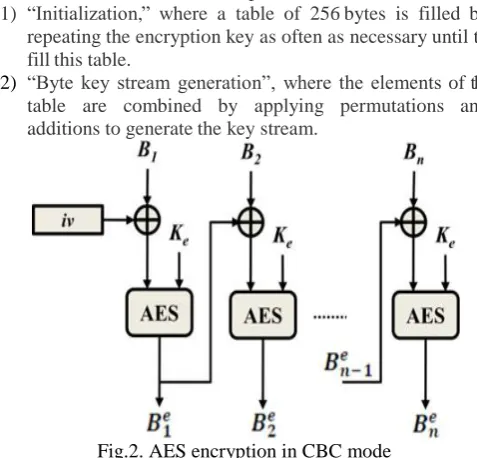
Where Ke is the encryption key. The reader may refer for a complete description of the AES. AES Encryption in CBC mode, Bi, denote the plaintext block, the encrypted block, and the encryption key, respectively. iv is a random vector initialization
AES in CBC Mode of Operation:
In this paper, we use the block cipher algorithm AES in the cipher block chaining (CBC) mode of operation in order to be compliant with the DICOM standard. The concept of mode of operation refers to the manner in which blocks of plaintext (sequence of bytes) are treated at the encryption stage (respectively, decryption stage). As depicted in Fig. 2, when the CBC mode is applied, a plaintext block is combined, with the previous cipher text block through a XOR operation before being encrypted with the AES. If we denote 𝐵𝑖𝑒the encrypted version of a block Bi and the previous encrypted block, 𝐵𝑖𝑒 is thus given by
Bie = AES Bi⊕ Bi−1e , Ke
A.2. Mapping Primitives:
In this mapping method of encryption we have several mappings in Chaotic maps like Arnold, Bernoulli, Bifurcation, Chebyshev, Mach-Zehnder interferometer etc.,
Arnold or Toral automorphism c- map:
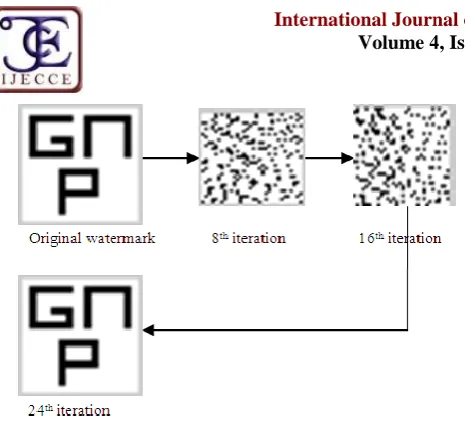
Chaotic systems are deterministic systems (predictable if you have enough information) that are governed by non-linear dynamics. These systems show deterministic behavior which is very sensitive to its initial conditions, in a way that the forthcoming results are uncorrelated and seem random. One category of chaotic systems is chaotic maps. A chaotic map, which can be considered a two dimension chaotic function, is also a tool that could relocate the pixels of an image and break spatial continuity. If we transform the resulting chaotic image in the frequency domain, the significant coefficients are highly increased in comparison with the respective transformed image as has been shown in [3]. Therefore the transformed chaotic image is richer in frequency content, a desirable property in watermarking, as there are more suitable candidate coefficients for manipulation and information embedding. Voyatzis and Pitas in [3] presented a watermarking scheme based on a two dimensional chaotic function, called ―toral auto orphism‖. This cyclic chaotic function, each time applied on a square image rearranges its pixels. After applied T times, where T is the period of the function, the pixels are found in their initial location. If (x, y) are the initial coordinates of a pixel, the outcome coordinates of the chaotic function (x’, y’) are given by
𝑋′
𝑌′
= 1 1
𝛼 𝛼 + 1 . 𝑋
𝑌
𝑚𝑜𝑑 𝑁
Copyright © 2013 IJECCE, All right reserved
B. Watermarking Primitives:
The Mixed transform Technique for Digital Image proposed by Chien-Pen Chuang , Cheng-Hung Liu , Yi-Tsai Liao , Huan-Wei Chi in [5] used to protect intellectual property right of digital image. A scale-invariant feature transform technique was employed for resisting geometric attacks and two dimensional bar code was used for its high capacity and fault tolerance to enhance digital watermarking capacity. Besides, the discrete wavelet transform (DWT) and discrete cosine transform (DCT) were joined to cope with noise problem and enhance perceptual transparency of watermarking image. The algorithm performance was presented with a plurality of experimental results, including several attack models such as lossy compression, scaling, blurring and sharpening etc. The experimental results proved the robustness of this mixed transformation technique on protecting intellectual property right of digital image.
The embedded watermarking algorithm adopted can be divided into five stages:
Stage 1: With scale-invariant feature transforms to extract feature information, so as to solve synchronization problem of watermarking.
Stage 2: In discrete wavelet transform domain, with noise visibility function to estimate watermarking embedded robustness.
Stage 3: In discrete cosine transform domain, in accordance with JPEG quantization table, to select embedded position for the watermark.
Stage 4: By Toral Automorphism to disturb watermarking sequence for embedding.
Stage 5: According to estimated robustness of watermark, to embed the watermark onto frequency domain coefficient of original image.
The watermark embedding can be explained with the following schematic
Fig.4. System Architecture
III.
P
ROPOSEDJ
OINTE
NCRYPTION ANDW
ATERMARKINGT
ECHNIQUEThe purpose of our system is to verify the reliability of the image within the special domain as well as the encrypted domain. The watermark is passes through the c-map for protection of the original watermark through which the encryption process is done and then the watermark is placed in the original aerospace image to be transmitted. This
encrypted watermark image is again subjected to the encryption through the AES method for the extra protection. Now this encrypted watermarked image is allowed for the watermarking followed by the decryption which result the image that can be transmitted.
Thus the encryption and watermarking can be joined together which gives justification for the title joint encryption and watermarking.
Fig.5. Watermark Embedding
The dual encrypted and watermarked image is taken/ received and encrypted first then the path for the detection of the watermark. Now the watermark detection is applied to the encrypted image. This detected image is obtained when the non-blind watermarking is used so the watermark detected image is decrypted using the AES decryption method and thus the last stage if encryption and decryption is cleared. Now the resulted image is de-watermarked using the blind watermarking technique which results the encrypted watermark. This watermark is decrypted using the c-map technique Arnold thus the original watermark is obtained.
Fig.6. Watermark extraction
IV.
I
MPLEMENTATION OFJ
OINTE
NCRYPTION ANDW
ATERMARKINGM
ETHODEarlier, our implementation works with AES and chaotic-maps encryption methods and the blind and non-blind watermarking methods. The methods and their implementation are stated as follows.
Choatic map Implementation:
Of all the chaotic maps we prefer the Arnold chaotic mapping or toral auto orphism for the present encryption. In this toral auto orphism the actual watermark is applied a toral transform say Arnold transform by using the formula
𝑋′
𝑌′
= 1 1
𝛼 𝛼 + 1 . 𝑋
𝑌
𝑚𝑜𝑑 𝑁
Copyright © 2013 IJECCE, All right reserved Fig.7. Choatic map implementation
In this mixed transform watermarking technique the process consists of four steps basically given as in[4]. 1) Estimating Watermarking Embedded robustness 2) Selecting watermark embedding positions 3) Disturbing watermark
4) Embedding watermark
In this estimating watermarking embedded robustness the actual image will be tested for the amount of watermark to be embedded, by dividing the actual image into blocks of size 8X8 an then calculating the NVF (Noise Visibility Function) which shows local texture change at a particular image position. Which can be obtained by knowing the local variance of the particular sub block.
The watermark embedding position is obtained by using the quantization tables as shown below:
Table 1: Chrominance-sub sampled 2:1
17 18 24 47 99 99 99 99
18 21 26 66 99 99 99 99
24 26 56 99 99 99 99 99
47 66 99 99 99 99 99 99
99 99 99 99 99 99 99 99
99 99 99 99 99 99 99 99
99 99 99 99 99 99 99 99
99 99 99 99 99 99 99 99
Table 2: Luminance
16 11 10 16 24 40 51 61
12 12 14 19 26 58 60 55
14 13 16 24 40 57 69 56
14 17 22 29 51 87 80 62
18 22 37 56 68 109 103 77
24 36 55 64 81 104 113 92
49 64 78 87 103 121 120 101
72 92 95 98 112 100 103 99
Now this blocks are applied through the toral auto orphism for the security (developed by scholars of G.Yoatis and I.Pitas) before watermarking embedding this is done using the formula..
𝑋′
𝑌′
= 1 1
𝛼 𝛼 + 1 . 𝑋
𝑌
𝑚𝑜𝑑 𝑁
AES encryption implementation :
This encryption method is implemented mainly using 4 steps which are shown as follows.
Fig.8. AES Encryption Implementation
Thus applying these steps on an image the encryption methods are carried out and thus the image will get encrypted. These steps are followed based on the round around key given by the AES method.
Non Blind Watermark Embedding algorithm:
In this non-blind watermarking algorithm the actual image pixels are added by the watermark pixels by multiplying them with a constant factor say α.
The implementation can be given as
𝑊𝑚 = 𝐼𝑚 + 𝛼 × 𝑤
Where Im is the original Image α is the scaling factor
w is the watermark image.
Wm is the resultant watermarked image.
V.
P
ERFORMANCEE
VALUATION ANDD
ISCUSSIONExperiments are conducted on the aerospace images and thus the reliability is verified
Image Distortion:
We are using Peak Signal to Noise Ratio (PSNR) in order to measure the distortion between the image (I) and its watermarked and deciphered version (Iwd)
The formulae to calculate the distortion is given as follows
Where L corresponds to the length of the pixels of Image (I) and d corresponds to its depth. Our choice relies on the fact that the algorithm we proposed in Section IV introduces on average the same image distortion in each block, thus spreading it over the whole image. Furthermore, it does not take advantage of a psycho visual model which is helpful to adapt the watermark amplitude locally into the image, making at the same time the PSNR not appropriate. Even though there exist some models for natural images, none of them have been proved adapted for aerospace imaging yet.
Copyright © 2013 IJECCE, All right reserved merely withstands JPEG compression down to quality 20
(with PSNR = 56.34 dB in [1]) opposed to JPEG compression with quality factor 5 and PSNR 64.34 dB presented in this work
Image Correlation:
The robustness of the watermark depends on the strength parameter (strength) used during the embedding procedure. As the strength increases the robustness of the scheme raises respectively. Nevertheless, the quality of the watermarked image is conversely proportional to strength parameter and robustness.
The correlation method is based on the fact that the sequence generated is normally distributed with zero mean and unit variance. The correlation factor varies depending on the starting coefficient and the number of coefficients affected (N).
In our experiments the acceptable PSNR threshold (PSNTthres) was set to 60, while the correlation threshold (corthres) which determines whether an image is watermarked or not was set to 4. Strength parameter for the embedding procedure was set to 0,5 and a series of images were used for experimentation. For most images the results were similar, therefore due to limited space, only the results regarding Lena are presented in this work, for comparisons with other methods. Achieving correlation factor of 15.60 dB with a PSNR value of 60.00 dB.
R
EFERENCES[1] ―A Joint Encryption/Watermarking System for Verifying the Reliability of Medical Images‖ Dalel Bouslimi, Member, IEEE, Gouenou Coatrieux, Member, IEEE, Michel Cozic, - IEEE TRANSACTIONS ON INFORMATION TECHNOLOGY IN BIOMEDICINE, VOL. 16, NO. 5, SEPTEMBER 2012
[2] ―Chaotic-Correlation Based Watermarking Scheme for Still Images‖ E.Chrysochos V.Fotopoulus M.Xenos Proceedings of ―Applied Electronics 2008‖ Int. Conference, Pilsen, Czech Republic, 10-11 September 2008.
[3] ―Applications of toral automorphisms in image watermarking‖ G.Voyatzis and I.Pitas.
[4] ―A Robust Digital Watermarking with Mixed Transform Technique for Digital Image‖ Chien-Pen Chuang , Cheng-Hung Liu , Yi-Tsai Liao , Huan-Wei Chi – Proceedings of the International multiConference of Engineers and Computer scientists 2012 vol I IMECS 2012 march 14-16 Hong Kong
[5] ―G. Coatrieux, H. Maˆıtre, B. Sankur, Y. Rolland, and R. Collorec, ―Relevance of watermarking in medical imaging,‖ in Proc. IEEE EMBS Int. Conf. Inf. Technol. Appl. Biomed., 2000, pp. 250–255. [6] G. Coatrieux, C. Le Guillou, J.-M. Cauvin, and C. Roux,
―Reversible watermarking for knowledge digest embedding and reliability control in medical images,‖ IEEE Trans. Inf. Technol. Biomed., vol. 13, no. 2, pp. 158–165, Mar. 2009.
[7] U. Rajendra Acharya, D. Acharya, P. Subbanna Bhat, and U. C. Niranjan, ―Compact storage of medical images with patient information,‖ IEEE Trans. Inf. Technol. Biomed., vol. 5, no. 4, pp. 320–323, Dec. 2001.
[8] W. Pan, G. Coatrieux, N. Cuppens-Boulahia, F. Cuppens, and C. Roux, ―Medical image integrity control combining digital signature and lossless watermarking,‖ Data Privacy Manage. Autonom. Spontaneous Sec. (LNCS), vol. 5939/2010, pp. 153–162, 2010.
A
UTHOR’
SP
ROFILEB. Santosh Kumar
obtained B.Tech., from GMRIT, Rajam, Srikakulam and pursuing M.Tech., in GMRIT, Rajam, Srikakulam, A.P., India. His area of interest is image processing.