MODERATING CUSTOMER RELATIONSHIP MANAGEMENT (CRM) TO ENHANCE FIRM PERFORMANCE THROUGH CONTINUOUS PRODUCT DEVELOPMENT
Oladele Olajide Patrick, Ph.D Associate Professor of Business Administration
Ekiti State University [email protected]
ABSTRACT
The banking sector in Nigeria went through various reforms in the last few years and this has resulted in stiff competition in the industry. Based on this the few surviving ones are making concerted efforts to stabilize in the ever changing competitive and uncertain business environment. More importantly, the banks have come to realized that building long-term relationship with their customer is sine qua non to achieving sustainable competitive advantage. This study examines the link between customer relationship management and performance on the banking sector. The researcher built a model using continuous product development to moderate the effect that CRM has on bank performance. Data using primary source was collected from the financial market through a cross sectional survey in Ekiti State, Nigeria. Two pretests of the questionnaire were performed for validity and reliability assessment. Based on extensive review of literature, a 54 item capturing all major sub processes in implementing CRM was evaluated. The Data collected were fitted into regression model. The result indicates that CRM implementation processes are associated with better firm performance more importantly when it is moderated by continuous product development.
Keywords: Continuous Product Development, Customer Orientation, Customer Relationship Management, Improved Marketing Strategy, Performance
INTRODUCTION
It is crystal clear to many organizations these days that the customer has graduated from being the ‘king’ to being the ‘business’ which if ignored, is at their peril (Oladele, 2006). Some customers are willing to change where they buy services or products, and others are unwilling. Harsh economic conditions are forcing consumer to become more prudent and selective in his buying decision (Oladele, 2009). Product and service providers are now constantly reminded of the increased sophistication of the consumer which has made him have more discrete choice of market offerings. We are also witnessing increased competition and standardization of goods and services in the market places as the number of distributors of products have multiplied thereby increasing options for the consumers.
Whatever service we provide, we have the responsibility not only to personalize our relationships but more importantly to develop and sustain our customer loyalty. More than ever before the ability to maximize customer loyalty through close and durable relationship is critical to firms’ ability to grow their business. As firms strive to create and manage customer relationships, several emerging trends affect the approach and tools they employ to achieve sustainable growth. These trends reflect a fundamental change in the way firms interact with the customers they have and those they want to acquire. To build stronger customer loyalty, firms need improved customer knowledge to develop products and deliver services targeted at specific market segments resulting in more directed marketing, sales and service tactics. They need to evaluate their customer management strategy in order to optimize the customer experience and increase satisfaction and profitability. Firms must move out of their comfort zone and develop products and services that address the specific needs of different market segments
An Executive Guides from Darwin Publication identified some keys to successful CRM implementation. Keys to Successful CRM implementation.
There are six basic keys to successful CRM implementation which can be identified as follows:
ii. The management should ensure that CRM plans include a scalable architectural framework. iii. The management should not underestimate how much data they might collect (there will be LOTS)
and be sure that if they need to expand systems, they will be able to.
iv. They should be thoughtful about what data they are collecting and storing. The impulse will be to grab and then store EVERY piece of data can, but there is often no reason to store data.
v. The organisation should recognize the individuality of customers and respond appropriately. A CRM system should for example, have built-in pricing flexibility.
vi. The management should maintain continuous product development and innovation.
The summation of the above key point to improved CRM and consequent organisational efficiency and effectiveness. This paper however focuses on the sixth key which is continuous product development as a tool to enhancing firm financial performance.
The emphasis on continuous product development stems form the findings of Eggert, Ulaga and Schultz (2006) which states that when CRM is well moderated and nominated it improves support for product development and consequent increased revenue.
The paper then intends to moderate CRM to enhance financial performance through continuous product development
The continuous development and launching of new products is an important determinant of sustained firm (Sorescu and Spanjol, 2008, Zhou et al, 2005). While continuous product improvement opens up growth opportunities the for failure may be significant and one potential strategy for reducing this for sustaining and retaining customer is to align with market requirement (Ernst 2002, Henard and Szymanski, 2001).
Im and Workman, (2004); Joshi and Sharma, (2004) in their studies have shown a positive impact of overall market or customer orientation on new product success. Ernst et al (2010) in their studies also emphasized an integrated and systematic organisational framework for leveraging customer knowledge on an ongoing basis for product performance. But product innovation is an antecedent of product success.
Many studies have focused on CRM in terms of technology, information sharing and product performance. Infact thinking about CRM in primarily technological terms is likely to be a mistake. Perhaps, the more useful way to think about CRM is as a process of providing better customer service; discover new customer and enhancing and exceeding customer expectation through continuous product development. The major aim of this paper is to conduct an investigation into the relationship between CRM and firm financial performance with a mediating effect of continuous product development in the financial sector.
LITERATURE REVIEW
Customer Relationship Management as conceptualised by Oghojafor et.al, (2011) is a process companies utilize to understand and react to customers’ evolving desires, utilizing detailed customer acquisition, loyalty, satisfaction and profitability. Vavra (1992) consider CRM only as seeking customer retention by using a variety of after marketing tactics that lead to customer bonding or staying in touch with the customer after a sale is made. Another important facet of CRM is viewed as a comprehensive strategy and process of acquiring, retaining and partnering with selective customers to create superior value for the company and the customer. It involves the integration of marketing, sales, customer service, and the supply-chain functions of the organisation to achieve greater efficiencies and effectiveness in delivering customer value (Parvatiyar and Sheth, 2001). From this definition the aim of CRM is to improve marketing productivity. Marketing productivity is achieved by increasing marketing efficiency and by enhancing marketing effectiveness (Sheth and Sisodia, 1995). Berry (1995), in a broader terms proposed that relationship marketing be seen as attracting, maintaining and in multi-service organizations enhancing customer relationships. The Berry argument was in consonant with Gronroos (1990), Gummeson (1987), and Levitt (1983). For instance Gronroos and Gummeson maintained that relationship with customers be the focus and dominant paradigm of marketing because marketing is to establish, maintain, and enhance relationships with customers and other partners at a profit, so that the objectives of the parties involved are met.
This study conceptualizes CRM as a process to initiate new product by enhancing and delivering superior value to customers.
and defining market strategy from outside in. This means the focus should be on customer needs rather than on product features. Thus the need for banks to better understand their customers and provide personalized customer service. The task of the second stage involves moving beyond the basics by not resting on their laurels but rather push firms’ development of customer orientation by integrating CRM across the entire customer experience chain through the use of technology to achieve real-time customer management and by constantly innovating their value proposition to customers (IDC and Cap Gemini, 1999).
It should be noted that CRM is a complement of the relationship marketing perspectives and continuous product development should be used to cement that relationship. Thus, Couldwell (1998) sees CRM as a combination of business process and technology that seeks to understand a company’s customers from the perspective of who they are, what they do and what they’re like. Looking at relationship marketing, CRM focus is on how to retain customer (Lockard, 1998; Deighton, 1998) and relationship development (Galbreath, 1998).
Kutner and Cripps (1997) assert that CRM is established on four relationship building tenets: Customers should be managed as important assets.
Customer profitability varies and not all customers are equally desirable.
Customers vary in terms of their needs, preferences, buying behaviour and price sensitivity.
By understanding customer drivers and customer profitability, companies can tailor their offerings to maximize the overall value of their customer portfolio.
Ueno (2006) in an occasional paper for the US-Japan relations asserts that marketing operations consist of two sets of activity:- acquisition and retention of customers. The acquisition of customer is dominant in the world of target marketing and retention of customer is the focus in relationship marketing world. Hence, Gray and Byun (2001) maintain that it is 5 to 10 times more expensive to acquire a new customer than obtain repeat business from an existing customer because as the needs of customers became diversified conventional promotions became less efficient and drove costs up.
The Pareto principle provides a well-known empirical work in this paper. It assumed that 20% of a firm’s customers generate 80% of its profit. Hence retention of a large customer base is a major issue (Wikipedia, 2006).
The focus of many studies on CRM have been on analysing how customer acquisition retention, cross-selling, loyalty programmes and others affect firm performance (Reinartz, (2004). The role of CRM can be effectively used, to leverage current product portfolio (Ernst et al 2010), as well as continuous product innovation.
Boulding et al, (2005) in their study of Xerox firm, concluded the firm only managed to improve customer relationship for existing products but failed to leverage the potential of new technologies and products which led to low market performance. Prior research studies have found a significant impact of CRM on firm performance (Boulding et al, 2005; Reinartz et al, 2004) and more recently the work of Ernst et al (2010) emphasizing product performance. This study suggests continuous product development as a panacea toward leveraging CRM for superior bank financial performance.
Product development is the introduction of a good or service that is new or significantly improved regarding its characteristics or intended use (OECD Oslo Manual, 2005).
Research Evidence between CRM and Firm Financial Performance
CRM represents a strategy for creating value for both the firm and its customers through appropriate use of technology, data, and customer knowledge (Payne and Frow, 2005). This strategy requires focus, training and investment in new technology and software to aid in the development of value adding CRM systems (Day and Van den Bulte, 2001).
Therefore CRM brings together people, technology, organisational capabilities (Coltman, Devinney, and Midgley) to development new products in order to ensure connectivity between the firm, and its customers.
Research Evidence between Product Innovation and Firm Performance
Peffers, 1995; McGrath et al, 1996; Gao and Fu, 1996; Han et al, 1998; Olson and Schwab, 2000; Hult and Ketchen, 2001; Du and Farley, 2001 Glantone et al, 2002; Garg et al, 2003; Wu et al, 2003). Particularly, Atuagene – Gima (2001), Subramanian and Nilakanta (1996), Han et al, (1998) and Li and Atuagene – Gima (2001) focus on product innovations. Pauwels et al, (2004) conducted a study on new product introduction and sales promotion and found that new product introductions increase long-term financial performance and firm value, but promotions do not.
For most firms, successful new products are engines of growth (Cohen, Eliashberg and Ho, 1997), Menge, (1962), Farr, (2000). Several models such as the product-life cycle and the growth-share matrix have postulated the need for new products that generate future profitability and prevent the obsolescence of the firm product line (Cooper, 1984; Chaney, Devinney and Winer, 1991).
Research Relationship between CRM and Product Innovation
Changes in customer expectations can be identified throughout the world. Hence, CRM strategies have become increasingly important worldwide due to these changes in expectation from customers as well as changes in the nature of markets (Berndt et al, 2005). The implementation of CRM is regarded as desirable by organisations due to the benefits that accrue from these strategies among their customers, such as greater loyalty and resulting profits (Frei, et al 1997). This is why Kotler, (1997) assertion on CRM focus on retention deals with ensuring that customer continues to purchase and support the firm products.
In the banks today investment in PC banking technology is growing on the increase (Frei and Kalakota, 1997) so as to introduce new ways for customers to access their account balances, transfer funds, pay bills, buy goods and services without using cash and mailing cheque. This therefore, helps to cement relationship between customers and help bank gain new customers (Frei, Harker, and Hunter, 1997).
CONCEPTUAL FRAMEWORK
The researchers try to measure the effects of CRM on bank performance. Therefore customer relationship management will impact on the performance of banks. The conceptual framework was developed by considering the problem after detailed analysis of prevailing literature. The dependent variable of this study is the level of performance of banks and only one independent variable to support the dependent variable. The identified independent variable of this study is CRM. Triablehis will consist the level of usage of CRM strategies. There is a moderator variable that moderates the relationship between independent and dependent variables. This is continuous product development. This consist the level at which the bank has the affinity to innovate. Thus, from the literature support, the following conceptual framework is proposed.
Independent
Dependent
Moderating Variable
According to the above conceptual framework the following hypotheses was derived. H1: Bank level of performance is dependent on the level of CRM.
H2: Bank level of performance is moderated by the level of continuous product development.
DESIGN AND METHODOLOGY
In order to test our framework, data using primary source was collected. A cross-sectional survey was conducted in Ekiti state, Nigeria. We limited our investigation to financial market since business activities in the state are hinged upon activities in the financial market. Also, banks were selected based on characteristics such as having a large customer base, intensive usage of a variety of channels to market their products, professionalism in CRM activities, and market pressure to differentiate from the competition. A pretest of the questionnaire was performed on a small sample of marketing managers and CRM experts of the sampled financial firms. Then, a second pre-test of the questionnaire was performed to assess the validity of the scales. The final questionnaire was sent to a sample of 100 respondents across the sampled state.
CRM
Performance
In more than 70% of the cases, the research instrument was filled out by senior executives such as marketing or sales executives. These executives were knowledgeable key informants about information concerning CRM design since they are directing entities which in most cases are responsible for CRM activities. Based on an extensive review of relevant articles, we identified 54 items that were evaluated by participants of pre-test interviews as capturing all major sub-processes in implementing CRM at the customer-facing level. A five-point Likert format was used for rating. Data collected were fitted to regression model, pearson product moment correlation matrix and analysis of variance. The regression model is explicitly specified as;
Economic performance = α + β
1 CRM+ u
Economic performance = α + β
1 CPD+ u
Economic performance = α + β
1 CRM+ β1 CPD+ u
Where
CRM represent customer relationship management
CPD represent continuous product development
RELIABILITY AND VALIDITY OF RESEARCH INSTRUMENT
Reliability is an assessment of the degree of consistency between multiple measurements of a variable (Pallant, 2004). Cronbach's alpha was used to assess the internal consistency of the entire scale. According to Pallant (2004), reliability scores greater than 0.70 are acceptable. As all of the items for this study had an alpha above the standard guideline of 0.70, the scales are suitable for analysis with acceptable reliability. Cronbach’s alpha score of 0.914 was obtained for the entire scale. This indicates that there is internal consistency of the entire variable scale and that variables construct exhibited strong internal reliability. The results, therefore, confirmed that the instrument used for this study had satisfactory construct validity.
RESULTS AND DISCUSSION Hypothesis one
H1: Bank level of performance is dependent on the level of CRM.
The estimated specification (β= 0.824; p < .05) indicates that CRM is positively and significantly influence performance of banks. The result indicates that the implementation of CRM processes is associated with better company performance. The F-statistic (Table 2) estimates (F= 34.284) also indicate the relevance of CRM in the performance of financial firms such as banks.
Table 1: CRM and Performance
Model Coefficient Standard error
Constant 0.604 0.561
CRM 0.824 0.141*
*, Significant at 5%
Table 2: ANOVA from regression estimates
Model Sum of squares df Mean square F
Regression 10.987 1 10.987 34.284*
Residual 20.830 99 0.320
Total 31.816 100
*, significant at 5%
Hypothesis two
H2: Bank level of performance is moderated by the level of continuous product development.
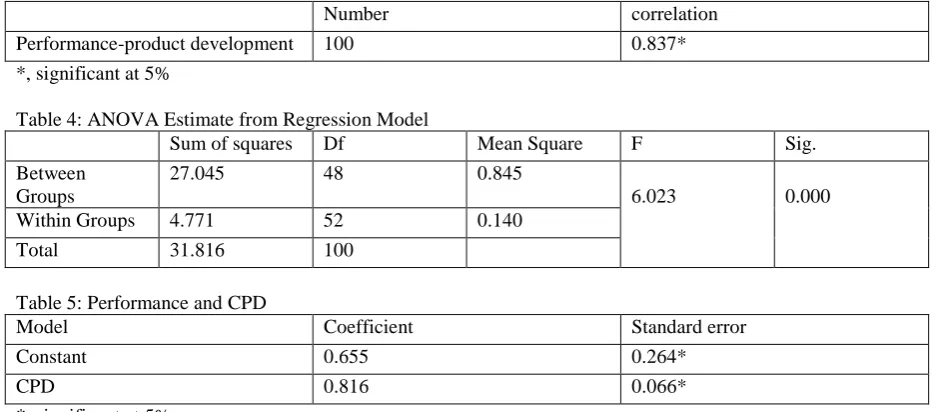
estimation from regression model indicates that a unit change in CPD would increase performance of banks by 0.816. The result is significant at 5 per cent level (Table 5)
Table 3: Correlation matrix of variables
Number correlation
Performance-product development 100 0.837*
*, significant at 5%
Table 4: ANOVA Estimate from Regression Model
Sum of squares Df Mean Square F Sig.
Between Groups
27.045 48 0.845
6.023 0.000
Within Groups 4.771 52 0.140
Total 31.816 100
Table 5: Performance and CPD
Model Coefficient Standard error
Constant 0.655 0.264*
CPD 0.816 0.066*
*, significant at 5%
CONCLUSION
Moderating customer relationship management represents means to enhance firm financial performance through continuous product development. The continuous development and launching of new products is an important determinant of sustained firm. The finding of the study indicates that the implementation of CRM processes is associated with better company performance. Similarly, continuous product development is found to positively influence performance of firms. Thus the study recommends that firms should enhance their productive capacity to ensure efficient customer relationship through continuous product development.
REFERENCES
1. Atuahene, G. K. (1996). Market Orientation and Innovation. Journal of Business Research. 35, 93-103. 2. Berndt, A., Herbst, F. and Roux, L. (2005). Implementing A Customer Relationship Management
Programme in an Emerging Market. Journal of Global Business and Technology, 1(2) 81-89.
3. Boulding,W., Staelin, R., Ehret, M. & Johnston, W. J. (2005). A Customer Relationship Management
Roadmap: What is Known, Potential Pitfalls, and Where to Go? Journal of Marketing, 69(4), 155–166.
4. Calantone, R.J., Cavusgil, S.T. & Zhao, Y. (2002). Learning orientation, firm innovation capability, and firm performance. Industrial Marketing Management. 31, 515-524.
5. Chaney, P. K., Devinney, T. M., and Winner, R. S. (1991). The Impact of New Product Introductions on the Market Value of Firms. Journal of Business, 64(4), 573–610.
6. Cohen, M. A., Eliashberg, J., & Ho, T. H. (1996). New Product Development: The Performance and Time-to-Market Tradeoff. Management Science, 42 (Feb), 173-186.
7. Cooper, R. (1984). How New Product Strategies Impact on Performance. Journal of Product Innovation Management, 1, 5-18.
8. Couldwell, C. (1998). A data day battle, Computing. 21 May, 64-66.
9. Damanpour, F., & Evan, W. M., (1984). Organisational innovation and performance: the problem of “Organisational Lag”. Administrative Science Quarterly, 29(3), 392-409.
10. Damanpour, F., Szabat, K.A. & Evan, W.M. (1989). The Relationship between Types of Innovation and Organizational Performance. Journal of Management Studies, 26(6), 587–601.
11. Day, G. S., & Bulte, D. C. (2002). Superiority in Customer Relationship Management: Consequences for Competitive Advantage and Performance. Working Paper, Wharton School, University of Pennsylvania.
12. Deighton, J. (1998). The Future of Interactive Marketing. Harvard Business Review, 74(6), 151–160. 13. Deshpande, R., Farley, J.U. & Webster, F.Jr. (1993). Corporate culture, customer orientation, and
Innovativeness in Japanese firms: A quadrate analysis. Journal of Marketing 57, 23–27.
14. Dos Santos, B.L., & Peffers, K. (1995). Rewards to investors in innovative information technology applications: first movers and early followers in ATMs. Organisation Science, 6, 241-259.
16. Eggert, A., Ulaga, W., & Schultz, F. (2006). Value creation in the relationship lifecycle: A quasi-longitudinal analysis. Industrial Marketing Management, 35(1), 20−27.
17. Ernst, H., Hoger, D. W., Kraffrim., Krieger, K. (2010). CRM and Company Performance – The mediating Role of New Product Performance. Journal of the Academy of Marketing Science. 39 (2), 290-306.
18. Farr, M. (2000) Automobile Industry. Hoover’s Online. February.
19. Frei, F. X. and Kalakota, R. (1997). Frontiers of Online Financial Services in M. J. Cronin (ed.), Banking and Finance on the Internet (New York: Van Nostrand Reinhold Press).
20. Frei, F.X., Harker, P.T., and Hunter, L.W. (1997). Innovation in Retail Banking. Working Paper. Wharton Financial Institutions Center, Jan.
21. Galbreath, J. (1998). Relationship Management Environments. Credit World, 87(2),14–21.
22. Gao, J., & Fu, J. (1996). Key issues on technological innovation in Chinese enterprises. Science and Technology Policy and Management, 1, 24-33.
23. Garg, V.K., Walters, B.A., & Priem, R.L. (2003). Chief executive scanning emphases, environmental dynamism, and manufacturing firm performance. Strategic Management Journal, 24, 725-744.
24. Gray, P., and Byun J. (2001). Customer Relationship Management. pp 10. Wikipedia: The Free Encyclopedia. 21 June 2006. http://en.wikipedia.org/wiki/Pareto_principle
25. Gronroos, C. (1990). Relationship Approach to Marketing in Service Contexts: The Marketing and Organizational Behavior Interface. Journal of Business Research, 20, 3-11.
26. Gummesson, E. (1987). The New Marketing: A Developing Long-Term Interactive Relationships. Long Range Planning, 20 (4), pp. 10-20.
27. Han, J. K., Kim, N., and Srivastava, K. R. (1998). Marketing Orientation and Organisational Performance: Is Innovation a Missing Link? Journal of Marketing, 62(4), 30-45.
28. Han, J.K., Kim, N., & Srivastava, R.K. (1998). Market orientation and organisational performance: is innovation the missing link? Journal of Marketing, 62 (4), 30-45.
29. Hult, G.T., Ketchen Jr., D.J. (2001). Does market orientation matter? A test of the relationship between positional advantage and performance. Strategic Management Journal, 22, 899-906.
30. IDC and Cap Gemini (1999). Four elements of customer relationship management. Cap Gemini White Paper.
31. Kotler, P. (1997). Marketing Management: Analysis, Planning, Implementation, and Control. New Jersey: Prentice Hall International.
32. Kutner, S., and Cripps, J. (1997). Managing the customer portfolio of healthcare enterprises. The Healthcare Forum Journal. 40(5), 52–54.
33. Levitt, T. (1983). After the Sale is over. Harvard Business Review, pp. 87-93. 34. Lockard, M. (1998). Test your retention IQ’, Target Marketing, Vol. 21(3), 32–41.
35. McGrath, R.G., Tsai, M.H., Venkataraman, S., & MacMillan, I.C. (1996). Innovation, competitive advantage and rent: A model and test. Management Science, 42, 389-403.
36. Menge, J. A. (1962). Style change costs as a market weapon. Quarterly Journal of Economics, 76, 632-647.
37. OECD, (2005). Oslo Manual: Proposed Guidelines for Collecting and Interpreting Technological Innovation Data. Paris.
38. Oghojafor, B. E. A., Aduloju S. A., and Olowokudejo, F. F. (2011). Information technology and customer relationship management (CRM) in some selected insurance firms in Nigeria. Journal of Economics and International Finance, Vol. 3(7), pp. 452-461.
39. Oladele, O. (2009). Essentials of Marketing Management. Niyak Print and Publications, Lagos. 40. Olson, C.A., Schwab, A., 2000. The performance effects of human resource practices: the case of
interclub networks in professional baseball, 1991-1940. Industrial Relations 39, 553-577.
41. Pallant, J. (2004). SPSS Survival Manual: A Step by Step Guide to Data Analysis Using SPSS. Maidenhead, Berkshire, United Kingdom: Open University Press, McGraw- Hill Education.
42. Parratiyar, A., & Sheth, J. N. (2001). CRM: Emerging Practice, Process, and Discipline. Journal of Economic and Social Res. 3(2). 1-34.
43. Pauwels, K., Silva-Risso, J., Srinivasan, S. and Hanssens, D. M. (2004). New Products, Sales Promotions and Firm Value, With Application to the Automobile Industry. Journal of Marketing. September. 1-15.
44. Paye, A. & Frow, P. (2005). Strategic Framework for CRM. Journal of Marketing, 69 (4), 167-176. 45. Reinartz, W., Krafft, M., and Hoyer, W. D. (2004). The Customer Relationship Management Process:
Its Measurement and Impact on Performance. Journal of Marketing Research, 41, 293–305.
47. Siomkos, G. J. and Tsiames, I. S. (2006). Analytical CRM Technologies in Financial Services Institutions. Int. Journal of Financial Services Management, 1(2/3), 215-231.
48. Szymanski, D. M., and David H. H. (2001). Customer Satisfaction: A Meta-Analysis of the Empirical Evidence. Journal of the Academy of Marketing Science. 29, 16–35.
49. Ueno, S. (2006). The Impact of CRM. U.S.-Japan Occasion Paper. 06-13. Program on US-Japan Relations. Cambridge.
50. Vavra, T. G. (1992). After Marketing: How to keep customer life through relationship marketing. Business One-Irwin, Homewood, II.