Journal of Agriculture, Food Systems,
and Community Development
Volume 3, Issue 3
Spring 2013
Published online at www.AgDevJournal.com
New Leaf Associates, Inc.
ISSN 2152-0801 (online only)
Surf and Turf
Ardyth Harris Gillespie, Nutritional Sciences, Cornell Univ. (USA) (cochair)
Heidi Mouillesseaux-Kunzman, Development Sociology, Cornell Univ. (USA) (cochair)*
Pierre Clavel, City and Regional Planning (Emeritus), Cornell Univ. (USA)
Cheryl Danley, Center for Regional Food Systems, Michigan State Univ. (USA)
Mary Jo Dudley, Development Sociology and Cornell Farmworker Program, Cornell Univ. (USA) Gilbert W. Gillespie, Cornell Univ. (Retired) (USA)* Joanna Green, Groundswell Center for Local Food &
Farming, Ithaca, NY (USA)
Richard Kiely, Center for Community Engaged Learning and Research, Cornell Univ. (USA)
Scott Peters, Imagining America, Syracuse Univ. (USA) Ricardo Salvador, Union of Concerned Scientists (USA) Jennifer Wilkins, Nutritional Sciences, Cornell Univ.
(USA)
JAFSCD Advisors
Laura Brown, Univ. of Wisconsin Cooperative Extension (USA)*
Kate Clancy, Minnesota Institute for Sustainable Agriculture (USA) †
Nevin Cohen, The New School (USA)* David Conner, Univ. of Vermont (USA)* Cornelia Butler Flora, Iowa State Univ. (USA) Julia Freedgood, American Farmland Trust (USA)* R. Bruce Gregory, Farmer, Mitchell Bay Farm & Nursery
(USA)*
Shermain Hardesty, Univ. of California (USA)* John Ikerd, Univ. of Missouri, Columbia (Emeritus)
(USA)†
Anupama Joshi, National Farm to School Network/Occidental College (USA)* Larry Lev, Oregon State Univ. (USA)
Joseph McIntyre, Ag Innovations Network (USA)* † Ken Meter, Crossroads Resource Center (USA)* † Rich Pirog, Iowa State Univ. (USA)
Ken Robinson, Clemson Univ. (USA) John Smithers, Univ. of Guelph (Canada)
G. W. (Steve) Stevenson, Univ. of Wisconsin-Madison (USA)
Dawn Thilmany McFadden, Colorado State Univ. (USA) Mark Winne, Community Food Security Coalition (USA) Larry Yee, Fairhaven Strategy Group (USA)
Rami Zurayk, American Univ. of Beirut (Lebanon)*† *Also serves on editorial committee
† Also writes a regular column
JAFSCD Reviewers
Paivi Abernethy, Univ. of Waterloo (Canada) Mahbubul Alam, Ehime Univ. (Japan) Colin Anderson, Univ. of Manitoda (Canada) Hossein Azadi, Ghent Univ. (Belgium) Sandip Banerjee, Hawassa Univ. (India) Herb Barbolet, Simon Fraser Univ., Centre for
Sustainable Community Development (Canada) Mary Margaret Barth, Responsible Source, UIUC (USA) Ricky Martin Bates, Penn State Univ. (USA) Dani E. Battle, Patriot RC&D (USA) Mark Bauermeister, Iowa State Univ. (USA) Molly K. Bean, The Ohio State Univ. (USA) Mihaela Begea, Institute of Food Research (Romania) Ghose Bishwajit, Tong Ji Medical College (China) Eliav Bitan, National Wildlife Federation (USA) Colleen Boodleman, Univ. of Arizona (USA) Rachelle Bostwick, Farmer, Earthkeeper Farm (USA) Mladen Brnčić, Univ. of Zagreb (Croatia) Megan Carney, U.C.–Santa Barbara (USA) Marcia Caton Campbell, Center for Resilient Cities
(USA)
Renee Ciulla, Instituto Ricerche Economico Sociale (USA)
Sean Connelly, Alberta Social Economy Research Alliance Centre for Sustainable Community Development (Canada)
Christine Costello, Cornell Univ. (USA)
Sasha Cuerda, Univ. of Illinois at Urbana-Champaign (USA)
Carolyn Dimitri, New York Univ. (USA) Michael L. Dougherty, Illinois State Univ. (USA) Leslie Duram, Southern Illinois Univ. (USA) Ayman Ekram Fahim, Suez Canal Univ. (Egypt) Hamid El Bilali, Mediterranean Agronomic Institute of
Bari (CIHEAM-MAIB) (Italy)
Patti Taranto Erickson, Salisbury Univ. (USA) Mark Estep, Montana Mobile Processing Company
(USA)
James R. Farmer, Earlham College (USA) Melissa Fernandez Arrigoitia, London School of
Economics (UK)
Ian Finch, Univ. of Montana (USA) Rok Fink, Univerza v Ljubljani (Slovenia) Danielle Nicholas Fisher, Eagle Ridge Ranch (USA) Jill Ann Fitzsimmons, Univ. of Massachusetts–Amherst
(USA)
Katherine Flynn, SAFE Consortium (France) Nancy Franz, Iowa State Univ. (USA) Lynn Fredericks, FamilyCook Productions (USA) Jasenka Gajdoš Kljusurić, Univ. of Zagreb (Croatia) Hanna Garth, Univ. of California–Los Angeles (USA) Angela Gordon Glore, AmeriCorps/VISTA (USA) Carol Goland, Ohio Ecological Food and Farm
Association (USA)
Sheila L. Gray, Washington State Univ.–Lewis County Extension (USA)
Arthur Green, Okanagan College (Canada) John Guszkowski, CME Associates, Inc. (USA) Ella Haley, Athabasca Univ. (Canada) Edmund Harris, Clark Univ. (USA)
Amber A. Heckelman, Washington State Univ. (USA) Elizabeth Hill, Univ. of Maryland Extension (USA) Leslie Hossfeld, Univ. of North Carolina–Wilmington
(USA)
Susanne Howard, Missouri State Univ. (USA) Guiping Hu, Iowa State Univ. (USA)
Lauren Hunter, Coop. Extension, Univ. of Idaho-Blaine County (USA)
Lucilla Iacumin, Univ. of Udine (Italy) Valerie Imbruce, Bennington College (USA) Martin Kabaluapa, World Food Programme (Kenya) Sanjay Kharod, New Orleans Food and Farm Network
(USA)
Joel Kimmons, Centers for Disease Control and Prevention (USA)
Franz Klingender, Canada Agriculture Museum (Canada) David A. Knauft, Univ. of Georgia (USA)
Fiona Knight, Private food system consulting practice (Canada)
Uma Koirala, Tribhuvan Univ. (Nepal) Jane Kolodinsky, Univ. of Vermont (USA) Laura Lavid, American Community Gardening
Association (USA)
John D. Lee, Farmer, Allandale Farm, Inc. (USA) Dale Levering, LCC International Univ. (Lithuania) Matt Lobley, Univ. of Exeter (UK)
Bohdan Lojka, Czech Univ. of Life Sciences (Czech Republic)
Samya Lutz, Whatcom County (USA) Uford A. Madden, Florida A&M Univ. (USA) William Armand Mala, Univ. of Yaounde I (Cameroon) Christian Man, Vanderbilt Univesity (USA) Lisa Markowitz, Univ. of Louisville (USA)
(Canada)
Florentina Matei, Universitatea de Stiinte Agronomice si Medicina Veterinara – Bucuresti (Romania) Allen Matthews, Chatham Univ. (USA) Nathan McClintock, Portland State Univ. (USA) Mike McDonald, Florida Gulf Coast Univ. (USA) Jesse C. McEntee, Cardiff Univ. (UK)
Devan McGranahan, Sewanee: The Univ. of the South (USA)
Kim McMann, Berkshire Community Action Council (USA)
Mahbubur R. Meenar, Temple Univ. (USA) Bethann G. Merkle, Missoula Urban Demonstration
Project (USA)
Farhad Mirzaei, Animal Sciences Research Institute of Iran (Iran)
Bernadette Montanari, Univ. of Kent, Canterbury (UK) Alfonso Morales, Univ. of Wisconsin–Madison (USA) Sunshine Morrison, Univ. of Latvia and Wageningen
Univ. (Latvia and the Netherlands) Vicki Morrone, Michigan State Univ. (USA) Phil Mount, Univ. of Guelph (Canada) Scot Nelson, Univ. of Hawaii at Manoa (USA) Kim L. Niewolny, Virginia Tech (USA) Kimberly Norris, Univ. of Maryland (USA) Lydia Oberholtzer, Penn State Univ. (USA) Fernando Ona, Indiana Univ. (USA) Aleck Ostry, Univ. of Victoria (Canada)
Isidro Ovando-Medina, Center of Biosciences, Univ. of Chiapas (Mexico)
Tapan B. Pathak, Univ. of Nebraska (USA) Mary Peabody, Northeast Regional Center for Rural
Development (USA)
François Pelatan, AMAP Dordogne (France) Robert Perry, Univ. of Kentucky (USA) Greg Pillar, Queens Univ. of Charlotte (USA) Michael Pinto, Osborn Architects (USA)
William A. Powers, Nebraska Sustainable Agriculture Society (USA)
Madeleine Pullman, Portland State Univ. (USA) Masud Parves Rana, Rajshahi Univ. (Bangladesh) Shivaugn M. Rayl, Carolina Farm Stewardship
Association (USA)
Taylor Reid, Michigan State Univ. (USA)
Kristin A. Reynolds, The New School, New York (USA) David Richey, Lane Council of Governments (USA) Suzana Rimac Brnčić, Univ. of Zagreb (Croatia) Antonio Roman-Alcalá, Alemany Farm (USA) Natalie R. Sampson, Univ. of Michigan, School of Public
Health (USA)
Valerie M. Scopaz, VMS Planning Services (USA) Syed Suhail Mumtaz Shah, The Agronomy Institute
(Scotland)
Uma i Shankari, Rashtriya Raithu Seva Samithi, a farmers’ organization (India)
Christopher Sneed, The Univ. of Tennessee Extension– Blount County (USA)
Garry Stephenson, Oregon State Univ. (USA) Bill Swanson, Valentine Hill Farm (USA) Nicole Elizabeth Tichenor, Tufts Univ. (USA) Diana Vergis Vinh, Public Health Department, Seattle
(USA)
Gerald W. Warmann, South Dakota State Univ. (USA) Amy Webb Girard, Emory Univ. (USA)
E. Christian Wells, Univ. of South Florida (USA) Robert Wengronowitz, Univ. of Chicago (USA) Niki C. Whitley, North Carolina A&T State Univ. (USA) Mollie Woods, Michigan State Univ. (USA)
Jen Wrye, Carleton Univ. (USA)
Steve Young-Burns, PastureLand Cooperative and freelance food writer (USA)
Lorna Zach, Univ. of Wisconsin (USA)
The Journal of Agriculture, Food Systems, and Community Development is published quarterly (Summer, Fall, Winter, Spring) by New Leaf Associates, Inc., ISSN 2152-0801 (online only). Corporate office: 295 Hook Place, Ithaca, NY 14850 USA. Online subscriptions: Farmer/Student/Sole Proprietor/Retiree: US$39; Agency/Nonprofit Staffperson: US$49; Faculty/Consultant/Corporate Employee: US$69; Institutional Library: US$227–US$658 (based on FTE students).
Journal of Agriculture, Food Systems, and Community Development ISSN: 2152-0801 online
www.AgDevJournal.com
Contents /
Volume 3, Issue 3 / Spring 2013
On the cover:
“
Kerrera in all its glory” — Isle of Kerrera, Inner Hebrides, Scotland. See the paper 21st Century Crofting: Strengths and Opportunities for Community Development for more about rural Scotland. Photo courtesy of Bryan J. Hains (2010)In This Issue
Surf and Turf: JAFSCD Looks at Both Land and Seafood Systems / Duncan Hilchey 1
Columns
Digging Deeper: Feedback Loops / Kate Clancy 5
Metrics from the Field: Addressing Hunger by Strengthening Local Foods Logistics / Ken Meter 9
Open Call
Seafood as Local Food: Food Security and Locally Caught Seafood on Alaska’s Kenai Peninsula / Philip
A. Loring, S. Craig Gerlach, and Hannah L. Harrison — published with JAFSCD Open Choice 13
Northern Food Networks: Building Collaborative Efforts for Food Security in Remote Canadian Aboriginal
Communities / Rebecca Schiff and Fern Brunger 31
21st Century Crofting: Strengths and Opportunities for Community Development / Bryan J. Hains,
Ronald Hustedde, and Kristina G. Ricketts 47
An Economic Impact Comparative Analysis of Farmers’ Markets in Michigan and Ontario /
Richard C. Sadler, Michael A. R. Clark, and Jason A. Gilliland 61
Measuring Current Consumption of Locally Grown Foods in Vermont: Methods for Baselines and Targets /
David Conner, Florence Becot, Doug Hoffer, Ellen Kahler, Scott Sawyer, and Linda Berlin 83
Toward an Informative and Applied Methodology for Price Comparison Studies of Farmers’ Markets and Competing Retailers at the Local Scale / Joshua Long, M. Anwar Sounny-Slitine, Katherine Castles, Jillian Curran, Harrison Glaser, Ellen Hoyer, Whitney Moore, Lisa Morse, Molly O’Hara, and
Ben Parafina 95
Community Food Systems: Strengthening the Research-to-Practice Continuum / David C. Campbell,
Ildi Carlisle-Cummins, and Gail Feenstra (freely accessible as open access through Aug. 31, 2013) 121
Strengthening Informal Seed Systems To Enhance Food Security in Southeast Asia / Thomas B. Gill,
Regulatory and Other Barriers to Urban and Peri-urban Agriculture: A Case Study of Urban Planners and Urban Farmers from the Greater Chicago Metropolitan Area / Sheila R. Castillo, Curtis R. Winkle,
Stephen Krauss, Amalia Turkewitz, Cristina Silva, and Edie S. Heinemann 155
Integrating Food Waste Diversion into Food Systems Planning: A Case Study of the Mississippi Gulf Coast /
Jennifer S. Evans-Cowley and Angel Arroyo-Rodríguez 167
Book Review
Journal of Agriculture, Food Systems, and Community Development ISSN: 2152-0801 online
www.AgDevJournal.com
I
NT
HISI
SSUED
UNCANH
ILCHEYSurf and turf:
JAFSCD
looks at both land and seafood systems
Published online June 23, 2013
Citation: Hilchey, D. L. (2013). Surf and turf [Editorial]. Journal of Agriculture, Food Systems, and Community Development, 3(3), 1–3. http://dx.doi.org/10.5304/jafscd.2013.033.014
Copyright © 2013 by New Leaf Associates, Inc.
gain we run the gamut of food systems issues in this open call issue of JAFSCD, with our first paper focusing exclusively on seafood (I couldn’t resist this kitschy title). Despite their fragile state and enormous contribution to the protein intake of people around the world, fisheries are a neglected topic in the food systems literature. We haven’t tackled the research gap in this issue, but we may take a crack at it in the future. Please let me know if you think local fisheries and food systems are a good special topic call.
Loring et al.’s Seafood as Local Food provides another superlative: our first JAFSCD Open Choice publica-tion. JAFSCD Open Choice allows papers to be published as freely accessible (not limited to subscribers). To ensure the broadest distribution of their paper, the authors have paid a fee that allows free access to the public. In addition, we’re also sending out a press release promoting the topic and the authors. We hope other authors will consider this option as well. Learn more about JAFSCD Open Choice.
We begin this surf-and-turf issue with our columnists. In her Digging Deeper column, Kate Clancy applies the concept of feedback loops to food systems work as an efficient method of tracking progress and making program adjustments. And in Metrics from the Field,Ken Meter looks at a new trend among food banks in working with local farmers (and perhaps even operating a farm!) to promote healthy food, farms, and communities.
Our first papers in the issue focus on food and farming systems in northern climes: Seafood as Local Food: Food Security and Locally Caught Seafood on Alaska's Kenai Peninsula. Using data collected in Alaska, Philip A. Loring, S. Craig Gerlach, and Hannah L. Harrison argue that responsibly managed fisheries can continue to be a sustainable source of food for locally oriented communities.
Meanwhile, on the other side of the continent (but only a slightly lower latitude), Rebecca Schiff and Fern Brunger identify the factors that have led to the success of food security projects in remote and extreme conditions, in Northern Food Networks: Building Collaborative Efforts for Food Security in Remote Canadian Aboriginal Communities.
Shifting even further east we come to Scotland, where Bryan J. Hains, Ronald Hustedde, and Kristina G. Ricketts have studied island-based small-scale land-holders (crofters) who are managing to maintain and even expand a long-standing way of life despite limited resources and markets, in 21st Century Crofting: Strengths and Opportunities for Community Development.
Next is a set of quantitative papers that offer new and improved methods for understanding food systems economics. In An Economic Impact Comparative Analysis of Farmers’ Markets in Michigan and Ontario,Richard C. Sadler, Michael A. R. Clark, and Jason A. Gilliland use customer surveys and kernel density analysis to explore the special distribution of farmers’ market customers in two different marketscapes and to suggest ways of targeting critical new customers, especially in food-insecure neighborhoods.
David Conner, Florence Becot, Doug Hoffer, Ellen Kahler, Scott Sawyer, and Linda Berlin follow up with a new and improved methodology for local consumption estimates in Measuring Current Consumption of Locally Grown Foods in Vermont: Methods for Baselines and Targets.
In Toward an Informative and Applied Methodology for Price Comparison Studies of Farmers’ Markets and Competing Retailers at the Local Scale by Joshua Long, M. Anwar Sounny-Slitine, Katherine Castles, Jillian Curran, Harrison Glaser, Ellen Hoyer, Whitney Moore, Lisa Morse, Molly O’Hara, and Ben Parafina improve upon previous methods of local food price comparisons. They offer their system as a replicable and adaptable method for doing farmers’ market customer analysis.
In a nod to our forthcoming summer issue on food systems research priorities, David C. Campbell, Ildi Carlisle-Cummins, and Gail Feenstra demonstrate how bibliographic research can help guide future research and practice in Community Food Systems: Strengthening the Research-to-Practice Continuum. We will be making the paper open access for two months this summer to encourage use by researchers and practitioners and will be spreading the word about it through a press release.
In Strengthening Informal Seed Systems To Enhance Food Security in Southeast Asia,Thomas B. Gill, Ricky Bates, Abram Bicksler, Rick Burnette, Vincent Ricciardi, and Laura Yoder present the two-step approach they used for strengthening such systems as a food security strategy in rural Cambodia and Thailand.
Sheila R. Castillo, Curtis R. Winkle, Stephen Krauss, Amalia Turkewitz, Cristina Silva, and Edie S. Heinemann identify seven perceived barriers to urban and peri-urban agriculture in and around Chicago in
Regulatory and Other Barriers to Urban and Peri-urban Agriculture: A Case Study of Urban Planners and Urban Farmers from the Greater Chicago Metropolitan Area.
Journal of Agriculture, Food Systems, and Community Development ISSN: 2152-0801 online
www.AgDevJournal.com
And finally, food systems practitioner and author Bethann G. Merkle reviews the Community Food Secu-rity Coalition’s monograph Whole Measures for Community Food Systems (2009), and finds that its companion publication, Whole Measures for Community Food Systems: Stories from the Field, published in 2012, fills some of the original’s critical gaps.
Journal of Agriculture, Food Systems, and Community Development ISSN: 2152-0801 online
www.AgDevJournal.com
D
IGGINGD
EEPERBringing a systems approach to food systems
K
ATEC
LANCYFeedback loops
Published online June 14, 2013
Citation: Clancy, K. (2013). Feedback loops. Journal of Agriculture, Food Systems, and Community Development, 3(3), 5–7.
http://dx.doi.org/10.5304/jafscd.2013.033.007 Copyright © 2013 by New Leaf Associates, Inc.
ontinuing from my first column in JAFSCD’s volume 3, issue 1, feedback loops are another systems concept with a great deal to offer to food systems projects and activities at any level — local to global. Feedback can be thought of as “an influence or message that conveys information about the outcome of a process or activity back to its source” (Capra, 1996, as cited in Sundkvist, Milestad, & Jansson, 2005, p. 225). Feedback loops act as communication and control devices in both natural and socioeconomic systems.
Most people who have worked on sustainable
agriculture are accustomed to thinking about ecosystem feedbacks such as those from eroded land, polluted water, declining biodiversity, and many other resource problems. People who study the phenomenon point out that feedback can be masked (when information can not be detected) or disregarded (when a problem is not addressed even though it is perceived). In the latter situation, often no effective measures are taken to change manage-ment practices — which allows disturbances to accumulate and create conditions for large-scale crises later on (Berkes & Folke, 1998, cited by Sundkvist et al., 2005), for example dead zones.
With regard to masked feedback, we can examine the problem of long distances that impede the flow of information in the food system and block ecological feedback along the whole chain (Princen, 1999). We see this as the problem of not knowing how food is produced or where it comes from. Without information, the likelihood of farmers making good decisions on management and consumers good decisions on purchases is reduced. Also, as feedback loops become looser and less effective, the motivation for environ-mental action is reduced (Levin, 1999).
C
Experts have called for tightening the feedback loops to make it possible for people other than farmers to pick up ecosystem signals. One way is through increased reliance on local ecosystems and food production. A second is to develop systems that provide the kind of information needed for consumers to know where and how their food has been produced (Sundkvist et al., 2005). As I mentioned in my last column, local food systems are limited in their ability to provide significant amounts of food for a
popula-tion. Therefore there is a need to strengthen feedback mech-anisms via labels, standards, and accurate information about national and global food suppliers.
There is another type of feedback that is controlled entirely by people and their organizations, and one for which distance can’t be blamed:
evaluation. How are we learning whether local food system activities are successful, and how this is being communicated back and forth between the other nested scales in which local functions? What I perceive is that not much of this is occurring — so instead of a problem of disregard or not perceiving outcomes, too often no measurements are being taken at all to supply the information needed. Project directors, including leaders of food policy councils, should be identifying indicators or benchmarks and measuring them frequently; we call this evaluation or, in policy language, oversight. What I see are some good evaluation efforts in some places and few efforts in most other places. This is despite the fact that the critical need for evaluation has been known for a long time. Garrett and Feenstra discussed it in their manual Growing a Community Food System in 1999. The Center for an Agricultural Economy (CAE) writes on its website that evaluations are used “to justify certain projects, to know what is working and further successful initiatives, or for other communities to use if they are looking to follow a path” (CAE, n.d., para. 3). There are good examples, e.g., the Marin County and Sacramento, California, comprehensive plans, which include specified
methods for evaluating their achievements (Hodgson, 2012).
On the negative side, Seattle Local Food Action acknowledges that its lack of program measures “makes consistent and meaningful evaluation difficult” and “limits the Department’s ability to develop plans for improvements, adopt best practices and enhance performance” (Seattle Local Food Action, 2009, p. 3). Hardesty (2010) mentions in her assessment of local policy that she
found no studies measuring the impact of government policies that support local food. Evalu-ation has been discussed in this journal in several of Ken Meter’s columns — but not many evaluation studies can be found here. Without such evaluations we don’t know either the outcomes or impacts of these activities; we don’t know what parts of projects are working; we don’t know if a problem has been solved or if it is even solvable; and without evalua-tion groups can’t share their successes and mistakes with others in a useful and replicable way. Further-more, resources are probably not being used efficiently if everybody is reinventing every wheel everywhere. And perhaps most importantly, feedback is also information transferred between different levels of society; in a systems context, evaluations are critical for the scales, e.g., local and state, to operate together, to be moving in the same direction, and to grasp the fact that they are dependent on each other.
There are many different methods available (too many to list) for conducting small to large evaluations. By “small to large,” I don’t mean the size of the project; I mean the amount of informa-tion wanted about a project. Methods are becom-ing more sophisticated and systems-oriented as people recognize that food systems are what can be thought of as complex adaptive systems in which individuals act in ways that are not always predict-able and whose actions change the context for others (Complex Adaptive System, 2011).
But I don’t believe that groups have to do costly, long-term, complicated evaluations to
Journal of Agriculture, Food Systems, and Community Development ISSN: 2152-0801 online
www.AgDevJournal.com
gather information that will help with planning and make it possible to turn around underperforming activities. It seems to me a set of simple templates could be developed that nonprofessional evaluators can use to get quick and usable feedback. The most important thing is to do something — and to not let the lessons learned slip away from all the useful work people are doing.
References
Center for an Agricultural Economy. (n.d.). Food System Research. Retrieved May 2013 from
http://www.hardwickagriculture.org/programs/ food-system-research
Complex Adaptive System. (2011, March 31). In CAS-Wiki. Retrieved from http://wiki.cas-group.net/ index.php?title=Complex_Adaptive_System Garrett, S., & Feenstra, G. (1999). Growing a community
food system (Western Regional Extension Publication WREP0135). Puyallup, Washington: Washington State University Cooperative Extension.
Hardesty, S. D. (2010). Do government policies grow local food? Choices: The Magazine of Food, Farm, and Resource Issues. Retrieved from
http://www.choicesmagazine.org/magazine/ article.php?article=113
Hodgson, K. (2012). Planning for food access and community-based food systems: A national scan and evaluation of local comprehensive and sustainability plans. American Planning Association. Available from
http://www.planning.org
Levin, S. A. (1999). Towards a science of ecological management. Conservation Ecology, 3(2), 6.
http://www.consecol.org/vol3/iss2/art6/ Princen, T. (1999). Consumption and environment:
Some conceptual issues. Ecological Economics, 31(3), 347–363. http://dx.doi.org/10.1016/S0921-8009(99)00039-7
Seattle Local Food Action. (2009). A stroll in the garden: An evaluation of the P-Patch program. Retrieved from the City of Seattle Department of Neighborhoods website: http://www.seattle.gov/neighborhoods/ ppatch/documents/PPatchevaluation2009.pdf Sundkvist, A., Milestad, R, & Jansson, A. (2005). On the
importance of tightening feedback loops for sustainable development of food systems. Food Policy, 30(2), 224–239.
Journal of Agriculture, Food Systems, and Community Development ISSN: 2152-0801 online
www.AgDevJournal.com
M
ETRICS FROM THEF
IELDBlending insights from research with insights from practice
K
ENM
ETERAddressing hunger by strengthening local foods logistics
Published online June 20, 2013
Citation: Meter, K. (2013). Addressing hunger by strengthening local foods logistics. Journal of Agriculture, Food Systems, and Community Development, 3(3), 9–11. http://dx.doi.org/10.5304/jafscd.2013.033.011
Copyright © 2013 by New Leaf Associates, Inc.
as Milpitas de Cottonwood Farm in southwest Tucson is an unusual urban farm. On an intensely sandy stretch of land, bright green vege-tables flourish in penetrating sunlight. Billowy clouds waft over observant mountain ridges. A straw-hatted farm manager sprints between rows to welcome his guests, avoiding plastic irrigation cable that will soon be buried along the rows.
Las Milpitas is a farm owned by the Commu-nity Food Bank (CFB) of Southern Arizona. A working farm that produces food for the hungry, it is also a place where permaculture practices are
honed, where an arid landscape is being restored, and where waste is composted into new fertility. Most critically, it is a farm where CFB constituents can learn farming skills.
The farm represents a broad dream held by one of the pioneering food banks in the U.S. While exceptionally efficient at delivering 29 million pounds (13 million kg) of food annually through its five locations and over 300 agencies, the food bank’s leaders note with chagrin that the number of clients coming to the food bank has more than doubled since 1997. Rising to the challenge, CFB now delivers almost three times as much food as it did then, yet staff realize that hunger is outpacing their ability to deliver food, as the economy continues to create poverty.
As vice president of the food bank’s Com-munity Food Resource Center Robert Ojeda points out, “The solutions for alleviating an ever-growing hunger problem lie not only in serving immediate needs, but in supporting the creation of robust and resilient local food systems.” One of the challenges CFB and other food banks have taken on is to serve as a force that fosters both economic
L
development and leadership development where it is most needed: among low-income residents.
A cluster of food banks nationally has embraced similar approaches to food security that seek to cultivate capacity among their constituents. To raise awareness of this purpose, CFB will host a national conference running September 18–20, 2013, called “Closing the Hunger Gap” (CFB, 2013). More than 50 food banks and allied organi-zations from across the U.S. will present innovative strategies for remaining resilient in the face of growing hunger, and for addressing its root causes.
Another innovator, the Oregon Food Bank, expressed its dedication to ending hunger by launching the FEAST (Food, Education, Agriculture Solutions Together) program that engages local residents in
com-munity organizing toward food security. Each initiative forms a local steering committee that creates a self-determined plan. The aim is to build solid net-works supporting the growth of local food systems, engaging the wider community in issues that affect low-income constituents, and assessing for themselves the opportunities they strive for and the needs they hold. More than 50 FEAST initiatives have flourished in Oregon and Idaho,
says Community Food Systems Manager Sharon Thornberry; now she is bringing the model to partners nationally.
The Food Bank of North Alabama (FBNA) in Huntsville reports that it received a wake-up call several years ago after it purchased several palettes of canned peas. Close inspection of the labels revealed that the vegetables had been raised and packed in China. Stunned that they were spending hard-won donations to purchase food from 11,000 miles away when they were located in a fertile farming region, the food bank focused on pro-moting the growth of local farms. FBNA first collaborated with community partners to set up an investment fund that assists emerging growers. Then, in collaboration with its partners, the food bank concluded that it needed to become an
aggregation point for small farms, drawing upon the food bank’s logistical expertise and its estab-lished facilities including warehouses, packing areas, freezer and cooler space, and refrigerated trucks.
Yet, even holding this logistical reach, FBNA is taking its first steps slowly. For the time being it serves more as a communications hub than an actual aggregation point, says Executive Director Kathryn Strickland. In these early stages, the food bank connects nearby farms with grocers, restau-rants, and institutions that purchase locally, adapting a “brokering” model that has been well honed by Red Tomato in New England. FBNA reports that it facilitated the sale of US$99,000 of local products during its first eight months of
operation.
Rochester, New York’s, Foodlink has developed a complex array of relief and economic development initiatives centered on food production farms and gardens, a catering business, and value-added food processing, each of which includes workforce development for its consti-tuents. The food bank donates its waste food to a partner firm that converts this organic matter into ethanol. It also partners with another nearby firm that installs green roofs and walls. Now, it is moving to form an aggregation center of its own, drawing upon its three warehouses, a fleet of trucks, and the community partnerships it has formed with 450 agencies serving a 10-county area.
Food banks also realize that by purchasing food directly from farmers, many of whom are low-income, they are promoting more traditional forms of economic development. Researchers from the University of Pennsylvania concluded after surveying food banks across the nation that these purchases may be quite significant. Although only one percent of the food distributed by food banks nationally is grown locally, the researchers said, “We found 17 food banks that produced and sourced over five percent (5%) of their total food
Food banks realize that by purchasing food directly from farmers, many of whom are
low-income, they are promoting more traditional forms of
Journal of Agriculture, Food Systems, and Community Development ISSN: 2152-0801 online
www.AgDevJournal.com
directly from local agriculture. At 13 of those food banks the proportion was above 10%, and at 4 food banks it reached 40% or
higher” (Vitiello, Grisso, Fischman & Whiteside, 2013).
This is only a handful of the groups that draw upon the multibillion dollar investment that has already been made by communities nationally to create sophisticated and efficient food banks over the past 40 years. Not only does this transforma-tional work leverage the prior investment, it also draws upon the respect and political capital food banks have garnered over decades of advocacy for the
poor. Many food banks have also built exceptional legitimacy among their low-income constituents, which means they are well placed to engage
residents in creating their own solutions. As the University of Pennsylvania team
con-cluded, “Food banks can play important roles in farmland preservation, regional food distribution, and in training and incubating new farmers, chefs, and food enterprises, contributing to the vitality and sustainability of far more than just the emergency food system” (Vitiello et al., 2013).
No food system can be considered successful unless all people are well fed with the best food available. The growth of these food bank initiatives is not only critical to those whom the food banks serve, it is also stands as a prime indicator of the growth of sustainable local food systems.
References
Community Food Bank [CFB]. (2013). Closing the hunger gap: Cultivating food security. Retrieved from
http://thehungergap.org/
Vitiello, D., Grisso, J. A., Fischman, R., & Whiteside, L. L. (2013). Food relief goes local: Gardening, gleaning, and farming for food banks in the U.S. Philadelphia: University of
Pennsylvania Center for Public Health Initiatives. Retrieved from https://sites.google.com/site/ urbanagriculturephiladelphia/food-banks-and-local-agriculture
Not only does this transformational work leverage
the prior investment, it also draws upon the respect and political capital food banks have
Journal of Agriculture, Food Systems, and Community Development ISSN: 2152-0801 online
www.AgDevJournal.com
Seafood as local food: Food security and locally caught
seafood on Alaska’s Kenai Peninsula
Philip A. Loring,a,b,* S. Craig Gerlach,b and Hannah L. Harrison b University of Alaska Fairbanks
Submitted January 25, 2013 / Revised March 29, 2013 / Accepted April 22, 2013 / Published online May 31, 2013 Citation: Loring, P. A., Gerlach, S. C., & Harrison, H. L. (2013). Seafood as local food: Food security and locally caught seafood on Alaska’s Kenai Peninsula. Journal of Agriculture, Food Systems, and Community Development, 3(3), 13–41.
http://dx.doi.org/10.5304/jafscd.2013.033.006 Copyright © 2013 by New Leaf Associates, Inc. Abstract
In this paper we explore the relationship between food security and access to locally caught seafood for communities of the Kenai Peninsula region of Alaska. Seafood and fisheries are infrequently discussed in the literature on local and small-scale food movements; instead, they are more
commonly construed as overexploited components of a global food system and a source of conflict with respect to global food security and fisheries conservation. By way of contrast, we argue here that many fisheries have the potential to be sources of healthy and sustainable “local” food, in support of the many values and goals embraced by local food movement, including conservation. With data collected via a by-mail survey, we show that many
people in our Alaskan study region enjoy improved food security because they have access to locally caught seafood, especially those households at the lowest income levels. We also show, however, that access to these resources is still uneven for some, and we discuss strategies for improving the social-justice aspects of this component of the regional food system. Our findings are important not just to the fisheries and food security research
communities, but also for contributing to a better understanding of the conditions within which local and regional food movements can achieve the ambitious social and ecological goals they seek.
Keywords
fisheries, food security, foodways, local food, salmon, seafood, social justice, sustainability
Introduction
In this paper we report on a research project designed to explore the role of locally caught seafood in providing for food security in the Kenai Peninsula region of Alaska. Seafood and the seafood industry are well established components
a Water and Environmental Research Center, University of
Alaska Fairbanks; P.O. Box 755910; Fairbanks, Alaska 99775 USA.
b Center for Cross-Cultural Studies, University of Alaska
Fairbanks; P.O. Box 756730; Fairbanks, Alaska 99775 USA. * Corresponding author: Philip A. Loring; +1-907-474-7163;
of Alaska’s local economies and cultures, and many people across the state rely on local seafood that they catch themselves for a significant portion of their diet (Hanna, Frazier, Parker, & Ikatova, 2012). Likewise, more Alaskans are employed by fisheries or fisheries-related industries than by any other sector (Northern Economics, 2011). This said, however, food insecurity is a growing problem across Alaska, especially for remote rural commu-nities where people rely heavily on wild fish and game (Caulfield, 2002; Loring & Gerlach, 2009). Given that Alaska’s seafood industry enjoys a widespread reputation for sustainability, and as conventional wisdom features seafood so promi-nently in the lives and livelihoods of Alaskans, the apparent contradiction between a thriving seafood industry and food-insecure fishing-dependent communities provides an informative setting within which to explore the circumstances under which local and purportedly sustainable food resources do or do not contribute to household food security. In other words, which Alaskans enjoy reliable access to locally caught seafood, which do not, and why?
Answers to these questions are important not just to Alaskans, but to anyone who is concerned with how to achieve outcomes of individual health, social justice, and community sustainability through local and regional food movements. Many justifica-tions are made for eating local, not the least of which include the environmental impacts of industrial, chemical-intensive agriculture (Kimbrell, 2002), the decline of rural communities and cultures (Berry, 1982), and persistent worldwide malnutrition (Shiva, 2000). However, as the de rigeuer alternative to the dominant system, people too easily assume a variety of positive outcomes from local food movements, including, for example, that they are more environmentally sustainable, that they produce healthier foods, and that they are more amenable to positive food-security and social-justice outcomes. These assumptions are not without justification, but they are often uncritically accepted as fact; it is more accurate, perhaps, to understand food security and environmental sustainability as possible rather than inevitable outcomes of local and small-scale food systems (Born & Purcell, 2006; Tregear, 2011;
Trivette, 2012). Thus, reflexive research on both the successes and failures of local food movements is critical if the field is to move forward.
As we discuss below, seafood and fisheries are not commonly discussed in the local and regional food movement literature, although there are a few notable exceptions (e.g., Andreatta, Nash, & Martin, 2011; Brinson, Lee, & Rountree, 2011; Evans-Cowley, 2011; Paolisso, 2007). Given that roughly 44% of the world’s population lives on or near the coast (United Nations Environmental Programme, 2010), seafood clearly has the poten-tial to be a major component in the rebuilding of community-based food systems. Below, we review how fisheries have been discussed in food systems and sustainability literatures, including limitations and strengths as we perceive them, and then sug-gest reasons for featuring seafood more promi-nently in local food movements. We also briefly scope the concept of food security as it is currently defined and implemented through research in Alaska and the Arctic. This regional tour of the literature is important because northern food systems have some unique characteristics when compared to other regions, such as limited local agricultural production, extremely remote commu-nities that are not on a road system, and a very large segment of the population that relies on locally caught fish and game for a significant portion of its diet. This literature is also of interest because of the emphasis on the social and cultural dimensions of food, specifically with respect to understanding food security as more than just a biophysical or socioeconomic outcome.
Journal of Agriculture, Food Systems, and Community Development ISSN: 2152-0801 online
www.AgDevJournal.com
products at a fair price is a key design and policy challenge for strengthening coastal community food systems.
Seafood as Local Food
Fisheries and seafood have not figured prominently in the academic discourse on local food, especially in the U.S., where Americans consume a growing but still not a tremendous amount of seafood in comparison to nations in Scandinavia and Asia (Food and Agriculture Organization of the United Nations [FAO], 2011). Just over 4.8 billion pounds (2.2 billion kg), or roughly 16 pounds (7.3 kg) of seafood per person (edible portion) were con-sumed in the U.S. in 2009, the most recent year for which data are available (National Marine Fisheries Service [NMFS], 2010). Seafood accounted for just 7.6% of the total available animal protein in the U.S. in 2009 (FAO, 2011). Again by comparison, seafood provides 21.3% of the total available protein in China, 22.6% in Japan, and 14.3% in Norway, with proportions that can be even higher in smaller and developing coastal or island nations (FAO, 2011). However, given that 39% of
Americans live on or near the coast (National Oceanic and Atmospheric Administration, 2013), and that Americans currently consume only half as much seafood as is recommended in the USDA’s latest nutrition guidelines, we argue that there is an opportunity for finding ways to meet goals for community sustainability and food security by incorporating innovative seafood harvesting and marketing strategies into local food movements.
Seafood consumption worldwide is higher than ever, however, with ramifications for the sustaina-bility of the world’s fisheries. As such, when fisheries are discussed in the various literatures on food systems and food security, they tend to be cast in a negative light, with the emphasis on concerns such as human population growth, the overallocation and depletion of ocean fisheries, and the impacts of aquaculture on ecosystem health (FAO, 2010; Godfray et al., 2010; Hilborn, Stewart, Branch, & Jensen, 2012; Pauly, Watson, & Alder, 2005). While this is an important body of research in that it highlights the ubiquitous, and perhaps even pernicious, unsustainability of industrial fishing, a shortcoming is the assumption that
human needs (e.g., food security) are necessarily at odds with the sustainability of the world’s fisheries and marine ecosystems (Loring, 2013; Loring & Gerlach, 2010). In other words, fisheries are more commonly construed as a part of the world’s food-security problem rather than as part of its possible solutions.
That said, however, there is some fisheries research that is conducted under the rubric of common pool resources and co-management that offers a compelling case for envisioning seafood systems not as part of a global food security “problem,” but rather as a part of effective local solutions (e.g., Cinner et al., 2012; McClanahan & Cinner, 2011). In the work by Cinner and his colleagues, for example, the various challenges posed by climate change to coral reef ecosystems in Madagascar and Papua New Guinea are explored, with the focus on declining coral reef fisheries and the impacts of such declines on artisanal fishing communities. What they find is that local and co-management of small-scale fisheries can foster win-win scenarios, with marine ecosystems conserved and local artisanal livelihoods strengthened (Cinner et al., 2012). While they do not use the language of food security or food systems per se, their work nevertheless underscores the potential for using small-scale and artisanal fisheries to support sus-tainable food systems, coastal community develop-ment, and fisheries conservation.
the values that are commonly attributed to local food systems. For example, wild-caught seafood is generally healthy, nutritious, and safe, although the problem of industrial pollutants in some waters can be an important caveat (Kris-Etherton, Harris, & Appel, 2002). Pacific salmon, one example that is relevant in Alaska as well as for much of the Pacific Rim, has favorable omega-3 fatty acid and
macronutrient profiles that both enhance dietary quality and also buffer against contaminants like methylmercury (Loring, Duffy, & Murray, 2010; USDA, 2011).
Development of a local seafood industry can also be consistent with the goals of improved environmental conservation and sustainability. The assumption is that locally oriented food systems connect participants more closely to their environ-ments, enabling them to be better stewards (Sundkvist, Milestad, & Jansson, 2005). Pacific salmon, again a relevant example, is at the center of multiple environmental debates and reforms in the U.S., including the Pacific Northwest region where salmon are a motivating force behind the removal of dams and the restoration of riverine habitats (Hawley, 2011; Klingle, 2007; Wolf, & Zuckerman, 2003). Likewise, in Alaska salmon are powerful symbols in ongoing debates over logging in the Tongass National Forest and gold and copper mining in the Bristol Bay watershed (Lempinen, 2011).
Finally, when describing local food systems, opportunities, and options, Trivette (2012) empha-sizes the important element of intentionality: that local food should be “intended for consumption within the same area that it is produced…rather than simply incorporating food that is available in a particular area” (p. 5). Admittedly, seafood as most Americans currently procure it does not necessarily meet this requirement; commercial seafood is not produced locally in the same sense that agricultural products are, but rather is caught in the open ocean, often far away from shore. However, the concept of locality, for example through regional branding, is already a powerful symbol in many seafood markets (Andreatta, Nash, & Martin, 2011; Knapp, Roheim, & Anderson, 2007). Likewise, fisheries are important and key frames of reference for the cultural identity of many coastal communities; the
entire Pacific Northwest region of the U.S. has been dubbed “Salmon Nation” in acknowledge-ment of the multifaceted role that various salmon species play in place-based cultures and traditions there (Wolf and Zuckerman, 2003). Other U.S. coastal areas also relate closely with their fishing activities and traditions, and marketing strategies for seafood products commonly feature the specific communities where the products are landed, as with Maryland blue crab, Maine lobster, and Copper River Red salmon (Acheson, 1997; Mccay, 1981; Paolisso, 2007). And, as we describe in more detail below, intentional participation in fisheries in Alaska by individuals for the sake of self-sufficiency and eating locally is also quite common.
Food Security and Food Systems in the North
Journal of Agriculture, Food Systems, and Community Development ISSN: 2152-0801 online
www.AgDevJournal.com
of self-worth and identity (Fienup-Riordan, 2000; Loring & Gerlach, 2009).
Yet food insecurity in Alaska and the North American Arctic is a rising challenge (Caulfield, 2002; Egeland, Pacey, Cao, & Sobol, 2010; Ford, 2009; Loring & Gerlach, 2010). According to the United States Department of Agriculture (USDA), Alaska currently has a food-insecurity rate of 14.5%, which is lower than the nationwide average of 16% (Coleman-Jensen, Nord, Andrews, & Carlson, 2011). However, rates are much higher for rural communities, and the nonprofit group Feeding America (2011) estimates that some rural parts of the state presently experience food insecu-rity rates as high as 30%, with children among those most affected. People in many rural Alaskan communities are experiencing a “nutrition transi-tion,” whereby the use of traditional country foods is declining and is being replaced with market foods that, while readily available, are both expen-sive and generally poor in nutritional quality by comparison (H. V. Kuhnlein, Receveur, Soueida, & Egeland, 2004). Consistent with this transition, Alaskans are increasingly experiencing a host of diet-related health problems, including but not limited to higher incidences of colorectal cancer, obesity, and diabetes (Fenaughty, Fink, Peck, Wells, Utermohle, & Peterson, 2010; McLaughlin,
Middaugh, Utermohle, Asay, Fenaughty, & Eberhardt-Phillips, 2004), as well as a variety of chronic psychological and psychosocial problems such as domestic violence, alcoholism, depression, and drug abuse (Alaska Department of Health and Social Services [AKDHSS], 2011a). While direct causality among one or more of these dietary changes and health trends is difficult to pin down, the consensus among health researchers, practi-tioners, and local people is that the solution to these problems is best situated in local food system reform and revitalization (Arnold & Middaugh, 2004; Hassel, 2006; H. Kuhnlein et al., 2007; Nabhan, 1990).
Part of the challenge with respect to food security in Alaska relates to the limited nature of the state’s food system. Despite active local food movements in many parts of the state (Garcia, 2012), only an estimated 3% to 5% of agricultural products consumed in Alaska are produced in
Alaska. Agricultural production is limited by a variety of factors, not least of which is a paucity of farms, farmers, and in-state infrastructure for food processing and distribution (Hanna et al., 2012; Paragi, Gerlach, & Meadow, 2010). Similarly, while the commercial seafood industry is robust and thriving, providing 50% of U.S. wild landings (NMFS, 2010), very little of this commercial catch is marketed in Alaska, and is instead fed into national and global seafood markets. Specifics are rare regarding the quantity and origin of seafood that is actually consumed directly by Alaskans (Hanna et al., 2012), but even in the iconic fishing communities featured in this research, most grocers do not offer a fresh seafood counter. Recently, noticeable disparities in who benefits from Alaska’s commercial fisheries has led some to question the social-justice implications of their widespread reputation of sustainability (Loring, 2013; Richmond, 2013).
Other, noncommercial fisheries in Alaska include sport fisheries and personal use (subsis-tence) fisheries.1 The former are managed as recreational in nature, allow only a limited daily catch, and are open to any participant; the latter are open only to state residents and are generally de-fined as for personal consumption and not for sale, barter, or trade. These noncommercial fisheries are highly valued by Alaskans, yet their overall contri-bution to the statewide food system and the extent to which all Alaskans enjoy equal ability to parti-cipate in these fisheries remain unclear.
Research Area and Methods
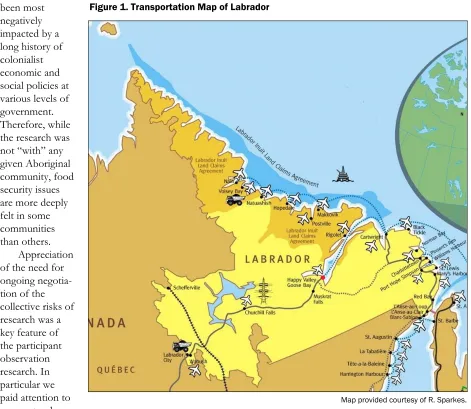
During the winter of 2011 we were approached by representatives of two community groups in the study region (figure 1), the Kachemak Bay Research Reserve (KBRR) and MAPP of the Southern Kenai Peninsula (MAPP-SKP, formerly the Southern Kenai Peninsula Communities Project), and asked to give a public presentation on food security. Food security emerged as a priority for these groups as a result of a multiyear strategic
1 In Alaska, the word “subsistence” is legally defined and
planning project that utilized the Mobilizing for Action through Planning and Partnerships (MAPP) framework.2 During our visit, we also participated in two informal focus groups with representatives from KBRR and MAPP-SKP, as well as with other interested community members that included nurses and other community health practitioners, commercial fishermen, and representatives from the group Sustainable Homer. From these discus-sions one specific theme emerged: frustration with a lack of access to locally caught seafood. Partici-pants described how if one does not fish for him- or herself, or does not know someone who fishes, it is extremely difficult to procure affordable, locally caught fish such as salmon and halibut. One important outcome of these meetings is unanimous support for research that evaluates access to local seafood and its role in food security, in order to identify both barriers to and opportunities for strengthening this component of the local food system.
2 For more information on the MAPP process, which is not
discussed here, see the National Association of County and City Health Officials’ website at http://www.naccho.org/ topics/infrastructure/mapp/index.cfm
The Kenai Peninsula is well known among Alaskans and tourists from outside the state for its productive salmon and halibut fisheries. Cook Inlet is a stretch of ocean that reaches 180 miles north from the Gulf of Alaska, along the west coast of the Kenai Penin-sula, to the city of Anchorage. The associated watershed covers approximately 47,000 square miles (122,729 square kilometers) of the south-central portion of the state. It is home to all five species of Pacific salmon as well as over 400,000 Alaskans, more than half the population of the state. About 50,000 people live on the Kenai Peninsula itself, a land mass about 16,000 square miles (41,440 square kilometers), or half the size of Maine. Communities include the iconic fishing ports of Homer, Seward, Kenai, and Soldotna, as well as smaller, predominately Alaska Native and Russian communities, including Port Graham, Nanwalek, and Seldovia, which are not accessible by road in spite of their relative proximity to large urban centers.
In addition to local support for this research, the Kenai Peninsula provides an effective and strategic case study location because many of the sociocultural, economic, ecological, and geo-political circumstances and challenges found here are arguably representative of those found state-wide. Though the region suffers from something of a reputation for affluence among many Alaskans, there are nevertheless many similarities in vital statistics among this region and the state as a whole (table 1). Per capita income, percent of the popu-lation below the poverty level, and food security rates, for example, all match statewide numbers. Additional parallels between the Kenai Peninsula and the state as a whole also exist: the region is home to communities that are on and off of the road system; renewable-resource industries such as fishing and tourism are hugely important, as are Figure 1. Map of the Kenai Peninsula Region of Alaska.
Journal of Agriculture, Food Systems, and Community Development ISSN: 2152-0801 online
www.AgDevJournal.com
contentiously debated extractive resource indus-tries such as coal and offshore oil and now natural gas developments; and finally, more than 70% of the land on the Kenai Peninsula is federally managed, a proportion that approximates land jurisdiction for the state as a whole.
Methods
In order to better understand the state of house-hold food security in the region, including the role of locally caught seafood, we distributed a survey via the U.S. Postal Service to 1,500 households randomly selected3 from a list all 24,500 residential addresses on the Kenai Peninsula. Given the popu-lation of the region, we require a sample of least 381 responses to make strong inferences about the peninsula at large (Krejcie & Morgan, 1970), and we anticipated that response rate could be between 40% and 70% (AKDHSS, 2011b). Surveys were distributed following a modified version of the Tailored Design Method (Dillman, 2007). To improve response rates, we sent postcards notify-ing recipients that their address had been randomly
3A random number generator was written in the statistical
software package R (R Development Core Team, 2011) to select addresses from the list.
selected and that they should expect a survey soon. With the survey we also included a one dollar bill as a token of appre-ciation. To further raise awareness of the study, we also arranged inter-views on Kenai Peninsula public radio stations. Respondents were asked to report if some-one in their household fishes, and if so, to specify whether this includes fishing commer-cially, fishing for sport, fishing as a guide or charter, and/or fishing for personal use or subsistence. Next, they were asked to report if they consume locally caught fish or other seafood; for those with a positive response, several ques-tions followed regarding how and where they obtain the seafood, that is, whether they fish for it themselves, purchase it at a local retailer, barter or trade for it, or receive it as a gift. We also asked about seafood consumption rates during the fish-ing season (defined as late May through September) and outside the fishing season (October through May), with options including: frequently (almost every day), sometimes (2–5 times per week), rarely (once or fewer times per week), and never. We also asked about fish waste, querying households whether at the beginning of the fishing season they had any seafood from the previous year, and if so, what they did with it (e.g., smoke or can it, feed it to dogs, give it away, throw it away, etc.).
To measure food security, the survey also included six questions about “coping strategies” (after D. G. Maxwell 1996; D. G. Maxwell, Ahiadeke, Levin, Armar-Klemesu, Zakariah, & Lamptey, 1999), which ask respondents to report how often in the last month they have taken actions such as reducing meal size or skipping meals because there is not enough food and/or so that someone else in their household can eat Table 1. Comparative Details for the Kenai Peninsula and the State of Alaska
Vital Statisticsa Kenai Peninsula Alaska
Population 56,293 722,718
Demography Caucasian African American
Alaska Native/American Indian Asian
Native Hawaiian 2+ Races
85.0% 0.6% 7.5% 1.2% 0.3% 5.4%
67.9% 3.6% 14.9% 5.6% 1.1% 7.0%
Unemploymentb 9.3% 7.6%
Food Insecurityc
Children
14.7%
20.4% 14.6%19.9%
Per Capita Income US$29,127 US$30,726
Below Poverty Level 9.5% 9.5%
a Data presented here are for 2011 from the U.S. Cenus Bureau’s QuickFacts website unless
otherwise noted, http://quickfacts.census.gov/qfd/index.html, retrieved 09/12/2012.
b Unemployment data from the State of Alaska Department of Labor and Workforce Development
Research and Analysis website, http://laborstats.alaska.gov/, retrieved 09/12/2012.
c Food insecurity rates are from Feeding America’s Map the Meal Gap model,
(table 2). Frequencies allowed were: never (worth 4 points), rarely (once or fewer times per week, worth 3 points), sometimes (2–5 times per week, worth 2 points), and frequently (almost every day, worth 1 point). The monthly recall duration was chosen to in order to gauge food security at the time during the year that locally caught seafood is most likely being utilized; surveys were distributed at the end of September, and major salmon fishing activities in the region end in August.
One of the reasons we selected this coping strategies protocol is because it does not rely on prescriptive definitions of food security or insecu-rity, and as such is more accommodating to the less quantifiable social and cultural dimensions of food security (D. G. Maxwell 1996; D. G. Maxwell et al. 1999). Multiple variations of this protocol have been implemented and validated in different set-tings (e.g., Coleman-Jensen et al., 2011; USDA 2001b), although their appropriateness for Alaskan settings, and especially remote communities, is questionable. For example, the USDA (2011b) food insecurity protocol focuses on the availability of money to buy food, but in Alaska subsistence foods play an important role for households in both rural and urban settings (Bersamin,
Sidenberg-Cherr, Stern, & Luick, 2007; Fazzino &
Loring, 2009). Likewise, the USDA protocol also invokes the concept of a “balanced” diet, but this could be confusing to many in Alaska since food-ways here are traditionally flexible and highly seasonal in nature (Wolfe & Bosworth, 1990). Likewise, use of the word “balanced” could lead some respondents to self-assess against their perceptions of government standards for nutrition, rather than in terms of their own traditions, preferences, and conceptions of health. As such, our six chosen questions focus primarily on food preference and disruption of meal patterns as cross-culturally relevant domains of food insecurity (after Coates, Frongillo, Rogers, Webb, Wilde, & Houser, 2006).
Responses to these six questions are tallied in such a way as to create a single, unit-less score in the range of 11 to 44, with 11 being food insecure and 44 being completely food secure. The formula for calculating food security is shown below:
Score = Q1×1+Q2×1+Q3×2+Q4×2+Q5×2+Q6×3
We loosely define food insecurity as a score falling below 40, as this score indicates that respondents are enacting at least two of the lowest-weighted coping strategies, and or one or more of the more disruptive strategies. Note also that this scale is Table 2. Coping Strategies Questions
These six questions are intended to get at a range of possible coping strategies among respondents. The weights indicate relative severity of the strategy and are used as part of the calculation of the final score. Maxwell et al. (1999) recommends using focus groups to determine the most appropriate weighting, but funding limitations required us to set weightings based on the relative severity of dietary pattern disruption. Note that we do include a question on food preference (Q1), and weigh borrowing money for food (Q3), a strategy often associated with significant psychological stress, more than a modest portion reduction (Q2).
Question Weight
1. In the last month, how often have you and your household eaten foods that are less preferred in order to
make sure that everyone in the household could eat? 1
2. In the last month, how often has someone in your household had to limit their portion size in order to
make sure everyone in the household could eat? 1
3. In the last month, how often have you had to borrow food, or borrow money to buy food, so that everyone
in the household could eat? 2
4. In the last month, how often have you or another adult in your household limited their portion size
specifically so that a child could eat? 2
5. In the last month, how often have you or anyone else in your household had to skip a meal because there
was not enough food? 2
6. In the last month, how often have you or anyone else in your household gone an entire day without eating
Journal of Agriculture, Food Systems, and Community Development ISSN: 2152-0801 online
www.AgDevJournal.com
intentionally not adjusted to begin at zero out of recognition that more severe forms of food insecurity and hunger are possible than can be captured by this instrument.
Other questions on the survey addressed household composition, income level, opinions regarding the sustainability of local fisheries, and whether respondents rely on some form of nutritional assistance such as the Alaska Food Stamp Program or the Special Supplemental Nutrition Program for Women, Infants, and Children (WIC).
Results
Of the 1,500 surveys mailed, 490 responses were received and 75 were returned as undeliverable, for an adjusted response rate of 34.38% and a confi-dence level greater than 95% that the sampled population is representative of the population of the Kenai Peninsula at large (Krejcie & Morgan, 1970). While the response rate for our survey (34.38%) is modest, and just below the Center for Disease Control and Prevention’s low target of 40%
for Alaska (AKDHSS, 2011b), our data for vital statistics such as household income distribution and food assistance rates match known statistics for the region, suggesting that our sample does not have a reporting bias (Dey, 1997). For example, median household income in 2010 in the Kenai Peninsula Borough according to the state of Alaska was US$57,000, and in our study, the median response fell in the US$50,000–US$75,000 range. Likewise, 11.8% of our respondents report receiving food assistance, which is on par with the state reported rate in 2011 of 11.2% (USDA, 2013).
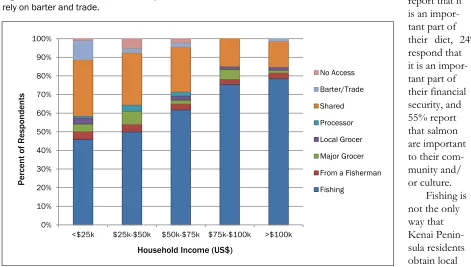
We find that fishing and the consumption of seafood are both extremely common in the Kenai Peninsula. Nearly 95% of respondents report at least some access to local seafood, and 80% of survey takers report that someone in their house-hold fishes, the majority of whom (66.5%) describe their primary fishing activities as for personal use and subsistence. Sport fishing is the next most common kind of fishing (42%), followed by a much smaller group of commercial fishers (7%) and guide/charter operators (2%). When asked to
describe the role of salmon in their house-hold, 67% report that it is an impor-tant part of their diet, 24% respond that it is an impor-tant part of their financial security, and 55% report that salmon are important to their com-munity and/ or culture. Fishing is not the only way that Kenai Penin-sula residents obtain local
0% 10% 20% 30% 40% 50% 60% 70% 80% 90% 100%
<$25k $25k-$50k $50k-$75k $75k-$100k >$100k
Percent of
Respondents
Household Income (US$)
No Access
Barter/Trade
Shared
Processor
Local Grocer
Major Grocer
From a Fisherman
Fishing Figure 2. Primary Method of Seafood Procurement, by Income (N= 490)
seafood, however. While 62% of respondents describe fishing as their primary method of obtain-ing local seafood, 23% report that sharobtain-ing is the most common way they procure it. Very few of those with access to local seafood, between 2% and 5%, obtain this through one of the other means, such as purchasing local fish direct from a com-mercial fisher or purchasing from major or local grocers. This aligns with our observations and local complaints regarding the lack of local venues for purchasing locally caught seafood. Regarding the 5% of households without any access to local seafood, just over half (54%) are households in the US$25,000–US$50,000 income bracket, while 29% are in the US$50,000–US$75,000 bracket, and 17% are in the lowest (<US$25,000) bracket. No households at higher income levels report not having access to local seafood.
We also explored how procurement strategies vary by the respondent’s socioeconomic details, and found a compelling, if not terribly surprising pattern (figure 2). Two-way ANOVA shows that household income has a statistically significant influence on the means by which survey takers report procuring local seafood (p < 0.01). Fishing, sharing, and barter/trade are found to be the primary sources of this variance. In other words, more low-income households rely on sharing as their primary source of locally caught seafood than do households at higher income levels, and con-versely, more high-income households rely on fishing as their primary source of locally caught
seafood than do lower-income households. We also find that barter and trade of local seafood, which is different from sharing in that it describes an explicit component of fair exchange of goods and services, is the primary method by which 10% of respondents at the lowest income level procure local seafood. This is notably higher than reported by respondents at all other income levels.
Food Security and Local Seafood
We find that 27% of respondents have a food security score lower than 40, and only 39% of respondents achieve a perfect score of 44. One specific hypothesis that we aim to test with this research is that there is a positive relationship between food security and access to locally caught seafood. In other words, we propose that house-holds with access to locally caught seafood have greater food security than do those households that do not. To test this hypothesis, we first used a two-tailed Students T-test (table 3), and find a statisti-cally significant increase in the mean food security score for those with access to locally caught sea-food, but only at the lowest income bracket. Research shows, however, that household income and food security are likely to share a positive rela-tionship (e.g., Kent, 1997), meaning that house-holds with higher incomes also are likely to be more food secure. Indeed, our data show a weak (r = 0.50) overall correlation in the population between food-security score and income. To test access to local seafood as an intervening variable, Table 3. Comparison of Food-Security Scores Among Households With and Without Access to Locally Caught Seafood
Household Income
Food Security Score, With Fish
Food Security Score,
Without Fish Difference p
>US$25,000 39.19 36.32 2.87* <0.01
US$25,000–US$50,000 39.42 38.23 1.19 0.16
US$50,000–US$75,000 42.15 42.93 –0.78 0.26
US$75,000–US$100,000 43.32 43.42 –0.10 0.77
>US$100k 43.53 42.75 0.78 0.38
All 41.30 39.31 1.99
ANOVA F = 25.9 F = 16.02
Journal of Agriculture, Food Systems, and Community Development ISSN: 2152-0801 online
www.AgDevJournal.com
we also temporarily removed from the sample population those low-income households who report having access to local fish,4 and then tested again for a correlation between food-security score and household income for this adjusted sample. Our hypothesis is that if access to locally caught fish has no intervening effect on the food-security score for low-income households, the strength of the overall correlation between food security and income should not change. We do find that the correlation coefficient between food-security score and household income increases (r = 0.71) when the low-income households with access to local seafood are excluded from analysis.
We also looked at how food-security scores vary by reported local seafood consumption frequencies during and outside of the fishing season. No statistically significant difference from the mean food-security score is found for those responding that they eat seafood frequently, sometimes, or rarely, but those who report never eating local seafood had an average score of 36, which is significantly lower than the mean for the Kenai Peninsula as a whole.
Regarding fish waste, 65.4% of respondents report having some fish left over from the previous year when the new fishing season begins. Of those, 30% smoke, can, or otherwise p