A NEW APPROACH TO COMPRESSION
AND CONFIDENTIALITY OF TEXT
DATA IN TABULAR FORM USING
ONE-TO-MANY DICTIONARY-BASED
PREPROCESSING ALGORITHM: A
CASE STUDY IN CLOUD SUPPLY
CHAIN
WUTHIKRAI THARACHATR
Faculty of Science and Technology, Assumption University,
Bangkok, Thailand [email protected]
Abstract:
In today's world, cloud supply chain is changing the way that enterprises deploy and operate by providing various benefits and competitive advantages. However, challenges in improving its confidentiality along with providing efficient data compression performance should be considered. In this paper, a simple approach to compression and confidentiality of text data in cloud supply chain is introduced as an integrated solution. Sets of duplicated data are preprocessed based on analyses of static-data ratio and number of receivers in order to generate a single compressed file, while different decoding overheads are encoded and separately distributed to particular receivers in parallel. The results show that both compression ratio and data confidentiality can be improved with some trade-offs for decoding overheads. Static-data ratio and size of duplicated static data are found to be directly proportional to the compression ratio while number of receivers is related to the efficient use of encoding tokens.
Keywords: spreadsheets; lossless data compression; preprocessing; data isolation; data confidentiality; cloud supply chain
1. Introduction
76.0% 76.8% 79.8% 80.2% 81.0% 82.9% 83.3% 87.5%
70% 72% 74% 76% 78% 80% 82% 84% 86% 88% 90% Not enough ability to customize
Hard to integrate with in-house IT Bringing back in-house may be difficult Lack of interoperability standards On-demand payment model may cost more Performance Availability Security
% re sponding 3, 4, 5
Figure 1: Cloud security survey [1]
0 2 4 6 8 10 12 C lou d c om p u ti n g V ir tu a liz a tio n M o b ile te c h n o lo g y IT m a nagem e nt B u sin e ss I n te llig e n t N e tw o rk ing a n d vo ic e da ta E n ter p ri se ap p li cat io n T e c h n o lo g y c o ll a b o ra tio n In fr a str u c tu re We b 2 .0 Technology Ra n k in g
Figure 2: Top-ten technology priority [2]
this case, each receiver can only generate outputs that are associated with that particular receiver assigned by the sender.
In addition to data security and confidentiality, everyday communication and documentation among the supply chain parties usually create redundancy of duplicated data, which cause unnecessary requirements for larger cloud data storage. Nowadays, there are many data compression and preprocessing techniques designed to reduce size of data that are shared and transmitted in the cloud. For data compression, it can be categorized into two main techniques consisting of Lossless Data Compression and Lossy Data Compression. Lossless Data Compression can decode the data exactly what it encoded. This compression technique allows the exact original data to be reconstructed from the compressed data. It is normally used for all kinds of text, scientific and statistical databases to ensure that the decoded output will be exactly identical to the original data. For Lossy Data Compression, the compressed data will be slightly distorted in which it is mostly used for digital sound or image compression where the distortion is acceptable. It aims to minimize the amount of data that needs to be kept or transmitted.
In this paper, text compression is focused; therefore, only lossless compression algorithms are elaborated. Nowadays, lossless compression techniques can be mainly categorized into five popular techniques which are 1) Shannon-Fano coding and Huffman coding, 2) Arithmetic coding 3) Dictionary-based coding, 4) Prediction by Partial Matching (PPM), and 5) Burrows-Wheeler Transform (BWT). In this study; five archiving software consisting of 7-Zip, PeaZip, WinAce, WinRar, and WinZip are selected based on their algorithms that they implement, which are related to the five aforementioned lossless data compression algorithms, in order to be integrated with the proposed preprocessing technique.
In addition to the lossless text compression, there are also various preprocessing techniques available nowadays which bring better compression performance when they are properly used together with lossless data compression algorithms. Preprocessing techniques bring some compression at the initial preprocessing stage itself as well as retain enough context and redundancy for existing compression algorithms to bring out better results [4]. The famous preprocessing techniques are Burrows Wheeler Transformation (BWT), Star Encoding, Length Index Preserving Transformation (LIPT), StarNT, and Word Replacement Transformation (WRT). According to these preprocessing methods, the dictionary is made in time as static one and distributed by both encoding units and decoding units. The usefulness of dictionary-based text preprocessing skills are the less memory utilization, simple concepts, higher speed in process, and better results in the compression rates [4].
However, the proposed preprocessing technique in this paper is different from the preprocessing techniques previously described especially in terms of number of receivers involvement, static-to-dynamic data consideration, and single shared file creation; therefore, the next sections detail only the focused areas consisting of data isolation and lossless data compression which are applicable to the proposed technique.
The aim of this study is to create a solution for supporting both confidentiality and compression of text data structured in tabular form for sharing in cloud supply chain by integrating the proposed preprocessing technique with existing archiving software. Since each particular existing data compression algorithm has its own strengths and weaknesses based on which data type it was designed to work best for, therefore, only a single technique might not be employed in order to get the minimum compressed complex internal structure data together with data confidentiality.
This study presents benefits of using the proposed approach and suggests the appropriate archiving software that works best with the proposed technique in order to practically support the file sharing in cloud supply chain. This paper is organized as follows: the next Section, Section 2, details the literatures related to the proposed technique; Section 3 explains the proposed technique including encoding and decoding modules; Section 4 details the simulation of the model, selected archiving software, and selected data sets; Section 5 presents the results of the integration and comparisons of the integrated results with each archiving compression software; and Section 6 provides conclusion and discussion of the study.
2. Literature Review and Related Studies
Prior to the proposed technique, this section provides general ideas regarding data isolation that is used in different ways for confidentiality purpose, lossless data compression algorithms, and some other studies that are related to the improvements of data security, confidentiality, and compression.
2.1. Data Isolation
Currently, there are many data isolations or segregations available for service providers; for example, IBM Tivoli® Service Automation Manager in which service providers can use the multi-customer support feature to segregate data. With this software, each user within a cloud other than cloud administrator is assigned to a customer. All the requests that these users submit are automatically associated with that customer. A single cloud can support multiple customers, but each user only sees the objects that are associated with the customer they are assigned to. Objects visible to an individual customer include both customer-specific resources and resources that are shared among customers of a cloud. Because the main focus is meeting the specific needs of all customers, it is possible to customize data center resources so that they meet individual requirements or are shared among customers [5]. In addition, Microsoft offers a multi-tenant format of Office 365 that stores data from multiple customers on the same equipment to enable customer cost savings and efficiencies together with supporting users' privacy and security by logically separating data storage and process between accounts [6].
2.2. Lossless Data Compression
For lossless data compression techniques, they can be categorized into five popular techniques which are 1) Shannon-Fano coding and Huffman coding, 2) Arithmetic coding, 3) Dictionary-based coding, 4) Prediction by Partial Matching (PPM), and 5) Burrows-Wheeler Transform (BWT).
2.2.1. Shannon–Fano Coding and Huffman Coding
Shannon–Fano coding, introduced by Claude Elwood Shannon [7] and Robert Fano [8], is a data compression technique that constructs a prefix code based on a set of symbols and their estimated or measured probabilities. The symbols are arranged in order from most probable to least probable, after that they will be divided into two sets in which total probabilities will be as close as possible to being equal. Then, all symbols have the first digits of their codes assigned; symbols in the first set will be assigned as "0" and symbols in the second set will be assigned as "1". If there is any set with more than one member remains, the same process will be repeated for those sets in order to determine successive digits of their codes. When a set has been reduced to one symbol, it means that the symbol's code is completed and will not assign the prefix of any other symbol's code. Huffman coding was introduced in 1952 by David A. Huffman [9], which represents a different technique compared to Shannon-Fano algorithm. While the Shannon-Fano tree is created from the root to the leaves, the Huffman algorithm does in the opposite direction by starting from leaves to the root. Huffman coding can be divided into two types, which are static Huffman coding and adaptive Huffman coding. For adaptive Huffman coding (Dynamic Huffman coding), it is an adaptive coding technique based on Huffman coding in which it dynamically calculates the probabilities based on recent actual frequencies in the sequence of source symbols, and then changes the coding tree structure in order to match with the updated probability estimates.
2.2.2. Arithmetic Coding
Arithmetic coding takes a stream of input symbols and then replaces them with a single floating point output number in which the longer the message will require more bits for output number. Arithmetic coding works on infinite-precision numbers in which this single number can be only in the range of zero to one. The output numbers are generated by probabilities assigned to the symbols that are being encoded. It means that the arithmetic coding differs from other forms of entropy encoding especially Huffman coding because it does not separating the input into component symbols and replacing each with a code but the arithmetic coding encodes the entire message into a single number. By comparing compression ability between Huffman coding and Arithmetic coding, the Arithmetic coding performs better than Huffman in many parts because Arithmetic is an adaptive model and does not need to translate each symbol into an integral number of bits. However, Arithmetic coding requires more computation on multiplication and division, which causes slower coding time and more complication.
2.2.3. Dictionary-based Coding
“static dictionary” and “dynamic dictionary”. For “static dictionary”, the complete set of strings is determined prior to the starting of coding and it will not be changed during the coding process. It is frequently used when set of messages being encoded is fixed and large. The list will be set up to cover all the types of files to be coded which will be updated to both sender and receiver sides in advance, therefore, there will be no overhead sending from sender to receiver for decoding purpose later on. Anyway, this static dictionary list has to be large enough to cover as many as possible of the types of data to be compressed. A static dictionary that is created for particular types of data might not be effectively applied to other types of data because the compressed data might be larger than the original data instead as the dictionary might not perfectly matched with those kinds of data. On the other hands, there are numbers of methods where the dictionary-based algorithms start by using some predetermined state while the contents can be changed during the encoding process based on the data that has already been encoded, which are called as “dynamic dictionary”, for examples, LZ77 and LZ78 algorithms.
2.2.4. Prediction by Partial Matching (PPM)
The prediction by partial matching (PPM) data compression technique was developed by Cleary and Witten [12] in 1984. It is an adaptive statistical data compression technique based on context modeling and prediction. PPM algorithm uses a set of previous symbols in the uncompressed symbol stream to predict probability of occurrence of the next symbol in the stream. This probability is then used for encoding the symbol by the use of arithmetic coding algorithm. The idea of this algorithm is that if a large context is used to determine the probability of the symbol being encoded, it will require estimation and storage of an extremely large number of conditional probabilities in which it is unfeasible. Instead of estimating these probabilities in advance, the burden can be reduced by estimating the probabilities as the coding proceeds. In this case, it is only required to store these contexts which have been occurred in the sequence being encoded, therefore, it is much smaller number compared to number of all possible contexts.
2.2.5. Burrows–Wheeler Transform (BWT)
In 1994, Michael Burrows and David Wheeler [13] introduced a data compression algorithm based on the Burrows–Wheeler transform (BWT). The Burrows–Wheeler transform is also called as block-sorting compression such as bzip2. The compression ratios were comparable with the ones obtained using known best methods. When a character string is transformed by the BWT, the value of the characters will not be changed. The transformation arranges the order of the characters. If the original string had several substrings that frequently occurred, then the transformed string will have several places where a single character is repeated multiple times in a row. This is useful for compression, since it is easy to compress a string that has runs of repeated characters by using move-to-front transform and run-length encoding.
2.3. Related Studies
Recently, there are number of studies that present developments of new techniques to improve data security, data confidentiality, and increase data compression performance.
In 2004, Govindan and Shajeemohan [14] presented an intelligent text data encryption and compression for high speed and secure data transmission over Internet called Intelligent Dictionary Based Encoding (IDBE) in which a preprocessing of the text prior to conventional compression will improve the compression efficiency and provide the required security.
In 2007, Robert and Nadarajan [15] also proposed a method which transforms a text file into intermediate file with minimum possible byte values called Dictionary-based transformation (DBT) and Dynamic reversible transformation (DRT) in order to reduce the number of possible bytes that appear after every byte in the source file which increases backend algorithm's compression performance.
In 2010, Ullah et al. [16] presented a novel use of steganography for both confidentiality and compression in which message is encoded by using a grayscale bitmap image. The image acts as a steganographic carrier for the text and the carrier is never transmitted across the untrusted channel while only the compressed index array that contains the indices for hidden data in the image is transmitted. The image also acts as a shared key between sender and receiver, which is used for confidentiality and also to extract the desired text from the image. They described that encoding text into the image is not only to make it secure but good amount of compression is also achieved and found that the text length is directly proportional to compression performance.
3. Proposed Technique
The prime concern of this study is to implement a simple approach that can improve compression and confidentiality of shared text data in structured tabular form for supporting cloud supply chain. An efficient text preprocessing algorithm for data compression and confidentiality that can encode specific multiple data into a single encoding token is introduced.
can support multiple receivers with different meanings and each receiver only sees the decoded data that are associated with that particular assigned receiver. The data visible in the cloud supply chain includes both static data that is preprocessed by the proposed algorithm and dynamic data that is filtered based on assigned receivers.
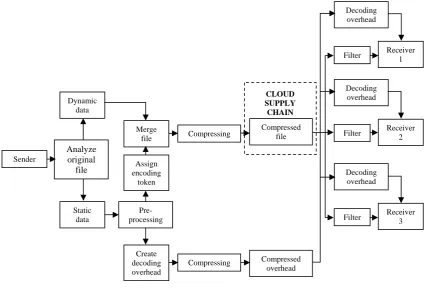
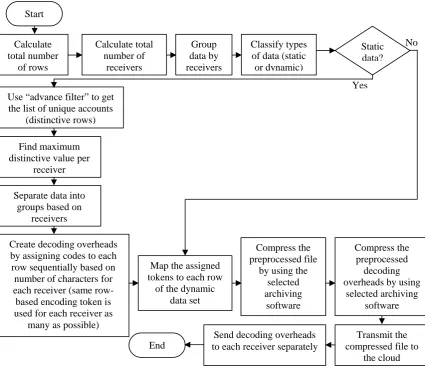
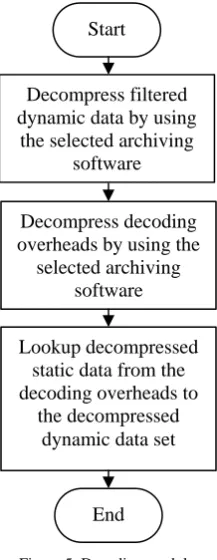
By using the proposed preprocessing algorithm, the encoding tokens can be more efficiently utilized and decoding overheads are separately provided to particular assigned receivers. Therefore, the proposed algorithm can respectively increase compression performance and improve data confidentiality of the shared file stored in the cloud. There are three sub-techniques applied in this algorithm, which are 1) the use of single encoding token to many decoding overheads (one-to-many dictionary-based preprocessing), 2) data isolation, and 3) integrated solution. Figure 3 presents an overview paradigm of the proposed algorithm as a whole, while the encoding and decoding modules are elaborated in details presented in figure 4 and 5.
Figure 3: The proposed technique paradigm 3.1. Single Encoding Token to Many Decoding Overheads
In order to make the dictionary-based data compression technique more effective, the proposed study introduces another method to reduce the number of encoding tokens used for a particular set of original data. In this circumstance, static data in the original file is analyzed and unique in order to find distinctiveness of the static data contained in the file for the purpose of token utilization. Subsequently, a single encoding token is used based on a particular group of original data and multi-receivers in which it can be decoded into number of meanings differently based on sets of isolated decoding overheads that are transmitted to each assigned receiver differently and separately.
In general, one encoding token is used for a single meaning of an original data in which it is just only a one-to-one relationship. On the other hands, by using the proposed technique, the relationship of data coding is a one-to-many in which multiple meanings of decoding overheads can be referred just to a single encoding token.
3.2. Data Isolation
As cloud security is one of the important issues that enterprises have to be aware of and the main issue of dictionary-based compression technique is about an effective list of words used between sender and receiver known as overhead that may impact to compression performance, this paper proposes a simple technique by utilizing the data isolation method to gain opportunities from isolated decoding overhead that directly improves the compression performance of the encoded file stored in the cloud since the decoding overhead is not taken into consideration because the overhead is only transmitted to each assigned receiver separately.
Another benefit of using isolated decoding overhead is to improve data confidentiality shared in the cloud, since the encoding tokens are assigned as one-to-many relationship with decoding overheads, each receiver only
Sender
Analyze original
file Dynamic
data
Static data
Pre- processing
Assign encoding
token
Create decoding overhead
Compressing
Compressing Compressed file
Compressed overhead Merge
file
Decoding overhead
Filter Receiver 2
Decoding overhead
Filter Receiver 1
Decoding overhead
Filter Receiver 3
CLOUD SUPPLY CHAIN
sees the decoded data that are only associated with that particular assigned receiver. Other receivers, hackers, or even eavesdroppers will not know that particular decoding overheads and are not able to interpret that encoded file into meaningful data.
3.3. Integrated Solution
In order to make the proposed preprocessing technique practical for data sharing in the cloud supply chain, the proposed technique is used together with selected existing archiving software as an integrated solution to improve data compression performance.
The proposed technique can bring some compression and data confidentiality at the initial preprocessing stage itself as aforementioned, and the compression performance is then improved again by using the selected archiving software to ensure that this integrated solution can effectively and efficiently provide good results in both compression performance and data confidentiality for cloud supply chain users.
Figure 4: Encoding module Start
Calculate total number
of rows
Calculate total number of
receivers
Group data by receivers
Classify types of data (static or dynamic)
Static data?
Use “advance filter” to get the list of unique accounts
(distinctive rows)
Separate data into groups based on
receivers Find maximum distinctive value per
receiver
Create decoding overheads by assigning codes to each row sequentially based on number of characters for each receiver (same row-based encoding token is used for each receiver as
many as possible)
Compress the preprocessed
decoding overheads by using
selected archiving software
Send decoding overheads to each receiver separately End
Map the assigned tokens to each row
of the dynamic data set
Compress the preprocessed file
by using the selected archiving
software
Transmit the compressed file to
the cloud Yes
Figure 5: Decoding module 4. Testing Methods
4.1. Simulation
In this paper, Microsoft Excel 2003 macros and functions were used for simulation purposes to simulate this one-to-many dictionary-based preprocessing algorithm in which encoding was preprocessed at the sender by using the encoding module at initial stage prior to the next data compression integrated with the selected archiving software. The simulation was also used for decoding module in which the decoding overheads prepared for each assigned receiver are used in retrieving the original messages from the shared file.
4.2. Selected Archiving Software
In this study, the tested software products were selected based on their algorithms implemented to support text data compression, which are 7-Zip, PeaZip, WinAce, WinRar, and WinZip. Table 1 presents selected software products and data compression algorithms that are implemented by these software products [17]. This paper focuses on how well these software products can support the purposed one-to-many dictionary-based preprocessing technique as the integration tool by seeing the differences in compression efficiency among the integrated solutions. Integrations of each software product with the proposed algorithm were tested. The results of compression ratio of all integrations are presented and compared in the next sections with some elaborations.
Table 1: Selected archiving software
Software Algorithms 7-Zip Program used filters, LZ77, LZMA, PPM, BWT
PeaZip LZ77, Huffman, LZMA, PPM
WinAce Program used filters, LZ77, Huffman WinRar Program used filters, LZ77, PPM, Huffman
WinZip Shannon-Fano, PPM, Huffman, LZH, LZW
Start
Decompress filtered dynamic data by using
the selected archiving software
Decompress decoding overheads by using the
selected archiving software
Lookup decompressed static data from the decoding overheads to
the decompressed dynamic data set
4.3. Data Sets
In general, there are two methods of choosing the test files for testing the compression performance. The first method is to use a well-known standard data; for examples, Calgary corpus, Canterbury corpus, or Silesia corpus. Another method is to prepare a new data set for testing. Actually, it is more convenient to use the standard sets of data because they are easier to compare new results with previous techniques. However, in order to test the compression performance of the proposed preprocessing algorithm, new data sets were prepared because the algorithm is designed specifically for text data in tabular form for data sharing in cloud supply chain.
In this study, real data sets in spreadsheet format used for communicating between manufacturers and raw material suppliers were selected. In order to test the compression performance in relation to number of receivers, static-data ratio (percentage of static data available in the original file), and size of duplicated static data (the static data that are duplicated in the original file); the data were modified and separated into 12 sets. The first two sets of data were prepared for checking compression performance of the selected archiving software in order to choose only single software that generated the best result in order to test it further in relation to static data and duplicated static data ratios (the ratio of the duplicated static data stated in this study means the ratio of duplicated static-data size to total static-data size available in the original file). Another 9 sets of the data were prepared as presented in table 2 in which they were used for measuring compression performance of the proposed technique in relation to static-data ratio and duplicated static-data ratio. The last set of the data contained 100 data rows in which it was used for testing minimum and maximum use of encoding tokens in relation to variation of the number of receivers.
Table 2: Data sets used for testing compression performance in relation to the ratios of static data and duplicated static data
Data set Ratio of static data Ratio of duplicated static data
1 25% 25%
2 25% 50%
3 25% 75%
4 50% 25%
5 50% 50%
6 50% 75%
7 75% 25%
8 75% 50%
9 75% 75%
5. Results and Comparisons
In this paper, the testing results are classified into 3 groups as 1) compression performances of the selected archiving software with and without the integration of the preprocessing algorithm, 2) compression performance in relation to ratios of static data and duplicated static data, and 3) minimum and maximum encoding tokens required in relation to number of receivers.
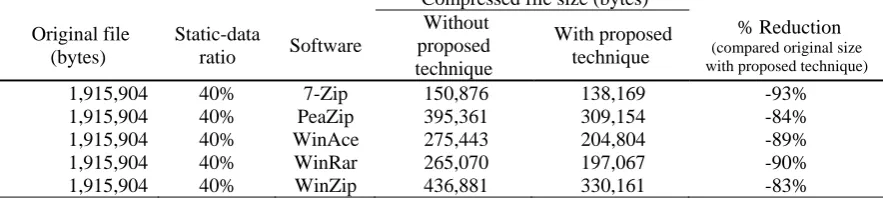
Table 3 and 4 present compression performances of the selected archiving software with and without the integration of the preprocessing algorithm in which two sets of data were prepared with the difference of static- data ratio at 40% and 80% respectively.
Table 3: Compression performances of the selected archiving software with and without the integration of the preprocessing algorithm at 40% static-data ratio
Compressed file size (bytes)
Original file (bytes)
Static-data
ratio Software
Without proposed technique
With proposed technique
% Reduction (compared original size
with proposed technique)
1,915,904 40% 7-Zip 150,876 138,169 -93%
1,915,904 40% PeaZip 395,361 309,154 -84%
1,915,904 40% WinAce 275,443 204,804 -89%
1,915,904 40% WinRar 265,070 197,067 -90%
Table 4: Compression performances of the selected archiving software with and without the integration of the preprocessing algorithm at 80% static-data ratio
Compressed file size (bytes) Original file
(bytes)
Static-data
ratio Software
Without proposed technique
With proposed technique
% Reduction (compared original size with proposed technique)
1,915,904 80% 7-Zip 150,876 107,048 -94%
1,915,904 80% PeaZip 395,361 223,274 -88%
1,915,904 80% WinAce 275,443 128,939 -93%
1,915,904 80% WinRar 265,070 130,457 -93%
1,915,904 80% WinZip 436,881 231,329 -88%
According to the compression results presented in table 3 and 4, 7-Zip produced the best compression performance compared to other software in both sets of data since it used various algorithms to compress the files consisting of its own filters, LZ77, LZMA, PPM, and BWT. Therefore, 7-Zip was selected for the next testing of compression performance in relation to the ratios of static data and duplicated static data.
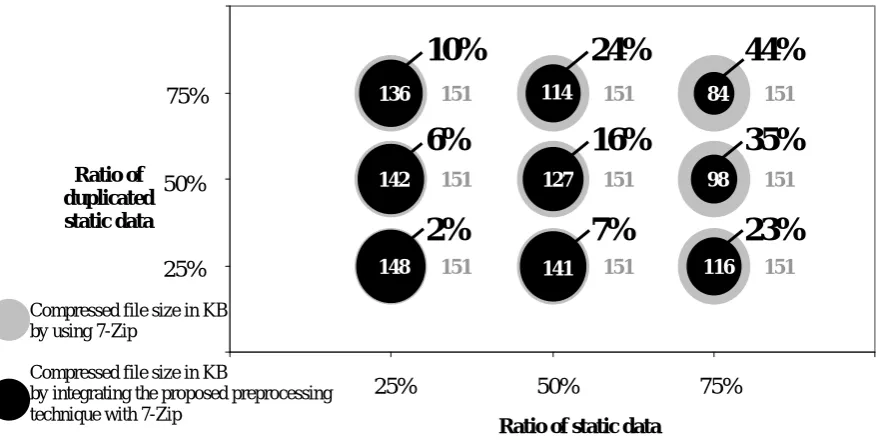
By comparing the compression performance of the selected archiving software, 7-Zip, with the integration of the proposed preprocessing technique; this study used another 9 sets of data that contained different ratios of static data and duplicated static data ranged from 25%, 50%, and 75% each. Figure 6 illustrates that the proposed preprocessing technique can provide benefits with more interesting results when ratios of static data and duplicated static data are higher. Gray circles represent the compressed file sizes in kilobytes by using only 7-Zip, while black circles represent the compressed file sized in kilobytes by integrating the proposed preprocessing algorithm with 7-Zip software. The percentages shown in figure 6 present the reduction of file sizes by using the integration of preprocessing technique compared with the use of only 7-Zip software. In the case that there are only 25 percent of both static data and duplicated static data found in the original file, the result of this proposed algorithm compared to the only use of 7-Zip is not significantly different in which only 2 percent of data reduction (space saving) is improved. On the other hands, if the ratio of either static data or duplicated static data is increased, the compression performance of the proposed preprocessing algorithm can be consequently improved.
According to the experimental results, the higher ratio of static data provides more interesting outcomes compared to the higher ratio of duplicated static data which delivers slightly less significant improvements. However, by increasing of both static data and duplicated static-data ratios, the integration of proposed algorithm with the archiving software can provide better results that benefit to both sender and receiver in term of data compression performance. As presented in Figure 6, if the ratios of both static data and duplicated static data are increased to 75 percent each, the compressed file size can be reduced at 44 percent as compared with the use of 7-Zip individually.
Figure 6: Comparison of the compressed file sizes in kilobytes between the integration of the proposed preprocessing technique with 7-Zip and the use of 7-7-Zip individually, and data size reduction in percentages
151 151 151
151 151 151
151 151 151
136 114 84
142 127 98
148 141 116
0 25 50 75 100
0 1 2 3 4
25% 50% 75%
75%
50%
25%
Ratio of static data Ratio of
duplicated static data
Compressed file size in KB by using 7-Zip
Compressed file size in KB
by integrating the proposed preprocessing technique with 7-Zip
10% 24% 44%
6% 16%
35%
For the utilization of the encoding tokens, as the relationship of data coding of the proposed technique is a one-to-many in which multiple meanings of decoding overheads can be referred just to a single encoding token, the encoding tokens can be efficiently utilized based on particular groups of original data in relation to distinctiveness of the static data and number of receivers. Figure 7 presents minimum and maximum numbers of encoding tokens required for a particular set of data in relation to number of receivers. In this study, 100 data rows were selected in order to find out the ranges of tokens that could be generated for the specific ranges of receivers.
The results show that encoding tokens can be more effectively utilized if the particular data set contains data for a larger number of receivers. Minimum numbers of required tokens can be reached if the distinctive data rows are balanced and equally assigned to each receiver, while maximum numbers of tokens represent maximum required tokens that are possibly occurred if the distinctive data rows assigned to each receiver are imbalanced. In the range of 1 to 10 percent of receivers toward distinctive data rows (1 to 10 receivers per 100 distinctive data rows are tested), the numbers of required tokens are significantly dropped if the data set contains equivalent number of distinctive data rows per receiver. After 10 percent of the proportion, the minimum numbers of required token are slightly decreased.
Figure 7: Number of tokens used in relation to number of receivers 6. Conclusion and Discussion
In this paper, one-to-many data sharing is used in a novel way in which it is applied to the improvements of data compression and data confidentiality. This study focuses on the improvements specifically on text data in tabular form created for data sharing purpose in cloud supply chain. By integrating the purposed preprocessing technique with existing data archiving software, users both sender and receivers can get some benefits from the better data compression performance as well as higher data confidentiality at the same time.
Based on the simulation results, it can be concluded that the purposed algorithm is very useful when there are high static data and duplicated static-data ratios that are directly proportional to compression performance. The larger number of receivers per shared file can utilize the use of encoding tokens more efficiently and the data confidentiality can be improved through the isolation of decoding overheads in which each receiver only sees the decoded data that are only associated with that particular assigned receiver. Other receivers, hackers, or even eavesdroppers will not know that particular decoding overheads and are not able to interpret that encoded file into meaningful data.
The future work may consider about additional integration of data encryption or steganography in order to get other interesting results.
References
[1] Chang, L, Ti; Chin, L.; Chang, A.Y.; Chun J, C. (2010): Information Security issue of enterprises adopting the application of cloud
computing, IEEE 2010 Sixth International Conference on Networked Computing and Advanced Information Management (NCM), pp. 645, 16-18 August.
[2] Shuai, Z.; Shufen, Z.; Xuebin, C.; Xiuzhen, H. (2010): Cloud Computing Research and Development Trend, 2nd International
Conference on Future Networks, 2010. ICFN’10, pp. 23, 22-24 January.
[3] http://www.sdcexec.com/article/10625625/supply-chain-security-from-a-systems-perspective
100
11 21 31 41 51 61 71 81 91
1 2 2 2 2 2 3 4 5 10
1 0 20 40 60 80 100
0 10 20 30 40 50 60 70 80 90 100
number of receivers
N
u
m
be
r
o
f t
o
ke
n
s us
e
d
[4] Rexline, S. J.; Robert, L. (2011): Dictionary Based Preprocessing Methods in Text Compression – A Survey, International Journal of Wisdom Based Computing, Vol. 1(2), pp. 13-18, August.
[5] http://publib.boulder.ibm.com/infocenter/tivihelp/v10r1/topic/com.ibm.tsam_7.2.2.2.doc/c_sp_data_segregation.html
[6] http://www.microsoft.com/privacy/cloudcomputing.aspx
[7] Shannon, C.E. (1948): A Mathematical Theory of Communication, Bell System Technical, Journal 27: pp. 379–423.
[8] Fano, R.M. (1949): The transmission of information, Technical Report No. 65 (Cambridge (Mass.), USA: Research Laboratory of
Electronics at MIT).
[9] Huffman, D. A. (1952): A method for the construction of minimum-redundancy codes, In Proceedings of the Institute of Radio
Engineers, September, pp. 1098–1101.
[10] Liao, S.; Devadas, S.; Keutzer, K. (1995): Code density optimization for embedded DSP processors using data compression
techniques, In Proceedings of Advanced Research in VLSI, pp. 393-399.
[11] Lefurgy, C.; Bird, P.; Chen, I.; Mudge, T. (1997): Improving code density using compression techniques, In Proceedings of
International Symposium on Microarchitectures (MICRO), pp. 194-203.
[12] Cleary, J. and Witten, I. (1984): Data compression using adaptive coding and partial string matching, IEEE Transactions on
Communications, COM-32, pp. 396–402.
[13] Burrows, M. and Wheeler, D. J. (1994): A block-sorting lossless data compression algorithm, SRC Research Report 124, Digital
Equipment Corporation, California.
[14] V. K. Govindan and B. S. Shajeemohan (2004): IDBE-An Intelligent Text Data Compression for High Speed data Transmission Over
Internet, Proceedings of the International conference on Intelligent Signal Processing and Robotics, ISPR 2004 IIT Allahabad, pp. 20-23, February.
[15] Robert, L. and Nadarajan, R. (2009): Simple Lossless Preprocessing Algorithms for Text Compression, IET Software, 2009, Vol. 3,
Issue 1, pp. 37-45.
[16] Ullah, F.; Naveed, M.; Inayatullah Babar, M.; Iqbal, F. (2010): Novel use of Steganography for both Confidentiality and Compression,
International Journal of Engineering and Technology, vol. 2 no. 4, pp. 361-366, IACSIT Press Singapore.
![Figure 1: Cloud security survey [1]](https://thumb-us.123doks.com/thumbv2/123dok_us/9663650.1494205/2.595.82.524.76.554/figure-cloud-security-survey.webp)