QUANTUM CRYPTOGRAPHY WITH
PHOTON PAIRS
ANAND SHARMA MITS, Lakshmangarh, Sikar-332311, Rajasthan, India
VIBHA OJHA IITM, Gwalior Madhya Pradesh, India [email protected]
Abstract :
Quantum cryptographic systems use quantum mechanical concepts that are based on qubit superposition of states, and on the no cloning or no copying theorem to establish unbreakable cipher keys. The basic idea of quantum cryptography is to send the key in the form of photons over a public channel, encoding the zeros and one on quantum states in such a way that any eavesdropping attempt can be detected. Using optical communications the most commonly quantum mechanical property used is the polarization state of photon. However, in most quantum cryptographic algorithms a random polarization state is required. The photons are ideal for low loss transport, either in free space or in optical fibers, i.e. we have the full arsenal of fiber optic technology at our disposal. In this paper we are describing the process of quantum cryptography with photon pairs.
Keywords: Cryptography; Entanglement; Photon polarization; Quantum Cryptography; QKD.
1. Introduction
The possibility to use entangled photon pairs for quantum cryptography was first proposed by Ekert in 1991. In a subsequent paper, he investigated, with other researchers, the feasibility of a practical system [Ekert et al. (1992)]. Although all tests of Bell inequalities [Zeilinger, A., (1999)] can be seen as experiments of quantum cryptography, systems specifically designed to meet the special requirements of QC, like quick change of bases, were first implemented only recently. In 1999, three groups demonstrated quantum cryptography based on the properties of entangled photons, illustrating the fast progress in the still new field of quantum communication [Jennewein, T., et al.(2000)],[ Naik, D. et al.(2000)],[ Tittel, W. et al.(2000)]. When using photon pairs for QC, one advantage lies in the fact that one can remove empty pulses, since the detection of one photon of a pair reveals the presence of a companion. In principle, it is thus possible to have a probability of emitting a non-empty pulse equal to one. It is beneficial only because presently available single-photon detector feature high dark count probability. The difficulty to always collect both photons of a pair somewhat reduces this advantage. One frequently hears that photon-pairs have also the advantage of avoiding multi-photon pulses, but this is not correct. For a given mean photon number, the probability that a non-empty pulse contains more than one photon is essentially the same for weak pulses and for photon pairs. Second, using entangled photons pairs prevents unintended information leakage in unused degrees of freedom [Mayers, D.,(1998)]. Observing a QBER smaller than approximately 15%, or equivalently that Bell’s inequality is violated, indeed guarantees that the photons are entangled and so that the different states are not fully distinguishable through other degrees of freedom. A third advantage was indicated recently by new and elaborate eavesdropping analyses. The fact that passive state preparation can be implemented prevents multi photon splitting attacks.
entanglement is thus not adequate for QC over long optical fibers. A similar effect arises when dealing with energy-time entangled photons. Here, the chromatic dispersion destroys the strong time-correlations between the photons forming a pair. However, it is possible to passively compensate for this effect using either additional fibers with opposite dispersion, or exploiting the inherent energy correlation of photon pairs.
It is interesting to emphasize the close analogy between 1 and 2-photon schemes [Bennett, Ch.H., G. Brassard and Mermin N.D., (1992)]. Indeed, in a 2-photon scheme, one can always consider that when Alice detects her photon, she effectively prepares Bob’s photon in a given state. In the 1-photon analogy, Alice’s detectors are replaced by sources, while the photon pair source between Alice and Bob is bypassed. The difference between these schemes lies only in practical issues, like the spectral widths of the light. Alternatively, one can look at this analogy from a different point of view: in 2-photon schemes, everything is as if Alice’s photon propagated backwards in time from Alice to the source and then forwards from the source to Bob.
2. Polarization Entanglement
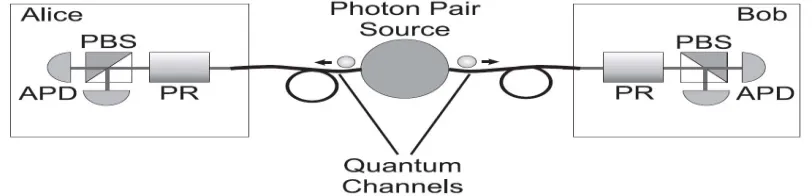
A first class of experiments takes advantage of polarization-entangled photon pairs. The setup ( Fig. 1), is similar to the scheme used for polarization coding based on faint pulses. A two-photon source emits pairs of entangled photons flying back to back towards Alice and Bob. Each photon is analyzed with a polarizing beam splitter whose orientation with respect to a common reference system can be changed rapidly [Jennewein, T., et al.(2000)],[ Naik, D. et al.(2000)].
Fig. 1. Typical system for Quantum Cryptography exploiting photon pairs entangled in polarization (PR: active polarization rotator, PBS: polarizing beam splitter, APD: avalanche photodiode)
Both used photon pairs at a wavelength of 700 nm, which were detected with commercial single photon detectors based on Silicon APD’s. To create the photon pairs, both groups took advantage of parametric down conversion in one or two BBO crystals pumped by an argon-ion laser. The analyzers consisted of fast modulators, used to rotate the polarization state of the photons, in front of polarizing beam splitters. Inspired by a test of Bell inequalities performed with the same set-up a year earlier [Weighs, G.,et al. (1998)], the two-photon source was located near the center between the two analyzers. Special optical fibers, designed for guiding only a single mode at 700 nm, were used to transmit the photons to the two analyzers. The results of the remote measurements were recorded locally and the processes of key sifting and of error correction implemented at a later stage, long after the distribution of the qubits. Two different protocols were implemented : one based on Wigner’s inequality (a special form of Bell inequalities), and the other one following BB84.
The group of Paul Kwiat then at Los Alamos National Laboratory, demonstrated the Ekert protocol [ Naik, D. et al.(2000)]. This experiment was a table-top realization with the source and the analyzers only separated by a few meters. The quantum channel consisted of a short free space distance. In addition to performing QC, the researchers simulated different eavesdropping strategies as well. Moreover, they also recently implemented the six-state protocol, and observed the predicted QBER increase to 33% [Enzer, D. et al. (2001)].
3. Energy- Time Entanglement
3.1.Phase-Coding
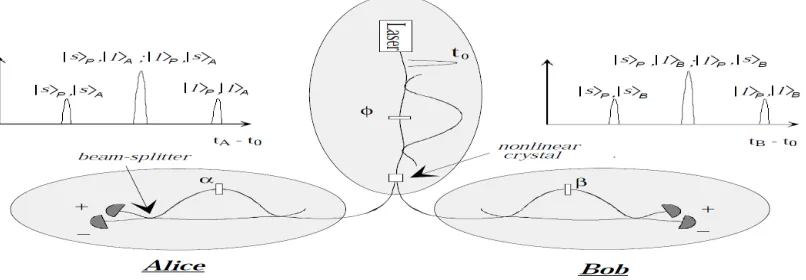
The other class of experiments takes advantage of energy-time entangled photon pairs. The idea originates from an arrangement proposed by Franson in 1989 to test Bell inequalities. As we will see below, it is comparable to the double Mach-Zehnder configuration. A source emits pairs of energy correlated photons with both particles created at exactly the same, however uncertain time (Fig. 2).
Fig. 2 Principal of phase coding Quantum Cryptography using energy-time entangled photons pairs.
This can be achieved by pumping a non-linear crystal with a pump of large coherence time. The pairs of down converted photons are then split, and one photon is sent to each party down quantum channels. Both Alice and Bob possess a widely, but identically unbalanced Mach- Zehnder interferometer, with photon counting detectors connected to the outputs. Locally, if Alice or Bob change the phase of their interferometer, no effect on the count rates is observed, since the imbalancement prevents any single-photon interference. Looking at the detection-time at Bob’s with respect to the arrival time at Alice’s, three different values are possible for each combination of detectors. The different possibilities in a time spectrum are shown in Fig. 2.
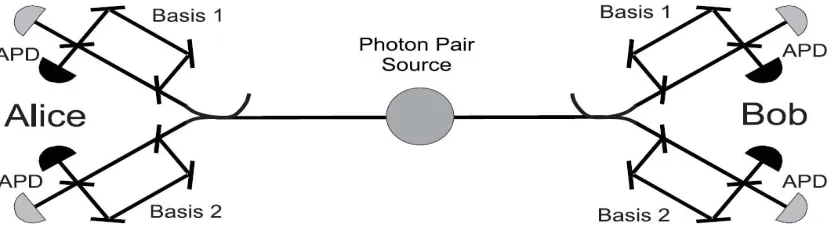
First, both photons can propagate through the short arms of the interferometers. Next, one can take the long arm at Alice’s, while the other one takes the short one at Bob’s. The opposite is also possible. Finally, both photons can propagate through the long arms. When the path differences of the interferometers are matched within a fraction of the coherence length of the down-converted photons, the short-short and the long-long processes are indistinguishable, provided that the coherence length of the pump photon is larger than the path-length difference. Conditioning detection only on the central time peak, one observes two-photon interferences which depends on the sum of the relative phases in Alice’s and Bob’s interferometer – non-local quantum correlation [Franson J.D., (1989)]. The phase in the interferometers at Alice’s and Bob’s can, for example, be adjusted so that both photons always emerge from the same output port. It is then possible to exchange bits by associating values to the two ports. This is, however, not sufficient. A second measurement basis must be implemented, to ensure security against eavesdropping attempts. This can be done for example by adding a second interferometer to the systems (Fig. 3).
In the latter case, when reaching an analyzer, a photon chooses randomly to go to one or the other interferometer. The second set of interferometers can be adjusted to also yield perfect correlations between output ports. The relative phase between their arms should however be chosen so that when the photons go to interferometers not associated, the outcomes are completely uncorrelated.
Such a system features a passive state preparation by Alice, yielding security against multiphoton splitting attacks. In addition, it also features a passive basis choice by Bob, which constitutes an elegant solution: neither a random number generator, nor an active modulator are necessary. It is nevertheless clear that QBERdet and QBERacc are doubled since the number of activated detectors is twice as high. This disadvantage is however not as important as it first appears since the alternative, a fast modulator, introduces losses close to 3dB, also resulting in an increase of these error contributions.
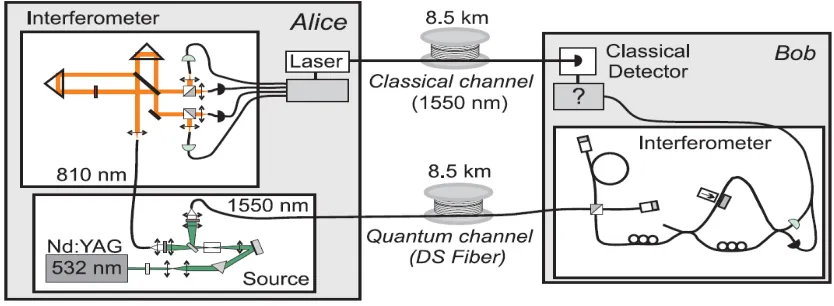
It constitutes the first experiment in which an asymmetric setup [Ribordy, G. et al. (2001)], optimized for QC was used instead of a system designed for tests of Bell inequality and having a source located in the center between Alice and Bob ( Fig. 4). The two-photon source (a KNbO3 crystal pumped by a doubled Nd-YAG laser) provides energy-time entangled photons at non-degenerate wavelengths – one around 810 nm, the other one centered at 1550 nm. This choice allows to use high efficiency silicon based single photon counters featuring low noise to detect the photons of the lower wavelength. To avoid the high transmission losses at this wavelength in optical fibers, the distance between the source and the corresponding analyzer is very short, of the order of a few meters. The other photon, at the wavelength where fiber losses are minimal, is sent via an optical fiber to Bob’s interferometer and is then detected by InGaAs APD’s. The decoherence induced by chromatic dispersion is limited by the use of dispersion shifted optical fiber.
Fig. 4 Schematic diagram of the first system designed and optimized for long distance quantum cryptography and exploiting phase coding of entangled photons.
Implementing the BB84 protocols in the way discussed above, with a total of four interferometers, is difficult. They must indeed be aligned and their relative phase kept accurately stable during the whole key distribution session. To simplify this problem, we devised birefringent interferometers with polarization multiplexing of the two bases. Consequently, the constraint on the stability of the interferometers is equivalent to that encountered in the faint pulses double Mach-Zehnder system. We obtained interference visibilities of typically 92%, yielding in turn a QBERopt contribution of about 4%. We demonstrated QC over a transmission distance of 8.5 km in a laboratory setting using a fiber on a spool and generated several Mbits of key in hour long sessions. This is the largest span realized to date for QC with photon pairs.
As already mentioned, it is essential for this scheme to have a pump laser whose coherence length is larger than the path imbalancement of the interferometers. In addition, its wavelength must remain stable during a key exchange session. These requirements imply that the pump laser must be somewhat more elaborate than in the case of polarization entanglement.
3.2.Phase-Time Coding
Fig. 5 Schematics of quantum cryptography using entangled photons phase-time coding.
If Alice registers the arrival times of the photons with respect to the emission time of the pump pulse t0, she finds the photons in one of three time slots (note that she has two detectors to take into account). For instance, detection of a photon in the first slot corresponds to “pump photon having traveled via the short arm and downconverted photon via the short arm”. To keep it short, we refer to this process as | s
P , | s
A , where P stands for the pump- and A for Alice’s photon. However, the characterization of the complete photon pair is still ambiguous, since, at this point, the path of the photon having traveled to Bob (short or long in his interferometer) is unknown to Alice. Fig. 5 illustrates all processes leading to a detection in the different time slots both at Alice’s and at Bob’s detector. Obviously, this reasoning holds for any combination of two detectors. In order to build up the secret key, Alice and Bob now publicly agree about the events where both detected a photon in one of the satellite peaks – without revealing in which one – or both in the central peak – without revealing the detector. This procedure corresponds to key-sifting. For instance, in the example discussed above, if Bob tells Alice that he also detected his photon in a satellite peak, she knows that it must have been the left peak as well. Therefore, in case of joint detection in a satellite peak, Alice and Bob must have correlated detection times. Assigning a bit value to each side peak, Alice and Bob can exchange a sequence of correlated bits.The cases where both find the photon in the central time slot are used to implement the second basis. They correspond to the |s
P , | l
A | l
B and | l
P , | s
A| s
B possibilities. If these are indistinguishable, one obtains two-photon interferences, exactly as in the case discussed in the previous paragraph on phase coding. Adjusting the phases, and maintaining them stable, perfect correlations between output ports chosen by the photons at Alice’s and Bob’s interferometers are used to establish the key bits in this second basis. Phase-time coding has recently been implemented in a laboratory experiment and was reported at the same time as the two polarization entanglement-based schemes mentioned above. A contrast of approximately 93% was obtained, yielding a QBERopt contribution of 3.5%, similar to that obtained with the phase coding scheme. This experiment will be repeated over long distances, since losses in optical fibers are low at the downconverted photons’ wavelength (1300 nm).An advantage of this set-up is that coding in the time basis is particularly stable. In addition, the coherence length of the pump laser is not critical anymore. It is however necessary to use relatively short pulses (≈ 500 ps) powerful enough to induce a significant downconversion probability. Phase-time coding can also be realized with faint laser pulses . The 1-photon configuration has though never been realized. It would be similar to the double Mach-Zehnder, but with the first coupler replaced by an active switch. For the time-basis, Alice would set the switch either to full transmission or to full reflection, while for the energy-basis she would set it at 50%. This illustrates how considerations initiated on photon pairs can yield advances on faint pulses systems.
3.3. Quantum Secret Sharing
be dishonest – in order to obtain a given piece of information. In contrast with previous proposals using three-particle GHZ states, pairs of entangled photons in so-called energy-time Bell states were used to mimic the necessary quantum correlation of three entangled qubits, albeit only two photons exist at the same time. This is possible because of the symmetry between the preparation device acting on the pump pulse and the devices analyzing the down converted photons. Therefore, the emission of a pump pulse can be considered as the detection of a photon with 100% efficiency, and the scheme features a much higher coincidence rate than that expected with the initially proposed “triple-photon” schemes.
4. Conclusion
The interest for quantum cryptography is expanding. Today there is barely a country without at least one lab working on QC. Entangled photon pairs have become an important resource in experiments on fundamental quantum mechanics as well as in quantum communications, quantum computing and quantum networks. At the last for conclusion we can say that entanglement based photon pair systems are far more complex than faint laser pulses set-ups. They will most certainly not be used in the short term for the realization of industrial prototypes. Nevertheless, they offer interesting possibilities in the context of cryptographic optical networks. The photon pairs source can indeed be operated by a key provider and situated somewhere in between potential QC customers. In this case, the operator of the source has no way to get any information about the key obtained by Alice and Bob. Progress over recent years has been impressive: reliable commercial products exist, improved detection schemes and technologies provide better photon counter, simpler concepts and means of analyzing security have been discovered.
References
[1] Ekert, A.K.,( 1991 ), “Quantum cryptography based on Bell’s theorem”, Phys. Rev. Lett. 67, 661-663.
[2] Ekert, A.K., J.G. Rarity, P.R. Tapster, and G.M. Palma,(1992), “Practical quantum cryptography based on two-photon interferometry”, Phys. Rev. Lett. 69, 1293-1296.
[3] Ekert, A.K., B. Huttner, (1994), “Eavesdropping Techniques in Quantum Cryptosystems”, J. Modern Optics 41, 2455- 2466. [4] H Takesue , E Diamanti , T Honjo, C Langrock , M M Fejer , K Inoue and Y Yamamoto (2005) “Differential phase shift
quantum key distribution experiment over 105 km fibre” New J. Phys. Volume 7, 232
[5] Zeilinger, A., (1999), “Experiment and the foundations of quantum physics”, Rev. Mod. Phys. 71, S288-S297.
[6] Jennewein, T., C. Simon, G. Weihs, H. Weinfurter, and A. Zeilinger, (2000) “Quantum Cryptography with Entangled Photons”, Phys. Rev. Lett. 84, 4729-4732
[7] R T Thew , S Tanzilli, S C Zeller , H Zbinden “Low jitter up-conversion detectors for telecom wavelength GHz QKD” (2006)
New J. Phys. Volume 8, 32
[8] Naik, D., C. Peterson, A. White, A. Berglund, and P. Kwiat, (2000), “Entangled State Quantum Cryptography: Eavesdropping on the Ekert Protocol”, Phys. Rev. Lett. 84, 4733-4736
[9] Tittel, W., J. Brendel, H. Zbinden, and N. Gisin, (2000), “Quantum Cryptography Using Entangled Photons in Energy-Time Bell States”, Phys. Rev. Lett. 84, 4737-4740
[10] Mayers, D., and A. Yao, (1998), “Quantum Cryptography with Imperfect Apparatus”, Proceedings of the 39th IEEE Conference on Foundations of Computer Science.
[11] Vishnu Teja, Payel Banerjee, N.N.Sharma and R.K.Mittal, (2007)“ Quantum Cryptrography: State-of-Art and Future Perspectives”, Proceedings of the International Conference on Emerging Mechanical Technology- Macro to Nano , pp. 355-361 [12] Bennett, Ch.H., G. Brassard and Mermin N.D., (1992), “Quantum cryptography without Bell’s theorem”, Phys. Rev. Lett. 68,
557-559.
[13] Clara I Osorio , G Molina-Terriza and Juan P Torres (2009)“Orbital angular momentum correlations of entangled paired photons” J. Opt. A: Pure Appl. Opt.11 094013
[14] D. Gottesman, “Uncloneable encryption” (2003), Quantum Information and Computing 3(6), pp. 581-602 .
[15] Weihs, G., T. Jennewein, C. Simon, H. Weinfurter, and A. Zeilinger, (1998), ”Violation of Bell’s Inequality under Strict Einstein Locality Conditions”, Phys. Rev. Lett. 81, 5039-5043.
[16] P. Hayden, D. Leung, P. W. Shor and A. Winter, (2004 )“Randomizing quantum states: Constructions and applications,”
Commun. Math. Phys. 250(2):pp. 371-391,.
[17] Enzer, D., P. Hadley, R. Hughes, G. Peterson, and P. Kwiat, (2001), private communication. [18] Franson J.D., (1989), “Bell Inequality for Position and Time”, Phys. Rev. Lett. 62, 2205-2208.
[19] Christelle Monat, Blandine Alloing, Carl Zinoni, Lianhe H. Li and Andrea Fiore, (2006) “Nanostructured Current-Confined Single Quantum Dot Light-Emitting Diode at 1300 nm”, Nano letters, , vol.6 no.7, pp. 1464-1467.
[20] Ribordy, G., J. Brendel, J.D. Gautier, N. Gisin, and H. Zbinden, (2001), “Long distance entanglement based quantum key distribution”, Phys. Rev. A 63, 012309.
[21] V. Abazov, et al (2010) “Measurement of direct photon pair production cross sections in ppbar collisions at sqrt(s)=1.96 TeV”
physics letters B (Available at http://arxiv.org/abs/1002.4917)
[22] Albrecht Haase, Nicolas Piro, Jürgen Eschner and Morgan W. Mitchell (2009) “Tunable narrowband entangled photon pair source for resonant single-photon single-atom interaction” Vol. 34, No. 1 Optics letters pp. 55-57