S T U D Y P R O T O C O L
Open Access
Longitudinal Evaluation of Transition Services
(
“
LETS Study
”
): Protocol for outcome evaluation
Irina Tsybina
1, Shauna Kingsnorth
1*, Joanne Maxwell
2,3, Mark Bayley
3, Sally Lindsay
1, Patricia McKeever
1,
Angela Colantonio
3, Yani Hamdani
4, Helen Healy
2and Colin Macarthur
5Abstract
Background:Because of advances in medical treatment, most children with physical disabilities can expect to achieve near normal life spans. Typically, coordinated teams of health care providers in specialized pediatric settings care for these children. As these children reach adulthood, however, the availability of services and expertise changes because the adult health care system has different processes designed to meet their specialized needs. Gaps in continuity of care during the transition from pediatric to adult services, and associated poor health outcomes are well documented. In response, new models of care are being introduced to address the complex process of health care transition. This paper describes a study protocol of a client-centred, prospective, longitudinal, mixed-method evaluation of linked model of health care across the lifespan (the LIFEspan Model), offered by a pediatric rehabilitation centre and an adult rehabilitation centre.
Method:This project will include a process and an outcome evaluation of the LIFEspan Model. Theprocess evaluationwill detail the specific service delivery that occurs with respect to preparation for transition and transfer of care through chart audits of pediatric medical records and qualitative interviews with LIFEspan staff. Theoutcome evaluationwill measure the effect of the model on: 1) maintaining continuity within the health care system from pediatric to adult care; and 2) secondary outcomes related to health, well-being, social participation, transition readiness, and health care utilization of youth with cerebral palsy and acquired brain injury. Standardized
instruments will include Health Utilities Inventory, Assessment of Life Habits, Arc’s Self-Determination, Assessment of Health-Related Quality of Life, Partners in Health Questionnaire, Social Support Questionnaire, and Self-Efficacy for Managing Chronic Disease.
Discussion:The LETS study will be original in its undertaking of a prospective examination of outcomes 1-year post-transition, use of multiple comparison groups, and absence of disability-related exclusion criteria ensuring that the transition experiences of varied populations of young people and their families will be represented.
Trial registration:www.clinicaltrials.gov, ID NCT00975338
Keywords:Transitions, Youth, Complex chronic conditions, Disability, Rehabilitation, Study protocol, Research methods
Background
Effective transition of adolescents from pediatric to adult health services has become a prominent issue in health care research. As a result of unprecedented advances in medical practice over the past three decades, as many as 50 - 90% of children with congenital or acquired physical disabilities now reach adolescence and live into adulthood
[1-6]. For example, in 1995, twice as many newborns with spina bifida survived in the US as compared to 1975 [3]. Consequently, a new cohort of adults with childhood-onset disabilities and complex chronic conditions has emerged, requiring appropriate transitional care upon their“discharge”from pediatric facilities.
Transition from the pediatric to adult health care sys-tem is a complex process that must be addressed in a holistic manner inclusive of medical, psychosocial, edu-cational, and vocational components [7,8]. Ideally, health
* Correspondence:[email protected] 1Bloorview Research Institute, Toronto, Canada
Full list of author information is available at the end of the article
care during the period of transition should be delivered in a coordinated and uninterrupted manner through the provision of developmentally appropriate and compre-hensive services [7]. However, finding appropriate adult care is challenging [9], as many adult programs have eli-gibility criteria that focus on adults with new onset dis-ability issues [10], and there is a general lack of expertise among most adult health care providers related to aging with a childhood-onset disability [4,11,12]. In the ab-sence of an adequate system of care, adolescents with disabilities are often significantly under-serviced as young adults, and many receive no care whatsoever [6,13,14].
Even when links to adult care are established, the process of transition remains difficult. First, there are important dif-ferences between the pediatric and adult health care envir-onments, such as decreased family involvement and highly specialized, fragmented care that characterize the adult health care system [15-18]. To succeed in this system, young people need to learn how to manage their own health [19]. Unfortunately, the pediatric system has not emphasized developing the skills of children with disabil-ities to enable them to navigate the adult system that requires more self-advocacy and self-determination skills than the pediatric sector, where parents often play this role [20,21]. Second, adolescence is a critical developmental phase between childhood and adulthood, characterized by increased socio-cultural turbulence and vulnerability for all adolescents, regardless of disability [19,22]. Two of its hallmarks are a search for an identity separate from that of the family of origin and re-defining relationships with adults in parental and caring roles [23]. These may con-tribute to tension in the relationships of adolescents with their families and health care providers.
This difficulty in establishing continuity of care from the pediatric to adult system and inadequate transition preparation often results in unfavourable outcomes for young adults with disabilities. Gaps in transition to the adult health system result in poor health outcomes and diminished opportunities to participate as productive members of the community [6,24]. Lack of continuity is especially detrimental to populations with demanding and complex health care needs. For example, Young et al. [14] reported a significant drop in self-reported health status from youth to adulthood in young people with acquired brain injury (ABI), cerebral palsy (CP), and spina bifida (SB). In the absence of community and primary care services, health issues go unmonitored, putting these individuals at further risk for developing preventable secondary complications [25]. This paradox-ically has led to increased utilization of health services (e.g., inpatient hospitalizations) and inappropriate reli-ance on emergency health services (e.g., use of walk-in clinics and emergency departments) [10,14,26].
Despite much pressure to identify best practices in transition, research has only recently started to move from consensus reports to formal evaluations. The re-search to-date has focused largely on the need for transitional care [19] and articulating challenges to implementing effective models of care [9,10,13,17]. Empirical evidence addressing processes and out-comes of transition remains limited [27,28]. The ma-jority of recent papers on transition focus on generating recommendations for supporting transitions, while few qualitative studies and one prospective evaluation pro-vided empirical data [29]. To our knowledge, only seven studies described in the transition literature on physical disability (SB [29]) and chronic illness (type 1 diabetes, cystic fibrosis, juvenile arthritis, epilepsy [30-35]) were for-mal evaluations of transition care that included prospect-ive data collection. Of these, no studies were longitudinal or followed the participants significantly past the transi-tional period, and three studies were qualitative and thus lacked a comparison group and dealt with patient percep-tions rather than provided measures of transition outcomes [31,32,34]. Only four studies [29,30,33,35] examined health status, health care utilization, quality of life or drop-out rates using objective measures. It is difficult to draw conclu-sions from these studies because of the variability in the sample sizes, diagnoses, measures, types of comparison groups, and international differences in models of health care provision affecting access to services (e.g., health care insurance differences in the US and Canada). In addition, participants in the majority of these studies had a chronic illness as their primary diagnosis [30-35], rather than a physical disability. Although these chronic conditions can be quite physically disabling, transition preparation for these youth may differ from that for youth with disabilities in having a much more specific self-management focus. Thus, research in transition care for these clients is rooted in adult literature that does not take into account the shift of responsibility from parent to youth [36,37]. Finally, the optimal window for measuring continuity of care is not yet known, and cross-sectional studies might not have reflected the outcomes of youth who‘fall through the cracks in the system’several years after discharge from the pediatric sys-tem. In summary, the current status of childhood disability transition literature is characterized by methodological lim-itations, lack of definitive results or focus on physical childhood-onset disability, and absence of mixed-method longitudinal studies that would capture both objective mea-sures of functional status and patient/clinician experiences [19].
The“LETS Study”
prospective, longitudinal, mixed-method evaluation of the LIFEspan (“Living Independently and Fully Engaged”) model of transition care [38]. LIFEspan is a recently funded, coordinated, client-centred model of linked health care across the lifespan, offered through a partner-ship between a pediatric rehabilitation centre and an adult rehabilitation centre. The study will compare ado-lescents with the diagnoses of CP and those with ABI, who receive LIFEspan, to a group of adolescents with SB who will not receive LIFEspan. A second cohort of young adults with CP and ABI who had been discharged prior to the formal launch of LIFEspan, will also be used as a comparison group. The findings of this work will inform the understanding of delivery of transitional care services for young people with childhood-onset disabilities. The objective of this paper is to serve as the first step in knowledge dissemination related to the LETS study. The current paper outlines the study protocol, explains the rationale for the study design and selection of outcome measures, and documents several methodological chal-lenges encountered.
Hypotheses
The primary quantitative outcome of the study will be participants’post-transition continuity of care, as defined in the “Measures” section of the protocol. We hypo-thesize that continuity within the health care system after transitioning from pediatric to adult care will be maintained by those participants who receive LIFEspan. Secondary outcomes of interest will include health and well-being, activities and social participation, transition readiness, and health care utilization (frequency, type and duration of emergency services and hospitaliza-tions). It is further hypothesized that youth who will have experienced continuity of care will have enhanced access to health care professionals, reduced emergency health care use, better health status and well-being, more involvement in the community, and greater self-determination, self-efficacy, and self-management skills, as compared with youth not having received LIFEspan. In-depth qualitative analyses of interviews conducted with parents and youth will further inform our under-standing of the transition experience. In addition, a detailed chart audit will provide a comprehensive de-scription of the services received by participants, in order to ascertain the model’s treatment fidelity.
Methods
Intervention
The LIFEspan model involves a unique partnership be-tween a pediatric and an adult rehabilitation centre to offer a continuous model of care. The LIFEspan model attempts to address the need for continuity of care by en-gaging adolescents with childhood-onset disabilities in a
two-year transition preparation, then coordinating the transfer of their care through a formal linkage and cross-appointed health care providers between the two aca-demic pediatric and adult health sciences centres. The model is described in detail by Kingsnorth et al. [38].
Design
To bridge the pediatric-adult divide, health care provi-ders from both systems were engaged in the develop-ment of this project as part of the research team. The study will consist of process and outcome components. The process evaluation will detail the specific service de-livery that occurs with respect to LIFEspan preparation for transition and transfer of care, and will describe the pediatric clinical interventions and processes of the two year preparation period. It will include a comprehensive chart audit and interviews with LIFEspan staff. Findings from Phase 1 of these interviews (i.e., enablers and bar-riers to the development and implementation of the LIFEspan model) have been reported [38]. The emphasis of the current paper will be to outline the outcome evaluation component.
Ethics
The study has been granted ethics approval at each of the partnering hospitals and institutions providing the data sources: Holland Bloorview Research Ethics Board (Approval Number: 09–035) on August 17 2009, To-ronto Rehabilitation Institute Research Ethics Board (Approval Number: 10–009) on May 10 2011 and Sun-nybrook Health Sciences Centre Research Ethics Office (Approval Number: 251–2011) on September 27 2011. This study has been registered as a clinical trial (www. clinicaltrials.gov, ID NCT00975338).
Participants
outcomes of interest is that of current pediatric clients with SB, as they face similar challenges with respect to complexity of care, the need for ongoing monitoring, and holistic support to maximize their social participation and community involvement. Further, young people with SB experience the same gaps in obtaining adult health care services and demonstrate comparable health and participation related outcomes as a result [13,14,39]. Des-pite this strategy, there is the potential that the inclusion of SB participants may confound the results because of differences in medical issues. Therefore, the study will also include a retrospective component, to allow for comparisons of continuity of care in the year following discharge for clients with the same diagnosis (ABI or CP) but who received different interventions; that is, LIFE-span vs. ‘standard of care’, prior to the introduction of LIFEspan, which would typically involve discharge with-out transition preparation.
The intervention group will consist of 30 youth with ABI and 50 youth with CP enrolled in LIFEspan. The two comparison groups will consist of youth not en-rolled in this service model: 21 youth with SB (prospect-ive cohort) and 15 young adults with ABI and 20 with CP (retrospective cohort). Data from each participant group will be collected from a matched window of time, corresponding to the participants’ 16thto 19th birthday. All parents of participants from the prospective groups will be eligible to participate as secondary participants in a qualitative component of the outcome evaluation. Re-cruitment for this component will be built into recruit-ment of the primary study participants.
Proxy reporting
Given the disability groups included in this study, a tre-mendous variation in the range of participants’ func-tional, communicative and cognitive abilities is expected. Varied strategies for enhancing participant autonomy and supporting communicative abilities will be imple-mented, such as proxy reporting and special accommo-dations. Ethical considerations in participants’abilities to consent to research participation will be addressed as described below. However, data will be coded as self-report or proxy to explore potential patterns as they might emerge.
Consent
A study information letter will be sent to all eligible fam-ilies, followed by a phone call. Informed consent will be obtained from all eligible participants who express inter-est in participating, and if required, from substitute deci-sion makers.
The study will be introduced to all prospective partici-pants in an in-person meeting, where the study personnel will use her judgment to determine whether
the youth would provide consent or assent. If a partici-pant demonstrates a clear understanding and appreci-ation of the purpose of the study and his/her rights regarding participation, consent will be obtained directly. If the young person demonstrates a partial understand-ing, parental consent and participant assent will be obtained. If a participant does not have a reliable means of communicating yes/no, consent for study participa-tion will be obtained from a substitute decision maker, such as a parent. Prospective youth consent will include acknowledgement of the quantitative assessments of sec-ondary outcomes related to health, well-being, social par-ticipation, and transition readiness; permission for the research team to access their health care utilization data held within the administrative databases maintained by the Ministry of Health and Long-Term Care (MOHLTC) and individually identified primary pediatric and adult health care facilities, and participation in qualitative inter-views regarding their transition experience.
All retrospective participants will receive the consent packages by mail if they express interest in participating during the initial phone call. Thus, the parent and youth will be responsible for making this decision jointly, and they will be sent all versions of the consent materials. Retrospective primary participant consent will include the release of health care numbers and permission to re-view pediatric and adult health service use through identified administrative database reviews and chart audits. All participants will be informed at the time of consent that they can withdraw from the study at any point in time. Data collection would cease as of the date of withdrawal and outstanding MOHLTC information release forms would be destroyed.
Measures
Quantitative data
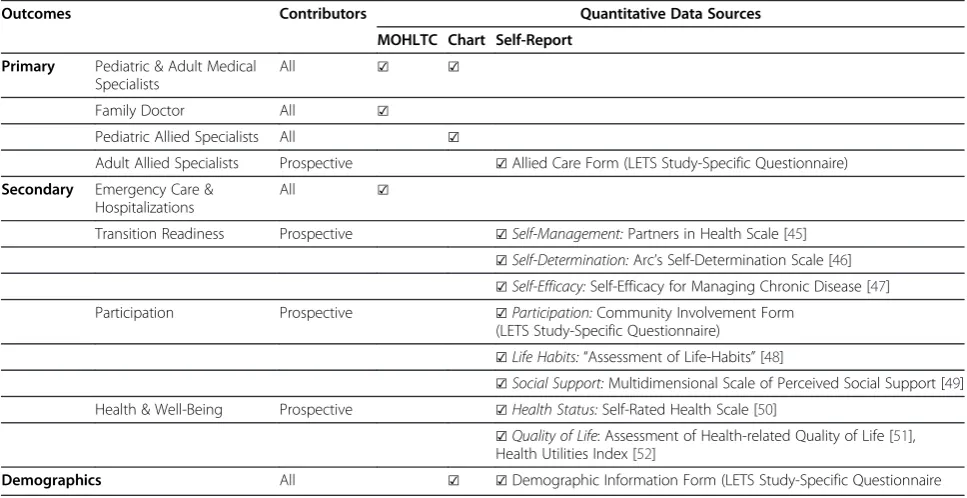
process as facilitated by the LIFEspan model. Thus, we will use a combination of measures that assess skills that have been identified in the literature through descriptive research as central to successful transition (although yet not empirically proven). In doing so, the choice of study measures reflects a multidimensional approach to transi-tion. The outcomes of the LETS study and corresponding measures for data collection related to each outcome are summarized in Table 1.
For the primary outcome of interest related to the LIFEspan model of linked health care, we will capture continuity of care between the ages of 18 (discharge from the pediatric centre) and 19 years (one year post-discharge). Continuity of care is not an all-or-nothing outcome [44]; therefore, a study-specific scale will be used to classify participants as having continuity of care on several levels (i.e., achieving a formal discharge from a pediatric facility; having a referral or seeing at least one medical specialist analogous to currently seen pediatric professional; having access to a family phys-ician, etc.). The continuity of care score will be assigned to each participant in their final year of this longitudinal study based on reviewing their health care utilization data, which will include primary care as reflected by MOHLTC summaries, and transition care as abstracted from participant charts (Table 1).
Secondary outcome measures will include patterns of hospitalizations and emergency care utilization, and measures of health and well-being, participation, and transition readiness. As summarized in Table 1, patterns
of hospitalizations and emergency care will be deter-mined from MOHLTC summaries that provide informa-tion on frequency and durainforma-tion of access, which we expect will vary as a function of continuity of care. All other outcomes will be obtained through personal assessments using standardized and study-specific tools. A demographic questionnaire and community participa-tion form were developed specifically for the study. Three different standardized measures of health and well-being will be used: the self-rated health scale from the National Health Interview Survey [50], the Health Utilities Index (HUI3 [52]), and the Assessment of Health-related Quality of Life (AQoL [51]). Young et al.’s work provides health status scores for the HUI3 and the health scale for youth and adults with CP, ABI, and SB [13]. These historical data will be valuable in under-standing the patterns of change in the current study. The LIFE-H [48] and a survey on community involve-ment, developed for the study, will be used to assess so-cial participation. However, currently there are no measures available regarding youths’ transition readi-ness; that is, their capacity to navigate the adult system as a function of transition preparation. Thus, to provide an approximation of this capacity, Arc’s Measure of Self-Determination (capacity to determine their own fate) [46], Self-Efficacy for Managing Chronic Disease (cap-ability to perform in a goal-directed manner) [53], and Partners in Health (PIH) self-management questionnaire (the ability to participate in the management of one’s health condition) [45] will be used. All standardized
Table 1 Outcomes and Measures
Outcomes Contributors Quantitative Data Sources
MOHLTC Chart Self-Report
Primary Pediatric & Adult Medical Specialists
All ☑ ☑
Family Doctor All ☑
Pediatric Allied Specialists All ☑
Adult Allied Specialists Prospective ☑Allied Care Form (LETS Study-Specific Questionnaire)
Secondary Emergency Care & Hospitalizations
All ☑
Transition Readiness Prospective ☑Self-Management:Partners in Health Scale [45] ☑Self-Determination:Arc’s Self-Determination Scale [46] ☑Self-Efficacy:Self-Efficacy for Managing Chronic Disease [47] Participation Prospective ☑Participation:Community Involvement Form
(LETS Study-Specific Questionnaire) ☑Life Habits:“Assessment of Life-Habits”[48]
☑Social Support:Multidimensional Scale of Perceived Social Support [49] Health & Well-Being Prospective ☑Health Status:Self-Rated Health Scale [50]
☑Quality of Life: Assessment of Health-related Quality of Life [51], Health Utilities Index [52]
measures selected for the study have good psychometric properties [45,46,51-57].
Finally, a chart audit tool will be used to abstract infor-mation from medical records and to comprise a master record for all visits made during the identified timeframe for each clinical group. The audit tool will include basic demographic data such as date of birth, gender, disability diagnosis, severity, and level of functioning (e.g., Gross-Motor Function Classification System). Cognitive level and educational status, communicative ability, ambula-tion status, and living arrangements will also be noted if information had been documented in the chart. An additional demographic questionnaire will also be com-pleted by the participants and capture similar informa-tion. With respect to service delivery, data including visit dates, discussion of key domains, health care pro-fessionals seen and referrals made, discharge summary, date of discharge/transfer, name of primary care pro-vider, and name of follow-up provider will be collected. This information will provide a comprehensive descrip-tion of the transidescrip-tion services received by the partici-pants as part of the process evaluation, and will serve to explain the trends that emerge in the outcome evaluation.
Qualitative data
To further understanding of the patterns of primary and secondary outcome data, participants (if feasible) and their caregivers will be asked to participate in a 45 mi-nute in-depth interview as part of the 1 year post-transfer data collection period. In addition to exploring changes in health and social services, guided, semi-structured questions regarding the transition experience (e.g., experience with continuity of care, preparation for transfer, health, social participation, and their recom-mendations) will be posed. Such an approach will help foster flexibility and is particularly well suited to explor-ing the transition process. Although this is a semi-structured format, participants will be encouraged to talk freely about their experiences.
Data collection
Study timeline
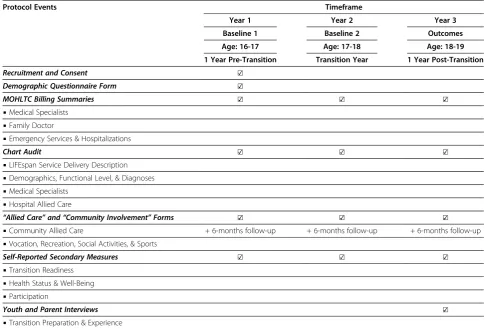
The inclusion of three different disability groups raises the possibility of differences arising as a function of disability-related influences rather than the transition intervention. To offset this possibility, baseline measures will be sampled twice to document existing differences within the three prospective participant groups and reduce individual vari-ability, resulting in three different data collection periods for ABI and CP groups (Table 2). The first baseline will occur at 17 years of age and correspond to the completion of year 1 of LIFEspan. The second will occur at 18 years of age, just prior to discharge, corresponding to the end of
year 2 of LIFEspan. Follow-up measurement of outcomes of interest will occur at 19 years of age and correspond to 1 year post-transfer. Additionally, participants will be contacted bi-annually to complete specific survey mate-rials (i.e., community involvement and allied health care surveys) to ensure a short window of recollection. SB group data will also be collected at these age markers, though this group will not have had exposure to LIFEspan. For retrospective participants, once consent is received, the ABI/CP participants will be‘followed’for a three-year period preceding introduction of the LIFEspan model. This window will match the age-related collection periods outlined for the prospective participants (i.e., first and sec-ond baseline, and post-transfer).
Quantitative data
LIFE-H, HUI3, AQoL, and Arc assessment tools have been designed for use with individuals with disabilities; and thus, have low reading levels and do not include ab-stract questions that might be challenging to adolescents [19]. PIH and Self-Efficacy questionnaires are being trialed for the first time with the populations of partici-pants enrolled in the study. Clinicians working with these participant groups have reviewed the tools for po-tential issues in comprehension. In addition, it will be emphasized to the participants that unlike school tests, the questions on these surveys have no right or wrong answers. Considerations of special accommodations, such as the provision of additional time, convenient locations, and functional and/or communicative assist-ance, will also be made, in accordance with recommen-dations in the literature [58]. Despite the potential for bias, completion by proxy respondents (e.g., parents, caregivers) will be sought where participants are un-able to complete the measures by means of self-report. In these circumstances, parents’ views may be equally valuable as they will continue to play a significant and active role in managing the young person’s health care transition.
Since all data will be manually entered, we will ensure the accuracy of data by entering numerical data from all questionnaires twice, and establishing a 90% inter-rater reliability on 20% of chart audit entries and MOHLTC data that require coding.
Qualitative data
During the semi-structured interviews, participants will be provided with a hand-held stop-and-go sign they can use when they feel comfortable going ahead with the next question or stopping when they do not wish to an-swer a question. The use of such images may help minimize the adult-child (or experimenter/participant) power differential and ensure that participants feel com-fortable and in control at all stages of the interview. The interviews will be digitally recorded to permit verbatim transcription. For the first 4 to 6 interviews, research team members skilled in qualitative interview techniques will review the transcripts and modify the interview guide as required. This process will highlight questions that require repeated clarification or rewording; identify new questions that may need to be posed; and allow a refinement of the script that is in keeping with a more natural conversation. We will verbally inform these first
few participants that we are piloting the interview to en-sure that‘we are asking the right questions in the right way’. They will also be informed that we may follow-up and ask if they would be willing to respond to a few add-itional questions if significant changes to the script are made. This would be done by phone; if participants ver-bally consent, their answers will be recorded and included with their original interview transcript.
Power calculation
Based on Young et al.’s study [13], we expect that 25% of young adults transferring from pediatric to adult services will meet our continuity of care definition (i.e., at least one visit to a primary care provider during the first year post-transition). It is hypothesized that the LIFEspan model will increase continuity of care to 75% in the intervention group (i.e., a three-fold increase). A sample size of 88 youth for the prospective comparison (70 Intervention and 75% continuity of care versus 18 Com-parison and 25% continuity of care) will provide 90% power to detect this difference at an alpha level of 0.05. A similar retrospective group will also be required. Given the large sample size, the comparison between the prospective and retrospective group of participants with Table 2 Timeline of the Study
Protocol Events Timeframe
Year 1 Year 2 Year 3
Baseline 1 Baseline 2 Outcomes
Age: 16-17 Age: 17-18 Age: 18-19
1 Year Pre-Transition Transition Year 1 Year Post-Transition
Recruitment and Consent ☑
Demographic Questionnaire Form ☑
MOHLTC Billing Summaries ☑ ☑ ☑
▪Medical Specialists ▪Family Doctor
▪Emergency Services & Hospitalizations
Chart Audit ☑ ☑ ☑
▪LIFEspan Service Delivery Description ▪Demographics, Functional Level, & Diagnoses ▪Medical Specialists
▪Hospital Allied Care
“Allied Care”and“Community Involvement”Forms ☑ ☑ ☑
▪Community Allied Care + 6-months follow-up + 6-months follow-up + 6-months follow-up ▪Vocation, Recreation, Social Activities, & Sports
Self-Reported Secondary Measures ☑ ☑ ☑
▪Transition Readiness ▪Health Status & Well-Being ▪Participation
Youth and Parent Interviews ☑
ABI and CP will also have very high power to detect this clinically important difference.
Data analyses
Quantitative analyses
The audit information collected about each visit will be entered into a statistical software package (SASW) and will include categorical data (yes/no), frequency counts, and calculated percentages. SASW software will be used to conduct a descriptive analysis and generate graphical representations, measures of central tendency, and cal-culations of confidence intervals. This analysis will com-pare actual practice with practices proposed in the LIFEspan model. A similar analysis will be conducted comparing practices in the LIFEspan model to the stand-ard of care model. For the subset of variables that are subject to participant variability, further analyses using polytomous logistic regression will compare service pro-vided by degree of disability and diagnosis to identify factors associated with greater or lesser than expected use of services predicted by LIFEspan. Because of the large number of comparisons this entails, the analysis will be limited to univariate models and will be explora-tory in nature. Rather than reporting p-values as being greater or lesser than .05 or .01, we will report the exact p-values.
Using SASW software, multiple regression (health, well-being, social participation, and transition readiness scales), logistic regression (continuity of care and com-munity involvement) and Poisson regression (health care utilization) analyses will be conducted to determine if there are differences between the intervention and com-parison groups after controlling for disability, severity, basic demographics (e.g., SES, gender), and baseline data on both the outcome of interest and other baseline mea-sures, taking into account within subject correlations. Planned contrasts will be used to compare outcomes for the intervention group with the prospective SB group as well as comparing outcomes for the intervention group with the retrospective ABI/CP group. A within interven-tion comparison between LIFEspan ABI and LIFEspan CP will also be conducted.
Qualitative analyses
Transcribed data will be inputted into NVivoWsoftware to support the qualitative data analysis. General guiding questions and a semi-structured design will support the emergence of categories and codesa posteriori. The ana-lyses will begin by each investigator independently reading each transcript several times. Through inductive analysis and an iterative process of organizing the data, patterns and themes will be identified. Through group discussion and consensus, codes will be clustered by topic and con-nections identified between common themes to form
super-ordinate themes. The transcripts will be subse-quently re-examined and coded according to the thematic branches identified during these preliminary stages. Using a constant comparative approach with continual adjust-ment throughout the process, codes will be examined, compared, and merged, relabeled or split as necessary. Codes resulting from this open coding process will be reviewed with reference to structure and relations be-tween them. Finally, an advanced level of coding will be conducted which aims to reorganize the data segments and assign those with similar meanings to a new category. Code-recode and peer examination will help establish the trustworthiness of theme identification and coding.
Compensation
All participants will receive a monetary gift-card as a thank you for their enrolment and completion of base-line data measures, followed by additional gift-cards upon completion of each additional data collection period. This is an expectation of the research ethics committee, and recognizes the value of participants’ time. Participants who complete measures on-site will also be reimbursed for their traveling expenses and pro-vided with a light meal, if desired. Similarly, mail costs will be absorbed to support this data collection strategy.
Dissemination
The results of the study will be disseminated in academic publications and journal special issues, reports to youth and their families, and websites maintained by various dis-ability and transition groups, as well as knowledge transla-tion activities involving the LIFEspan team members. The LETS study project team included several knowledge users as investigators, whose interdisciplinary perspectives contributed to the design of the study from the outset and will serve to facilitate knowledge translation as the project rolls out and findings become available.
Discussion
financial and socio-cultural demographics, and in particular, the absence of guiding theoretical research frameworks to address “the complex multidimensional, multidisciplinary, and multiagency nature”(p. 690) of transition [19]. McDo-nagh and Kelly’s careful consideration of such challenges is validating for transition researchers attempting to make headway. Based on our experiences as a multidisciplinary team of pediatric and adult rehabilitation clinicians and researchers, we argue that these issues are not unique to transplantation but are common to the field of health care transition for youth with complex chronic conditions and disabilities broadly [27,28,59]. The current paper describes similar methodological challenges. We continue this discus-sion by providing concrete examples of such issues and the strategies used to address them as they were encountered in designing an active longitudinal study.
Despite these challenges, the LETS study has a number of methodological strengths. Unlike previous retrospect-ive cross-sectional studies reported in the chronic condi-tion and disability literature to-date [9,29-32,34,35], this prospective longitudinal study will examine the prepar-ation for transition as well as their outcomes within one year post-transition. The outcome component of this study will determine whether LIFEspan establishes con-tinuity of care within the first year post-transition, which is an important first step in maintaining long-term health. This window of time is previously unaccounted, as Young et al.’s study [14] examined a longer time frame (5 – 15 years) and did not provide information on the transition itself or its immediate consequences. Second, while there are no available measures of transition readi-ness, we will use a combination of measures that assess skills central to successful transition and thus reflect the multidimensional approach to transition, as recom-mended [19]. A wide range of measures with good psy-chometric properties and appropriate for individuals with disabilities will be implemented to assess outcomes such as quality of life, health, well-being, and emer-gency health care utilization. In addition, the qualitative component of the study will enrich this quantitative data and provide in-depth subjective perceptions of youth and their parents regarding their experiences of transition process, health care services, continuity of care, preparation interventions, etc. Finally, a compre-hensive audit of implementation of LIFEspan (the process evaluation component) will allow for a detailed description of the intervention received by the partici-pants. Previous evaluations described in the literature have not provided such detailed documentation of interventions.
Additionally, CP, ABI, and SB populations represent some of the most complex individuals who need support in transition and comprehensive, lifelong health and so-cial services. Therefore, there is ample reason to believe
that the findings from this study will generalize to a wide range of pediatric patients transitioning to adult systems. However, in general, heterogeneity is a huge issue in transition studies, due to the tremendous diversity across impairment groupings arising from variations in cognitive maturation, psychosocial development, skeletal and musculature growth, motor function and other co-morbidities [59]. Such variations manifest themselves in very different clinical presentations with implications for self-management, multi-disciplinary treatment needs, and multi-agency service utilization [59]. Conversely, ex-ploring service needs and effective models of care within a single population is also extremely challenging given the vast number of potentially confounding factors asso-ciated with the potential spectrum of severity. While narrow inclusion criteria can be used to generate homo-geneous samples and optimize data collection strategies, such efforts can diminish the representativeness of the sample by excluding participants who are more severely disabled, have worse health status, are least likely to achieve adequate societal participation, and who are, po-tentially, the most vulnerable with respect to lacking ac-cess to services that would respond to their complex needs. Thus, despite the demand for high level evidence, identification of an ethically sound and practical control group remains challenging within disability research and the field of transition [58]. In the current study, the issue of potential differences among population groups will be addressed by using multiple baselines (i.e., participants serving as their own controls) and including a retro-spective control group from the same populations as those of the intervention group. Through its inclusive design, this study will offer a unique insight in the experiences of non-verbal participants via proxy report-ing and inclusion of augmentative and alternative com-munication users, whose transition experiences to-date have not been incorporated in formal evaluations [60]. Studies supporting large samples and varied data collec-tion techniques are still required as they will be critical to allow for natural variations in health and disability as well as socio-economic, geographical and cultural demo-graphics among the youth.
the study with those that did not. However, subject attri-tion will still be concerning for secondary measures. Sec-ond, since this project is a longitudinal prospective cohort study of the LIFEspan model, the representativeness of the sample is also a potential risk. At present, the LIFEspan model is only available for clients of one pediatric centre. The centre is recognized as Canada’s largest rehabilitation centre and is located in a large multi-cultural urban area of Ontario. As such, LIFEspan does set the stage for an ideal model for which to strive in service delivery, where, for example, LIFEspan clients benefit from a publicly funded health care system and transportation services to and from the centre. However, generalizability of the LETS study is thereby somewhat limited, as these services and such multicultural populations might not be found in other jurisdictions. Third, the inclusion of three different disability groups also does raise the possibility of differ-ences arising as a function of disability-related infludiffer-ences and not the intervention. While the standardized mea-sures in this study have been selected based on their ap-propriateness for completion by people with disabilities, it is well recognized that individuals with physical and devel-opmental disabilities may not follow the same develop-mental trajectory as their age-matched peers and as such, normative milestones may not be valid [61].
While there is a wealth of evidence articulating chal-lenges to implementing effective models of care, empirical evidence addressing processes and outcomes of transition remains limited. The importance of continuing research on adolescent health care transitions is indisputable for both practice and policy development, since due to a multitude of factors related to systemic deficiencies and inadequate preparation of clients for transition to adult-hood, adolescents with childhood-onset disability are at an increased risk of health problems, secondary disabil-ities, and failure to achieve optimal adult societal roles and community participation. Generally, the population of young adults with disabilities and complex chronic condi-tions and their families will benefit greatly from stronger partnerships between the pediatric and adult sector, con-sistent financing, and dedicated human resources [3]. However, there is a lack of written institutional guidance or policy regarding transition to influence such decisions, as existing research has not yet translated into policy [5,62]. Thus, systematic evaluations are essential to deter-mine the success of transition programs and address this gap. The LETS study is unique in design, aims to address gaps in the literature, and will provide evidence to support the expansion of the LIFEspan model and its adaptability to other organizations, within different clinical settings, and for clients with other childhood disabilities. The current paper serves as an important step in the dissemin-ation of the results by outlining the project background, explaining its key concepts, and providing a detailed
description of methods adopted prior to the results of the analyses.
Abbreviations
ABI: Acquired brain injury; CP: Cerebral palsy; LETS: Longitudinal Evaluation of Transition Services; LIFEspan: Living Independently and Fully Engaged Across the Lifespan; SB: Spina bifida; MOHLTC: Ministry of Health and Long-Term Care.
Competing interests
The authors declare that they have no competing interests.
Authors’contributions
SK, JM, MB, CM, and HH conceptualized the study; SL, PM, AC, and YH contributed to the design of the study and were investigators/consultants on the grant application. IT participated in the coordination of the study. All authors participated in the drafting of this manuscript, and all authors read and approved the final manuscript.
Acknowledgements
This study was funded by the Ontario Neurotrauma Foundation. Annie Dupuis assisted with plans for data analyses.
Author details
1Bloorview Research Institute, Toronto, Canada.2Holland Bloorview Kids Rehabilitation Hospital, Toronto, Canada.3Toronto Rehabilitation Institute, Toronto, Canada.4Dalla Lana School of Public Health, University of Toronto, Toronto, Canada.5SickKids Research Institute, Toronto, Canada.
Received: 9 January 2012 Accepted: 24 April 2012 Published: 15 May 2012
References
1. Strauss D, Shavelle R, Anderson T:Life expectancy of children with cerebral palsy.Pediatr Neurol1998,18(2):143–149.
2. Pediatrics AAo:A consensus statement on health care transitions for young adults with special health care needs.Pediatrics2002, 110(6 Pt 2):1304–1306.
3. Rapley P, Davidson P:Enough of the problem: a review of time for health care transition solutions for young adults with a chronic illness.J Clin Nurs2010,19(3–4):313–323.
4. Reiss J, Gibson R:Health care transition: destinations unknown.Pediatrics 2002,110(6 Pt 2):1307–1314.
5. Scal P:Transition for youth with chronic conditions: primary care physicians’approaches.Pediatrics2002,110(6 Pt 2):1315–1321. 6. Steinbeck K, Brodie L, Towns S:Transition in chronic illness: who is going
where?J Paediatr Child Health2008,44(9):478–482.
7. Blum R, Garell D, Hodgman C, Jorissen T, Okinow N, Orr D, Slap G: Transition from child-centered to adult health-care systems for adolescents with chronic conditions. A position paper of the society for adolescent medicine.J Adolesc Health1993,14(7):570–576.
8. Hamdani Y, Jetha A, Norman C:Systems thinking perspectives applied to health care transition for youth with disabilities: a paradigm shift for practice, policy and research.Child Care Health Dev2011,37(6):806–814. 9. McDonagh J:Transition of care from paediatric to adult rheumatology.
Arch Dis Child2007,92(9):802–807.
10. McDonagh JE:Growing up and moving on: transition from pediatric to adult care.Pediatr Transplant2005,9(3):364–372.
11. Stevenson C, Pharoah P, Stevenson R:Cerebral palsy–the transition from youth to adulthood.Dev Med Child Neurol1997,39(5):336–342. 12. Bowes G, Sinnema G, Suris J, Buhlmann U:Transition health services for
youth with disabilities: a global perspective.J Adolesc Health 1995,17(1):23–31.
13. Young N, Steele C, Fehlings D, Jutai J, Olmsted N, Williams J:Use of health care among adults with chronic and complex physical disabilities of childhood.Disabil Rehabil2005,27(23):1455–1460.
15. McColl M:Disability studies at the population level: issues of health service utilization.Am J Occup Ther2005,59(5):516–526.
16. Lewis-Gary M:Transitioning to adult health care facilities for young adults with a chronic condition.Pediatr Nurs2001,27(5):521–524. 17. Reiss J, Gibson R, Walker L:Health care transition: youth, family, and
provider perspectives.Pediatrics2005,115(1):112–120.
18. Rosen D:Between two worlds: bridging the cultures of child health and adult medicine.J Adolesc Health1995,17(1):10–16.
19. McDonagh J, Kelly D:The challenges and opportunities for transitional care research.Pediatr Transplant2010,14:688–700.
20. Scal P, Evans T, Blozis S, Okinow N, Blum R:Trends in transition from pediatric to adult health care services for young adults with chronic conditions.J Adolesc Health1999,24(4):259–264.
21. White P:Success on the road to adulthood. Issues and hurdles for adolescents with disabilities.Rheum Dis Clin North Am1997,23(3):697–707. 22. Colver A, Dickinson H:Study protocol: determinants of participation and
quality of life of adolescents with cerebral palsy: a longitudinal study (SPARCLE2).BMC Publ Health2010,10:280.
23. Simpson AR:Raising teens: A Synthesis of Research and a Foundation For action. Boston: Center for Health Communication, Harvard School of Public Health; 2001.
24. Stevens S, Steele C, Jutai J, Kalnins I, Bortolussi J, Biggar W:Adolescents with physical disabilities: some psychosocial aspects of health.J Adolesc Health1996,19(2):157–164.
25. Murphy K:Medical problems in adults with cerebral palsy: case examples.Assist Technol1999,11(2):97–104.
26. Newacheck P, Kim S:A national profile of health care utilization and expenditures for children with special health care needs.[erratum appears in arch pediatr adolesc med. 2005 apr;159(4):318].Arch Pediatr Adolesc Med2005,159(1):10–17.
27. Stewart D, Stavness C, King G, Antle B, Law M:A critical appraisal of literature reviews about the transition to adulthood for youth with disabilities.Phys Occup Ther Pediatr2006,26(4):5–24.
28. While A, Forbes A, Ullman R, Lewis S, Mathes L, Griffiths P:Good practices that address continuity during transition from child to adult care: synthesis of the evidence.Child Care Health Dev2004,30(5):439–452. 29. Betz C, Smith K, Macias K:Testing the transition preparation training
program: a randomized controlled trial.Int J Child and Adolescent Health 2011,3:595–607.
30. Craig S, Towns S, Bibby H:Moving on from paediatric to adult health care: an initial evaluation of a transition program for young people with cystic fibrosis.Int J Adolesc Med Health2007,19(3):333–343.
31. Hess J, Straub D:Brief report: preliminary findings from a pilot health care transition education intervention for adolescents and young adults with special health care needs.J Pediatr Psychol2011,36(2):172–178. 32. Jurasek L, Ray L, Quigley D:Development and implementation of an
adolescent epilepsy transition clinic.J Neurosci Nurs2010,42(4):181–189. 33. McDonagh J, Southwood T, Shaw K:The impact of a coordinated
transitional care programme on adolescents with juvenile idiopathic arthritis.Rheumatology (Oxford)2007,46(1):161–168.
34. Robertson L, McDonagh J, Southwood T, Shaw K:Growing up and moving on. A multicentre UK audit of the transfer of adolescents with juvenile idiopathic arthritis from paediatric to adult centred care.Ann Rheum Dis 2006,65(1):74–80.
35. Van Walleghem N, Macdonald C, Dean H:Evaluation of a systems navigator model for transition from pediatric to adult care for young adults with type 1 diabetes.Diabetes Care2008,31(8):1529–1530. 36. Gall C, Kingsnorth S, Healy H:“Growing Up Ready”: a shared management
approach.Phys Occup Ther Pediatr2006,26(4):47–62.
37. Kieckhefer G, Trahms C:Supporting development of children with chronic conditions: from compliance toward shared management.Pediatr Nurs 2000,26(4):354–363.
38. Kingsnorth S, Lindsay S, Maxwell J, Tsybina I, Seo H, Macarthur C, Bayley M: Implementation of the LIFEspan model of transition care for youth with childhood onset disabilities.Int J Child & Adolescent Health2011, 3:547–561.
39. Young N:Data on health services utilization and health status for youth and young adults. InCAPHC 2004 Annual Meeting: 9 November 2004, Montreal.
40. Majnemer A, Limperopoulos C:Importance of outcome determination in pediatric rehabilitation.Dev Med Child Neurol2002,44(11):773–777.
41. Kipps S, Bahu T, Ong K, Ackland F, Brown R, Fox C, Griffin N, Knight A, Mann N, Neil H,et al:Current methods of transfer of young people with type 1 diabetes to adult services.Diabet Med2002,19(8):649–654.
42. Pai A, Ostendorf HM:Treatment adherence in adolescents and young adults affected by chronic illness during the health care transition from pediatric to adult health care: a literature review.Child Health Care2011, 40(1):16–33.
43. McDonagh J, Kaufman M:Transition from pediatric to adult care after solid organ transplantation.Curr Opin Organ Transplant2009, 14(5):526–532.
44. de Kraus Camargo O:Systems of care: transition from the bio-psycho-social perspective of the international classification of functioning, disability and health.Child Care Health Dev2011,37(6):792–799. 45. Battersby M, Higgins P, Collins J, Reece M, Homwood C, Daniel B:Partners
in Health: The development of self-management for SA HealthPlus participants. InThe Australian Coordinated Care Trials: Recollections of an Evaluation. Canberra, Australia: Publications Production Unit (Public Affairs, Parliamentary and Access Branch): Commonwealth Department of Health and Ageing; 2002.
46. Wehmeyer ML, Kelchner K:The Arc’s self-determination scale. Silver Springs, MD: The Arc of the United States; 1995.
47. Lorig K, Ritter P, Stewart A, Sobel D, Brown B, Bandura A, Gonzalez V, Laurent D, Holman H:Chronic disease self-management program: 2-year health status and health care utilization outcomes.Med Care2001, 39(11):1217–1223.
48. Noreau L, Fougeyrollas P, Vincent C:The LIFE-H: assessment of the quality of social participation.Technol Disabil2002,14(3):113–118.
49. Zimet GD, Dahlem NW, Zimet SG, Farley GK:The multidimensional scale of perceived social support.J Pers Assess1988,52(1):30–41.
50. National health interview survey.http://www.statcan.gc.ca/start-debut-eng.html. 51. Hawthorne G, Richardson J, Osborne R:The Assessment of Quality of Life
(AQoL) instrument: a psychometric measure of health-related quality of life.Qual Life Res1999,8(3):209–224.
52. Horsman J, Furlong W, Feeny D, Torrance G:The Health Utilities Index (HUI): concepts, measurement, properties and applications.Health Qual Life Outcomes2003,1(54): doi: 10.1186/1477-7525-1-54.
53. Lorig K, Sobel D, Ritter P, Laurent D, Hobbs M:Effect of a self-management program for patients with chronic disease.Eff Clin Pract2001,4:256–262. 54. Hawthorne G:Assessing utility where short measures are required:
development of the short Assessment of Quality of Life-2 (AQoL-2) instrument.Value Health2009,12(6):948–957.
55. Hawthorne G, Richardson J, Day NA:A comparison of the Assessment of Quality of Life (AQoL) with four other generic utility instruments.Ann Med2001,33(5):358–370.
56. Furlong WJ, Feeny DH, Torrance GW, Barr RD:The Health Utilities Index (HUIW) system for assessing health-related quality of life in clinical studies.Ann Med2001,33(5):375–384.
57. Noreau L, Desrosiers J, Robichaud L, Fougeyrollas P, Rochette A, Viscogliosi C:Measuring social participation: reliability of the LIFE-H in older adults with disabilities.Disabil Rehabil2004,26(6):346–352.
58. Kroll T, Morris J:Challenges and opportunities in using mixed method designs in rehabilitation research.Arch Phys Med Rehabil2009, 90(11 Suppl):S11–S16.
59. Binks J, Barden W, Burke T, Young N:What do we really know about the transition to adult-centered health care? A focus on cerebral palsy and spina bifida.Arch Phys Med Rehabil2007,88(8):1064–1073.
60. Transitions: straight talk. Augmentative Communication News. vol. 17. 2005:1–11. 61. Liptak G:Health and well being of adults with cerebral palsy.Curr Opin
Neurol2008,21(2):136–142.
62. Burke R, Spoerri M, Price A, Cardosi A, Flanagan P:Survey of primary care pediatricians on the transition and transfer of adolescents to adult health care.Clin Pediatr (Phila)2008,47(4):347–354.
doi:10.1186/1471-2431-12-51
Cite this article as:Tsybinaet al.:Longitudinal Evaluation of Transition