R E S E A R C H
Open Access
Privacy preserving data anonymization of
spontaneous ADE reporting system dataset
Wen-Yang Lin
*†, Duen-Chuan Yang
†and Jie-Teng Wang
From
The ACM Ninth International Workshop on Data and Text Mining in Biomedical Informatics
Melbourne, Australia. 23 October 2015
Abstract
Background:To facilitate long-term safety surveillance of marketing drugs, many spontaneously reporting systems (SRSs) of ADR events have been established world-wide. Since the data collected by SRSs contain sensitive personal health information that should be protected to prevent the identification of individuals, it procures the issue of privacy preserving data publishing (PPDP), that is, how to sanitize (anonymize) raw data before publishing. Although much work has been done on PPDP, very few studies have focused on protecting privacy of SRS data and none of the anonymization methods is favorable for SRS datasets, due to which contain some characteristics such as rare events, multiple individual records, and multi-valued sensitive attributes.
Methods:We propose a new privacy model called MS(k,θ*)-bounding for protecting published spontaneous ADE
reporting data from privacy attacks. Our model has the flexibility of varying privacy thresholds, i.e.,θ*, for different sensitive values and takes the characteristics of SRS data into consideration. We also propose an anonymization algorithm for sanitizing the raw data to meet the requirements specified through the proposed model. Our algorithm adopts a greedy-based clustering strategy to group the records into clusters, conforming to an innovative anonymization metric aiming to minimize the privacy risk as well as maintain the data utility for ADR detection. Empirical study was conducted using FAERS dataset from 2004Q1 to 2011Q4. We compared our model with four prevailing methods, includingk-anonymity, (X,Y)-anonymity, Multi-sensitivel-diversity, and (α,k)
-anonymity, evaluated via two measures, Danger Ratio (DR) and Information Loss (IL), and considered three different scenarios of threshold setting forθ*, including uniform setting, level-wise setting and frequency-based setting. We also conducted experiments to inspect the impact of anonymized data on the strengths of discovered ADR signals. Results:With all three different threshold settings for sensitive value, our method can successively prevent the disclosure of sensitive values (nearly all observedDRs are zeros) without sacrificing too much of data utility. With non-uniform threshold setting, level-wise or frequency-based, our MS(k,θ*)-bounding exhibits the best data utility and the least privacy risk among all the models. The experiments conducted on selected ADR signals from MedWatch show that only very small difference on signal strength (PRR or ROR) were observed. The results show that our method can effectively prevent the disclosure of patient sensitive information without sacrificing data utility for ADR signal detection.
(Continued on next page)
* Correspondence:[email protected]
†Equal contributors
Department of Computer Science and Information Engineering, National University of Kaohsiung, Nanzih District, Kaohsiung 811, Taiwan, R.O.C
(Continued from previous page)
Conclusions:We propose a new privacy model for protecting SRS data that possess some characteristics
overlooked by contemporary models and an anonymization algorithm to sanitize SRS data in accordance with the proposed model. Empirical evaluation on the real SRS dataset, i.e., FAERS, shows that our method can effectively solve the privacy problem in SRS data without influencing the ADR signal strength.
Keywords:Adverse drug reaction, ADR signal detection, Data anonymization, Privacy preserving data publishing, Spontaneous reporting system
Background
It is well known that a new drug before hitting the mar-ket needs to undergo a series of clinical trials to reveal all possible adverse drug reactions (ADRs). Unfortu-nately, many serious ADRs cannot be disclosed in the premarketing stage through the limited number of vol-unteers participate in clinical trials; on the contrary, they can only be identified through long term surveillance of extensive usages of the drug on the masses. Therefore, most of highly developed countries have established various spontaneous reporting systems (SRSs) to collect adverse drug events (ADEs) as a data repository for ADR detection and analysis, e.g., the FDA Adverse Event Reporting System (FAERS) of the US Food and Drug Ad-ministration (FDA) [1], the UK Yellow Card scheme [2], and the MedEffect Canada [3], among others.
Usually, the data collected by the SRSs contain sensitive personal health information that should be protected to prevent the identification of individuals. This procures the need of anonymizing the raw data before being published, namely privacy-preserving data publishing (PPDP) [4]. Although in the past few years there have been a lot of researches on this topic, none of the anonymization methods is favorable for SRS datasets, due to which con-tain some characteristics, including rare events, multiple individual records, and multi-valued sensitive attributes.
In this paper, we present a new privacy-preserving model, called MS(k,θ*)-bounding, for protecting the pub-lished spontaneous ADE reporting data from privacy at-tacks. We also propose an anonymization algorithm for sanitizing the raw data to meet the requirements specified through the proposed model. Empirical study conducted using FAERS datasets show that our method can effectively prevent the disclosure of patient sensitive information without sacrificing data utility for ADR signal detection. In what follows, we present some background knowledge re-lated to this work, including ADR signal detection and privacy-preserving models, followed by a summarization of our previous work [5] on the deficiency of contemporary PPDP models for publishing SRS datasets.
Spontaneously reporting systems and ADR signal detection
According to WHO, the definition of ADRs or ADEs is uncomfortable, noxious, unexpected, or potentially
harmful reactions resulting from the use of given medications for patients. Usually, an ADR signal (rule) can be represented as an association between symptoms and drugs with some extra conditions, for example, a rule “Avandia, age > 18 years old⇒death.”
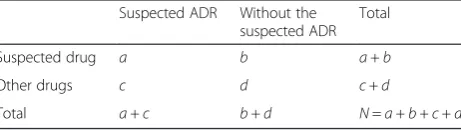
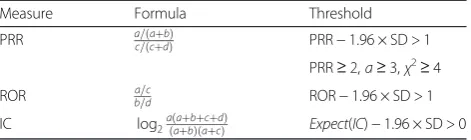
Statisticians have developed various criteria based on the concept of measuring disproportionality or information component (IC) to evaluate the significance of an ADR signal [6]. The most widely adopted disproportionality-based measurements are Proportional Reporting Ratio (PRR) [7] and Reporting Odds Ratio (ROR) [8]. The PRR measure is used by the U.K. Yellow Card database and UK Medicines and Healthcare products Regulatory Agency (MHRA), while ROR is used by the Netherlands Pharma-covigilance Foundation. All of these measurements can be calculated using a contingency table as shown in Table 1. Table 2 shows some ADR measures and thresholds that commonly used in the pharmacovigilance community for detecting ADR signals.
Privacy models for microdata publishing
Microdata refer to a kind of data which contains individ-ual information and usindivid-ually can be represented as tables including tuples defined in a set of attributes, and we can divide these attributes into the following categories:
Explicit Identifiers (ID):These refer to attributes that can uniquely identify each individual, such as SSN, Name, etc.
Quasi-identifiers (QID): These refer to attributes that might be linked with external information to re-identify some of the individuals, e.g., Sex, Age, ZIP code, etc.
Sensitive Attributes (SA):These refer to attributes that contain sensitive information, such as Disease, Salary, etc.
Table 1The 2 × 2 contingency table used for the identification of ADRs
Suspected ADR Without the suspected ADR
Total
Suspected drug a b a+b
Other drugs c d c+d
Non-sensitive Attributes (NSA):These refer to attributes not fall into the above three categories.
Since Sweeney [9] pointed out that publishing micro-data by only removing ID without paying attention to
QID may threat the privacy of data owners, there have been a lot of researches on this topic [4]. These research efforts towards protecting released microdata aim at thwarting two primary types of privacy attacks,individual disclosureandattribute disclosure.
Individual disclosure (also known as table linkage attack) refers to the situation that a specific tuple for an individual in the published table is re-identified. The most famous privacy model for this purpose is k -ano-nymity [9]. With k-anonymity, the data publisher should generalize QID of the data such that each QID group contains no less thanktuples, making a given record in-distinguishable from at leastk- 1 other records byQID. Attribute disclosure (also known asattribute linkage at-tack) refers to the situation that the sensitive attribute value of an individual can be inferred without the neces-sity to link the value to a specific tuple. The prevailing model for this protection is l-diversity [10], which re-quires each QID group contains at least l “ well-repre-sented”sensitive values so as to ensure the probability of inferring the specific sensitive value within each QID
group will be no more than 1/l.
Problems of contemporary privacy models
We summarize our previous work on the deficiency of contemporary PPDP models for publishing SRS datasets [5]. First, we present the features of SRS data, and then summarize the results of our analysis.
Special features of SRS data
Rare Events:Usually, undiscovered or new ADRs are rarely observed, so almost all criteria used in measuring the significance of ADRs ignore or overlook the frequency of ADRs. For example, the MHRA measure may output a suspected signal even it occurs only three times. With PPDP models, we often generalize or suppress the records, which may increase the risk of false positive as well as false negative signals of ADRs, especially when we perform stratified ADR detection by factors such as Age, Gender, and Location, i.e., members of the typicalQID.
Multiple Individual Records:A typical SRS data usually contains reports called follow-ups, which complement the information of an initial report and have to be merged with the initial report to form a more accurate and complete version. Most of contemporary PPDP models assume that there is only one record for each individual, e.g.,k-anonymity, l-diversity. Overlooking the existence of multiple individual records might impair the privacy requirement to be achieved. For example, consider a table satisfyingk-anonymity. AQIDgroup might containktuples, all of which are of the same individual, thus ruin the privacy requirement. Multi-valued Sensitive and Quasi-sensitive Attribute:
Quasi-sensitive attributes (QSA) are not sensitive attributes, but as link to external knowledge may reveal sensitive information of an individual. Typical SRS datasets, e.g., FAERS, usually contain Drug and PT (Preferred Terms of symptoms), each of which, if being linked with external knowledge of clinical treatments, could reveal the disease information of an individual. For example, Prezista and Ritonavir are commonly used together for treating HIV; knowing a patient taking these medicines is almost equivalent to perceiving him having HIV. Besides, FAERS contains another attribute named INDI_PT, which records the indications of the patient before treatment. Values of this attribute can be sensitive (represent some disease, e.g., Multiple Sclerosis) or quasi-sensitive (describe symptoms of some illness, e.g., Muscle Spasticity, possibly caused by Parkinson’s disease). All of these three attributes are multi-valued, i.e., containing more than one value. Very few PPDP models can handle multi-valued sensitive attributes and consider the existence of quasi-sensitive attributes.
Analysis of previous work
Our previous work in [5] can be summarized as follows:
(1)Variants ofk-anonymity orl-diversity overlook the existence of rare instances in the dataset.
(2)Only very few models, e.g., (X,Y)-privacy [11], consider multiple individual records.
(3)ExceptQS l-diversity [12], no model notices the existence of quasi-sensitive attributes, not to mention the case of multivalued quasi-sensitive attributes. (4)Most models entail the assumption of single
sensitive attribute, while very few embrace the situation of multiple sensitive attributes, e.g., (α,k )-anonymity [13], Multi-sensitivel-diversity [14]. (5)No model takes into account all of the
mentioned features of SRS datasets, which raises the need to design a new PPDP model to handle these features.
Table 2Commonly used ADR measures and thresholds
Measure Formula Threshold
PRR ac==ððacþþdbÞÞ PRR−1.96 × SD > 1 PRR≥2,a≥3,χ2≥4
ROR ba==cd ROR−1.96 × SD > 1
IC log2
a aðþbþcþdÞ
aþb
Methods
The proposed MS(k,θ*)-bounding model
To solve the aforementioned problems, we developed a privacy model called Multi-Sensitive (k, θ*)-anonymity (abbrev. MS(k,θ*)-anonymity). LetD be SRS data to be published that consists of four disjoint sets of attributes,
QID,SA,QSA, andNSA, i.e.,D= <QID,SA,QSA,NSA>, and D* the released SRS data after anonymization. We called the records with the same QID values a “QID -group.” We also assume an external knowledge table E
about treatment is available, which can be constructed from websites such as Drugs.com, wrongdiagnosis, etc. For simplicity, let E contain a pair of attribute group (QE,SE), whereQEdenotes the set of attributes that can
be linked with QSA in D, e.g., Drug, and SE the set of
sensitive attributes, e.g.,Disease.
Definition 1 (Confidence). Lets be a sensitive value inSA orSE. For aQID-group in D(orD*) with value of
q, we define the probability thatqhavesas
conf qð →sÞ;
and the same probability after linkingEviaSAandSEas conf qð →s;EÞ:
Definition 2 (Confidence Bounding). Let S= {s1, s2, …,sl} be the set of sensitive values to be protected and θ*
= (θ1,θ2, …,θl) be the user specified disclosure
prob-ability thresholds associated withS, whereθidenotes the
threshold forsi, 1≤i≤l. That is,θiis an upper bound of
the confidence to infer anyQID-group having si, with or
without external knowledgeE, i.e.,
conf qð →si;EÞ≤θi:
Note that S is a subset of all values legal in SA and
SE, i.e.,
SUA∈SA∪SEdom Að Þ;
wheredom(A) represents the domain of attributeA. Definition 3 (MS(k, θ*
)-bounding). Given S and the correspondingθ*, we say a release dataD*satisfies MS(k,
θ*
)-bounding if
(1)EveryQID-group contains at leastkdistinct individuals (cases);
(2)The confidence to infer anyQID-groupqhavingsiis less thanθi, i.e.,conf(q→si,E)≤θi.
In MS(k,θ*)-bounding, we defineθ*to control the ratio of sensitive values inQIDgroup because not all sensitive values is“really”sensitive. For example, most diseases are sensitive for people, but it does not matter when the others know someone got a flu. This model can solve the multiple individual records problem becausek is defined
by the distinct individuals, and it is easy to check whether theQIDgroup satisfies the model or not.
Another noteworthy thing is about the setting of con-fidence bounding θ*. In general, as applying MS(k, θ* )-bounding to the dataset, everyθiinθ
*
should be no less than the frequency of siin the dataset, i.e., we must set
every θi so as to satisfy θi≥P(si). This is because after
generalization the occurrence ofsiin everyQID-group is
no less than P(si), and so setting θi<P(si) nullifies the
work of anonymization, i.e., the result fails to meet the privacy requirement. However, for a dataset containing some relatively frequent sensitive values, we still can apply MS(k, θ*)-bounding to the dataset using some other methods like adding counterfeit records or sup-pressing some of those sensitive values, though those method may severely decrease the utility of the data.
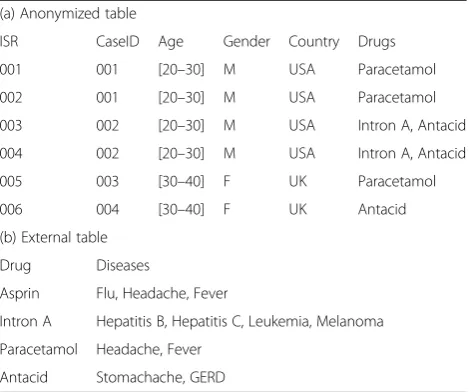
Example 1.Table 3 illustrates a sample of the FAERS data, where ISR and CaseID denote the IDs of a record and an event, respectively. Since an event may have more than one reporting records, a CaseID can correspond to many different ISRs. Here we assume QID comprises {Age,Gender,Country}. Table 3(a) shows the anonymized tableD*composed of twoQIDgroups, ([20–30], M, USA) and ([30–40], F, UK), each of which contains two different events; Table 3(b) represents the external tableEshowing knowledge of treating diseases with drugs. It is not hard to derive that the probability of each disease associated with a specificQIDgroup is less than 0.4, e.g.,conf([30–40], F, UK→Headache,E) = 0.25. This anonymized tableD*thus satisfies MS(2, 0.4)-bounding.
Anonymization algorithm for MS(k,θ*)-anonymity Algorithm basics
Our algorithm is a hybrid of greedy and clustering approaches. We view each QID-group as a cluster and
Table 3A sample FAERS data satisfying MS(2, 0.4)-bounding
(a) Anonymized table
ISR CaseID Age Gender Country Drugs
001 001 [20–30] M USA Paracetamol
002 001 [20–30] M USA Paracetamol
003 002 [20–30] M USA Intron A, Antacid
004 002 [20–30] M USA Intron A, Antacid
005 003 [30–40] F UK Paracetamol
006 004 [30–40] F UK Antacid
(b) External table
Drug Diseases
Asprin Flu, Headache, Fever
Intron A Hepatitis B, Hepatitis C, Leukemia, Melanoma
Paracetamol Headache, Fever
so develop a clustering-based method [15] to form all
QID-groups.
Each QID-group (cluster) begins with a randomly se-lected record, and then is gradually increased by adding an isolated record that exhibits the best characteristic among all candidates. This process continues until the group is composed ofkdifferent cases. Finally, theQIDs of all records belonging to the same cluster are general-ized to the same value.
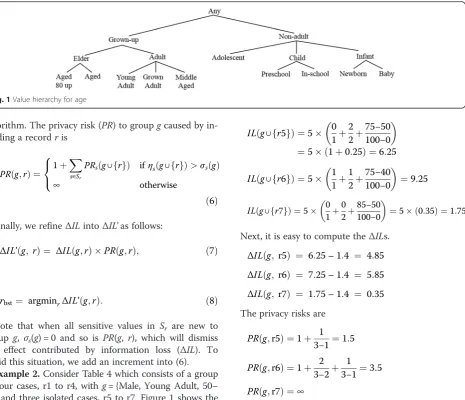
We use generalization rather than suppression as the anonymization operation because suppression tends to remove records corresponding to rare events. We adopt both hierarchy-based generalization and hierarchy-free generalization; the former is used when a value generalization hierarchy is defined for the attribute (usu-ally, it is categorical), otherwise the latter is used. For ex-ample, we adopt the age hierarchy defined in MeSH [16], a domain knowledge of value generalization hier-archies widely used in medical and healthcare areas. In the following, we describe the metric for evaluating an isolated record quality.
Intuitively, the best record to be included into aQID -group should exhibit the most similarity to the -group. This implies its addition will result in the least degree of generalization (distortion of data, destruction of utility, or information loss) to be performed on the QID attri-butes of the group. Here in this study, we adapt the measure of information loss defined in [15].
Definition 4 (Information Loss). Let g denote a group (cluster) constructed during the execution of our algorithm, where the QID comprise two different sets, numerical attributesN1,N2,…,Nm, and categorical
attri-butes C1, C2, …, Cn, and each Ci is associated with a
generalization hierarchy Ti. The information loss (IL) of
groupgis defined as follows:
IL gð Þ ¼j j g X m
i¼1
maxðNi;gÞ−minðNi;gÞ maxð ÞNi −minð ÞNi
þXn j¼1
h Cj;g
h Cj
!
;
ð1Þ
where max (Ni) (min(Ni)) and max(Ni, g) (min(Ni, g))
denote the maximum (minimum) values of attribute
Ni in the whole dataset and group g, respectively; |g|
denotes the number of records in g; h(Cj) is the
height of the hierarchy tree Tj, and h(Cj, g) the height
of the generalized value of Cj for all records in g, i.e.,
the lowest common ancestor in Tj with respect to
every Cj value in g.
The information loss measures how generalization im-pact the data utility. As we are building a group g by adding new records, we can use the difference of IL
(ΔIL) between the original group and the group with
recordrto determine the best record that produces the leastΔIL, i.e.,
ΔIL gð ;rÞ ¼IL gð ∪f gr Þ–IL gð Þ; ð2Þ
and the best choicerbstis
rbst¼ argminrΔIL gð ;rÞ: ð3Þ
In addition to the data distortion, the privacy require-ment is another factor critical for the determination of the best record. This is because the inclusion of a new record would increase the disclosure risk of some sensi-tive values in the resulting QID-group. We introduce a new parameter called Privacy Risk (PR) to measure the risk of sensitive value disclosure incurred by adding new records into the QID-group, thus alleviating the breach of our privacy requirement.
Let Sr denote the set of sensitive values contained in
record r. Consider a QID-group g and a sensitive value
s∈Sr. Letσs(g) represent the number of records ing
con-taining sensitive value s. We define the maximum num-ber of records in g, ηs(g), that will cause the breach of
the boundθsassociated withs
ηsð Þ ¼g
⌊
maxfk; j jg g θs⌋
; ð4Þand the privacy risk to explore s with the inclusion of recordras
PRsðg∪f gr Þ ¼
σsð Þg
ηsðg∪f gr Þ−σsð Þg ifηsðg∪f gr Þ>σsð Þg
∞ otherwise
8 < :
ð5Þ
Since a record may contain multiple sensitive values, the privacy risk of group gcaused by includingrcan be defined as the summation of the risk to each sensitive value.
Definition 5 (Privacy Risk). Let g denote a group (cluster) constructed during the execution of our
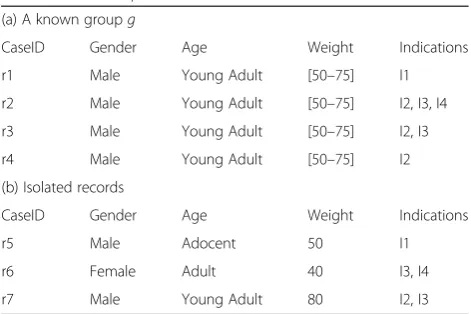
Table 4An example data
(a) A known groupg
CaseID Gender Age Weight Indications
r1 Male Young Adult [50–75] I1
r2 Male Young Adult [50–75] I2, I3, I4
r3 Male Young Adult [50–75] I2, I3
r4 Male Young Adult [50–75] I2
(b) Isolated records
CaseID Gender Age Weight Indications
r5 Male Adocent 50 I1
r6 Female Adult 40 I3, I4
algorithm. The privacy risk (PR) to groupgcaused by in-cluding a recordris
PR gð ;rÞ ¼ 1þ X
s∈Sr
PRsðg∪f gr Þ ifηsðg∪f gr Þ>σsð Þg
∞ otherwise
8 < :
ð6Þ
Finally, we refineΔILintoΔIL’as follows:
ΔIL’ðg; rÞ ¼ ΔIL gð ;rÞ PR gð ;rÞ; ð7Þ
and
rbst¼ argminrΔIL’ðg;rÞ: ð8Þ
Note that when all sensitive values in Sr are new to
group g, σs(g) = 0 and so is PR(g, r), which will dismiss
the effect contributed by information loss (ΔIL). To avoid this situation, we add an increment into (6).
Example 2.Consider Table 4 which consists of a group of four cases, r1 to r4, withg= {Male, Young Adult, 50– 75} and three isolated cases, r5 to r7. Figure 1 shows the age hierarchy defined in MeSH and Fig. 2 depicts a simple hierarchy for gender. Let QID= {Gender, Age, Weight} and SA= {Indications}, and suppose k= 5, θ*= 0.6, and weight range = 0 ~ 100. The information loss for groupgis
IL gð Þ ¼4 0 1þ
0 2þ
75−50 100−0
¼40:25¼1;
and forg∪{r5},g∪{r6}, andg∪{r7} the values are
IL gð ∪f gr5 Þ ¼5 0 1þ
2 2þ
75−50 100−0
¼5ð1þ0:25Þ ¼6:25
IL gð ∪f gr6 Þ ¼5 1 1þ
1 2þ
75−40 100−0
¼9:25
IL gð ∪f gr7 Þ ¼5 0 1þ
0 2þ
85−50 100−0
¼5ð0:35Þ ¼1:75
Next, it is easy to compute theΔILs.
ΔIL gð ; r5Þ ¼ 6:25–1:4 ¼ 4:85
ΔIL gð ; r6Þ ¼ 7:25–1:4 ¼ 5:85
ΔIL gð ; r7Þ ¼ 1:75–1:4 ¼ 0:35
The privacy risks are
PR gð ;r5Þ ¼1þ 1 3−1¼1:5
PR gð ;r6Þ ¼1þ 2 3−2þ
1 3−1¼3:5
PR gð ;r7Þ ¼∞
Finally, we can compute the ΔIL’s and obtain the best choicerbstamong r5 to r7, concludingrbst= r5.
rbst¼ argminrfΔIL’ðg; r5Þ; ΔIL’ðg; r6Þ; ΔIL’ðg; r7Þg ¼ argminrf4:181:5; 5:853:5;∞g ¼ r5
Detail description
Algorithms 1 and 2 present the description of our algo-rithm, which is composed of two stages. The first stage is to create as many QID-groups that satisfy MS(k, θ* )-bounding as possible. We introduce a concept called
combined record(orsuper record) to handle the issue of multiple individual records. That is, all records with the same CaseID are combined into a super record before the anonymization procedure. This avoids the abnormal situation that members of this CaseID group will be, after generalization, divided into different QID-groups, which will cause larger bias on the data quality and per-plex the process of identifying duplicate records during ADR signal detection.
Initially, we combine records with the same CaseID into one super record per CaseID by generalizing the values of those records. The generalization is neces-sary because not all members of the same CaseID ex-hibit the same QID value. This is due to the existence of follow-up records, which represent compensation for the initial report and so may contain update information.
Next, we create an empty group and add into it a ran-domly selected record, then into which we add more re-cords step by step, each with the least ΔIL’ (defined in (7)) until the group satisfies MS(k,θ*)-bounding. Thirdly, we choose a new record that is most distinguished from the one chosen for creating the latest group and repeat the same steps to grow the group. These steps are re-peated until the remaining records cannot form a group, e.g., the number of records is less thankor most of the remaining records contain the same sensitive value.
The second stage is then activated by calling function
QID-generalization (see Algorithm 2). First, we take care of the ungrouping records by adding each of them into the group that produces the leastΔIL’to ensure the util-ity and meet the privacy requirement. Next, we split those combined records back to their original records (do not change the group they belong to). Finally, we generalize all records within the same group into the same QIDs such that the whole data set will satisfy MS(k,θ*)-bounding.
Results and Discussions
We have conducted a series of experiments to confirm if our model is more suitable for anonymizing SRS data-sets than prevailing PPDP models. We describe the de-sign of each experiment, present the experimental results, and state our observations.
Experimental design
All experiments were conducted over FAERS datasets, which is a SRS system provided by U.S. Food and Drug Administration (FDA) and released quarterly. Each re-port in FAERS is uniquely identified by an attribute called ISR, and contains an attribute CaseID to identify distinct individuals, along with some demographic informa-tion such as Weight, Age, and Gender, drugs information such as drug name (Drug) and indication (INDI_PT), and reaction information (PT).
We used {Weight,Age, Gender} as QID,CaseIDas the individual identifier, and used drug indication (INDI_PT) and drug reaction (PT) asSA. Datasets from 2004Q1 to 2011Q4 were selected to build the test sets, where any record withQIDcontaining missing values was discarded.
Four prevailing PPDP models were evaluated against our model. They are k-anonymity, (X, Y)-anonymity, Multi-sensitive l-diversity, and (α, k)-anonymity. These models were chosen because each of them is the repre-sentative or the prevailing models, and can be applied to anonymize SRS data without additional modification; this is why l-diversity is replaced by Multi-sensitive
l-diversity.
criteria, i.e., data utility and privacy risk, and the influ-ence to ADR signals.
For the anonymization quality, we considered two measurements. The first one calledNormalized Informa-tion Loss(NIL) is used to measure the data utility, defined as follows:
NIL Dð Þ ¼ 1 ngjQIDj
X
g∈D
IL gð Þ !
; ð9Þ
where D* is the anonymized data table, ng denotes the
number of QID-groups in D*, g denotes a QID-group, and |QID| the cardinality of QID. The value of NIL
ranges over [0, 1]; largerNILmeans poorer data utility. The second one called Dangerous Ratio (DR) is used to measure the privacy risk of anonymized dataset, de-fined as follows:
DR¼number of dangerousQID−groups
number ofQID−groups ð10Þ
A QID-group is dangerous if it contains at least one unsafe sensitive value, that is, the attacker’s confi-dence for inferring that value is higher than the speci-fied threshold. In this sense, the DR measure also estimates the privacy-preserving quality of an anon-ymized table.
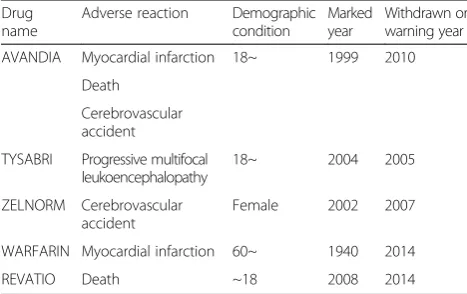
For the influence to ADR signals, we inspect the im-pact of anonymized data on the strength of observed ADR rules. Following our previous work in [17], we chosen from FDA MedWatch [18] all significant ADR rules that render withdrawal or warning of the drugs and associated with patient demographics, such as age or gender conditions. Detail description of these ADR rules is shown in Table 5.
Since our model allows non-uniform settings of confi-dence bounding, i.e., θ*, we considered three different scenarios of thresholds for θ* to inspect the effect of
different settings: 1) Uniform setting forθ*, i.e., all confi-dences of symptoms were set to the same value (0.2 or 0.4); 2) Level-wise specification, that is, all symptoms (or diseases) were classified into three levels, high sensitive, low sensitive, and non-sensitive. Those symptoms cor-responding to high sensitive are assigned a smaller threshold, i.e., 0.2, low sensitive are assigned a larger threshold, i.e., 0.4, and non-sensitive are assigned to 1; 3) Frequency-based strategy, the threshold of each symptom is determined based on the idea:“The more frequently the symptom occurs, the less sensitive it is.”
Results for uniform confidence setting
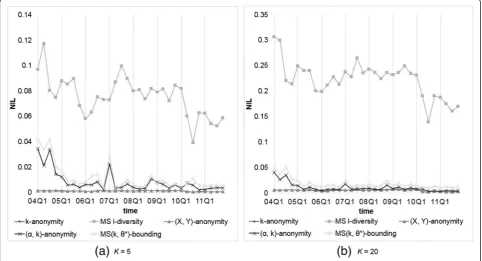
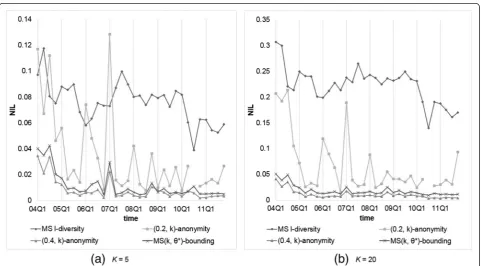
We assume every symptom is of the same sensitivity with confidence bounded by 0.2 or 0.4. Analogously,αis set to 0.2 or 0.4 for (α,k)-anonymity, whilek(orl) = 5, 10, 15, 20 for k-anonymity, (X,Y)-anonymity, Multi-sensitive l -diver-sity, and our MS(k, θ*)-bounding. First, we compared the data utility generated by each anonymization method. Figures 3 and 4 show the resultingNILs for every method, where MS l-diversity means Multi-sensitive l-diversity. Panels inside are for better view of data position, and ap-plicable to all following figures. Since the results fork(orl) = 10, 15 are somewhere in between those fork(orl) = 5, 20 and conform to the overall trend, hereafter we omit these two cases. From the obtained results, we observe that
1. k-anonymity and (X,Y)-anonymity are good at preserving the data utility, and both exhibit nearly identical results, which are less than those generated by our methods.
2. (α,k)-anonymity and our model yield similarNIL results, because under uniform setting the only difference between (α,k)-anonymity and our model is that (α,k)-anonymity does not consider duplicate reports, yielding not too much effect in information loss. Furthermore, (α,k)-anonymity and our model suffer from much less information loss when the confidence threshold is set relatively higher (0.4 vs 0.2).
3. Multi-sensitivel-diversity causes much more information loss than the other models because the top-down method tends to create largerQID-groups than that by bottom-up method.
4. Even in larger threshold setting, the information loss generated by our method is around 5 to 40 times of that byk-anonymity and (X,Y)-anonymity, though the values are still small, normally between 0.01 to 0.2; the largerkvalue is, so isNIL. That it, the data utility decreases as largerQID-group is allowed.
It is noteworthy that some datasets anonymized by our method with lower θ produce very high NILs, i.e., 2004Q4, 2007Q1, and 2010Q3. After further inspection
Table 5Selected ADR rules from FDA MedWatch
Drug name
Adverse reaction Demographic condition
Marked year
Withdrawn or warning year
AVANDIA Myocardial infarction 18~ 1999 2010
Death
Cerebrovascular accident
TYSABRI Progressive multifocal leukoencephalopathy
18~ 2004 2005
ZELNORM Cerebrovascular accident
Female 2002 2007
WARFARIN Myocardial infarction 60~ 1940 2014
we found that it is because most of these datasets con-tain some relatively high frequent symptoms. For ex-ample, there are 22,730 reports (without missing values) in 2007Q1, and 3,890 (17.1 %) of them recorded “ Dia-betes Mellitus Non-Insulin-Dependent,” and in 2010Q3,
12,833 of 63,838 (20.1 %) reports containing “Smoking Cessation Therapy.”In this situation, it is hardly to apply (α, k)-anonymity or our MS(k, θ*)-bounding with α (so asθ) = 0.2 (<20.1 %) to this dataset. It looks like uniform threshold setting of our model is not suitable to data with
Fig. 3Comparison of models onNILs withθ* (orα) = 0.2 andk(orl) = 5 or 20
high frequent sensitive values, but in most scenarios, the more frequent the values occur, the lesser sensitive they are. All we need is to adopt non-uniform setting forθ*, as to be shown later.
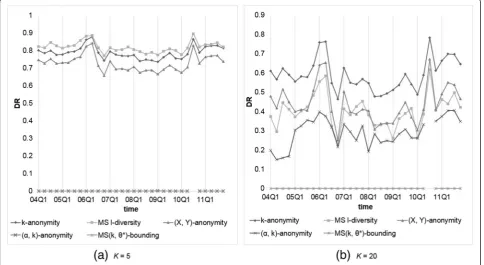
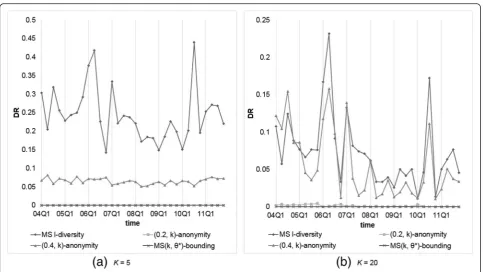
Next, we compared the privacy risk raised by each anon-ymization method. Figures 5 and 6 depict the resulting
DRs for all methods. From the obtained results, we ob-serve that
1. Our MS(k,θ*)-bounding yields noDRbecause the flexibility to setθ*according to user requirement. On the contrary, (α,k)-anonymity would suffer from someDRsbecauseQID-groups contain duplicate reports, which may decrease actual group size, causing violation of the privacy requirement. While kis getting larger, the probability of duplicate reports accumulated to the same group is increasing, further aggravatingDRs.
2. Multi-sensitivel-diversity does not perform well on protecting the sensitive values. This is because it only guarantees the number of records with distinct sensitive values in each group no less thanl, which may fail to thwart the attacker’s confidence on inferring the patient symptoms.
For those models not considering confidence thresh-old on sensitive values, including k-anonymity and (X,
Y)-anonymity, it can be observed that the larger k is,
the lowerDRbeing generated. That it, the data privacy risk increases as largerQID-group is allowed.
Results for level-wise confidence setting
To inspect the applicability of our model to more prac-tical situation, we also adopted level-wise setting of θ*. In practice, most symptoms or indications are not “really” sensitive. We choose group of symptoms called “Acquired immunodeficiency syndromes” (a High Level Term (HLT) in MedDRA), which contains 32 PTs and most of them are similar to AIDS, as “high sensitive” with confidence threshold = 0.2, and another two groups called“Coughing and associated symptoms”and“Allergies to foods, food additives, drugs and other chemicals,” which contain 44 PTs, as “non-sensitive” symptoms with confidence threshold = 1. The confidence thresh-olds of symptoms not belonging to the above groups are set to 0.4.
We compared our MS(k, θ*)-bounding with those models considering sensitive values, including Multi-sensitivel-diversity and (α,k)-anonymity. The parameter setting isα= 0.2 and 0.4, andk(orl) = 5, 10, 15, and 20. Figures 7 and 8 show the resulting NILs and DRs, re-spectively. From the obtained results, we observe that
1. AllNILs generated except by MS(k,θ*)-bounding are the same as observed previously, butDRs are different because of various threshold settings.
Fig. 6Comparison of models onDRs withθ* (orα) = 0.4 andk(orl) = 5 or 20
2. Because records containing“high sensitive”and duplicate records are rare, (0.2, k)-anonymity generate very few DRs. However, the generated NIL is very high for data with high frequent sensitive value that may decrease data utility severely.
3. MS(k, θ*)-bounding produces only a little larger NIL than (0.4, k)-anonymity because in this level-wise specification, most symptoms receive confidence threshold at 0.4. In contrast, MS(k, θ*)-bounding does not produce any DR but (0.4, k)-anonymity violates the privacy requirement more often due to overlooking duplicate records.
In summary, the performance of our MS(k, θ* )-bound-ing is better than the other models, while Multi-sensitive
l-diversity yields the worst performance.
Results for frequency-based confidence setting
Finally, we consider another scenario of confidence set-ting: the threshold of a symptom is set according to its frequency in the dataset. We calculated the frequencies of all symptoms appear in the dataset and set the confi-dence thresholds of the most 10 % frequent symptoms to 1, the last 10 % frequent symptoms to 0.2, and the remaining to 0.4, respectively.
Again, we compared our MS(k,θ*)-bounding with Multi-sensitivel-diversity and (α,k)-anonymity with the same par-ameter settings, i.e.,α= 0.2 and 0.4, andk(orl) = 5, 10, 15, and 20. Figures 9 and 10 show the resultingNILs andDRs, respectively. From the obtained results, we observe that
1. As mentioned previously, allNILs generated except by MS(k,θ*)-bounding are the same as the uniform setting, whileDRs are different because of different threshold settings.
2. All models generate lessDRs than that by level-wise setting, because most dangerous groups appearing in the previous experiments are caused by high frequent symptoms, whose thresholds are set to 1 in this experiment. 3. Even 90 % ofθ's inθ*are set to 0.4 or lower, our
MS(k,θ*)-bounding produces very smallNILthan (0.4,k)-anonymity when being applied to data with high frequent symptoms such as 2004Q1 and 2007Q1.
In FAERS data, there are more than 20,000 different symptoms, which will require much researching effort and background knowledge to determine the threshold of each symptom. The frequency-based approach is a simple but reasonable method, and with this threshold definition, our MS(k,θ*)-bounding exhibits the best data utility and the least privacy risk among all the models we examined.
Fig. 9Comparison of our MS(k,θ*)-bounding with frequency-based setting with other models onNILs withk(orl) = 5 or 20
Influence on ADR signals
We also conducted an experiment to inspect the impact of anonymized data on the strengths of discovered ADR rules. For each ADR rule shown in Table 5, we computed and checked the difference on the number of events, PRR and ROR measures between the original datasets and anon-ymized datasets. Since all rules exhibit similar pheno-menon, we only show the results of the following rule
AVANDIA, age > 18⇒CEREBROVASCULAR ACCIDENT. Figure 11 depicts the occurrence and strength of the above rule in the original dataset (original count and ori-ginal PRR) and from which the difference yielded from the dataset anonymized by Multi-sensitive l-diversity, (0.2,k)-anonymity, (0.4,k)-anonymity, and our MS(k, θ* )-bounding with frequency-based setting, with k= 20. The obtained results show that
1. Multi-sensitivel-diversity does not perform well because of the top-down strategy, which is less flexible to createQID-groups.
2. Most of the time there is no difference between the original and anonymized datasets except Multi-sensitive l-diversity. All of them are less than five, and the extreme value only occurs when original count is large (more than 80).
3. Not surprisingly, only very small difference on PRR ranging from−1 to 1 were observed from the anonymized datasets (except Multi-sensitivel-diversity), which nearly can be ignored.
These observations reveal that our method can effect-ively solve the privacy problem in SRS datasets without overlooking rare events and influencing the ADR signal strength.
Conclusions
In this paper, we proposed a new PPDP model for pro-tecting SRS data that possess some characteristics over-looked by contemporary models, including rare events, multiple individual records, and multi-valued sensitive attributes. We also presented an anonymization algo-rithm to sanitize SRS data in accordance with the pro-posed model. Empirical studies showed that our method can prevent the disclosure of personal sensitive informa-tion without sacrificing the data utility and biasing the discovered ADR signals.
Although our approach is designed mainly for SRS data, it can also be applied to other types of medical data or applications with features analogous to SRS data; for example, electronic health records (EHRs), which con-tain more detailed private information and so deserve further investigation.
We also notice that FAERS data contain lots of miss-ing values. Existmiss-ing PPDP methods usually ignore the presence of missing values, simply deleting them before executing data anonymization. However, for data with enormous missing values, like SRS data, deleting all re-cords with missing values may ruin the data utility ser-iously, so how to deal with missing values is an interesting
issue. Another important and challenging issue goes to continuous data publishing [11, 19]. Typically, SRS data are released sequentially. Combining related releases would sharpen the identification of an individual record or sensitive information. We are endeavoring to extend our current approach to solve these problems.
Acknowledgements
This problem was initiated when WYL was on sabbatical leave to University of Maryland, Baltimore County in 2011. He especially appreciates Prof. Hillol Kargupta for his gracious hospitality and valuable discussion on this topic. This work was supported in part by the Ministry of Science and Technology of Taiwan under grant No. MOST102-2221-E-390-020.
Availability of data and materials
FDA Adverse Event Reporting System (FAERS): Latest Quarterly Data Files. http://www.fda.gov/Drugs/GuidanceComplianceRegulatoryInformation/ Surveillance/AdverseDrugEffects/ucm082193.htm Accessed 2 Jan 2016.
Authors’contributions
WYL and DCY worked in collaboration in every aspect of this research, while DCY was responsible for the implementation of the algorithm. JTW helped to carry out the experiments and the revision of this paper. All authors read and approved the final manuscript.
Competing interests
The authors declare that they have no competing interests. This research received no specific grant from any funding agency in the public, commercial, or not-for-profit sectors.
Consent for publication Not applicable.
Ethics of approval and consent to participate Not applicable.
Declarations
Publication of this article was funded by the corresponding author. This article has been published as part of BMC Medical Informatics and Decision Making Volume 16 Supplement 1, 2016: Proceedings of the ACM Ninth International Workshop on Data and Text Mining in Biomedical Informatics. The full contents of the supplement are available online at https://bmcmedinformdecismak.biomedcentral.com/articles/supplements/ volume-16-supplement-1.
Published: 18 July 2016
References
1. FDA Adverse Event Reporting System (FAERS). http://www.fda.gov/cder/ aers/default.htm Accessed 2 Jan 2016.
2. The Yellow Card Scheme. https://yellowcard.mhra.gov.uk/ Accessed 2 Jan 2016. 3. MedEffect Canada. http://www.healthcanada.gc.ca/medeffect Accessed
2 Jan 2016.
4. Fung BCM, Wang K, Chen R, Yu PS. Privacy-preserving data publishing: A survey of recent developments. ACM Comput Surv. 2010;42(4):14. 5. Lin WY, Yang DC. On privacy-preserving publishing of spontaneous ADE
reporting data. In: Proceedings of 2013 IEEE International Conference on Bioinformatics and Biomedicine. 2013. p. 51–3.
6. Gould AL. Practical pharmacovigilance analysis strategies. Pharmacoepidemiol Drug Saf. 2003;12(7):559–74.
7. Evans SJ, Waller PC, Davis S. Use of proportional reporting ratios (PRRs) for signal generation from spontaneous adverse drug reaction reports. Pharmacoepidemiol Drug Saf. 2001;10(6):483–6.
8. Egberts AC, Meyboom RH, van Puijenbroek EP. Use of measures of disproportionality in pharmacovigilance: three dutch examples. Drug Saf. 2002;25(6):453–8.
9. Sweeney L.k-anonymity: A model for protecting privacy. Int J Uncertainty Fuzziness Knowledge Based Syst. 2002;10(5):557–70.
10. Machanavajjhala A, Gehrke J, Kifer D, Venkitasubramaniam M.l-diversity: Privacy beyondk-anonymity. ACM Trans Knowl Discov Data. 2007;1(1):3.
11. Wang K, Fung BCM. Anonymizing sequential releases. In: Proceedings of 12th ACM SIGKDD International Conference on Knowledge Discovery and Data Mining. 2006. p. 414–23.
12. Shi P, Xiong L, Fung BCM. Anonymizing data with quasi-sensitive attribute values. In: Proceedings of 19th ACM International Conference on Information and Knowledge Management. 2010. p. 1389–92. 13. Wong RCW, Li J, Fu AWC, Wang K. (α, k)-anonymity: An enhancedk
-anonymity model for privacy preserving data publishing. In: Proceedings of 12th ACM SIGKDD International Conference on Knowledge Discovery and Data Mining. 2006. p. 754–9.
14. Gal TS, Chen Z, Gangopadhyay A. A privacy protection model for patient data with multiple sensitive attributes. Int J Inf Secur Priv. 2008;2(3):28–44. 15. Byun JW, Kamra A, Bertino E, Li N. Efficientk-anonymization using clustering
techniques. In: Proceedings of the 12th International Conference on Database Systems for Advanced Applications. 2007. p. 188–200. 16. MeSH (Medical Subject Headings) Tree Structures. http://www.nlm.nih.gov/
mesh/MBrowser.html Accessed 2 Jan 2016.
17. Lin WY, Lan L, Huang FS. Rough-set-based ADR signaling from spontaneous reporting data with missing values. J Biomed Inform. 2015;58:235–46. 18. MedWatch. http://www.fda.gov/Safety/MedWatch Accessed 2 Jan 2016. 19. Fung BCM, Wang K, Fu AWC, Pei J. Anonymity for continuous data
publishing. In: Proceedings 11th International Conference on Extending Database Technology: Advances in Database Technology. 2008. p. 264–75.
• We accept pre-submission inquiries
• Our selector tool helps you to find the most relevant journal
• We provide round the clock customer support
• Convenient online submission
• Thorough peer review
• Inclusion in PubMed and all major indexing services
• Maximum visibility for your research
Submit your manuscript at www.biomedcentral.com/submit