R E S E A R C H A R T I C L E
Open Access
Evaluating risk factor assumptions: a
simulation-based approach
Carolyn M Rutter
1,2*, Diana L Miglioretti
1,2and James E Savarino
1Abstract
Background:Microsimulation models are an important tool for estimating the comparative effectiveness of interventions through prediction of individual-level disease outcomes for a hypothetical population. To estimate the effectiveness of interventions targeted toward high risk groups, the mechanism by which risk factors influence the natural history of disease must be specified. We propose a method for evaluating these risk factor assumptions as part of model-building.
Methods:We used simulation studies to examine the impact of risk factor assumptions on the relative rate (RR) of colorectal cancer (CRC) incidence and mortality for a cohort with a risk factor compared to a cohort without the risk factor using an extension of the CRC-SPIN model for colorectal cancer. We also compared the impact of changing age at initiation of screening colonoscopy for different risk mechanisms.
Results:Across CRC-specific risk factor mechanisms, the RR of CRC incidence and mortality decreased (towards one) with increasing age. The rate of change in RRs across age groups depended on both the risk factor mechanism and the strength of the risk factor effect. Increased non-CRC mortality attenuated the effect of CRC-specific risk factors on the RR of CRC when both were present. For each risk factor mechanism, earlier initiation of screening resulted in more life years gained, though the magnitude of life years gained varied across risk
mechanisms.
Conclusions:Simulation studies can provide insight into both the effect of risk factor assumptions on model predictions and the type of data needed to calibrate risk factor models.
Keywords:microsimulation, colorectal cancer, comparative effectiveness, screening
1.0 Background
Microsimulation models describe events and outcomes at the person-level and provide policy-relevant informa-tion by predicting the populainforma-tion-level impact of differ-ent intervdiffer-entions [1]. For example, microsimulation models can be used to predict trends in disease inci-dence and mortality under alternative health policy scenarios [2,3] or to compare the clinical effectiveness and cost-effectiveness of treatments [4]. Several risk factors play a role in colorectal cancer, including both non-modifiable factors such as age, sex, race, and family history and modifiable risk factors related to lifestyle including diet, activity level, and medication use [5,6]. Microsimulation models can be used to examine the
impact of patient-centered interventions that are focused on risk reduction and interventions targeted to high risk individuals, such as more intensive colorectal cancer (CRC) screening for individuals at higher risk, with initiation at earlier ages and/or shorter screening inter-vals [7]. Models that include risk factors must make assumptions about how risk factors affect specific dis-ease processes and the magnitude of these effects [7-9]. For example, two microsimulation models for CRC include detailed risk factor components including factors related to increased risk (body mass index, smoking sta-tus, red meat consumption) and factors related reduced risk (physical activity, fruit and vegetable consumption, multivitamin use, aspirin use, hormone replacement therapy). One model allows these factors to affect only adenoma occurrence [2,10], the other allows risk factors to affect both adenoma occurrence and progression to * Correspondence: [email protected]
1Biostatistics Unit, Group Health Research Institute, Seattle, WA, USA
Full list of author information is available at the end of the article
preclinical CRC [11]. These risk factor models are com-plex, requiring description of changes in modifiable risk factors over time, yet basic work to inform risk factor modeling is lacking and little is known about the rela-tionship between different assumptions and conclusions about the effectiveness of interventions. This is espe-cially important because data available to distinguish between different risk mechanisms is sparse.
Race is an example of a relatively simple risk factor that we wish to include in natural history models for colorec-tal cancer [7,11]. Race is an imperfect proxy measure of genetic and lifestyle factors [12] associated with increased risk of CRC. There are demonstrated racial disparities in CRC outcomes. African Americans have higher CRC incidence and mortality than non-Hispanic whites, parti-cularly at younger ages, and are more likely to be diag-nosed with late stage disease [13]. The overall CRC incidence rate ratio for African American versus non-Hispanic white groups is 1.21 among men and 1.26 among women [14]. In addition, African Americans tend to be diagnosed with later stage CRC than whites [13,15,16] and at a younger age [17]. There is scant direct information about the reasons for these disparities [18]. Some studies suggest that African American and non-Hispanic white groups have similar adenoma prevalence [18,19]. Colonoscopy studies have found that African Americans are more likely to have large adenomas than non-Hispanic whites [20]. Therefore, race could plausibly be modeled as a risk factor that is related to adenoma incidence, growth, or progression to colorectal cancer. We describe a method for exploring the impact of these risk factor assumptions on model results, which provides insight into the data required to build a model that includes a risk factors.
2.0 Methods
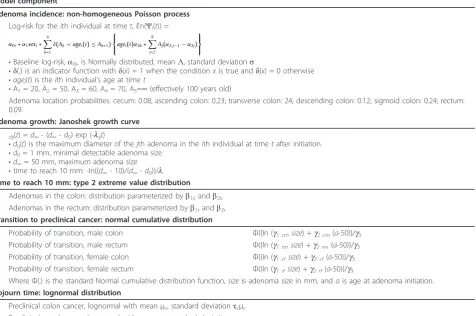
We consider the impact of risk factors in the context of the Colorectal Cancer Simulated Population model for Incidence and Natural history (SPIN) [21]. CRC-SPIN simulates the natural history of colorectal cancer arising from adenomas (Table 1). For each simulated individual, the CRC-SPIN model generates a time of birth and a time of non-CRC (other-cause) death. Within this lifetime, adenoma occurrence is simulated using a non-homogeneous Poisson process with risk that systematically varies as a function of gender and age. Each initiated adenoma is stochastically assigned a location in the large intestine and a time to reach 10 mm (which may exceed the individual’s lifetime). Ade-noma growth depends on adeAde-noma location (colon or rectum) and is modeled using a continuous process with an asymmetric growth curve that specifies exponential growth early that slows as adenomas reach a maximum of 50 mm. The probability of adenoma transition to
preclinical cancer is a function of adenoma size, ade-noma location (colon or rectum), gender, and age at adenoma initiation. The time of transition from preclini-cal cancer to clinipreclini-cal detection due to the onset of symptoms in the absence of screening, sojourn time, depends on the location of the preclinical cancer (colon or rectum). Once a cancer becomes clinically detectable, the size, stage at clinical detection, and survival are simulated based on SEER data. Details about the model structure and calibration are provided elsewhere, [21,22] below we focus on incorporation of risk factors into this basic model.
2.1 Risk factors
For simplicity, we consider a single binary risk factor indicated by xi(t) for theith individual at timetwhere
xi(t) = 1 if the risk factor is present at timetandxi(t) =
0 otherwise. We allow this risk factor to affect adenoma incidence, adenoma growth, transition to clinically detectable cancer, sojourn time, and other cause mortal-ity. We do not allow risk factors to affect CRC survival given stage at detection.
Adenoma risk
Let ΨI(t) be theith individual’s risk of developing an
adenoma at time t in the absence of any risk factor. This model has a proportional hazards structure, so that adenoma risk can be written as exp[δ1 xI(t)]ΨI(t). The
number of adenomas an individual develops by time t
has a Poisson distribution, and the expected number of adenomas for an individual with a fixed risk factor is exp[δ1] times greater than the expected number for an
individual of the same age and gender without the risk factor.
Adenoma growth
Let d(t) be adenoma size at time tin the absence of any risk factor. We incorporate risk factors into the ade-noma growth model by assuming that the effect of risk factors is to either expand or contract the time scale, t, so that given risk factor information, adenoma size is a function oft’(xi(t)) = exp (δ2xi(t))t. Under this model,
adenomas in an individual with a fixed risk factor reach a given size (e.g., 10 mm) in exp(-δ2) the time it takes
adenomas to reach the same size in similar individuals without the risk factor.
Transition from adenoma to cancer
sij(xi(t)) = s
0
expδ3xi(u)
du. Let P(s | age, location, gender) be the probability that an adenoma of sizes in an individual without the risk factor transitions to can-cer given theirgender, thelocation of the adenoma and the age at adenoma initiation. Under this model, if a person with the same characteristics also had the risk factor, then the probability that an adenoma of size s
transitions to cancer is equal to exp(δ3)P(s |age,
loca-tion, gender). For an individual with a fixed adenoma transition risk factor, the increase in risk is Ф((ln(g1exp
(δ3)s) + g2(a-50))/g3) -Ф((ln(g1s) +g2(a-50))/g3) wherea
is age at adenoma initiation in years, g1andg2 are
loca-tion- and gender-specific transition parameters (see Table 1), andФ(.) is the standard Normal cumulative distribution function.
Sojourn time (time to clinical detection)
In contrast to adenoma growth and transition to pre-clinical cancer, which may take a decade or more to occur, transition from preclinical cancer to clinically detectable cancer is believed to occur within about 5 years [23-25]. We assume that only those risk factors present at the time of transition to preclinical cancer
affect sojourn time, and assume that they have a multi-plicative effect on sojourn time. Let STij be sojourn
time for the ith individual’sjth preclinical cancer in the absence of risk factor information. Ifxiindicates a
risk factor present at the time of transition to preclini-cal cancer, then sojourn time is given by ST’ij(xi) = exp
[δ4 xi]STij.
Other-cause mortality
Risk factors that increase risk for CRC such as high body mass index and smoking [10] may also increase risk of death from other causes. The CRC-SPIN model stochastically assigns age at other-cause (non-CRC) death based on data from the National Center for Health Statistics with survival that depends on gender and birth cohort [26]. Let ai be the age at other-cause
death for the ith individual in the absence of risk factor information. For a dichotomous risk factor, we allow the change in age at other cause death to be propor-tional to the time the risk factor is present, so that
ai(xi(t)) = a
0
expδ5xi(u)
du. Under this model, the age
at other-cause death given a fixed risk factor xiisa’j(xi)
= exp[δ5xi]aj. Table 1 Basic structure of the CRC-SPIN Model
Model component
Adenoma incidence: non-homogeneous Poisson process
Log-risk for theith individual at timet,ℓn(Ψi(t)) =
α0i+α1sexi+ 4
k=1
δ(Ak<agei(t)≤Ak+1) ⎧ ⎨ ⎩agei(t)α2k+
k
j=2
Aj(α2,j−1−α2j) ⎫ ⎬ ⎭
•Baseline log-risk,a0i, is Normally distributed, meanΛ, standard deviations
•δ(.) is an indicator function withδ(x) = 1 when the conditionxis true andδ(x) = 0 otherwise •agei(t) is theith individual’s age at timet
•A1= 20, A2= 50, A3= 60, A4= 70, A5=∞(effectively 100 years old)
Adenoma location probabilities: cecum: 0.08; ascending colon: 0.23; transverse colon: 24; descending colon: 0.12; sigmoid colon: 0.24; rectum: 0.09.
Adenoma growth: Janoshek growth curve
dij(t) =d∞- (d∞-d0) exp (-lijt)
•dij(t) is the maximum diameter of thejth adenoma in theith individual at timetafter initiation. •d0= 1 mm, minimal detectable adenoma size
•d∞= 50 mm, maximum adenoma size
•time to reach 10 mm: -In((d∞- 10)/(d∞-d0))/l.
Time to reach 10 mm: type 2 extreme value distribution
Adenomas in the colon: distribution parameterized byb1candb2c Adenomas in the rectum: distribution parameterized byb1randb2r
Transition to preclinical cancer: normal cumulative distribution
Probability of transition, male colon Ф({In (g1 cmsize) +g2 cm(a-50)}/g3
Probability of transition, male rectum Ф({In (g1 rmsize) +g2 rm(a-50)}/g3
Probability of transition, female colon Ф({In (g1 cfsize) +g2 cf(a-50)}/g3
Probability of transition, female rectum Ф({In (g1 rfsize) +g2 rf(a-50)}/g3
WhereФ(.) is the standard Normal cumulative distribution function,sizeis adenoma size in mm, andais age at adenoma initiation.
Sojourn time: lognormal distribution
2.2 Simulation studies
We conducted two simulation studies to explore the effect of risk factor mechanisms on CRC incidence and mortality and screening effectiveness assuming a single dichotomous risk factor that is present or absent for an individuals’entire life (e.g., race).
The first simulation study examined the effect of differ-ent risk factor mechanisms on predicted CRC outcomes. We simulated 10 scenarios: no risk factors present, pre-sence of one of four CRC-specific risk factor mechan-isms, increased other-cause mortality, and increased other-cause mortality in combination with one of the four CRC-risk factor mechanisms. The four CRC-specific risk factor mechanisms were: increased adenoma risk, faster adenoma growth, more likely and earlier progres-sion to cancer, and shorter sojourn time. To simulate increased adenoma risk we specified a 10%, 25%, 50%, or 100% increase in adenoma incidence (corresponding to exp(δ1) = 1.10, 1.25, 1.50, and 2.0, respectively). To
simu-late faster adenoma growth we specified a 10%, 20%, 30%, or 50% reduction in the time to reach 10 mm (corre-sponding to exp(-δ2) = 0.9, 0.8, 0.7, and 0.5, respectively).
To simulate more likely and earlier progression to cancer we specified transition rates comparable to an adenoma that is 5%, 10%, 20%, or 30% larger (corresponding to exp (δ3) = 1.05, 1.10, 1.20, and 1.30, respectively). To simulate
shorter sojourn time we specified a 10%, 20%, 50%, or 75% reduction in the time from preclinical cancer to clin-ical detection (corresponding to exp(δ4) = 0.9, 0.8, 0.5,
and 0.25, respectively). To simulate increased other-cause mortality we specified a 5%, 10%, 15%, or 20% reduction in survival due to death from other causes (correspond-ing to exp(δ5) = 0.95, 0.9, 0.85, and 0.8, respectively).
Simulations that examined the combined effect of CRC-specific risk factors and increased other-cause mortality focused on a 10% reduction in survival due to death from other causes.
For each scenario and each level of risk factor within scenario we simulated a cohort of 10 million individuals aged 45 years for each of 1,000 simulated draws from the posterior distribution of our model parameters. We aged individuals in the cohort for 35 years, though some died before reaching age 80. For each of our 1,000 draws, we estimated the mean for each outcome and 95% prediction intervals based on upper and lower 2.5thpercentiles. Pre-diction intervals reflect variability in prePre-dictions resulting from estimated parameters and variability due to estima-tion of sample statistics. Simulated sample sizes were chosen to be large to minimize sampling variability.
We conducted a simulation study to evaluate the effects of risk factors on intermediate disease processes related to the risk factor mechanisms: average time from adenoma onset to preclinical CRC (preclinical dwell time), the proportion of adenomas that transition to
preclinical cancer, the proportion of preclinical cancers that transition to clinically detectable cancer, and the average time of transition from preclinical cancer to clinically detectable cancer (sojourn time). Next, we esti-mated the relative rate (RR) of CRC incidence and mor-tality and 95% prediction intervals for cohorts with each of the 9 risk factor scenarios compared to a cohort with no risk factors. We calculated relative rates for both the 30-year period from age 45 to 79 years (the‘overall’RR) and for three age groups (45-54, 55-64, 65-79). This is analogous to a hypothetical observational study that enrolls individuals at age 45, with 35 years of follow-up.
Our second simulation study examined the effect of different risk factor mechanisms on predicted efficacy of screening colonoscopy, focusing on a subset of risk fac-tor mechanisms and strengths that resulted in similar increased rates of CRC. We simulated four risk factor scenarios: a no risk factor scenario and three scenarios with increased CRC risk (100% increase in adenoma incidence, 30% faster adenoma growth, and transition probabilities as if adenomas were 30% larger). We simu-lated two colonoscopy screening regimens. The first regimen reflects current guidelines with screening begin-ning at age 50 and subsequent screebegin-ning every 10 years. The second screening regimen assumes earlier initiation with screening beginning at age 45 and subsequent screening every 10 years. For both regimens we assumed 100% compliance, with the screening regimen, including surveillance colonoscopy at 3 or 5 years based on the number and size of adenomas detected at screening, consistent with current guidelines. If screening detected three or more adenomas or at least one adenoma that is 10 mm or larger, then the individual returns for colono-scopy in three years. If screening detects one or two adenomas that are each less than 10 mm large, then the individual returns for colonoscopy in five years. If no adenomas are found, then the individual continues rou-tine screening and returns for colonoscopy in ten years. For each risk factor scenario and screening regimen we examined the RR of CRC incidence and mortality along with 95% prediction intervals for those with and without screening.
When simulating colonoscopy, we assumed that ade-noma miss rates decreased with size. Based on observed miss rates [27-29], we modeled the probability of missing an adenoma or cancer given its size as P(miss|size =sand
s< 20 mm) = 0.34-0.035s+ 0.0009s2
complete to the transverse colon, and 2% complete to the descending colon.
For each risk factor scenario and level, and each of 1,000 model parameter values, we simulated a cohort of 10 million 45 year old individuals. For each risk factor cohort, we calculated the mortality reduction (MR) and life years gained (LYG) per 1000 individuals attributable to screening by comparing screened to unscreened cohorts up the each individual’s 80th birthday. MR represents the proportional reduction in colorectal can-cer deaths and LYG representing the difference in survi-val following the age at screening initiation. Finally, we compared the predicted impact of different screening regimens across risk factor cohorts. We estimated pos-terior means, based on the average predictions across 1,000 simulated parameter values; 95% prediction inter-vals, based on 2.5th and 97.5th percentiles of predictions across 1,000 simulated parameter values; and the poster-ior probability of differential effectiveness of different screening regimens for different risk cohorts, based on the percentage of times screening was more effective in one cohort compared to another across 1,0000 simu-lated parameter values [31].
3.0 Results
Simulated intermediate (and not directly observable) out-comes were consistent with risk factor assumptions, with CRC-specific risk factors affecting only their associated mechanisms (data not shown). Increased adenoma inci-dence resulted in greater adenoma prevalence and decreased sojourn time resulted in a higher probability of transition from preclinical to clinical CRC and shorter mean sojourn time. Increased adenoma growth and increased probability of transition from adenoma to pre-clinical cancer had similar effects with both resulting in a higher probability of transition to preclinical cancer and shorter mean preclinical dwell time. The similarity of these effects is consistent with the structure of the CRC-SPIN model, which assumes that the probability of tran-sition to preclinical CRC increases with adenoma size. Increased risk of other-cause death resulted in a lower probability of transition to preclinical CRC, slightly shorter preclinical dwell time, a slightly lower probability of transition from preclinical to clinical CRC, and a slight shortening of sojourn time. This occurs because indivi-duals with longer preclinical dwell and sojourn times are more likely to die before transition to the next disease state.
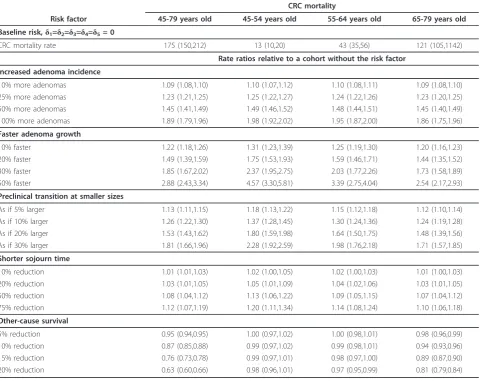
For a given risk factor mechanism and strength of effect, the RR of CRC incidence with versus without the risk factor was nearly identical to the RR of CRC morality with versus without the risk factor. For example, when adenomas grew 30% faster, the mean RR of CRC inci-dence versus CRC mortality was: 1.84 versus 1.85 for
ages 45-79; 2.34 versus 2.37 for ages 45-54; 2.00 versus 2.03 for ages 55-64; and 1.72 versus 1.73 for ages 65-79. Across the range of scenarios explored, differences in RRs for CRC mortality and incidence ranged from -0.04 to 0.14, with 77% of the scenarios showing a 0.01 or smaller difference in RRs. Given this similarity, the remainder of our paper focuses exclusively on CRC mortality.
The RR of CRC mortality associated with presence of a CRC-specific risk factor decreased towards one with increasing age, and the rate of change across age groups depended on the risk factor mechanism (Table 2). For example, there was a greater change in RR across age groups for faster adenoma growth than for increased ade-noma incidence, even when the risk factors were set to levels that produced similar overall increases in CRC mortality. The rate of change increased with the strength of the risk factor. A 100% increase in adenoma incidence resulted in a 1.89 RR of CRC mortality from age 45 to 79, and the RR ranged from 1.98 for ages 45-54 down to 1.86 for ages 65-79. Similarly, 30% faster adenoma growth resulted in a 1.85 RR of CRC mortality from age 45 to 79, but for this mechanism the RR ranged from 2.37 for ages 45-54 down to 1.73 for ages 65-79. The effects of faster adenoma growth and transition to preclinical cancer at smaller adenoma sizes on the RR were similar. Reduced sojourn time had little impact on the RR of CRC inci-dence or mortality.
Increased other-cause mortality reduced the risk of CRC mortality (RR < 1, Table 2), a result of competing risks. The reduction in risk increased with both increas-ing other-cause mortality and increasincreas-ing age. Collapsincreas-ing across age groups results in greater estimated risk reduc-tion (across the 45-79 year age range) than age-specific RRs, demonstrating Simpson’s paradox [32,33]. We observed similar patterns when we modeled co-occur-rence of CRC-specific risk factors and increased mortal-ity. In the presence of increased risk for other-cause mortality, age specific RRs associated with colorectal can-cer were slightly attenuated, with greater degrees of observed attenuation for RR across the whole 45-79 year old age range (data not shown). For example, a 10% reduction in other-cause survival reduced the RR asso-ciated with a 100% increase in adenoma incidence from 1.89 down to 1.64 (95% prediction interval (PI) (1.57,1.71)) overall and from 1.86 down to 1.76 (95% PI (1.66,1.85)) in the 65-79 year old age group, with no evi-dence of attenuation of the RR in the 45-54 and 55-64 year old age groups.
RR for faster adenoma growth, and 1.81 RR for transition at smaller sizes). There were small differences in the pre-dicted CRC mortality reduction (Table 3) and life years gained (Table 4) across risk factor mechanisms. The ordering of these differences was consistent with small differences in the overall relative risk of CRC mortality. In all cases, earlier initiation of screening resulted in both a greater mortality reduction and more life years gained
per 1000 individuals screened (LYG). Across risk groups (including the no increased risk group), initiating screen-ing at age 45 resulted in a 5 percentage point increase in mortality reduction compared to initiation at age 50.
We also examined the differential LYG for screening initiation at 45 versus 50 years. There were larger increases in LYG due to screening in risk factor cohorts compared to the no risk cohort, ranging from 15 more Table 2 Estimated impact of a hypothetical fixed risk factor on CRC mortality, with 95% prediction intervals
CRC mortality
Risk factor 45-79 years old 45-54 years old 55-64 years old 65-79 years old
Baseline risk,δ1=δ2=δ3=δ4=δ5= 0
CRC mortality rate 175 (150,212) 13 (10,20) 43 (35,56) 121 (105,1142)
Rate ratios relative to a cohort without the risk factor
Increased adenoma incidence
10% more adenomas 1.09 (1.08,1.10) 1.10 (1.07,1.12) 1.10 (1.08,1.11) 1.09 (1.08,1.10)
25% more adenomas 1.23 (1.21,1.25) 1.25 (1.22,1.27) 1.24 (1.22,1.26) 1.23 (1.20,1.25)
50% more adenomas 1.45 (1.41,1.49) 1.49 (1.46,1.52) 1.48 (1.44,1.51) 1.45 (1.40,1.49)
100% more adenomas 1.89 (1.79,1.96) 1.98 (1.92,2.02) 1.95 (1.87,2.00) 1.86 (1.75,1.96)
Faster adenoma growth
10% faster 1.22 (1.18,1.26) 1.31 (1.23,1.39) 1.25 (1.19,1.30) 1.20 (1.16,1.23)
20% faster 1.49 (1.39,1.59) 1.75 (1.53,1.93) 1.59 (1.46,1.71) 1.44 (1.35,1.52)
30% faster 1.85 (1.67,2.02) 2.37 (1.95,2.75) 2.03 (1.77,2.26) 1.73 (1.58,1.89)
50% faster 2.88 (2.43,3.34) 4.57 (3.30,5.81) 3.39 (2.75,4.04) 2.54 (2.17,2.93)
Preclinical transition at smaller sizes
As if 5% larger 1.13 (1.11,1.15) 1.18 (1.13,1.22) 1.15 (1.12,1.18) 1.12 (1.10,1.14)
As if 10% larger 1.26 (1.22,1.30) 1.37 (1.28,1.45) 1.30 (1.24,1.36) 1.24 (1.19,1.28)
As if 20% larger 1.53 (1.43,1.62) 1.80 (1.59,1.98) 1.64 (1.50,1.75) 1.48 (1.39,1.56)
As if 30% larger 1.81 (1.66,1.96) 2.28 (1.92,2.59) 1.98 (1.76,2.18) 1.71 (1.57,1.85)
Shorter sojourn time
10% reduction 1.01 (1.01,1.03) 1.02 (1.00,1.05) 1.02 (1.00,1.03) 1.01 (1.00,1.03)
20% reduction 1.03 (1.01,1.05) 1.05 (1.01,1.09) 1.04 (1.02,1.06) 1.03 (1.01,1.05)
50% reduction 1.08 (1.04,1.12) 1.13 (1.06,1.22) 1.09 (1.05,1.15) 1.07 (1.04,1.12)
75% reduction 1.12 (1.07,1.19) 1.20 (1.11,1.34) 1.14 (1.08,1.24) 1.10 (1.06,1.18)
Other-cause survival
5% reduction 0.95 (0.94,0.95) 1.00 (0.97,1.02) 1.00 (0.98,1.01) 0.98 (0.96,0.99)
10% reduction 0.87 (0.85,0.88) 0.99 (0.97,1.02) 0.99 (0.98,1.01) 0.94 (0.93,0.96)
15% reduction 0.76 (0.73,0.78) 0.99 (0.97,1.01) 0.98 (0.97,1.00) 0.89 (0.87,0.90)
20% reduction 0.63 (0.60,0.66) 0.98 (0.96,1.01) 0.97 (0.95,0.99) 0.81 (0.79,0.84)
The table shows the CRC death rates per 10,000 life years in the cohort without risk factors, and relative rates comparing CRC death rates cohorts with risk factors to cohorts without risk factors. 95% prediction intervals are shown in parenthesis.
Table 3 CRC mortality reduction by risk factor cohort and screening regimen, relative to no screening
Age at screening initiation (years)
50 45
Risk factors:
None 0.90 (0.87,0.92) 0.95 (0.92,0.96)
100% more adenomas 0.89 (0.86,0.92) 0.96 (0.94,0.97)
30% faster adenoma growth 0.86 (0.83,0.88) 0.92 (0.89,0.94)
Preclinical transition sizes as if 30% larger 0.86 (0.83,0.88) 0.92 (0.89,0.94)
years per 1000 individuals screened (95% PI (11,22)) for cohorts with more adenomas to 22 more years per 1000 individuals (95% PI (16,28)) for cohorts with faster growing adenomas, though overall the impact of earlier screening on LYG was very small. In spite of having a slightly lower overall risk for CRC mortality, we found larger differences in LYG for cohorts with faster growing adenomas and adenoma transition at smaller sizes than cohorts with more adenomas: Cohorts with faster ade-nomas had a mean of 8 more LYG per 1000 individuals screened (95% CR (0, 13) compared to cohorts without the risk factor, posterior probability p= 0.023); Cohorts with adenomas that transition to cancer at smaller sizes had a mean of 6 more LYG per 1000 individuals screened (95% CR (0, 11), posterior probability p = 0.027.
4.0 Discussion
Risk factors provide clinical information that can poten-tially be used to target screening and treatment [7]. Microsimulation models provide a method for evaluating the comparative effectiveness of such targeted interven-tions, but this requires that modelers make specific assumptions about how risk factors influence the natural history of disease.
We demonstrated the use of simulation studies to explore risk factor assumptions. Simulating different mechanisms by which a hypothetical risk factor affects the natural history of CRC allowed us to explore the impact of risk factor assumptions within the CRC-SPIN model, and was an important step toward building a comprehensive risk factor model. We found that age-specific CRC dence and mortality and the rate of change in disease inci-dence across age groups are important sources of information about risk factor mechanisms. For the CRC-SPIN model, the rate of change in CRC incidence and mortality across age groups was smaller for risk factors associated with disease initiation (adenoma risk), with lar-ger rates of change for risk factors associated with disease progress (adenoma growth and transition to preclinical cancer). This indicates that calibration to age-specific out-comes is critical for risk factor models. Age-specific
information is especially important when modeling risk factors that affect both CRC risk and other-cause survival.
While the predicted mortality reduction and life years gained attributed to screening did not vary much across risk factor assumptions, there were small differences in the predicted increase in life years gained resulting from a shift to screening initiation at age 45 rather than a later initiation at age 50 years. The gains attributed to earlier screening were small, especially in the group without risk factors.
These findings should be considered in the context of our analyses, which focused on the effect of risk factor assumptions on model predictions. We did not estimate costs associated with screening, nor costs per life year gained. Cost considerations add another layer of assumptions and may affect policy decisions related to risk-stratified screening. Our simulations assumed per-fect adherence to screening recommendations, but adherence may vary across risk groups. For example, African Americans are at increase risk of CRC relative to non-Hispanic whites, but are also less likely to undergo screening for CRC [34,35]. In addition, we only allowed adenoma size and reach of scope to affect the accuracy of colonoscopy. Other factors, including inade-quate preparation, shorter scope withdrawal time, and adenoma type (e.g., flat adenomas) and proximal loca-tion may reduce the accuracy of colonoscopy and hence reduce its effectiveness, and presence of these factors may vary across risk groups. The occurrence of de-novo cancer, without a precursor adenoma, could also impact simulated effectiveness. While the CRC-SPIN model allows adenomas to transition to preclinical cancer at any size, the model does not explicitly simulate de-novo cancers. Estimating the impact of these clinical and behavioral factors on colonoscopy effectiveness is an active area of research.
Our study is limited by its focus on a single microsimu-lation model, and exploration of a single risk factor that was present for an individual’s entire lifetime. This focus was motivated by our desire to explore possible mechan-isms for increased risk of colorectal cancer incidence in African Americans, who have approximately 1.2 times the Table 4 Life years gained per 1000 individuals screened compared to no screening by risk factor cohort and screening regimen: Mean predictions are shown with 95% prediction intervals
Age at initiation (years)
50 45 Difference*
Risk Factors:
None 128 (108, 155) 146 (122, 181) 18 (14, 26)
100% more adenomas 248 (210, 298) 281 (236, 346) 33 (25, 48)
30% faster adenoma growth 236 (198, 272) 276 (230, 322) 41 (21, 51)
Preclinical transition sizes as if 30% larger 232 (198, 267) 271 (229, 317) 39 (31, 50)
risk of CRC relative to non-Hispanic whites, near the low end of the range we explored in our simulations. While this type of non-modifiable risk factor is of interest, modi-fiable risk factors such as smoking and body mass index are also important and incorporating these modifiable risks into models requires additional assumptions about how changes in risk factors over an individual’s lifetime influence the natural history of disease. For example, the time lag between changes in risk factor status and observed changes in risk may be related to the assumed risk factor mechanism. Simulations that inform model choices may be even more important when considering these more complex risk factor structures. We restricted our attention to a risk factor that affects one component of the process leading to diagnosis with colorectal cancer and possibly other-cause (non-colorectal cancer) survival. Our approach to modeling other-cause survival was also fairly simplistic. We suggested this approach primarily for purposes of exploring the possible interaction between risk factors that affect both other-cause survival and CRC natural history processes. We did not allow risk factors to also affect survival after diagnosis with colorectal cancer, an assumption that is consistent with current modeling approaches [2,11], but likely drove the similarity of our findings for colorectal cancer incidence and mortality. Our estimates of screening benefit would change if a risk factor was allowed affect both CRC incidence and survival from CRC. For example, there is some evidence that African Americans have poorer stage-specific CRC survival than non-Hispanic whites [36].
5.0 Conclusions
Our study demonstrates the importance of careful eva-luation of risk factor assumptions, and the ability to use simulation studies to carry out exploratory analyses. In addition to providing information about the effect of risk factor assumptions on model results, simulation studies can provide insight into the type of data needed to calibrate risk factor models. Gaining clarity about the data needed to calibrate risk factor models is an impor-tant first step toward collaborations between modelers and clinician researchers to develop data-driven risk fac-tor models. Finally, these results demonstrate the impor-tance of including a clear description of assumed risk factor mechanisms in studies using microsimulation models, along with sensitivity analyses showing how these assumptions influence results.
Acknowledgements and Funding
This work was supported by NCI U01-CA-097427 and NCI U01-CA-52959
Author details
1
Biostatistics Unit, Group Health Research Institute, Seattle, WA, USA. 2Department of Biostatistics, University of Washington, Seattle, WA, USA.
Authors’contributions
CMR developed the microsimulation model used to demonstrate risk factor assumptions, designed the simulation study used to assess risk factor effects, and drafted the manuscript. DLM assisted in development of the CRC-SPIN model, design of the simulation study, and manuscript development. JES was the programming architect for the CRC-SPIN algorithm, developed and implemented all of the programs used to generate and summarize results. All authors read and approved the final manuscript.
Competing interests
The authors declare that they have no competing interests.
Received: 13 December 2010 Accepted: 7 September 2011 Published: 7 September 2011
References
1. Rutter CM, Zaslavsky AM, Feuer EJ:Dynamic microsimulation models for health outcomes: A review.Med Decis Making2010.
2. Vogelaar I, Van Ballegooijen M, Schrag D, Boer R, Winawer SJ, Habbema JD, Zauber AG:How much can current interventions reduce colorectal cancer mortality in the U.S.?Cancer2006,107:1623-1633.
3. Colorectal Cancer Mortality Projections.[http://www.cisnet.cancer.gov/ projections/colorectal/index.php].
4. Zauber AG, Lansdorp-Vogelaar I, Knudsen AB, Wilschut J, van
Ballegooijen M, Kuntz KM:Evaluating test strategies for colorectal cancer screening: a decision analysis for the U.S. Preventive Services Task Force.
Ann Intern Med2008,149(9):659-669.
5. Lieberman DA, Prindiville S, Weiss DG, Willett W:Risk factors for advanced colonic neoplasia and hyperplastic polyps in asymptomatic individuals.
JAMA2003,290(22):2959-2967.
6. Heavey PM, McKenna D, Rowland IR:Colorectal cancer and the relationship between genes and the environment.Nutr Cancer2004, 48(2):124-141.
7. Lansdorp-Vogelaar I, van Ballegooijen M, Zauber AG, Boer R, Wilschut J, Winawer SJ, Habbema JD:Individualizing colonoscopy screening by sex and race.Gastrointest Endosc2009,70(1):96-108, 108 e101-124. 8. U.S. Department of Health and Human Services:Healthy People 2010.2
edition. Washington, DC: U.S. Government Printing Office; 2000, With Understanding and Improving Health and Objectives for Improving Health. 2 vols. edn.
9. IOM (Institute of Medicine):Initial National Priorities for Comparative Effectiveness Research.Washington, DC:: The National Academies Press; 2009.
10. Edwards BK, Ward E, Kohler BA, Eheman C, Zauber AG, Anderson RN, Jemal A, Schymura MJ, Lansdorp-Vogelaar I, Seeff LC,et al:Annual report to the nation on the status of cancer, 1975-2006, featuring colorectal cancer trends and impact of interventions (risk factors, screening, and treatment) to reduce future rates.Cancer2009,116(3):544-573.
11. Knudsen AB:Explaining secular trends in colorectal cancer incidence and mortality with an empirically-calibrated microsimulation model. Cambridge, MA: Harvard University; 2005.
12. Simon MS, Thomson CA, Pettijohn E, Kato I, Rodabough RJ, Lane D, Hubbell FA, O’Sullivan MJ, Adams-Campbell L, Mouton CP,et al:Racial Differences in Colorectal Cancer Incidence and Mortality in the Women’s Health Initiative.Cancer Epidemiol Biomarkers Prev2011,20(7):1368-1378. 13. Polite BN, Dignam JJ, Olopade OI:Colorectal cancer model of health
disparities: understanding mortality differences in minority populations.
J Clin Oncol2006,24:2179-2187.
14. Cancer Facts & Figures 2008.[http://www.cancer.org/acs/groups/content/ @nho/documents/document/2008cafffinalsecuredpdf.pdf].
15. Cheng X, Chen VW, Steele B, Ruiz B, Fulton J, Liu L, Carozza SE, Greenlee R: Subsite-specific incidence rate and stage of disease in colorectal cancer by race, gender, and age group in the United States, 1992-1997.Cancer
2001,92(10):2547-2554.
16. Doubeni CA, Field TS, Buist DS, Korner EJ, Bigelow C, Lamerato L, Herrinton L, Quinn VP, Hart G, Hornbrook MC,et al:Racial differences in tumor stage and survival for colorectal cancer in an insured population.
Cancer2007,109(3):612-620.
18. Penn E, Garrow D, Romagnuolo J:Influence of race and sex on prevalence and recurrence of colon polyps.Arch Intern Med2010, 170(13):1127-1132.
19. Francois F, Park J, Bini EJ:Colon pathology detected after a positive screening flexible sigmoidoscopy: a prospective study in an ethnically diverse cohort.Am J Gastroenterol2006,101(4):823-830.
20. Lieberman DA, Holub JL, Moravec MD, Eisen GM, Peters D, Morris CD: Prevalence of colon polyps detected by colonoscopy screening in asymptomatic black and white patients.JAMA2008,300(12):1417-1422. 21. Rutter CM, Savarino JE:An evidence-based microsimulation model for
colorectal cancer.Cancer Epidemiol Biomarkers Prev2010,19(August, 2010):1992-2002.
22. Rutter CM, Miglioretti DL, Savarino JE:Bayesian calibration of microsimulation models.J Am Stat Assoc2009,104(488):1338-1350. 23. Chen TH, Yen MF, Lai MS, Koong SL, Wang CY, Wong JM, Prevost TC,
Duffy SW:Evaluation of a selective screening for colorectal carcinoma: the Taiwan Multicenter Cancer Screening (TAMCAS) project.Cancer1999, 86(7):1116-1128.
24. Launoy G, Smith TC, Duffy SW, Bouvier V:Colorectal cancer mass-screening: estimation of faecal occult blood test sensitivity, taking into account cancer mean sojourn time.Int J Cancer1997,73(2):220-224. 25. Prevost TC, Launoy G, Duffy SW, Chen HH:Estimating sensitivity and sojourn time in screening for colorectal cancer: a comparison of statistical approaches.Am J Epidemiol1998,148(6):609-619.
26. US Life Tables.[http://www.cdc.gov/nchs/products/pubs/pubd/lftbls/life/ 1966.htm].
27. Hixson LJ, Fennerty MB, Sampliner RE, McGee D, Garewal H:Prospective study of the frequency and size distribution of polyps missed by colonoscopy.J Natl Cancer Inst1990,82(22):1769-1772.
28. Rex DK, Cutler CS, Lemmel GT, Rahmani EY, Clark DW, Helper DJ, Lehman GA, Mark DG:Colonoscopic miss rates of adenomas determined by back-to-back colonoscopies.Gastroenterology1997,112(1):24-28. 29. van Rijn JC, Reitsma JB, Stoker J, Bossuyt PM, van Deventer SJ, Dekker E:
Polyp miss rate determined by tandem colonoscopy: a systematic review.Am J Gastroenterol2006,101(2):343-350.
30. Wilkins T, LeClaire B, Smolkin M, Davies K, Thomas A, Taylor ML, Stayer S: Screening colonoscopies by primary care physicians: A meta-analysis.
Ann Fam Med2009,7:56-62.
31. Berger JO:Statistical decision theory and Bayesian analysis.New York: Springer-Verlag;, 2 1985.
32. Simpson EH:The Interpretation of Interaction in Contingency Tables.
Journal of the Royal Statistical Society Series B - Methodological1951,
13(2):238-241.
33. Greenland S, Robins JM, Pearl J:Confounding and Collapsibility in Causal Inference.Stat Sci1999,14(1):29-46.
34. Doubeni CA, Laiyemo AO, Reed G, Field TS, Fletcher RH:Socioeconomic and racial patterns of colorectal cancer screening among Medicare enrollees in 2000 to 2005.Cancer Epidemiol Biomarkers Prev2009, 18(8):2170-2175.
35. Jerant AF, Fenton JJ, Franks P:Determinants of racial/ethnic colorectal cancer screening disparities.Arch Intern Med2008,168(12):1317-1324. 36. Soneji S, Iyer SS, Armstrong K, Asch DA:Racial disparities in stage-specific
colorectal cancer mortality: 1960-2005.Am J Public Health2010, 100(10):1912-1916.
Pre-publication history
The pre-publication history for this paper can be accessed here: http://www.biomedcentral.com/1472-6947/11/55/prepub
doi:10.1186/1472-6947-11-55
Cite this article as:Rutteret al.:Evaluating risk factor assumptions: a simulation-based approach.BMC Medical Informatics and Decision Making
201111:55.
Submit your next manuscript to BioMed Central and take full advantage of:
• Convenient online submission
• Thorough peer review
• No space constraints or color figure charges
• Immediate publication on acceptance
• Inclusion in PubMed, CAS, Scopus and Google Scholar
• Research which is freely available for redistribution