Munich Personal RePEc Archive
Simulation based approach for measuring
concentration risk
Kim, Joocheol and Lee, Duyeol
1 February 2007
Simulation based approach for measuring
concentration risk
April, 2007
Joocheol Kim
∗School of Economics, Yonsei University, 134 Shinchon-dong, Seodaemun-ku, Seoul,
120-749, Korea
Duyeol Lee
School of Economics, Yonsei University, 134 Shinchon-dong, Seodaemun-ku, Seoul,
120-749, Korea
Abstract
Asymptotic Single Risk Factor (ASRF) model is used to derive the regulatory
capital formula of Internal Ratings-Based approach in the new Basel accord
(Basel II). One of the important assumptions in ASRF model for credit risk is that
the given portfolio is well diversified so that one can easily calculate the required
capital level by focusing only on systematic risk. In real world, however,
idiosyncratic risk of a portfolio cannot be fully diversified away, causing the so
called concentration risk problem. In this paper we suggest simulation based
approach for measuring concentration risk using bank capital dynamic model.
This approach is especially suitable for a portfolio with relatively small to
medium number of obligors and relatively large sized loans.
Keywords: Basel II, ASRF model, credit risk, concentration risk
JEL Codes: G32, G33, G38
∗ Corresponding author
Email addresses : [email protected] (Joocheol Kim) [email protected] (Duyeol Lee). Tel : +82-2-2123-5498 (Joocheol Kim)
Simulation based approach for measuring
concentration risk
1. Introduction
In recent years, many important advances have been made in modeling credit risk of
a portfolio. One of them is Asymptotic Single Risk Factor (ASRF) model, which is used
to derive the regulatory capital formula of Internal Ratings-Based approach in the new
Basel accord (Basel II).
Under the ASRF framework there are only two sources of risk, systematic risk and
idiosyncratic risk. As the number of obligors in a portfolio increases, idiosyncratic risk
is diversified away, so its contribution to portfolio risk disappears. Thus, one can easily
calculate required capital level by focusing only on systematic risk under the ASRF
assumptions. In real world, however, a bank’s portfolio is often not sufficiently
diversified. The fact that there are some large exposures in the portfolio implies that
there is a residual of undiversified idiosyncratic risk in the portfolio. Under these
circumstances, IRB formula in the Basel accord underestimates the required regulatory
capital. Some historical examples such as insolvency of Enron, Worldcom and Parmalat
show the dangers of misunderstanding concentration risk.1
The approaches for measuring concentration risk suggested in recent studies can be
categorized into two different types. The first approach is to adapt indices of
concentration such as Gini coefficient or Herfindahl-Hirschman Index (HHI). This
approach is simple and easy to perform. While these indices could be good measures for
concentration itself, they do not seem to serve well for concentration risk because they
do not take distribution of different quality obligors into consideration. The second
approach is granularity adjustment suggested by Gordy (2003). Its difficulties in
implementation and huge data requirement make it hard to be performed in practice.
Usually practitioners use both approaches to measure the concentration risk of their
portfolio. While the concentration measurement index such as HHI could not measure
the actual risk accurately, granularity adjustment sometimes overestimates the actual
concentration risk of a portfolio.
In this paper, we introduce a simulation based approach to measure concentration
risk. We show that HHI could not provide enough information to measure the actual
concentration risk. With the proposed approach, we are able to calculate the amount of
required capital for concentration risk directly. We believe that the approach is
especially suitable for banks with portfolios of relatively small number of obligors with
relatively large size of loans.
This paper is organized as follows. In section 2, we present detailed descriptions of
concentration risk and Herfindahl-Hirshman Index, respectively. Section 3 explains the
frameworks of our simulation based approach to measure concentration risk. Section 4
provides some numerical results based on the actual example and explains the
implication of those numbers. Section 5 concludes the paper.
2. Concentration risk under Basel II framework
2.1 The IRB model and concentration risk
In this section, we provide a brief summary on the key assumptions of the
Asymptotic Single-Risk Factor (ASRF) model that is used to calculate the regulatory
capital requirement by Basel II. In the risk factor model frameworks that underpin the
Internal Ratings-Based (IRB) risk weights of Basel II, credit risk of a portfolio is caused
by two main sources, systematic and idiosyncratic risks.2
Systematic risk represents the effect of unexpected changes in macroeconomic and
financial market conditions on the performance of borrowers. Borrowers may differ in
their degree of sensitivity to systematic risk, but few firms are completely indifferent to
the wider economic conditions in which they operate. Therefore, the systematic
component of portfolio risk is unavoidable and only partly diversifiable. Meanwhile
idiosyncratic risk represents the effects of risks that are particular to individual
borrowers. As a portfolio becomes more fine-grained, in the sense that the largest
individual exposures account for a smaller share of total portfolio exposure,
idiosyncratic risk is diversified away at the portfolio level. This risk is totally eliminated
in an infinitely granular portfolio (one with a very large number of exposures) as
unsystematic risk vanishes in Capital Asset Pricing Model.
The ASRF model framework underlying the IRB approach is based on two key
assumptions. The first one is that bank portfolios are perfectly fine-grained and the
second one is that there is only one source of systematic risk. When these two
assumptions hold, one can easily calculate required capital level depending on only one
systematic risk. In case of well diversified portfolio, the capital required for a loan does
not depend on the portfolio it is added to. This simplicity makes the new IRB
framework applicable to a wider range of countries and institutions. However, if any of
two assumptions is violated, there is no guarantee that the IRB approach and ASRF
model will be accurate. The violation of the assumption of the fine-grained portfolio
leads to concentration risk problem. Concentration of exposures in credit portfolios
arises from imperfect diversification of idiosyncratic risk in the portfolio. The small to
medium size of credit portfolio or some large exposures to specific individual obligors
can lead to concentration risk.
2.2 Herfindahl-Hirshman Index
The Herfindahl-Hirshman index3 (HHI), better known as the Herfindahl index, is a
statistical measure of concentration. The HHI accounts for the number of firms in a
market, as well as concentration, by incorporating the relative size of all firms in a
market. It is calculated by squaring the market shares of all firms in a market and then
summing the squares, as follows:
∑
== n
i i
MS HHI
1
2
)
( , (1)
where MSi is market share of i th firm and n is the number of firms.
Well-diversified portfolios with a very large number of very small firms have an
HHI value close to zero whereas heavily concentrated portfolios can have a
considerably higher HHI value. In the extreme case of a monopoly, the HHI takes the
value of one.
In the context of the measurement of concentration risk, the HHI formula is
included as a main component of a number of approaches. But HHI itself has some
drawbacks to be used for measuring concentration risk. At first, it does not consider
distribution of exposures across credit ratings, so portfolios with the same HHI values
can have different sizes of concentration risks. Secondly, it does not allow concentration
risk to be expressed directly as economic capital, so it needs additional functions to
3 Board of Governors of the Federal Reserve System (1993): The Herfindahl-Hirshman
calculate economic capital for concentration risk.
3. Framework for simulations
In this section, We introduce the framework for simulations presented in Peura and
Jokivuolle(2003) and how to use this bank capital dynamics model to calculate
concentration risk.
3.1 Bank capital dynamics based on rating transitions
To model bank capital dynamics and required capital buffers and to avoid confusion
of notations, we use three different types of bank capital, the actual capital, the
regulatory capital and the economic capital. The actual capital is bank’s actual capital
and denoted by . The regulatory capital is the minimum regulatory capital charge of
Basel II and denoted by . And the economic capital is minimum capital level
calculated by bank without considering regulatory capital. Now let there be a bank with
assets consisting of illiquid corporate loans. Under Basel II framework, the actual bank
capital must satisfy equation (2).
t
A
t
R
t
t R
A ≥ (2)
Equation (2) gives us intuition how to determine initial actual capital of a bank. By
calculating required initial actual capital subject to equation (2), we can have the
required capital amount for credit risk of a portfolio.
Now, to model bank’s actual capital dynamics, we assume that the bank’s profit
occurs before credit losses during period t. The bank’s credit loss during period t is
denoted by and the dividends paid out of the bank capital at time t by , the issues
of new equity at time t by . Now, the bank’s capital dynamics can be determined by
t
L Vt
t
S
1 1 1 1
1 + + + +
+ = t + t − t − t + t
t A I L V S
A . (3)
The bank determines the actual capital level preparing for severe macroeconomic
downturns. In those conditions when capital is insufficient, it is natural to assume that
equity. So, with little loss of generality, we can assume that both the and the
terms in equation (3) equal zero in all scenarios. Now we can express the capital
dynamics that we simulate as
1
+
t
V St+1
1 1
1 + +
+ = t + t − t
t A I L
A (4)
By rolling the difference equation (4) forward, we can get the capital at time t from
∑
∑
= =
− +
= t
s s t
s s
t A I L
A
1 1
0 (5)
The equation (5) implies that the bank’s capital dynamics are determined by two
stochastic factors, the cumulative net profit and the cumulative change in the minimum
capital requirement. Now, we need to model bank income, credit losses and regulatory
capital in order to simulate the dynamics of a bank’s capital. The bank income and
credit losses depend on rating transitions because they depend on default events of
obligors. Obligors’ defaults can be simulated based on rating transitions model. And
also regulatory capital can be simulated by rating transitions because IRB formula of
Basel II needs credit ratings of obligors as a component. In Peura and Jokivuolle (2003),
they used a one-factor version of the CreditMetrics™ framework (J.P. Morgan, 1997) as
rating transitions, extended with an underlying conditioning variable which is
interpreted as business cycle state. The Creditmetrics model takes the transition
probability matrix of ratings as given, which is determined by the business cycle state in
Peura and Jokivuolle (2003). In particular, they assume that the business cycle variable
is a two-state, time homogenous, Markov Chain, whose possible states are ‘expansion’
and ‘recession’. In Bangia et al.(2002), they used models of ratings dynamics of this
type.
Credit portfolio models are typically implemented as one-period simulations with an
annual horizon. However, because banks in most countries report their capital adequacy
to their regulators quarterly, multi-period simulations of rating changes should be
performed in quarterly time increments. Both the rating transition probabilities and the
regime transition probabilities in this simulation are quarterly probabilities estimated
based on US data. The conditional transition matrices for the expansion and the
recession states are from Bangia et al.(2002), which are based on Standard and Poor’s
data on US corporate ratings over the period 1981-1998. The regime switching
1959-1998. The stationary distribution of the business cycle state implied by this transition
matrix is (79%, 21%).
Now we will explain how the evolution of ratings in this model determines bank
income, credit losses. For convention of notations, we define an indicator variable
which assigns 1 when i th obligor of the bank’s portfolio defaults at time t, otherwise 0.
t i D, , , 1 ( 0 i t i t
with probability PD k D otherwise ⎧ ⎨ ⎩ ) , ) i t
, (6)
where unconditional default probability corresponding to rating by .
Regulatory capital is determined by the capital charge function of Basel II and rating
transitions. Bank income is determined by interests of loans and usually interests are
determined directly proportional to expected loss of loans. Credit losses are determined
by default events. Using these properties, we can express the variables , and
defined earlier equations in terms of the following sums over obligors in the bank’s
portfolio:
, i t
k PD k( i t, )
t
R It Lt
, 1
( ( ) ) ( 1
n
t i t i
i
R f PD k EAD D
=
=
∑
⋅ ⋅ −, i t
, (7)
, 1
( ) ( 1 )
n
t i i t i
i
I β LGD PD k EAD D
=
=
∑
⋅ ⋅ ⋅ ⋅ − , (8), , 1
1
(
n
t i i i t
i
L LGD EAD D D −
=
=
∑
⋅ ⋅ − i t ), (9)where is the capital charge function of Basel II, which takes the default
probability as an argument. is the credit rating of obligor at time t. is
the nominal exposure of obligor . )
(⋅
f
t i
k, i EADi
i β is a parameter which indicates the ratio of the
nominal loan margin to the expected loss rate (the unconditional default probability
times the loss given default percentage) in the portfolio. is the loss given default
to nominal exposure ratio. is the number of obligors in the bank’s portfolio at time 0.
Formula (9) implies that the bank earns income as a fixed multiple of its unconditional
expected loss rate.
i
LGD
n
We assume that the underlying asset value correlations, which together with the
transition probabilities determine the rating transition correlations, do not depend on the
correlation formula of Basel II.
Now, we have bank’s capital dynamics and this result must satisfy equation (2). For
convenience of notation, we define capital buffer , which is the difference between
the bank’s actual capital and the regulatory capital. It can be interpreted as capital buffer
to absorb the risk from uncertainty and given by
t
B
t t
t A R
B = − (10)
Holding capital buffer means an opportunity cost for banks. In this point of view,
requiring equation (2) to hold in all possible states of the world is not economical to the
bank. Therefore banks use value-at-risk type probabilistic regulatory capital requirement
to calculate the size of capital buffer. Value-at-risk is defined as the α th percentile of
the distribution and the constraint of VaR can be expressed as
0mint T t 0
P B α
≤ ≤
⎡ ≥ ⎤ ≥
⎣ ⎦ , (11)
where α is a confidence level associated with regulatory capital adequacy, such as
99% or 99.9%. The dynamics of depend on the initial capital buffer because
is increasing in . By substituting equation (5) into equation (10), and applying
the inequality (2), we can express the regulatory capital requirement at time t:
t
B B0
t
B B0
0
0 1
1
0 + − − + ≥
=
∑
∑
= = R R L I B B t t s s t s st (12)
Here the capital buffer at time t is expressed in terms of the initial capital buffer, the
inflows and outflows of capital between time 0 and time t, as well as the change in the
regulatory capital charge Rt between time t and time 0. In particular, is the capital charge associated with the bank’s initial portfolio evaluated based on ratings of the
assets in the portfolio at time t. By simulation based on capital dynamics explained
above, we can calculate a minimum value for which satisfies equation (12) and we
denote it with
t R 0 B 0 ˆ
B . The required initial capital buffer Bˆ0 is given by
{
}
0 0 0
ˆ inf : min 0
t t T
B B P B α
≤ ≤
⎡ ⎤
Now, by assuming that equation (13) determines the capital buffer, we can calculate
initial bank capital as
0 0
ˆ ˆ
0
A =R +B , (14)
where Aˆ0 is required initial capital for credit risk of a loan portfolio.
3.2 Measuring concentration risk
Simulations based on bank capital dynamics model introduced in previous section
provide required capital minimum level directly from distribution of bank’s initial actual
capital. However, in this paper, we need additional simulation and model extensions to
calculate concentration risk. Any given portfolio, there exist a benchmark portfolio
which have no concentration. Now using simulations, we can calculate required initial
capital levels for these two portfolios, real one and benchmark case. The difference
between these two values is additional required capital caused by concentration in the
real portfolio. In Peura and Jokivuolle(2003), they form portfolios according the given
quality distributions that each have 100 equal sized loans to stress test bank capital
adequacy. In this framework, there is no concentration in the portfolio. It is not only
unrealistic but also unsuitable for our main goal which is to calculate concentration risk.
Therefore, we form portfolios which have differently sized loans. In order to perform
the simulation, we need business cycle scenarios. In Peura and Jokivuolle(2003), they
used various assumptions concerning the initial business cycle state as well as the
duration of recessions. But we used randomly selected scenarios because the main
purpose of our model is just to calculate the VaR type criterions from the distributions.
3.3 Testing Herfindahl-Hirschman Index
In the context of the measurement of concentration risk, the HHI formula is
included as a main component of a number of approaches. But there are two types of
shortcomings of HHI to be used for measuring concentration risk. Firstly, HHI doesn’t
take quality of a portfolio into consideration. It implies that the portfolios differently
distributed across the credit ratings can have the same HHI. In the next section, we form
portfolios have different sizes of concentration risk. Secondly, HHI doesn’t reflect
location of concentration in a portfolio. Even though distributions of loans in portfolios
are same, the locations of concentration can differ. If the sizes of loans in portfolios are
same, then they still have same HHI regardless the locations of concentration. It means
the portfolios that have concentrations in different credit ratings can have same HHI. To
show this we form two portfolios which have same distribution of loans across the
credit ratings but have concentrations in different grades and also show these portfolios
have different sizes of concentration risk in the next section.
4. Numerical Results
Our simulations results are calculated by following steps. First, we form two sets of
portfolios. Second, we determine business cycle scenarios. Last, we perform
Monte-Carlo simulations based on bank capital dynamics described above.
We present our main results subject to the following base case parameters: portfolio
maturity T equal to 2.5 years, a bank income equal to the unconditional expected credit
loss(β =1), an loss given default of 45% across all obligors( ), and a
confidence level
0.45
i
LGD =
α of 99%. We use 1,000 scenarios selected randomly. The number of simulations is 1,000 for each scenario. So we have 1,000,000 samples.
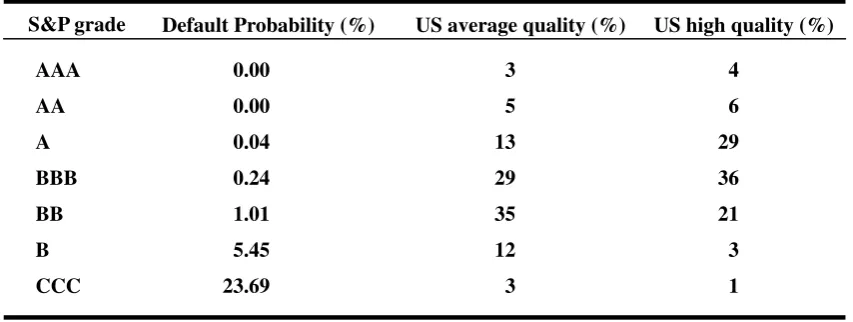
We take representative portfolios of banks from a Federal Reserve Board survey as
[image:11.595.87.514.523.684.2]reported by Gordy(2000). The portfolios are reported in Table 1.
Table 1. Average bank portfolios
AAA
AA
A
BBB
BB
B
CCC
0.00
0.00
0.04
0.24
1.01
5.45
23.69
3
5
13
29
35
12
3
4
6
1 3 21 36 29
US high quality (%) US average quality (%)
S&P grade Default Probability (%)
These distributions of portfolios do not reflect concentration because they are
calculated using exposure based data. In the first case, we form two portfolios using US
average quality portfolio and two portfolios using US high quality portfolio. In each
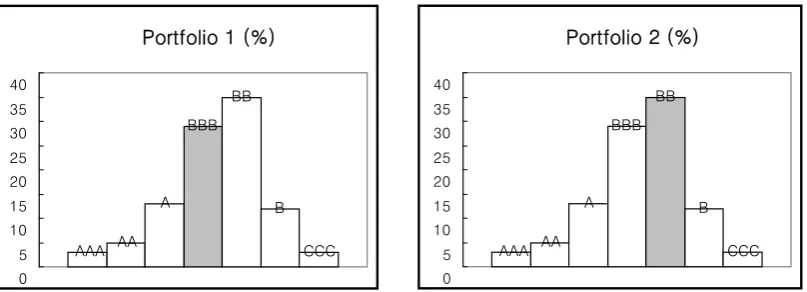
case, the benchmark portfolios have the distributions that each obligor has same
nominal exposure. Portfolio 1 has concentration in credit rating of BB of average
quality portfolio. Portfolio 2 has concentration in the same grade of high quality
portfolio. In order to eliminate the effect of location of concentration, we let both
portfolios have concentrations in the same grades.
Portfolio 1
AAA AA A
BBB BB
B
CCC
0 5 10 15 20 25 30 35 40
Portfolio 2
40 35
0 5 10 15 20 25 30
AAA AA A
BBB
BB
[image:12.595.96.497.270.413.2]B CCC
Fig. 1. The distributions of portfolio 1 and 2. Each portfolio has concentration in shaded
area.
These two portfolios have two obligors which have exposures of about 10% out of
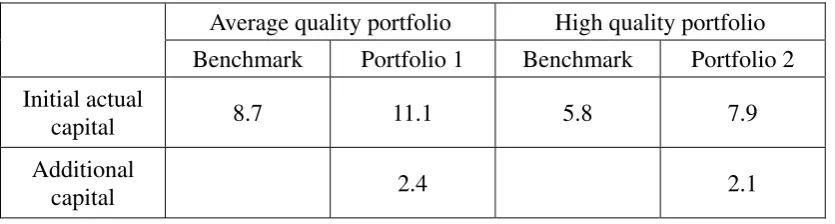
total portfolio exposures. And two portfolios have the same HHI (0.272). Table 2 shows
the main result of simulations.
Table 2. Initial actual capitals of portfolios (%)
Average quality portfolio High quality portfolio
Benchmark Portfolio 1 Benchmark Portfolio 2
Initial actual
capital 8.7 11.1 5.8 7.9
Additional
capital 2.4 2.1
The differences between each portfolio and benchmark portfolio are additional
required capitals arise from concentration. It can be interpreted as additional risks from
[image:12.595.91.509.566.678.2]risk of portfolio 2 is 2.1%. The difference 0.3% is large enough to conclude that the
concentration risk from differently distributed portfolios with same HHI can be different.
In the second case, we form three portfolios using US average quality portfolio. The
benchmark portfolio has the distribution that each obligor has same nominal exposure.
Portfolio 1 has concentration in credit rating of BBB. Portfolio 2 has concentration in
BB.
Portfolio 2 (%)
AAA AA A
BBB BB
B
CCC
0 5 10 15 20 25 30 35 40 Portfolio 1 (%)
AAA AA A
BBB BB
B
CCC
[image:13.595.98.502.230.376.2]0 5 10 15 20 25 30 35 40
Fig. 2. The distributions of portfolio 1 and 2. Each portfolio has concentration in shaded
area.
These two portfolios have two obligors which have exposures of about 10% out of
total portfolio exposures. And two portfolios have the same HHI (0.272). Table 3 shows
the main result of simulations.
Table 3. Initial actual capitals of portfolios (%)
Benchmark Portfolio 1 Portfolio 2
Initial actual capital 8.7 10.3 11.1
Additional capital 1.6 2.4
In this case, the additional risk of portfolio 1 is 1.6% and the additional risk of
portfolio 2 is 2.4%. The difference 0.8% is large enough to conclude that the
concentration risk from portfolios that have concentrations in different grade with same
HHI can be different.
In order to show the problems caused by using HHI for concentration risk measure
more clearly, we form 1000 randomly selected portfolios(with HHI from 0.012~0.015)
[image:13.595.90.507.531.604.2]risk. Using simple linear regression, we found R2equal to 0.043. It implies that HHI could not provide enough information to measure the actual concentration risk.
Fig. 3. Scatter diagram for Herfindahl-Hirschman Index and concentration risk of
average quality portfolio
5. Conclusion
This paper provides a simulation based approach to measure concentration risk. In
addition, it is shown that Herfindahl-Hirshman Index can not be a good measure for
concentration risk. Given bank capital dynamic model, simulations directly provide the
amount of required capital for concentration risk of a loan portfolio while more simple
methods such as HHI or Gini coefficient need an additional function. And also it
provides more precise result, compared with approximation methods such as granularity
adjustment. It might be more time-consuming than other methods, but it is still the
better way especially for banks with portfolios of relatively small number of obligors
[image:14.595.116.470.159.452.2]References
Bangia, A, Diebold, F, Kronimus, A, Schagen, C, Schuermann, T(2002): “Ratings
migration and the business cycle, with application to credit portfolio stress testing,
Journal of Banking and Finance, vol 26, pp 445-474.
Basel Committee on Banking Supervision(2001): The new Basel capital accord,
consultative document, Basel, January.
(2003): The new Basel capital accord, consultative document, Basel, April.
(2006): International convergence of capital measurement and capital
standards: a revised freamework, comprehensive version, Basel, June.
(2006): Studies on credit risk concentration, working paper, Basel, November.
Board of Governors of the Federal Reserve System (1993): The Herfindahl-Hirshman
Index, Federal Reserve Bulletin, March, pp 188-189
Deutsche Bundesbank(2006): Concentration risk in credit portfolios, monthly report,
June.
Emmer, S and D Tasche(2003): “Calculating credit risk capital charges with the
one-factor model”, Journal of Risk, vol 7, no 2, pp 85-101.
Gordy, M(2000): “A comparative anatomy of credit risk models, Journal of Banking and
Finance, vol 24, pp 119-149.
Gordy, M and E Lutkebohmert(2004): “Granularity adjustment in portfolio credit risk
measurement”, in G Szego(ed), Risk measures for the 21st Century, Wiley.
J.P. Morgan(1997): CreditMetrics™ - Technical Document, J.P. Morgan, New York
Peura, S and Jokivuolle, E(2003): “Simulation based stress tests of banks’ regulatory
capital adequacy”, Journal of Banking & Finance, vol 28, pp1801-1824.