Keywords
Highlights
Abstract
Graphical abstract
265
Review Paper
Received 2016-11-24 Revised 2017-01-13 Accepted 2017-01-13 Available online 2017-01-13
Co-extraction Spray drying Coacervation Layer-by-layer Interfacial polymerization
• Developments in microencapsulation technologies • Microencapsulation in food chemistry
• Microencapsulation methods explanation
Microencapsulation in Food Chemistry
1 Centre Tecnològic de la Química de Catalunya, Carrer de Marcel·lí Domingo, 43007 Tarragona, Spain 2 Universitat Rovira i Virgili, Departament d’Enginyeria Quimica, Av. Paisos Catalans, 26, 43007 Tarragona, Spain 3 Institute of Chemical Engineering, Bulgarian Academy of Sciences, 1113 Sofia, Bulgaria
4 Faculty of Chemistry, Adam Mickiewicz University, Umultowska 89b, 61-614, Poznan, Poland
Anna Trojanowska
1,2, Marta Giamberini
1,2, Irene Tsibranska
3, Martyna Nowak
4, Łukasz Marciniak
4, Renata Jatrzab
4,
Bartosz Tylkowski
1,*Article info
© 2017 MPRL. All rights reserved.
* Corresponding author at: Phone: +34 97 7297086; fax: +34 97 7297954 E-mail address: [email protected] (B. Tylkowski)
DOI: 10.22079/jmsr.2017.23652
Contents
1. Encapsulation …….…….…….….….…….…….…….…..….…….…….…….…….…….…….…….…….…….…….…….…….……..…….…….…….266 2. Spray drying ……..…….…….…….…….…….…….…….…….…….…….…….…….…..….…….…….…….…….…….…….…….…….…….………266 3. Fluidized-bed spray coating….…….…….…….…….…….…….…….…….…….…….…….…….…….…….…….…….…….…….…….…….…….…..267 4. Co-extruction …….…….…….…….…….…….…….…….…….…….…….……...…….…….…….…….…….…….…….…….…….…….……..……..267 5. Coacervation …….…….…….…….…….…….…….…….…….…….……...…….…….…….…….…….…….…….…….…….…….……..…….……...268 6. Layer-by-layer …….…….…….…….…….…….…….…….…….…….…….…….…...….…….…….…….…….…….…….…….…….…….…….…….269 7. Interfacial polymerization …….…….…….……....…….…….…….…….…….…….…….…….…….…….…….…….…….…….…….…….…….……269 8. Conclusions …….…….…….…….……....…….…….…….…….…….…….…….…….…….…….…….…….…….…….…….…….…….…….……….270
Journal of Membrane Science & Research
journal homepage: www.msrjournal.com
Encapsulation, invented in 1953 by B.K. Green & L. Schleicher employed in the laboratories of the National Cash Register Company, Dayton, USA, is defined as a technology of packaging solids, liquids, or gaseous materials in miniature, sealed capsules that can release their contents at controlled rates under specific conditions. Encapsulation involves the incorporation of food ingredients, enzymes, cells, or other materials in small capsules. Microcapsules offer food processors a means to protect sensitive food components, ensure against nutritional loss, utilize otherwise sensitive ingredients, incorporate unusual or time-release mechanisms into the formulation, mask or preserve flavors and aromas, and transform liquids into easily handled solid ingredients. Various techniques are employed to form microcapsules, including: spray drying, extrusion coating, fluidized-bed coating,
coacervation, layer-by-layer, and interfacial polymerization method. Recent developments in each of these techniques are discussed in this review, comprehensively.
A. Trojanowska et al. / Journal of Membrane Science and Research 3 (2017) 265-271
Acknowledgments …….…….…….…….…….…….…….…….…….…….…….…….…….…….……...….…….…….…….…….…….…….…….…….…….270 References …….…….…….…….…….…….…….…….…….…….…….…….…….…….…….…….…….…….…….…….…….…….…….…….………270
1. Encapsulation
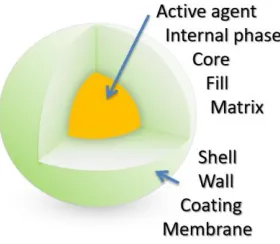
Encapsulation, invented in 1953 by B.K. Green & L. Schleicher employed in the laboratories of the National Cash Register Company, Dayton, USA, is defined as a technology of packaging solids, liquids, or gaseous materials in miniature, sealed capsules that can release their contents at controlled rates under specific conditions [1]. Nanocapsules (10-1000 nm), microcapsules (1-1000 µm), and milicapsules (bigger than 1 mm) are particles which contain an active agent (core, fill, internal phase) surrounded by a coating or shell, as it is shown in Figure 1. The main objective of encapsulation is to protect the core material from adverse environmental conditions, such as: undesirable effects of light, moisture, and oxygen, thereby contributing to an increase in the shelf life of the product, and promoting a controlled liberation of the encapsulate [2].
In the food industry, the microencapsulation process can be applied for a variety of reasons, summarized by Desai and Park [1] as follows: (1) protection of the core material from degradation by reducing its reactivity to its outside environment; (2) reduction of the evaporation or transfer rate of the core material to the outside environment; (3) modification of the physical characteristics of the original material to allow easier handling; (4) tailoring the release of the core material slowly over time, or at a particular time; (5) to mask an unwanted flavor or taste of the core material; (6) dilution of the core material when only small amounts are required, while achieving uniform dispersion in the host material; (7) to help separate the components of the mixture that would otherwise react with one another.
In food products, different components, including aromas, vitamins, probiotics, and enzymes, have been encapsulated. Numerous methods have been developed for the preparation of nano- , micro- and mili-capsules [3]. In this review, detailed information about different methods used in food chemistry for microcapsules preparation are discussed. Since encapsulating compounds are very often in a liquid form, so many technologies are mainly based on drying.
Fig. 1. Schematic presentation of the capsule structure.
2. Spray drying
Spray drying is one of the oldest and the most widely used encapsulation technique in the food sector. It is a flexible, continuous, but more important an economical operation. It produces particles of good quality, which size is less than 40 µm [4]. Spray drying is a process where liquid phase (emulsion, suspension or solution) is forced to form droplets by an atomizer or spray nozzle. In the further part of the devise droplets are dried by the hot air and solidified capsules are created and then collected. Schematic representation of this technology is shown in Figure 2. This method has been widely used since 19th century in the industry because of its simplicity, flexibility, and consistent particle size distribution, as well as possibility of system fully automation [5]. Nevertheless spray drying operation presents several drawbacks such as: low thermal efficiencies, nozzles clogging, and time-consuming cleaning procedures. Moreover, product loss has been commonly observed, due to the agglomeration of capsules and material sticking to the internal chamber walls. Therefore, the process calls for various optimizations.
The most important factors that influence the efficiency of encapsulation and the quality of the microcapsules obtained by spray-drying method are: the nature of the encapsulating material, the viscosity of the oil-in-water (O/W) emulsions, oil/solid content ratio, and the spray-drying parameters (gas-flow
rate, liquid flow rate, air inlet and outlet temperature) [6, 7]. The spray drying process is economical; flexible, in that it offers substantial variation in the microencapsulation matrix; adaptable to commonly used processing equipment; and produces particles of good quality. In fact, spray-drying production costs are lower than those associated with most other methods of encapsulation. One limitation of the spray-drying technology is the limited number of shell materials available.
Since almost all spray-drying processes in the food industry are carried out from aqueous feed formulations, the shell material must be soluble in water at an acceptable level [1]. The spray drying method is one of the most used encapsulation methods of flavour compounds. Nowadays, the vegetal extracts are highly used in food production either as sources of biocomponents or as alternative to the synthetic additives with proven high toxicity risks. From the vegetal extracts used in the food production, an important role is assigned to essential oils, extracted from aromatic herbs. The essential oils are used in a wide variety of applications in pharmaceutical, cosmetics and food industries due to their anti-inflammatory, antibacterial, antifungal, analgesic, sedative, spasmolytic, antioxidant and flavouring properties [3, 8, 9]. The essential oils are complex mixture of chemical compounds sensitive to oxygen, light and high temperature. These factors contribute to the degradation of essential oils and subsequently to the decrease of their biological potential. Therefore, the encapsulation of essential oils in different matrices is required in order to prevent these inconveniences [9]. The microencapsulation of essential oils assures: the stability of the volatile compounds during thermic processing, the transformation of essential oils from liquid state into free flowing powder and a slow and controlled release of volatile compounds.
The data in the literature reflect the worldwide interest regarding the improvement of the encapsulation methods of essential oils [10]. Dima et al. [9] have studied encapsulation of coriander essential oil (CEO) applying the spray drying method and using various materials (chitosan, alginate, chitosan/alginate, chitosan/inulin) as a capsule wall material. The authors investigated viscoelastic properties of the O/W emulsions and the characteristics of CEO-loaded microcapsules like morphology, moisture, wettability, solubility, flowability properties, as well as swelling and release mechanisms. Obtained results show that the chitosan microcapsules had a brain-like morphology while the alginate and chitosan/alginate microcapsules are spherical with a smooth surface. Moreover, Compressibility Index (CI = 29.09–32.25%) and Hausner Ratio (HR = 1.38–1.44) values indicated that all the microcapsules prepared correspond to the “poor” flowability powders group. The experimental studies and the kinetic modelling based on Peppas, Higuchi, first-order and zero-order equations revealed that the release of the coriander essential oil followed a swelling-diffusion controlled process. The value of the diffusion exponent from the Peppas equation was 0.43 ⩽ n < 0.85, so the diffusion process could be considered as an “anomalous diffusion”. Considering the swelling process, the water penetrated the polymeric matrix and the release rate was determined by the glass-to-rubbery process. The microcapsules swelling and the release of the coriander essential oil were found to be influenced by temperature and pH variations. As a result of the different acid-base character of the two polyelectrolytes, the microcapsules with chitosan had the highest swelling degree and the highest release rate at pH 2.5, while the microcapsules with alginate presented the maximum values of the swelling degree and release rate at pH 6.5. Inulin facilitated the swelling of microcapsules due to its hydrophilicity and a 6.5 pH value ensured a higher release rate than considering the case of chitosan microcapsules.
Very interesting studies have been performed by Delgadillo end co-workers [11, 12]. The authors evaluated a potential of rice starch, gelatine/sucrose and inulin as wall material for encapsulation and controlled release of Oregano essential oil. In order to understand both the characteristics of the wall capsules and a release of the encapsulated agent, the authors employed several analytical tools, such as: scanning electron
microscopy, differential scanning calorimetry, ATR-MID infrared
spectroscopy and RAMAN. By spray drying at different solids concentration and drying temperatures, the authors were able to prepare inulin smooth, regular and uninjured microcapsules ranging in size from 3 to 4.5 μm. Both IR and Raman analyzes showed that drying conditions clearly affected the capsules properties probably being related to the phase transitions of inulin. Encapsulation of oregano essential oil in those matrices conducted also to differentiated releasing profiles that are explained by the dissimilar properties
of the wall [11]. The authors demonstrated that gelatine/sucrose
A. Trojanowska et al. / Journal of Membrane Science and Research 3 (2017) 265-271
microparticles exhibit high antioxidant and antimicrobial activity while inulin and rice starch microencapsulates ensure higher stability. According to the authors, the bioactivity of each system could be improved by manipulating different processing parameters such as bonding agents, solids content and drying temperature. Higher diffusion coefficients were obtained for starch microcapsules (about 10−13 m2/s) followed by spray-dried gelatine/sucrose systems (about 10−15 m2/s) and inulin microcapsules (about 10−16 m2/s). Therefore the authors demonstrated that depending on the characteristics desired in the final product wall materials can be selected from a wide variety of natural polymers to provide different release properties. The knowledge gained by Delgadillo end co-workers [11, 12] provides important insights for the design of promising functional ingredients with application in food industry.
Application of the inulin as the microcapsule wall material has been also investigated by Botrel and co-workers [13] and de Paula and co-workers [14]. By using the spray dryer method, the authors encapsulated rosemary essential oil and ginger essential oil, respectively. The authors studied the influence of inulin on arabic/starch/maltodextrin capsule walls [13] and they evaluated the effect of partial replacement of cashew gum by inulin used as wall materials [14], respectively. Botrel and co-workers [13] by using carbohydrates with a high capacity for emulsification (i.e., gum arabic and modified starch) as wall materials showed that such materials are more efficient in retaining volatiles; however, the presence of inulin improved the wettability of the particles and decreased the hygroscopicity under high relative humidity. But it decreased the encapsulation efficiency, as well. According to the authors [13], an interesting alternative for the encapsulation of rosemary essential oil would be a mixture of modified starch and maltodextrin, which are relatively inexpensive wall materials with good properties, including high retention of volatiles. Although adding inulin decreased the oil retention of the particles, the combination of modified starch and inulin was shown to be a viable substitute for gum arabic in foods. This combination was observed to retain oil better than the combination of gum arabic and inulin, and was similar to the combination of gum arabic and maltodextrin. According to Paula and co-workers [14] cashew gum and inulin can be considered as alternatives in the encapsulation process of essential oils according to presenting technological characteristics of interest. However, the evaluation of new compounds is needed to obtain higher ginger oil encapsulation efficiency values.
Fig. 2. Schematic presentation of the spray drying process.
3. Fluidized-bed spray coating
Originally developed as a pharmaceutical technique, fluidized-bed coating is now increasingly being applied in the food industry to fine-tune the effect of functional ingredients and additives. The main benefits of such
miniature packages, called microcapsules, include increased shelf life, taste masking, ease of handling, controlled release, and improved aesthetics, taste, and color. Fluidized-bed coating increasingly supplies the food industry with a wide variety of encapsulated versions of food ingredients and additives. Compared to pharmaceutical bed coating, food industry fluidized-bed coating is more obliged to cut production costs and, therefore, should adopt a somewhat different approach to this rather expensive technology. Solid particles are suspended in a temperature and humidity-controlled chamber of high-velocity air where the coating material is atomized [1, 15]. Though fluidized bed drying offers a lot of advantages, freeze and spray drying are preferred drying techniques for probiotic microencapsulation. Compared to lyophilization fluidized bed, drying is more cost effective. Due to an optimal heat and mass transport as well as equal temperature distribution, drying and granulation processes in a fluidized bed dryer can be carried out at lower temperatures compared to spray drying which results in higher survival rates of encapsulated bacteria [16].
Further, granulation and coating procedures can be combined within one fluidized bed drying process. At least, the coating material determines the protection and targeted release properties. Recently, Schell and Beermann [17] applied sweet whey and shellac as encapsulation and coating materials in order to establish an acidic resistant formulation for dietary probiotics with a pH-value controlled release of core enclosed bacteria. The authors used the sweet whey powder because it is a cheap waste by-product in cheese manufacturing; and shellac is an anionic natural polymer lacquer which has been approved as an additive in the food sector, being a suitable coating material for a broad spectrum of products. Moreover, the authors decided to employ shellac due to its acid resistant and coincidently solubility at slightly alkaline conditions. It means that a coating of probiotic granules with shellac might provide distinct resistance to acid conditions and improve the bacterial survival during gastro-intestinal transit. Under this investigation bacterial survival rates were evaluated by pour plate counting. Viabilities after granulation were 43±5%, after 15 min shellac coating and, 23±2% and 15±1% after 30 min coating time, respectively. Endpoint bacterial count after 28 days of storage at 4 °C remained equal for coated and uncoated bacteria. After incubation in gastric acid and intestinal conditions, the final survival rate of coated L. reuteri DSM 20016 with 77±24% was higher compared to free cells with 18±11% (p = 0.04). Hence, the usage of shellac and sweet whey powder as encapsulation material improves the effectiveness of probiotic food applications.
4. Co-extruction
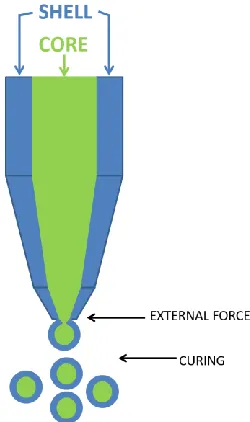
Co-extruction was first patented in 1957 and future developed by the group that originally patented the technique [18]. It is a process where dual fluid stream is pumped through the nozzle. One of the liquids contains core material and the other wall material. Droplets are formed by the vibrations applied at the exit of the concentric tubes. Then, the droplets undergo solidification by chemical crosslinking, cooling or solvent evaporation [19]. Schematic representation of co-extrusion is shown in Figure 3.
Fig. 3. Schematic presentation of the co-extrusion process.
A. Trojanowska et al. / Journal of Membrane Science and Research 3 (2017) 265-271
Depending on the device, a monocentric or concentric nozzle system is used, which produces different types of microcapsules, respectively, by extrusion and co-extrusion. The concentric system presents internal and external nozzles that allow the production of reservoir type microcapsules [20]. Extrusion microencapsulation has been used almost exclusively for the encapsulation of volatile and unstable flavors in glassy carbohydrate matrices. The main advantage of this process is the very long shelf life imparted to normally oxidation-prone flavor compounds such as citrus oils, because atmospheric gases diffuse very slowly through the hydrophilic glassy matrix, thus providing an almost impermeable barrier against oxygen. Shelf lives of up to 5 years have been reported for extruded flavor oils, compared to typically one year for spray dried flavors and a few months for un encapsulated citrus oils [21].
Recently, Pasukamonset et al. [22] published very interesting results concerning microencapsulation of phenolic extracts of Clitoria ternatea (CT) petal flower extract through extrusion method of alginate with calcium chloride (CaCl2). The authors reported that the encapsulation efficiency varied in the range from 74±1% to 84.9±0.3% depending on the percentage of CT (5–20%), alginate (1–2%), and CaCl2 (1.5–5%). The results showed that the optimized conditions of CT-loaded alginate beads (CT beads) were as
follows: 10% CT, 1.5% alginate, and 3% CaCl2 (w/v). Under these
conditions, the maximal antioxidant capacity of 11.8±0.1 mg gallic acid equivalent/gbeads and the encapsulation efficiency of 84.8±0.4% were obtained. Moreover, provided results demonstrated that the prepared microcapsules possessed smooth surface shape with a particle size distribution of 985 ±1 μm. Without any doubts this report provides a novel food-grade encapsulation formulation to improve the stability, as well as the biological activity of plant polyphenols.
Recently, Shinde et al. [23] evaluated the co-extrusion using alginate and apple skin polyphenols to protect Lactobacillus acidophilus in a milk beverage at 4 °C. The authors decided to employ probiotic bacteria and polyphenols for microcapsules preparation due to their great demand in food products. Lactic acid bacteria have been used to ferment or culture foods for at least 4000 years. The bacteria have been used in particular in fermented milk products from all over the world, including yoghurt, cheese, butter, buttermilk, kefir and koumiss. Probiotics are defined as “live micro-organisms which, when administered in adequate amounts, confer a health benefit on the host” [23] and polyphenols possess antioxidant capacity, anti-inflammatory and anticarcinogenic properties, as well as protective effects against a variety of chronic diseases [3, 8, 24, 25]. Results published by Shinde et al. [23] indicated that the co-extrusion technology was efficient to protect probiotics after 50 days of storage, due to very low decrease on cell viability.
In another work, Silva et al. [26] reported exciting results concerning encapsulation of Lactobacillus paracasei BGP-1 probiotic dispersed into sunflower oil or coconut fat by using the co-extrusion process. Under this study, the authors used alginate or alginate-shellac blend as capsule shell materials and fluidized bed or lyophilization as post-treatment processes to dry the capsules. By using the co-extrusion method, authors have been able to prepare capsules with a diameter between 0.71 and 0.86 mm, which encourage their application in solid foods such as cereal bars, dark chocolate and mixed nuts. The authors also reported that after 60 days of storage at 25 °C, the viability of probiotic loaded into capsules dried by fluidized bed was up to 6 log CFU/g, corresponding to 90% of the initial probiotic population. In addition, the formulation produced with alginate-shellac and coconut fat was the most effective on improving probiotic survival in simulated gastrointestinal fluids, mainly by reducing the porosity of microcapsules, in which 7.5 log CFU/g of probiotics (95%) survived at the end of the assay. Thus, according to the authors, immobilization of probiotics in coconut fat co-extruded with alginate-shellac blend followed by fluidized bed drying is a promising technology to protect and extend the viability of probiotics in functional foods.
5. Coacervation
Coacervation was the first encapsulation process patented in 1953 by Green & Schleicher working in the laboratories of the National Cash Register
Company, Dayton, USA [27]. The investigators have encapsulated
trichlorodiphenyl inside microscopic gelatin capsules by coacervate forces. We can speak about coacervation when an active agent is distributed within the homogeneous polymer solution, and by triggering coacervation colloidal polymer aggregates (coacerates) are formed on the outer surface of an active agent droplet. Initiation of the coacervation can be achieved by varying some parameters of the system such as temperature, pH, or the composition of the reaction mixture (addition of water-miscible non-solvent or salt). In the work of Green & Schleicher, coacervation was initiated by the addition of salt, in
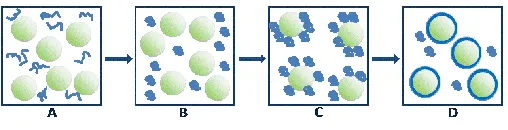
this case sodium sulphate. Coacervation techniques are divided into two groups: simple coacervation and complex coacervation. They differ in the mechanism of the phase separation. Simple coacervation occurs when used polymer is salted out or desolvated, whereas complex coacervation is achieved by the complexation of two or more oppositely charged polyelectrolytes. The simple technique has been mentioned above, while Green & Schleicher patent was discussed, and the complex one will be described here in more detail. Phases of complex coacervation method are presented schematically in Figure 4. Briefly, it can be presented as a four step process: (A) dispersion of the core material in homogeneous two-different-polymer solution, (B) initial agglomeration of polyelectrolytes after triggering the coacervation, (C) coacervation of polymer on the surface of the core, and (D) wall hardening.
Fig. 4. Schematic presentation of the complex coacervation process.
However, through the years researchers made many adjustments to optimize this process, e.g. Dardelle et al. [28] in their invention have modified complex coacervation method to produce capsules with improved barrier properties for encapsulated material. According to Gouin [29], the coacervation method is a unique and promising microencapsulation technology for flavours encapsulation because of the very high payloads achievable (up to 99%) and the controlled release possibilities based on mechanical stress, temperature or sustained release. Flavours are known as the essence of foods. They play important roles in consumer satisfaction and influence the further consumption of foods. However, the stability of flavours in foods has attracted intense attentions because of its relationship with the quality and acceptability of foods.
Most liquid food flavours are volatile and chemically unstable in the presence of air, light, moisture and high temperatures. Hence, it is beneficial to microencapsulate volatile ingredients prior to use in foods or beverages to limit aroma degradation or loss during processing and storage. As it was mentioned before, the complex coacervation process involves at least two differently charged polymers under set conditions. In most cases, the two biopolymers include a proteinaceous molecule and a polysaccharide molecule. The interaction between proteins and polysaccharides in complex coacervation, the phase transition, related thermodynamic studies, and various influencing factors have been reviewed by Wang et al. [30], De Kruif et al. [31], Wagoner and Foegeding [32], and Schmitt et al. [33]. The protein– polysaccharide combinations that have been reported for flavour microencapsulation by complex coacervation include xanthan gum/gelatin [34], gelatin/gum arabic [35], soybean protein isolate/pectin [36], gum arabic/albumin [37], and many other natural components [32]. The most classical system of complex coacervation is that gelatin is used as the positive polyelectrolyte and gum arabic is used as the negatively polyelectrolyte. The system has been successfully used in the production of carbonless paper, scent strips, fragrance samplers and flavour ingredients. Due to the emergence of new diseases such as the prion diseases, regulations concerning safety of animal-derived protein were reinforced [38]. These shortcomings restrict the application of this system in foods.
A. Trojanowska et al. / Journal of Membrane Science and Research 3 (2017) 265-271
Furthermore, a core–shell structure was confirmed by LSCM, which was beneficial to improve the thermostability of vanilla oil in the microcapsule. In addition, the studies of thermostability and release profile of flavour microcapsules proved that the thermostability and long residual action of vanilla oil were effectively enhanced after being encapsulated in the microcapsules. According to the authors, the flavour microcapsule containing vanilla oil developed by complex coacervation approach is promising for serve as a high quality food spice with long residual action and high thermostability.
Hussain and Maji [38] and, Huang and co-workers [40] have also investigated the chitosan-gelatin complex microcapsules cross-linked with genipin. It is important to underline that Huang and co-workers have used a
carboxymethylated chitosan. Carboxymethylation is an important
modification method of chitosan and the resultant carboxymethylated chitosan has gained wide biomedical applications due to the improved solubility, biocompatibility, and pH sensitivity [41]. Hussain and Maji [38] fabricated microcapsules containing Zanthoxylum limonella oil (ZLO) as a core material, while Huang and co-workers [40] encapsulated a serum albumin (BSA) as a hydrophobic model drug, which could be easily quantified by spectrophotometry, to evaluate the intestine-targeted delivery potency of the chitosan-gelatin coacervation system. Hussain and Maji [38] have studied the effects of various parameters such as oil loading, degree of cross-linking, ratio of chitosan to gelatin, etc. on oil content, encapsulation efficiency and the release rate of ZLO. They have employed the FTIR spectroscopy to understand the interaction between the polymers and oil, and the SEM to study morphology of the prepared microcapsules. The authors reported that the release of ZLO was found to be dependent on percentage of oil loading, cross-linking density and chitosan-gelatin ratio. SEM study also showed the presence of oil on the microcapsule surface. Published results indicated that it was an interaction between chitosan and gelatin during the formation of complex, as evident by FTIR study.
In contrary to Hussain and Maji who have used unmodified chitosan
[38], the FTIR analysis performed by Huang and co-workers [40]
demonstrated that the crosslinking reaction occurred readily between carboxymethylated chitosan and genipin. Moreover, Huang and co-workers reported that the coacervation in higher pH led to reduced crosslinking speed and degree, more elastic structure, and higher thermal stability. All the coacervates displayed higher swelling ratios in the simulated gastric solution than in the simulated intestinal and colon solutions, but the emulsified BSA-loaded and genipin-crosslinked chitosan-gelatin microcapsules in the core-shell structure effectively limited the release of BSA to the simulated gastric fluid, the higher the coacervation pH, the better the protection. It was concluded that the genipin-crosslinked modified chitosan-gelatin coacervates in the core-shell structure could be used in the intestine-targeted delivery of hydrophobic compounds used in food and pharmaceutical products, and the desired delivery performance could be tailored by simply varying the coacervation pH.
Very similar conclusion were reported by Chen and co-workers [42] who
have investigated genipin cross-linked polymeric alginate-chitosan
microcapsules for oral delivery. To summarize, coacervation processes became a widely used encapsulation methods, because of their simplicity, low cost, and reproducibility. Moreover, those methods can be easily scaled-up to fabricate microcapsules at the industrial set-up. Nevertheless, those techniques need a constant attention and the adjustment of operating conditions (such as: stirring, viscosity, pH, and temperature), also unwanted agglomerated microcapsules have been commonly observed.
6. Layer-by-layer
Microencapsulation by layer-by-layer (LbL) assembly, developed in 1991 by Decher et al. [43], is the sequential adsorption of oppositely charged materials on a template to form polyelectrolyte shells. It is a simple and inexpensive method to control the shell thickness of the microcapsules and the release of encapsulated materials. This technique can offer capsules with a broad permeability coefficients spectrum that can be tailored depending on the desired application [44]. The properties of polyelectrolyte capsules can be tuned by proper selection of the shell constituents and the core template used in the fabrication. The shell can be customized because a variety of polymers can serve as building materials: going from synthetic polymers to biodegradable polymers. The majority of polyelectrolyte capsules reported today are composed of synthetic polymers, mainly the anionic poly(sodium)styrenesulfonate and the cationic poly(allylamine)hydrochloride. However, for food industry, pharmaceutical and biological settings, the use of biocompatible and biodegradable materials (vulnerable to, e.g., enzymatic degradation) is required [45].
Recently, Yu and co-workers [46] reviewed LbL capsules formation and
their application. Efforts to adapt LbL technology to the production of food-applicable capsules have been made. For example Noshad et al. [47] have studied the effect of layer-by-layer polyelectrolyte method on encapsulation of vanillin and reported that the use of multilayer technique prior to spray drying of vanillin microcapsules made it possible to protect it and control its release. Humblet-Hua and co-workers [44] produced microcapsules using layer-by-layer adsorption of food-grade polyelectrolytes on an emulsion droplet template. The authors compared the mechanical stability of microcapsules to shells consisting of alternating layers of ovalbumin–high methoxyl pectin (Ova–HMP) complexes and semi-flexible ovalbumin (Ova) fibrils (average contour length, Lc ∼ 200 nm), with microcapsules built of alternating layers of lysozyme–high methoxyl pectin (LYS–HMP) complexes and lysozyme (LYS) fibrils. The authors employed two types of LYS fibrils: short and rod-like (Lc∼ 500 nm) and long and semi-flexible (Lc = 1.2–1.5 μm). Obtained results showed that a low number of layers (≤4), microcapsules from Ova complexes and fibrils were stronger than microcapsules prepared from LYS complexes and fibrils. Moreover, the authors reported that with an increase of the number of layers, the mechanical stability of microcapsules from LYS–HMP/LYS fibrils increased significantly and capsules were stronger than those prepared from Ova–HMP/Ova fibrils with the same number of layers.
Ogawa and co-workers [48] demonstrated the possibility of producing stable oil-in-water (O/W) emulsions containing oil droplets surrounded by multiple layer interfacial microcapsule shell from food grade ingredients. The authors produced these emulsions using a three stage process that relies on the adsorption of charged biopolymers to oppositely charged surfaces. Then by using the interfacial layer-by-layer deposition process, the authors formed lecithin−chitosan−pectin microcapsule membranes containing oil droplets. Obtained results have shown that the droplets in these emulsions had good stability to aggregation over a wide range of pH values and salt concentrations (pH 4−8 at 0 mM NaCl and pH 3−8 at 100 mM NaCl).
Pommersheim et al. [49] demonstrated that enzymes could be retained within alginate microcapsules upon coating with polycation/polyanion multilayers, for example, polyethyleneimine, poly(acrylic acid), poly(N -vinylamine), carboxymethylcellulose, and chitosan. It was reported that coating of cytochrome C-loaded alginate beads with a multilayer membrane consisting of alternating layers of poly(N-vinylamine) and poly(acrylic acid) or water-soluble anionic cellulose derivatives minimized loss of the protein during storage when at least two polycation/polyanion double layers were used. However, single-layer membranes were not able to retain cytochrome C.
Moreover results reported by Gaserod [50] showed that one double layer of alginate and chitosan deposited on preformed alginate-chitosan capsules had only a minor effect on the permeability of immunoglobulin G (IgG), whereas four double layers yielded a large effect in limiting the diffusion of IgG. The decrease in permeability was attributed to the complexed structure of the polyelectrolyte pairs. Furthermore, it was found that the final permeability was dependent on the initial porosity of the uncoated alginate capsules. In addition, Bartkowiak and Hunkeler [51] demonstrated the simultaneous regulation of mechanical properties and permeability for microcapsules based on oligochitosan and alginate through control of the reaction conditions.According to the authorsa molar mass of the polyanion influences the mechanical resistance of the capsule.
7. Interfacial polymerization
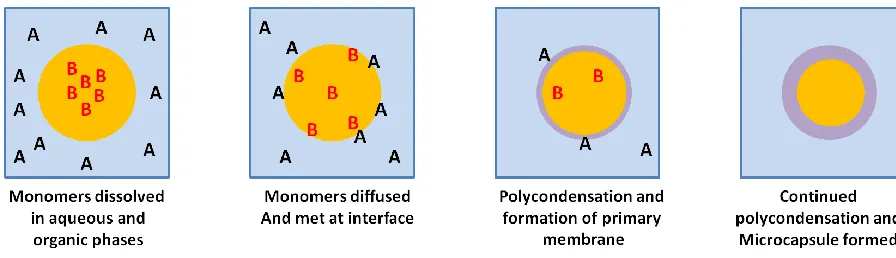
Chemical methods involve sphere fabrication along with various polymerization reactions. This indicates that the starting materials in these cases will be monomers or pre-polymers. Microcapsules formed by interfacial polymerization method, known also as polycondensation method, can be produced as either oil-in-water or water-in-oil emulsions. The technique involves two monomers that are dissolved in incompatible phases meeting at the interface and reacting to produce a ‘primary membrane’, almost instantaneously. The reaction rate is then decreased as diffusion of monomers becomes restricted by the polymeric shell. Sufficient time is required to ensure complete wall formation. The process is shown schematically in Figure 5[52].
First theinterfacial polymerization technology was reported by an American polymer scientists - Morgan and his group at Dupont Nemour in 1959 [53-56]. Not far from it, the process has been expanded. In 1960s, researchers applied this method for encapsulation purposes [57-59]. In 1983, Beestman et al. [60] patented the basic methodology of this process. Since then the method has been improved significantly. One of its major advantages is its controllable character. Capsule mean size and membrane thickness can be directly designed. Yáñez-Fernández and co-workers [61] have used gum arabic (A), gellan gum (G) and mesquite seed gum (M) to prepared
A. Trojanowska et al. / Journal of Membrane Science and Research 3 (2017) 265-271
degradable microcapsules, applying the interfacial polymerization method in order to keep lactic bacteria (Lactobacillus sp.) viable. Fernández and co-workers [61] have selected the biopolymers as a microcapsules shell due to their degradable properties and their known applications in food chemistry, pharmacology, medicine. Indeed, gum arabic, which is a complex arabinogalactan-type polysaccharide exuded by Acacia trees, is widely used for its nutritional and surface properties in food industry [62].
Gellan, which is an extracellular polysaccharide produced by
aerobic-submerged fermentation of Pseudomonas paucimobilis (previously
called Pseudomonas elodea), has been used mainly for dessert jellies, jams, and fillings [63]. Mesquite seed gum, which is a galactomannans extracted from the endosperm layer of the seed, due to its excellent properties as a thickening agent stabilizer and an absence of toxicity has been used in the food industry [64]. The authors used sunflower oil as the oily phase in a 1:1, 1:3 and 1:5 ratio with the disperse phase (deionized water), and a glutaraldehyde as a crosslinking agent. The mean diameter of the obtained microcapsules was 30.17, 16.86 and 10.34 μm according to the AG, AM and GM mixtures, respectively. The authors reported that in the AG and AM dispersions, the microcapsules diameters became larger as the viscosity increased. The highest viability (46.7%) of Lactobacillus sp. was obtained with the GM mixture.
8. Conclusions
Encapsulation provides an effective method to cover an active compound with a protective wall material and thus, offers numerous advantages. These
bioactive components include lipids, vitamins, peptides, fatty acids, antioxidants, minerals and living cells such as probiotics. Some of the main benefits are protection of various actives against evaporation, chemical reactions or migration in food, controlled delivery and preservation of stability of the bioactive compounds during processing and storage, prevention of undesirable interactions with other components in food products and masking unpleasant feelings during eating.
Encapsulation is an important approach to meet all demands by delivering bioactive food components at the right time and right place. An attractive possibility is to use a methodology where two or more bioactive components can be combined to have a synergistic effect. It may be foreseen that encapsulated bioactives will play a significant role in increasing the efficacy of functional foods over the next period. With advanced strategies for stabilization of food ingredients and development of new approaches, we will be able to improve nutritional properties and health benefits of food compounds. The microcapsule technologies cover the following production methods: spray drying, extrusion coating, fluidized-bed coating, coacervation, layer-by-layer, and interfacial polymerization.
Acknowledgments
Financial support from People Programme (Marie Curies Actions) of the Seventh Framework Programme of the European Union (FP7/2007-2013) under REA grant agreement no. 600388 (TECNIOspring programme), and from the Agency for Business Competitiveness of the Government of Catalonia, ACCIÓ are gratefully acknowledged by Dr. Tylkowski.
Fig. 5. Schematic presentation of the polycondensation formation of shells around emulsion droplets.
References
[1] K.G.H. Desai, H. Jin Park, Recent Developments in Microencapsulation of Food Ingredients, Drying Technology. 23 (2005) 1361-1394.
[2] F. Shahidi, X.Q. Han, Encapsulation of food ingredients, Crit Rev Food Sci Nutr. 33 (1993) 501-547.
[3] M. Giamberini, S. Fernandez Prieto, B. Tylkowski, Microencapsulation, Innovative Applications, DeGruyter, Berlin, 2015.
[4] V. Nedovic, A. Kalusevic, V. Manojlovic, S. Levic, B. Bugarski, An overview of encapsulation technologies for food applications, Procedia Food Sci. 1 (2011) 1806-1815.
[5] S.L. Percy, Improvement in drying and concentrating liquid substances by atomizing, in, Google Patents, 1872.
[6] B.N. Estevinho, F. Rocha, L. Santos, A. Alves, Microencapsulation with chitosan by spray drying for industry applications - A review, Trends Food Sci Technol. 31 (2013) 138-155.
[7] C. Turchiuli, M.T. Jimenez Munguia, M. Hernandez Sanchez, H. Cortes Ferre, E. Dumoulin, Use of different supports for oil encapsulation in powder by spray drying, Powder Technol. 255 (2014) 103-108.
[8] B. Tylkowski, M. Nowak, I. Tsibranska, A. trojanowska, Ł. Maecinkiewicz, R. Garcia Valls, T. Gumi, M. Giamberini, R. Jastrzab, Concentration and fractionation of polyphenols by membrane operations, Curr Pharm Des. 22 (2016) 1-1. [9] C. Dima, L. Pătraşcu, A. Cantaragiu, P. Alexe, Ş. Dima, The kinetics of the swelling
process and the release mechanisms of Coriandrum sativum L. essential oil from chitosan/alginate/inulin microcapsules, Food Chem. 195 (2016) 39-48.
[10] G.S. Vishwakarma, N. Gautam, J.N. Babu, S. Mittal, V. Jaitak, Polymeric Encapsulates of Essential Oils and Their Constituents: A Review of Preparation Techniques, Characterization, and Sustainable Release Mechanisms, Polym Rev. 56 (2016) 668-701.
[11] S. Beirão-da-Costa, C. Duarte, A.I. Bourbon, A.C. Pinheiro, M.I.N. Januário, A.A. Vicente, M.L. Beirão-da-Costa, I. Delgadillo, Inulin potential for encapsulation and controlled delivery of Oregano essential oil, Food Hydrocoll. 33 (2013) 199-206. [12] S. Beirão da Costa, C. Duarte, A.I. Bourbon, A.C. Pinheiro, A.T. Serra, M. Moldão
Martins, M.I. Nunes Januário, A.A. Vicente, I. Delgadillo, C. Duarte, M.L. Beirão
da Costa, Effect of the matrix system in the delivery and in vitro bioactivity of microencapsulated Oregano essential oil, J Food Eng. 110 (2012) 190-199. [13] R.V.d.B. Fernandes, S.V. Borges, D.A. Botrel, Gum
arabic/starch/maltodextrin/inulin as wall materials on the microencapsulation of rosemary essential oil, Carbohydr Polym. 101 (2014) 524-532.
[14] R.V.d.B. Fernandes, D.A. Botrel, E.K. Silva, S.V. Borges, C.R.d. Oliveira, M.I. Yoshida, J.P.d.A. Feitosa, R.C.M. de Paula, Cashew gum and inulin: New alternative for ginger essential oil microencapsulation, Carbohydr Polym. 153 (2016) 133-142.
[15] S.K.I.A.C.N.M.B. F. Gibbs, Encapsulation in the food industry: a review, Int J Food Sci Nutr. 50 (1999) 213-224.
[16] S. Strasser, M. Neureiter, M. Geppl, R. Braun, H. Danner, Influence of lyophilization, fluidized bed drying, addition of protectants, and storage on the viability of lactic acid bacteria, J Appl Microbiol. 107 (2009) 167-177.
[17] D. Schell, C. Beermann, Fluidized bed microencapsulation of Lactobacillus reuteri with sweet whey and shellac for improved acid resistance and in-vitro gastro-intestinal survival, Food Res Int. 62 (2014) 308-314.
[18] S.J. Risch, Encapsulation of Flavors by Extrusion, Flavor Encapsulation, ACS, 370 (1988) 103-109.
[19] A. Nussinovitch, Liquid-Core Beads and Their Applications in Food, Biotechnology, and Other Fields, in: Polymer Macro- and Micro-Gel Beads: Fundamentals and Applications, Springer New York, New York, NY, 2010, pp. 163-189.
[20] M. Whelehan, I.W. Marison, Microencapsulation using vibrating technology, J Microencapsul. 28 (2011) 669-688.
[21] S. Abbas, C. Da Wei, K. Hayat, Z. Xiaoming, Ascorbic Acid: Microencapsulation Techniques and Trends—A Review, Food Res Int. 28 (2012) 343-374.
[22] P. Pasukamonset, O. Kwon, S. Adisakwattana, Alginate-based encapsulation of polyphenols from Clitoria ternatea petal flower extract enhances stability and biological activity under simulated gastrointestinal conditions, Food Hydrocoll. 61 (2016) 772-779.
[23] T. Shinde, D. Sun-Waterhouse, J. Brooks, Co-extrusion Encapsulation of Probiotic Lactobacillus acidophilus Alone or Together with Apple Skin Polyphenols: An Aqueous and Value-Added Delivery System Using Alginate, Food Bioproc Tech. 7
A. Trojanowska et al. / Journal of Membrane Science and Research 3 (2017) 265-271
(2014) 1581-1596.
[24] B. Tylkowski, I. Tsibranska, Polyphenols encapsulation – application of innovation technologies to improve stability of natural products, in: M. Giamberini, S. Fernandez Prieto, B. Tylkowski (Eds), Microencapsulation, Innovative Applications, DeGruyter, Berlin, 20152015, pp. 97-113.
[25] I. Tsibranska, B. Tylkowski, R. Kochanov, K. Alipieva, Extraction of biologically active compounds from Sideritis ssp. L, Food and Bioproducts Proc. 89 (2011) 273-280.
[26] M.P. Silva, F.L. Tulini, M.M. Ribas, M. Penning, C.S. Fávaro-Trindade, D. Poncelet, Microcapsules loaded with the probiotic Lactobacillus paracasei BGP-1 produced by co-extrusion technology using alginate/shellac as wall material: Characterization and evaluation of drying processes, FFood Res Int. 89 (2016) 582-590.
[27] B.K. Green, S. Lowell, Oil-containing microscopic capsules and method of making them, in, Google Patents, 1957.
[28] G. Dardelle, P. Beaussoubre, P. Erni, Hybrid coacervate capsules, in, Google Patents, 2015.
[29] S. Gouin, Microencapsulation: Industrial appraisal of existing technologies and trends, Trends Food Sci Technol. 15 (2004) 330-347.
[30] C.S. Wang, G. Natale, N. Virgilio, M.C. Heuzey, Synergistic gelation of gelatin B with xanthan gum, Food Hydrocoll. 60 (2016) 374-383.
[31] C.G. De Kruif, F. Weinbreck, R. De Vries, Complex coacervation of proteins and anionic polysaccharides, Curr Opin Colloid Interface Sci. 9 (2004) 340-349. [32] T.B. Wagoner, E.A. Foegeding, Whey protein–pectin soluble complexes for
beverage applications, Food Hydrocoll. 63 (2017) 130-138.
[33] C. Schmitt, L. Aberkane, C. Sanchez, Protein-polysaccharide complexes and coacervates, in: G.O. Phillips and P.A. Williams (Eds.), Handbook of Hydrocolloids: 2nd Edition, The North East Wales Institute, UK, 2009, pp. 420-476.
[34] C.Y. Lii, S.C. Liaw, V.F. Lai, P. Tomasik, Xanthan gum-gelatin complexes, Eur Polym J. 38 (2002) 1377-1381.
[35] Y. Yeo, E. Bellas, W. Firestone, R. Langer, D.S. Kohane, Complex coacervates for thermally sensitive controlled release of flavor compounds, J Agric Food Chem. 53 (2005) 7518-7525.
[36] D.V. Mendanha, S.E. Molina Ortiz, C.S. Favaro-Trindade, A. Mauri, E.S. Monterrey-Quintero, M. Thomazini, Microencapsulation of casein hydrolysate by complex coacervation with SPI/pectin, Food Res Int. 42 (2009) 1099-1104. [37] D.J. Burgess, O.N. Singh, Spontaneous Formation of Small Sized Albumin/acacia
Coacervate Particles, J Pharm Pharmacol. 45 (1993) 586-591.
[38] I. Chourpa, V. Ducel, J. Richard, P. Dubois, F. Boury, Conformational modifications of α gliadin and globulin proteins upon complex coacervates formation with gum arabic as studied by Raman microspectroscopy, Biomacromolecules. 7 (2006) 2616-2623.
[39] Z. Yang, Z. Peng, J. Li, S. Li, L. Kong, P. Li, Q. Wang, Development and evaluation of novel flavour microcapsules containing vanilla oil using complex coacervation approach, Food Chem. 145 (2014) 272-277.
[40] G.-Q. Huang, X.-N. Han, J.-X. Xiao, L.-Y. Cheng, Effects of coacervation acidity on the genipin crosslinking action and intestine-targeted delivery potency of the O-carboxymethyl chitosan–gum arabic coacervates, Int. J Poly Mat and Poly Biomat. 66 (2017) 89-96.
[41] L. Upadhyaya, J. Singh, V. Agarwal, R.P. Tewari, Biomedical applications of carboxymethyl chitosans, Carbohydr Polym. 91 (2013) 452-466.
[42] H. Chen, W. Ouyang, C. Martoni, S. Prakash, Genipin Cross-Linked Polymeric Alginate-Chitosan Microcapsules for Oral Delivery: In-Vitro Analysis, Int J Polym Sci. 2009 (2009) 16.
[43] G. Decher, J.-D. Hong, Buildup of ultrathin multilayer films by a self-assembly process, 1 consecutive adsorption of anionic and cationic bipolar amphiphiles on charged surfaces, Makromolekulare Chemie. Macromol Symp. 46 (1991) 321-327. [44] N.-P.K. Humblet-Hua, E. van der Linden, L.M.C. Sagis, Microcapsules with Protein
Fibril Reinforced Shells: Effect of Fibril Properties on Mechanical Strength of the Shell, J Agric Food Chem. 60 (2012) 9502-9511.
[45] M.-L. De Temmerman, J. Demeester, F. De Vos, S.C. De Smedt, Encapsulation Performance of Layer-by-Layer Microcapsules for Proteins, Biomacromolecules. 12 (2011) 1283-1289.
[46] F.F. Yu, H. Zou, Y.Q. Zhong, [Research progress of layer-by-layer self-assembly technique in drug delivery], Yao xue xue bao. 47 (2012) 332-338.
[47] M. Noshad, M. Mohebbi, F. Shahidi, A. Koocheki, Effect of layer-by-layer polyelectrolyte method on encapsulation of vanillin, Int J Biol Macromol. 81 (2015) 803-808.
[48] S. Ogawa, E.A. Decker, D.J. McClements, Production and Characterization of O/W Emulsions Containing Cationic Droplets Stabilized by Lecithin−Chitosan Membranes, J Agric Food Chem. 51 (2003) 2806-2812.
[49] R. Pommersheim, J. Schrezenmeir, W. Vogt, Immobilization of enzymes by multilayer microcapsules, Macromol Chem Phys. 195 (1994) 1557-1567. [50] O. Gaserod, A. Sannes, G. Skjak-Braek, Microcapsules of alginate-chitosan. II. A
study of capsule stability and permeability, Biomaterials. 20 (1999) 773-783. [51] A. Bartkowiak, D. Hunkeler, Alginate−Oligochitosan Microcapsules. II. Control of
Mechanical Resistance and Permeability of the Membrane, Chemistry of Materials. 12 (2000) 206-212.
[52] F. Salaön, Microencapsulation by Interfacial Polymerization, in: Encapsulation Nanotechnologies, John Wiley & Sons, Inc., New York, 2013, pp. 137-173. [53] E.L. Wittbecker, P.W. Morgan, Interfacial polycondensation. I, J Polym Sci. 40
(1959) 289-297.
[54] R.G. Beaman, P.W. Morgan, C.R. Koller, E.L. Wittbecker, E.E. Magat, Interfacial polycondensation. III. Polyamides, Journal of Polymer Science, 40 (1959) 329-336. [55] W.M. Eareckson, Interfacial polycondensation. X. Polyphenyl esters, J Polym Sci.
40 (1959) 399-406.
[56] P.W. Morgan, S.L. Kwolek, Interfacial polycondensation. II. Fundamentals of polymer formation at liquid interfaces, J Polym Sci A. 34 (1996) 531-559.
[57] T.M.S. Chang, Semipermeable Microcapsules, Science. 146 (1964) 524-525. [58] S. Torza, S.G. Mason, Coalescence of Two Immiscible Liquid Drops, Science. 163
(1969) 813-814.
[59] G.R. Fink, Gene-Enzyme Relations in Histidine Biosynthesis in Yeast, Science.146 (1964) 525-527.
[60] G.B. Beestman, J.M. Deming, Encapsulation by interfacial polycondensation, in, Google Patents, 1983.
[61] J. Yáñez-Fernández, E.G. Ramos-Ramírez, J.A. Salazar-Montoya, Rheological characterization of dispersions and emulsions used in the preparation of microcapsules obtained by interfacial polymerization containing Lactobacillus sp, Eur Food Res Technol. 226 (2007) 957.
[62] C. Sanchez, D. Renard, P. Robert, C. Schmitt, J. Lefebvre, Structure and rheological properties of acacia gum dispersions, Food Hydrocoll. 16 (2002) 257-267. [63] T. Omoto, Y. Uno, I. Asai, The latest technologies for the application of gellan gum,
in: K. Nishinari (Ed.) Physical Chemistry and Industrial Application of Gellan Gum, Springer Berlin Heidelberg, Berlin, Heidelberg, 1999, pp. 123-126.
[64] D. Meyer, R. Becker, M.R. Gumbmann, P. Vohra, H. Neukom, R.M. Saunders, Processing, composition, nutritional evaluation, and utilization of mesquite (Prosopis spp.) pods as a raw material for the food industry, J Agric Food Chem. 34 (1986) 914-919.