(IJC)
ISSN 2307-4523 (Print & Online) © Global Society of Scientific Research and Researchers
http://ijcjournal.org/
Automatic Car Number Plate Extraction Using Connected
Components and Geometrical Features Approach
Phyo Thet Khin
a*, Lai Lai Win Kyi
b, Nang Aye Aye Htwe
ca
Department of Information Technology, Mandalay Technological University, Mandalay and Postcode,
Myanmar b
Department of Information Technology, Mandalay Technological University, Mandalay and Postcode,
Myanmar c
Department of Information Technology, Mandalay Technological University, Mandalay and Postcode,
Myanmar a
Email: [email protected] b
Email: [email protected] c
Email: [email protected]
Abstract
As today information era of advanced and secure digital technology field, monitoring system and security
mechanisms are played as the most important role. By using specialized security camera in public sectors and
pedestrian crossings, it can monitor and record a real time events and information of the sectors as video clips to
track criminals. According to get the important data clearly and correctly from the video clips, the detection and
extraction methods are essential. The proposed system focuses on the detection and extraction of car number
plate that are taken from over speed driving cars. So, these number plates are deburred to overcome some of the
security threat and enhance the motion deburring technique. Our proposed method is the combination of
connected component based approach with the regional geometrical features. In this method, key frames are
generated from an input video clips using Discrete Wavelet Transform (DWT) based approach. From the key
frame images, rectangle shape areas which has high luminance value is detected and extracted as foreground
regions and others are discarded as background by using regional geometric features. Finally, the rectangle
shapes are checked whether any text is included or not. If a rectangle shape area contains text, this system
accepts that it is a number plate and other region is omitted. Then the accuracy of the research method is
evaluated with various experiments to compare with previous researches.
--- * Corresponding author
This system can be widely used in E-mail address: [email protected], [email protected],
[email protected]. Many applications such as detection of speeding cars, security control in restricted areas,
unattended parking zone, traffic law enforcement and electronic toll collection.
Keywords: connected component; license palate region extraction; regional geometric features; text detection;
video clip.
1.Introduction
Now a day, vehicles have been widely used in every area of production and life of people. The license plate
number is a simple and an effective way for identifying vehicles; it is unique information for every car. With the
total number of vehicles increases quickly, traffic violations will appear more frequently in the public traffic,
such as running the red light, over speed, etc. The license plate extraction is considered as an important part of
car license plate recognition system.
Roughly, a license plate recognition system can be conceptually considered as containing four stages: (i) license
plate detection; (ii) license plate extraction; (iii) character segmentation; and (iv) character recognition. Among
them, the license plate extraction is the second phase and the most important phase of the license plate
recognition system. For the overall system to be accurate, the license plate detection has to detect the license
plate correctly in different conditions, so the license plate area can be correctly extracted. Variability of the
environment and conditions in which the image is captured as well as variations in license plate texture are the
main challenges for license plate extraction systems. The image can be captured in various illumination
conditions and may contain one or more license plates in various locations and sizes. Texture of the license plate
can vary due to shadows, dirt and plate types. Also a background may include trees, road, platform, cars
bumpers and headlights, etc., containing patterns similar to license plate. The numerous proposed license plate
extraction systems are based on different properties.
In this paper, connected component analysis and geometric feature approach is researched for number plate
extraction system. There are two main stages. The first stage is rectangle shape detection which can be detected
the rectangle shape area that contains text. The second stage is text (number plate) area extraction in which
characters from a single line are segmented using connected component analysis based method and estimated
the gradient pairs in horizontal and vertical direction to verify and enhance the result image. If any touching
characters occur in the detected text line, then that line is further processed for morphological operations. The
rest of this paper is organized as follows. Section 2 reviews the related work. Section 3 describes the key frame
generation and rectangle shape detection. It also discusses the text area detection and extraction and then the
enhancement of number plate region. The experimental results are shown in Section 4. Finally, concluding
remarks are presented in section 5.
2. Related Works
Most of existing video text detection process has been proposed on the basis of region, color, edge, and
texture-based feature.
Region-based methods can still be divided into two approaches [1,2,3]: connected component (CC)-based [2],
[3] methods and edge-based [1] methods. CC-based methods work in a bottom-up fashion by identifying and
combining sub-structures such as CCs and classify them into text or non-text regions. In fact, for the latter
approach, it is common to use morphological filters to identify text region candidates [1,2,3] and then applying
heuristics [1,3] or classifiers [2,4] to label them as text or non-text regions. Component-based methods, text
regions are detected by analyzing the geometrical arrangement of edges or homogeneous color/gray scale
components that belong to characters. For example, Smith and Kanade [5] located text as horizontal structures
of clustered sharp edges. Similarly, Lienhard [6] identified text as connected components which are of same
color and have corresponding matching components in successive video frames. Jain and Yu [7] decomposed
the video frames into sub images of different colors and then examined if each sub image contains text
components which satisfy some specified heuristics. Connected component analysis is performed on the edge
pixels of remaining regions.
Edge-based methods work in a top-down fashion by emphasizing high contrast between texts and their
background in order to identify regions and classify them into text or non-text regions. Edge-based approaches
are also considered useful for video text detection since text regions contain rich edge information. The
commonly adopted method is to apply an edge detector to the video frame and then identify regions with high
edge density and strength. This method performs well if there is no complex background and it becomes less
reliable as the scene contains more edges in the background. Lyu and his colleagues [8] use a modified edge
map with strength for text region detection.
A modified color texture-based method for detecting license plate in images was presented in [1]. Bertini and
his colleagues [9] detect corner points from the video scene and then detect the text region using similarity of
corner points between frames. Zhong and his colleagues [10] detect text in JPEG/MPEG compressed domain
using texture features from DCT coefficients. The potential caption text regions are verified by the vertical
spectrum energy. However, it can only handle captions and cannot deal with complex text layouts. Some
methods combine these two paradigms. For example, Wernicke and Lienhart [11] performed multiple passes of
horizontal and vertical projections within initial bounding boxes to cope with complex text layouts.
After the text detection step, the text extraction step should be employed. The text extraction methods can be
classified into colour-based [11] and stroke based methods [12], since the text pixels are of different color from
the background pixels, so that they can be segmented by thresholding. The former holds the assumption that
besides the validity of the assumption, another difficulty in this approach is the color polarity of text, i.e., light
or dark, must be determined. Antani and his colleagues [13] proposed a color-based method that first generates
two segmented results in both polarities for each text string and then selects the one with a higher score on
text-like characteristics as the final result.
The stroke-based methods, on the other hand, employ some filters to output only those pixels likely on the
strokes to the final results, such as the asymmetric filter, the four-direction character extraction filter [14], and
the topographical feature mask.
These filters are intended to enhance the stripe (i.e., stroke-like) shapes and to suppress others; however, the
intersection of strokes may also be suppressed due to the lack of stripe shape.[14], proposed the wavelet
transform technique and gradient features for text extraction respectively. Recently, it has been proposed a
region based method to label regions, extracted from scene images by morphological filters (opening and
closing top-hats), into text or non-text region. Finally the plate region is obtained based on Connected
Component Labeling and geometrical relationship of numbers on plate [16].
3. Proposed Method
In this system, all rectangle shape without connected components are not car number plates that it is assumed,
all regions which contain connected components are impossible car number plates. A car number plate has both
rectangle shaped area and connected components (number and text). The text is connected components and also
has high luminance value on low intensity background. Based on these assumptions, if an extracted region is
rectangle shape which has connected components, the region can be exactly defined as car number plate. By this
way, the car number plate can be exactly detected and extracted from a video clip. Hence, the proposed car
number plate extraction method can be divided into three main stages.
The first stage is the key frame generation. And the second stage is rectangle shape detection. The last one is
text area detection and extraction. After the car number plate has extracted, it may be blurred or degraded in
visual quality. As a result, we imagine the visual qualities of the result car number plate are improved. The car
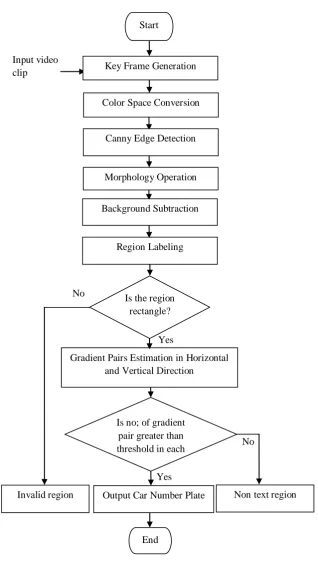
number plate extraction process can be presented in the following flow chart and explanations.
3.1. Key frame generation
In a video clip, there are many scenes which are composed of many frame images. Even in a video scene, more
than 30 frame images are included. These frame images are nearly the same and can present only information
related to the scene. Hence, only one scene of a video clip, only one frame image which can present the
information of the scene is needed to process instead of processing all frames.
The frame which can present entirely information of a scene can be called key frame of the scene. Hence, as the
first section of the proposed method, key frame is extracted from different scenes of a video clip. Here, each key
frame is special image which can represent each related scene and also entirely contains all important information
of the scene. So, we do not need all frame of a particular video clip.
Hence, key frame generation method is suitable for most of video processing. In the proposed method, the key
frame generation is implemented based on DWT approach. Whenever visual contents are changed in original
image, the frequency components of transformed image are also changed.
As soon as the changes occur in the scene, the visual contents of current and later frames are not the same. Hence,
the frequency components of the frames are exactly different. By using the difference of frequency components
of the two consecutive frame images, we can detect the key frame of next scene.
Figure 1: Flow chart of the proposed system
The key frame generating process can be presented by the following steps.
• In the first step, two successive frames are read and transformed with DWT to achieve four sub-bands, LL, HL, LH and HH. Among the four sub-bands, only two sub-bands, LL and LH are used to detect key frame and other
two bands are omitted in order to improve processing speed.
Region Labeling
End Yes No
Is no; of gradient pair greater than threshold in each
Yes
No Input video
clip Key Frame Generation
Background Subtraction
Gradient Pairs Estimation in Horizontal and Vertical Direction
Non text region Output Car Number Plate
Invalid region
Start
Color Space Conversion
Canny Edge Detection
Morphology Operation
Is the region rectangle?
• For each sub-band, different value is estimated by subtracting related frequency component values of current and next frame.
• Mean and Standard Deviation are computed from the difference values of each sub-band.
• Threshold value for each sub-band is calculated by adding the Mean and Standard Deviation.
(T = M + α*STD, here α is a constant to adjust the number of key frames and processing speed).
• In final step, the threshold and difference value of each band are compared. If two difference values of any two sub-bands are over the related threshold, the last frame can be considered as a key frame.
• The output key frames are saved as images for the later processes.
After the Key Frame Generation process, rectangle shape detection and text area detection and extraction steps
are expressed in next sub section. In both section, the input key frame is firstly converted into YUV colour space
to detect the rectangle shape and extract the license plate area. Among three channel of the image, only Y
channel is used which can represent the brightness and intensity of an image. And then, Canny Edge detector is
used to detect the edges of the region. These edges are modified and enhanced with morphology to connect and
fill boundaries and region. Long and narrow region, unwanted lines and noises are removed by using median
filter with larger kernel size such as 7x7 or 9x9. Hence, these steps can be considered as background subtraction.
After finishing these steps, the remaining process of Rectangle Shape Detection and Tex Area Detection and
Extraction are presented in the next sub section.
3.2. Rectangle shape detection
This section is the accuracy enhancement of previous [16] and the main point of the research method because it is
the detection of geometrical features of car number plate. As we already known that all car number plates are
rectangle shapes. Furthermore, text components (usually white colour) which have higher luminance value are
printed on lower luminance background (black or red).The text background colour of number plate is very
distinct with the color of body frame on which number plate is put on. Hence, in a visual scene, the car number
plate can be seen from a rather distance. As distinct as in visual, the car number plates can be remained as
rectangle shaped regions in image segmentation process. Hence, we can exactly detect and extract the car number
plates by holding the features of the rectangle shape.
The main geometrical feature of a rectangle shape is the distance between its major axis length and minor axis
length. In a square, major axis and minor axis are the same length and their difference is zero. In the rectangle,
there is a different value between major axis length and minor axis length because major axis length is always
longer than minor axis length. Hence, the difference between the two axes is a key factor to detect the rectangle.
Moreover, when we took the testing video clips, we made a fixed target area and view point in capturing them.
Hence, the areas of all car number plates are laid in limited boundary because of taking with fixed target area. For
this reason, the area of segmented region is a considerable factor to detect the car number plate. Similarly, as the
fixed target area, the tracks of the motion of cars must be laid within the area.
And, the centroid of the car number plates also must be laid on the track. Hence, the centroid is also a geometrical
feature to detect the car number plates. In proposed method, we used the three key features, the centroid, the area
and the difference between major axis and minor axis, are used to detect required rectangle shape regions (car
number plate regions) among segmented regions.
Just as usual, detection process is implemented by candy edge detector and morphological processes. After these
processing steps, the three geometrical features are used to detect rectangle shaped regions among segmented
regions.
The first three steps of rectangle shape detection are expressed in previous section. So, the remaining processes
are summarized as follow.
• After the above processing steps, these regions are label and inquired regional geometric features such as area, major axis length, minor axis length, and centroid.
• According to the geometric features, if the area of a particular region is lied within predefined limitation and the difference of major axis and minor axis is less than predefined threshold, the region can be remarked as
rectangle shaped region. The detection procedure can be described as follow.
After the rectangle shape detection process, these rectangle shapes are also detect which contain text or non-text.
Because all rectangle shapes are not car number plate. So, Text Area Detection and Extraction process are
presented in the next sub section.
3.3 Text area detection and extraction
According to the assumption of the research method, the car number plate must be rectangle shape and also has
connected components. Thus, after we have achieved the rectangle shaped regions, we have to detect whether
texts and numbers are include or not in the rectangle shaped regions by finding connected components. If there is
no connected component, the regions will be skipped. If connected components are found, the region can be
considered as number plate region and it is cropped and saved. The first three steps of text area detection and
extraction are the same as rectangle shape detection process.
In remaining process, the connected components or texts are detected and extracted by the following steps.
• Edges of the number region can be subtracted from background and ready for counting gradient pairs. If (area of region is within predefined limitation)&& (the difference between Major Axis Length and Minor Axis Length is within predefined interval) && (Centroid position of the region is lie with predefined interval))
The region can be remarked as rectangle shaped. It is selected and covered by Bounding Box.
• Gradient values between two consecutive pixels are firstly calculated in vertical direction and horizontal direction. In calculating the gradient value, negative gradient is found at the entering edge of number region and
positive gradient is found at the outgoing edge. The negative edge gradient and positive edge gradient are defined
as a gradient pair.
• In both directions, if the numbers of gradient pair is larger than predefined threshold, the image contains text.
• If text is detected on a particular region, the region is not only rectangle shaped but also contains text, this region is cropped.
• This cropped region is displayed as output car number plate images.
According to this processes, we can be easily extracted the car number plates from a recorded video clips. The
processing time is depending on the length and frame rate of given video clips. However, because of the fast
motion of cars, the car number plates are possible blurred or degraded in visual quality. Hence, they are needed to
enhance to improve their visual quality. Therefore, the following additional enhancement process is needed to
perform.
3.4. Number plate enhancement
The process is to enhance the cropped number plates in visual quality. In this process, motion deblurring and
contract enhancement are performed. In the deblurring process, instead of Laplacian distribution, Maximum a
Posteriori (MAP) technique is used to estimate the optimum point spread function (PSF) for colour image
deblurring. There are less gradients in natural images (smooth image) but large gradients in blurred images as the
results of spares. In other word, the most favored image under prior (natural) is a flat image with no gradient.
Hence, natural image is recovered by selecting minimum values of MAP estimations. To calculate the MAP
estimations, centered region area of blurred image is used as sub image in relative size. From this sub image, true
kernel of PSF (x′, k′) is estimated by using the following formula [15].
(𝑥′,𝑘′) =𝑎𝑟𝑔 𝑚𝑖𝑛
𝑥,𝑘(−𝑒𝑥𝑝 �𝛾2‖𝑥 ∗ 𝑘 − 𝑦‖2�+ ( ∑𝑖( [𝐷𝑥𝑥]𝑖2+ �𝐷𝑦𝑥�𝑖2)
1
2+∑ 𝑘𝑖 𝑖+𝐶 ) ) (1)
Where, x is a visually plausible sharp image and k is a non- negative blur kernel. Dx and Dy are partial derivative
operators in order to horizontal and vertical direction, ki is zero for no gradient and no change or positive for
spares. From this calculation, we can received sub natural image and true kernel of PSF (x′, k′). After that, no
blurred image is restored by convoluting with the kernel (k′) to the whole blurred image.
After the deblurring process, the deblurred image is also enhanced in contrast using contrast stretching depending
on the output image histogram. The contrast stretching operation is implemented by the formula.
𝐼𝑜𝑢𝑡𝑝𝑢𝑡(𝑖,𝑗) =�𝐼𝑖𝑛𝑝𝑢𝑡(𝑖,𝑗)− 𝑐� �𝑎−𝑏𝑐−𝑑�+𝑎 (2)
Where, 𝐼𝑜𝑢𝑡𝑝𝑢𝑡 and 𝐼𝑖𝑛𝑝𝑢𝑡 are output pixel and input pixel at the image location of (i,j).
And a and b are the maximum (255) and minimum (0) pixel values of a given image, and then c and d are the 5th
and 95th percentile points of the cumulative histogram distribution. By the two processes, deblurring and contrast
stretching, we can enhance the output cropped car number plate to be clearer in visual perception.
After finishing the above four main processes, we can received readable car number plate to identify. The
accuracy of the number plate extraction can be seen in next section.
4. Experimental Results & Discussions
In this section, we are going to represent the accuracy measurement of the research method with many different
video clips.
The objective of research method is to detect and extract car number plate from any video clip in more precisely.
To measure and proof of the accuracy of the proposed method, experimental settings and some experimental
results can be shown as follow.
4.1. Implementation of the proposed system
The proposed method is tested with many video clips with different frame length and different types of car.
Among our experiments, the results of three video clips which represent different types of car and different
locations are discussed. In the proposed method, Matlab 2014Ra is used to simulate the proposed processing
procedures.
Under the implementation process, we have first to load video clip to generate the key frame in second stage.
After the second stage has finished, the number plate extraction process is applied. Finally, we have to smooth
over the visual qualities of the result by enhancing extracted number plate image. In the loading process, desired
video clip which is situated on current processed machine or anywhere can be load and opened from opened
dialog box. After loading the video clip, it is copied and saved in the processed folder. To reduce the processing
frame image and eliminate the processing time, key frame generation is performed by using DWT transformed
based method as discussed in the above section.
After generating the key frames, they are saved in the destination folder for later processes. Car number plate
extraction is performed on all key frames which are already saved. The extraction action is displayed on the
implemented GUI. In the extraction processes, there are many extracted regions from the key frame images but
they are all rectangle shaped. Among these rectangle shaped regions, the certain regions which contain number
and text are selected by Boundary Box and cropped, and then the cropped regions are saved in output folder. In
the final process, the cropped images in output folder are enhanced in edges and colours contract and then they
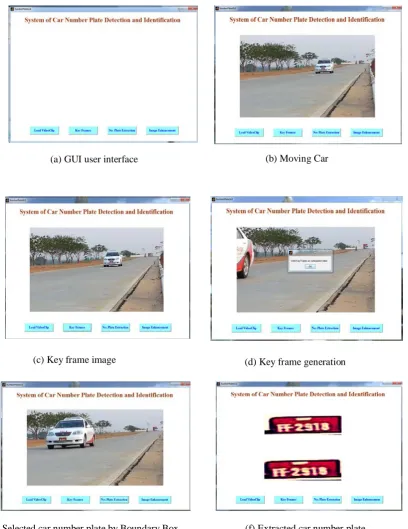
are displayed on the system GUI as destined outputs. The implementation process is demonstrated with the series
of GUIs as described in the following figures.
4.2. Experimental results
In this section, the experimental results are discussed based on extraction results. The accuracy and processing
time of the proposed method (Connected Component Based Method with geometrical feature approach) is
evaluated and compared with previous method (Connected Component Based Method). The value of accuracy
and processing speed of the previous method are taken from [16].
(a) GUI user interface (b) Moving Car
(c) Key frame image (d) Key frame generation
(f) Extracted car number plate (e) Selected car number plate by Boundary Box
Figure 2: Illustration of system implementation and its processing simulations
Figure 3: illustration of extracted number plate of proposed method
The experimental results of the proposed method are carried out many video clips with different frame length and
different types of car by using Intel (R) Core(TM) i7-3517U CPU@ 1.90GHz.
The purpose of the proposed system is how much precisely extracted the car number plate image from a
particular recorded video clip. The accuracy can be described as the following formula.
𝐴𝑐𝑐𝑢𝑟𝑎𝑐𝑦 (%) = 𝑁𝑝𝑙𝑎𝑡𝑒
𝑁𝑐𝑟𝑜𝑝𝑝𝑒𝑑 × 100 (3)
Where,
𝑁𝑝𝑙𝑎𝑡𝑒 = numbers of cropped car number plate images that especially contain car number plate area
𝑁𝑐𝑟𝑜𝑝𝑝𝑒𝑑 = numbers of all cropped images that contain the image of car number plate area and other part of the
whole car image
To calculate the accuracy, we need the value of numbers of cropped car number plate images (𝑁𝑝𝑙𝑎𝑡𝑒) and total
numbers of all cropped images (𝑁𝑐𝑟𝑜𝑝𝑝𝑒𝑑). For example, in Video 1, the value of 𝑁𝑐𝑟𝑜𝑝𝑝𝑒𝑑 is 12 and the value of
𝑁𝑝𝑙𝑎𝑡𝑒 is 11. So the accuracy value of Video 1 implemented by the proposed system is 91.6667. And, in Video 2,
the value of 𝑁𝑐𝑟𝑜𝑝𝑝𝑒𝑑 is 5 and the value of 𝑁𝑝𝑙𝑎𝑡𝑒 is 5. So the accuracy value of Video 2 implemented by the
proposed system is 100. Similarly, in Video 3, the value of 𝑁𝑐𝑟𝑜𝑝𝑝𝑒𝑑 is 5 and the value of 𝑁𝑝𝑙𝑎𝑡𝑒 is 5. So the
accuracy value of Video 3 implemented by the proposed system is 100. Moreover, the accuracy value of proposed
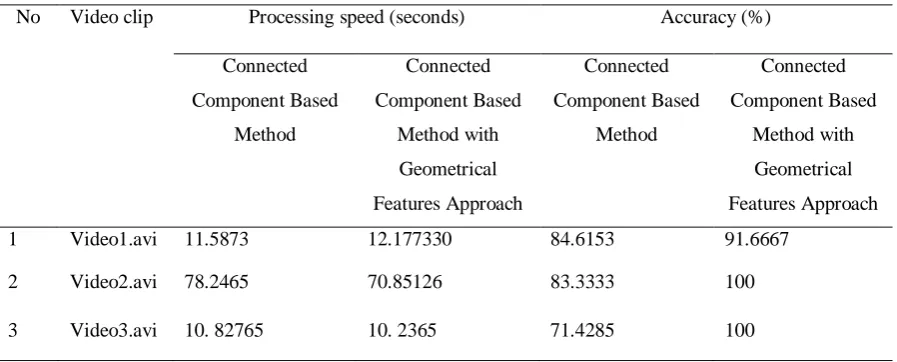
method is compared with the accuracy value of previous method. These results are shown in Table 1. The
proposed system is not only evaluated the accuracy value but also the processing speed. To complete the system,
it takes the time to generate the key frame from the video clip and extract the car number plate area. The
processing time is evaluated from the key frame generation process until the output results. The processing speed
of proposed method is also compared with the previous method. Although the geometric features are added to the
proposed system, the processing speed doesn't take more time. It can give acceptable time compared with the
previous method
(a) Cropped number plate from
(a) Cropped number plate from video1.avi
(c) Cropped number plate from video3.avi
Table 1: Accuracy and processing time of proposed method and connected previous method.
No Video clip Processing speed (seconds) Accuracy (%)
Connected
Component Based
Method
Connected
Component Based
Method with
Geometrical
Features Approach
Connected
Component Based
Method
Connected
Component Based
Method with
Geometrical
Features Approach
1 Video1.avi 11.5873 12.177330 84.6153 91.6667
2 Video2.avi 78.2465 70.85126 83.3333 100
3 Video3.avi 10. 82765 10. 2365 71.4285 100
According to the above table and experimental results, the proposed method can detected and extracted the car
number plate exactly. In the above table, the proposed method achieves 100% accuracy which means that all
cropped images of the proposed method are exactly car number plates. In the previous method, cropped images
contain other item likes texts. It is because it neglected geometrical shape feature of number plates. As the
proposed method achieved faster processing speed and the most precise accuracy, the proposed method
outperform in detection and extraction.
5. Conclusion
In this paper, we discussed the key frame generation and presented the car number plate extraction method by
combining connected components and regional geometrical features approach. According to the experimental
results, the proposed system can reduce the key frame calculation time by using the difference features of
adjacent video frame instead of calculating the length of all frames in video clip. Connected components for
each candidate region are generated and we filter out clutter regions from this candidates region by using
geometrical features of the plate region. The boundaries of the detected text regions are localized accurately
using the projection of text pixels. Final extraction of the plate region is performed by using the correlation and
geometrical feature approach between candidate regions and a plate. According to experimental results, the
research method achieved faster speed and outperformed accuracy in extraction. In the future researches, we
will go on the monitoring and security based image processing area in trying to achieve more precise and better
results and then we will continue the deblurring research with other optimized methods such as genetic
algorithm, iterative annealing and so on.
Acknowledgements
A special thank is offered to Dr. Aung Myint Aye, Associate Professor and Head of Department of Information
Technology, Mandalay Technological University, for his encouragement, constructive guidance and kindly
advice throughout the preparation of this paper.
The author especially would like to take this opportunity to express my sincere gratitude, respect and regards for
supervisor Dr. Lai Lai Win Kyi, Lecturer, Department of Information Technology, Mandalay Technological
University, under whose guidance, constant encouragement, patient and trust, I have worked on this paper.
And, the author special thanks are extended to Dr. Nang Aye Aye Htwe for her kind permission and precious
guidance to conduct this paper.And then, the author is thankful to all teachers in Department of Information
Technology, Mandalay Technological University, for their effective guidance, helpful suggestion and supervision
for this paper.
References
[1] Y. M. Y. Hasan and L. J. Karam, “Morphological text extraction from images,” Image Processing, IEEE
Transactions on, vol. 9, no. 11, pp. 1978–1983, 2000.
[2] T. Retornaz and B. Marcotegui, “Scene text localization based on the ultimate opening,” in International
Symposium on Mathematical Morphology, 8 (ISMM), vol. 1, 2007, Image processing, pp. 177–188.
[3] L. Gu, “Character region identification from cover images using dtt,” in ICADL, 2004, pp. 388–397.
[4] R. Jiang, F. Qi, L. Xu, and G. Wu, “Detecting and segmenting text from natural scenes with 2-stage
classification,” in ISDA ’06: Proceedings of the Sixth International Conference on Intelligent Systems Design
and Applications, Washington, DC, USA, 2006, pp. 819–824.
[5] M. A. Smith and T. Kanade, Video skimming and characterization through the combination of image and
language understanding techniques, Technical Report CMUCS- 97-111, Carnegie Mellon University, Feb. 1997.
[6] R. Lienhart, Indexing and retrieval of digital video sequences based on automatic text recognition, Technical
Report 6/96, University of Mannheim, 1996.
[7] A.K. Jain and B. Yu, Automatic text location in images and video frames, Pattern Recognition, vol. 31, no.
12, pp 2055-2076, 1998.
[8] M. R. Lyu, J. Song, and M. Cai, “A comprehensive method for multilingual video text detection,
localization, and extraction,” IEEE Trans. Circuit and Systems for Video Technology, vol. 15, no. 2, pp. 243–
255,Feb. 2005.
[9] M. Bertini, C. Colombo, and A. D. Bimbo, “Automatic caption localization in videos using salient points,”
in Proc. Int. Conf. Multimedia and Expo, Aug. 2001, pp. 68–71.
[10] Y. Zhong, H.J. Zhang, A.K. Jain, Automatic caption localization in compressed video, IEEE Transactions
on PAMI 22 (2000) 385–392
[11] A. Wernicke and R. Lienhart, “On the segmentation of text in videos,” in Proc. IEEE Int. Conf. Multimedia
Expo, vol. 3, Jul. 2000, pp. 1511–151.
[12] N. Otsu, “A threshold selection method from gray-levl histograms”, IEEE Trans. Syst., Man, Cybern., vol.
9, no. 1, pp. 62– 66, Mar. 1979.
[13] S. Antani, D. Crandall, and R. Kasturi, “Robust extraction of text in video,” in Proc. 15th Int. Conf. Pattern
Recognit., vol. 1, 2000.
[14] T. Sato, T. Kanade, E. K. Hughes, and M. A. Smith, “Video OCR for digital news archive,” in Proc. IEEE
International Workshop on Content Based Access of Image and Video Libraries, Jan. 1998, pp. 52–60.
[15] Phyo Thet Khin, and Lai Lai Win Kyi, "Optimization of Maximum A Posteriori (MAP) for Single Blur
Images", 5th International Conference on Science and Engineering, 2014.
[16] Phyo Thet Khin, and Lai Lai Win Kyi, "Correlation Based Car Number Plate Extraction System", 23rd The
IIER International Conference, Singapore, 25th April 2015, pp-119-123.