Asian Journal of Pharmaceutical Research and Development
(An International Peer-Reviewed Journal of Pharmaceutical Research and Development)
www.ajprd.com
ISSN 2320-4850
Review Article
A REVIEW ON HYDROGELS
Sharma Sunil*,Goutam Shubham, NamaNitin, Khinchi M.P., Singh S.P.
Department of Pharmaceutics, Kota College of Pharmacy Kota Rajasthan, India.
ABSTRACT
Hydrogels are three-dimensional, hydrophilic, polymericnetworks capable of absorbing large amounts of water orbiological fluids.Today, drug delivery experience several challenges where hydrogel could be one potential answer to those.Hydrogels are of particular interest for drug delivery applications due to their ability to address these needs in addition to their good biocompatibility, tunable network structure to control the diffusion of drugs and, tunable affinity for drugs. Hydrogels are also limited for drug delivery applications due to the often quick elution of drug from their highly swollen polymer matrices as well as the difficulty inherent in the injection of macroscopic hydrogels into the body. The hydrogels have been used extensively invarious biomedical applications, viz. drug delivery, cell carriers and/or entrapment, wound management and tissue engineering. They have started to create a niche in severalfields of medicine like in specific site drug delivery, tissue reconstruction and tissue engineering and even as biosensors.In this review article an attempt has been made to explain the properties of hydrogels, their methods of preparation and its applications.
Keywords: Hydrogels, swelling,biocompatible,tissue engineering, IPN.
INTRODUCTION
ydrogels are three-dimensional,
hydrophilic, polymeric networks
capable of absorbing large amounts of water or biological fluids. Due to their high water content, porosity and soft consistency, they closely simulate natural living tissue, more than any other class of synthetic biomaterials. Hydrogels may be chemically stable or they may degrade and eventually disintegrate and dissolve
1
.
They are prepared from materials such as
gelatin, polysaccharides, cross-linked
polyacrylamide polymers, polyelectrolyte
complexes, and polymers or copolymers derived from methacrylate esters. They are insoluble in water and are available in dry or hydrated sheets or as a hydrated gel in drug delivery systems designed for single use 5.
*Corresponding Author: Sunil Sharma
Department of Pharmaceutics, Kota College of Pharmacy, Kota Email – [email protected]
These unique physical properties of hydrogels have stimulated particular interest in their use in drug delivery applications. Their highly porous structure can easily be tuned by controlling the density of cross-links in the gel matrix and the affinity of the hydrogels for the aqueous environment in which they are swollen. Their porosity also permits loading of drugs into the gel matrix and subsequent drug release at a rate dependent on the diffusion coefficient of a small molecule or a macromolecule through the gel
network 6.Since the polymer cannot dissolve due
to the covalent crosslinks, water uptakes far in excess of those achievable with hydrophilic linear polymers can be obtained 9.
Hydrogels are relatively deformable and can conform to the shape of the surface onto which they are applied. In the latter context, the mucoadhesive or bioadhesive properties of some hydrogels can be advantageous by keeping them immobilized at the site of application or in applying them on surfaces that are not horizontal. The high water content and large pore sizes of most hydrogels often result in
relatively rapid drug release, over a period of few hours to a few days. Ease of application can also be problematic; although some hydrogels are sufficiently deformable to be injectable,
many are not, necessitating surgical
implantation. Above problems restrict the practical use of hydrogel-based drug delivery systems in the clinical practice 6.
CLASSIFICATION OF HYDROGEL
The hydrogels can be broadly classified on different bases as detailed below:
Classification based on source
Natural origins
Synthetic origins.
Classification according to polymeric
composition
Homopolymeric hydrogels.
Copolymeric hydrogels.
Multipolymer interpenetrating polymeric
hydrogel (IPN).
Classification based on configuration
Amorphous (non-crystalline)
Semicrystalline
Crystalline
Classification based on type of cross-linking
Chemically cross-linked networks.
Physical networks
Classification based on physical appearance Hydrogels appearance as matrix, film, or microsphere depends on the technique of polymerization involved in the preparation process.
Classification according to network electrical charge
Nonionic (neutral).
Ionic (including anionic or cationic).
Amphoteric electrolyte (ampholytic).
Zwitterionic (polybetaines).
Classification according to mechanism
controlling the drug release they are classifiedinto:
Diffusion controlled release systems
Swelling controlled release systems
Chemically controlled release systems
Environment responsive systems 2
Important Properties of Hydrogel
Swelling properties
All polymer chains in hydrogels are cross linked to each other either physically or chemicallyand thus, considered as one molecule regardless of its size2.One of the variables that effects capacity of water absorption is the degree of cross linking andthe type of cross linking agent used.
Mechanical properties
Mechanical properties of hydrogels are very
important from the pharmaceutical and
biomedical point of view. The evaluation of mechanical property is essential in various biomedical applications viz. ligament and tendon repair, wound dressing material, matrix for drug delivery, tissue engineering and as cartilage replacement material.
Biocompatible properties
It is important for the hydrogels to be biocompatible and nontoxic in order to make it applicable in biomedical field. Most polymers used for this purpose must pass cytotoxicity and
in-vivo toxicity tests. Biocompatibility studies
consists of two parameters namely bio safety andbiofunctionality:4
Methods of Preparation of Hydrogels
In general, hydrogels can be prepared from either synthetic polymers or natural polymers. Water-soluble linear polymers of both natural and synthetic origin are cross-linked to form hydrogels in a number of ways:
Linking polymer chains via chemical reaction.
Using ionizing radiation
Physical interactions such as entanglements,
electrostatics, and crystallite formation.
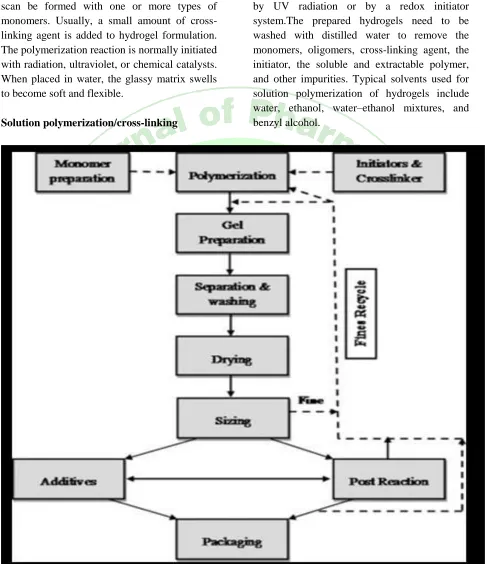
Bulk polymerization
Many vinyl monomers can potentially be used for the productions of hydrogels. Bulk hydrogel scan be formed with one or more types of monomers. Usually, a small amount of cross-linking agent is added to hydrogel formulation. The polymerization reaction is normally initiated with radiation, ultraviolet, or chemical catalysts. When placed in water, the glassy matrix swells to become soft and flexible.
Solution polymerization/cross-linking
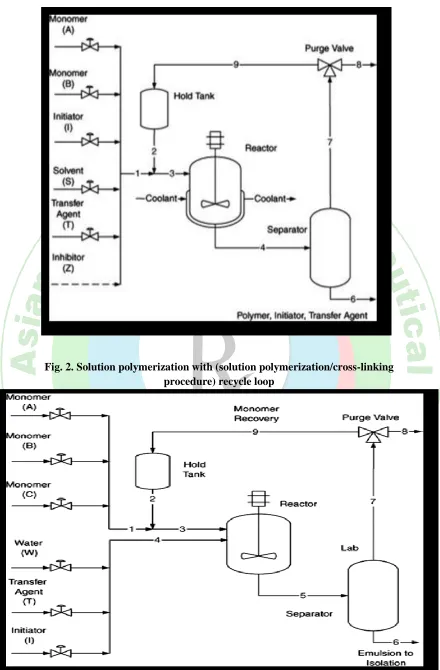
In solution copolymerization/cross-linking
reactions, the ionic or neutral monomers are mixed with the multifunctional cross-linking agent. The polymerization is initiated thermally by UV radiation or by a redox initiator system.The prepared hydrogels need to be washed with distilled water to remove the monomers, oligomers, cross-linking agent, the initiator, the soluble and extractable polymer, and other impurities. Typical solvents used for solution polymerization of hydrogels include water, ethanol, water–ethanol mixtures, and benzyl alcohol.
Fig. 2. Solution polymerization with (solution polymerization/cross-linking procedure) recycle loop
The polymerization is referred to as“inverse-suspension” technique. In this technique, the monomers and initiators are dispersed in the hydrocarbon phase as a homogenous mixture. The viscosity of the monomer solution, agitation speed, rotor design, and dispersant type mainly governs the resin particle size and shape.
Polymerization by Irradiation
Ionizing high energy radiations like gamma rays and electron beams have been used as an initiator to prepare the hydrogels of unsaturated
compounds .The irradiation of aqueous
polymersolution results in the formation of radicals on the polymer chains. Also, radiolysis of water molecules results in the formation of hydroxyl radicals, which also attack the polymer chains, resulting in the formation of macro-radicals.
Grafting to a support
Generally, hydrogels prepared by bulk
polymerization have inherent weak structure. To improve the mechanical properties of a hydrogel, it can be grafted on surface coated
onto a stronger support. This technique involves the generation of free radicals onto a stronger
support surface and then polymerizing
monomers directly onto it as a result a chain of monomers are covalently bounded to the support[2].
MECHENISM OF DRUG DELIVERY OF HYDROGELS
The high water content of most hydrogels typically results in relatively rapid release of drugs from the gel matrix over the period of hours or days, particularly in the case of hydrophilic drugs for which hydrogel delivery is typically applied.
Drug–hydrogel interactions
Both physical and chemical strategies can be employed to enhance the binding between a loaded drug and the hydrogel matrix to extend the duration of drug release, as illustrated schematically
in the Figure.
Fig. 4. Physical (a) and chemical (b) strategies for enhancing the interaction between a loaded drug and a polymeric gel to slow drug release.
Physical interactions
Charge interactions between ionic polymers and charged drugs have frequently been employed to increase the strength of the interactions between the gel and a target drug to delay drug release. Both anionic and cationic functional groups typically found in carbohydrate-based polymers can have significant effects on prolonging the release of a drug of opposite charge.
Covalent bonding
analogue. The cross-linker can be engineered to give specific durations of release.
Gel network engineering
A simple method of performing such
modifications is to increase the percentage of cross-linking monomer incorporated into the gel. However, highly cross-linked gels exhibit very slow responses to environmental stimuli and may possess undesirable mechanical properties. Interpenetrating polymer networks (IPNs)
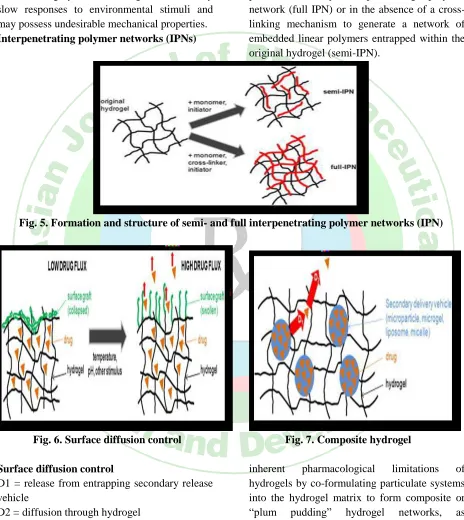
An interpenetrating polymer network is formed when a second hydrogel network is polymerized within a pre-polymerized hydrogel. This is typically done by immersing a pre-polymerized hydrogel into a solution of monomers and a polymerization initiator. IPNs can be formed either in the presence of a cross-linker to produce a fully interpenetrating polymer network (full IPN) or in the absence of a cross-linking mechanism to generate a network of embedded linear polymers entrapped within the original hydrogel (semi-IPN).
Fig. 5. Formation and structure of semi- and full interpenetrating polymer networks (IPN)
Fig. 6. Surface diffusion control Fig. 7. Composite hydrogel
Surface diffusion control
D1 = release from entrapping secondary release vehicle
D2 = diffusion through hydrogel
Composite hydrogels
Microspheres, liposomes, and other types of particulate drug delivery vehicles have proven capacity for long-term release. As a result, growing interest has focused on overcoming the
inherent pharmacological limitations of
hydrogels by co-formulating particulate systems into the hydrogel matrix to form composite or “plum pudding” hydrogel networks, as illustrated in the Fig. 7.6.
EVALUATION OF HYDROGELS
Measurement of pH
of gel was dissolved in 100 ml distilled water and stored for two hours. The measurement of pH of each formulation was done in triplicate and average values are calculated.
Drug content
1 g of the prepared gel was mixed with 100ml of
suitable solvent. Aliquots of different
concentration were prepared by suitable
dilutions after filtering the stock solution and absorbance was measured. Drug content was calculated using the equation, which was obtained by linear regression analysis of calibration curve.
Viscosity study
The measurement of viscosity of the prepared gel was done with a Brookfield Viscometer. The gels were rotated at 0.3, 0.6 and 1.5 rotations per minute. At each speed, the corresponding dial reading was noted. The viscosity of the gel was obtained by multiplication of the dial reading with factor
given in the Brookfield Viscometer catalogues19.
Spreadability
It indicates the extent of area to which gel readily spreads on application to skin or affected part. The therapeutic potency of a formulation also depends upon its spreading value11.
Extra durability study
After the gels were set in the container, the formulations were filled in the collapsible tubes. The extra durability of the formulation was determined in terms of weight in grams required to extrude a 0.5 cm. ribbon of gel in 10 second.
Skin irritation study
Guinea pigs (400-500 g) of either sex were used for testing of skin irritation and the site was observed for any sensitivity and the reaction if any.
In vitro Diffusion studies
The diffusion studies of the prepared gels can be carrying out in Franz diffusion cell for studying the dissolution release of gels through a cellophane membrane. The samples were
analyzed for the drug content by using phosphate buffer as blank20
In vivo studies
Inhibition of carrageen an - induced rat paw odema– three groups of 6 male wistaralbino rats were used one for marketed sample (reference), other for test formulation and one group for control. The volume of unilateral hind paw test animal were measured.
Stability
The stability studies were carried out for all the gel formulation by freeze - thaw cycling. Here, by subjecting the product to a temperature of 4° C for 1 month, then at 25°C for 1 month and then at 40°C for 1month, syneresis was observed. After this, the gel is exposed to ambient room temperature and liquid exudate separating is noted.
Homogeneity
After the gels have been set in the container, all developed gels were tested for homogeneity by visual inspection. They were tested for their appearance and presence of any aggregates.
Grittiness
All the formulations were evaluated
microscopically for the presence of any appreciable particulate matter which was seen under light microscope. The gel preparation full fills the requirement of freedom from particular matter and from grittiness as desired for any topical preparation.
HYDROGELS DRUG DELIVERY DEVICE
Peroral drug delivery
Oral delivery of drug is cheap and allows maximum patient compliance. Through this route one can target mouth, stomach, small intestine and colon. The bio adhesive hydrogels could deliver drugs to the oral cavity or at the specific sites of gastro intestinal tract10.
Drug Delivery in the Gastrointestinal (GI) tract
sites of the GIT[16]. The enteric polymers like eudragit are used for long either to protect the acid-labile drugs (e.g. peptides and penicillin-G) from the harsh environment of the stomach or to avoid the contact of the gastric mucosa with the
gastric-irritant drugs (e.g. ibuprofen,
indomethacin), which may lead to gastric mucosa perforations 9.
Drug Delivery in the oral cavity
Buccal or oral mucosal routes have various advantages for the administration of drugs which undergo severe first-pass metabolism. Hydrogel seemed an appropriate material for the buccal delivery because of its muco adhesiveness, sustained-release property, comfortable feeling in the buccal cavity and safety 11.
Ocular Delivery
Instillation of aqueous drops is the preferred way to administer drug in the ocular cavity. But most of the drug is removed from the cavity due to tear drainage and blinking. In addition to this, the low permeability of the cornea worsens the situation 12.
Nasal Delivery
A new thermo sensitive hydrogel can be dropped or sprayed easily into nasal cavity and spread on the nasal mucosa in solution state. After being administered into nasal cavity, the solution transformed into viscous hydrogel at body temperature, which decreased nasal mucociliary clearance rate and release drug slowly 13.
Transdermal Delivery
Drugs like nitroglycerin and hydrocortisone are administered via this route. Hydrogels are also proposed as a delivery system to the wound surface. In situ forming hydrogels are preferred due to relative ease of application and increased contact between the hydrogel and wound surface
14
.
Subcutaneous Delivery
Hydrogels are ideal implantable material. Their high water content creates the environment similar to biological tissue, making them relatively bio compatible. Thus hydrogels could be used in the subcutaneous delivery for
anticancer drugs. In a study, cross linked PHEMA was used for the delivery of cyratabine15.
Ear Delivery
The delivery of drug to the ear cavity is mainly carried out by the use of aqueous or oil drops. The main limitation of ear drops is the retention time in the cavity while the person is standing. Hydrogels could be used successfully for the delivery of drugs to the ear cavity 16.
Rectal Delivery
Rectal route has been used to deliver drugs for the treatment of disease associated with the
rectum, such as hemorrhoids 17. Rich blood flow
to this region can improve the systemic availability of drugs and also helps to bypass first pass metabolism 18
APPLICATIONS OF HYDROGELS
Biomedical applications of hydrogels Contact lenses and ocular implants
Soft contact lenses are one of the most widely used applications of hydrogels. The PHEMA-based hydrogels are extensively used as soft
contact lenses due to their excellent
biocompatibility and mechanical properties. Medicated contact lenses are attracting keen interest for ophthalmic drug delivery, as they significantly increase residence time of the drug in the pre corneal area.
Tissue regeneration and tissue engineering Hydrogels have been utilized to support and assist restoration of range of tissues such as bones, cartilage, nerves, vessels and skin.
Examples of various tissue engineering
employing various hydrogels have been
provided. Collagen-coated tissue culture inserts are used for growing three- dimensional corneal implant, tracheal gland cells etc.
Biosensors
Hydrogels are used in the preparation of
biosensors, acting as supports for
immobilization of enzymes. The verones group has prepared diverse biosensors for enzyme
immobilization. This sensor allows for
measuring the hydrogen peroxide production as a result of the enzymatic reaction, which can be used in the determination of serum glucose 3.
Wound dressings and wound healing
Hydrogel dressings are available in several forms including amorphous hydrogels saturated gauzes or hydrogel sheets. The gel is applied directly to the wound and is usually covered with a secondary dressing (for example foam or gauze). Exudate is absorbed into the gel whilst moisture evaporates through the secondary dressing. This makes them useful in burn treatment 8.
Oral
The oral administration of drugs through hydrogels is one of the routes that have aroused the highest interest among researchers, which have tackled this form of administration. The use of buccal cavity for placing devices of controlled drug release allows it to avoid the first pass metabolism and prevents degradation of the drug in the GIT. Various hydrogels, particularly enzyme-sensitive hydrogels, are currently being considered and developed for use in colon-specific drug delivery 3.
Sealant
The hydrogels also can adhere to various plastics due to hydrophobic interactions. Both findings suggest the use of these hydrogels as a sealant for vessels containing corrosive acids 7.
Plastic surgery
From their first development into the scientific research field, hydrogel where seen as good materials for application in contact with the human body because of their extracellular matrix-like (ECM-like) properties22.
Immunotherapy and vaccine
Annano vector composed of peptide-based nano fibrous hydrogel can condense DNA to result in strong immune responses against HIV. This peptide-based nano fibrous hydrogel used as a HIV DNA nano vector can open the doors for effective vaccination based on peptide-based nano fibrous hydrogels 23
Injectable hydrogels
Injectable hydrogel-drug system emerges as a powerful tool for noninvasive and in-situ controlled-release of drugs. Such application could also reduce the healthcare expenses and improve the recovery time for the patients. Minimal invasive procedures using endoscopes,
catheters and needles have been developed28.
Cardiac applications
In the developing injectable hydrogels for the purpose of cardiac repair. Hydrogels have also been shown to improve cell retention when co-injected for cellular cardio myoplasty and to prolong release of therapeutics when used as a delivery vehicle 26.
Dental applications
Pulp regeneration therapy is important to overcome the limitations of conventional therapy to induce reparative dentin genesis. To overcome this limitation, it is considered important to develop pulp regeneration therapy as well as clarify the mechanisms of pulp wound healing 27.
Bone regeneration
Alginate hydrogel has been shown to be a useful tool for producing bone and cartilage tissues. It is very biocompatible in humans and peptides can also be covalently coupled to the molecules. Althoughosteo inductive growth factors such as bone morphogenetic proteins have entered clinics, transplantation or autologous bone remains the gold standard to treat bone defects
25
.
Culture of organs-on-chips
Recent trends towards the development of
in-vitro multicellular systems with definite
architectures, or “organs on chips” are studied. In this perspective, the flourishing interest in hydrogels as cellular substrates has highlighted the main parameters directing cell differentiation that need to be recapitulated in artificial matrix
24
.
CONCLUSIONS
water or biological liquids, due to which they are widely being used in the medical industry as dressings and even in tissue regeneration and tissue engineering.
Vast improvements have been made in the properties of hydrogels used in drug delivery. However further improvements needs to be made to improve the applicability of hydrogels. Further progress needs to be achieved in the delivery of hydrophobic molecules. Progress and success in such aspects would significantly improve the delivery of drugs through hydrogels to certain desired locations in the body. In this review article an attempt has been made to explain the classification of hydrogels properties of hydrogels, their methods of prepraration, their evaluations methods and its applications.
REFERENCES
1. Caló E., Khutoryanskiy V.V., Biomedical applications of hydrogels: A review of patents and commercialproducts,Volume 65, April 2015: 252-267 2. Ahmed E.M.,Hydrogel: Preparation, characterization
and applications, Journal of advanced research, Volume 6, Issue 2, March 2015:105–121
3. Swarbrick J., Encyclopedia Of Pharmaceutics, 4thedition,Vol III, F-O, 6000 Broken Sound Parkway NW, Suite 300, Boca Raton, FL 33487-2742, Taylor & Francis Group,, 2013
4. Das N., Preparation methods and properties of hydrogels: a review, International Journal of Pharmacy and Pharmaceutical Sciences ,Vol 5, Issue 3, 2013 :112-117
5. 12. K. Pal, A. K. Banthia And D. K.Majumdar ,Polymeric Hydrogels: Characterization and Biomedical Applications –A minireview,design monomers and polymers 12 (2009):197-220
6. Hoare T.R., Kohane D.S, Hydrogels in drug delivery: Progress and challenges,Polymer, Volume 49, Issue 8,15April 2008:1993–2007
7. Phadke A, Zhang C, Arman B, Cheng-Chih Hsu, Mashelkar R., Lele A.,Tauber M., Arya G., and Varghese S., Rapid self-healing hydrogels:4383-4388 Available from:
8. Aulton M., Aulton’s pharmaceutics, The Design and Manufacture of Medicines, Third Edition, Elsevier’s Health Sciences Rights Department, 1600 John F. Kennedy Boulevard, Suite 1800, Philadelphia, PA 19103-2899, Harcourt Publishers Limited 2001 9. Remington, The science and practice of pharmacy, 21st
edition, Vol II, Wolters Kluwer Health (India) Pvt. Ltd., New Delhi.
10. Peppas NA, Bures P, Leobandung W, Ichikawa H. Hydrogels in pharmaceutical formulations. Eur J Pharm Biopharm 50: 27- 46, (2000).
11. Senel S, kinci GI, Kas S, Yousefi-Rad A, Sargon MF, Hincal AA. Chitosan films and hydrogels of chlorhexidinegluconate for oral mucosal delivery. Int J Pharm 193: 197-203, (2000).
12. Cohen S, Lobel E, Trevgoda A, Peled T. A novel in-situ forming ophthalmic drug delivery system from alginates undergoing gelation in the eye. J Controlled Rel 44: 201 8, (1997).
13. Wu J, Wei W, Wang LY, Su ZG, Ma GH. A thermosensitive hydrogel based on quaternized chitosan and poly(ethylene glycol) for nasal drug delivery system.Biomaterials 28: 2220-32, (2007). 14. Pal K, Banthia AK, Majumdar DK. Polyvinyl
alcohol-gelatin patches of salicylic acid: preparation, characterization and drug release studies. J BiomaterAppl 21: 75-91, (2006).
15. Teijon JM, Trigo RM, Garcia O, Blanco MD. Cytarabine trapping in poly (2-hydroxyethyl methacrylate) hydrogels: drug delivery studies. Biomaterials 18: 383-8, (1997).
16. Lee KY, Nakagawa T, Okano T, Hori R, Ono K, Tabata Y, Lee SH, Ito J. Novel therapy for hearing loss: delivery of insulinlike growth factor 1 to the cochlea using gelatin hydrogel. Otology and Neurotology 28: 976-81, (2007).
17. Miyazaki S, Suisha F, Kawasaki N, Shirakawa M, Yamatoya K, Attwood D. Thermally reversible xyloglucan gels as vehicles for rectal drug delivery. J Controlled Rel 56: 75-83, (1998).
18. de Leede LGJ, de Boer AG, Portzgen E, Feijen J, Breime DD. Rate-controlled rectal drug delivery in man with a hydrogel preparation. J Controlled Rel 4: 17-24,
(1986).
19. 36. Chandira RM and PradeepPasupathi A. Design development and formulation of antiacne dermatological gel. Journal of Chemical and Pharmaceutical Research. 2010;2(1):401- 404. 20. Reddy SM, Mutalik S, Rao GB, Preparation and
evaluation of Minoxidil gel for topical application in alopecia. Indian Journal of Pharmaceutical Sciencs.2006;68(4):432-436.
21. Gupta GD, GoundRS.Release rate of Nimesulide from different gellants. Indian Journal of Pharmaceutical Sciences. 1999; 61: 229-234.
22. Slaughter BV, Khurshid SS, Fisher OZ, Khademhosseini A, Peppas NA (2009) Hydrogels in regenerative medicine. Adv Mater 21: 3307- 3329. 23. Joint United Nations Programme on HIV/AIDS.
UNAIDS report on the global AIDS epidemic;http://www.unaids.org/globalreport,2010 24. Ziv K, Nuhn H, Ben-Haim Y, Sasportas LS, Kempen PJ,
et al. (2014) A tunable silk-alginate hydrogel scaffold for stem cell culture and transplantation. Biomaterials 35: 3736-3743.
25. Tse JR, Engler AJ (2010) Preparation of hydrogel substrates with tunable mechanical properties. CurrProtoc Cell Biol Chapter 10: Unit 10.
26. Stevens MM1, George JH (2005) Exploring and engineering the cell surface interface. Science 310: 1135-1138.
27. Munarin F, Guerreiro SG, Grellier MA, Tanzi MC, Barbosa MA, et al. (2011) Pectin-based injectable biomaterials for bone tissue engineering. Biomacromolecules 12: 568-577.