96 Dr. Ayman K. Agbaria is lecturer at the Department
for Leadership and Policy in Education, Faculty of Education, The University of Haifa, Education and Sciences Building, University of Haifa, Mount Carmel Haifa 31905
Email: [email protected]
Revital Katz-Pade is doctoral candidate at the Department of Leadership and Policy in Education, Education and Sciences Building, University of Haifa, Mount Carmel, Haifa 31905
Email: [email protected]
Ayman K. Agbaria, Revital Katz-Pade
Human Rights Education in Israel: Four Types of Good Citizenship
This article examines the involvement of civil society organizations in human rights education (HRE) in Israel. Focussing on the educational programs of the Association for Civil Rights in Israel (ACRI), as a qualitative instrumental case study, this article examines the conceptions of good citizenship embedded in these programs. Specifically, the article analyzes the educational programs’ goals, content, targeted populations, and practices. The analysis revealed that ACRI’s HRE model reflect four ideal types of citizens: citizen of a democratic liberal state, citizen of a participatory polity, citizen of an ethical profession, and citizen of an empowered community. These constitute a multilayered human rights discourse that enables ACRI to engage differentially with various sectors and populations, while still remaining faithful to the ethno-national parameters of a Jewish and democratic state political framework.
Keywords:
Human rights education, good citizenship, civil society, Israel, Palestinian minority
1 Introduction
Despite the growing international interest in citizenship education (e.g., Banks, 2007; Hahn, 2010; Arthur, Davison, & Stow, 2014), much of this literature has been concerned primarily with school curricula and pedago-gies. However, this literature is still wanting with regard to the involvement of civil society organizations in citi-zenship and human rights education (HRE), especially in deeply divided and conflict-ridden states. Focusing on Israel, this article addresses this lacunae by examining the involvement of one human rights organization: the Association for Civil Rights in Israel (ACRI). Founded in 1972, it is considered Israel’s oldest and largest human rights organization. For the most part, the paper is con-cerned with mapping and analyzing the conceptions of “good citizenship” embedded in ACRI’s human rights education programs, and how these reflect some of the major socio-political controversies in Israel.
2 Theoretical framework
The literature is rife with examples of how education systems are altered, due to political pressures and in ser-vice of dominant groups. In the field of the history education, for example, the literature is abundant with case studies that reflect “conflicting expectations among politicians, the general public, history teachers or educators and historians, about what the purposes of history education are” (Guyver, 2013, p. 3). Citizenship education is another good example of how school subjects are subjected to political debates, in which each camp seeks to impose a certain ideology or direction
(Hughes, Print, & Sears, 2010). These debates seem more intense especially in divided societies (Gallagher, 2004). In such societies, controversies are ubiquitous. In this article, controversies are perceived as issues on which society is clearly divided and significant groups within society advocate conflicting solutions and provide rival explanations to their sociopolitical reality based on com-peting visions and alternative founding values (Dearden, 1981; Stradling, 1985; Hess, 2004). Among other things, these controversies concern how to define and educate towards ‘good citizenship’.
Although there is no consensus on what good citizen-ship is, there is a growing agreement about the need to focus citizenship education on developing an “autono-mous” citizen who is not only and essentially law-abiding and public-spirited, but also questioning and critical (Galston, 2001). Put differently, citizenship education should cultivate a maximal citizen, not a minimal one (McLaughlin, 1992). In the same vein, Westheimer and Kahne (2004) argued that citizenship education is not only about educating well mannered, responsible, and law-abiding citizens who are politically active and engaged in their communities as individuals; it is also about cultivating critical citizens who are cooperative, motivated, and committed to social change and justice. Banks (2008) referred to this “critical-democratic citizen” (Veugelers, 2007) as a “transformative citizen”: A citizen who can “take action to promote social justice even when their actions violate, challenge, or dismantle existing laws, conventions, or structures” (p. 136).
In these various maximal approaches, citizenship is challenged to be more critical, more inclusive, and more supportive of human rights (Tibbitts, 2002; Osler & Starkey, 2005). While there might indeed be an inherent tension between citizenship education and HRE - given that human rights are universal and inalienable, whereas citizenship rights are perceived as context-dependent rights and derived from the specific nation-state polity in which they are situated - there is a growing consensus on the entwined relations between both types of education (Kiwan, 2005; 2008; 2012). That said, HRE has become rising on the agenda of citizenship education (Leung & Yuen, 2009); and it is commonly seen as “both a political and pedagogical strategy to facilitate democratization and active citizenship” (Bajaj, 2011, p. 484).
97
citizenship education [for] contexts of social, economic and cultural inequalities wherein constitutionally and internationally designated rights have yet to be realized across society” (Tsolakis, 2013, p. 39). In such contexts, Tsolakis (2013, p. 39) argued, “education should raise awareness about rights and enable students to use this awareness for societal transformation.” In order to achieve transformative HRE, it is not enough to teach and learn about human rights debates, instruments and actors; rather, what is needed is teaching and learning for or to human rights, emphasizing not only values of responsibility and solidarity, but also practices of em-powerment that might enable citizens to protest and struggle against HR violations and seek social justice (Lohrenscheit, 2002).
With this transformative agenda, HRE has become a greater part of the work of civil society organizations (Ramirez, Suárez, & Meyer, 2007; Bajaj, 2011; Spring, 2014). In this regard, the work of these organizations is part and parcel of “the ecology of civic learning” (Longo, 2007), which encompasses a wide range of places and activities, including not only schools but also, for exam-ple, libraries, community organizations, after school programs, and festivals. In this ecology, “NGOs [Non Governmental Organizations] have long been active in human rights education and utilize human rights discourse as a strategy to frame the demands of diverse social movements-a more bottom-up approach to HRE” (Bajaj, 2011, p. 484).
Against this backdrop of increased involvement of civil society organizations in HRE, one should bear in mind that the literature is persistent in indicating that “many students are unlikely to be exposed to in-depth dis-cussions about public issues…, and low-socioeconomic status, immigrant, and urban students are particularly unlikely to experience such discussions…Furthermore, some research suggests what teachers identify as “discussions” are more characteristic of recitation…” (Avery, Levy, & Simmons, 2013, p. 106-7). Commenting on the growing literature on the benefits from the inclu-sion of controversial issues in social studies curricula, Zembylas and Kambani (2012) observed that this literature also “highlights the tremendous challenges -intellectual and emotional - that teachers face when they handle controversial issues in the classroom”, especially “in divided societies, that is, societies characterized by violent conflict, contention, and instability” (p. 108).
3 The research context
3.1 Israel as a conflict-ridden state
Yiftachel (2006) conceptualized the political regime in Israel as an ethnocracy rather than a democracy, which implies that the boundaries of its citizenry are deter-mined by belonging to the Jewish group rather than adhering to universal criteria of civic membership. According to Shafir and Peled (2002), Israeli citizenship is differential, hierarchical, and in service of the political interests of the Jewish majority. This majority is consti-tuted as a gated ethno-national polity, which excludes Arab citizens, who are treated as an aggregate of
individuals entitled to selective individual liberal rights, but deprived of group based rights (Shafir & Peled, 2002).
These citizens are Palestinian by nationality and Israeli by citizenship. In fact, They are an example of what Kymlicka (1995) classified as national minorities whose minority status was acquired involuntarily and often unwillingly. Following the 1948 war and its aftermaths, Palestinians who remained within the boundaries of the newly created State of Israel were granted Israeli citizenship and became a minority. Mari (1978, p. 18) describes the impact of the 1948 war on this minority as leaving it “emotionally wounded, socially rural, politically lost, economically poverty-stricken and nationally hurt.” Against this fragile and traumatized community, the state of Israel has been utilizing various strategies of surveillance and control (Lustick, 1980), including direct interference of the Israel Security Agency (Shabak in Hebrew) in Arab education (Golan-Agnon, 2004). This mi-nority constitutes about 20.7% (approximately 1.730 million people) of the total population of Israel in 2015 (Central Bureau of Statistics, 2015).
Commenting on the Israeli political regime, Gordon (2012) argued that this regime inhibits HRE values of tolerance, respect, well-being, and protection of rights; and it also prioritizes ethnic belonging to the Jewish ethnos over the demos of Israeli citizens. He further contended that the segregation between Jews and Palestinians in the school system and the centrality of a hyper-ethno-nationalist ideology in the Israeli educa-tional system were eroding the foundations of HRE.
In recent years, several examples have reflected this hyper-ethno-nationalist ideology in education(Agbaria, Mustafa, & Jabareen, 2015). In this regard, Azoulay and Ophir (2013, p. 229-230) observed:
The Israeli educational system denies young citizens elementary historical and geopolitical knowledge, nurtures forgetting and ignorance, and disseminates falsehoods ... The narrative of the founding of the State of Israel does not, for example, include the Nakba – the expulsion of the Palestinians, which rendered them refugees … the Green Line has been erased from maps and from Israelis' consciousness... The common deno-minator of all these forms of denying knowledge and nurturing ignorance is the effort to separate the citizenry (the civil nation) from the ethnic nation, drawing the nationality image along the precepts of the Zionist narrative.
98
from its leadership (Al-Haj, 1995). To this end, Israel operates Arab education under conditions of unequal allocation of state resources, lack of recognition of the Palestinian minority’s historical narrative and cultural needs, and marginalization of the influence of Arab leadership on education policy (Jabareen & Agbaria, 2010).
The centralized system through which Arab education is controlled make it very difficult for Arab teachers to discuss controversial issues in their classrooms (Abu-Asbe, 2007). Michaeli (2014) argued that, since the 1980s, the Ministry of Education has increasingly been privatizing political education through civil society and business organizations. Consequently, these organiza-tions have penetrated not only the Jewish education system, but also the Arab one. Most importantly, the involvement of these organizations created more space to discussing controversial issues in the Jewish and Arab education systems, though to a lesser extent in the Arab system (Chorev, 2008; Agbaria & Mahajnah, 2009).
To date, hundreds of NGOs have become involved in promoting citizenship education programs at the school level (Barak & Ofarim, 2009; Gordon, 2012). According to Barak and Ofarim (2009), 86% of the NGOs have developed their own learning materials for citizenship education. Moreover, 24% of the NGOs involved focus on democracy and HRE, 19% focus on Jewish-Arab relations, 13% on active citizenship, and 3% on tolerance. This deep involvement of civil society organizations in citizenship education and HRE reflects not only an attempt to ideologize this field in the service of certain political agendas, but also an effort to privatize the education system in Israel (Stein, 2010). However, despite this involvement, the scholarship on citizenship education to date has centered almost exclusively on the school setting. A good example of this focus is Avnon’s (2013) recent edited volume on citizenship education, which was entirely devoted to citizenship education that is supervised by the state and delivered on its behalf in the school system.
Noticeably, HRE is an integral module of the curriculum for citizenship education in Israel. Specifically, the main textbook in citizenship education - To Be a Citizen in Israel: A Jewish and Democratic State (Ministry of Education, 2000) - includes a chapter on human rights. However, Pinson (2007) argued that this textbook re-flects ethnocentric approach and serves as a conduit of the Zionist narrative, while marginalizing the ideal of Israel as a state of all its citizens. More recently, the Ministry of Education has commissioned a new version of this textbook to place more emphasis on the Jewish characteristics of the State. Pinson (2014) closely examined some of the rewritten chapters of the text-book’s draft, concluding that the revisions reflect an adherence to a strong ethno-national political approach that prioritizes the Jewish characteristics of the State.
3.2 Methodological remarks
This is a qualitative instrumental case study (Stake, 2013) of one civil society organization: ACRI. An instrumental
case study is defined as a case study that is selected in the hope that it will be instrumental for the under-standing of a larger phenomenon (Yin, 1989). In this particular study, we used ACRI as an instrumental case study to examine the varying ways in which civil society organizations are involved in citizenship and human rights education, and to identify the diverse ideals of ‘good citizenship’ that these organizations promote.
We decided to focus on the Human Rights Education Department in ACRI, which is directly responsible for all educational programs. Yet, we were not interested in this department in the ethnographic sense of it; rather we were interested in it because it represented a vivid example of sustainable and significant involvement in HRE, while running large projects in parallel and em-ploying considerable number of professional staff in various capacities. This department was founded in the late 1980s, and succeeded over the years to initiate wide scale projects, including some in cooperation with the Ministry of Education. The official goals of department are to link theory and practice with regard to human rights, to encourage civic involvement and social activism, to produce educational programs that are rele-vant to the professional needs of the participants, to raise their awareness of human rights, and to improve their strategies for addressing violations that might occur in their workplace (ACRI, 2010).
This study draws on twelve semi-structured interviews that were conducted in late 2012 with various stake-holders. These included the departments’ director and its four coordinators, two freelance facilitators who work regularly with the department, three senior staff employees from ACRI who work closely with the depart-ment, one member of the ACRI’s board of directors, and a former senior employee of ACRI who is familiar with the departments’ development and current work. The field work included also eight natural observations on different educational activities (e.g. workshops, staff meetings, lectures, and exhibitions). To preserve anony-mity, we will not provide a profile of the inter-viewed participants because we are dealing with one organi-zation, one department, and the participants are well known professionals in their cycles. A combo-nation of purposive and snowball sampling was adopted to select the participants. All of the interviews were conducted in Hebrew, which all of the interviewees fluently speak and to a large extent define as their professional “first” language. All interviews were recorded and transcribed.
99
key features of this approach, especially in the coding and categorization processes.
The analysis was accomplished in three stages. First, the interviews transcripts were read holistically. Second, we analyzed the data thematically and inductively. Six main themes emerged at this stage, each with its own subcategories: (a) Descriptions of the organizational development of the department (e.g. chronicle trajectory , purposes of organizational changes, changes in staff composition); (b) Goals of the department ( e.g. to pose a mirror in front of society, to raise awareness to human rights, to empower individuals and communities, to encourage activism, to change professional identities, to improve the service provided to citizens); (c) The specific educational content that the department choose to focus on ( e.g. types of social rights, types of political rights, types of democracy, types of good citizenship, types of conventions and declarations of international law); (d) Targeted populations and sites of operation (e.g. pupils,
teachers, journalists, social workers, security forces); (e) Methods and practices (e.g. workshops, study tours, lectures, media campaigns, reaching out); (f) Challenges (e.g. challenges within ACRI, challenges vis-a-vis the Arab society, challenges vis-á-vis the Jewish sector, challenges vis-á-vis the education system).
In the third stage, the data was analyzed discursively (Gee, Michaels, & O’Connor, 1992), meaning that we took a multi-layered approach to looking at the various themes mentioned above. For the purposes of this pa-per, we are mainly concerned with the theme of ‘good citizenship’, and how it was rendered and conceptual-lized. The analysis of this theme was informed by rele-vant literature, especially the works of Banks (2008), Johnson and Morris (2010), McLaughlin (1992), Veugelers (2007), and Westheimer and Kahne (2004) on the concept of the ideal citizen.
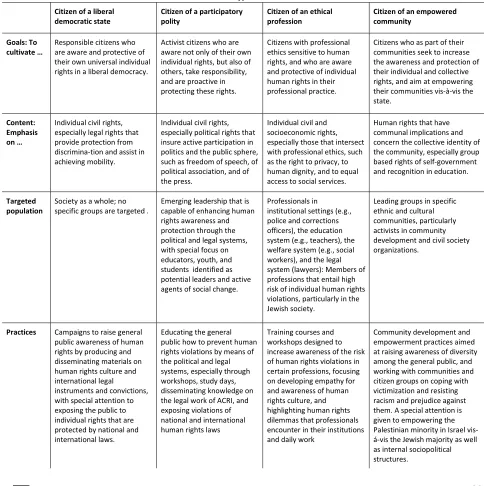
Table 1: Ideal types of citizens
Citizen of a liberal democratic state
Citizen of a participatory polity
Citizen of an ethical profession
Citizen of an empowered community
Goals: To cultivate …
Responsible citizens who are aware and protective of their own universal individual rights in a liberal democracy.
Activist citizens who are aware not only of their own individual rights, but also of others, take responsibility, and are proactive in protecting these rights.
Citizens with professional ethics sensitive to human rights, and who are aware and protective of individual human rights in their professional practice.
Citizens who as part of their communities seek to increase the awareness and protection of their individual and collective rights, and aim at empowering their communities vis-à-vis the state.
Content: Emphasis on …
Individual civil rights, especially legal rights that provide protection from discrimina-tion and assist in achieving mobility.
Individual civil rights, especially political rights that insure active participation in politics and the public sphere, such as freedom of speech, of political association, and of the press.
Individual civil and socioeconomic rights, especially those that intersect with professional ethics, such as the right to privacy, to human dignity, and to equal access to social services.
Human rights that have communal implications and concern the collective identity of the community, especially group based rights of self-government and recognition in education.
Targeted population
Society as a whole; no specific groups are targeted .
Emerging leadership that is capable of enhancing human rights awareness and protection through the political and legal systems, with special focus on educators, youth, and students identified as potential leaders and active agents of social change.
Professionals in institutional settings (e.g., police and corrections officers), the education system (e.g., teachers), the welfare system (e.g., social workers), and the legal system (lawyers): Members of professions that entail high risk of individual human rights violations, particularly in the Jewish society.
Leading groups in specific ethnic and cultural communities, particularly activists in community development and civil society organizations.
Practices Campaigns to raise general public awareness of human rights by producing and disseminating materials on human rights culture and international legal
instruments and convictions, with special attention to exposing the public to individual rights that are protected by national and international laws.
Educating the general public how to prevent human rights violations by means of the political and legal systems, especially through workshops, study days, disseminating knowledge on the legal work of ACRI, and exposing violations of national and international human rights laws
Training courses and workshops designed to increase awareness of the risk of human rights violations in certain professions, focusing on developing empathy for and awareness of human rights culture, and highlighting human rights dilemmas that professionals encounter in their institutions and daily work
100
4 Conceptions of the good citizenThis part provides an analysis of the activities of the Human Rights Education Department in ACRI, focusing on presenting four major ideal types of citizen. Each one of these represents “the type of citizen they might be aiming for through their teaching projects and programs” (Johnson & Morris, 2010, p. 84). In introducing the defe-rent types, we applied the basic principle of inductive analysis, that is ‘to let the data talk’ (Janesick, 2003). Below, Table 1 presents a summary of the four types and related aspects.
4.1 Citizen of a democratic liberal state
ACRI attempts to cultivate liberal democratic citizens who are aware and protective of their individual rights. Emphasizing that human rights are universal, egalitarian, inalienable, and applicable to all human beings, regard-less of personal status or identity, ACRI promotes human rights as neutral and apolitical norms that are universally shared by all liberal democracies. These human rights are conceived as basic individual civil liberties that a govern-ment may not restrict, because they are legally protected under international law. Advanced as universal liberties that all liberal democracies are required to respect and protect (e.g., freedom of conscience, of religion, of assembly, and of speech), ACRI links these rights to the foundations and principles of the democratic liberal re-gime. Specifically, ACRI associates the protection of these human rights with endorsing equality and social justice for all citizens. ‘Galia’ explained that importance of HRE expressed in the following words (the names cited are all fictional, and Hebrew and Arab names are arbitrary and do not indicate that nationality, religion, or gender of the participants):
Human rights are based on setting values that are very important to the existence of humanity, to talk about them, see them, study them, to be educated in their light; this is part of what ensures continuity. Respecting human rights ensues that democracy will be sustain-able and that equality is granted. In our context, ACRI’s role is to ensure that the rights of Arabs are equal to the rights of Jews in the state of Israel. ACRI goes to courts to defend human rights, because it believes in equality, and it believes that the legal system can defend all Israeli citizens. This is how democracy works. That is why we emphasize legal education. Laws, regu-lations, international law are all important to know.
Noticeably, this discourse of good citizenship reflects a strong belief in the fairness of the international and domestic legal systems. In this regard, the Israeli legal system is perceived as an equalizing system that can firmly protect human rights and defend the very foun-dations of democracy. Accordingly, legal rights ( e.g., to equal treatment, to a fair trial and due process, and to seek redress or a legal remedy) receive considerable attention in ACRI’s workshops. In these workshops, the
participants are encouraged to acquire in-depth know-ledge of the Israeli legal system, how to use this system to protect human rights.
In this discourse, the discussion of human rights is often situated in the context of a possible discrimination on grounds of race, gender, national origin, color, sexual orientation, ethnicity, religion, or disability. In this uni-versal discourse, all citizens in Israel are seen as poten-tially vulnerable to human rights violations. Therefore, ACRI equally reaches out to all citizens of Israel with the same messages, encouraging them to be more aware and protective to their own individual rights, but not necessarily those of other individuals or groups. Placing more emphasis on both the universal and individual aspects of the human rights, this discourse does not pro-vide enough space to deliberate on issues of privilege in Israeli society. In this regard, ’Said’ observed that ado-pting an educational approach that centers on the universality and individuality of human rights provokes less resistance and appeals to more audiences:
When it comes to human rights, we are all, Arabs and Jews, men and women, might be victims. Our individual rights might be not respected by the state, therefore, we address society in Israel as a whole, with similar messages: first be aware of your own rights … Good citizens are citizens with developed awareness … We emphasize the individual rights that concern everyone, regardless of who he or she is. Therefore, we started with rights, but not entitlements and privileges, be-cause this will shut the discussion. Discussing the su-periorrity of Jews, men, or even Ashkinazi jews will make the participants either more defensive or more offensive. We want to talk first about the citizen as a citizen, as an individual, and what happens with him when he encounters the the state’s systems and servi-ces. This makes human rights relevant to all citizens.
Worth noting, this conception of good citizenship is often coupled with strong emphasis on cooperation with the state’s governmental authorities, which are percei-ved as potentially capable of both violating and protect-ting all citizens and all rights. These authorities, ‘Fathy’ is convinced, are both sources of human rights violations and potential remedies. Commenting on the role of HRE in the educational system, he said:
We work through the education system. This system is highly committed to militarism and Zionist values, but we still need to work in cooperation with it, if we want to reach as many as possible, be influential, and pro-voke less resistance. We can not educate and protect every-one, but governmental organizations can do that. They can violate human rights and they can be protective of these. The question is how to encourage them be more respectful of human rights.
101
often identified in the public as advancing leftist agendas, working with governmental organizations is seen as a good strategy to appear as apolitical, neutral and pro-fessional organization:
ACRI wants to work with the establishment and not against it , because we will gain legitimacy not only for ACRI , but also for its cause. Its is not easy to work with security forces. These are populations that are hard to change. But, we must work with them because if we do not, others will do that , and they might be less demo-cratic, and less sensitive to human rights … We can not meet them only in courts and litigations, and only when there are problems. These are huge mainstream orga-nizations, with many Israelis serving in and interacting with them … Undoubtedly, we are considered as part of the left in Israel. Sadly, if you struggle for equality and human rights you are considered as leftist. For many segments in the Jewish society, human rights are indeed threatening their identity as right wing voters and even as Jews. Unfortunately, human rights insti-gate antagonism and sometimes hostility. Therefore, working in education enables us to suggest and share with the Israeli society zones of cooperation not only zones of conflict, as always happen when ACRI leads campaigns against governmental policies. Education help us to promote human rights from a neutral place that has no affiliation to a specific political camp.
4.2 Citizen of a participatory polity
The ideal of a citizen of a participatory polity aspires to cultivate citizens who are capable of engaging effectively in politics. This citizen links between human rights and activism, and is more engaged in protecting human rights than the first type. ‘Ahmand’ commented on the cent-rality of activism in what follows:
Good citizenship is based on the perceptions of sub-stantive democracy… [A good citizen] is unwilling to remain silent on human rights violations, and seeks to prevent violations, not only one’s own rights but also those of others.
With this ideal of the involved citizen, ACRI is less interested in influencing society as a whole, and is more geared to cultivating individuals as self-motivated agents of social change. Specifically, ACRI targets specific settings - especially schools, youth organizations, co-mmunity centers, universities - to train interested indivi-duals and potential activists to be active participants in defending human rights, especially in the political realm. To do so, ACRI provides educational content that is less concerned with the general framework of human rights, as the case in the previous type of citizen. Here the emphasis is placed on the socio-economic rights (e.g., education, health, house, employment) that might be violated by governmental agencies. This content pertains primarily to issues of equal access to social services. For Avner, a good citizen is an active and critical citizen:
Through our education programs, … I want to create a dialogue that moves citizens from passive knowledge about human rights to activism. I want to see teachers as activists, who challenge their pupils, convey a strong human rights discourse, and ask critical questions.
ACRI encourages activism with much caution. In many interviews, activism was described as capable of chang-ing society, and activists were referred to as the ultimate ‘good citizens’. However, it was emphasized that activism should always starts with small and gradual changes. Good citizens are activists who have a strong reflective awareness. In this regard, awareness is sometimes per-ceived as a substitute of activism, or at least as a form of it. ‘Nasrean’ put this theory of change in the following words:
We prepare the teachers for activism by raising aware-ness to social justice, by changing their professional discourse. The activism we encourage is not reflected necessarily in going out to the streets. It is more about asking questions and being more critical. We advocate changes that are small. The goal is to make people believe change is possible … The state’s discrimination is given and known. If we want to change that, each teacher, social worker, teenager should change himself for the better. The first and most important step is to create a new awareness, as we all could potentially be violators of rights, discriminators, and even racists. For example, one group studied in depth slavery in Islam, and that helped the group reflect on racist attitudes toward blacks in Arab society. Foe me, this is a major change, more important than going out in a demon-stration, or signing a petition.
4.3 Citizen of an ethical profession
HRE may also be aimed at cultivating citizens as ethical professionals. Here, good citizenship is perceived as good professionalism that reflects high awareness of the risks of human rights violations. Shlomit states:
I don't think we have a concept of the good citizen; the concept I know is that of a good professional, who cares for human rights and takes responsibility to pre-vent violations.
In this discourse, the focus is on training professionals to show more respect and sensitivity to human rights. Be it in the police forces, the correctional services, welfare departments, or schools, the goal is to improve the prac-tice of the targeted professionals in these services in a way that makes them more aware and protective of human rights when they provide services to citizens. For example, ‘Avner’ stressed the ability of police officers to understand human rights from the perspective of the citizens after training them to perceive good service as good citizenship, and to approach citizens as their clients:
102
in the context of human rights ... basically to make them understand the feelings and perspective of the citizens, to which they become oblivious in the course of their police work ... the second step is to discuss their actual work as police officers ... the purpose of their job, how they restrain potential violations of rights… themes of balancing and proportionality … The Border Guard Forces are widely considered as violent and as the spearhead in implementing Israel brutal policies against the Palestinians. They are often respon-sible for dispersing demonstrations. Now, either we stand on the side and only blame this population, or we do something about their job and the services they provide to the citizens in Israel. If security offices are trained to understand that they should be both good professionals and good citizens, their service and contact with the citizens will improve dramatically. There would be less violations, less resistance by the citizens, and more cooperation and order.
ACRI developed special training workshops for various groups of professionals: teachers, journalist, social wor-kers, police forces, etc. These workshops include simula-tions of human rights dilemmas and violasimula-tions that are distinctive to the organizational context of each group of these professionals, and is derived from their daily practices and routines. The overarching goal of these workshops is to change the participants’ professional approach and language into one that is more sensitive to human rights. ‘Narsean’ described a work-shop with social workers in what follows:
My role as a social worker is to recognize that a person's rights have been violated. A person who has rights has power. The workshop changes how they look at their clients - not as unfortunate people, not as a collection of all their troubles, but as a collection of all their rights. This is totally a different perspective on their clients. In short, we want them to change pers-pective and orientation. We encourage them to think as empowered social workers and as empowered citi-zens who do not treat their clients as victims , and as only suffering and being subjected and subordinated, but also as clients who are entitled to rights. Never to work with language of needs, weaknesses, and distress, but to replace this language with one of rights and strengths… The purpose is to link the language of citizenry to professional practice.
Here, good citizenship is understood as good service that would eventually elect compliance and cooperation from the citizens. Especially in the security sector, ACRI's training programs for professionals seem to promote a type of political clientelism approach that increases the acceptance and legitimacy of both ACRI and the security forces in the general public. In this regard, the security forces are approached by ACRI as neutral and profe-ssional actors, who are expected to act in accordance with the norms of human rights. ‘Dan’ critically explained
the rational of working with specific groups of profe-ssionals:
ACRI sees teachers, social workers, and security forces as trained insiders who in the worse scenario case will be ethical professionals, and in the best case scenario will transform the organizations and services. …the more trained professionals we have, the better these organizations will be. If we will train more and more people in governmental organizations, this will change these organizations, and make them more sensitive to human rights. These professionals know better than anyone else how to introduce changes in their work. Regrettably, the programs do not provide the profe-ssionals with strategies how to transform their insti-tutions into more human right respecting and pro-tecting environments, how to handle specific violations by colleagues, and how to reform long-standing policies and practices of discrimination in their organizations. We do not train them how to do that. We leave it to their sense of responsibility and leadership.
4.4 Citizen of an empowered community
Said commented on the cultural differences between the Jewish and the Arab communities served by the HRE programs of ACRI:
There are different needs and different degrees of willingness to accept materials. I also think that at pre-sent the two societies are at entirely different starting points. In my view, the first thing Arab society needs is various kinds of empowerment. Jewish society does not need empowerment, but the opposite... everyone needs empowerment as a value, but from a national perspective... more humility is needed … Officially, we want to work the same with everyone. However, we work differently in both societies… The needs of the Arab society are different and these are most state centered: discrimination, racism and inequality. In the Jewish sec-tor, the agenda is broader, we discuss not only inequality and racism, but also issues, for example, that pertain to Russian and Ethiopian immigrants and youth, and issues of housing, health, single mothers, and unemployment. We try to open up the discourse in the Arab society, but we rarely discuss issues that pertain, for example, to relationships between religious groups in the Arab society, We rarely discuss violations of the Arab local municipalities. Our programs provides Arab youth and professionals with a mirror to reflect on their society, but we need to do that more often.
103
society that recognizes the cultural needs of the different groups within it. Accordingly, the content of such HRE programs focuses on collective rights, issues concerning discrimination and racism against disempowered groups, and the impoverished living conditions of the Palestinian minority. ‘Ahmad’ commented on the importance of discussing ACRI human rights violations in the context of disempowered groups:
Of course there is discrimination against the Arab population… Now let's look within the Arab population - Is everything about Arab society okay? What about women? What about blacks within Arab society? …Same with Ethiopians, with people living in the periphery. These groups’ rights are violated, but also there are violations within them, violations based on traditions and costumes … I wish we could discuss these internal issues more, but right now we are more focused on the state’s violations, which are by far more important to the quality of life in the Arab localities.
In this regard, ACRI programs equips leading groups within these communities with community development tools and strategies. The programs train these groups to be able of mobilizing collective action vis-a-vis the state’s institutional discrimination, and vis-à-vis the commu-nities internal practices of marginalization. The focus is on training community leaders and activists (e.g., youth leaders, students activists, civil society organizations’ em-ployees) to be more strategic and more systematic in defending human rights, and in minimizing manifest-tations of prejudice. ACRI believes that empowered groups will claim responsibility and act collectively to end discrimination. ‘Fathy’ critically highlighted the particu-larities of cultivating citizens of an empowered commu-nity in the context of the Palestinian minority in Israel:
In our work with the Palestinian minority, we advance a discourse of human rights that emphasizes that community is not only the site in which human rights should be protected, but also the political actor that should be empowered to ensure individual and collec-tive rights. This discourse of colleccollec-tive empowerment is advanced in parallel to the universal one. However, we discuss issues of collective rights, issues that pertain to the recognition of Palestinian minority and identity only in activities with Palestinian participants. We rarely discuss these issues while working, for example, with Jewish professionals, though we discuss violations of individual rights of the Arab citizens with them, but not issues of collective rights.
5 Concluding thoughts
In line with Galston (2001), who reminded us that “civic education is relative to regime type” (p. 217), it seems reasonable to argue that different sociopolitical contexts produce different citizenship and human rights education forms and emphases. For example, in undemocratic countries, HRE programs tend to focus on empowerment and resistance, and in developing countries they are
ofte-n associated with issues of sustaiofte-nable developmeofte-nt aofte-nd women’s rights. In post-totalitarian countries, HRE has highlighted the protection of individual and minority rights, and in established democracies, such programs often emphasize issues of discrimination and promote reforms to enhance the protection of minority, migrant, and refugee rights (Tibbitts, 2002). Gordon (2012) concluded that: “the social space in which HRE takes place helps determine its content” (p. 389).
Therefore, we argue that the characteristics of the Israeli context, and especially its strong ethno-national politics and differential citizenship regime, have shaped HRE orientations in Israel. Like many human rights organizations that have made education a high priority in their attempts to raise the general public awareness of human rights (Mihr & Schmitz, 2007), ACRI has invested in education in an effort to foster a culture of human rights. However, although ACRI’s experience in promo-ting HRE resembles the global experience of many international organizations (e.g., UNICEF, UNESCO, HREA) in developing HRE programs and materials (Tomasevski, 2004), the work of ACRI represents a unique case study of HRE in a deeply divided and conflict ridden context. According to Bajaj (2011), in these conflict ridden contexts, HRE tends to be associated with the conso-lidation of the rule of law and efforts to establish the legitimacy and acceptance of the state’s authorities.
Commenting on HRE in Israel, Gordon (2012) referred to Yiftachel’s (2006) conceptualization of Israel as an ethnocracy rather than a democracy to explain that the excluding ethnocratic nature of the Israeli regime hinders individual and institutional internalization of the basic values of HRE. According to Gordon the universal princi-ples of HRE conflict with the particularistic hyper-ethno-nationalist ideology of Israel that seeks to cultivate the Jewish character of the students at the expense of constructing a democratic and civic identity.
104
In doing so, the ACRI’s HRE model closely resembles what Bajaj (2011) calls HRE for coexistence. This model focuses on the “the interpersonal and intergroup aspects of rights and is usually a strategy utilized where conflict emerges not from absolute deprivation, but from ethnic or civil strife” (p. 490).
Admittedly, the types of “good citizens” that we identified in ACRI’s HRE programs correspond well with the literature. Specifically, they intersect with the types identified by Westheimer and Kahne (2004) in many points of convergence and divergence. For example, cultivating a citizen in a liberal democracy is similar to their notion of the “personally responsible citizen,” which emphasizes awareness of and compliance with the norms of human rights. The citizens of a participatory po-litical system and of an empowered community resemble Westheimer’s and Kahne's “participatory” and “justice-oriented” citizen types in their critical approach that advocates reaching out, political participation, and civic activism.
However, ACRI’s types differ in their focus on human rights as definitive of citizenship, as well as their empha-sis on cultural and ethnic affiliations as definitive of community. In the model that we have presented, citi-zens of an empowered community focus their attention not only on individual human rights, but also on group rights, which are seen as essential to empower their community, face the state’s discrimination, and to address inner-groups prejudices. Additionally, commu-nity is seen as both a site, in which citizens operate to protect their rights, and as a political actor, who should be empowered to achieve greater level of equality, recognition, and social justice. It is worth to note that Westheimer’s and Kahne's (2004) model did not relate at all to good citizenship as good professionalism.
Nonetheless, the emphasis on the professional domain is evident in the HRE literature. For example, Tibbitts (2002) recognized the importance of training profess-ionals to become committed leaders in HRE. In this re-gard, the ideal type of a ‘citizen of an ethical profession’ reflects the increasing efforts to establish a more genu-ine relevance of the HRE programs to the lives of their participants (Tibbitts, 2002). For example, in their dis-cussion of HRE workshops in teacher education, Nazzari, McAdams, and Roy (2005) emphasized that educators should engage with human rights in settings that encourage cooperative learning, dialogue, reflection on practice, and praxis.
All in all, the types of the ‘good citizen’ identified here reflect two interrelated continuums. The first ranges bet-ween passive and active notions of HRE, and the second between liberal and republican notions of citizenship. The first pertains to the extent of involvement the individual citizen is required to demonstrate in the public sphere and politics, ranging from mere awareness and minimal involvement (especially when it comes to protecting ones’ individual rights), to active participation in politics and engagement with the public sphere (especially when it comes to protecting others’ human rights). The second refers to the goals of HRE and its
scope, ranging from the individual as a bearer of rights, through the local community as the site where rights are exercised and as a political actor, to the state as responsible and accountable for individual and group rights.
Undoubtedly, ACRI’s HRE model places a strong em-phasis on realizing a thick conception of citizenship in Israel. It encourages more engagement with politics, pro-fessional ethics, cultural communities, and the discri-mination of the marginalized Palestinian community in Israel. This growing focus on engagement signifies a shift from the narrow liberal conception of the citizen - as a bearer of rights that the state guarantees and as a rational and autonomous individual who is aware and protective of his or her individual rights - to a civic repu-blican conception of the citizen - who is more involved, responsible, and grounded an a specific communal life. In ACRI’s model of HRE, citizenship signifies not only a legal status that entails certain rights and duties, but it also refers to modes of political participation, and forms of ethnic, cultural, and professional belonging (Heater, 2004). All in all, good citizenship is largely perceived here as thick and active citizenship (Pykett, Saward, & Schaefer, 2010).
With the ideal types of citizens, ACRI employs a multi-layered human rights discourse that enables it to engage differentially with the various divisions in Israel, espe-cially the national rift. Although this multilayered human rights discourse enables ACRI to gain legitimacy in the Jewish and Palestinian societies in Israel, it seems that ACRI’s ability to induce change in the understanding and protection of human rights in both societies is rather limited.
On the one hand, ACRI’s efforts in the Palestinian society are indeed brave and critical, as it strives to empower Palestinian society to defend the individual and, to a lesser extent, collective rights of its members. However, ACRI focuses on promoting HRE activities that are predominately state-centered, that is, related to raising awareness and protecting human rights that the state might jeopardize due to its Jewish ethnocentricity. This leaves little room to address human rights sub-versions and violations within Palestinian society itself. In this respect, this state-centered approach, which largely overlooks internal debates on human rights, is in fact disempowering.
105
In this regard, Golan and Orr (2012) argued that the increasing use of legal language in the international human rights discourse of NGOs’ struggles in Israel reflects not only a priority of legal aspects over the political of these struggles, but also a persistent attempt to gain acceptance and legitimization in Israeli society and establishment. However, seemingly, this attempt is doomed to be ineffective in Israel, as the members of many sectors still perceive the work of human rights organizations as embracing a leftist political agenda that threatens the particular values and collective identity of the Jewish Israeli society (Mizrachi, 2011). Therefore, as Golan and Orr (2012, p. 809) put it, “Israelis, generally speaking, do not differentiate between human rights activities and political activities.”
That said, it seems that ACRI, similar to many other human rights organizations, has become increasingly reserved in its expression of political positions. As the information presented in its programs on Palestinian citizens and society in Israel has focused almost entirely on contemporary human rights violations, ACRI’s HRE model seems less concerned with the silenced historical narrative of the Palestinian group and the reexamination of the history of violence against it. It emphasizes minority rights and pluralism as part of the larger human rights framework, but lacks transformative elements that are geared towards empowering individuals and commu-nities to put in a historical context the “analysis of how human rights norms and standards are often selectively respected based on communities’ varied access to resources, representation, and influence” (Bajaj, 2011, p. 493).
In general, ACRI’s programs do encourage their parti-cipants to engage within the boundaries of Israeli citizen-ship. However, in its efforts to gain legitimization and acceptance, it seems that ACRI has remained faithful to the ethno-national parameters of a Jewish and demo-cratic state. According to our review of its activities, ACRI does not challenge this framework. In particular, its efforts to raise awareness of the cultural and group-based rights of the Palestinians are for the most part confined to educational settings within the Palestinian minority. The programs within the Jewish educational settings do not address the effects of the Palestinian– Israeli conflict on the condition of human rights of the Palestinian minority, but focus only on the individual human rights of Palestinians in Israel. Avoiding a critical engagement with the definition of Israel as a Jewish and democratic state seems to mold ACRI’s model of HRE as apolitical and ahistorical.
On the whole, it seems that a more transformative approach to HRE is required in both the Palestinian minority (i.e., putting more effort into confronting internal barriers to human rights culture) and the Jewish majority (i.e., investing more in transforming institutional cultures, focusing more on group-based rights, and emphasizing the relevance of the Palestinian-Israeli conflict to the current condition of human rights in Israel). Easy to say, hard to do; but remarkably rewarding for the Jewish and the Palestinian societies, both alike.
References
Abu-Asbe, K. (2007). Arab education in Israel: Dilemmas of a national minority. Jerusalem: Florscheim. (Hebrew). Association for Civil Rights in Israel (ACRI).(2010). Annual Report 2009-2010. Tel-Aviv: ACRI. Retrieved from www.acri.org.il/he/wp-content/uploads/ 2011/03/doch2009-10.pdf. (Hebrew).
Agbaria, A., & Mahajanah, A. (2009). Arab education in Israel between achievement and recognition. Alpayim: Issues of knowledge, philosophy and literature, 34, 111– 129. (Hebrew).
Agbaria, A. K., Mustafa, M., & Jabareen, Y. T. (2015). ‘In your face ’democracy: education for belonging and its challenges in Israel. British Educational Research Journal, 41(1), 143-175.
Al-Haj, M. (1995). Education, empowerment and control: The case of the Arabs in Israel. Albany, NY: State
University of New York Press.
Arthur, J., Davison, J., & Stow, W. (2014). Social literacy, citizenship education and the national curriculum. New York, NY: Routledge.
Avnon, D. (2013). Civic education in Israel. Tel Aviv: Am Oved. (Hebrew).
Avery, P. G., Levy, S. A., & Simmons, A. M. (2013). Deliberating Controversial Public Issues As Part of Civic Education. The Social Studies, 104(3), 105-114.
Azoulay, A., & Ophir, A. (2012). The one-state condition: occupation and democracy in Israel/Palestine. Stanford, CL: Stanford University Press.
Bajaj, M. (2011). Human rights education: ideology, location, and approaches. Human Rights Quarterly, 33(2), 481-508.
Banks, J. A. (2007). Diversity and citizenship education: global perspectives. Indianapolis, IN: Wiley.
Banks, J. A. (2008). Diversity, group identity, and citizenship education in a global age. Educational Researcher, 37(3), 129-139.
Barak, M., & Ofarim, Y. (2009). Education for citizenship, democracy and shared living. Jerusalem: Van Leer Institute. (Hebrew).
Central Bureau of Statistics. (2015). Press release: 67th Independence Day - 8.3 million residents in the State of Israel. Retrieved from www.cbs.gov.il/reader/
newhodaot/hodaa_template.html?hodaa=201511099.
Chorev, E. N. (2008). Arab NGOs civic and social change in Israel: mapping the field. Jerusalem:Van Leer Institute. Dearden, R.F. (1981). Controversial issues in the
curriculum. Journal of Curriculum Studies, 13(1), 37-44.
106
Glaser, B. G., & Strauss, A. L. (1967). The discovery of grounded theory: Strategies for qualitative research. Hawthorne, NY: Aldine de Gruyter.
Galston, W. A. (2001). Political knowledge, political engagement, and civic education. Annual Review of Political Science, 4(1), 217-234.
Gee, J. P., Michaels, S., & O’Connor, M. C. (1992). Discourse analysis. In M. D. LeCompte, W. L. Millroy, & J. Preissle (Eds.), The handbook of qualitative research in education (pp. 227–291). San Diego, CA: Academic Press. Golan-Agnon, D. (2004). Inequality in education. Tel-Aviv: Babel. (Hebrew)
Golan, D., & Orr, Z. (2012). Translating human rights of the "enemy": the case of Israeli NGOs defending
Palestinian rights. Law & Society Review, 46(4), 781-814.
Gordon, N. (2012). The geography and political context of human rights education: Israel as a case study. Journal of Human Rights, 11(3), 384-404.
Guyver, R. (2013). Editorial: History teaching, pedagogy, curriculum and politics: Dialogues and debates in regional, national, transnational, international and supranational settings. International Journal of Historical Learning, Teaching and Research, 11(2), 3–10.
Hahn, C. L. (2010). Comparative civic education research: what we know and what we need to know. Citizenship Teaching & Learning, 6(1), 5-23.
Heater, D. (2004) Citizenship: the civic ideal in world history, politics and education. Harlow: Longman. Hess, D. E. (2004). Controversies about controversial issues in democratic education. Political science and politics, 37(02), 257-261.
Hughes, A. S., Print, M., & Sears, A. (2010). Curriculum capacity and citizenship education: a comparative analysis of four democracies. Compare: A Journal of Comparative and International Education, 40(3), 293-309.
Jabareen, Y., & Agbaria, A. (2010). Education on hold. Haifa, Israel: University of Haifa & Dirasat.(Hebrew).
Janesick, V. (2003) The choreography of qualitative research design. Minuets, improvisations, and crystallization. In. N. Denzin, N., & Y. Lincoln (Eds.), Strategies of Qualitative inquiry (pp. 46-79).Thousands Oaks: Sage Publications.
Johnson, L., & Morris, P. (2010). Towards a framework for critical citizenship education. The Curriculum Journal, 21(1), 77-96.
Kiwan, D. (2005). Human rights and citizenship: an unjustifiable conflation?. Journal of Philosophy of Education, 39(1), 37-50.
Kiwan, D. (2008). Citizenship education in England at the cross-roads? Four models of citizenship and their
implications for ethnic and religious diversity. Oxford Review of Education, 34(1), 39-58.
Kiwan, D. (2012). Human rights and citizenship
education: re-positioning the debate. Cambridge Journal of Education, 42(1), 1-7.
Kymlicka, W. (1995). Multicultural citizenship: A liberal theory of minority rights. Oxford: Clarendon Press.
Leung, Y. W., & Yuen, T. W. W. (2009). School civic education since 1980s: a brief review of the literature in Hong Kong. Educational Research Journal, 24(2), 257.
Lohrenscheit, C. (2002). International approaches in human rights education. International Review of Education, 48(3–4), 173–185.
Longo, N. V. (2007). Why community matters: Connecting education with civic life. Albany, NY: State University of New York Press.
Lustick, I. (1980). Arabs in the Jewish State: Israel’s control of a national minority. Austin, TX: University of Texas Press.
Mari, S. (1978). Arab education in Israel. Syracuse, NY: Syracuse University Press.
McLaughlin, T. H. (1992). Citizenship, diversity and education: a philosophical perspective. Journal of Moral Education, 21(3), 235–250.
Michaeli, N. (2014). Introduction: Education and politics in the Israeli education. In N. Michaeli (Ed.), Political education: An anthology (pp. 9-29). Bnei Brak: Hakibbutz Hameuchad. (Hebrew).
Ministry of Education. (2000). To be citizens in Israel: A Jewish and democratic state. Jerusalem, Israel: Ministry of Education. (Hebrew).
Mihr, A., & Schmitz, H. P. (2007). Human rights education (HRE) and transnational activism. Human Rights
Quarterly, 29(4), 973-993.
Mizrachi, N. (2011). Beyond the garden and the jungle: On the social limits of the human rights discourse in Israel. Law & Social Change (Ma'asei Mishpat), 4, 51-74. (Hebrew).
Nazzari, V., McAdams, P., & Roy, D. (2005). Using transformative learning as a model for human rights education: a case study of the Canadian Human Rights Foundation's International Human Rights Training Program. Intercultural Education, 16(2), 171-186.
Osler, A., & Starkey, H. (2005). Changing citizenship: democracy and inclusion in education. Maidenhead: Open University Press.
Pinson, H. (2007). Inclusive curriculum? Challenges to the role of civic education in a Jewish and democratic state. Curriculum Inquiry, 37(4), 351-382.
Pinson, H. (2014). From a Jewish and democratic state to a Jewish state period. Nazareth, Israel:
107
Pykett, J., Saward, M., & Schaefer, A. (2010). Framing the good citizen. The British Journal of Politics &
International Relations, 12(4), 523-538.
Ramirez, F. O., Suárez, D., & Meyer, J. W. (2007). The worldwide rise of human rights education. In A. Benavot, & C. Braslavsky (Eds.), School knowledge in comparative and historical perspective (pp. 35-52). Netherlands: Springer.
Shafir, G., & Peled, Y. (2002). Being Israeli: The dynamics of multiple citizenship. Cambridge, England: Cambridge University Press.
Spring, J. (2014). How educational ideologies are shaping global society: intergovernmental organizations, NGOs, and the decline of the nation-state. New York, NY: Routledge.
Stake, R. E. (2013). Multiple case study analysis. New York: Guilford Press.
Stein, A. (2010). To learn from business- to educate the market: The education ministry policy toward the involvement of business groups in schools. In O. Ichilov (Ed.), Privatization and commercialization in state education in Israel (pp. 267-291). Tel Aviv: Ramot. (Hebrew).
Stradling, R. (1985). Controversial issues in the
curriculum. Bulletin of Environmental Education, 170, 9-13.
Svirsky, S., & Dagan-Bozaglo, N. (2009). Separation, inequality and faltering leadership. Tel-Aviv: Adva Center.
Tibbitts, F. (2002). Understanding what we do: emerging models for human rights education. International Review of Education, 48(3-4), 159-171.
Tomasevski, K. (2004). Manual on Rights-based education: global human rights requirements made simple. Bangkok: UNESCO.
Tsolakis, M. (2013). Citizenship and transformative human rights education: surveys as “praxis” in the São Paulo periphery. JSSE-Journal of Social Science Education, 12(3), 39-50.
Veugelers, W. (2007). Creating critical-democratic citizenship education: empowering humanity and democracy in Dutch education. Compare: A Journal of Comparative and International Education, 37(1), 105-119.
Westheimer, J., & Kahne, J. (2004). What kind of citizen? The politics of educating for democracy. American Educational Research Journal, 41(2), 237-269.
Yiftachel, O. (2006). Ethnocracy: land and identity politics in Israel/Palestine. Philadelphia: University of
Pennsylvania Press.
Yin, R. K. (2003). Case study research: Design and methods. Thousand Oaks, CA: Sage.