GSJ: Volume 6, Issue 9, September 2018, Online: ISSN 2320-9186
www.globalscientificjournal.com
ADOLESCENT
STRESS
AND
HOME
ENVIRONMENT
OF
GRADES
IX
AND
XI
STUDENTS:
AN
ANALYSIS
OF
THE
ADOLESCENT
STRESS
QUESTIONNAIRE
Dr. Monika M. Dass CPsychol CSci AFBPsS Title: Psychologist & Counsellor
Address: Nath Valley School, Paithan Road, Cantt P.O. Box 567, Aurangabad-431002, M.S.
Email id: [email protected] Mobile No: 09372003300
INTRODUCTION
Adolescence is a developmental transition between childhood and adulthood. There are several theories of adolescence; some of them are: Hall (1916) – period of storm and stress; Freud (1925) – psychosexual development; Bandura (1964) - human development is a continuous process not divided into stages; and, Kohlberg (1963) – cognitive development precedes moral development. Parfenoff and Jose (1989) - results indicated that daily stressors or hassles were a better predictor of children’s self-rated anxiety than life events; results also indicated that as the child experienced a life event, daily stressors or hassles increased. Dinesh and Kumari (2010) - level of stress in children has significant relationship with their academic competence irrespective of their gender difference. Kapani and Rao’s (2007) - research shows significant role that family functioning plays in relation to attachment style and psychological distress. Mathur and Pareekh (2003) - results indicate that family pathology followed by ineffective parenting and family interaction patterns are the major contributors of problem behavior among adolescents. Warner (2008) - found that negative effects of stress at home lingers and affects teenagers’ academic performance at school. Feld’s (2011) - study suggests that emphasizing the association between parent or student relationships and student life satisfaction is important. Verma et al., (2002) - one context of school stress is the time that children spend doing homework.
Statement of Problem: To study Adolescent Stress in relation to Grade and Home Environment.
OBJECTIVES OF STUDY: To examine the difference in adolescent stress along grades and to study a correlation between adolescent stress and the home environment.
METHODOLOGY
RESEARCH DESIGN: Co-relational research design was used for this study (Kumar, 2005).
VARIABLES UNDER STUDY: The variables were as follows (Kumar, 2005; Aron et al., 2006): Adolescent Stress, Home Environment and Demographic variables: grades IX and XI.
HYPOTHESES:
1. Adolescent Stress would be significantly higher for Grade XI students as compared to Grade IX students.
2. There would be a significant positive correlation between Adolescent Stress and the Home Environment.
SAMPLE/PARTICIPANTS: Stratified random sampling method was used for this study. The student population for this study was taken from the city of Aurangabad, Maharashtra, India. A student population of Grades IX and XI was chosen because these students would be appearing for a Board Exam the following year (in Grades X and XII respectively). The sample of this study constituted 620 students.
INSTRUMENTS/TOOLS:
1. Adolescent Stress Questionnaire (ASQ) (Byrne, Davenport & Mazanov, 2007):
The ASQ is a broadly based instrument which allows adolescents to report their own exposure to a wide span of stressors and to report, as well, the extent to which any stressor experience has constituted a psychological challenge for them as individuals. The 10 dimensions reflect adolescent stress, which are qualitatively consistent with the contemporary literature on the stressfulness of adolescence (Byrne et al., 2007). Test-retest reliability over a single week time period showed correlations ranged between 0.68 (Stress of Financial Pressure) and 0.88 (Stress of Home Life). Three criterion measures (anxiety, depression and self-esteem) correlated strongly and in the expected directions with one another showing concurrent criterion validity of the ASQ. The instrument shows good reliability both internally and across repeat testing.
INTERVENTION: The researcher has conducted a pilot study to check the relevancy of the contents in the test, to check language difficulty, understanding of contents and timing, from four different schools from each of the four areas on the map of Aurangabad. This was conducted on 20 participants; 10 from Grade IX and 10 from Grade XI. Participants were able to understand the questionnaire well and attempted the ASQ without any problem. It was felt that since participants did not have a problem attempting the ASQ, a further adaptation of the test would not be required.
2. Home Environment Inventory (HEI) (Mishra, 2003):
The Home Environment Inventory (HEI) is an instrument designed to measure the psycho-social environment of home as perceived by children. It provides a measure of the quality and quantity of cognitive, emotional and social support that has been available to the child within the home environment.
The instrument requires students to tell the frequency – multiple choice type items - with which a particular parent-child interaction behaviour has been observed by them in their homes, that is, he/she is requested to tell whether a particular parental behaviour (as mentioned in the item). Approximately 25 – 30 minutes is required to attempt this inventory.
Split half reliabilities (corrected for length) were worked out separately for all the ten dimensions and ranged from .73 to .95. Inter-correlations among HEI scales were between -.04 to .88. Observations show that eight coefficients of correlations are moderate/high. One composite score could be safely calculated.
The HEI possesses content validity as measured with the help of views expressed by judges. Criterion related validity could not be established because of the lack of appropriate external criteria. Thus, the instrument is satisfactorily valid.
DATA COLLECTION & ANALYSIS PROCEDURE:
The standard procedure of collection of data was done. Data was collected from a cross section of students from six different schools and colleges in the city of Aurangabad, in the form of questionnaires. All standard procedures of test administration was maintained, data was collected over a period of two to two-and-a-half hours in each school. The following shows the number of students that attempted the: ASQ inventory: 605 students; ALESS inventory: 600 students; SEI inventory: 620 students.
Data was entered on Excel sheets. Analysis was done along the Hypotheses. The data was checked for Normality, Means, SDs, t-test values and Pearson’s correlation were computed using SPSS 17.0 for Windows. Responses to certain statements that were left out by the students were not included.
The analysis of the scores for the ASQ, ALESS, and SEI was done by obtaining the Mean and Standard Deviation, the scores t-test for independent samples and Pearson’s Correlation Coefficient was computed between the scores for the ASQ and SEI.
RESULTS AND DISCUSSION
GRADE-WISE PERFORMANCE ON ADOLESCENT STRESS
Hypothesis 1: Adolescent Stress would be significantly higher for Grade XI students as compared to Grade IX students. The results reveal that there is significantly higher Adolescent Stress for Grade XI students than Grade IX students.
Table 1: Grade-wise performance on ASQ
**. Significant at the 0.01 level (2-tailed)
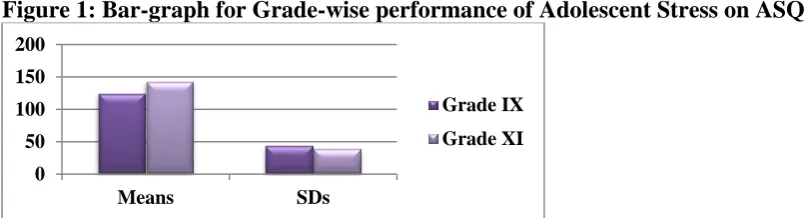
The performance of Grade XI students on the ASQ was higher (M=142.86, SD=39.25) than Grade IX students (M=124.34, SD=44.21), t (603) =5.33, p=.000. The Grade-wise comparison denotes that there is a significant difference of Adolescent Stress as measured by the ASQ for Grades IX and XI. The following graph shows a clear difference for the ASQ; Grade XI having higher stress levels than Grade IX.
Figure 1: Bar-graph for Grade-wise performance of Adolescent Stress on ASQ
0 50 100 150 200
Means SDs
Grade IX Grade XI Grades
Group
Statistics for
ASQ Ns Means SD
‘t’ values
p-Values Grade
IX
ASQ 351 124.34 44.21 5.33** .000
Grade XI
ASQ 254 142.86 39.25
The performance of Grade XI students on the ALESS was higher (M=508.71, SD=270.37) than Grade IX students (M=456.62, SD=229.17), t (603) =2.55, p=.000. The Grade-wise comparison denotes that there is significant difference of adolescent stress as measured by ALESS for Grades IX and XI. The results reveal that there is significantly higher adolescent stress for Grade XI students than Grade IX students.
In the study by Aggarwal et al (2007) when they considered adolescence as an age when the child is striving for independence, and though the stress occurring in the life of the adolescent showed some degree of overlap with that of stress in the parent’s life, a degree of independence was observed among the stress scores. Events related to relationships, deviance, relocation, family and parenting, ambiguous, distressful, autonomy, accident and illness events are found to be stressful in the life of a young adolescent in this study.
Dinesh & Kumari (2010) found more number of children with severe stress at the age of 14 whereas the majority of the children from ages 13 to 15 showed moderate or severe level of stress than any other age groups. The researchers suggest from their study, that in every age, more than 90% of the school children of the State are facing above normal levels of stress and tension. These results are different to my study where students aged 16 or 17 years of age (Grade XI) were found to be highly stressed in comparison to students aged 14 or 15 years of age (Grade IX).
A more detailed analysis of each scale reveals the following:
When analysing ASQ Scale 1: Arguments at Home – it was found that 19.7% of Grade IX Females were Moderately Stressed as compared to Grade XI where 16.9% of Males were found to be A Little Stressed.
When analysing ASQ Scale 2: Having to Study Things You Do Not Understand – it was found that 14.85% Grade IX Males did not find this stressful as compared to Grade XI Females where 13.79% found this area A Little Stressful.
When analysing ASQ Scale 3: Getting Up Early Morning To Go To School – neither Males or Females in either Grades IX or XI found this stressful.
When analysing ASQ Scale 4 – Getting Along With Your Friends - neither Males or Females in either Grades IX or XI found this stressful.
When analysing ASQ Scale 5 – Pressure To Fit In With Peers - neither Males or Females in either Grades IX or XI found this stressful.
When analysing ASQ Scale 6 – Lack Of Respect From Teachers - neither Males or Females in either Grades IX or XI found this stressful.
When analysing ASQ Scale 7 – Concern About Your Future – 16.97% Males of Grade IX found this Very Stressful as compared to 10.69% Females of Grade XI found this Very Stressful.
When analysing ASQ Scale 8 – Not Getting Enough of Time for Leisure – 16.9% of Females found this a little stressful in Grade XI as compared to 16.67% Males in Grade IX who found were not stressed out.
Table 2: Adolescent Stress Questionnaire Dimensions –Descriptive Statistics for each dimension
ASQ Dimensions
N=605 Mean Std. Deviation
Stress of Home Life 29.14 10.70
Stress of School Performance 18.76 06.94
Stress of School Attendance 05.69 03.39
Stress of Relationship with Friends 08.20 06.86
Stress of Peer Pressure 14.75 06.56
Stress of Teacher Interaction 15.95 07.16
Stress of Future Uncertainty 08.52 04.14
Stress of School and Leisure Conflict 12.85 05.74
Stress of Financial Pressure 08.19 04.51
Stress of Emerging Adult Responsibility 06.85 03.60
The Stress of Home Life M=29.14 and SD=10.70 on a sample of 605 is higher as compared to the other dimensions.
From the above study, it is clear that stress has an adverse effect on students. The results of the present study show that in relation to adolescent stress and Grades IX and XI, students may be prone to stress because of an impending Board Examination (both IX and XI will be approaching Board Examinations in Grade X and XII respectively) which they have to face. Grade XI students have to make career choices and decisions have to be made. More responsibilities may have to be shouldered by them as they grow up. Financial responsibilities may have to be taken on in terms of considering expenses for college or university education; in some cases loans may have to be taken by parents if students decide to study abroad. They may be under more stress than Grade IX students as this is a turning point in their lives in several other areas such as attraction to the opposite sex; in Grade IX it could be that students are just beginning to become aware of the opposite sex which could lead to an attraction or forming of friendships or trying to get themselves noticed by someone they are attracted to. Their environments are very open and diversity is great; Grade IX students are given less freedom, they have to follow certain rules both at home and at school whereas Grade XI students, being young adults are given more freedom to express their ideas, more freedom to move about and do things; they are treated as young adults and not as children. Hence, any or all of these factors could play a part in adding stress in the lives of Grade XI students as compared to Grade IX.
ENVIRONMENT-WISE PERFORMANCE ON ADOLESCENT STRESS
Hypothesis 2: There would be a significant positive correlation between Adolescent Stress and the Home Environment.
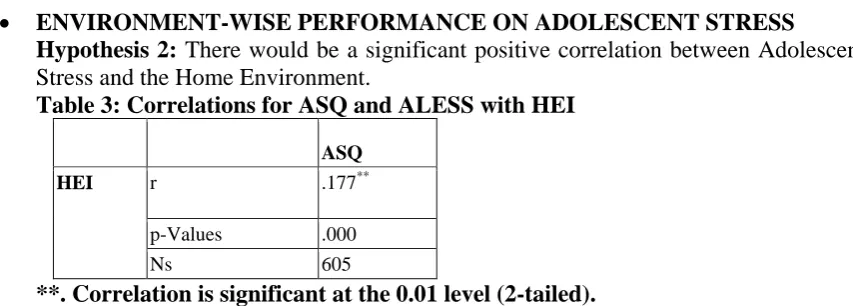
Table 3: Correlations for ASQ and ALESS with HEI
ASQ
HEI r .177**
p-Values .000
Ns 605
**. Correlation is significant at the 0.01 level (2-tailed).
The results suggest that there is a significant correlation between Home Environment and Adolescent Stress: A significant correlation was found for HEI and ASQ, Pearson’s r(605) =
.177, p < .001. Hence, Hypothesis 2 is supported suggesting that there is a significant correlation between Adolescent Stress and the Home Environment.
Padmasree’s (1992) study also yielded significant correlations on stress and family support, stress and family health, stress and locus of control, family stress and locus of control, stress and academic achievement, locus of control and academic achievement. Parental ambitions, pressure to perform, inability to give space to their children to develop and express their own ideas, the busyness of daily existence including both parents working and perhaps not having or giving enough of quality time to their children are just some of the factors that need to be taken into account.
In examining the daily influence of school on adolescents’ lives, Verma et al., (2002) looked at the different contexts in which Indian adolescents do academic work. Tuitions has become the normal pursuit of adolescents because admission to various colleges around the country has become competitive and sought after (Varma, 1998). As a result, adolescents are under pressure not only in school but also after school hours. A questionnaire study of high school students found that they spend an average of 3 - 4 hours daily in homework (Verma & Gupta, 1990). In Indian homes homework often takes place under parental supervision. It could be expected that this continuity of adult pressure, which the child receives from teachers in school, tutors at tuition, and finally from parents at home, will result in negative emotions during the experience of homework (Verma et al., 2002). Kapani and Rao’s (2007), research highlights the need to focus on family education and parenting skills training to prevent the development of vulnerability and to promote positive individual and familial well-being.
From the results of the present study, it is clear that stress is evident in the home environment and that parents need to take cognizance of this fact. Parents need to work to bring about as much as is possible a stress-free environment for their children to grow up in; parental ambitions transferred to their children may need to be questioned; over-competitiveness may need to be questioned. Another thing to keep in mind is that parents have a very tough time dealing with their children at Grade XI level these days; youngsters question them at every level and many arguments ensue at home as a result of this.
CONCLUSIONS
Hypothesis 1 is accepted suggesting that Grade XI students show significantly higher Adolescent Stress as compared to Grade IX students.
Hypothesis 2 is accepted suggesting that there is a significant correlation between the Home Environment and Adolescent Stress.
LIMITATIONS OF STUDY
This is limited to English-speaking schools only; Marathi and Hindi medium schools were not included in this study.
A smaller number of students participating may throw up better results in terms of the effect on the Environment.
IMPLICATIONS AND FURTHER AVENUES FOR RESEARCH
This study can be replicated in different cities in India; replicated in rural areas and a comparative study of urban/rural could be done.
Other Independent variables can be included such as geographical area – based on a North, South, East and West query, and regional area.
De-stress programmes are a necessity. Students could undergo this in schools for six to eight weeks and a before/after study could be conducted to see the difference such a programme would make.
REFERENCES
Aggarwal, S., Prabhu, H.R.A., Anand, A., & Kotwal, A. (2007). Stressful life events among adolescents: The development of a new measure. Indian Journal of Psychiatry, 49, 96-102. Aron, A., Aron, E.N. & Coups, E.J. (2006). Statistics for psychology. (4th edition). Australia: Pearson Education and Dorling Kindersley Publishing, Inc.
Bandura, A. (1964). The stormy decade: fact or fiction? Psychology in the Schools (1), 224-231.
Byrne, D. G., Davenport, S. C., & Mazanov, J. (2007). Profiles of adolescent stress: The development of the adolescent stress questionnaire (ASQ). Journal of Adolescence, 30(3), 393-416.
Dinesh, S., & Kumari, S.S. (2010). Prevalence of stress among school children in Kerala. Retrieved on 4.1.2012 from http://www.articlesbase.com/mental-health-articles/prevalence-of-stress-among-school-children-in-kerala-1868702.html
Feld, L.D. (2011). Student Stress in High-Pressure College Preparatory Schools. Honors Theses - All. Paper 685. http://wesscholar.wesleyan.edu/etd_hon_theses/685.
Freud, S. (1925). Three contributions to the sexual theory. Nervous and Mental Disease Monograph Series, No. 7. New York: Nervous and Mental Disease Publishing Co.
Hall, G.S. (1916). Adolescence. 2 vols. New York: Appleton
Kapani, A.R.M., & Rao, K. (2007). Attachment Style in Relation to Family Functioning and Distress in College Students. Journal of the Indian Academy of Applied Psychology, 33(1), 15-21.
Kohlberg, L. (1963). The development of children's orientations toward a moral order. Vita Humana (6), 11-33.
Kumar, R. (2005). Research Methodology. (2nd edition), Australia: Pearson Education and Dorling Kindersley Publishing Inc.
Mathur, M., & Pareekh, K. (2003). Adolescent’s problem behavior: A study of family risk factors. Indian Journal of Psychometry and Education, 34(1), 59-66.
Misra, K.S.M. (2003). Manual for Home Environment Inventory. Lucknow: Ankur Psychological Agency.
Padmasree, J. V. (1992). Stressful life events in school systems and educational development in children. M. Phil., Home Science. Sri Venkateshwara University.
Parfenoff, S.H., & Jose, P.E. (1989). Measuring daily stress in children. Paper presented at the biennial meeting of the Society for Research Development in Child Development, Kansas City, Missouri, April 1989.
Verma, S., Sharma, D., & Larson, R.W. (2002). School stress in India: Effects on time and daily emotions. International Journal of Behavioural Development, 26(6), 500-508.
Varma, P.K. (1998). The great Indian middle class. New Delhi: Penguin.
Verma, S., & Gupta, J. (1990). Some aspects of high academic stress and symptoms. Journal of Personality and Clinical Studies, 6(1), 7-12.
Warner, J. (2008). Teen stress at home lingers in school, WebMD Health News, Reviewed By Louise Chang, MD, May 15. http://www.medicinenet.com.
---