Language Selectivity in Lexical Access: an Experimental Study on Bilinguals
Fatma Demiray
is currently Instructor Dr. at the School of Foreign Languages, AIBU. Correspondence: Instr.Dr. Fatma Demiray, Abant Izzet Baysal University, School of Foreign Languages.14280 Gölköy/Bolu-Turkey. E-mail: [email protected]/[email protected] Phone: +90 374 2541000
Dilek Peçenek
is currently Assoc. Prof. at Ankara University, Department of Linguistics. Correspondence: Assoc. Prof. Dilek Peçenek, Ankara University, Department of Linguistics, Ankara/Turkey. E-mail: [email protected]
Abstract
In this study, the locus of language selection in bilingual lexical access is investigated based on some basic factors such as first languages, second language proficiency, age of acquisition and multilingualism. In particular, this study explores competition between bilinguals’ languages and proposes two language selection models; Inhibitory Control Model (Green, 1998) and Concept Selection Model (La Heij, 2005). In experiment 1, the participants were asked to perform a word translation task from their second language (L2) to first language (L1). Each target was accompanied by a distracter item in the form of a picture or a word which was related/unrelated to the target word semantically. As a result, all participants translated target words faster when they are accompanied with semantically related/unrelated word distracters than picture distracters. On the other hand, they translated target words faster when they are accompanied with unrelated word distracters than related word distracters. Finally, they translated target words faster when they are accompanied with related picture distracters than unrelated picture distracters. In experiment 2, participants were asked to perform a switching task with the numbers in their first language and second language according to the background color of the digits. Finally, the language switching cost was larger when switching from L2 to L1 than vice versa. The results have shown that while the factors such as L1 andage of acquisition do not affect the locus of language selection during lexical access, proficiency in L2 and multilingualism factors affect the locus of language selection.
Keywords: Bilingualism, Inhibitory Control Model, Concept Selection Model, Lexical Access
1. Bilingual Lexical Access and Speech Production
Bilingual lexical access and speech utterance terms require that language to be chosen to produce can be determined in advance of speech planning. When an Italian- English bilingual is asked to name a picture of a tree in English, he/she will
come up with the word table. The process that makes the connection between the “idea” table and the word table is often
referred to as lexical access (La Heij, 2005).
Lexical access is only a small part of bilingual language production but a very fundamental step because it bridges the gap between nonverbal thought world and language world (La Heij, 2005; Bloem & La Heij, 2003). Besides, the lexicons in both languages share a common conceptual system. That is, the concept of a tree is the same in both languages but happens
to be mapped on to two lexical entries (table and tavolo) (Schwieter, 2007; Kroll & Stewart, 1994; Kroll & de Groot, 1997).
1. 1 Language Specific Selection and Concept Selection Model
As in Levelt’s (2001) proposal lexical access occurs automatically in the sense that it delivers a winner depending on the information in preverbal message and “complex access, simple selection” idea is emphasized. Costa (2005) assumes that during speech planning semantic system activates lexical nodes in both languages however, these nodes do not compete for selection because they have been already selected in preverbal message, in other words in conceptual level. Finally, according to Concept Selection Model (CSM), the most highly activated lexical node in the target language is chosen (Costa, 2005; Kroll, Bob & Wodniecka, 2006; Fishman, 2001; Francis, 2000; La Heij, 2005). Therefore, this selection process is not based on inhibition or suppression as competition does not occur between languages but within languages (see Figure 2).
1. 2 Language Non-Specific Selection and Inhibitory Control Model
Figure 2. Langauge Specific Model (Costa, Miozzo & Caramazza, 1999, p.370)
Conceptual Cues Language
Cue: English
pane sedia tavolo
table chair bread
Conceptual Level
Lemma Level
Phonological Level
Figure 1. A model of Bilingual Language Production (adapted from Poulisse & Bongaerts, 1994 & Hermans, 2000) (cited in Kroll, Bobb & Wodniecka, 2006, p.120).
CHAIR
chair tabl
e sedia tavolo
Semantic Representation
Lex
ic
al
N
od
es
Some researchers who favor non-specific language selection are opposed to language specific selection hypothesis (Green, 1998; Caramazza, 1997; De Bot, 1992). They assume that there is cross-language activity the languages compete for selection. In other words, lexical nodes in both languages are activated by semantic system (see Figure 3).
The basic hypothesis of Inhibitory Control Model (ICM) is that the selection of one language is only possible after suppression or inhibition of nontarget language. This inhibition is the main reason for longer Response Times (RTs) and more errors. Moreover, more dominant language will take longer time to produce because it has a larger system than weaker language and it will need stronger inhibition.
2. Method of the Study
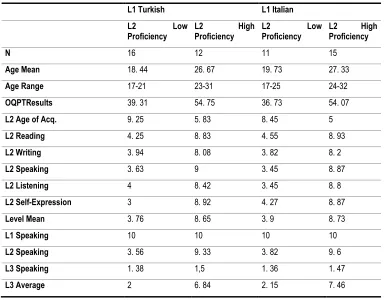
This study in which the lexical access and language selection process are supposed to analyze on undergraduate or graduate English learners of Turkish and Italian is based on experimental approach and the data has been observed quantitatively. In this frame, firstly, Oxford Quick Placement Test (OQPT) is applied to determine the proficiency level in L2 of the participants. Afterword, language history questionnaire is performed to reach the participants’ demographic information and all participants are grouped into two in terms of L1, L2 Proficiency Level, L2 Age of Acquisition and Multilingualism. After then, two experiments have been designed in the name of Word Translation Task based on CSM (La Heij, 2005) and Numeral Task based on ICM (Green, 1998).
CHAIR
chair table sedia tavolo
Semantic Representation
Lex
ic
al
N
od
es
Lexical Selection Mechanism
English Lexicon Italian Lexicon
2. 1 Overview of the Experiments
The goal of the present study is to examine the underlying processes of bilingual lexical selection and speech production in terms of the nature of bilinguals (i. e. varying types of bilinguals, L2 proficiency level, age of acquisition and multilingualism). In particular, the experiments investigate the loci of language selection and competition based on CSM and ICM. These two distinct theories seek to explore whether speech production are found at conceptual or lexical level.
In Experiment 1, it is investigated that target language is established at the initial stages of the lexical process and other mechanisms such as inhibition are not necessary during speech production process. In the experiment, Italian-English and Turkish-English bilinguals who translated English words into Italian or Turkish are included. Each target word was accompanied by a distracter item in the form of a picture or a word which semantically related or unrelated to the target. To understand whether factors of bilingualism affect these lexical process or the loci of selection and competition, four kinds of bilingual groups are included comparatively. If participants take longer to translate when distracter items are in the form of pictures, it can be concluded that there is a competition at the conceptual level (because pictures activate their conceptual representation). However, if participants are slower to translate when the distracters are words, it can be assumed that there is a competition at the lexical level of the speech production process.
In Experiment 2, the main goal is to examine whether bilinguals suppress the nonrelevant language during speech production. Recall that IC Model expresses the fact that there is a difference between the size of L1 and L2 and that is the reason why more time is required when switching from L2 to L1 than vice versa. Inhibitory mechanism during language switching appears and the words in the nonrelevant language are inhibited in order to produce the target language. This experiment consists of numeral task (from 0 to 9) with language switches. Bilinguals name the digits according to the background color which is seen on the computer screen. If the digits are presented with a blue background color they name them in English. If they are presented with a yellow background color, they name them in Italian (for Italian-English bilinguals) or in Turkish (for Turkish-English bilinguals). All numbers are presented in short lists of switch or nonswitch trials. If participants need more time switching from L2 to L1 than vice versa, it can be assumed that there is a competition at lexical level.
2. 2 Oxford Quick Placement Test and Language History Questionnaires
OQPT (Allan, 1992) was conducted to explore the bilinguals’ proficiency levels and Language History Questionnaire was used to reach some information about participants’ background knowledge about language (s). It was taken from Schwieter (2007) and Marian, Blumfeld & Kaushanskaya (2007) and adapted after pilot study. In this questionnaire, twenty five items were presented to explore L2 early and late age of acquisition of bilinguals and bilingual or multilingual participants. Additional information about their language backgrounds such as age, use of languages, self-rated scores for reading, writing, listening, speaking and the other languages which have been learnt after second languages of them was obtained.
2. 3 Participants and Grouping
A total of 54 participants were recruited from the graduate or undergraduate students who were studying at Roma Tre University, Italy and Ankara University, Turkey. They have different language backgrounds, L2 age of acquisition and knowledge of other languages except from English (L2).
Fifty-four participants took part in the experiments. Participants in Italy were native speakers of Italian and learning English for an average 7 years. These participants were receiving formal training in English as a second language. Participants in Turkey were native speakers of Turkish and learning English for an average of 10 years. Twenty six participants were living in Italy, the rest of them were living in Turkey. Participants from different countries were considered to be L2 learners or late-bilinguals of Italian-English or Turkish-English.
Table 1. Descriptive Statistics for the Participant Groups
L1 Turkish L1 Italian
L2 Low
Proficiency
L2 High
Proficiency
L2 Low
Proficiency
L2 High Proficiency
N 16 12 11 15
Age Mean 18. 44 26. 67 19. 73 27. 33
Age Range 17-21 23-31 17-25 24-32
OQPTResults 39. 31 54. 75 36. 73 54. 07
L2 Age of Acq. 9. 25 5. 83 8. 45 5
L2 Reading 4. 25 8. 83 4. 55 8. 93
L2 Writing 3. 94 8. 08 3. 82 8. 2
L2 Speaking 3. 63 9 3. 45 8. 87
L2 Listening 4 8. 42 3. 45 8. 8
L2 Self-Expression 3 8. 92 4. 27 8. 87
Level Mean 3. 76 8. 65 3. 9 8. 73
L1 Speaking 10 10 10 10
L2 Speaking 3. 56 9. 33 3. 82 9. 6
L3 Speaking 1. 38 1,5 1. 36 1. 47
L3 Average 2 6. 84 2. 15 7. 46
3. Experiment 1: Word Translation Task 3. 1 Materials
Thirty two high frequency English words were selected. The target words in the experiments were taken from Bloem and La Heij (2003) and after the pilot study they were adapted (see Appendix A and B for a description). Each of the target words were presented with a semantically related or unrelated words or pictures. For example, the target word DOG (to be translated into Italian as “cane” or into Turkish as “köpek”) was accompanied by the picture of a peach or by the word “pesca” (Italian translation equivalent of peach) or “şeftali” (Turkish translation equivalent of peach) in an unrelated context. However, in the related context the same target word DOG was accompanied by the picture of cat or by the word “gatto” (the Italian translation equivalent of cat) or “kedi” ” (the Turkish translation equivalent of cat) in a related context. English target words were seen one by one on the computer screen in black-lower case and the distracters were presented in black-lower case immediately over the target words. Half of the participants started the experiment with picture distracters, the other half started with word distracters.
3. 2 Procedure
give any answer during this time, the next trial was seen. The researcher took notes for true and false responses simultaneously and also used voice recorder to indicate and judge the responses later again.
3. 3 Data analysis
Response latencies of only correct responses (in L1 or L2) were included in the statistical analyses. There are two main variables as picture-word or related-unrelated contexts. The analyses were conducted to each bilingual group separately and T-test was conducted in four phases: a) L1, b) L2 age of acquisition, c) Proficiency level and d) Multilingualism.
3. 4 Results and Discussion
The results gathered from word translation task to analyze locus of language selection and competition in terms of CSM were investigated on the basis of context (word or picture) and relatedness (related or unrelated). As seen in Table 2, the
statistics have shown there was a significant main effect for context (t (107) = -5. 44, p=0. 000) that is, participants have
more difficulty in translating target words when accompanied with pictures (1091 ms. ) than words (1026ms. ). On the other
hand, the same significant effect cannot be seen in relatedness (t (107) = -0. 31, p=0. 755). This suggests that reaction
times for translating target words when they are accompanied by related (1057ms. ) or unrelated (1060ms. ) context were nearly same. It can be understood from these results that words created semantic interference while pictures induced semantic facilitation.
Table 2. Paired Samples Statistics for Context (word-picture) and Relatedness (related-unrelated) in Experiment 1
Paired Samples Statistics
Mean N Std. Deviation Paired Samples Correlations Correlation Sig.
Pair 1 Word 1026,347 108 2093,243 0,863 0,000 Picture 1091,117 108 2474,211
Pair 2 Related 1057,457 108 2322,456 0,896 0,000 Unrelated 1060,445 108 2307,936
Paired Differences
Mean Std. Deviation t df Sig. (2-tailed)
Pair 1 Word-Picture -655,702 1,250 -5,443 107 0,000
Pair 2 Related-Unrelated -316,737 1,050 -0,312 107 0,755
3. 4. 1 L1 Factor and Lexical Access
between L1 Turkish and Italian participants, however, the semantic relatedness effect is the same for both experimental groups.
According to the independent samples T-test results, there is a significant main effect between participants in terms of word
(t (106)= 6. 01, p=0. 000), picture (t (106) = 4. 39, p=0. 000), related (t (106) = 5. 07, p=0. 000) and unrelated (t (106)= 4.
94, p=0. 000) context. In other words, Italians were faster for all contexts than Turkish participants. To analyze the main effect of the distracters, Turkish and Italian participants are examined separately (see Table 4 and Table 5).
Table 3. Mean RTs (ms. ), Accuracy (in percent) and SRE for L2 Learners of Italian and Turkish in Experiment 1
L1 Italian L1 Turkish
Word Picture Word Picture
Rt Acc. Rt Acc. Rt Acc. Rt Acc.
Unrelated 912 1,9 1002 1,7 1115 1,1 1197 2,3
Related 922 1,6 980 1,5 1139 2,3 1171 1,4
Sre -10 22 -24 26
Figure 4. SRE and RTs (in ms. ) for L2 learners of Italian and Turkish in Experiment 1
Paired samples statistics were included for the reason context and relatedness data were collected from each participant
group. L1 Turkish participants’ mean RTs in picture context is more than word context (t (55)= -3. 453, p=0. 000, r=0. 811),
L1 Italian participants also have similar RTs mean (t (51)= -4. 233, p=0. 000, r=0. 861). When relatedness effect is analyzed,
both L1 Turkish (t (55)=-0. 04, p=0. 971, r=0. 850) and Italian participants (t (51)=-0. 419, p=0. 000, r=0. 891) have similar
results. Consequently, similar effects were reported for both groups and the results support CSM regardless of what type of bilingual may be. In other words, lexical access occurs at conceptual level.
Table 4. Paired Samples Statistics for L2 Learners of Turkish in Experiment 1
Paired Samples Statistics
-30 -20 -10 0 10 20 30
Word Picture
L1 Turkish L1 Italian
1115 1139
912 922
1197 1171
1002
980
850 900 950 1000 1050 1100 1150 1200
Unrelated
(Tr) Related(Tr) Unrelated(It) Related (It)
Paired Samples Correlation
Mean N Std. Deviation Correlation Sig.
Pair 1 Word 1127,534 56 1753,289 0,811 0,000
Picture 1184,921 56 2125,853
Pair 2 Related 1155,963 56 1972,677 0,850 0,000 Unrelated 1156,491 56 1967,095
Paired SamplesT-test
Paired Differences
Mean Std. Deviation t df Sig. (2-tailed)
Pair 1 Word - Picture -573,867 1243,669 -3,453 55 0,001
Pair 2 Related - Unrelated -527,661 1079,440 -0,037 55 0,971
Table 5. Paired Samples Statistics for L2 learners of Italian in Experiment 1
Paired Samples Statistics
Paired Samples Correlations
Mean N Std. Deviation Correlation Sig.
Pair 1 Word 917,203 52 1881,146 0,861 0,000
Picture 991,586 52 2447,878
Pair 2 Related 951,390 52 2215,314 0,891 0,000
Unrelated 957,400 52 2214,369
Paired Samples T-test
Paired Differences
Mean Std. Deviation t df Sig. (2-tailed)
Pair 1 Word-Picture -743,834 1267,058 -4,233 51 0,000
Pair 2 Related-Unrelated -601,014 1035,367 -0,419 51 0,677
3. 4. 2 L2 Proficiency Level Factor and Lexical Access
According to the independent samples test results, there is a significant main effect between the groups on the basis of
word (t (106)=11. 275, p=0. 000), picture (t (106)=13. 694, p=0. 000), related (t (106)= 12. 057, p=0. 000) and unrelated (t
(106)=12. 093, p=0. 000) context. That shows that, high proficient bilinguals were faster than low proficient bilinguals as expected. To analyze the main overall effect of the proficiency on lexical access, both groups are analyzed separately with paired samples test.
Table 6. Mean RTs (ms. ), Accuracy (in percent) and SRE for L2 Low and Highly Proficient Bilinguals in Experiment 1
L2 LowProficiency L2 HighProficiency
Word Picture Word Picture
Rt Acc. Rt Acc. Rt Acc. Rt Acc.
Unrelated 1216 1,5 1278 1,8 814 1,5 932 2,2
Related 1272 2 1252 1,6 800 1,8 904 2,5
Sre -56 +26 +14 +28
Figure 5. SRE and RTs (in ms. ) for L2 Low Highly Proficient Bilinguals in Experiment 1
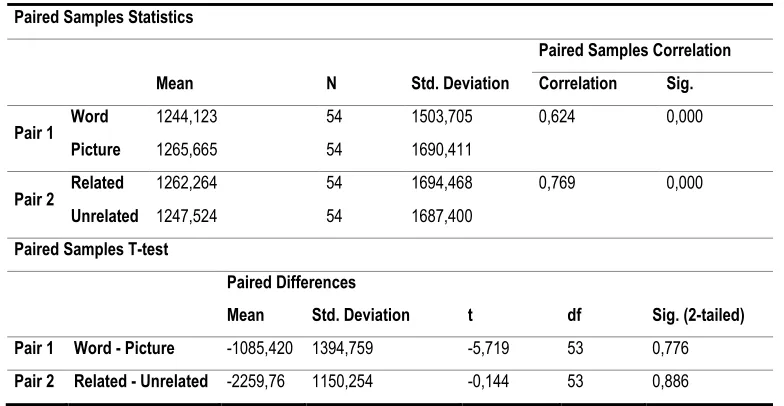
Paired samples statistics in Table 7 and 8 are included for the same reason mentioned in L1 and language selection. There are several significant interactions which should be reported and emphasized. Firstly, for context and relatedness, only low
proficient bilinguals could not get significant effect for context (t (53)=-5. 72, p=0. 776, r=0. 624) and for relatedness (t (53)=
-0. 14, p=0. 886, r=0. 769). However, high proficient bilinguals could get significant effect only for context (t (53)=-1. 809,
p=0. 004, r=0. 750) not for relatedness (t (53)=-0. 31, p=0. 756, r=0. 729).
All in all, low and highly proficient bilinguals are affected from different lexical selection processes. Thus, it can be hypothesized that low proficient bilinguals are probably using inhibitory control mechanism to be able to choose the correct language since the language cues in L2 may enter the selection process only after the suppressing of nontarget language nodes.
Finally, it should be emphasized that after the second experiment on ICM, it will be possible to reach a final and exact result about lexical selection process of them.
-80 -60 -40 -20 0 20 40 Word Picture
L2 Low Proficiency L2 High Proficiency
Table 7. Paired Samples Statistics for L2 Low Proficient Participants in Experiment 1
Paired Samples Statistics
Paired Samples Correlation
Mean N Std. Deviation Correlation Sig.
Pair 1 Word 1244,123 54 1503,705 0,624 0,000
Picture 1265,665 54 1690,411
Pair 2 Related 1262,264 54 1694,468 0,769 0,000 Unrelated 1247,524 54 1687,400
Paired Samples T-test
Paired Differences
Mean Std. Deviation t df Sig. (2-tailed)
Pair 1 Word - Picture -1085,420 1394,759 -5,719 53 0,776
Pair 2 Related - Unrelated -2259,76 1150,254 -0,144 53 0,886
Table 8. Paired Samples Statistics for L2 Highly Proficient Participants in Experiment 1
Paired Samples T-test Statistics
Paired Samples Correlation
Mean N Std. Deviation Correlation Sig.
Pair 1 Word 807,404 54 1326,957 0,750 0,000
Picture 918,003 54 1266,948
Pair 2 Related 852,666 54 1311,833 0,729 0,000 Unrelated 873,741 54 1292,375
Paired Samples T-test
Paired Differences
Mean Std. Deviation t df Sig. (2-tailed)
Pair 1 Word - Picture -2259,820 918,143 -1,809 53 0,004
Pair 2 Related - Unrelated -4074,980 958,627 -0,312 53 0,756
3. 4. 3 Age of Acquisition Factor and Lexical Access
in early age of acquisition. This interpretation shows the parallel results to the hypothesis of CSM. In other words, the participants in each group select language at conceptual level. Just as L1, age of acquisition independent samples analyses
show that there was an overall main effect for word (t (106)=-7. 895, p=0. 000), picture (t (104,781) =-9,145, p=0,000),
related (t (105,605) =-8,468, p=0,000) and unrelated (t (105,99) =-8,694, p=0,000) context.
Table 9. Mean RTs (ms. ), Accuracy (in percent) and SRE for L2 Early and Late Age of Acquisition in Experiment 1
Early Age of Acquisition Late Age of Acquisition
Word Picture Word Picture
Rt Acc. Rt Acc. Rt Acc. Rt Acc.
Unrelated 908 2,2 974 1,1 1122 1,7 1236 1,3
Related 931 1,6 950 1,5 1141 1,9 1206 1,4
Sre -23 24 -29 30
Figure 6. SRE and RTs (in ms. ) for L2 Early and Late Age of Acquisition in Experiment 1
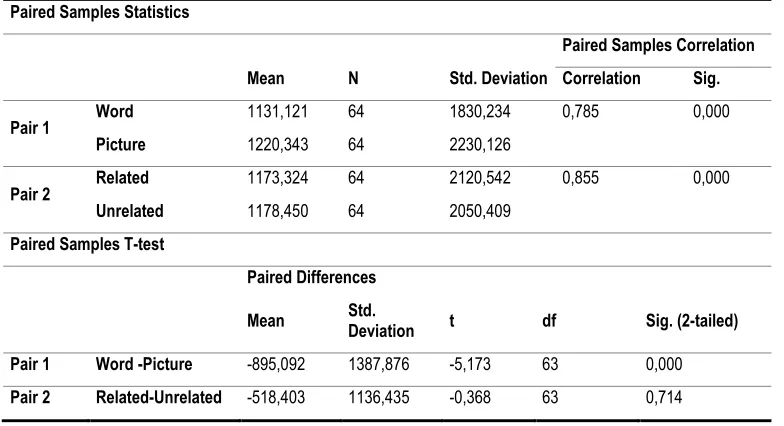
The significant interactions gathered from paired samples statistics in Table 10 and 11 are in Pair 1 as word and picture and Pair 2 as related and unrelated context. First of all, for both groups, on the basis of context there was a significant main
effect for bilinguals in early (t (43) = -2,169, p =0,026, r=0,769) and late age of acquisition (t (63) = -5,173, p =0,000,
r=0,785). Similarly, in terms of relatedness, there was not any significant main effect between those in early age of
acquisition (t (43) = -0,016 p =0,987, r=0,767) and late age of acquisition (t (63) = -0,368, p =0,714, r=0,855). Consequently,
lexical selection and competition occur at conceptual level without inhibition of nontarget language.
Table 10. Paired Samples Statistics for Early Age of Acquisition in L2 in Experiment 1
Paired Samples Statistics
Paired Samples Correlation
Mean N Std. Deviation Correlation Sig.
Pair 1 Word 919,355 44 1403,000 0,769 0,000
-40 -20 0 20 40
Word Picture
Early Age of Acquisition Late Age of Acquisition
908 931
1122 1141
974 950
1236 1206
700 750 800 850 900 950 1000 1050 1100 1150 1200 1250 1300
Unrelated
(Early) Related(Early) Unrelated(Late) Related(Late)
Picture 962,105 44 1364,651
Pair 2 Related 941,613 44 1367,907 0,767 0,000 Unrelated 940,847 44 1417,000
Paired Samples T-test
PairedDifferences
Mean Std. Deviation t df Sig. (2-tailed)
Pair 1 Word - Picture -3075,010 940,274 -2,169 43 0,026
Pair 2 Related - Unrelated -2340,450 951,095 -0,016 43 0,987
Table 11. Paired Samples Statistics for Late Age of Acquisition in L2 in Experiment 1
Paired Samples Statistics
Paired Samples Correlation
Mean N Std. Deviation Correlation Sig.
Pair 1 Word 1131,121 64 1830,234 0,785 0,000
Picture 1220,343 64 2230,126
Pair 2 Related 1173,324 64 2120,542 0,855 0,000 Unrelated 1178,450 64 2050,409
Paired Samples T-test
Paired Differences
Mean Std. Deviation t df Sig. (2-tailed)
Pair 1 Word -Picture -895,092 1387,876 -5,173 63 0,000
Pair 2 Related-Unrelated -518,403 1136,435 -0,368 63 0,714
3. 4. 4 Multilingualism Factor and Lexical Access
Independent samples test results show that there is a significant main effect between the groups in the meaning of word (t
(106) =0,322, p=0,000), picture (t (106) =0,261, p=0,000), related (t (106) =0,472, p=0,000) and unrelated context (t (106)
=0,103, p=0,000). That shows that the RTs difference between the groups of bilinguals and multilinguals is meaningful; in
other words bilinguals translated the target words in each position slower than multilinguals.
Table 12. Mean RTs (ms. ), Accuracy (in percent) and SRE for Multilinguals and Bilinguals in Experiment 1
Multilinguals Bilinguals
Word Picture Word Picture
Rt Acc. Rt Acc. Rt Acc. Rt Acc.
Unrelated 902 1,1 912 0,9 1128 1,3 1298 2,1
Related 900 1 882 0,7 1172 1,7 1274 1,6
Sre 2 30 -44 24
Figure 7. SRE and RTs (in ms) for Multilinguals and Bilinguals in Experiment 1
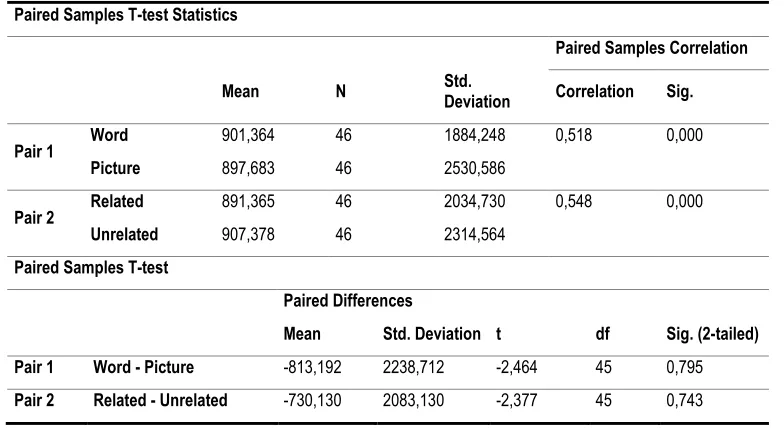
To analyze the main overall effect of multilingualism on language selection, bilinguals (in Table 13) and multilinguals (in Table 14) were divided into two groups and examined separately. Bilinguals support language selectivity in that locus of selection is at conceptual level since they have the similar results of CSM hypothesis explained at the beginning of the
experiment for context (t (61) = -1,946, p =0,004, r=0,708) and relatedness (t (61) = 0,223, p =0,824, r=0,710). However,
multilinguals statistics result shows that they are probably affected differently in lexical selection such as inhibition or suppression. Moreover, language production can be easier but the lexical selection process can be more difficult. As in the
results, significant main effect in context (t (45) = -2,464, p =0,795, r=0,518) and relatedness (t (45) = -2,377, p =0,743,
r=0,548) in multilinguals’ responses have nothing in common with CSM results.
Table 13. Paired Samples Statistics for Bilinguals in Experiment 1
Paired Samples Statistics
Paired Samples Correlation
Mean N Std. Deviation Correlation Sig.
-44
24 8
30
-60 -40 -20 0 20 40
Word Picture
Bilinguals Multilinguals
902 900
1128 1172
912
882
1298 1274
800 850 900 950 1000 1050 1100 1150 1200 1250
Unrelated
Pair 1 Word 1150,286 62 2379,291 0,708 0,000 Picture 1286,042 62 2360,025
Pair 2 Related 1223,233 62 2393,479 0,710 0,000 Unrelated 1213,095 62 2366,952
Paired Samples T-test
Paired Differences
Mean Std. Deviation t df Sig. (2-tailed)
Pair 1 Word - Picture -4475,660 1810,837 -1,946 61 0,004
Pair 2 Related - Unrelated 5137,435 1812,483 0,223 61 0,824
Table 14. Paired Samples Statistics for Multilinguals in Experiment 1
Paired Samples T-test Statistics
Paired Samples Correlation
Mean N Std. Deviation Correlation Sig.
Pair 1 Word 901,364 46 1884,248 0,518 0,000
Picture 897,683 46 2530,586
Pair 2 Related 891,365 46 2034,730 0,548 0,000 Unrelated 907,378 46 2314,564
Paired Samples T-test
Paired Differences
Mean Std. Deviation t df Sig. (2-tailed)
Pair 1 Word - Picture -813,192 2238,712 -2,464 45 0,795
Pair 2 Related - Unrelated -730,130 2083,130 -2,377 45 0,743
4. Expriment 2: Numeral Task
4. 1 Materials
trials: switch to L1, switch to L2, nonswitch in L1, nonswitch in L2. The total number of the trials in the experiment was 1000 (700 nonswitch trials (70%) and 300 switch trials (30%). There was the same number of production in L1 or L2 (500 responses for each language). Each number was presented 100 times during the experiment.
4. 2 Procedure
The participants were tested individually in a soundproof room immediately after Experiment 1. As in the first experiment, in written and orally, they were asked to name the digits which were seen on the computer screen according to the background color of them. When the digits were seen in blue color they were expected to answer in L2, in yellow color they were expected to answer in L1. Each participant was given the numbers in a series of 100 digits. Each number appeared on the computer screen and remained for 800 ms. If the participant does not give any answer during this time, the next trial was seen on the screen and this procedure repeated until the end of the list, at which time an asterisk (*) was presented for 1000 ms to show that the list finished and another one would begin in 1000ms. After each 10 lists, participants were given a break of approximately 5 minutes to prevent participants from overloading. All responses were recorded as in the first experiment and coded as “correct” or “incorrect”.
4. 3 Data Analysis
Response latencies of only correct responses (in L1 or L2) were included in the statistical analyses. There are two main variables as L1-L2 or switch-nonswitch contexts. The analyses were conducted to each bilingual group separately as mentioned in Experiment 1.
4. 4 Results and Discussion
Numeral task including language switches was conducted to observe whether lexical access and language selection occur at lexical level or not. Recall that IC model hypothesize the words in the nontarget language are inhibited to produce of the target language because there is difference in the size of L1 and L2, in other words L1 system is larger than L2 system so L1 must be reactivated. That is the reason why more time is needed when switching into larger one of two systems. Previous researchers (Costa & Santesteban, 2004; Meuter, 1994; Meuter & Allport, 1999) claimed that asymmetric switch cost (ASC) is associated with L1 and L2 switches and in the present experiment RTs of language (L1 and L2) and trial type (switch and nonswitch) performances were analyzed separately. This experiment is also important to understand the factors which have been consisted in CSM and Word Translation Task to see the main effect of this difference between participants in terms of L2 proficiency level and multilingualism. As in Table 15, the RTs results show that regardless of the factors, all bilinguals were slower in naming the switch trials than nonswitch trials. Also, they were slower in naming L1 trials than L2
trials. Furthermore there was a significant effect for response language (L1 and L2) (t (107) = 6,801, p =0,000, r=0,697)
and trial type (switch and nonswitch) (t (107) = 7,943, p =0,000, r=0,743). It can be understood from the statistics that
switching to L1 is more difficult than switching to L2 and ASC for switch trials is more than nonswitch trials.
Table 15. Paired Samples Statistics for Language Response (L1 or L2) and Trial Types (switch-nonswitch) in Experiment 2
Paired Samples Statistics
Paired Samples Correlation
Mean N Std. Deviation Correlation Sig.
Pair 1 L1 659,422 108 1271,646 0,697 0,000
Pair 2 Switch 661,959 108 1288,924 0,743 0,000 Nonswitch 595,405 108 1074,728
Paired Differences
Mean Std. Deviation t df Sig. (2-tailed)
Pair 1 L1 - L2 61480,18 93945,09 6,801 107 0,000
Pair 2 Switch - Nonswitch 66553,92 87079,64 7,943 107 0,000
4. 4. 1 L1 Factor and Lexical Access
One of the main aims of this experiment is to see whether L1 factor affects the locus of language selection and completion during bilingual speech production. To analyze this factor, participants are grouped into two; English learners of Italian and English learners of Turkish. The mean reaction times gathered from the experiment show that switch trials take longer than nonswitch trials and Italian participants’ RTs are more than Turkish participants’ (see Table 16 and for graph see Figure 8).
In language response and trial type observation, there is a significant main effect between L1 Turkish and Italian participants. According to the independent samples test results, there is a significant main effect between two groups on
the basis of L1 (t (95,8) =-3,929, p=0,000), L2 (t (106) =-2,643, p=0,009), switch (t (96,416) =-3,383, p=0,001) and nonswitch
(t (106) =-3,294, p=0,001) trials.
Table 16. Mean RTS (ms. ), Accuracy (in percent) and ASC for L2 learners of Italian and Turkish in Experiment 2
L1 Italian L1 Turkish
L1 L2 L1 L2
Rt Acc. Rt Acc. Rt Acc. Rt Acc.
Switch 740 0,7 666 0,2 660 0,6 580 0,5
Nonswitch 672 0,8 586 0,7 574 0,5 558 0,4
Asc 68 80 86 22
Figure 8. RTs (in ms. ) for L2 learners of Italian and Turkish in Experiment 2 740
672 660
574 666
586 580 558
450 500 550 600 650 700 750 800 850
Switch (IT) Nonswitch (IT) Switch (TR) Nonswitch (TR)
To analyze the main effect of the switch or nonswitch trials, L1 Turkish and L1 Italian participants are examined separately with paired samples statistics (as in Table 17 and 18). The language response and trial type data are obtained from each group and the RTs show that the results of both group are similar to each other in terms of “language response” for L1
Turkish (t (55) = 4,279, p =0,000, r=0,742) and L1 Italian (t (51) = 5,413, p =0,000, r=0,626). Similarly, the “trial type
responses” are similar to each other because there is a significant main effect between switch and nonswitch trials for L1
Turkish (t (55) = 6,681, p =0,000, r=0,803) and L1 Italian (t (51) = 5,117 p =0,000, r=0,652) groups. Consequently, similar
effects can be seen for both groups and the results support ICM regardless of what type of bilingual one may be. That is, locus of language selection and lexical access process are solved at lexical level as long as language switching is needed in production of target language.
Table 17. Paired Samples Statistics for L2 Learners of Turkish in Experiment 2
Paired Samples Statistics
Paired Samples Correlation
Mean N Std. Deviation Correlation Sig.
Pair 1 L1 617,575 56 1034,706 0,742 0,000
L2 569,466 56 1104,983
Pair 2 Switch 620,046 56 1074,538 0,803 0,000 Nonswitch 566,995 56 1028,838
Paired Samples T-test
Paired Differences
Mean Std. Deviation t df Sig. (2-tailed)
Pair 1 L1 - L2 44109,52 77141,57 4,279 55 0,000
Pair 2 Switch - Nonswitch 59050,02 66139,71 6,681 55 0,000
Table 18. Paired Samples Statistics for L2 learners of Italian in Experiment 2
Paired Samples Statistics
it Paired Samples Correlation
Mean N Std. Deviation Correlation Sig.
Pair 1 L1 706,641 52 1341,522 0,626 0,000
L2 626,454 52 1052,766
Pair 2 Switch 703,865 52 1376,593 0,652 0,000 Nonswitch 629,230 52 1028,013
Paired Differences
Mean Std. Deviation t df Sig. (2-tailed)
Pair 1 L1 - L2 801,870 1068,220 5,413 51 0,000
Pair 2 Switch - Nonswitch 746,350 1051,816 5,117 51 0,000
4. 4. 2 L2 Proficiency Level Factor and Lexical Access
As in the first experiment, the participants were categorized into two according to L2 proficiency level; low and highly proficient bilinguals. As expected, mean reaction times show highly proficient bilinguals are faster than low proficient ones. However, as Table 19 illustrates, ASC in L1 and L2 for low proficient bilinguals (117 ms. , 64 ms. respectively) is much more than highly proficient bilinguals’ cost (47 ms. , 38 ms. ) (Figure 9 shows more detailed graph). These findings are important because they do not validate the hypotheses of ICM and support the findings found in Experiment 1. From these results, it can be assumed that in order to select the appropriate word in the target language, low proficient bilinguals must inhibit the nonrelevant language temporarily.
According to the independent samples test, there is a significant main effect between two groups in terms of L1 (t (95,8)
=6,484, p=0,000), L2 (t (106) =6,863, p=0,000), switch (t (106) =7,222, p=0,000) and nonswitch trials (t (106) =6,181,
p=0,000). Analyzing these results it can be assumed that low proficient bilinguals are slower than highly proficient bilinguals
as expected. However, to get knowledge about what the main difference between them, separate analyses with paired samples test are needed.
Table 19. Mean RTs (ms. ), Accuracy (in percent) and ASC for L2 Low and Highly Proficient Bilinguals in Experiment 2
L2 Low Proficiency L2 High Proficiency
L1 L2 L1 L2
Rt Acc. Rt Acc. Rt Acc. Rt Acc.
Switch 796 0,8 696 0,3 604 0,6 550 0,4
Nonswitch 679 0,7 632 0,7 557 0,6 512 0,4
Asc 117 64 47 38
796
679
604
557 696
632
550
512
450 500 550 600 650 700 750 800 850
Switch (Low Proficiency) Nonswitch (Low
Proficiency)
Switch (High Proficiency) Nonswitch (High
Proficiency)
Figure 9. RTs (in ms. ) for L2 Low and Highly Proficient Bilinguals in Experiment 2
Paired samples statistics are shown in Table 20 and 21 separately. They are analyzed for the same reason in the first experiment and there are several significant interactions in the results. Most importantly, for language response and trial
types, only low proficient bilinguals could get the significant effect for language response (t (53) = 4,595, p =0,000, r=0,526)
and for trial types (t (53) = 4,541, p =0,000, r=0,611). These results are also parallel to the results of ICM itself (Green,
1998) which has been found at the beginning of the study. Alike low proficient bilinguals, highly proficient bilinguals could
not get the significant effect for both language response (t (53) = 1,862, p =0,068, r=0,831) and trial types (t (53) = 2,159,
p =0,064, r=0,721). The results of the present experiment for low proficient bilinguals are completely in line with the claims put forth by ICM and the inhibition rules to produce target language. On the other hand, the same discussion is not possible for highly proficient bilinguals in the shadow of their asymmetric switch cost; in other words, highly proficient bilinguals are completely in line with CSM and they select language at conceptual level using language cues in preverbal message.
Table 20. Paired Samples Statistics for L2 Low Proficient Bilinguals in Experiment 2
Paired Samples Statistics
Paired Samples Correlation
Mean N Std. Deviation Correlation Sig.
Pair 1 L1 737,876 54 1193,714 0,526 0,000
L2 664,222 54 1000,946
Pair 2 Switch 746,632 54 1165,801 0,611 0,000 Nonswitch 655,466 54 965,099
Paired Samples T-test
Paired Differences
Mean Std. Deviation t df Sig. (2-tailed)
Pair 1 L1 - L2 676,537 1082,010 4,595 53 0,000
Pair 2 Switch – Nonswitch 851,661 956,835 6,541 53 0,000
Table 21. Paired Samples Statistics for L2 Highly Proficient Bilinguals in Experiment 2
Paired Samples Statistics
Paired Samples Correlation
Mean N Std. Deviation Correlation Sig.
Pair 1 L1 580,968 54 955,273 0,831 0,000
L2 531,402 54 1014,424
Nonswitch 534,121 54 888,809
Paired Samples T-test
Paired Differences
Mean Std. Deviation t df Sig. (2-tailed)
Pair 1 L1 - L2 1456,587 574,961 1,862 53 0,068
Pair 2 Switch - Nonswitch 2016,394 686,457 2,159 53 0,064
4. 4. 3 L2 Age of Acquisition Factor and Lexical Access
As was emphasized in L2 Age of Acquisition Factor and Language Selection section of Experiment 1, all participants were grouped into two, L2 early and late age of acquisition. As expected, those in early age of acquisition were faster than those in late age of acquisition. However, as shown in Table 22, their ASC rate is similar to each other, as for L1: 82ms. to 83ms. (early and late age of acquisition respectively) and for L2: 48ms. to 53ms. (also see Figure 10). From these results, it is obvious to predict that all bilinguals regardless of their L2 age of acquisition proceeds their lexical selection via ICM hypothesis. In other words, they use inhibitory control mechanisms in selection target language as long as they do language switching.
Age of acquisition independent samples analyses also show that there was an overall main effect for L1 (t (106) =-3,014,
p=0,003), L2 (t (106) =-3,404, p=0,001), switch (t (106) =-2,980, p=0,004) and nonswitch (t (106) =-3,516, p=0,001) trials.
To analyze the main overall effect of language response and trial types, both groups must be indicated separately.
Table 22. Mean RTs (ms. ), Accuracy (in percent) and ASC for L2 Early and Late Age of Acquisition in Experiment 2
Early Age of Acquisition Late Age of Acquisition
L1 L2 L1 L2
Rt Acc. Rt Acc. Rt Acc. Rt Acc.
Switch 656 0,8 578 0,1 745 0,6 668 0,3
Nonswitch 574 0,8 530 0,9 662 0,7 615 0,4
Figure 10. RTs (in ms. ) for L2 Early and Late Age of Acquisition in Experiment 2
The magnitude interactions obtained from paired samples statistics (in Table 23 and 24) are as follows: First, there was an
observed main effect in response language for those in not only early age of acquisition (t (41) = 5,252 p =0,000, r=0,811)
but also late age of acquisition (t (65) = 4,811, p =0,000, r=0,562). Second, the last observed significant main effect can be
analyzed from the part of trial types and both the participants who are at early age of acquisition (t (41) = 5,372, p =0,000,
r=0,799) and late age of acquisition (t (65) = 5,914, p =0,000, r=0,657) get similar results. The findings from these analyses
suggest that L2 age of acquisition does not affect the locus of language selection and competition. Surprisingly, although they are totally different from each other in nature their statistics are similar except from the time they needed to name the digits in target language.
Table 23. Paired Samples Statistics for L2 Early Age of Acquisition in Experiment 2
Paired Samples Statistics
Paired Samples Correlation
Mean N Std. Deviation Correlation Sig.
Pair 1 L1 614,849 42 1228,812 0,811 0,000
L2 554,465 42 1189,993
Pair 2 SWITCH 617,251 42 1303,556 0,799 0,000
NONSWİTCH 552,063 42 1093,575
Paired Samples T-test
Paired Differences
Mean Std. Deviation t df Sig. tailed)
(2-Pair 1 L1 - L2 603,843 745,157 5,252 41 0,000
Pair 2 Switch - Nonswitch 651,882 786,445 5,372 41 0,000 656
574
745
662
578
530
668
615
400 450 500 550 600 650 700 750 800
Switch (Early) Nonswitch (Early) Switch (Late) Nonswitch (Late)
Table 24. Paired Samples Statistics for L2 Late Age of Acquisition in Experiment 2
Paired Samples Statistics
Paired Samples Correlation
Mean N Std. Deviation Correlation Sig.
Pair 1 L1 703,786 66 1224,523 0,562 0,000
L2 641,609 66 966,999
Pair 2 Switch 706,409 66 1204,832 0,657 0,000 Nonswitch 638,986 66 973,863
Paired Samples T-test
Paired Differences
Mean Std. Deviation t df Sig. (2-tailed) Pair 1 L1 - L2 621,775 1049,988 4,811 65 0,000
Pair 2 Switch - Nonswitch 674,229 926,245 5,914 65 0,000
4. 4. 4 Multilingualism Factor and Lexical Access
In the light of diverse language histories and background, the participants who knew and used other languages except from English were separated from those who knew and used only English as L2 as explained in Experiment 1. Alike word translation task, the multilinguals were slower in naming digits than bilinguals in numeral task. Moreover, as Table 25 illustrates asymmetric switch cost shows that multilinguals needed more time (ASC=115 ms. ) switching from L2 to L1 than bilinguals needed (ASC. =49 ms. ). The same effect can be seen in L2 asymmetric switch cost (also see Figure 11). The analyses present the effects of certain factors on the nature of multilinguals such as inhibition effect of the other language (L3). To be sure on this hypothesis, it will be suggested to obtain data from two groups first comparatively and then separately. Independent samples test results suggest that there is a significant main effect between participants in terms
of L1 (t (106) =-3,481, p=0,001), L2 (t (106) =-5,228, p=0,000), switch (t (106) =-4,214, p=0,000) and nonswitch (t (106)
=-4,391, p=0,000) trials. That shows that bilinguals are faster in naming digits than multilinguals.
Table 25. Mean RTs (ms. ), Accuracy (in percent) and ASC for Multilinguals and Bilinguals in Experiment 2
Multilinguals Bilinguals
L1 L2 L1 L2
Rt Acc. Rt Acc. Rt Acc. Rt Acc.
Switch 777 0,3 677 0,4 623 0,5 569 0,5
Asc 115 67 49 35
Figure 11. RTs (in ms) for Multilinguals and Bilinguals in Experiment 2
Main overall effect of multilingualism in language selection and lexical access process should be considered as significant. Since, only indicating the RTs and ASCs, one may predict, multilinguals are affected from different process during the language selection. Also, one may ask why multilinguals had difficulty in naming digits instead of being fast because of the proficiency levels. The answer to this question is coming from IC model; because the inhibitory control mechanisms prevent them producing the language at conceptual level but lexical level and that is the reason why switching from L2 to L1 is more difficult than L1 to L2 when they are compared with bilinguals. The paired samples results shown in Table 26 and 27 say
that there is a significant main effect in language response (t (45) = 1,973, p =0,021, r=0,737) and trial types (t (45) = 2,391,
p =0,015, r=0,476) in multinguals’ responses. However, we cannot see the significant main effect in bilinguals language
responses (t (61) = 6,032, p =0,065, r=0,637 and trial types (t (61) = 5,860, p =0,074, r=0,705). Finally, these analyses
suggest that multilinguals use inhibitory control during lexical selection and that bilinguals do not.
Table 26. Paired Samples Statistics for Bilinguals in Experiment 2
Paired Samples Statistics
Paired Samples Correlation
Mean N Std. Deviation Correlation Sig.
Pair 1 L1 598,501 62 1163,691 0,637 0,000
L2 551,852 62 888,780
Pair 2 Switch 596,097 62 1126,700 0,705 0,000 Nonswitch 554,256 62 965,950
Paired Samples T-test
EşleştirilmişFark
Mean Std. Deviation t df Sig. (2-tailed)
Pair 1 L1 - L2 696,493 909,148 6,032 61 0,065
Pair 2 Switch - Nonswitch 608,409 817,477 5,860 61 0,074 777
662
623
574 677
610
569
534
450 500 550 600 650 700 750 800
Switch (Multilingual) Nonswitch (Multilingual) Switch (Bilingual) Nonswitch (Bilingual)
Table 27. Paired Samples Statistics for Multilinguals in Experiment 2
Paired Samples Statistics
Paired Samples Correlation
Mean N SS Correlation Sig.
Pair 1 L1 719,227 46 1192,693 0,737 0,000
L2 643,845 46 1106,681
Pair 2 Switch 727,598 46 1148,655 0,476 0,000 Nonswitch 636,126 46 1029,037
Paired Samples T-test
Paired Differences
Mean Std. Deviation t df Sig. (2-tailed)
Pair 1 L1 - L2 2438,26 838,343 1,973 45 0,021
Pair 2 Switch - Nonswitch 3947,143 1119,628 2,391 45 0,015
5. Conclusion and Suggestion
The answer to the question whether basic factors such as L1, L2 proficiency level, L2 age of acquisition and multilingualism affect the locus of language selection and lexical access process is tried to be given in this study. After the analyses, it can be concluded that while more proficient learners provide support for CSM, less proficient learners provide support for ICM for the first experiment. Besides, multilingual speakers provide support for ICM bilingual speakers provide support for CSM for the second experiment. Finally, it can be proposed that language selection and competition differ according to the some basic factors such as L2 proficiency level and multilingualism and these are the determining factor in the locus of language selection during lexical access (Demiray, 2014).
Based on this general conclusion, in figure 12, Language Selection by L2 Proficiency and Multilingualism Model has been proposed. In this model, English learner of Italian is shown the concept “chair” and expected to name it in L1. When target language is produced, if L2 proficiency level is high, semantic system will immediately activate lexical nodes of target language in preverbal message; however lexical nodes of nontarget language will not be activated. Thus, language selection occurs within target language only using one lexicon without competition for selection across languages. On the other hand, if L2 proficiency level of the participant is low, inhibitory control mechanisms will be involved in language selection. Nontarget language lexicon will compete for selection with target language lexicon at lexical level. In other words, the higher L2 proficiency is, the more language selection occurs at conceptual level. However, if the participant is multilingual, the inhibition occurring at lexical level will be stronger and response time will be longer.
Whatever L3 proficiency level is, the multilingual will go into production of target language at lexical level and lexicons for each language will compete with each other and finally the more highly activated lexicon will be the winner. As in figure 12, the higher English learner of Italian participant’s L2 proficiency level is, the more he/she will shifte to conceptual level from lexical level (follow arrows in figure). If this participant has L3 knowledge, inhibitory control mechanisms get on the stage, lexicons and the lexical nodes regarding L2 (English) and L3 (Spanish) are suppressed and the language production in L1 (Italian) occurs in a higher cost.
have different language backgrounds. Finally, it was seen that language selection at conceptual or lexical level differs depending on L2 Proficiency Level (as in Costa & Santesteban, 2004 and Schwieter, 2007) and Multilingualism.
References
Allan, D. (1992). The Oxford Placement Test. Oxford: Oxford University Press.
Bloem, L. , and La Heij, W. (2003). Semantic facilitation and semantic interference in word translation: Implications for
models of lexical access in language production. Journal of Memory and Language, 48, p. 468-488.
Caramazza, A. (1997). How many levels of processing are there in lexical access? Cognitive Neuropsychology, 14 (1), p.
177-208.
L2 Highly Proficency L2 Low Proficiency Multilingualism
L1 L2 L1 L2
L3 L2
L1
Concept:chair
sed ia
tavol o
L1 chai
r L2
table L2
mesa
L3 silla
L3 table
L2 chair
L2 tavol
o L1 sedi
a L1
Conceptual level: preverbal message an activation level
Lexical level: inhibition of nontarget language(s) chair
L2
Costa, A. (2005). Lexical access in bilingual production. In J. F. Kroll and A. M. B. de Groot (Eds. ), Handbook of bilingualism: Psycholinguistic approaches (p. 308-325). New York: Oxford.
Costa, A. and Santesteban, M. (2004). Lexical access in bilingual speech production: Evidence from language switching in
highly proficient bilinguals and L2 learners. Journal of Memory and Language, 50, p. 491-511.
Costa, A. , Miozzo, M. , and Caramazza, A. (1999). Lexical selection in bilinguals: Do words in the bilinguals' two lexicons
compete for selection? Journal of Memory and Language, 41,p. 365-397.
De Bot, K. (1992). A bilingual production model: Levelt's speaking model adapted. Applied Linguistics, 13, p. 1-24.
Demiray, F. (2014). Language Selectivity in Lexical Access: An Experimental Study on Bilinguals. Unpublished Phd
Dissertation, Ankara University Social Sciences Institute. Ankara.
Fishman, J. A. (2001). 300-plus years of heritage language education in the United States. In J. K. Peyton, D. A. Ranard,
and S. McGinnis (Eds. ), Heritage languages in America: Preserving a national resource (p. 81-97). Washington, DC and
McHenry, IL: Center for Applied Linguistics and Delta Systems.
Francis S. W. (2000). Bilingual Semantic and Conceptual Representation. The University of Texas: El Paso.
Green, D. W (1998). Mental control of the bilingual lexico-semantic system. Bilingualism: Language and Cognition, 1,p.
67-81.
Kroll, J. , Bobb, S. , and Wodniecka, Z. (2006). Language selectivity is the exception, not the rule: Arguments against a
fixed locus of language selection in bilingual speech. Bilingualism: Language and Cognition, 9 (2), p. 119-135.
Kroll, J. F. ,and De Groot, A. M. B. (1997). Lexical and conceptual memory in the bilingual. A. M. B. De Groot, and J. F.
Kroll (Eds. ) In, Tutorials in bilingualism: Psycholinguistic perspectives (p. 169-199). Mahwah, NJ: Lawrence Erlbaum
Associates.
Kroll, J. F. , and Stewart, E. (1994). Category interference in translation and picture naming: Evidence for asymmetric
connections between bilingual memory representations. Journal of Memory and Language, 33, p. 149-174.
La Heij, W. (2005). Selection processes in monolingual and bilingual lexical access. In J. F. Kroll and A. M. B. de Groot
(Eds. ),Handbook of bilingualism: Psycholinguistic approaches (p. 289-307). New York: Oxford.
Levelt, W. J. M. (2001). Spoken word production: A theory of lexical access. Proceedings of the National Academy of
Sciences, 98, p. 13464-13471.
Marian, F. , Blumenfeld, H. , and Kaushanskaya, M. (2007). The Language Experience and Proficiency Questionnaire
(LEAP-Q): Assessing Language Profiles in Bilinguals and Multilinguals: Journal of Speech, Language, and Hearing
Research, Vol. 50, p. 940-967.
Meuter, R. F. I. , and Allport, A. (1999). Bilingual language switching in naming: Asymmetrical costs of language selection. Journal of Memory and Language, 40, p. 25-40.
Schwieter, J. (2007). A psycholinguistic investigation of language selectivity in bilingual speech production. Phd
Dissertation, 68 (9), Florida University. (UMI No. 3282661).
Appendix A
Target words and stimuli used in Experiment 1 for L1 Turkish Participants
Target Word
Translation (produced)
Related Context (picture or word distracter)
Unrelated Context (picture or word distracter)
Pig Domuz Keçi Goat Cetvel Ruler
Duck Ördek Tavuk Chicken Sepet Basket
Donkey Eşek Zebra Zebra Araba Car
Dog Köpek Kedi Cat Şeftali Peach
Deer Geyik Bufalo Buffalo Bluz Blouse
Tree Ağaç Yaprak Leaf Dudak Lips
Frog Kurbağa Salyangoz Snail Kol Arm
Ant Karınca Örümcek Spider Kapı Door
Shark Köpekbalığı Yunus Dolphin Zincir Chain
Plane Uçak Tren Train Burun Nose
Garlic Sarımsak Soğan Onion Ceket Coat
Grapes Üzüm Limon Lemon Yunus Dolphin
Rabbit Tavşan Sincap Squirrel Limon Lemon
Cherry Kiraz Elma Apple Zebra Zebra
Orange Portakal Şeftali Peach Kedi Cat
Ear Kulak Dudak Lips Solucan Snail
Spoon Kaşık Çatal Fork Sincap Squirrel
Scissors Makas Cetvel Ruler Yaprak Leaf
Glove Eldiven Çorap Sock Tavuk Chicken
Saw Testere Çekiç Hammer Elma Apple
Knife Bıçak Balta Axe Tren Train
Trousers Pantalon Hırka Cardigan Inek Cow
Dress Elbise Bluz Blouse Keçi Goat
Skirt Etek Ceket Coat Çekiç Hammer
Rope Halat Zincir Chain Örümcek Spider
Leg Ayak Kol Arm Soğan Onion
Eye Göz Burun Nose Balta Axe
Bike Bisiklet Araba Car Divan Couch
Suitcase Valiz Sepet Basket Çatal Fork
Window Pencere Kapı Door Hırka Cardigan
Chair Sandalye Divan Couch Bufalo Buffalo
Target words and stimuli used in Experiment 1 for L1 Italian Participants
Target Word Translation
(produced) Related Context (picture or word distracter) Unrelated Context (picture or word distracter)
Pig Maiale Capra Goat Righello Ruler
Horse Cavallo Mucca Cow Calzino Sock
Duck Anatra Pollo Chicken Cestino Basket
Donkey Asino Zebra Zebra Macchina Car
Dog Cane Gatto Cat Pesca Peach
Deer Cervo Bufalo Buffalo Camicetta Blouse
Tree Albero Foglia Leaf Labbro Lips
Frog Rana Lumaca Snail Braccio Arm
Ant Formica Ragno Spider Porta Door
Shark Squalo Delfino Dolphin Catena Chain
Plane Aereo Treno Train Naso Nose
Garlic Aglio Cipolla Onion Cappotto Coat
Grapes Uva Limone Lemon Delfino Dolphin
Rabbit Coniglio Scoiattolo Squirrel Limone Lemon
Cherry Ciliegia Mela Apple Zebra Zebra
Orange Arancione Pesca Peach Gatto Cat
Ear Orecchio Labbro Lips Lumaca Snail
Spoon Cucchiaio Forchetta Fork Scoiattolo Squirrel
Scissors Forbici Righello Ruler Foglia Leaf
Glove Guanto Calzino Sock Pollo Chicken
Saw Sega Martello Hammer Mela Apple
Knife Coltello Ascia Axe Treno Train
Trousers Pantaloni Cardigan Cardigan Mucca Cow
Dress Vestire Camicetta Blouse Capra Goat
Skirt Gonna Cappotto Coat Martello Hammer
Rope Corda Catena Chain Ragno Spider
Leg Gamba Braccio Arm Cipolla Onion
Eye Occhio Naso Nose Ascia Axe
Suitcase Valigia Cestino Basket Forshetta Fork
Window Finestra Porta Door Cardigan Cardigan