I. Introduction
Apache ZooKeeper [1] is a high-availabile system offering coordination services to Internet-scale distributed applica-tions. These services include: leader election (used by Apache Hadoop [2]), failure-detection and group membership con-figuration (by HBase [3]) and reliable information storage and update (by Storm in Twitter [4]). ZooKeeper itself is a replicated system made up of N, N ≥3, servers that can crash at any moment and recover after an arbitrary downtime with pre-crash state in stable store. Server crashes may even be correlated and all servers may crash at the same time. Despite these failure possibilities, ZooKeeper is guaranteed to provide uninterrupted services, so long as at leastdN+1
2 e servers are operative and connected.
At the heart of ZooKeeper is the ZooKeeper atomic broad-cast protocol, Zab for short, to ensure that the service state is kept mutually consistent across all correct servers. Zab performance therefore impacts that of Zookeeper. Further-more, efficient atomic broadcast protocols have far wider applications, e.g., in coordinating transactions particularly in large-scale in-memory database systems [5, 6]. In such applications,theatomicbroadcastprotocoltypicallyoperates inheavyloadconditionsandisexpectedtoofferlowlatencies even at such extreme loads. Zab is a leader-based protocol and, like many other leader-based ones, it tends to o‡er worsening performance when the load on the leader increases. For example, [7]
reveals that ZooKeeper throughput decreases gradually as the write requests outnumber the read requests in a cluster of any size. The reason is that read requests can be processed without involving Zab while write requests cannot proceed until Zab execution is completed.
The aim of this paper is to explore ways of improving Zab performance, particularly at high work loads, by pri-marily shitting some of the leader load onto other nodes, while atthe sametime maintaining thewell-understood and implementation-friendly structure Zab itself. We accomplish our aiminthreeways.
First, we consider a set of restricted fault assumptions: servers crash independent of each other and at leastdN+1
2 e servers remain operative and connected at all time. Secondly, we let non-leader servers broadcast acknowledgements and thereby deliver atomic broadcasts with less involvement from the leader; a novel concept of coin-tossing is used to limit the broadcast traffic, particularly the incoming traffic at the leader. Thirdly, the coin-tossing protocol is then upgraded to operate with Zab fault assumptions, providing thus a genuine alternative to Zab itself.
We develop 5 new protocols in total and their performance are compared with Zab. All new protocols perform better than Zab at all loads and the coin-tossing ones particularly well under heavy loads. We identify a new protocol for a 3-server system which outperforms all others at all loads, but requires restrictive fault assumptions.
It is important to note that the new protocols we propose
Improving ZooKeeper Atomic Broadcast Performance
When a Server ’orum Never Crashes
Ibrahim EL-Sanosi
1*and Paul Ezhilchelvan
11School of Computer Science Newcastle University Newcastle Upon Tyne United Kingdom
∗
Correspondingauthor.Email:[email protected]; [email protected]
EAI Endorsed Transactions
on Future Internet
Research Article
Abstract
Operating at the core of the highly-available ZooKeeper system is the ZooKeeper atomic broadcast (Zab) for imposing a total order on service requests that seek to modify the replicated system state. Zab is designed with the weakest assumptions possible under crash-recovery fault model; e.g., any number - even all - of servers can crash simultaneously and the system will continue or resume its service provisioning when a server quorum remains or resumes to be operative. Our aim is to explore ways of improving Zab performance without modifying its easy-to-implement structure. To this end, we ÿrst assume that server crashes are independent and a server quorum remains operative at all time. Under these restrictive, yet practical, assumptions, we propose three variations of Zab and do performance comparison. ⁄e ÿrst variation o‡ers excellent performance but can be only used for 3-server systems; the other two do not have this limitation. One of them reduces the leader overhead further by conditioning the sending of acknowledgements on the outcomes of coin tosses. Owing to its superb performance, it is re-designed to operate under the least-restricted Zab fault assumptions. Further performance comparisons conÿrm the potential of coin-tossing in o‡ering performances better than Zab, particularly at high workloads.
Keywords: Apache ZooKeeper; Atomic Broadcast; Crash-Tolerance; Server Replication; Protocol Latency; roughput; Performance Evaluation
Received on 12 December 2017, accepted on 06January 2018, published on 12 January 2018
Copyright © 2018 Ibrahim EL-Sanosi and Paul Ezhilchelvan, licensed to EAI. This is an open-access article distributed under the terms of theCreative Commons Attribution licence (http://creativecommons.org/licenses/by/3.0/), which permits unlimited use, distribution and reproduction in any medium so long as the original work is properly cited.
here differ from Zab only in the latter’s normal (fail-free) part and are shown to preserve all invariants necessary to make use of the crash-recovery part of Zab unchanged. Hence they can be easily implemented using existing Zab implementations.
The paper is structured as follows. Section II describes the role of Zab in the context of the ZooKeeper system, Zab fault assumptions, and the protocol steps. Section III
presents the restrictive fault assumptions and develops three new protocols. The first one is suited only when N = 3, the second uses acknowledgement broadcasting and the last one reduces the traffic through coin-tossing. Section
IV is devoted to extensive performance comparison using latency and throughput as metrics. Having convinced of the potentials of the coin-tossing approach for performance improvement, we upgrade it to original Zab fault assumptions in the following section; we also derive a version without coin-tossing. Their performance comparison with Zab further confirms the benefits of coin-tossing. SectionVIdiscusses the related work. Finally, Section VII concludes the paper and outlines future research.
II. ZooKeeper Atomic Broadcast Protocol ZooKeeper implements replicated services using an ensem-ble of N, N ≥3, connected servers. N is typically an odd number, commonly 3 and occasionally 5 or 7. The following assumptions are made.
A1 - Server Crashes: A server can crash at any time and recover after a downtime of arbitrary duration. It has a stable store or log and the log contents survive a crash. Server crashes may be correlated and it is conceivable that all N servers remain crashed at the same time.
A server that remains operative during a period of interest is said to be correct during that period.
A2 - Server Communication: Servers are connected by a reliable communication subsystem: messages sent by a correct server are never permanently lost and are received by all correct destinations in the order sent.
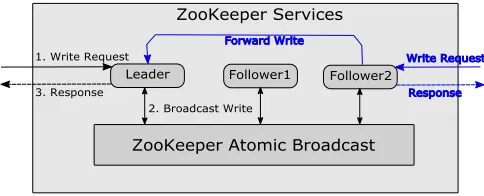
Servers are replicas of each other and each maintains a copy of the application state. Zookeeper clients can submit their requests to any one of the N servers. Requests may be broadly categorised as read or write; the latter seek state modification while the former do not. Read requests are serviced by the receiving server itself. Write requests, as illustrated in Figure 1, are first subject to total ordering through an execution of ZooKeeper atomic broadcast (Zab) protocol and then are processed concurrently by all servers as per the order decided. If a write request requires a response in return, then only the server that received the request directly from the client responds.
Let Π ={p1, p2, ...., pN} denote the set of Zab processes, one in each server. One of the Zab processes is designated as theleader and the rest asfollowers. As in 2-Phase commit protocol, only the leader can initiate atomic broadcasting of m, abcast(m) for short, and the followers execute Zab by responding to what they receive. So, when a follower receives
ZooKeeper Services
ZooKeeper Atomic Broadcast
Leader Follower1 Follower2
1. Write Request
3. Response
2. Broadcast Write
Response Write Request Forward Write
Fig. 1: Handling of Write Requests in ZooKeeper
a write requestm for ordering, it forwards m to the leader for initiating abcast(m) (see Fig1). When Zab execution for mterminates, both leader and followers delivermlocally for processing, and this delivery event is denoted asabdeliver(m). Since the leader can crash any moment, Zab, like its intel-lectual ancestor Paxos [8], exploits the notion of quorums: a quorumQis any majority subset ofΠand any two quorums must intersect.
Let Q be the set of all quorums in Π: Q = {Q : Q ⊆ Π∧ |Q| ≥ dN+1
2 e}. For any twoQ, Q
0 ∈Q: Q∩Q06={ }.
For example, whenN = 3,
Q={{p1, p2},{p2, p3},{p3, p1},{p1, p2, p3}}.
By thelivenessarguments in [1] (see Claim 7), one process gets elected as the new leader when the current leader crashes, so long as a quorum of processes are correct and can communicate in a timely manner. The new leader starts
abcasting after it has synchronised its abdelivered message history with those of the followers that elected it.
Let historyHi(t)denote the ordered sequence of messages
abdelivered by pi until (real) timet. (The sequence order is the order in which messages in Hi(t) were abdelivered by pi.) Zab guarantees the following (see [1] for details) which ensure that the service state remains mutually consistent across all correct replicas:
G1- Validity: If the leader does not crash until it completes
abcast(m), then m∈Hi(t)for any correctpi at somet. G2- Integrity: if m∈Hi(t)for any pi, abcast(m) occurred at somet0 < t.
G3- Total Order and Agreement: At any timetand for any two pi and pj ∈Π: either Hi(t) =Hj(t) or one is a prefix of the other.
A. Zab Protocol
Zab consists of the following steps.
• L1: Leader initiatesabcast(m)by assigningma sequence numberm.cand broadcastingmto all processes (includ-ing itself );
• F1: A follower, on receiving m (with m.c) from the leader, logs m and then sends an acknowledgement,
ack(m), to the leader;
• L2: Leader executes F1, sending ack(m) to itself. Upon receivingack(m) from a quorum, it sendscommit(m)to all processes (including itself );
• F2: A follower, on receivingcommit(m), executes
• L3: Leader, on receiving commit(m) (from itself ), exe-cutesabdeliver(m).
Zab protocol steps ensure the following invariant holds for every abdeliver(m):
Zab Invariant on abdeliver: If a process executes
abde-liver(m), then all processes in someQ∈Q have loggedm. The invariant is essential for correctly replacing a crashed leader: any m that might have been abdelivered under the old leadership is guaranteed to be abdelivered by the new leader since the quorum that elects the latter must intersect with Q.
III. Zab Variations with Additional Assumptions Assumption A2 is retained, A1 modified into A1.1 and A1.2, and A3 additionally made.
A. Assumptions
A1.1 - Leader Crash and Recovery: When the leader server crashes and recovers subsequently, it does not attempt to join the system until its successor has been installed, i.e., the recovery from its crashing is complete.
Note that Zab tracks leadership changes through epoch numbers [1]. Thus, when a process logs the epoch number in which it acts as a leader, it can, on recovery, suspend joining the system until the current epoch number is larger.
A1.1 can block leader election. Assume N = 3 and p1 is the leader in epoch 1. Following the crash of p1, letp2 also crash and thenp1 recovers. Even though a quorum{p1, p3} isnow correct, leader cannot be elected unlessp1takes part in the election. Assumption A1.2 forbids crash ofp2 in such circumstances.
A1.2 - Server Crashes: No process can fail when exactly dN+1
2 eprocesses in Πare executing the protocol.
Thus, a quorum remains operative always, allowing a new leader to be elected when a leader crashes and abdeliver to continue when a follower crashes.
A2 - Server Communication: Same as A2 in §II.
A3 - Follower Crash Suspicions: Followers monitor each other’s operative status and can thereby suspect a follower crash. This will require followers periodically exchanging ’heart-beat’ messages with each other. In our evaluations, servers make use of JGroups membership views to become aware of other server crashes.
B. Definitions and Lemma
For `, 1 ≤ ` ≤ N, let Q
` denote the set of all quorums that contain p` and Q¯
` be its complement: Q`={Q:Q∈Q∧p`∈Q}, andQ¯`=Q−Q`. For example, Q
1 = {{p1, p2},{p3, p1},{p1, p2, p3}}, and ¯
Q1={{p2, p3}}, whenN = 3. Let q¯
`={Q`− {p`}:Q`∈Q`}. Again, withN= 3 as an example, q¯
1={{p2},{p3},{p2, p3}}. Note thatq¯
`∈q`¯need not be a quorum and|q`¯| ≥ d N−1
2 e. Lemma: Anyq¯
`∈q`¯and any Q0∈Q¯` must intersect. Proof: By definition, q¯
` S
{p`} and Q0 are quorums which must intersect. The common process p cannot be p` since p`6∈Q0. ∴p∈q¯
` must hold and hence the lemma.
C. Design Approach
Implicit Acknowledgements. In one protocol, a follower does not transmit ack(m) for every m it receives from the leader, and may at times omit such transmissions in an attempt to reduce the traffic at the leader. When ack transmissions are skipped, an ack(m) from a given follower not only acknowledgesm (with sequence number m.c), but also will indicate an implicit acknowledgement for allm0sent by the same leader withm0.c < m.c.
The leader willabdeliver(m) once it receives a quorum of either implicit or explicit acknowledgements form. Note that a given m0 is implicitly acknowledged multiple times, i.e., whenever an ack(m), m.c > m0.c, is received. Any one of them from a given process suffices to build the necessary quorum.
Use of implicit acknowledgements does not undermine the correctness due to A2 (reliable communication and sent-ordered message reception) but can delayabdelivery. Commit Messages. Leader does not sendcommit messages to followers which decide onabdelivery by themselves. Invariants onabdeliver. Zab invariant stated earlier holds only when the leaderabdelivers m. For followers:
Follower Invariant on Abdelivery: If a follower process
abdelivers mthat wasabcast by leaderp`, then all followers in someq¯
`∈q`¯have loggedm. Recall that|q¯
`| ≥ d N−1
2 e. This means that a follower can
abdeliver mas soon as at least dN−1
2 efollowers are known to have logged m; in particular, it is not conditional on p` loggingm. Whenp` does logm, the original Zab invariant holds sinceq¯
` S
{p`} is a quorum.
Thus, the follower invariant eventually leads to Zab in-variant, if p` does not crash. If p` does crash, it cannot, by A1.1, take part in the subsequent leader election; by A1.2, a quorum Q0 ∈ Q¯
` must exist to elect the new leader. By lemma,q¯
` andQ0 intersect; so, the new leader is guaranteed toabdeliver anymthat could have beenabdeliveredwhenp` was the leader. We note that Zab mechanisms for recovering from leader crashes can be used unchanged in all variants proposed.
Switch to/from Zab: One of the protocols proposed in this section is designed to perform well when allN−1followers are correct. It is also designed to switch to Zab whenever a follower crash is observed, and back to itself when the crashed follower joins the system. Assumption A3 is used for this purpose.
D. Leader Protocol
The steps executed by the leader are the same in all variations proposed here. They are as follows.
• L1: Leader initiatesabcast(m)by assigningma sequence numberm.cand broadcastingmto all processes (includ-ing itself );
• L2: On receivingm(withm.c) from itself, it logsmand then sends an acknowledgement,ack(m), to itself;
• L4: Leader, on receiving commit(m), executes
abde-liver(m).
E. Protocol 1
1) Protocol 1.1: ZabAc: It works only when N = 3 and allows a follower to ’Ack and commit’ without waiting for a commit from the leader nor having any interaction with the other follower. (Hence the name ZabAc, Zab appended with ’Ac’ for ack and commit.) The protocol steps for a follower are as follows.
• F1: A follower, on receiving m (with m.c) from the leader, logsm;
• F2: It then sends ack(m) to the leader and to itself;
• F3: After receiving ack(m), it executesabdeliver(m). When N = 3, each follower forms a q¯
`; so, the follower invariant holds.
ZabAc is thus a simple protocol: it involves no switch to or from Zab nor uses implicit acknowledgements. Message complexity is 4 unicasts per abcast and abdelivery at followers is faster compared to Zab.
2) Protocol 1.2: ZabAa: It is an extension of ZabAc forN > 3. Instead of unicasting ack(m) only to the leader,ack(m) is broadcast to all. (Hence the name ZabAa: Zab appended with ’Aa’ for ack-all.) A follower abdelivers(m) once at least f = dN−1
2 efollowers are known to have loggedm. Its protocol steps are as follows.
• F1: A follower, on receiving m (with m.c) from the leader, logsm;
• F2: It then sends ack(m) to the leader and to followers (including itself );
• F3: On receiving ack(m) from f followers, it sends a
commit(m) to itself.
• F4: On receiving commit(m), it executesabdeliver(m). Message complexity is N(N − 1) unicasts per abcast and increases quadratically with N. Though abdelivery at followers can be expected to be faster, increased message handling may slow down their responses. These will be analysed in Section IVwhere we consider up to N = 9.
Next protocol seeks to reduce message complexity by conditioning the sending of acknowledgements by followers to outcomes of coin tosses.
F. Protocol 2: ZabCt
Each follower has a coin withprob(Head)=p. After logging m, it sends an ack(m) to itself and tosses the coin; if the outcome is Head, the follower behaves as in ZabAc or ZabAa; otherwise, it does nothing. It makes use of implicit acknowledgements for deciding on abdelivery and the steps are as follows.
• F1: A follower, on receiving mfrom the leader, logsm;
• F2: It sends ack(m) only to itself and tosses the coin;
• F3: If (coin = Head) then it sends ack(m) to the leader; ifN >3, it sendsack(m) to all other followers;
• F4: On receiving ack(m) or an implicit ack form from f followers, it sends acommit(m)to itself.
• F5: On receivingcommit(m), it executesabdeliver(m).
1) Optimal Value for p: Ideally, we would prefer exactly f followers to get Head, when they toss their coins for every given m sent by the leader. This will ensure that the leader has (f + 1) ack(m) and each follower f ack(m), and all processes abdeliver m without relying on implicit acknowledgements which will only delayabdelivery ofm.
For simplicity, assume that N is odd and all servers are correct. Thus,n=N−1is the number of followers that toss the coin on receiving m;f =dN−1
2 e= n
2 whenN is odd. Thus,n= 2f and(n−f) =f. The Binomial probability that f of thesen(independent) coin tosses are heads, is given by:
B(n, f) = nfpf(1−p)n−f = nfpf(1−p)f.
B(n, f) is a concave function ofp, withB(n, f) = 0for p= 0and p= 1, and has its maxima for some0< p <1.
˙
B(n, f) = 0⇒(1−pp)f = ( p 1−p)
(f−1).
When p = 0.5, B(n, f) = 0˙ and B(n, f¨ ) < 0,∀f ≥ 1. Thus,B(n, f)is at its maximum when the coin is fair. Remark 1: Total Message Cost.
The expected number of Heads from n independent coin tosses is np. Thus, the expected message complexity per
abcast is (N −1) + (N −1)p(N −1). When p = 0.5, it becomes(N−1) + 0.5(N−1)2 which is now quadratic only on(N−1). Note that it is the same as the message cost in ZabAc whenN = 3.
Remark 2: Incoming Traffic at the Leader.
Note also that the leader in ZabCt, irrespective of N, is expected to receive 0.5×(N −1) followeracks per abcast, which is just half of those it receives in ZabAc and ZabAa. For example, the leader in ZabCt with N = 3 is expected to receive one follower ack per abcast, while it receives 2 followeracksin ZabAc. Of course, this reduction in incoming traffic at the leader is at the cost of any additional waiting to receive implicit acknowledgements when more than f followers getTail outcomes for a givenabcast.
Remark 3: Role of abcasting Rate.
When a follower tosses its coin on successive abcast receptions, the expected number ofTailoutcomes before the first Head is 1−p
p = 1. Thus, if a follower skips transmitting anack once, it is expected that it would transmitack(m) for the next abcast(m) it receives. This means that the more frequently the leader abcasts, the less would be the extra
abdelivery delay imposed by implicit acknowledgements.
G. Switching Between Zab and ZabCt
Protocol switching is based on followers suspecting each other’s crash and it must therefore account for the possibility that a suspicion can be wrong and be reversed: a follower pi that suspects crash of follower pj can receive a delayed heartbeat message later from pj and reverse its suspicion subsequently.
resetting p = 0.5 and (ii) setting ai.zab = 0 in any ack it broadcasts.
Whenever the leader p` receives an ack(m) withzabfield set to 1, it sends commit(m) message to the sender of that
ack when it sends, or if it has already sent, commit(m) to itself.
Observe that when a follower pj does crash, Zab will be executed with all followerackshaving theirzabfield set to 1; when all followers are correct and none suspects any other, ZabCt will be executed with zabfield inacksset to 0.
IV. Experiments and Performance Comparison In this section, we compare the performances of the proto-cols under different load conditions. Atomic broadcast latency and throughput are the two metrics used for comparison.
We use 250 concurrent clients distributed equally on 10 identical machines; each machine thus hosts 25 clients. At most 9 machines were dedicated to running the protocols, thus covering N = 3,5,7,9. Machines used in our experi-ments are commodity PCs of 2.80GHz Intel Core i7 CP U and 8GB of RAM, running Fedora 21 and communicating over 100 Mbps Switched Ethernet. Connections between machines were established at the beginning of the experiment.
The protocols, including Zab, were implemented in Java ( JDK 1.8.0) on the top of the JGroups framework. JGroups is a toolkit for reliable communication and also supports crash detection, joining of recovered process and installation of group membership views [9]. Messages are transmitted using JGroups’ FIFO reliable UDP, more precisely, by using UNICAST3 protocol in JGroups suite which is functionally identical to TCP.
Each client generates a read or write request with a payload of 1Kbytes and sends the request to one ofNservers. If the request is of readtype, then the server simply returns the request as the response; if the request is ofwritetype, the server (if it is not the leader) forwards it forabcasting; when a server abdelivers a request it had received directly from a client, it sends the request back to the client as the response. Thus, no read/write operations actually occur since the aim is to measure and compareabdeliverylatencies and throughput. On receiving the response, the client repeats its action and selects the destination server in a round-robin manner. Thus, there are at most 250 client requests being handled by the servers.
We use write-ratio, W R,0< W R≤1, for clients to vary the load they impose on servers. For every write request that a given client generates, it will generate 1−W R
W R read requests; in other words, W R >0 is the probability that a request generated by a client is of write type. Experiments reported consider W Rvalues of25%,50%,75% or100%.
In an experiment, where the protocol, W R and N are fixed, clients send, and receive responses for, a total of10000 write requests after the warm-up phase. For example, if W R= 50%, the server system will process 10000
0.5 = 20000 read/write requests, i.e., each of the 250 clients will issue80
requests. Note that servers handle at most250×W Rabcasts at any moment.
Let t0 and t1 be the instants when a server receives a request from a client andabdelivers that request respectively; t1−t0 defines the abdelivery latency for that request. We compute the average of 10000 such latencies and repeat the experiment 20 times for a confidence interval of 95%. Throughput is defined as the number ofabdeliveriesmade by all servers per unit time and is computed, like latencies, with a95% confidence interval.
Experiments are run in failure-free and suspicion-free scenarios. Furthermore, servers do not log m in disk (as ideally required) but only record m in main-memory. Thus the performance figures we present here do not include disk write delays, but only network delays. This kind of evaluations correspond to the ’Net-Only’ category of the evaluations in [1] where several ways of logging have been considered. Since all protocol versions being compared re-quire logging ofmexactly at the same point in the execution for everyabcast(m), ignoring delays due to disk writes cannot invalidate the integrity of observations made and conclusions drawn from performance figures.
A. Observations
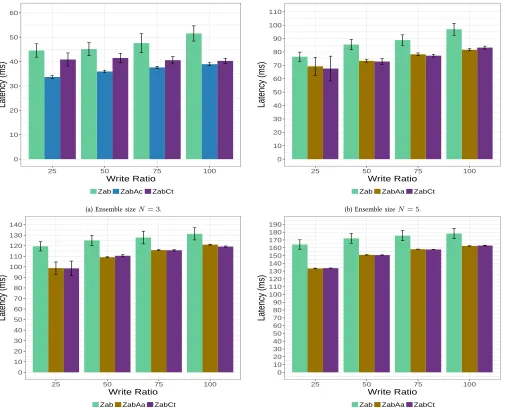
Figure2presents the latency figures for all three protocols for eachN = 3,5,7,9.
Let us first focus onN = 3depicted in Fig2a. Both ZabAc and ZabCt offer shorter latencies compared to Zab.
The difference between Zab and ZabAc increases as W R increases: about 12 ms at W R = 25% to 17 ms at W R= 100%. This can be attributed to the absence of commit message transmissions in ZabAc (also in ZabCt), and Zab followers having increased incoming traffic at higher loads.
What is interesting to note is the performance of ZabCt which nearly levels that of ZabAc when W R = 100%. Frequent abcasting leads to frequent coin-tosses which in turn reduce the delays due to the leader having to commit by receiving implicit acks from followers; moreover, the incoming traffic at the leader halves (Remark 2 in § III-F) when followers toss coins which will have the effect of reducing latencies at the leader.
Note that the followers in ZabCt do not suffer from implicit acks as they do not have to rely on each other’s acks for abdelivery. This advantage disappears in ZabCt for N = 5,7,9where a follower must await at least 1ack from another follower.
Considering the latency figures forN= 5,7,9, we observe the same trend between ZabAa and Zab as we did between ZabAc and Zab for N = 3. What is very different is the behaviour of ZabCt compared ZabAa which are nearly close at allW Rand the closeness tightening asN increases. This leads us to conclude that ZabCt is a desirable alternative to ZabAa from the perspectives of abdelivery latencies.
0 10 20 30 40 50 60
25 50 75 100 Write Ratio
Latency (ms)
Zab ZabAc ZabCt
(a) Ensemble sizeN= 3.
0 10 20 30 40 50 60 70 80 90 100 110
25 50 75 100 Write Ratio
Latency (ms)
Zab ZabAa ZabCt
(b) Ensemble sizeN= 5.
0 10 20 30 40 50 60 70 80 90 100 110 120 130 140
25 50 75 100 Write Ratio
Latency (ms)
Zab ZabAa ZabCt
(c) Ensemble sizeN= 7.
0 10 20 30 40 50 60 70 80 90 100 110 120 130 140 150 160 170 180 190
25 50 75 100 Write Ratio
Latency (ms)
Zab ZabAa ZabCt
(d) Ensemble sizeN= 9.
Fig. 2: Latency comparison.
well as, if not better than, Zab, differences due to coin-tosses are often within the widths of confidence interval.
V. Coin Tossing Under Assumptions A1-A3 Encouraged by the observations that coin-tossing and use of implicit acks do not seriously undermine abdelivery latencies, we consider upgrading ZabCt under original Zab crash-recovery assumptions. More precisely,
We restore Assumption A1 (see Section II), discard its restricted alternatives A1.1 and A1.3 (see Subsection III-A), retain A2 and A3. Thus, A3 is the only additional assumption made compared to Zab protocol. The upgraded version of ZabCt is denoted as ZabCT (with the upper-case T implying least restrictive assumptions). It involves minor changes in steps F3 and F4 of ZabCt:
• F1-F2: As in ZabCt (see subsection III-F);
• F3: If (coin = Head) then it sends ack(m) to the leader and to all other followers;
• F4: On receiving ack(m) or an implicit ack form from f+1followers, it sends acommit(m)to itself.
• F5: As in ZabCt.
A followerpicommitsmafter it knows thatf+1processes have logged m. Thus, ZabCT preserves the original Zab Invariant on abdelivery for followers as well. Therefore, it operates under assumption A1.
A follower waiting for 1 more ack(m) before doing
com-mit(m) additionally prolongs abdelivery latencies, whenever fewer than (f) other followers get a Head outcome when tossing for a givenabcast(m). A follower relies much more on (i) implicitacksand (ii) a different set of followers getting the
0 500 1000 1500 2000 2500 3000 3500 4000 4500 5000
3 5 7 9
Ensemble size
Throughput (ops/sec)
Zab ZabAc ZabAa ZabCt
Fig. 3: Throughput comparison for WR = 100%.
0 10 20 30 40 50 60
25 50 75 100 Write Ratio
Latency (ms)
Zab ZabCT ZabAA
Fig. 4: Latency comparison for Zab, ZabCT and ZabAA for N=3.
reflected in Step F3 above.
1) ZabAA with p =1: An interesting variation of ZabCT is whenpis fixed at 1, i.e.,(coin =Head)in step F4 returnstrue for everyabcast(m). This is similar to ZabAa, but operates for allN and under A1 and hence it is denoted as ZabAA. Also, it, unlike ZabAa, must switch to Zab when follower crashes are suspected.
Observe that the total message cost per abcast(m) in ZabAA is 6 when N = 3 which is the same as in Zab. In what follows, we compare the performance of Zab, ZabCT and ZabAA only for N= 3 - the most commonN for Zab.
A. Performance Comparison with N = 3
Fig 4 depicts the latencies of Zab, ZabAA and ZabCT. ZabAAabdeliversfaster than Zab as followers need not wait
for commit messages. ZabCT is even faster than ZabAA at all W R; this suggests that delays due to implicit acks are outdone by benefits of reduced message traffic due to coin toss. However, when we compare ZabAA and ZabCT with ZabAc and ZabCt forN = 3, the latter are much faster.
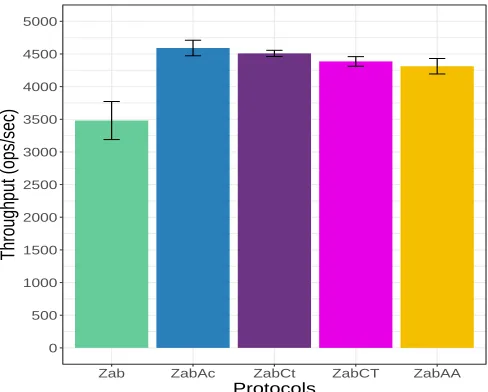
Fig 5 presents the throughput averages of all protocols for N = 3 at W R = 100% for an overall comparison. ZabAc outperforms all, closely followed by both coin-tossing protocols.
0 500 1000 1500 2000 2500 3000 3500 4000 4500 5000
Zab ZabAc ZabCt ZabCT ZabAA Protocols
Throughput (ops/sec)
Fig. 5: Throughput comparison for WR = 100% and N = 3.
VI. Related Works
As per [10], Zab belongs to the group of fixed sequencer protocols because the leader is responsible for establishing the order on abcast messages. The widely studied Paxos [8,11] is the intellectual ancestor of Zab. It permits different
abcasts to be made with the same m.c and resolves the conflict using ballots. Where as in Zab, there can at most be one leader at any moment and a new leader cannot commence its leadership role until a quorum of servers have disowned the old leader; there is no need for ballots. However, some abcasts may be permanently ’lost’ due to leadership change; i.e., they may not be abdelivered at all prior to or after the new leadership begins. Consequently Zab does not preserve the causal order delivery as traditionally understood [12].
Leader based protocols such as Zab tend to overload the leader disproportionately (compared to followers) and several authors [13, 14, 15, 16] have sought to remedy this drawback. S-Paxos [13], for instance, relieves the leader from broadcasting client requests by separating the roles of request dissemination and request ordering. Each process directly broadcasts client requests to others (instead of forwarding to the leader) and request ordering is done through Paxos executions using only request identifiers.
and increasing m.csuch that abcasts from all processes are uniquely and continuously numbered. It thus achieves a high throughput by balancing network utilization. However, the crash of any single server stops atomic broadcast delivery until recovery.
Chain replication [15] reduces the leader load by distribut-ing the role between two servers called the head and the
tail. The head is responsible for handling write requests and provides m.c for each write which it passes down the chain sequentially until received by the tail. This sequential transmission tends to increase abdelivery latencies for large N.
Broadcasting an acknowledgement is common in symmet-ric (leaderless) atomic broadcast protocols such as [5]. That it can help to avoid the leader broadcasting commit messages has been hinted by Zab authors themselves (e.g., [1]). In this paper, we explored this idea under various fault assumptions. Implicit acknowledgments and crash suspicions which we have used here are not new. The former are commonly used in TCP implmentations where they are also called cumulative acknowledgements. Suspecting crashes (using timeouts) is the basis for crash detection and building unreliable fail detectors [17] to ensure liveness in atomic broadcasting.
VII. Conclusion and Future Work
We have extended the well-known Zab protocol under its original fault assumptions as well as under a restricted fault assumptions which are yet practical. Extensions useack broadcasting - not an unknown idea - and coin tossing to reduce traffic at the leader. The latter is novel and, to the best of our knowledge, coin-tossing protocols are new.
Performance comparisons have been carried out without disk-based logging but the results still hold as logging is common to all protocols being compared. Two important conclusions emerge: restrictive fault assumptions do bring performance benefits when N = 3, the most common Zab configuration, in the form of ZabAc; secondly, coin-tossing is an effective alternative to naively broadcastingacks, irrespective ofWRandN, in both the restricted and the Zab fault assumptions.
We plan to pursue the coin-tossing approach to improving Zab performance under high loads in the light of Remarks made in SectionIII-F:pneeds to be adaptively chosen based on theabcastingrates observed and when number of correct followers is less than N−1but more thanf + 1.
References
[1] F. P. Junqueira, B. C. Reed, and M. Serafini, “Zab: High-performance broadcast for primary-backup systems,” in
IEEE/IFIP 41st International Conference on Dependable Systems & Networks (DSN), 2011, pp. 245–256.
[2] K. Shvachko, H. Kuang, S. Radia, and R. Chansler, “The hadoop distributed file system,” inIEEE 26th Symposium
on Mass Storage Systems and Technologies (MSST), 2010. IEEE, pp. 1–10.
[3] L. George,HBase: the definitive guide. ” O’Reilly Media, Inc.”, 2011.
[4] A. Toshniwal, S. Taneja, A. Shukla, K. Ramasamy, J. M. Patel, S. Kulkarni, J. Jackson, K. Gade, M. Fu, and J. Donham, “Storm@ twitter,” inProceedings of the 2014
ACM SIGMOD international conference on Management of data. ACM, pp. 147–156.
[5] P. Ruivo, M. Couceiro, P. Romano, and L. Rodrigues, “Exploiting total order multicast in weakly consistent transactional caches,” in IEEE 17th Pacific Rim
Interna-tional Symp. on Dependable Computing (PRDC), 2011. [6] R. Emerson and P. Ezhilchelvan, “An atomic-multicast
service for scalable in-memory transaction systems,” in
IEEE 6th International Conference on Cloud Computing Technology and Science, 2014, pp. 743–746.
[7] P. Hunt, M. Konar, F. P. Junqueira, and B. Reed, “Zookeeper: Wait-free coordination for internet-scale systems,” inUSENIX Annual Technical Conference, vol. 8, p. 9.
[8] L. Lamport, “Paxos made simple,” ACM Sigact News, vol. 32, no. 4, pp. 18–25, 2001.
[9] B. Ban, “Jgroups, a toolkit for reliable multicast commu-nication,”URL: http://www. jgroups. org, 2002.
[10] X. D ´efago, A. Schiper, and P. Urb ´an, “Total order broad-cast and multibroad-cast algorithms: Taxonomy and survey,”
ACM Computing Surveys (CSUR), vol. 36, no. 4, pp. 372– 421, 2004.
[11] T. D. Chandra, R. Griesemer, and J. Redstone, “Paxos made live: an engineering perspective,” inProceedings of
the twenty-sixth annual ACM symposium on Principles of distributed computing. ACM, pp. 398–407.
[12] L. Lamport, “Time, clocks, and the ordering of events in a distributed system,” Communications of the ACM, vol. 21, no. 7, pp. 558–565, 1978.
[13] M. Biely, Z. Milosevic, N. Santos, and A. Schiper, “S-paxos: Offloading the leader for high throughput state machine replication,” inIEEE 31st Symposium on Reliable
Distributed Systems (SRDS), 2012. IEEE, pp. 111–120. [14] Y. Mao, F. P. Junqueira, and K. Marzullo, “Mencius:
building efficient replicated state machines for wans,” inOSDI, vol. 8, pp. 369–384.
[15] R. Van Renesse and F. B. Schneider, “Chain replication for supporting high throughput and availability,” in
OSDI, vol. 4, pp. 91–104.
[16] L. Lamport, “Fast paxos,”Distributed Computing, vol. 19, no. 2, pp. 79–103, 2006.
[17] T. D. Chandra and S. Toueg, “Unreliable failure detectors for reliable distributed systems,” Journal of the ACM