1
KPIs identification for evaluating E-learning courses
through students’ perception
A. Caione
1, A.L. Guido
1, R. Paiano
1, A. Pandurino
1, S. Pasanisi
11 Department of Engineering for Innovation, University of Salento, Via per Monteroni, Lecce Italy
[email protected], [email protected], [email protected], [email protected], [email protected]
Abstract
The use of e-learning in education is an ever-increasing practice. E-learning could generate effective learning for education. There are several factors affecting the creation of successful e-learning for education as well as several criteria possibly applied to evaluate the effectiveness. The “traditional” way (questionnaire, interview, information system analysis) to measure effectiveness is not enough in e-learning measure of effectiveness because part of the information, that coming from social networks, will be lost. This paper, after identifying the Critical Success Factors (CSFs) of a synchronous e-learning system, and identifying the Key Performance Indicators (KPIs), proposes an approach for evaluation based on the analysis of information derived from social aspects. The paper proposes a set of CSFs and KPIs to study the students’ perception of e-learning platform and highlights how to measure the KPIs using social software information.
Keywords: E-learning, Critical Success Factors, Key Performance Indicators, Information Extraction, Sentiment Analysis, Social Media. Received on 14 January 2017, accepted on 06 June 2017, published on 20 June 2017
Copyright © 2017 A. Caione et al., licensed to EAI. This is an open access article distributed under the terms of the Creative
Commons Attribution licence (http://creativecommons.org/licenses/by/3.0/), which permits unlimited use, distribution and reproduction in any medium so long as the original work is properly cited.
doi: 10.4108/eai.20-6-2017.152743
1. Introduction
With the advance of information and communication technologies, e-learning has spread like a new modern educational paradigm.
One problem in the e-learning scenario is defining a useful method to evaluate an e-learning course. In effect, compared to the traditional teaching systems, in e-learning systems there are other aspects related to the use of technology and multimedia systems. An e-learning approach becomes sustainable when the use of computers in particular, and ICT in general, it can provide real added value to teaching, added value that could not be achieved with traditional tools and approaches. One of the major problem of distance learning compared to traditional training is the apparent lack of teacher who becomes a matter to be assessed for the effectiveness of e-learning systems.
The evaluation of education systems can be seen as a process in which one tries to indicate whether the learning experiences with educational software are effective [1]. It is very difficult to define good e-learning: a definition of good e-learning is in [2], where authors affirm that e-learning is
“good” if it provides the right people with the right skills at a reasonable cost in a timely manner.
It is possible to evaluate an e-learning course using the “traditional” approach based on information systems evaluation and other systems (e.g., questionnaires or tests). This approach, very useful to evaluate a business process in a company, may not to be sufficient in the e-learning field. With the advent of web 2.0 people express their opinion using typical web 2.0 tools, such as social networks and wiki. In [3] a survey and an analysis of the use of social software in education is proposed. The paper summarizes the characteristics and the existing problems of the educational application of various social software: the authors identify 438 articles as samples of the content analysis (Chine Journal FullText Database 2003–2008), which use blogs (335 items), wikis (51), social software (21), podcasts (20), and instant messaging (11) in education. Application areas include matters of most concern in teaching and professional development of the teacher, then knowledge management, web-based learning and other fields. The courses cover the following subjects: English, ICT, languages, physics, politics, etc. About the research-level, 78.4% of the articles come from universities and colleges. As for the research method (to assess the goodness of the method), it is seen that there is a
on e-Learning
Research Article
EAI Endorsed Transactions on
2 poor use of empirical methods (observations, investigations, experiments, analysis of the literature, content analysis, etc.) and a complete lack of non-empirical methods (theoretical discussions on a particular problem).
The rise of social software greatly facilitated the development of new type of education, bringing new teaching models, promoting educational renewal, optimizing the didactic resources, and endorsing the teachers’ growth and the sharing of knowledge and innovation. However, we must also note that the study of social software in education also has many problems and shortcomings and, for this reason, the research in the e-learning field is arousing considerable attention. In [3 there summarized many problems and deficiencies about the study of social software in Education. In details, the authors underline the following difficult in researches:
• uneven application areas: most social software are applied only to specific subjects such as language courses, and ICT course; while in other areas it are rarely used;
• the uneven study level: the theoretical aspects are explored by college researchers more than the front-line teachers;
• uneven research methods: there are imbalances between the theories and empirical research. Empirical research methods accounted only 6%. This is a greatly limits the scope and effectiveness of social software’s educational applications.
It is clear that a “simple” evaluation of e-learning courses using a traditional approach is not enough and the necessity to use data collected from the “social tools” (blog, wiki and so on) should be explored. In order to develop a systematic approach to the use of data derived from social software for e-learning evaluation, it is appropriate to adopt the Critical Success Factor (CSF) / Key Performance Indicator (KPI) analysis and apply it to this new source of data.
In this paper, we deepen the work described in [4] in which the authors describe a first step towards the evaluation of e-learning projects based on the learners’ discussions on social web pages.
Our idea is based on the identification of the CSFs and the KPIs in an education course scenario of synchronous e-learning. We define the social metrics for measuring the KPIs assessed with this social approach.
The use of a social approach is important as it allows us to capture the real perception that the student has with respect to an e-learning course: through a blog the student expresses his or her thoughts spontaneously. Spontaneity is difficult to catch with the classical methods. For example, the questionnaires are one way of gathering information from an e-learning system, but there are some problems with their usage, such as reluctance to answer questions, as well as guessing and the answer being time consuming.
In this paper, we propose also an idea to automatically measure the defined KPIs through the analysis of the information extracted from the learners’ opinions posted on some social web pages related to an e-learning course. To this end, it is possible to use the software platform, the
architecture of which is described in [4], after an upgrade and a customization of the platform itself for the e-learning scenario. This software platform has already been used, with remarkable results, in different agro-food contexts (e.g., wine, olive oil). For the purpose of this work, the KPI evaluation is facilitated by a new introduced feature of the software platform – that is, the ability to identify any positive, negative or neutral level of sentiment expressed by the learners in their discussions.
Section 2 describes the related work regarding the approaches and the assessment methodologies defined in the literature. Section 3 illustrates the methodology we propose and Section 4 illustrates an idea to measure the defined KPIs using a software platform for relevant information extraction and sentiment analysis. Finally, in Section 5, we draw some conclusions and discuss future work.
2. Related work
The works discussed in this paper are related to three main aspects analyzed for this paper: the study of Critical Success Factors in the e-learning systems; the study of Key Performance Indicators in the e-learning systems and the study of Sentiment Analysis, which is a very important aspect to understand the students’ perception.
2.1 Critical Success Factors (CSFs) in
e-learning systems
The concept of CSFs was defined in [5] as “those things that must be done if a company is to be successful”. The method of CSFs, developed by Rockart (1979), is a simple and inexpensive but successful method for choosing, generally, priority information. The CSFs can be defined, according to Rockart, as those few crucial areas where the company has to perfectly work to succeed in business. The CSFs are, therefore, areas of excellence [7]. It is possible to apply the idea of CSFs to the e-learning area.
In our previous work [4] we have widely described the concept of CSFs in e-learning systems. Since that work, we have further investigated CSFs in e-learning, looking to the more recent literature, with the aim to identify CSFs for the evaluation of e-learning systems and the KPIs to measure such factors.
In [8], the authors show that online courses are defined as having at least 80% of the course content delivered online, typically with little or no face-to-face learning (e.g., course management system (CMS), video conferences). The benefits of e-learning include: 1) 24-hour access to information, 2) up-to-date content materials, 3) self-paced learning, 4) customized courses, and 5) cost effectiveness. This work selected and studied a set of nineteen papers from databases of Chulalongkorn University published between the 2000 and the 2012. Based on the papers, the authors identified specific CSFs for e-learning in high education that are relevant for improving the efficiency of courses such as:
EAI Endorsed Transactions on
3 • institutional management that includes the following
sub-elements market research, program framework, operational plan and cost effectiveness;
• e-learning environment that is about the potential to develop appropriate learning environment in an online learning course. It contains the following sub-elements: course management system, technical infrastructure, interactive learning, access and navigation;
• instructional design that considers aspect such as clarify of objectives, content quality, learning strategies, psychology of learning, learning assessment;
• services support that include training, communication tools, help desk;
• course evaluation.
In [9], e-learning CSFs within a university environment have been grouped into four categories:
• Information technology (IT). It focuses on university IT infrastructure that must be rich, reliable and capable of providing the courses with the necessary tools to make the delivery process as smooth as possible. IT is critical to the success of e-learning. The IT tools are network bandwidth, network security, network accessibility, Internet availability, audio and video plug-ins, courseware authoring applications, instructional multimedia services, videoconferencing, course management systems, user interface;
• Instructor. He/She plays a fundamental role in the effectiveness of e-learning courses. The instructor’s IT expertise determines the effectiveness of e-learning; • Student. They need to have time management,
discipline, and computer skills in order to be successful in the e- learning area;
• University support. If the technical support is poor, the e-learning will not succeed. University administration support is essential.
The four key factors affecting the successful creation of an e-learning model for higher education are summarized in [10]: (1) human deliberation, which could be considered as “the processes undertaken by people which referred as people”; (2) instructional design, which is the practice of maximizing the effectiveness, the efficiency and the appeal of instruction and other learning experiences. It concerns the degree to which the course content is available online, how it is structured, the use of images and graphics, and the level of interaction among students and the lecturer and the type and quality of student assessment;
(3) development of technology;
(4) social delivery, which includes some items for measuring the success of e-learning, such as student participation, course content, course structure, financial support, cultural support, learning content and language support.
For the evaluation of these factors there were four major criteria applied to evaluate the performance of any operation. These are: a) cost efficiency – one important part of the e-learning value was the sum of an ability to save money and how much benefit is generated to the business; b) quality –
there are four levels of quality, including reaction, learning, performance, and results; c) service – in terms of easy accessibility and the quality of access; d) speed – how quickly an learning initiative is up and running, how quickly the e-learning initiative reaches everyone who needs the content, and how fast the e-learning initiative can be altered due to a change in the business or the need to distribute new or revised information.
2.2. Key Performance Indicators (KPIs) in
e-learning systems
KPIs are a set of indicators that measure the efficiency performance, level of service and quality of business processes [7]. The KPI approach is a flexible and popular approach to conducting performance measurement in organizations. KPIs can be used to assess almost any aspect of work performance, whether financial or non-financial, depending on the individual organization’s design.
KPIs give a clear picture for each individual in an organization, what is important for them and what they need to do [11].
In [12] are identified the following KPIs for e-learning: (1) effectiveness – the contribution of e-learning (object/program) to the degree of goal reaching; (2) costs (including project costs); (3) satisfaction – e-learning satisfaction (ELS), reaction and satisfaction; (4) effects on business processes; (5) cost–benefit ratio; (6) efficiency – tracking economic effort regarding the e-learning program; (7) material to stimulate lively and interactive learning processes; (8) project progress; (9) learning outcome. In [13] are defined the KPIs for e-learning systems, among which are: employee development, cost-benefit, performance improvement, knowledge gained, trainer performance, courseware performance, environment satisfaction. In [20] the KPIs for e-learning are presented. They concern the quality system, quantity and cost, according to the following scheme:
• Quality, including:
o Accuracy: the degree to which criteria matches a model without errors (the learning objectives of the e-learning program are measurable; the e-learning program improves computer skills of learners).
o Class: the comparative superiority of criteria (the e-learning program improves our core competencies; learners are satisfied with the e-learning program).
o Novelty: the degree of innovation represented (the e-learning program promotes interactive learning and student career development; it accommodates multiple styles of learning).
• Quantity, including:
o Rate: a productivity measure per unit time (the e-learning program increases usable knowledge and new skill transfer to the job; it improves learning efficiency).
o Timeliness: a measure of performance against
EAI Endorsed Transactions on
4 schedule (the e-learning program improves job performance immediately; it enables new skills to be immediately demonstrable).
o Volume: a measure of bulk or unit production (the e-learning program improves job capability and includes a sufficiently wide variety of topics). • Cost, including:
o Labor: employee time (the e-learning program reduces learning cost and it is easy to access).
o Material: cost of all material production resources (the e-learning program content is up to date and includes detailed content outlines)
o Management: includes the cost al all managerial resources (the e-learning program improves: manager coursework planning, organizational performance, communications).
2.3.
Sentiment Analysis
In unstructured document analysis, the sentiment represents the attitude expressed towards something (e.g., a product, a person). It can be positive, negative or neutral and it requires highly complex algorithms in order to be computed by software systems.
Research in the field of Sentiment Analysis, currently, shows a new emphasis, as demonstrated by the numerous works published in the last decade. To name but a few, in [14], the authors presented an overview of the techniques used for opinion and attitude detection within text documents. In [15] the authors focused on reviews of films. They ran experiments in Opinion Mining using Machine Learning techniques. In [16], the authors give the basis for the classification of text documents. Even space-time is an important factor in the process of Opinion Mining. In [17], the authors attempt to determine the political orientation of the users [18], through the analysis of the user opinion expressed by Tweets. They used supervised learning algorithms associated with the detection of emoticons. In e-learning, Sentiment Analysis could be useful in terms of understanding the learners’ perception about an e-learning course. The limitation of this technique is that it works well with text in English but not with text written in other languages.
3. Definition of the E-learning CSFs and
KPIs to understand student perceptions
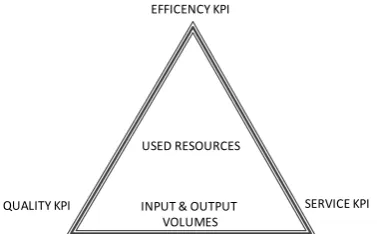
According to the studies reviewed in the ‘related work’ section, the e-learning CSFs can be grouped into five categories described in Step 1 of the methodology below. For the identification of KPIs in an e-learning education course scenario, we refer to the literature and, in addition, to a simplified approach to the identification of KPIs that is proposed through the use of the indicator triangle method [7] as showed in Figure 1.
Figure 1: Indicator Triangle Method
The method proceeds by identifying the "Resources Committed" in the system, the volumes of input and output, and the KPIs subdivided in three categories: service, quality and efficiency. After defining the KPIs, we select the KPIs that can be measured with social metrics and we define the social metrics for measuring those KPIs.
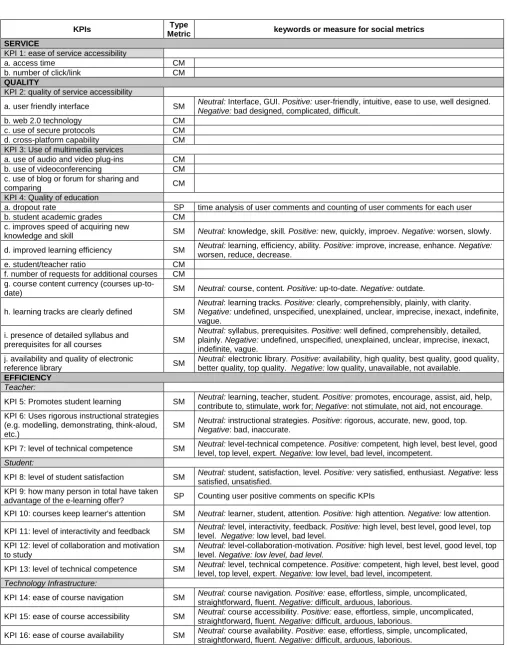
As we show in table 1, we propose as metrics for KPI measuring some examples of keywords, which map the information extracted by our system. The keywords are labelled in the following categories: neutral, positive and negative for identify the sentiment or the mood of users’ comments. Some KPIs are evaluable through statistical parameters extractable by blog. In table 1 the column “type metric” identifies three type of measure: Classic Metric (CM), Social Metric (SM), Statistical Parameters (SP) for each KPI.
The four steps in the identification of CSF and KPI are:
• Step 1: Identification of the areas of CSFs and analysis of the CSF elements;
• Step 2: Identification of KPIs;
• Step3: Selection of KPIs that can be measured with a social metrics;
• Step 4: Definition of social metrics for measuring KPIs.
In the following, we describe.
Step 1: Identification of the areas of CSFs and analysis of the CSF elements
The e-learning CSFs can be grouped in the following categories:
• Information Technology. Technology plays important role in delivering learning outcomes. The efficient and effective use of Information Technology in delivering e-learning based components of a course is of critical importance to the success and student acceptance of e-learning. IT tools include network bandwidth, network security, network accessibility, Internet availability, Cross-platform capability, Web 2.0 software, audio and video plug-ins, videoconferencing, course management systems, and user interface.
EFFICENCY KPI
QUALITY KPI SERVICE KPI
USED RESOURCES
INPUT & OUTPUT VOLUMES
EAI Endorsed Transactions on
5 • Human Factor. In [19], the authors explained that the
key main factor effecting to create e-learning model for higher education was human factor in terms of technical competency, e-learning mindset and level of collaboration of both instructor and student, and level of collaboration between instructors and students. In addition, the skills of instructor and student are important and affect e-learning success. The instructor’s features are technical competence, teaching style, interaction in class. The reference [6] suggested that instructors should adopt interactive teaching style, encourage student-student interaction. It is so important that instructors have good control over IT and is capable of performing basic troubleshooting tasks. The Students’ characteristics includes technical competence, student readiness to move online, student participation to study, perception of content and system, collaboration and interaction, motivation.
• Instructional design. In [10] Instructional Design is described as the practice of maximizing the effectiveness, efficiency and appeal of instruction and other learning experiences. It includes the following elements: clarify of objectives, content quality, learning strategies, psychology of learning [8]. Well-designed and selected courses content and learning material facilitate meaningful educational experiences that are essential for implementation of online learning materials.
• Cost Effectiveness. One important part of the e-learning value was the sum of an ability to save money and how much do the benefit generate to the business (enhance skill and knowledge, improve job performance, and impact results) [10]. Cost problems include budget to invest in the course, long-term sustainability, necessity of institutions to reduce costs. However, advancements in information technology are perceived by universities as the solution to the quality and cost problem (9). • Course Evaluation. The effective assessment of
e-learning is to evaluate and measure benefits resulting from e-learning implementation. Evaluation process must cover all aspects the online course, to ensure that e-learning systems achieve the objectives of the course. There were four levels of quality, included reaction (typical end-of-course evaluation or rating sheet); learning (evaluation simply as tracking strategy), performance (determination of the effectiveness) and results (often couched in a demand to prove that e-learning works and works better than others) [10].
Step 2: Identification of KPIs
Following the indicator triangle method [7] we identify the resources involved in an e-learning system: Teachers, Students and Technological Infrastructure. The input volumes are the contents to be dispensed while output
volumes are the knowledge acquired by students. In table 1 we classify the KPIs in service, quality and efficiency.
Step 3: Selection of KPIs that can be measured with a social metrics
Starting from the set of KPIs identified, we select those that can be assessed through a social metric using the system that we have developed. This analysis is shown in the table 1.
Step 4: Definition of social metrics for measuring KPIs In table 1, we define the social metric for the KPIs that can be assessed with a social metric approach. To define the social metric, we have proceeded in this way: for every KPI measurable with social metric we have analyzed the words that make up the indicator, researching the possible keywords that can be used in a human dialogue to qualify (in positive or negative) the aspects that this indicator describes. We have researched the possible synonyms of the keywords identified to try to have an exhaustive list of words that can be used in spoken language. Considering the KPI 2: quality of service accessibility, it depends by “user friendly interface” indicator. This indicator is evaluated considering the presence of the keyword such as interface, GUI, intuitive etc. which moods is evaluated, using the sentiment analysis, neutral, negative or positives. In table 1, there are details about all the KPI and the related keywords.
The keywords are then labeled in the following categories: neutral, positive and negative to identify the sentiment or the mood of users’ comments in the blog.
4. How to measure the defined KPIs
In order to measure, with the social metric, the KPIs defined in the previous section, our idea is to analyse the learners’ posts published on the social web pages related to an e-learning education course. To achieve this goal, we will use the software platform described in [4].
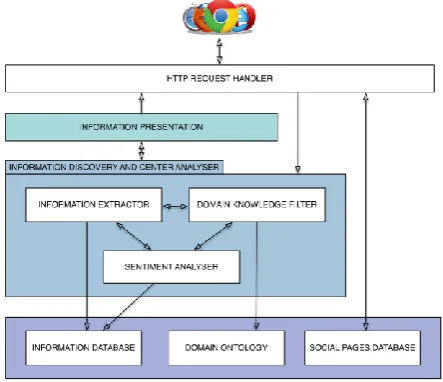
The architecture of the platform (showed in Figure 3) consists of the components below described.
HTTP Request Handler
The component queries the Social Pages Database in order to read and display to the user a list of social web pages, related to an e-learning course. The user request about the resources to analyse is forwarded to the Information Discovery and Sentiment Analyser macro module. This replies, through the Information Presentation component, showing the elaboration results.
Social Pages Database
It is the database that stores the web URLs of the social pages related to the e-learning course. This component is queried by the HTTP Request Handler in order to retrieve the list of social web pages.
EAI Endorsed Transactions on
6
Table 1: KPIs and Social Metrics
KPIs Type
Metric keywords or measure for social metrics
SERVICE
KPI 1: ease of service accessibility
a. access time CM
b. number of click/link CM
QUALITY
KPI 2: quality of service accessibility
a. user friendly interface SM Neutral:Negative: Interface, GUI. bad designed, complicated, difficult. Positive: user-friendly, intuitive, ease to use, well designed. b. web 2.0 technology CM
c. use of secure protocols CM d. cross-platform capability CM KPI 3: Use of multimedia services
a. use of audio and video plug-ins CM b. use of videoconferencing CM c. use of blog or forum for sharing and
comparing CM
KPI 4: Quality of education
a. dropout rate SP time analysis of user comments and counting of user comments for each user b. student academic grades CM
c. improves speed of acquiring new
knowledge and skill SM Neutral: knowledge, skill. Positive: new, quickly, improev. Negative: worsen, slowly. d. improved learning efficiency SM Neutral: learning, efficiency, ability. Positive: improve, increase, enhance. Negative:
worsen, reduce, decrease. e. student/teacher ratio CM
f. number of requests for additional courses CM g. course content currency (courses
up-to-date) SM Neutral: course, content. Positive: up-to-date. Negative: outdate. h. learning tracks are clearly defined SM
Neutral: learning tracks. Positive: clearly, comprehensibly, plainly, with clarity.
Negative: undefined, unspecified, unexplained, unclear, imprecise, inexact, indefinite, vague.
i. presence of detailed syllabus and
prerequisites for all courses SM
Neutral: syllabus, prerequisites. Positive: well defined, comprehensibly, detailed, plainly. Negative: undefined, unspecified, unexplained, unclear, imprecise, inexact, indefinite, vague.
j. availability and quality of electronic
reference library SM
Neutral: electronic library. Positive: availability, high quality, best quality, good quality, better quality, top quality. Negative: low quality, unavailable, not available.
EFFICIENCY
Teacher:
KPI 5: Promotes student learning SM Neutral: learning, teacher, student. Positive: promotes, encourage, assist, aid, help, contribute to, stimulate, work for; Negative: not stimulate, not aid, not encourage. KPI 6: Uses rigorous instructional strategies
(e.g. modelling, demonstrating, think-aloud, etc.)
SM Neutral: instructional strategies. Positive: rigorous, accurate, new, good, top.
Negative: bad, inaccurate.
KPI 7: level of technical competence SM Neutral: level-technical competence. Positive: competent, high level, best level, good level, top level, expert. Negative: low level, bad level, incompetent.
Student:
KPI 8: level of student satisfaction SM Neutral: satisfied, unsatisfied.student, satisfaction, level. Positive: very satisfied, enthusiast. Negative: less KPI 9: how many person in total have taken
advantage of the e-learning offer? SP Counting user positive comments on specific KPIs
KPI 10: courses keep learner's attention SM Neutral: learner, student, attention. Positive: high attention. Negative: low attention. KPI 11: level of interactivity and feedback SM Neutral: level, interactivity, feedback. Positive: high level, best level, good level, top
level. Negative: low level, bad level. KPI 12: level of collaboration and motivation
to study SM
Neutral: level-collaboration-motivation. Positive: high level, best level, good level, top level. Negative: low level, bad level.
KPI 13: level of technical competence SM Neutral: level, technical competence. Positive: competent, high level, best level, good level, top level, expert. Negative: low level, bad level, incompetent.
Technology Infrastructure:
KPI 14: ease of course navigation SM Neutral: course navigation. Positive: ease, effortless, simple, uncomplicated, straightforward, fluent. Negative: difficult, arduous, laborious.
KPI 15: ease of course accessibility SM Neutral: course accessibility. Positive: ease, effortless, simple, uncomplicated, straightforward, fluent. Negative: difficult, arduous, laborious.
KPI 16: ease of course availability SM Neutral: course availability. Positive: ease, effortless, simple, uncomplicated, straightforward, fluent. Negative: difficult, arduous, laborious.
EAI Endorsed Transactions on
7 Information Extraction
It extracts the significant keywords from the selected social web pages and for each of them it computes the sentiment. This component integrates existing third-party tools for content extraction and sentiment analysis from social web pages through NLP features along with IE by sentence segmentation, entity detection and relation detection. It interacts with the Information Database to store the extracted information, with the Sentiment Analyser component for the identification of the sentiment of the extracted information, with the Domain Knowledge Filter component to communicate with the learning ontology, that is the e-learning domain semantic representation in terms of concepts and relationships.
Domain Knowledge Filter
It is the component that interacts with the e-learning ontology and facilitates the comparison between the information extracted from the social web pages with the information of the e-learning domain. It filters out the not compliant information.
Sentiment Analyser
It is the component that analyses the keywords extracted and filtered by the Information Extraction and the Domain Knowledge Filter respectively, in order to identify the positive, negative or neutral meaning. The component integrates existing third-party tools that use Sentiment Analysis algorithms to look for words that carry a positive or negative sentiment.
Information Database
It is the database that contains the keywords extracted from the selected social web pages. For each keyword, this component stores information about the web URLs of the unstructured resources from which it has been extracted, its occurrence in each social page and the positive, negative or neutral sentiment.
Information Presentation
It is the component responsible for displaying to the user the social web page elaboration results, in the form of a tag cloud and/or tables. In the first form, each keyword is represented by a font of a size proportional to the number of occurrences in the text and a colour that suggests the sentiment level as showed in table 1. In the table, there are detailed information about a keyword selected by the user from those displayed in the tag cloud. In addition to the number of occurrences in the text and the sentiment level, it shows the social web pages in which the keyword is contained and the other keywords extracted from the same web pages. This platform has been improved through the use of the new version of the third-party AlchemyAPI (www.alchemyapi.com) APIs. This upgrade has led to a far clearer output in terms of significant extracted keywords beyond the ability to compute the level of the sentiment, that is the connotation positive, negative or neutral of each extracted keyword.
Figure 2: Architecture of the platform used to measure the KPIs
To evaluate the sentiment level, AlchemyAPI incorporates both linguistic and statistical analysis techniques. The first one uses a grammatical approach to understand how words combine into phrases, and how phrases combine into sentences. This technique works well with formal texts. The statistical analysis uses a mathematical approach and it is well suited with user-generated content. The combination of these techniques provides a greater accuracy in the sentiment evaluation of the information extracted from the social media. In order to employ the software platform in the analysis of the learners’ perception of an e-learning course, the platform itself must be adapted to the e-learning context.
In order to use the software platform in the analysis of the learners’ perception of an e-learning course, the platform itself must be adapted to the e-learning context.
To do that an ontology will be designed in order to model the e-learning domain. This means that it will contain the previously defined e-learning CSFs (information technology, human factor, etc.), KPIs (user friendly interface, improved learning efficiency, etc.) and keywords for social metric (user-friendly, intuitive, efficiency, decrease, etc.). So, the final ontology not only will describe the domain but it will permit the measurement of the KPIs through the analysis of the information retrieved from the learners’ opinions posted on the social web pages.
To be more precise, the output of the software platform is a tag cloud in which the extracted keywords are represented with different font sizes proportional to the number of occurrences in the text along with different colors that suggest the sentiment level (green for positive sentiment and red for negative one). In addition to this representation, a table form is useful to show the user detailed information about a keyword selected from the tag cloud.
EAI Endorsed Transactions on
8
Figure 3: The tag cloud output
They are the keyword number of occurrence in the text, the keyword sentiment level, the social web pages in which the selected keyword appears with the indication of the other keywords found in the same web pages. Furthermore, those keywords will be automatically mapped, if possible, with those contained in the e-learning ontology. In this way it would be possible to characterize the social metric of the KPIs and, as a consequence, to better understand what learners say about an e-learning education course.
5. Conclusions and Future Works
In the e-learning scenario, it is a good practice to define a method for the evaluation of the effectiveness of an e-learning course along with the achievement of the goals in order to better understand the learners’ point of view.
In this paper we propose an approach for the evaluation of an e-learning course in the education based on social metrics. It consists of the identification of the CSFs and the KPIs for an e-learning course and the definition of the social metrics in order to measure those KPIs to which a social approach can be applied. This approach, compared to others, assesses the real perception of the users of an e-learning course.
The paper also proposes an approach that seen the employ, the customization with the design and the development of an e-learning ontology along with the upgrade, in terms of APIs, of the system platform described in [4] which is useful in implementing the idea; in effect it can analyze and extract relevant keywords from the users’ experiences posted on social web pages and can compute the sentiment level of each retrieved information. These keywords will be then mapped, in the e-learning ontology, with those defined and associated with the relative KPI social metric in order to characterize the
KPIs from a quantitative (number of occurrences in text) and qualitative (sentiment level computed) point of view. As a result, the proposed approach could support the e-learning domain expert in identifying the strengths and the weaknesses of e-learning projects.
As future developments, we will work on a real use case in the education field: for the evaluation of the approach, it was considered a group of students (about eighty students) of the "Information Systems" course of the Master degree in Business Administration of Faculty of Economics. The students use a social platform available on the intranet of the University in order to insert comments about the course. Then we will analyse these statements to evaluate the proposed approach. We will analyse the goodness of the KPIs we have defined, the software platform developed and we will provide qualitative considerations about the KPIs themselves.
References
[1] Kelly, G.: A collaborative process for evaluating new educational technologies. Campus-Wide Information Systems, 25(2), 105-113 (2008)
[2] Dust, B.: The eLearning Guild’s Online Forums – Elearning
Metrics That Work (2007),
http://www.elearningguild.com/olf/olfarchives/index.cfm?id= 356&action=viewonly
[3] Haiyan, Z., Huanjing, W.: Survey and analysis of the use of social software in education. In 2010 International Conference on E-Health Networking Digital Ecosystems and Technologies (2010)
[4] Paiano R., Caione A., Guido A.L., Pandurino A., Pasanisi S.: E-learning project assessment: A new approach through the analysis of learners’ posts on social media. EAI Endorsed Transactions on e-Learning (in press)
[5] Freund, Y. P.: Critical success factors. Planning Review, 16(4), 20-23 (1988)
[6] Volery, T. and Lord, D. (2000) Critical success factors in online education. The International Journal of Educational Management 14(5): 216–223.
[7] Bracchi, G., Francalanci, C., Motta, G.: Sistemi informativi aziendali in rete, McGraw-Hill (2001)
[8] Cheawjindakarn, B., Suwannatthachote, P., Theeraroungchaisri, A.: Critical success factors for online distance learning in higher education: A review of the literature. Creative Education, 3(08), 61 (2013)
[9] Selim, H. M.: E-learning critical success factors: an exploratory investigation of student perceptions. International Journal of Technology Marketing, 2(2), 157-182 (2007)
[10]Prougestaporn, P., Visansakon, T., Saowapakpongchai, K.: Key Success Factors and Evaluation Criterias of e-Learning Websites for Higher Education. International Journal of Information and Education Technology, 5(3), 233 (2015) [11]Slizyte, A., Bakanauskiene, I.: Designing performance
measurement system in organization. Organizacij Vadyba. Sisteminiai Tyrimai, 43, 135-148 (2007)
[12]Hilgarth, B.: E-Learning success in action! From case study research to the creation of the cybernetic e-learning management model. e-Learning, 2004, 1-2 (2009)
[13]The eLearning Guild’s Online Forums – Strategies for Measuring the Value of e-Learning (2005), http://www.elearningguild.com/handouts/378_h1.pdf
!
delay
slow
contents
punctuality
engage
difficult
change
clear
research
socialunbundling
space structure
including goal
approach
education
developingdifferent
partecipants
happens impact unreadable
expert focus
process
work
adaptive
EAI Endorsed Transactions on
9 [14]Ravi, K., Ravi, V.: A survey on opinion mining and sentiment
analysis: tasks, approaches and applications. Knowledge-Based Systems, 89, 14-46 (2015)
[15]Pang, B., Lee, L., Vaithyanathan, S.: Thumbs up: sentiment classification using machine learning techniques. In Proceedings of the ACL-02 conference on Empirical methods in natural language processing - Volume 10 (pp. 79-86). Association for Computational Linguistics (2002)
[16]Liu, B.: Sentiment Analysis and Subjectivity. Handbook of natural language processing, 2, 627-666 (2010)
[17]Maynard, D., Funk, A.: Automatic detection of political opinions in tweets. In The semantic web: ESWC 2011 workshops (pp. 88-99). Springer Berlin Heidelberg (2011) [18]Go, A., Bhayani, R., Huang, L.: Twitter sentiment
classification using distant supervision. CS224N Project Report, Stanford, 1, 12 (2009)
[19]Soong, M. B., Chan, H. C., Chua, B. C., Loh, K. F.: Critical success factors for on-line course resources. Computers & Education, 36(2), 101-120 (2001)
[20] Brian Petersen: Measuring e-Learning Program Effectivenes, LAP LAMBERT Academic Publishing (2010)
EAI Endorsed Transactions on