• No results found

First-Order Fire Effects Models for Land Management: Overview and Issues

N/A
N/A
Protected

Academic year: 2020

Share "First-Order Fire Effects Models for Land Management: Overview and Issues"

Copied!
12
0
0

Loading.... (view fulltext now)

Full text

(1)

Forum: Issues, management, PolIcy, and oPInIons

F

IRST-

O

RDER

F

IRE

E

FFECTS

M

ODELS FOR

L

AND

M

ANAGEMENT:

O

VERVIEW AND

I

SSUES

Elizabeth D. Reinhardt1,* and Matthew B. Dickinson2

1Forest Service, Missoula Fire Sciences Laboratory, 5785 West Broadway Street, Missoula, Montana 59808, USA

2Forest Service, Northern Research Station, 359 Main Road, Delaware, Ohio 43015, USA

*Corresponding author: Tel.: 001-406-329-4760; e-mail: [email protected]

ABSTRACT

We give an overview of the science application process at work in supporting fire man-agement. First-order fire effects models, such as those discussed in accompanying papers, are the building blocks of software systems designed for application to landscapes over time scales from days to centuries. Fire effects may be modeled using empirical, rule based, or process approaches. Fire effects software systems can be used to conduct risk assessments, develop prescriptions for fuel treatments or prescribed fire, or support long-term planning. A brief review of the software systems available and the fire effects mod-els on which they are based is presented. We consider the future of software systems for fire management and, given gaps in fire effects modeling capabilities, how to strengthen their foundation.

Keywords: empirical models, first-order fire effects, land management applications, process mod-els, rule-based models

Citation: Reinhardt, E.D., and M.B. Dickinson. 2010. First-order fire effects models for land management: overview and issues. Fire Ecology 6(1): 131-142. doi: 10.4996/fireecology. 0601131

INTRODUCTION

Fire effects are the results of combustion. They include direct, or first-order effects on a wide variety of ecosystem components— plants, animals, dead biomass, soils, and air, as well as indirect, or second-order effects that take place over time and depend in large part on post-fire phenomena such as weather, land-use, seed availability, and insect and disease occurrence (Reinhardt et al. 2001). Important first-order fire effects include plant injury and

(2)

second-Fire Ecology Volume 6, Issue 1, 2010

doi: 10.4996/fireecology.0601131 Reinhardt and Dickinson: First-Order Fire Effects ModelsPage 132

order effects. Modeling fire effects to provide information for land managers is difficult for three reasons: 1) the intrinsic variability of the natural systems being modeled is large; 2) the data needed for modeling with precision may not be available to decision-makers; and 3) the information needs of land managers are di-verse and require predictions at a variety of temporal and spatial scales.

MODELS AND SOFTWARE SYSTEMS

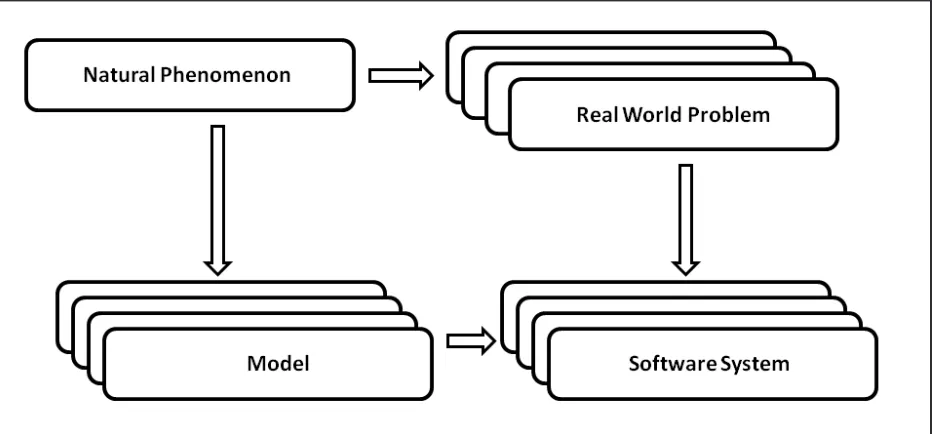
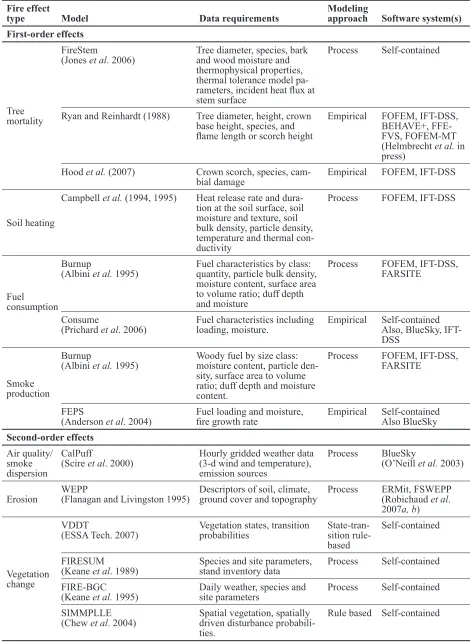
In this paper, we use the term model to re-fer to predictive relationships representing nat-ural phenomena that may be housed in various software systems, and used to answer a variety of management questions (Figure 1). A soft-ware system might contain one or several models, packaged in such a way as to support use for a particular management application. For practical purposes, in an extremely applied field such as forestry or fire science, the line between a model and a software system is of-ten blurred. Table 1 lists a number of fire ef-fects models and the software systems that house them. Many other models may incorpo-rate fire effects as one aspect of a more general

vegetation model. This list is limited to mod-els whose primary purpose is predicting fire effects. Some fire effects models are included in a number of software systems. For exam-ple, a single model of fire caused tree mortality (Ryan and Reinhardt 1988) is used in the First Order Fire Effects Model (FOFEM, Reinhardt 2003), the Fire Behavior Prediction System (BEHAVE+, Andrews et al. 2005), and the Fire and Fuels Extension of the Forest Vegeta-tion Simulator (FFE-FVS, Reinhardt and Crookson 2003). Ideally, the converse would also be true—a software system might include a number of alternative fire effects models. FOFEM was designed with this intent; howev-er, in practice, alternative models are provided only for tree mortality and duff consumption predictions.

WHY MODEL FIRST-ORDER FIRE EFFECTS?

What kinds of management needs have driven software development? Table 2 lists a number of software systems used for a variety of land management applications. Fundamen-tally, managers want to understand how their

(3)

Fire effect

type Model Data requirements Modeling approach Software system(s)

First-order effects

Tree mortality

FireStem

(Jones et al. 2006) Tree diameter, species, bark and wood moisture and thermophysical properties, thermal tolerance model

pa-rameters, incident heat flux at

stem surface

Process Self-contained

Ryan and Reinhardt (1988) Tree diameter, height, crown base height, species, and

flame length or scorch height

Empirical FOFEM, IFT-DSS, BEHAVE+, FFE-FVS, FOFEM-MT (Helmbrecht et al. in press)

Hood et al. (2007) Crown scorch, species,

cam-bial damage Empirical FOFEM, IFT-DSS

Soil heating

Campbell et al. (1994, 1995) Heat release rate and dura-tion at the soil surface, soil moisture and texture, soil bulk density, particle density, temperature and thermal con-ductivity

Process FOFEM, IFT-DSS

Fuel consumption

Burnup

(Albini et al. 1995) Fuel characteristics by class: quantity, particle bulk density, moisture content, surface area to volume ratio; duff depth and moisture

Process FOFEM, IFT-DSS, FARSITE

Consume

(Prichard et al. 2006) Fuel characteristics including loading, moisture. Empirical Self-containedAlso, BlueSky, IFT-DSS

Smoke production

Burnup

(Albini et al. 1995) Woody fuel by size class: moisture content, particle den-sity, surface area to volume ratio; duff depth and moisture content.

Process FOFEM, IFT-DSS, FARSITE

FEPS

(Anderson et al. 2004) Fuel loading and moisture, fire growth rate Empirical Self-containedAlso BlueSky Second-order effects

Air quality/ smoke dispersion

CalPuff

(Scire et al. 2000) Hourly gridded weather data (3-d wind and temperature), emission sources

Process BlueSky

(O’Neill et al. 2003)

Erosion WEPP (Flanagan and Livingston 1995) Descriptors of soil, climate, ground cover and topography Process ERMit, FSWEPP (Robichaud et al. 2007a, b)

Vegetation change

VDDT

(ESSA Tech. 2007) Vegetation states, transition probabilities State-tran-sition rule-based

Self-contained

FIRESUM

(Keane et al. 1989) Species and site parameters, stand inventory data Process Self-contained FIRE-BGC

(Keane et al. 1995) Daily weather, species and site parameters Process Self-contained SIMMPLLE

(Chew et al. 2004) Spatial vegetation, spatially driven disturbance probabili-ties.

Rule based Self-contained

(4)

Fire Ecology Volume 6, Issue 1, 2010

doi: 10.4996/fireecology.0601131 Reinhardt and Dickinson: First-Order Fire Effects ModelsPage 134

decisions and actions can be expected to play out through time, and how to achieve the best outcomes and minimize damage. Management needs can be characterized as falling into the categories of risk assessment, prescription de-velopment, or long-term planning.

Risk Assessment

Managers may predict fire effects in order to assess a variety of kinds of risk. For exam-ple, tree mortality and duff consumption mod-els might be used to assess which areas are most vulnerable to undesirable fire effects and should therefore have priority for fuel treat-ment. Often qualitative, rule based predictions may be sufficient for this purpose; for exam-ple, areas with high fuel loadings and steep slopes are more at risk of erosion following wildfire. Another kind of risk assessment for which first-order models are useful is smoke impacts. In this case, first-order fuel consump-tion and smoke producconsump-tion models are primar-ily useful as inputs to a smoke transport or air quality model. For example, the BlueSky modeling framework (http://www.airfire.org/

bluesky/) takes emission production estimates from the Fire Emission Production Simulator (FEPS, http://www.fs.fed.us/pnw/fera/feps/in-dex.shtml) and feeds them to an air dispersion model (CALPUFF, O’Neill et al. 2003; http:// www.getbluesky.org/home.cfm). Air quality is clearly a much more difficult prediction prob-lem than smoke production. It varies over time and space and is dependent not only on burn-site conditions and fire characteristics, but also on topography, air movement, atmospheric chemistry, and weather after the fire. Air qual-ity may be impacted many days after a fire and hundreds of miles away.

The US federal fire policy revision (Fire Executive Council 2009) calls for replacement of existing tactical to strategic analysis and de-cision processes by the web-based Wildland Fire Decision Support System (WFDSS). Agency use of WFDSS began in 2009. A key innovation of the WFDSS software system (http://wfdss.usgs.gov/wfdss/WFDSS_Home. shtml) is that it is a one-stop shop for a series of tools used in wildland fire decision-making. Although no fire effects models are currently included, the intent is to add fire effects assess-Software System Land management application Spatial scale Temporal scale

CONSUME (Prichard et al. 2006)/FEPS (Anderson et al.

2004) Permitting, prescribed fire planning Stand Minutes to hours BlueSky (O’Neill et al. 2003) Forecasting, permitting Region Minutes to days FOFEM (Reinhardt 2003) Prescribed fire planning,

permitting, Stand Minutes to 2 years

FOFEM-MT and Wildland Fire Assessment Tool (www.niftt. gov)

Mapping fire-caused

changes in fuels Watershed to landscape Minutes to 2 years ERMit (Robichaud et al.

2007a) Design post-fire erosion mitigation treatments Hillslope to watershed Years Disturbed WEPP (Spigel and

Robichaud 2007) Erosion—effects of fire and other disturbances Hillslope to watershed Years to decades FFE-FVS (Reinhardt and

Crookston 2003) Risk assessment, fuel treatment design Stand Many decades IFT-DSS (Wells 2009) Fuel treatment design Landscape Years to decades

(5)

ments (T. Zimmerman, Forest Service, person-al communication). Probabilistic fire growth predictions such as Fire Spread Probability (FSPro, Andrews and Finney 2007) are based on the Landscape Fire and Resource Manage-ment Tools (LANDFIRE, Rollins et al. 2006) and local datasets and can provide a founda-tion for fire effects predicfounda-tion. Risk to eco-nomic, cultural, water and natural resources, and other values are assessed by a Rapid As-sessment of Values-at-Risk process (http:// www.fs.fed.us/rm/wfdss_ravar/index.shtml).

Prescription Development

Fire effects models might be used to devel-op management prescriptions either before or after a fire occurs. Before a fire occurs, a fire effects model might be used to design fuel treatments or plan prescribed fires. In this case, the purpose of the modeling exercise is to choose conditions in which desirable or ac-ceptable fire effects can be achieved, by choos-ing burn conditions or designchoos-ing fuel modifi-cations. For example, a burn prescription might be designed to kill small encroaching Douglas-fir (Psuedotsuga menziesii [Mirb.] Franco.) without killing larger ponderosa pine (Pinus ponderosa Lawson). After the fact, a fire effects model might be used to develop salvage logging guidelines or post-fire rehabil-itation plans. In this case, a fire has already occurred, injury to trees or other effects on the site can be observed, and a fire effects model can be used to assess the likely outcomes of the effects. Hood et al. (2007) have developed a post-fire tree mortality model that includes cambial damage as a predictive variable.

Long-Term Planning

Fire effects modeling may be useful for land managers in developing targets and man-aging for sustainability, carbon storage, and forest resilience. Fire effects models may be used as a subcomponent of broader ecological

simulation models to understand historic vege-tation dynamics and to set targets and con-straints for management. For this kind of ap-plication, first-order fire effects models are useful in conjunction with, or as drivers of, second-order models of vegetation dynamics. As such, models of vegetation change follow-ing fire, a second-order fire effect, depend on predictions of first-order fire effects. That is, first-order fire effects models are often embed-ded in models of vegetation change. For ex-ample, simulations based on a mechanistic ecosystem process model for simulating fire succession (FIRE-BGC, Keane et al. 1996) de-pend on a suite of first-order effects predic-tions. Similarly, the process-based Mapped Atmosphere Plant-Soil System model (MAPSS) relies on a broad scale fire severity model (MCFIRE) for its first-order effects pre-dictions (Lenihan et al. 1998).

(6)

Fire Ecology Volume 6, Issue 1, 2010

doi: 10.4996/fireecology.0601131 Reinhardt and Dickinson: First-Order Fire Effects ModelsPage 136

Simulator developed by the Fire and Environ-mental Applications Research Team (http:// www.fs.fed.us/pnw/fera/).

BEING STRATEGIC ABOUT SOFTWARE DEVELOPMENT

From a land manager’s perspective, what is important is not the order of the model, or the degree to which it is process-based. What is important is whether the software housing the model provides information in a form that supports a particular decision-making need. To be most useful for land management deci-sion support, software should be designed to be relatively easy to learn and use, offer sup-port in developing required data inputs, and provide information at the temporal and spatial scales needed by decision makers. The trend toward consolidation (i.e., one-stop shopping) facilitates adoption, training, and support (Wells 2009). Well-designed software systems can incorporate new scientific content with a minimal impact on either the end user or, ide-ally, the developer.

Limits and Alternatives to the Application of Process Models

Process models are relatively robust and applicable across ecological boundaries (Dick-inson 2010). However, process models may require inputs that are not widely available to land managers. For example, Campbell’s soil heating model (Campbell et al. 1994, 1995) requires initialization data (e.g., soil moisture and texture, soil bulk density, particle density, initial temperature, and thermal conductivity) and boundary conditions (e.g., heat release rate and duration of heating at the soil surface) in the form of an input file (see also Massman et al. 2010). For most management applications, it is simply not feasible to acquire these data. FOFEM, which houses this model, attempts to support the model’s use by providing default values for many of these inputs. Soil surface heating inputs (boundary conditions) are pro-vided by other models in FOFEM (e.g., the burnout model for large woody debris [Bur-nup, Albini et al. 1995], Table 1). Similar ini-tialization and fire-behavior-related boundary conditions are required for other process mod-els that would predict tree injury and mortality (Butler and Dickinson 2010) and effects on shrub and herbaceous species (Stephan et al. 2010). To apply existing and future fire effects models, considerable effort will be required in developing datasets and methods for estimat-ing initialization variables and predictestimat-ing boundary conditions from fire behavior models and measurements (Kremens et al. 2010). In fact, a primary challenge in implementing WFDSS has been obtaining required locally-developed data sources to supplement avail-able LANDFIRE data (T. Zimmerman, per-sonal communication).

Fire effects process models are typically de-signed to operate at a small spatial scale (e.g., at the scale of an individual plant or in homoge-neous landscape patches) and require either as-sumptions of homogeneity or extensive, spa-tially explicit initialization and boundary con-dition information to operate at landscape

Research models

Funding agencies

Users Software

systems

Figure 2. Feedbacks within and among research-ers, software developresearch-ers, usresearch-ers, and funding

(7)

Simulation Approach Mechanistic / process Statistical Stochastic

Temporal scale Seconds to hours Year to decades Centuries

Spatial scale Individual organism to stand Stand to watershed Region

Data requirements Moderate to high Low High

Processing time Moderate to high Low High

Explanatory ability High Low Low

Advantages

Lend insight into underlying process. Extrapolate well

to changing conditions. Provide robust building block for linkage to other

models.

Associated estimates of error. High accuracy when

used within range.

Relatively easy to develop. May provide measure

of variability.

Disadvantages

Difficult to develop

and calibrate for natural systems that are

intrinsically variable. May have extensive input

requirements.

May be inapplicable under novel (e.g.,

new species or ecosystems) or changing conditions

(e.g., climate change).

Need for repeated simulations.

Difficulty of

interpreting model output.

Table 3. Characteristics of alternate simulation approaches in fire effects modeling.

scales (McKenzie et al. 1996). Reinhardt et al. (2001) suggest a rough correspondence be-tween simulation approach and spatial and temporal scales (Table 3), but point out that many models contain aspects of more than one simulation method. Differences among pro-cess, statistical, and stochastic models in their data requirements are only in degree.

Coordinating but Separating Research and Development

In wildland fire science, model develop-ment and model delivery have often been con-ducted simultaneously. A model and the soft-ware that houses it often have the same name and the same developers. This is a natural re-sult of scientists hoping to make their work useful to managers, but it has not proven to be conducive to the production of high quality software systems that consolidate available fire effects models (Wells 2009). Ideally, scientists should design research to address knowledge gaps. Using process-based models is likely to

contribute to a deeper understanding of natural systems and thus is intrinsically desirable. Separately, software engineers should design software systems to address managers’ needs. These software systems would incorporate whatever models are available and useful in addressing the management needs. When new science becomes available, it could be plugged in to the existing software such as is contem-plated for IFT-DSS and WFDSS. Over time, one would expect to see a trend of empirical models being replaced by process models. Ideally, this could occur without a software end-user being retrained and having to learn an entirely new user interface.

Synergy between Science and Application

(8)

Fire Ecology Volume 6, Issue 1, 2010

doi: 10.4996/fireecology.0601131 Reinhardt and Dickinson: First-Order Fire Effects ModelsPage 138

software systems. The program is funding de-velopment of an IFT-DSS and further develop-ment in BlueSky as models of software plat-forms that support distributed collaboration among fire and fuel managers (Wells 2009). Sporadic funding by funding bodies of the pro-cess-based research models that will form the foundation of future fire effects software sys-tems is of concern to researchers. Funding bodies are concerned that the research commu-nity has developed a profusion of software systems, while users are calling for one-stop-shopping. Given the several kinds of informa-tion needed by users, a handful of software systems will result (e.g., BlueSky, WFDSS, IFT-DSS). A commitment to steady funding support of research model development by the funding agencies, acknowledgement of the value in the separation of research and soft-ware development functions by researchers, and funding support for the coordinated devel-opment of fewer, yet more comprehensive software systems are all needed.

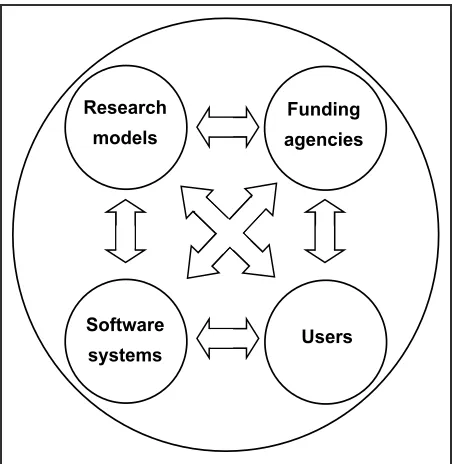
Multiple feedback loops need to be robust (Figure 2). One benefit of the current one-sci-entist (or group of scione-sci-entists), one-software-system approach is that feedback from user groups is relatively direct. Model validation exercises may be valuable, particularly when data from prescribed and wildfire effects moni-toring provide feedback on model perfor-mance. Fire Effects Monitors (FEMOs) work-ing within the National Incident Management System and trained to use available software would facilitate feedback. Coordination on fire effects prediction and monitoring with the University of Montana’s National Center for Landscape Fire Analysis (http://firecenter.umt. edu/) and the Fire Behavior Assessment Team (www.fs.fed.us/adaptivemanagement/) might also foster valuable feedback.

Improved functioning within the research community is also needed—something that in-creased or refocused funding cannot bring about alone. The community model concept provides a mechanism for improved

coordina-tion, model integracoordina-tion, and continual im-provement of research models. At its most ba-sic, a community model implies open source code and version control by some central arbi-ter. In the more organized form of community model development, researchers organize themselves around the goal of developing and improving software systems by coordinating and prioritizing their work and providing a mechanism whereby research users provide feedback to researchers and developers. Ex-amples of research models under development by a community model process include the Community Ice Sheet Model (Lipscomb et al. 2009), the Weather Research and Forecasting Model (WRF Research Applications Board 2006), and the Fire Dynamics Simulator (Mc-Grattan 2005). These research models are characterized by modular construction that fa-cilitates improvement of submodels.

The First Order Fire Effects Model has the potential to become a full-fledged community model, already involving version control and the distribution of source code. Increased co-ordination with the Core Fire Science commu-nity (Sandberg et al. 2003) would facilitate the development of approaches to provide bound-ary conditions from fire models that are needed by FOFEM’s component submodels. Ensem-ble predictions, an approach used extensively in meteorology, has its start in FOFEM with in-clusion of more than one tree mortality and duff consumption model. Of particular interest would be the inclusion of more process-based submodels whose results can be compared with existing statistical models. IFT-DSS, by in-cluding multiple fire and effects models, also has the potential to provide ensemble predic-tions (e.g., Burnup vs. CONSUME).

Gaps in Fire Effects Software Systems

(9)

support for wildland fire use and fuel treatment design. Both of these problem areas require software that fully integrates predictions of fire behavior and fire effects, in a spatial context.

Wildland fire use holds enormous promise as a way to allow more land to burn, with the goal of ultimately reducing large, severe wild-fires and restoring fire adapted ecosystems (van Wagtendonk 2007; Fire Executive Coun-cil 2009). For areas where fuels are excessive or where houses and other high-value resourc-es are in close proximity to wildland fuels, me-chanical fuel treatments may be useful in meet-ing these same goals. There is a need to de-velop decision support tools to examine eco-logical outcomes (e.g., tree mortality, erosion, air quality impacts, invasive establishment, wildlife habitat effects, ecosystem recovery) from a range of fire scenarios in a spatial con-text using a range of inputs (e.g., output from the Fire Area Simulator [FARSITE, Finney 2005], LANDFIRE layers, and weather infor-mation). Current efforts supported by the Na-tional Interagency Fuels Coordinating Group and the Joint Fire Science Program to design an integrated fuels treatment decision support system IFT-DSS (Wells 2009) recognize many of the concerns and opportunities discussed in this paper, although the focus is not simply modeling fire effects. The Wildland Fire Lead-ership Council has supported the development of WFDSS, which is currently providing infor-mation on fire growth and values-at-risk to support tactical decisions on wildland fires. Though WFDSS does not currently provide

fire effects information, the need for such in-formation is recognized.

Any software system will be limited by the availability of validated fire effects models ap-propriate for the species and ecosystems of in-terest to fire managers. The availability and capabilities of models describing first-order fire effects on trees (Butler and Dickinson 2010, Kavanagh et al. 2010), shrub and herba-ceous communities (Stephan et al. 2010), and soils (Massman et al. 2010) are discussed in accompanying papers. Ultimately, funding agencies and agency administrators need to be willing to adequately fund the basic research that supports software systems (Figure 2).

CONCLUSIONS

Fire effects have been modeled using a va-riety of approaches, and the resultant models are used in a variety of software systems to meet a variety of land management needs. The current trends in software system development toward consolidated one-stop shopping are ex-pected to have several desirable results. First, duplication of effort on the part of software de-signers could be avoided. Users would also benefit from having to learn how to use fewer software packages. Finally, development of software systems that are effective in meeting the information needs of fire managers should result in greater focus being given to the con-tinued development of fire effects models that support the software systems.

LITERATURE CITED

Albini, F.A., J.K. Brown, E.D. Reinhardt, and R.D. Ottmar. 1995. Calibration of a large fuel burnout model. International Journal of Wildland Fire 5: 173-192. doi: 10.1071/WF9950173

Anderson, G.K., D.V. Sandberg, and R.A. Norheim. 2004. Fire Emission Production Simulator (FEPS) user’s guide. Version 1.0. USDA Forest Service, Pacific Northwest Research Station, Corvallis, Oregon, USA.

(10)

Fire Ecology Volume 6, Issue 1, 2010

doi: 10.4996/fireecology.0601131 Reinhardt and Dickinson: First-Order Fire Effects ModelsPage 140

Andrews, P.L., M.A. Finney, and M. Fischetti. 2007. Predicting wildfires. Scientific American. August: 47-55.

Butler, B.W., and M.B. Dickinson. 2010. Tree injury and mortality in fires: developing process-based models. Fire Ecology 6(1): 55-79. doi: 10.4996/fireecology.0601055

Campbell, G.S., J.D. Jungbauer Jr., R. Bidlake, and R.D. Hungerford. 1994. Predicting the effect of temperature on soil thermal conductivity. Soil Science 158: 307-313.

Campbell, G.S., J.D. Jungbauer Jr., K.L. Bristow, and R.D. Hungerford. 1995. Soil tempera-ture and water content beneath a surface fire. Soil Science 159: 363-374. doi: 10.1097/00010694-199506000-00001

Chew, J.D., C. Stalling, and K. Moeller. 2004. Integrating knowledge for simulating vegetation change at landscape scales. Western Journal of Applied Forestry 19: 102-108.

Dickinson, M.B., and K.C. Ryan. 2010. Introduction: strengthening the foundation of wildland fire effects prediction for research and management. Fire Ecology 6(1): 1-12. doi: 10.4996/

fireecology.0601001

ESSA Technologies Ltd. 2007. Vegetation Dynamics Development Tooluser guide, version 6.0. ESSA Technologies Ltd., Vancouver, British Columbia, Canada.

Fire Executive Council. 2009. Guidance for implementation of federal wildland fire management policy. US Department of Agriculture and US Department of Interior, Washington, D.C., USA.

Finney, M.A. 1998. FARSITE: Fire Area Simulator—model development and evaluation. USDA Forest Service Research Paper RMRS-RP-4. Rocky Mountain Research Station, Fort Collins, Colorado, USA.

Flanagan, D.C., and S.J. Livingston, editors. 1995. WEPP user summary. USDA Agricultural Research Service NSERL Report No. 11. National Soil Erosion Research Laboratory, West Lafayette, Indiana, USA.

Hood, S.M., S.L. Smith, and D.R. Cluck. 2007. Delayed conifer tree mortality following fire in California. Pages 261-283 in: R.E. Powers, technical editor. Restoring fire-adapted ecosys-tems: proceedings of the 2005 national silviculture workshop. USDA Forest Service General Technical Report PNW-GTR-203. Pacific Southwest Research Station, Albany, California, USA.

Jones, J.L., B.W. Webb, B.W. Butler, M.B. Dickinson, D. Jimenez, J. Reardon, and A.S. Bova. 2006. Prediction and measurement of thermally induced cambial tissue necrosis in tree stems. International Journal of Wildland Fire 15: 3-17. doi: 10.1071/WF05017

Kavanagh, K.L., M.B. Dickinson, and A.S. Bova. 2010. A way forward for fire-caused tree mor-tality prediction: modeling a physiological consequence of fire. Fire Ecology 6(1): 80-94. doi: 10.4996/fireecology.0601080

Keane, R.E., S.F. Arno, and J.K. Brown. 1989. FIRESUM–an ecological process model for fire succession in western conifer forests. USDA Forest Service General Technical Report INT-266. Intermountain Forest and Range Experiment Station, Ogden, Utah, USA.

Keane, R.E., P. Morgan, and S.W. Running. 1996. FIRE-BGC—a mechanistic ecological pro-cess model for simulating fire sucpro-cession on northern Rocky Mountain coniferous forest land-scapes. USDA, Forest Service Research Report INT-RP-434. Intermountain Research Sta-tion, Ogden, Utah, USA.

Kremens, R.L., A.M.S. Smith, and M.B. Dickinson. 2010. Fire metrology: current and future directions in physics-based measurements. Fire Ecology 6(1): 13-35. doi: 10.4996/

(11)

Lenihan, J.M., C. Daly, D. Bachelet, and R.P. Neilson. 1998. Simulating broad-scale fire severity in a dynamic global vegetation model. Northwest Science 72: 91-103.

Lipscomb, W., R. Bindscahdler, E. Bueler, D. Holland, J. Johnson, and S. Price. 2009. A com-munity ice sheet model for sea level prediction. EOS, Transactions American Geophysical Union 90(3): 23. doi: 10.1029/2009EO030004

Massman, W.J., and J.M. Frank. 2010. Advancing investigation and physical modeling of first-order fire effects on soils. Fire Ecology 6(1): 36-54. doi: 10.4996/fireecology.0601036

McGrattan, K.B. 2005. Fire modeling: where are we? Where are we going? Pages 53-68 in: D.T. Gottuk and B.Y. Lattimer, editors. Fire Safety Science—proceedings of the 8th Interna-tional Symposium, InternaInterna-tional Association for Fire Safety Science, 18-23 September 2005, Boston, Massachusetts, USA.

McKenzie, D., D.L. Peterson, and E. Alverado. 1996. Extrapolation problems in modeling fire effects at large spatial scales: a review. International Journal of Wildland Fire 6: 165-176.

doi: 10.1071/WF9960165

O’Neill, S.M., S.A. Ferguson, and J. Peterson. 2003. The BlueSky smoke modeling framework. Paper J8.7 in: Proceedings of the 5th Symposium on Fire and Forest Meteorology. American Meteorological Society, 16-20 November 2003, Orlando, Florida, USA.

Prichard, S.J., R.D. Ottmar, and G.K. Anderson. 2006. Consume 3.0 user’s guide. Pacific North-west Research Station, Corvallis, Oregon, USA.

Reinhardt, E.D., R.E. Keane, and J.K. Brown. 2001. Modeling fire effects. International Journal of Wildland Fire 10: 373-380. doi: 10.1071/WF01035

Reinhardt, E.D. 2003. Using FOFEM 5.0 to estimate tree mortality, fuel consumption, smoke production and soil heating from wildland fire. Page P5.2 in: Proceedings of the Second In-ternational Wildland Fire Ecology and Fire Management Congress and Fifth Symposium on Fire and Forest Meteorology. American Meteorological Society, 16-20 November 2003, Or-lando, Florida, USA.

Reinhardt, E.D., and N.L. Crookston, technical editors. 2003. The Fire and Fuels Extension to the Forest Vegetation Simulator. USDA Forest Service General Technical Report RMRS-GTR-116. Rocky Mountain Research Station, Fort Collins, Colorado, USA.

Robichaud, P.R., W.J. Elliot, F.B. Pierson, D.E. Hall, and C.A. Moffet. 2007a. Predicting post-fire erosion and mitigation effectiveness with a web-based probabilistic model. Catena 71: 229-241. doi: 10.1016/j.catena.2007.03.003

Robichaud, P.R., W.J. Elliot, F.B. Pierson, D.E. Hall, C.A. Moffet, and L.E. Ashmun. 2007b. Erosion Risk Management Tool (ERMiT) user manual (version 2006.01.18). USDA Forest Service General Technical Report RMRS-GTR-188. Rocky Mountain Research Station, Fort Collins, Colorado, USA.

Rollins, M.G., and C.K. Frame, technical editors. 2006. The LANDFIRE Prototype Project: na-tionally consistent and locally relevant geospatial data for wildland fire management. USDA Forest Service General Technical Report RMRS-GTR-175. Rocky Mountain Research Sta-tion, Fort Collins, Colorado, USA.

Ryan, K.C., and E.D. Reinhardt. 1988. Predicting postfire mortality of seven western conifers. Canadian Journal of Forest Research 18: 1291 1297. doi: 10.1139/x88-199

(12)

Fire Ecology Volume 6, Issue 1, 2010

doi: 10.4996/fireecology.0601131 Reinhardt and Dickinson: First-Order Fire Effects ModelsPage 142

Scire, J.S., D.G. Strimaitis, and R.J. Yamartino. 2000. A user’s guide for the CALPUFF disper-sion model. Earth Tech, Concord, Massachusetts, USA.

Spiegel, K.M., and P.R. Robichaud. 2007. First-year post-fire erosion rates in Bitterroot National Forest, Montana. Hydrological Processes 21: 998-1005. doi: 10.1002/hyp.6295

Stephan, K., M. Miller, and M.B. Dickinson. 2010. First-order fire effects on herbs and shrubs: present knowledge and process modeling needs. Fire Ecology 6(1): 95-114. doi: 10.4996/

fireecology.0601095

van Wagtendonk, J.W. 2009. The history and evolution of wildland fire use. Fire Ecology 3(2): 3-17. doi: 10.4996/fireecology.0302003

Wells, G. 2009. A powerful new planning environment for fuels managers: the Interagency Fu-els Treatment Decision Support System. Fire Science Digest 7. Joint Fire Science Program, Boise, Idaho, USA.

Figure

Figure 1.  Models describe natural phenomena and are integral to software systems designed to help land managers answer questions about the ecosystems they manage.
Table 1.  Some fire effects models and the software systems that house them. This is not an exhaustive list.
Table 2.  Software systems delivering fire effects model predictions to support land management applications.
Figure 2.  Feedbacks within and among research-ers, software developers, users, and funding agen-cies that affect the development of fire effects soft-ware systems.
+2

References

Related documents

In order to meet the requirements of encrypting image and report files that are stored on external media and/or storage appliances, RVI has developed an optional encryption/

Identification of camel milk and shubat microflora provides a theoretical foundation for developing starter cultures by using local LAB strains for industrial production of

ToneComments is a discrete variable ([-3 to +3]) corresponding to a scale Very Negative to Very Positive for the question, “When you talk about Starbucks, what is typically the

• Libraries can have CSS, Javascript, and dependencies • Examples: normalize, html5shiv, jQuery, modernizer,.. backbone, underscore,

This longitudinal study enabled the development of “student-centred” personalised learning route through the outcomes of student assessments in for piloting in another module

Olsness Papers, MS 220, Institute for Regional Studies, North Dakota State University,

We carry out series of optimizations for wings based on three significantly different aircraft configurations (long-range transport, regional transport, and short-range commuter)