O R I G I N A L A R T I C L E
Open Access
Clinical features and outcomes of
prolonged mechanical ventilation: a
single-center retrospective observational study
Isao Nagata
*, Tetsuhiro Takei, Junji Hatakeyama, Masafumi Toh, Hiroyuki Yamada and Michiko Fujisawa
Abstract
Background:Information on epidemiology of prolonged mechanical ventilation (PMV) patients in the acute care setting in Japan is totally lacking. We aimed to investigate clinical features, impact, and long-term outcomes of PMV patients.
Methods:This was a retrospective observational study conducted in a tertiary care hospital. Adult patients who were admitted to our intensive care unit (ICU) from April 2009 to March 2014 and required mechanical ventilation (MV) for≥2 days were included. PMV was defined as having MV for≥21 consecutive days.
Results:Among 1282 MV patients, 93 (7.3%) required PMV, and median duration of MV was 37.0 days. Compared with the non-PMV patients, PMV patients had longer total ICU and high care unit (HCU) stay (34.0 vs. 7.0 days,p< 0.001), longer hospital stay (74.0 vs. 35.0 days,p< 0.001), and higher hospital mortality (54.8 vs. 21.4%,p< 0.001). In multivariable logistic regression analysis, emergency ICU admission and steroid use during MV were associated with PMV. The Kaplan–Meier curves for MV withdrawal and ICU/HCU discharge were almost identical. Among PMV patients, 52 (55.9%) died, 29 (31.2%) were successfully liberated from MV during hospitalization, and 12 (12.9%) still required MV at discharge.
Conclusion:In this investigation, 7.3% of the patients with MV required PMV. Most PMV patients were liberated from MV during hospitalization, while occupying critical care beds for an extended period. A nationwide survey is required to further elucidate the overall picture of PMV patients and to discuss whether specialized weaning centers to treat PMV patients are required in Japan.
Keywords:Prolonged mechanical ventilation, Intensive care unit, Long-term acute care, Weaning center
Introduction
Among patients admitted to the intensive care unit (ICU),
30–60% received mechanical ventilation (MV) [1–4].
Al-though most patients require MV for a short period, a certain proportion of patients require prolonged mechan-ical ventilation (PMV), and this number has been grad-ually increasing [5,6].
In some countries, patients requiring PMV are trans-ferred from ICUs in acute care hospitals to long-term acute care hospitals (LTACHs) or regional weaning cen-ters (RWCs) in the early stage of PMV. These facilities function as specialized post-ICU weaning centers, and
approximately 50% of PMV patients are successfully lib-erated from MV [7–11].
Conversely, in countries such as Japan lacking weaning centers, patients who require PMV may occupy ICU beds in acute care hospitals for an extended period, thereby affecting the fair allocation of critical care re-sources [2, 4, 12–14]. Furthermore, these patients place substantial loads on intensivists throughout the long period of the weaning trial. Nevertheless, after a total of 21-day stay in ICU or high care unit (HCU), no payment covers these efforts in hospitals that adapt diagnosis pro-cedure combination (DPC) payment system in Japan. Therefore, the concept of post-ICU weaning centers for PMV patients in Japan has recently become a subject of debate [15,16].
© The Author(s). 2019Open AccessThis article is distributed under the terms of the Creative Commons Attribution 4.0 International License (http://creativecommons.org/licenses/by/4.0/), which permits unrestricted use, distribution, and reproduction in any medium, provided you give appropriate credit to the original author(s) and the source, provide a link to the Creative Commons license, and indicate if changes were made.
* Correspondence:[email protected]
Although a previous multicenter study reported the in-vestigation for patients with chronic PMV in the
non-acute care setting in Japan [17], information on
epidemi-ology of PMV patients including how much fraction of MV patients progress to PMV, how long they occupy ICU and hospital beds, and long-term clinical outcomes in the acute care setting is totally lacking. We aimed to investigate the clinical features, impact, and long-term outcomes of patients requiring PMV in the acute care setting.
Methods
Study design and population
This investigation was a single-center retrospective obser-vational study conducted from April 2009 to March 2014. Our hospital is a tertiary care medical center located in the center of Yokohama City, comprising 634 beds
includ-ing 10 ICU and 8 HCU beds. The ICU is a medical–
surgi-cal high-intensity ICU with several intensivists working in the day shift and at least one in the night shift. In entire patient population during the 5-year observation period, mean ICU and hospital stays were 3.5 and 12.7 days, re-spectively. The hospital policy for MV patients is as fol-lows. Patients are initially treated in ICU or HCU by intensivists, and then they are liberated from MV accord-ing to our weanaccord-ing protocol which was based on the guidelines for weaning and discontinuing ventilatory
sup-port published in 2001 [18]. Briefly, all MV patients were
screened by intensivists whether to initiate SBT every morning (if SBT was indicated, MV patients were con-ducted SBT) and were evaluated whether to extubate. If MV liberation is difficult and they become stable or a withholding/withdrawal decision is made, they are trans-ferred to general wards with MV and followed by an intensivist-led respiratory care support team.
Patients aged≥18 years who received MV for ≥2 days
in our ICU were included in this study. PMV was de-fined as an application of MV for at least 6 h per day for
≥21 consecutive days [19]. Successful liberation was
de-fined as being liberated from MV for at least 48 con-secutive hours. We excluded patients with chronic home ventilation and those treated with extracorporeal mem-brane oxygenation. Also, we did not include patients with chronic progressive disease such as amyotrophic lateral sclerosis that were not expected to wean from MV.
The study protocol was reviewed by the Ethics Committee of Yokohama City Minato Red Cross hospital. Because of the anonymous and retrospective nature of this study, re-quirement of informed consent was waived.
Data collection
We collected the information of PMV patients (PMV group) from April 2009 to March 2014. To compare
PMV patients with non-PMV patients, the information of non-PMV patients from April 2011 to March 2012 (non-PMV group) were collected as representative values.
We collected the following information from elec-tronic medical records of the PMV and the non-PMV group: age, sex, comorbidities, type of admission to ICU, diagnosis at ICU admission, acute physiology and chronic health evaluation (APACHE) II score on the day of ICU admission, steroid use, neuromuscular blocker use, vasoactive drug use, and continuous renal replace-ment therapy (CRRT) during mechanical ventilation, spontaneous breathing trail (SBT) within 21 days, ostomy during MV, time from MV initiation to trache-ostomy, length of ICU and/or HCU stay, length of hospital stay, and outcome at discharge. We also col-lected the following information of the PMV patients: reintubation, reason for PMV and duration of MV, and post-discharge destination. Furthermore, by sending inquiry letters to destination facilities, patient outcomes at 6 months after discharge were collected for those who still required MV at discharge.
Statistical analysis
Normally or near normally distributed continuous variables were presented as mean values and standard
deviation (SD) and were compared using thettest.
Non-normally distributed continuous data were presented as medians and interquartile ranges (IQR) and were com-pared using the Wilcoxon rank sum test. Categorical data were expressed as counts and percentage and were
compared using the Fisher’s exact test or chi-square test.
A p value of < 0.05 was considered statistically
signifi-cant for all comparisons. Multivariable logistic regres-sion analysis was conducted to investigate the factors related to PMV. The following variables were applied to multivariable logistic regression analysis: age, sex, type of admission to ICU, acute respiratory disease, septic shock, APACHE II, and steroid use and neuromuscular blocker use during MV. Data are presented as odds ra-tios with 95% confidence intervals. Additionally, we drew
Kaplan–Meier curves for survival, MV continuation, and
ICU/HCU stay to understand general time course and critical care bed utilization of the PMV patients. All ana-lyses were performed using SAS 9.4 (SAS Institute Inc., NC, USA).
Results
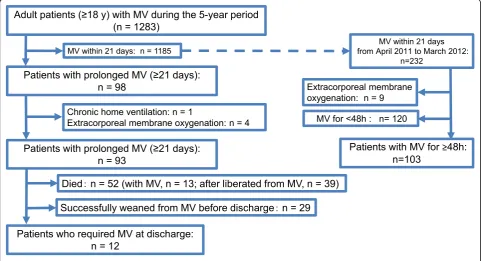
(41.9%) were liberated from MV and 13 (14.0%) required MV until the time of death). On the other hand, of the 1185 MV patients within 21 days, the non-PMV group was 103 patients (Fig.1).
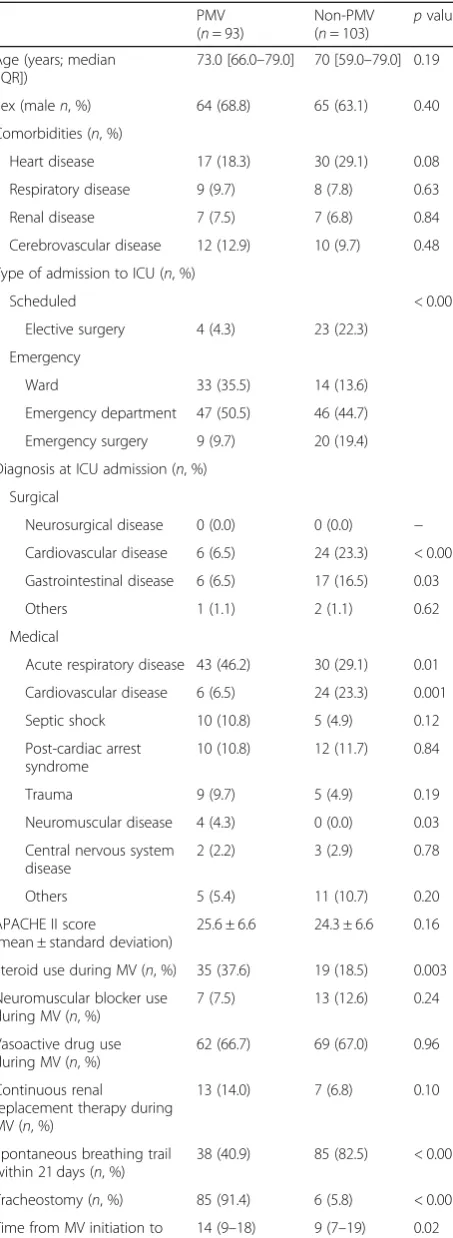
Table 1 summarizes the characteristics of the PMV
and the non-PMV group. Compared with the non-PMV group, the PMV group had higher rate of emergency
ICU admission (95.7 vs. 77.7%, p< 0.001) and acute
re-spiratory (46.2 vs. 29.1%, p= 0.01) and neuromuscular
(4.3 vs. 0.0%, p= 0.03) disease in the diagnosis at ICU
admission. Also, the PMV group had lower rate of surgi-cal cardiovascular (6.5 vs. 23.3%,p< 0.001), medical
car-diovascular (6.5 vs. 23.3%, p= 0.001), and surgical
gastrointestinal (6.5 vs. 16.5%,p= 0.03) disease. Age, sex,
comorbidities, and APACHE II score were not statisti-cally different between the two groups. In regard to the treatment during MV, the rate of steroid use and
trache-ostomy was higher (steroid use: 37.6 vs. 18.5%,p= 0.003,
tracheostomy: 91.4 vs. 5.8%, p< 0.001), and the time
from MV initiation to tracheostomy was longer (14 vs. 9
days, p< 0.02), whereas the rate of SBT within 21 days
was lower (40.9 vs. 82.5%, p< 0.001) in the PMV group
compared with the non-PMV group. PMV group had
longer ICU/HCU (34.0 vs. 7.0 days, p< 0.001) and
hos-pital stay (74.0 vs. 35.0 days, p< 0.001) and higher
hos-pital mortality (54.8 vs. 21.4%, p< 0.001) compared with
the non-PMV group. Further, in the PMV group, the rate of reintubation within 21 days was 16.1% (15 pa-tients), and median duration of MV was 37.0 days (IQR
27.0–62.0 days). The most common reason for PMV was
respiratory disorder (68 patients, 73.1%), followed by central nervous system disorder including cervical cord injury (17 patients, 18.3%), and neuromuscular disorder (7 patients, 7.5%).
The results of multivariable logistic regression analysis
for PMV are shown in Table2. Emergency ICU
admis-sion (OR 5.34; 95% CI 1.78–20.0; p= 0.006) and steroid
use during MV (OR 2.25; 95% CI 1.10–4.70; p= 0.03)
were the independent factors associated with PMV.
Figure 2 shows the Kaplan–Meier survival curve
extrapolated by the MV withdrawal and ICU/HCU dis-charge curves in the PMV group. The survival curve had a gentle downward slope from 21 to 90 days after initi-ation of MV, whereas the MV withdrawal and ICU/HCU discharge curves initially had a steep downward slope and transition to a gentle downward slope in the last third of the curves, indicating liberation from MV was difficult after approximately 60 days of MV. Further-more, the MV withdrawal and ICU/HCU discharge curves were almost identical, indicating that the MV pa-tients occupied ICU/HCU beds for a long period until successful liberation from MV.
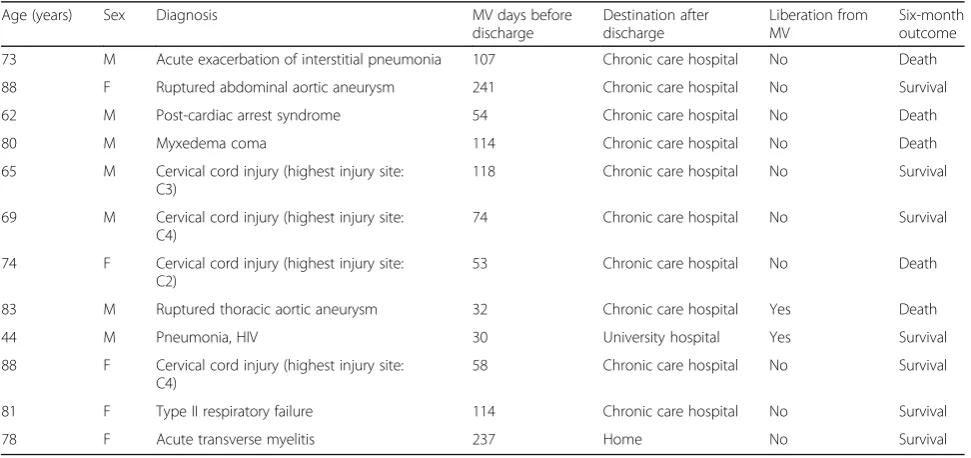
The patients who still required MV at discharge are
listed in Table 3. Their mean age was 73.8 years, and
33.3% of them developed PMV due to cervical cord in-jury. Patients who developed PMV due to cervical cord injury were seven, and they all had injury in the higher level in cervical cord, which included the fourth cervical cord. Four of them still required MV at discharge. Me-dian duration of MV at our hospital was 90.5 days, and
most patients were transferred to long-term chronic care hospital. Mortality rate at 6 months after discharge was 41.6%, and only one patient survived with successful lib-eration from MV.
Discussion Brief summary
In this 5-year observational study, 7.3% of the patients with MV required PMV. PMV patients occupied ICU/ HCU and hospital beds for an extraordinary amount of time and had higher hospital mortality than non-PMV patients. Emergency ICU admission and steroid use dur-ing MV were associated with PMV in multivariable lo-gistic regression analysis. Further, most PMV patients were liberated from MV whether they survived to dis-charge or not, and 12.9% still required MV at disdis-charge. Six months after discharge, mortality rate of these Table 1Characteristics of the PMV and the non-PMV patients
PMV (n= 93)
Non-PMV (n= 103) p
value
Age (years; median [IQR])
73.0 [66.0–79.0] 70 [59.0–79.0] 0.19
Sex (malen, %) 64 (68.8) 65 (63.1) 0.40
Comorbidities (n, %)
Heart disease 17 (18.3) 30 (29.1) 0.08
Respiratory disease 9 (9.7) 8 (7.8) 0.63
Renal disease 7 (7.5) 7 (6.8) 0.84
Cerebrovascular disease 12 (12.9) 10 (9.7) 0.48
Type of admission to ICU (n, %)
Scheduled < 0.001
Elective surgery 4 (4.3) 23 (22.3)
Emergency
Ward 33 (35.5) 14 (13.6)
Emergency department 47 (50.5) 46 (44.7)
Emergency surgery 9 (9.7) 20 (19.4)
Diagnosis at ICU admission (n, %)
Surgical
Neurosurgical disease 0 (0.0) 0 (0.0) −
Cardiovascular disease 6 (6.5) 24 (23.3) < 0.001
Gastrointestinal disease 6 (6.5) 17 (16.5) 0.03
Others 1 (1.1) 2 (1.1) 0.62
Medical
Acute respiratory disease 43 (46.2) 30 (29.1) 0.01
Cardiovascular disease 6 (6.5) 24 (23.3) 0.001
Septic shock 10 (10.8) 5 (4.9) 0.12
Post-cardiac arrest syndrome
10 (10.8) 12 (11.7) 0.84
Trauma 9 (9.7) 5 (4.9) 0.19
Neuromuscular disease 4 (4.3) 0 (0.0) 0.03
Central nervous system disease
2 (2.2) 3 (2.9) 0.78
Others 5 (5.4) 11 (10.7) 0.20
APACHE II score
(mean ± standard deviation)
25.6 ± 6.6 24.3 ± 6.6 0.16
Steroid use during MV (n, %) 35 (37.6) 19 (18.5) 0.003
Neuromuscular blocker use during MV (n, %)
7 (7.5) 13 (12.6) 0.24
Vasoactive drug use during MV (n, %)
62 (66.7) 69 (67.0) 0.96
Continuous renal
replacement therapy during MV (n, %)
13 (14.0) 7 (6.8) 0.10
Spontaneous breathing trail within 21 days (n, %)
38 (40.9) 85 (82.5) < 0.001
Tracheostomy (n, %) 85 (91.4) 6 (5.8) < 0.001
Time from MV initiation to tracheostomy (days; median
14 (9–18) 9 (7–19) 0.02
Table 1Characteristics of the PMV and the non-PMV patients (Continued)
PMV (n= 93)
Non-PMV (n= 103)
pvalue
[IQR])
Duration of MV (days; median [IQR])
37.0 [27.0–62.0] – –
ICU/HCU stay (days; median [IQR])
34.0 [25.0–49.5] 7.0 [5.0–10.0] < 0.001
Hospital stay (days; median [IQR])
74.0 [45.0–122.0] 35 [17.0–51.0] < 0.001
Hospital mortality (n, %) 51 (54.8) 22 (21.4) < 0.001 PMVprolonged mechanical ventilation,MVmechanical ventilation,APACHE acute physiology and chronic health evaluation,IQRinterquartile range,ICU intensive care unit,HCUhigh care unit
Table 2Multivariable logistic regression analysis for prolonged mechanical ventilation
Odds ratio
(95% CI) p
value
Age 1.02 (0.99–1.04) 0.14
Gender
Male 1.15 (0.60–2.20) 0.67
Type of admission to ICU
Scheduled 1.00 0.006
Emergency 5.34 (1.78–20.0)
APACHE II score 1.02 (0.97–1.07) 0.56
Acute respiratory disease 1.00 (0.48–2.06) 0.99
Septic shock 1.58 (0.50–5.61) 0.45
Steroid use during mechanical ventilation
2.25 (1.10–4.70) 0.03
Neuromuscular blocker use during mechanical ventilation
0.54 (0.17–1.66) 0.29
patients was 41.6%, and only 8.3% survived with success-ful liberation from MV.
Relationship with previous studies
According to the previous observational studies, the rates of PMV patients against those with MV were
5.1–28.0% [2–4, 12–14, 20]. In addition, previous
studies have shown that PMV patients had a longer
duration of MV, ICU stay, and hospital stay compared with those who did not. According to these studies,
duration of MV among PMV patients was 29–51 days,
ICU stay was 33–52 days, and hospital stay was 51–
77 days [2, 4, 12–14, 20]. These studies were
con-ducted in countries lacking the concept of weaning centers, and the results were consistent with those observed in our study.
Fig. 2Kaplan–Meier curves for survival, ICU/HCU stay, and continuation of mechanical ventilation (MV) in the patients mechanically ventilated for > 21 days (N= 93). The survival curve had a gentle slope from 21 to 90 days after initiation of MV. The curves of MV withdrawal and ICU/HCU discharge were almost identical, having an initial steep slope and transition to a gentle slope in the last third of the curves
Table 3Outcomes at 6 months after discharge of 12 patients who required mechanical ventilation at discharge
Age (years) Sex Diagnosis MV days before discharge
Destination after discharge
Liberation from MV
Six-month outcome
73 M Acute exacerbation of interstitial pneumonia 107 Chronic care hospital No Death
88 F Ruptured abdominal aortic aneurysm 241 Chronic care hospital No Survival
62 M Post-cardiac arrest syndrome 54 Chronic care hospital No Death
80 M Myxedema coma 114 Chronic care hospital No Death
65 M Cervical cord injury (highest injury site: C3)
118 Chronic care hospital No Survival
69 M Cervical cord injury (highest injury site: C4)
74 Chronic care hospital No Survival
74 F Cervical cord injury (highest injury site: C2)
53 Chronic care hospital No Death
83 M Ruptured thoracic aortic aneurysm 32 Chronic care hospital Yes Death
44 M Pneumonia, HIV 30 University hospital Yes Survival
88 F Cervical cord injury (highest injury site: C4)
58 Chronic care hospital No Survival
81 F Type II respiratory failure 114 Chronic care hospital No Survival
78 F Acute transverse myelitis 237 Home No Survival
In our study, emergency ICU admission and steroid use during MV were associated with PMV in multivari-able logistic regression analysis. Since few studies have investigated factors related to PMV, we applied the following variables that could potentially affect the de-velopment of PMV: age, sex, type of admission to ICU, acute respiratory disease, septic shock, APACHE II score, and steroid use and neuromuscular blocker use during MV, with reference to the factors related to
lon-ger duration of MV [21]. In a previous study, the rate of
emergency ICU admission in PMV patients was higher than that of non-PMV patients in univariate analysis
[14]. Also, previous studies have reported that a large
majority of PMV patients were admitted to ICU due to emergency medical reasons including sepsis, respiratory disease, and trauma which is consistent with our study
[2–4, 14]. Therefore, emergency ICU admission may be
a predictor associated with development of PMV. In
addition, although the relationship between
ICU-acquired weakness (ICUAW) and steroid use remains
controversial [22,23], steroid use may affect weakness of
the respiratory muscle including diaphragm, and thus may prolong the MV duration. However, because the sample size was limited, some confounding factors may exit in the association between PMV and steroid use. Further researches are needed to investigate the risk fac-tor for PMV.
An earlier study in a single RWC showed that the 6-month and 1-year mortality after discharge of patients who still required MV was 65.3% and 78.7%, respectively
[11]. A systematic review and meta-analysis reported
that pooled 1-year mortality of PMV patients discharged from post-acute care hospitals such as LTACHs was
59% [24]. In our study, 6-month mortality after
dis-charge of PMV patients was 41.6%. Further, it was
diffi-cult to compare our study with previous studies [11,24],
due to differences in the research setting. In any case, the long-term mortality of PMV patients was expected to be high. Nevertheless, at present, optimal patient se-lection at the time of MV initiation remains unclear and is a target for future research.
Significance and implications
Previous studies conducted in LTACHs and RWCs re-ported the rate of patients liberated from MV and
sur-vived to discharge to be 35.0–54.1% [8–11, 25, 26]. A
previous study conducted in an LTACH showed median time to be liberated from MV was 13.5 days, median days on MV before transfer was 29 days, and total
dur-ation of MV was 42.5 days [9]. Another multicenter
study conducted in LTACHs reported that median time to be liberated from MV was 15 days, median days on MV before transfer was 25 days, and total duration of
MV was 40 days [27]. Although research setting was
different, these results were similar to those of our study wherein the rate of patients who were liberated from MV and discharged alive against PMV patients was 31.2%; most PMV patients were successfully released from MV within 60 days; and the median duration of MV was 37.0 days. These data indicate that ICUs and HCUs in acute care hospitals in Japan play a role of LTACHs or RWCs.
In our study, MV was applied in ICU/HCU for up to 135 days, which was far longer than the coverage period of ICU/HCU payment (up to 14 days for ICU payment and up to 21 days for ICU/HCU payment in a single ad-mission). Although liberation from MV in PMV patients requires a certain degree of workload on intensivists, most of this effort is not covered by the current payment system in DPC hospitals, consequently burdening acute care hospitals with the economic load. As a result, clin-ical decisions regarding mechanclin-ical ventilation may be made in a less aggressive manner due to financial rea-sons. Moreover, occupying ICU or HCU beds for an ex-tended period may interfere with admission of other critically ill patients, thereby potentially infringing fair al-location of limited critical care resources [14].
Whether to have specialized centers for PMV patients who need long-term acute care remains contentious.
Al-though PMV patients might be regarded as “outlier”
subjects in the ordinary care process of critically ill pa-tients, our results indicated that 7.3% of MV patients were shifted to PMV, which is a substantial proportion. A multicenter investigation performed in the UK re-ported that establishing weaning centers would
poten-tially reduce acute bed occupancy by 8–10% and overall
treatment costs [14]. Because health insurance systems
among countries are diverse, this estimation cannot be directly applied to Japan. However, nationwide data demonstrating an overall picture of PMV in Japan is needed.
Strengths and limitations
Lastly, our ICU comprises a mixed and high-intensity ICU with many board-certified intensivists. Reportedly, not many ICUs in Japan had > 1 intensivists and were
managed with high-intensity policy [28]. Therefore,
decision-making to initiate MV, managing policy for MV patients, and number of efforts that were applied to PMV patients of other hospitals might differ from those of our hospital.
Conclusions
Approximately 7.3% of MV patients required PMV, oc-cupying critical care beds for an extended period. A na-tionwide multicenter study is needed to completely assess the epidemiologic aspects of PMV patients and to determine whether long-term acute care facilities are re-quired in Japan.
Abbreviations
ICU:Intensive care unit; IQR: Interquartile ranges; LTACHs: Long-term acute care hospitals; MV: Mechanical ventilation; PMV: Prolonged mechanical ventilation; RWCs: Regional weaning centers
Acknowledgements Not applicable
Authors’contributions
IN conceived and designed this study, conducted data processing, analyzed the data, and wrote the manuscript. TT contributed to the conception and design of this study and drafted the manuscript. JH, MT, HY, and MF contributed to the study design, data collection, and critical revision of the manuscript. All authors read and approved the final manuscript.
Funding Not applicable
Availability of data and materials
The datasets analyzed during the current study are available from the corresponding author on reasonable request.
Ethics approval and consent to participate
The study was approved by the Ethics Committee of Yokohama City Minato Red Cross hospital. Because of the anonymous and retrospective nature of this study, requirement of informed consent was waived.
Consent for publication Not applicable
Competing interests
The authors declare that they have no competing interests.
Received: 25 February 2019 Accepted: 12 September 2019
References
1. Vora CS, Karnik ND, Gupta V, Nadkar MY, Shetye JV. Clinical profile of patients requiring prolonged mechanical ventilation and their outcome in a tertiary care medical ICU. J Assoc Physicians India. 2015;63(10):14–9. 2. Loss SH, de Oliveira RP, Maccari JG, Savi A, Boniatti MM, Hetzel MP, et al.
The reality of patients requiring prolonged mechanical ventilation: a multicenter study. Revista Brasileira de terapia intensiva. 2015;27(1):26–35. 3. Cox CE, Carson SS, Lindquist JH, Olsen MK, Govert JA, Chelluri L. Differences
in one-year health outcomes and resource utilization by definition of prolonged mechanical ventilation: a prospective cohort study. Critical care (London, England). 2007;11(1):R9.
4. Estenssoro E, Gonzalez F, Laffaire E, Canales H, Saenz G, Reina R, et al. Shock on admission day is the best predictor of prolonged mechanical ventilation in the ICU. Chest. 2005;127(2):598–603.
5. Cox CE, Carson SS, Holmes GM, Howard A, Carey TS. Increase in
tracheostomy for prolonged mechanical ventilation in North Carolina, 1993-2002. Crit Care Med. 2004;32(11):2219–26.
6. Hung MC, Lu HM, Chen L, Hu FC, Chan SY, Yan YH, et al. Life expectancies and incidence rates of patients under prolonged mechanical ventilation: a population-based study during 1998 to 2007 in Taiwan. Critical care (London, England). 2011;15(2):R107.
7. Rose L, Fowler RA, Fan E, Fraser I, Leasa D, Mawdsley C, et al. Prolonged mechanical ventilation in Canadian intensive care units: a national survey. J Crit Care. 2015;30(1):25–31.
8. Scheinhorn DJ, Hassenpflug MS, Votto JJ, Chao DC, Epstein SK, Doig GS, et al. Post-ICU mechanical ventilation at 23 long-term care hospitals: a multicenter outcomes study. Chest. 2007;131(1):85–93.
9. Chao DC, Scheinhorn DJ. Determining the best threshold of rapid shallow breathing index in a therapist-implemented patient-specific weaning protocol. Respir Care. 2007;52(2):159–65.
10. Carson SS, Bach PB, Brzozowski L, Leff A. Outcomes after long-term acute care. An analysis of 133 mechanically ventilated patients. Am J Respir Crit Care Med. 1999;159(5 Pt 1):1568–73.
11. Scheinhorn DJ, Artinian BM, Catlin JL. Weaning from prolonged mechanical ventilation. The experience at a regional weaning center. Chest. 1994;105(2): 534–9.
12. Muzaffar SN, Gurjar M, Baronia AK, Azim A, Mishra P, Poddar B, et al. Predictors and pattern of weaning and long-term outcome of patients with prolonged mechanical ventilation at an acute intensive care unit in North India. Revista Brasileira de terapia intensiva. 2017;29(1):23–33.
13. Li J, Zhan QY, Wang C. Survey of prolonged mechanical ventilation in intensive care units in mainland China. Respir Care. 2016;61(9):1224–31. 14. Lone NI, Walsh TS. Prolonged mechanical ventilation in critically ill patients:
epidemiology, outcomes and modelling the potential cost consequences of establishing a regional weaning unit. Critical care (London, England). 2011; 15(2):R102.
15. Kazufumi Okamoto TK, Yukio Sekiguchi. Post-ICU respiratory care center is needed! J Jpn Soc Intensive Care Med. 2007;14:257–269.
16. Okamoto KYA, Kamijyo Y, Eguchi Y, Imamura H. Feature ~ various problems about post-ICU prolonged mechanical ventilation~. Jpn J Respir Care. 2014; 31(1):2–5.
17. Tatara KIY, Imai T, Shinno S, Nishima S, Fukunaga H. Survey of long-term ventilation in hospitals of the Japanese national hospital organization. Iryo. 2005;59(8):427–32.
18. MacIntyre NR, Cook DJ, Ely EW Jr, Epstein SK, Fink JB, Heffner JE, et al. Evidence-based guidelines for weaning and discontinuing ventilatory support: a collective task force facilitated by the American College of Chest Physicians; the American Association for Respiratory Care; and the American College of Critical Care Medicine. Chest. 2001;120(6 Suppl):375s–95s. 19. MacIntyre NR, Epstein SK, Carson S, Scheinhorn D, Christopher K, Muldoon
S. Management of patients requiring prolonged mechanical ventilation: report of a NAMDRC consensus conference. Chest. 2005;128(6):3937–54. 20. Kim MH, Cho WH, Lee K, Kim KU, Jeon DS, Park HK, et al. Prognostic factors
of patients requiring prolonged mechanical ventilation in a medical intensive care unit of Korea. Tuberculosis and respiratory diseases. 2012; 73(4):224–30.
21. Carson SS. Outcomes of prolonged mechanical ventilation. Curr Opin Crit Care. 2006;12(5):405–11.
22. Stevens RD, Dowdy DW, Michaels RK, Mendez-Tellez PA, Pronovost PJ, Needham DM. Neuromuscular dysfunction acquired in critical illness: a systematic review. Intensive Care Med. 2007;33(11):1876–91.
23. Jolley SE, Bunnell AE, Hough CL. ICU-acquired weakness. Chest. 2016;150(5): 1129–40.
24. Damuth E, Mitchell JA, Bartock JL, Roberts BW, Trzeciak S. Long-term survival of critically ill patients treated with prolonged mechanical ventilation: a systematic review and meta-analysis. Lancet Respir Med. 2015;3(7):544–53. 25. Schonhofer B, Euteneuer S, Nava S, Suchi S, Kohler D. Survival of
mechanically ventilated patients admitted to a specialised weaning centre. Intensive Care Med. 2002;28(7):908–16.
27. Scheinhorn DJ, Hassenpflug MS, Votto JJ, Chao DC, Epstein SK, Doig GS, et al. Ventilator-dependent survivors of catastrophic illness transferred to 23 long-term care hospitals for weaning from prolonged mechanical ventilation. Chest. 2007;131(1):76–84.
28. Yuichi Imanaka KH, Genki Murakami, Shinya Matsuda. Physician staffing and patient outcome in Japanese ICUs. J Jpn Soc Intensive Care Med 2010;17: 227–232.
Publisher’s Note