S Y S T E M A T I C R E V I E W
Open Access
Arthroscopic partial repair for massive
rotator cuff tears: does it work? A
systematic review
Michael-Alexander Malahias
1*, Lazaros Kostretzis
2, Efstathios Chronopoulos
3, Emmanouil Brilakis
1,
Grigorios Avramidis
1and Emmanouil Antonogiannakis
1Abstract
Background:While arthroscopic complete repair of massive rotator cuff tears (MRCT) back to their anatomic footprint is preferential, there are cases where this type of repair is not applicable due to the contraction of the torn tendons. In such cases, a non-anatomic incomplete or partial repair can be performed. A number of clinical studies have investigated the clinical and functional outcomes of arthroscopic partial repair for irreparable MRCT. To our knowledge, no systematic review has been published yet to synthetically evaluate these results.
Methods:Two reviewers independently conducted the search in a PRISMA-compliant systematic way using the MEDLINE/PubMed database and the Cochrane Database of Systematic Reviews. These databases were queried with the terms“arthroscopy”[MeSH Terms] OR arthroscopic surgical procedure [Text Word (tw)] AND massive rotator cuff tears [tw] AND arthroscopic partial repair [tw].
Results:From the 55 initial studies, we finally chose 11 clinical studies which were eligible to our inclusion-exclusion criteria. The mean modified methodology Coleman score was 58/100, whereas it ranged from 41/100 to 78/100. In total, 643 patients were included in this review. All postoperative mean clinical and functional subjective scores, as well as muscle strength of patients treated with arthroscopic partial repair, were found significantly improved, when compared with the respective mean preoperative values. The rate of structural failure of the partial repair, as it was estimated by postoperative imaging modalities, was 48.9%. The overall reoperations’rate was 2.9% regarding the patients who were treated with partial repair.
Conclusions:Arthroscopic partial repair might be a safe and effective alternative treatment for irreparable contracted MRCT, where a complete repair cannot be performed. The methodological quality of the relevant, available literature is low to moderate; therefore, further studies of higher quality are required to confirm these results.
Keywords:Shoulder arthroscopy, Arthroscopic partial repair, Medialized repair, Massive rotator cuff tear, Systematic review
© The Author(s). 2019Open AccessThis article is distributed under the terms of the Creative Commons Attribution 4.0 International License (http://creativecommons.org/licenses/by/4.0/), which permits unrestricted use, distribution, and reproduction in any medium, provided you give appropriate credit to the original author(s) and the source, provide a link to the Creative Commons license, and indicate if changes were made.
* Correspondence:[email protected]
13rd Orthopaedic Department, Hygeia Hospital, Erythrou Stavrou 4, 151 23
Marousi, Athens, Greece
Key Points
Arthroscopic partial repair might be a safe and effective salvage solution in cases where an
arthroscopic complete repair of massive rotator cuff tears cannot be performed.
The methodological quality of the relevant, available literature is low to moderate; therefore, further studies of higher quality are required to confirm our results.
Background
The understanding of rotator cuff pathology and healing continues to evolve, beginning with emerging descrip-tions of the anatomic footprint and natural history of ro-tator cuff tears [1]. Shoulder anatomy, pathology, and biomechanics place unique stress on the rotator cuff tendons during sports activity [2], whereas smoking, hypercholesterolemia, and genetics have all been shown to influence the development of rotator cuff tearing [3].
Depending on the degree of cuff pathology, acromio-plasty, debridement of partial cuff tears, and repair of full-thickness tears are usually successful in those who fail a rehabilitation program [4]. Complete repair, if pos-sible, is the optimal treatment for full-thickness rotator cuff tears [5]. On the other hand, the management of massive, irreparable rotator cuff tears (MRCT) is chal-lenging and associated with high failure rates, since there are no current consensus or definitive guidelines con-cerning the optimal surgical treatment for this devastat-ing condition [6]. Arthroscopic options include rotator cuff repair, partial cuff repairs, tendon allografts or xeno-grafts, decompression, débridement, biceps tenotomy, tenodesis, and tendon transfers [7]. The treatment mo-dality specifically chosen for the massive, irreparable ro-tator cuff tear must be tailored to the individual patient, their needs and expectations, and their ability to comply with intensive rehabilitation [8].
While arthroscopic complete repair of MRCT back to their anatomic footprint is preferential, there are cases where this type of repair is not applicable due to the contraction of the torn tendons. In such cases, a non-anatomic incomplete or partial repair can be per-formed. Arthroscopic partial repair is indicated for young patients when the muscle is still trophic with a fatty infiltration less than 3, according to the MRI-based Fuchs classification [9]. It can be combined with a ten-don transfer like latissimus dorsi (or alternatively lower trapezius) in irreparable posterosuperior tears or pector-alis major (or alternatively latissimus dorsi) in anterosu-perior cuff tears [10].
A number of clinical studies have investigated the clin-ical and functional outcomes of arthroscopic partial re-pair for irreparable MRCT [11–21]. To our knowledge,
no systematic review has been published yet to synthet-ically evaluate these results.
Our aims were twofold: (1) to summarize failure rates and clinical/functional/radiographic outcomes associated with the arthroscopic partial repair as the method of treatment for symptomatic irreparable MRCT and (2) to characterize the methodological quality of the relevant, available literature. Our hypothesis was that arthroscopic partial repair would be proven a safe and effective treat-ment for this type of lesions where no complete repair can be done.
Materials and methods
Two reviewers (MAM, LK) independently conducted the search in a systematic way according to the Preferred Reporting Items for Systematic Reviews and Meta-Analyses (PRISMA) using the MEDLINE/PubMed database and the Cochrane Database of Systematic Re-views. These databases were searched using the terms
“arthroscopy”[MeSH Terms] OR arthroscopic surgical procedure [Text Word (tw)] AND massive rotator cuff tears [tw] AND arthroscopic partial repair [tw]. To maximize the search, backward chaining of reference lists from retrieved papers was also undertaken. A pre-liminary assessment of only the titles and abstracts of the search results was initially performed. The second stage involved a careful review of the full-text publications.
Inclusion criteria were clinical studies investigating adult patients, diagnosed with symptomatic MRCT, who were treated with arthroscopic partial repair, and who had a minimum of 12 months clinical follow-up (with clinical tests and/or scores). These studies should have been written in English or German as full-text articles and they should have been published by March 1, 2018 (end of our search).
We excluded from our review all studies which were not dealing with partial repair (other means of operative or nonoperative treatment), non-arthroscopic proce-dures (open or mini-open), studies about reparable massive or non-massive RCT, trials with follow-up less than 12 months, studies without clinical/functional out-come variables, abstracts, editorial comments, case re-ports, corrigenda, technical notes, literature reviews, preclinical studies, and papers not written in English or German.
alternative to “risk of bias” [22], was examined by the modified Coleman methodology score [23]. The meth-odological quality of each study and the different types of detected bias were assessed independently by each re-viewer and then they were combined synthetically. Se-lective reporting bias like publication bias was not included in the assessment. The primary outcome meas-ure was the failmeas-ure rate leading to reoperation and the clinical, functional, and radiographic outcomes. The sec-ondary outcome was the quality assessment of the stud-ies with the use of the modified Coleman methodology score.
Results
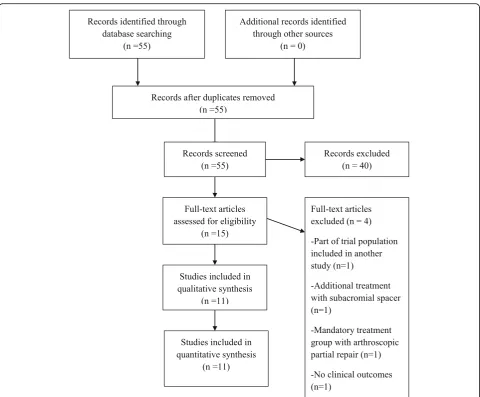
From the 55 initial studies, we finally chose and assessed 11 clinical studies which were eligible to our inclusion-exclusion criteria [11–21]. We excluded all the irrelevant studies (16), technical notes (6), trials not re-ferring to massive rotator cuff tears (5), reviews of the literature (4) (not relevant to our review), papers con-cerning only full repair (4), mini-open procedures (2), studies dealing with massive rotator cuff tears treated with subacromial biodegradable spacers (2) or greater tuberoplasty (1), trials regarding pigmented villonodular synovitis (1), case reports (1), papers without any clinical outcome (1), and papers written in Chinese (1). A sum-mary flowchart of our literature search according to PRISMA guidelines can be found in Fig.1.
Level of evidence and study’s design
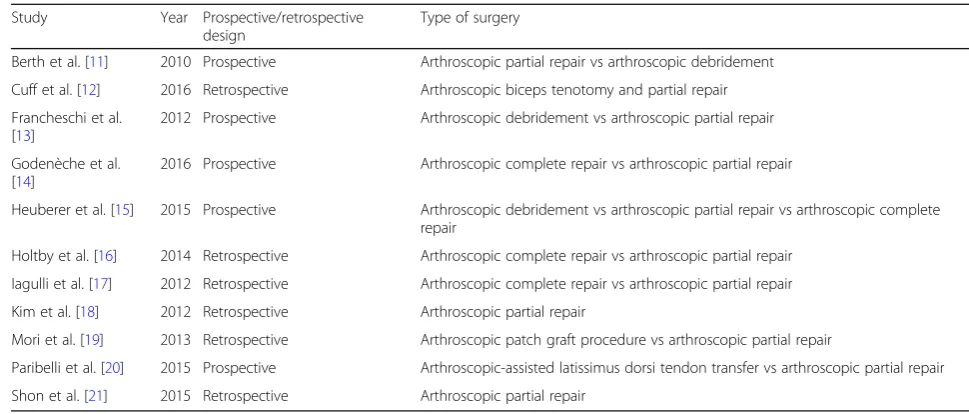
All studies included in this review were published be-tween 2010 and 2016 [11–21] (Table1).
Six out of the 11 studies of this review (54.5%) had a level of evidence III [13–17, 19], while three studies (27.3%) had a level of evidence IV [12,18,21], one study (9.1%) a level of evidence I [11], and another one (9.1%) a level of evidence II [20] (Table2).
We found eight comparative studies (72.7%) [11, 13– 17, 19, 20] and three non-comparative studies (27.3%) [12,18, 21], whereas only one trial (9.1%) [11] was ran-domized and ten trials (90.9%) were non-ranran-domized [12–20]. The most common comparisons were between arthroscopic complete repair and partial repair [14– 17] as well as arthroscopic partial repair and debride-ment [11, 13, 15]. One study compared the arthro-scopic partial repair technique with latissimus dorsi transfer [20] and another one with a patch autograft procedure [19] (Table 1).
Quality of the studies and possible risk of bias
The mean modified methodology Coleman score for methodological deficiencies of the studies was 58/100, whereas it ranged from 41/100 [16] to 78/100 [11] (Table2).
All studies of this review (100%) were characterized by a possible high risk of performance bias [11–21], while nine studies (81.8%) were found with possible selection bias [11,13–17,19–21], six studies (54.5%) with possible detection bias [11–13, 16, 19, 20], and five studies (45.5%) with possible attrition bias [12, 14, 17–19] (Table2).
Demographics
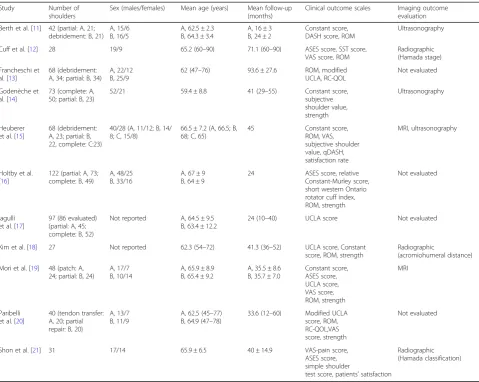
Totally, 643 patients were included in this review. From them, 348 patients were treated with an arthroscopic partial repair procedure, while 295 patients underwent another type of treatment (either as control or as study groups). The majority of the patients who were treated with the arthroscopic partial repair technique were males (63.7%). The mean age of the patients who under-went arthroscopic partial repair ranged from 59.4 years [14] to 68 years [15], while the mean age of the patients who were treated with other operative techniques ranged from 62.5 years [20] to 66.5 years [15]. The mean follow-up of the patients who underwent arthroscopic partial repair ranged between 16 [11] and 93.6 months [13], whereas the mean follow-up of the patients who were treated with other operative techniques ranged from 24 months [11, 16, 17] to 93.6 months [13] (Table3).
Reoperation rate
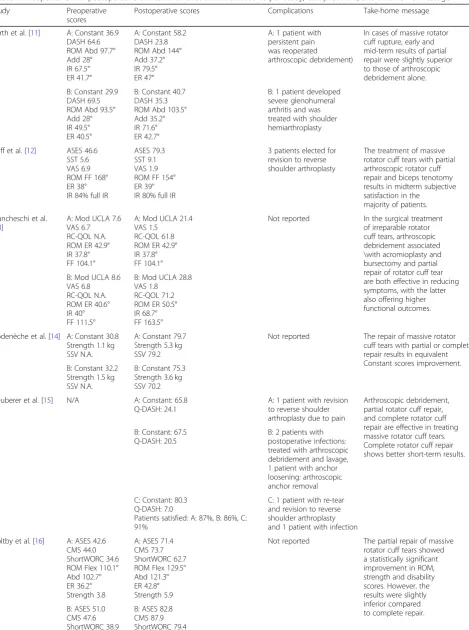
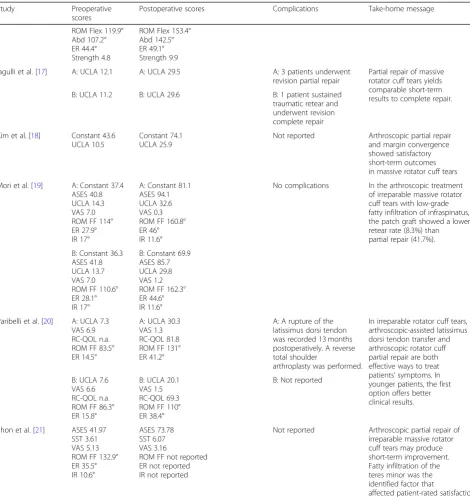
The overall reoperation rate was 2.9% for patients who were treated with partial repair. The most common rea-son for reoperation was severe glenohumeral osteoarth-ritis (1.1%) and the second most common reason was failure of the repair and persistent pain (0.9%). The most common type of reoperation was reverse shoulder arthroplasty (1.1%) (Table4).
Clinical and functional outcome variables
Range of motion (ROM) was measured in eight stud-ies (72.7%) [11–13, 15, 16, 19–21], muscle strength in six studies (54.5%) [11, 14, 16, 19–21], and patients’ satisfaction in two studies (18.2%) [15, 21]. The Con-stant score was used in six (54.5%) of the studies which were included in this review [11, 14–16, 18,
[11, 15], 18.2% [14, 15], 18.2% [12, 21], and 18.2% [13, 20], respectively. Finally, the short Western On-tario Rotator Cuff Index was used in one study (9.1%) [16] (Table 3).
All postoperative mean clinical and functional sub-jective scores, as well as muscle strength of patients treated with arthroscopic partial repair, were found significantly improved, when compared with the re-spective mean preoperative values in all 11 studies which were included in this review [11–21]. Ten out of 11 studies (90.9%) documented significant postop-erative improvement in the ROM of the arthroscopic partial repair-treated patients [11, 13–21], while one study (9.1%) [12] did not illustrate any significant im-provement in comparison with the preoperative ROM. In the two studies which evaluated patients’ satisfac-tion, Heuberer et al. illustrated high postoperative pa-tients’satisfaction (86%) with the use of partial repair
(no significant difference in comparison with the complete repair group as well as the debridement group), whereas Shon et al. showed that only half of the treated patients declared themselves satisfied [15,
21]. The specific preoperative and postoperative mean values of the clinical and functional outcome variables per study can be found in Table 4.
Repair integrity
Four studies of this review (36.4%) assessed the postop-erative re-tear rate of the partial repair [11, 14, 15, 19]. Three of these studies (28.2% of all studies) used diag-nostic ultrasonography for their postoperative imaging evaluation [11, 14, 15], while two studies (18.2%) made use of the MRI [15, 19]. Overall, the rate of structural failure of the partial repair was 48.9% amongst these studies [11,14,15,19].
Radiographic outcomes
Two studies (18.2%) [12, 21] reported the postopera-tive radiographic progression of osteoarthritis accord-ing to Hamada score [24]. According to Shon et al., all patients included in their study were found with-out any changes in the Hamada score at their final follow-up X-ray when it was compared with the initial preoperative score [21]. On the contrary, 36% of the patients (10 out of 28 patients) who were followed in the study of Cuff et al. had postoperative osteoarth-ritic progression of one or more Hamada stages [12] (Table 3).
Kim et al. found a small but statistically significant postoperative decrease in the acromiohumeral distance in comparison with the mean preoperative value (from a preoperative mean value of 6.5 mm to a postoperative mean value of 5.9 mm;p< 0.001) [18]. However, accord-ing to Kim et al., this difference was not clinically signifi-cant [18] (Table3).
Discussion
The most important finding of this review was that all those studies which evaluated arthroscopic partial repair for the treatment of irreparable MRCT documented sig-nificant improvements in all postoperative subjective clinical and functional scores which were measured. All studies showed significant improvement of postoperative muscle strength and almost all of them reported signifi-cant improvement in the ROM at the last follow-up as-sessment. It seems that the rebalanced remaining anterior and posterior parts of the rotator cuff recover shoulder stability, which subsequently allows better function and decreased pain even after a partial non-anatomic repair [25].
In addition, the complication and reoperation rates in our review were found to be very low. Clinical symp-toms like persistent pain due to failure of the repair were rather uncommon and only rarely led to a revision sur-gery. According to these results, arthroscopic partial
Table 1Year of study, design, and type of surgery for studies included in the review
Study Year Prospective/retrospective design
Type of surgery
Berth et al. [11] 2010 Prospective Arthroscopic partial repair vs arthroscopic debridement
Cuff et al. [12] 2016 Retrospective Arthroscopic biceps tenotomy and partial repair
Francheschi et al. [13]
2012 Prospective Arthroscopic debridement vs arthroscopic partial repair
Godenèche et al. [14]
2016 Prospective Arthroscopic complete repair vs arthroscopic partial repair
Heuberer et al. [15] 2015 Prospective Arthroscopic debridement vs arthroscopic partial repair vs arthroscopic complete repair
Holtby et al. [16] 2014 Retrospective Arthroscopic complete repair vs arthroscopic partial repair
Iagulli et al. [17] 2012 Retrospective Arthroscopic complete repair vs arthroscopic partial repair
Kim et al. [18] 2012 Retrospective Arthroscopic partial repair
Mori et al. [19] 2013 Retrospective Arthroscopic patch graft procedure vs arthroscopic partial repair
Paribelli et al. [20] 2015 Prospective Arthroscopic-assisted latissimus dorsi tendon transfer vs arthroscopic partial repair
Shon et al. [21] 2015 Retrospective Arthroscopic partial repair
Table 2Level of evidence, modified Coleman methodology score, and high risk of possible bias per study
Study Study level Modified Coleman score (0–100) Risk of bias
Berth et al. [11] I 78 Selection, performance, detection
Cuff et al. [12] IV 56 Performance, detection, attrition
Francheschi et al. [13] III 70 Selection, performance, detection
Godenèche et al. [14] III 63 Selection, performance, attrition
Heuberer et al. [15] III 59 Selection, performance
Holtby et al. [16] III 41 Selection, performance, detection
Iagulli et al. [17] III 51 Selection, performance, attrition
Kim et al. [18] IV 53 Performance, attrition
Mori et al. [19] III 48 Selection, performance, detection, attrition
Paribelli et al. [20] II 60 Selection, performance, detection
repair can be chosen as a safe and effective salvage solu-tion in cases where an arthroscopic complete repair can-not be performed. This means that arthroscopic partial repair does not substitute complete anatomic repair, which remains the treatment of choice in cases where the retracted torn tendons can be repaired back to their anatomic footprint.
On the other hand, the re-tear rate of the repair, as es-timated by postoperative MRI or ultrasound, was found to be almost 50%. This very high rate of structural fail-ure of the arthroscopic partial repair raises serious con-cerns regarding the actual value of this treatment. Notwithstanding, the clinical relevance of this finding re-mains controversial as many patients continue to im-prove, not only clinically but also functionally (ROM and strength), even when the integrity of the repair has deteriorated. According to Lubiatowski et al., rotator cuff integrity after arthroscopic repair does not seem to affect clinical scores [26]. A possible explanation might
be that the reduction of parelated muscle activity in-hibition via arthroscopic debridement, lavage, and intra-articular synovectomy could lead to increased shoulder muscle strength regardless of the success of the repair [11, 27]. Moreover, a possible complete or partial decompression of a tethered suprascapular nerve during the arthroscopic procedure might also contribute to the symptomatic relief of the patient, independently of the longevity of the repair [28].
Kim et al. illustrated that there was a significant de-crease in the acromiohumeral distance after surgery [18]. Nevertheless, the importance of this X-ray finding in relation to a possible development of rotator cuff ar-thropathy has yet to be determined in future studies. While Kim et al. reported no osteoarthritic changes (Hamada score) in any of their patients [18], Shon et al. showed that more than one third of their patients had deteriorated radiographic outcomes [21]. Long-term studies are considered necessary to show whether
Table 3Number of shoulders per study, sex, mean age, mean follow-up, clinical/functional, and imaging outcome variables used per study
Study Number of
shoulders
Sex (males/females) Mean age (years) Mean follow-up (months)
Clinical outcome scales Imaging outcome evaluation
Berth et al. [11] 42 (partial: A, 21; debridement: B, 21)
A, 15/6 B, 16/5
A, 62.5 ± 2.3 B, 64.3 ± 3.4
A, 16 ± 3 B, 24 ± 2
Constant score, DASH score, ROM
Ultrasonography
Cuff et al. [12] 28 19/9 65.2 (60–90) 71.1 (60–90) ASES score, SST score, VAS score, ROM
Radiographic (Hamada stage)
Francheschi et al. [13]
68 (debridement: A, 34; partial: B, 34)
A, 22/12 B, 25/9
62 (47–76) 93.6 ± 27.6 ROM, modified UCLA, RC-QOL
Not evaluated
Godenèche et al. [14]
73 (complete: A, 50; partial: B, 23)
52/21 59.4 ± 8.8 41 (29–55) Constant score,
subjective shoulder value, strength
Ultrasonography
Heuberer et al. [15]
68 (debridement: A, 23; partial: B, 22, complete: C:23)
40/28 (A, 11/12; B, 14/ 8; C, 15/8)
66.5 ± 7.2 (A, 66.5; B, 68; C, 65)
45 Constant score,
ROM, VAS, subjective shoulder value, qDASH, satisfaction rate
MRI, ultrasonography
Holtby et al. [16]
122 (partial: A, 73; complete: B, 49)
A, 48/25 B, 33/16
A, 67 ± 9 B, 64 ± 9
24 ASES score, relative Constant-Murley score, short western Ontario rotator cuff index, ROM, strength
Not evaluated
Iagulli et al. [17]
97 (86 evaluated) (partial: A, 45; complete: B, 52)
Not reported A, 64.5 ± 9.5 B, 63.4 ± 12.2
24 (10–40) UCLA score Not evaluated
Kim et al. [18] 27 Not reported 62.3 (54–72) 41.3 (36–52) UCLA score, Constant score, ROM, strength
Radiographic
(acromiohumeral distance)
Mori et al. [19] 48 (patch: A, 24; partial: B, 24)
A, 17/7 B, 10/14
A, 65.9 ± 8.9 B, 65.4 ± 9.2
A, 35.5 ± 8.6 B, 35.7 ± 7.0
Constant score, ASES score, UCLA score, VAS score, ROM, strength MRI Paribelli et al. [20]
40 (tendon transfer: A, 20; partial repair: B, 20)
A, 13/7 B, 11/9
A, 62.5 (45–77) B, 64.9 (47–78)
33.6 (12–60) Modified UCLA score, ROM, RC-QOL,VAS score, strength
Not evaluated
Shon et al. [21] 31 17/14 65.9 ± 6.5 40 ± 14.9 VAS-pain score,
ASES score, simple shoulder
test score, patients’satisfaction
Table 4Preoperative and postoperative clinical and functional mean scores per study, complications, and take-home message
Study Preoperative
scores
Postoperative scores Complications Take-home message
Berth et al. [11] A: Constant 36.9 DASH 64.6 ROM Abd 97.7° Add 28° IR 67.5° ER 41.7°
A: Constant 58.2 DASH 23.8 ROM Abd 144° Add 37.2° IR 79.5° ER 47°
A: 1 patient with persistent pain was reoperated
arthroscopic debridement)
In cases of massive rotator cuff rupture, early and mid-term results of partial repair were slightly superior to those of arthroscopic debridement alone.
B: Constant 29.9 DASH 69.5 ROM Abd 93.5° Add 28° IR 49.5° ER 40.5°
B: Constant 40.7 DASH 35.3 ROM Abd 103.5° Add 35.2° IR 71.6° ER 42.7°
B: 1 patient developed severe glenohumeral arthritis and was treated with shoulder hemiarthroplasty
Cuff et al. [12] ASES 46.6 SST 5.6 VAS 6.9 ROM FF 168° ER 38° IR 84% full IR
ASES 79.3 SST 9.1 VAS 1.9 ROM FF 154° ER 39° IR 80% full IR
3 patients elected for revision to reverse shoulder arthroplasty
The treatment of massive rotator cuff tears with partial arthroscopic rotator cuff repair and biceps tenotomy results in midterm subjective satisfaction in the
majority of patients.
Francheschi et al. [13]
A: Mod UCLA 7.6 VAS 6.7 RC-QOL N.A. ROM ER 42.9° IR 37.8° FF 104.1°
A: Mod UCLA 21.4 VAS 1.5
RC-QOL 61.8 ROM ER 42.9° IR 37.8° FF 104.1°
Not reported In the surgical treatment of irreparable rotator cuff tears, arthroscopic debridement associated \with acromioplasty and bursectomy and partial repair of rotator cuff tear are both effective in reducing symptoms, with the latter also offering higher functional outcomes. B: Mod UCLA 8.6
VAS 6.8 RC-QOL N.A. ROM ER 40.6° IR 40° FF 111.5°
B: Mod UCLA 28.8 VAS 1.8
RC-QOL 71.2 ROM ER 50.5° IR 68.7° FF 163.5°
Godenèche et al. [14] A: Constant 30.8 Strength 1.1 kg SSV N.A.
A: Constant 79.7 Strength 5.3 kg SSV 79.2
Not reported The repair of massive rotator cuff tears with partial or complete repair results in equivalent Constant scores improvement. B: Constant 32.2
Strength 1.5 kg SSV N.A.
B: Constant 75.3 Strength 3.6 kg SSV 70.2
Heuberer et al. [15] N/A A: Constant: 65.8 Q-DASH: 24.1
A: 1 patient with revision to reverse shoulder arthroplasty due to pain
Arthroscopic debridement, partial rotator cuff repair, and complete rotator cuff repair are effective in treating massive rotator cuff tears. Complete rotator cuff repair shows better short-term results. B: Constant: 67.5
Q-DASH: 20.5
B: 2 patients with postoperative infections: treated with arthroscopic debridement and lavage, 1 patient with anchor loosening: arthroscopic anchor removal
C: Constant: 80.3 Q-DASH: 7.0
Patients satisfied: A: 87%, B: 86%, C: 91%
C: 1 patient with re-tear and revision to reverse shoulder arthroplasty and 1 patient with infection
Holtby et al. [16] A: ASES 42.6 CMS 44.0 ShortWORC 34.6 ROM Flex 110.1° Abd 102.7° ER 36.2° Strength 3.8
A: ASES 71.4 CMS 73.7 ShortWORC 62.7 ROM Flex 129.5° Abd 121.3° ER 42.8° Strength 5.9
Not reported The partial repair of massive rotator cuff tears showed a statistically significant improvement in ROM, strength and disability scores. However, the results were slightly inferior compared to complete repair. B: ASES 51.0
CMS 47.6 ShortWORC 38.9
arthroscopic partial repair results in progression of gle-nohumeral osteoarthritis or not.
The total number of patients who were treated with arthroscopic partial repair was rather small to extract def-inite conclusions. In addition, the follow-up varied widely amongst studies, from 2 to 8 years, and no studies re-ported long-term follow-up. Considering that this is an operative procedure with only short- to mid-term results documented, new studies investigating the long-term
outcome of arthroscopic partial repair are required to confirm the therapeutic value of this technique.
The overall quality of the studies was not high and was rated as moderate according to the mean modified Cole-man methodology score. Most studies included were char-acterized by high risk of various potential bias, especially performance and selection bias. In addition, a relative lack of well-designed prospective trials was noted, since there was only one randomized controlled trial [11] and almost
Table 4Preoperative and postoperative clinical and functional mean scores per study, complications, and take-home message
(Continued)
Study Preoperative
scores
Postoperative scores Complications Take-home message
ROM Flex 119.9° Abd 107.2° ER 44.4° Strength 4.8
ROM Flex 153.4° Abd 142.5° ER 49.1° Strength 9.9
Iagulli et al. [17] A: UCLA 12.1 A: UCLA 29.5 A: 3 patients underwent
revision partial repair
Partial repair of massive rotator cuff tears yields comparable short-term results to complete repair.
B: UCLA 11.2 B: UCLA 29.6 B: 1 patient sustained
traumatic retear and underwent revision complete repair
Kim et al. [18] Constant 43.6 UCLA 10.5
Constant 74.1 UCLA 25.9
Not reported Arthroscopic partial repair and margin convergence showed satisfactory short-term outcomes in massive rotator cuff tears
Mori et al. [19] A: Constant 37.4 ASES 40.8 UCLA 14.3 VAS 7.0 ROM FF 114° ER 27.9° IR 17°
A: Constant 81.1 ASES 94.1 UCLA 32.6 VAS 0.3 ROM FF 160.8° ER 46° IR 11.6°
No complications In the arthroscopic treatment of irreparable massive rotator cuff tears with low-grade fatty infiltration of infraspinatus, the patch graft showed a lower retear rate (8.3%) than partial repair (41.7%).
B: Constant 36.3 ASES 41.8 UCLA 13.7 VAS 7.0 ROM FF 110.6° ER 28.1° IR 17°
B: Constant 69.9 ASES 85.7 UCLA 29.8 VAS 1.2 ROM FF 162.3° ER 44.6° IR 11.6°
Paribelli et al. [20] Α: UCLA 7.3 VAS 6.9 RC-QOL n.a. ROM FF 83.5° ER 14.5°
Α: UCLA 30.3 VAS 1.3 RC-QOL 81.8 ROM FF 131° ER 41.2°
A: A rupture of the latissimus dorsi tendon was recorded 13 months postoperatively. A reverse total shoulder
arthroplasty was performed.
In irreparable rotator cuff tears, arthroscopic-assisted latissimus dorsi tendon transfer and arthroscopic rotator cuff partial repair are both effective ways to treat patients’symptoms. In younger patients, the first option offers better clinical results. B: UCLA 7.6
VAS 6.6 RC-QOL n.a. ROM FF 86.3° ER 15.8°
B: UCLA 20.1 VAS 1.5 RC-QOL 69.3 ROM FF 110° ER 38.4°
B: Not reported
Shon et al. [21] ASES 41.97 SST 3.61 VAS 5.13 ROM FF 132.9° ER 35.5° IR 10.6°
ASES 73.78 SST 6.07 VAS 3.16
ROM FF not reported ER not reported IR not reported
Not reported Arthroscopic partial repair of irreparable massive rotator cuff tears may produce short-term improvement. Fatty infiltration of the teres minor was the identified factor that
all other studies were of level III or IV. Other drawbacks were that some studies assessed heterogeneous popula-tions with significantly different baseline characteristics amongst groups, including patients with different grades of fatty infiltration, size and types of lesions, and number and type of torn tendons. Finally, even the type of the op-erative procedure which was described as arthroscopic partial repair was not exactly the same. Some physicians performed a medialized repair that allowed for a tension-free repair [29], whereas some other authors used the typical partial repair with margin convergence as ini-tially described by Burkhart et al. [30].
Conclusions
Arthroscopic partial repair might be a safe and effective alternative treatment for irreparable contracted MRCT, where a complete repair cannot be performed. The methodological quality of the relevant, available litera-ture is low to moderate; therefore, further studies of higher quality are required to confirm these results.
Abbreviations
Abd:Abduction; Add: Adduction; CMS: Constant-Murley Score;
DASH: Disabilities of the Arm, Shoulder and Hand Score; ER: External rotation; FF: Forward flexion; IR: Internal rotation; MRCT: Massive rotator cuff tears; RC-QOL: Rotator Cuff Quality of Life score; RCT: Rotator cuff tears; ROM: Range of motion; SST: Simple shoulder test; SSV: Subjective shoulder value; TW: Text Word; UCLA: University of California at Los Angeles Shoulder Score; VAS: Visual analogue scale; WORC: Western Ontario Rotator Cuff Index
Acknowledgements None declared
Funding
No sources of funding were used to assist in the preparation of this review.
Availability of data and materials
Data sharing not applicable to this article as no datasets were generated or analysed during the current study.
Authors’contributions
M-AM conducted the research protocol, assessed the data of the review independently from the other reviewers, and wrote the manuscript as the main author. LK gathered the data and assessed them independently from the other reviewers. EC critically revised and edited the manuscript. EB assisted in the interpretation of data and critical revision of the manuscript. GA critically revised the manuscript. EA supervised as the senior author of the whole project and revised critically and edited the manuscript. All authors read and approved the final manuscript.
Ethics approval
Not applicable (Review Article without involving animals, human participants, human data or human tissue).
Consent for publication Not applicable.
Competing interests
The authors, Michael-Alex, er Malahias, Lazaros Kostretzis, Efstathios Chrono-poulos, Emmanouil Brilakis, Gregorios Avramidis, and Emmanouil Antono-giannakis, declare that they have no competing interests.
Publisher’s Note
Springer Nature remains neutral with regard to jurisdictional claims in published maps and institutional affiliations.
Author details
13rd Orthopaedic Department, Hygeia Hospital, Erythrou Stavrou 4, 151 23
Marousi, Athens, Greece.2HKF Zentrum, ATOS Klinik, Heidelberg, Germany. 3
2nd Orthopaedic Department, School of Medicine, National and Kapodistrian University of Athens, Agias Olgas 3, 14233 Nea Ionia, Athens, Greece.
Received: 7 November 2018 Accepted: 20 March 2019
References
1. Nathani A, Smith K, Wang T. Partial and full-thickness RCT: modern repair techniques. Curr Rev Musculoskelet Med. 2018;11(1):113–21.https://doi.org/ 10.1007/s12178-018-9465-4.
2. Plate JF, Haubruck P, Walters J, et al. Rotator cuff injuries in professional and recreational athletes. J Surg Orthop Adv. 2013;22(2):134–42 Summer. 3. Tashjian RZ. Epidemiology, natural history, and indications for treatment of
rotator cuff tears. Clin Sports Med. 2012;31(4):589–604.https://doi.org/10. 1016/j.csm.2012.07.001Epub 2012 Aug 30.
4. Blevins FT. Rotator cuff pathology in athletes. Sports Med. 1997;24(3):205–20. 5. Burkhart SS, Ricchetti ET, Levine WN, Galatz LM. Challenges and
controversies in treating massive rotator cuff tears. Instr Course Lect. 2016; 65:93–108.
6. Senekovic V, Poberaj B, Kovacic L, et al. The biodegradable spacer as a novel treatment modality for massive rotator cuff tears: a prospective study with 5-year follow-up. Arch Orthop Trauma Surg. 2017;137(1):95–103. https://doi.org/10.1007/s00402-016-2603-9.
7. Abrams JS. Arthroscopic approach to massive rotator cuff tears. Instr Course Lect. 2006;55:59–66.
8. Delaney RA, Lin A, Warner JJ. Nonarthroplasty options for the management of massive and irreparable rotator cuff tears. Clin Sports Med. 2012;31(4): 727–48.https://doi.org/10.1016/j.csm.2012.07.008.
9. Fuchs B, Weishaupt D, Zanetti M, Hodler J, Gerber C. Fatty degeneration of the muscles of the rotator cuff: assessment by computed tomography versus magnetic resonance imaging. J Shoulder Elb Surg. 1999;8:599–605. 10. Valenti P. Joint-preserving treatment options for irreparable rotator cuff tears.
Orthopade. 2018;47(2):103–12.https://doi.org/10.1007/s00132-017-3516-1. 11. Berth A, Neumann W, Awiszus F, Pap G. Massive rotator cuff tears:
functional outcome after debridement or arthroscopic partial repair. J Orthop Traumatol. 2010;11(1):13–20. https://doi.org/10.1007/s10195-010-0084-0.
12. Cuff DJ, Pupello DR, Santoni BG. Partial rotator cuff repair and biceps tenotomy for the treatment of patients with massive cuff tears and retained overhead elevation: midterm outcomes with a minimum 5 years of follow-up. J Shoulder Elb Surg. 2016;25(11):1803–9.https://doi.org/10.1016/j.jse. 2016.04.001.
13. Franceschi F, Papalia R, Vasta S, Leonardi F, Maffulli N, Denaro V. Surgical management of irreparable rotator cuff tears. Knee Surg Sports Traumatol Arthrosc. 2015;23(2):494–501.https://doi.org/10.1007/s00167-012-2317-7. 14. Godenèche A, Freychet B, Lanzetti RM, Clechet J, Carrillon Y, Saffarini M.
Should massive rotator cuff tears be reconstructed even when only partially repairable? Knee Surg Sports Traumatol Arthrosc. 2017;25(7):2164–73. https://doi.org/10.1007/s00167-016-4105-2.
15. Heuberer PR, Kölblinger R, Buchleitner S, et al. Arthroscopic management of massive rotator cuff tears: an evaluation of debridement, complete, and partial repair with and without force couple restoration. Knee Surg Sports Traumatol Arthrosc. 2016;24(12):3828–37.
16. Holtby R, Razmjou H. Relationship between clinical and surgical findings and reparability of large and massive rotator cuff tears: a longitudinal study. BMC Musculoskelet Disord. 2014;15:180. https://doi.org/10.1186/1471-2474-15-180.
17. Iagulli ND, Field LD, Hobgood ER, Ramsey JR, Savoie FH 3rd. Comparison of partial versus complete arthroscopic repair of massive rotator cuff tears. Am J Sports Med. 2012;40(5):1022–6.https://doi.org/10.1177/0363546512438763. 18. Kim SJ, Lee IS, Kim SH, Lee WY, Chun YM. Arthroscopic partial repair of
19. Mori D, Funakoshi N, Yamashita F. Arthroscopic surgery of irreparable large or massive rotator cuff tears with low-grade fatty degeneration of the infraspinatus: patch autograft procedure versus partial repair procedure. Arthroscopy. 2013;29(12):1911–21.https://doi.org/10.1016/j.arthro.2013.08.032. 20. Paribelli G, Boschi S, Randelli P, Compagnoni R, Leonardi F, Cassarino AM.
Clinical outcome of latissimus dorsi tendon transfer and partial cuff repair in irreparable postero-superior rotator cuff tear. Musculoskelet Surg. 2015;99(2): 127–32.https://doi.org/10.1007/s12306-015-0353-4.
21. Shon MS, Koh KH, Lim TK, et al. Arthroscopic partial repair of irreparable rotator cuff tears: preoperative factors associated with outcome
deterioration over 2 years. Am J Sports Med. 2015;43(8):1965–75.https://doi. org/10.1177/0363546515585122.
22. Viswanathan M, Ansari MT, Berkman ND, et al. Assessing the risk of bias of individual studies in systematic reviews of health care interventions. Methods guide for effectiveness and comparative effectiveness reviews [internet]. Rockville (MD): Agency for Healthcare Research and Quality (US); 2008–2012 Mar 8.
23. Sambandam SN, Gul A, Priyanka P. Analysis of methodological deficiencies of studies reporting surgical outcome following cemented total-joint arthroplasty of trapezio-metacarpal joint of the thumb. Int Orthop. 2007; 31(5):639–45 Epub 2006 Sep 23.
24. Hamada K, Fukuda H, Mikasa M, Kobayashi Y. Roentgenographic findings in massive rotator cuff tears a long-term observation. Clin Orthop Relat Res. 1990;254:92–6.
25. Burkhart SS, Nottage WM, Ogilvie-Harris DJ, et al. Partial repair of irreparable rotator cuff tears. Arthroscopy. 1994;10:363–70.
26. Lubiatowski P, Kaczmarek P, Dzianach M, et al. Clinical and biomechanical performance of patients with failed rotator cuff repair. Int Orthop. 2013; 37(12):2395–401.https://doi.org/10.1007/s00264-013-2024-0.
27. Mallon WJ, Wilson RJ, Basamania CJ. The association of suprascapular neuropathy with massive rotator cuff tears: a preliminary report. J Shoulder Elb Surg. 2006;15:395–8.
28. Itoi E, Minagawa H, Sato T, et al. Isokinetic strength after tears of the supraspinatus tendon. J Bone Joint Surg Br. 1997;79:77–82. 29. Lee KW, Moon KH, Ma CH, Lee GS, Yang DS, Choy WS. Clinical and
radiologic outcomes after medializing and not medializing rotator cuff tendon attachment site on chronic retracted rotator cuff tears. Arthroscopy. 2018.https://doi.org/10.1016/j.arthro.2018.03.015.