Carbon Capture
CCS: how regulatory, technological, and legislative failures have dogged the carbon
mitigation strategy throughout the decades
Jessica Farrell
Massachusetts Institute of Technology, Technology and Policy Program, E19-‐429, Boston, Massachusetts Corresponding author: [email protected]
Keywords: climate change, energy, carbon capture.
Executive Summary: Once proudly touted as an all-‐encompassing, middle-‐of-‐the-‐road solution to one of the planet’s greatest challenges, Carbon Capture and Storage (CCS) technology was crowned as the perfect compromise between the energy intensive demands of an increasingly industrialized world and the carbon mitigation agreements of international panels and consortia. Conceptually pitched as a technology that can be retrofitted onto existing coal or natural gas-‐fired power plants to capture the excess carbon dioxide emissions from energy production, CCS became an essential aspect of greenhouse gas mitigation strategies both in the United States and abroad. While evidence proving the efficiency, affordability, and marketability of this technology was severely lacking, investments into CCS started by the Department of Energy (DOE) decades ago continue today.
However, after billions of dollars spent on research and development, CCS has thus far largely failed to become an industrial-‐scale technology – in fact, there have been little to no large-‐ scale demonstrations of this technology worldwide. Still seen as prohibitively expensive given current market conditions and lack of regulatory incentives, the failure of the DOE and the Environmental Protection Agency (EPA) to better manage the research and development of CCS and accurately judge the underlying industrial interests have fatally slowed, if not permanently stalled, the technology from being used to reach pressing climate goals.
First, this paper seeks to evaluate the development of CCS as a viable policy option through the Clean Coal Power Initiative in order to both satisfy the energy needs of the United States and significantly reduce the carbon footprint in the energy sector. Next, several CCS projects significantly funded by the DOE will be summarized in detail, while characterizing the reasons for the projects’ significant delays or failures. Then, this paper seeks to appraise the measures taken by the DOE to acknowledge the proper amount of risk in CCS and to adequately address these uncertainties in a planned manner. The prospects of CCS for future energy portfolios and climate mitigation strategies will be discussed, and suggestions will be given for future development of CCS, whether for energy technologies or for industrial use.
I. Need for CCS
“CCS HAS BEEN ON THE AGENDA, BUT WITH LITTLE MOMENTUM.”
ATLE MIDTTUN & NINA WITOSZEK
Carbon Capture and Storage (CCS) technology seeks to remove up to 90% of carbon dioxide (CO2) from the flue stream of coal-‐ or natural gas-‐fired power plants. In the United States, the energy sector emits approximately 1,925 million metric tons of CO¬2 per year, with electricity production constituting approximately 30% of total greenhouse gas (GHG) emissions in 2015. Of the emitted CO2 in the energy sector, 71% of the emissions come from coal-‐fired power plants, while 28% come from natural gas-‐ fired power plants. However, the United States relies heavily on coal-‐ and natural gas-‐fired generation; together, coal and natural gas supplied 66% of the United States’ electricity generation in 2015. Therefore, CCS is, theoretically, a powerful tool that could remove a large percentage of CO2 emissions from the energy sector while allowing the United States to maintain its reliance on fossil-‐fuel generation.
International implementation of CCS is also essential to reaching international climate goals. In the Intergovernmental Panel on Climate Change (IPCC) report, CCS, along with other mitigation technologies, was seen as an essential aspect of limiting warming to only 2°C in this century, set as a target by the 2015 Paris Agreement. While the demand for energy in the United States and the European Union are expected to decline by 2040 (by 3% and 15%, respectively), the growth of energy demand in China and India are projected to grow substantially, increasing worldwide energy use by 33%. Despite international CO2 pledges, the use of coal and natural gas in both China and India are projected to grow substantially. China had originally planned on introducing an emissions trading scheme in the power sector and in heavy industry by 2017, but the plan was delayed until early 2018 to avoid “excessive investment.” India, undergoing rapid industrialization, is projected to rely more heavily on coal power. Therefore, despite increases in the
affordability and availability of renewable energy technologies, a strong international reliance on fossil-‐fueled generation is likely to continue past 2040. Because of President Trump’s expected removal of the United States from the Paris Agreement of 2015, limited action towards mitigating climate change is expected by the Trump Administration. While Secretary of Energy Rick Perry has continued to emphasize the promise of clean coal technology and the Petra Nova project in Texas, he has continued to deny that CO2 emissions are a primary contributor to global warming.
Capturing CO2 is not a novel idea – it has been done since the 1920s in natural gas reservoirs to separate CO2 and methane in order to sell the gases in large quantities. In the 1970s, captured CO¬2 began being sold to oil fields in Texas for use in Enhanced Oil Recovery (EOR), where excess oil in abandoned oil wells can be recovered cost-‐effectively. However, until the rise of climate change research regarding excess greenhouse gases in the Earth’s atmosphere, there existed no political or economic drive towards CCS on fossil-‐fuel power plants.
In the late 1980s and early 1990s, the DOE began conducting joint programs with various industries and states in order to demonstrate which “clean coal” technologies were the most promising. In these programs, the DOE sought projects that had significant promise to be economically viable. These early programs led to the creation of the Clean Coal Power Initiative (CCPI) in 2003, which focuses on research and large-‐scale projects that improved the efficiency and environmental impact of coal-‐fuel power plants. The initiative was created to implement “President Bush’s 10-‐year, $2 billion commitment to clean coal technology.” The Obama Administration continued the CCPI, which was funded through the Recovery Act in 2009 and 2010. In initial drafts of Obama’s Clean Power Plan, CCS was offered as a solution for coal-‐fired power plants to significantly reduce their CO2 output. However, in its subsequent drafts and final version, CCS was removed as a mitigation option, due to it not being a viable economic solution for coal-‐fired power plants.
Despite setbacks for CCS in the energy sector, large scale funding efforts continue today in industrial CCS projects and in research of combustion technologies by industry. CCS is being explored for industrial use primarily because industry (excluding energy) accounts for approximately 25% of global CO2 emissions; CCS is the only way to directly remove greenhouse gas emissions from industrial sectors without substantially altering the industrial process. For example, there is not a renewable alternative to cement production as there is for fossil-‐fueled generation.
ExxonMobil is investing heavily in CCS technology with fuel cell technology, but they believe that “the greatest opportunity for future large-‐scale deployment of CCS will be in natural gas power generation.” With the Paris climate agreement taking force, in November 2016, international oil companies, including Saudi Arabian Oil Co., Royal Dutch Shell Plc, Total Plc, and BP Plc, have pledged to invest up to $1 billion in the upcoming decade to develop CCS technologies and improve fossil-‐fuel efficiencies.
II. International CCS Work
“CCS HAS A CRUCIAL ROLE TO PLAY IN COST-‐ EFFECTIVE DECARBONISATION. THE COST OF MEETING THE 2050 TARGET WOULD BE TWICE AS
HIGH WITHOUT CCS.”
UK COMMITTEE ON CLIMATE CHANGE
It is also important to analyze international attempts toward CCS, as multinational corporations operate
in a wide variety of countries with varying carbon policies, and they are pursuing low CO2 outputs to compete with other firms. Although CCS has had some success internationally, full-‐scale commercialization still fails to be realized.
In the United States in the early 2000s, rising natural gas prices drove utilities to invest in building coal-‐ fired power plants – by 2007, over 150 projects had been proposed. However, due to falling natural gas prices and increasing construction costs, several projects were cancelled, and today the majority of coal generation relies on power plants built in the 1970s and 1980s. Canada, despite having the fifth largest coal reserve in the world, under intense domestic political pressure, stopped generating electricity from coal in 2014. However, as of July 2017, over 1,600 coal-‐fired power plants are under construction or in development across the world, with over 700 coal-‐fired power plants planned in China alone. While there continues to be significant growth in coal in China and India, the EIA expects electricity generation from coal to remain flat through 2040 due to China’s diversification in other energy sources, including natural gas, nuclear, and renewables. As of July 2017, 153 GW of coal was announced and permitted in China, 147 GW was under construction, and over 413 GW of coal projects had been shelved. In India, 101 GW of coal had been announced, with 43 GW under construction and over 81 GW shelved. Therefore, though coal is becoming less important in the United States, the expected continued use of coal in the
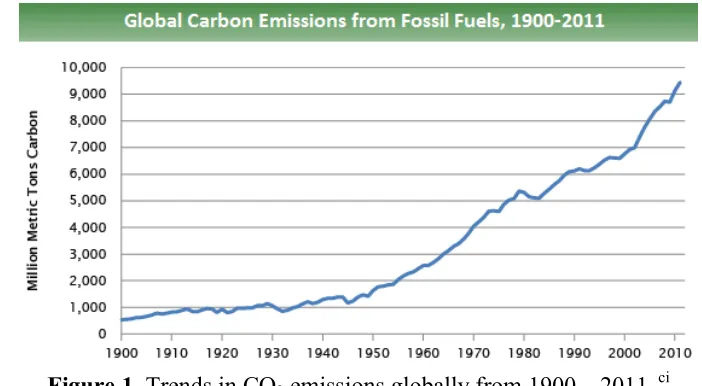
Figure 1
. Trends in CO2 emissions globally from 1900 – 2011.
ciinternational scene necessitates action to mitigate
the effects of greenhouse gas emissions.
In 2016, the Global CCS Institute identified 38 large-‐ scale CCS projects across the world in varying stages of development. As of October 2017, 17 of those projects are in operation. In addition, there are hundreds of pilot and demonstration-‐scale projects focused on basic research. The projects are in various countries, including Australia, Brazil, Canada, China, France, Germany, Japan, Saudi Arabia, Spain, and the United Kingdom. In addition, there are two large-‐scale industrial CCS projects being considered: the Abu Dhabi CCS project on an iron and steel plant in the United Arab Emirates and the North West Sturgeon Refinery project on an oil refinery in Alberta, Cannada. In December 2018, US Secretary of Energy Rick Perry signed a memorandum of understanding with energy leaders in Saudi Arabia to develop a framework to “cooperate on clean energy and carbon management,” which includes the possibility for future discussions of CCS.
Analyzing major geologic sequestration projects internationally, including projects specifically for Enhanced Oil Recovery, approximately 42 million tonnes of CO2 have been injected into geologic formations since 1996. However, many are quick to point out that in 2011, approximately 9,500 million tonnes of CO¬2 were released into the atmosphere from fossil fuels alone, and this trend will continue to increase, as shown in Figure 1. To reach the Paris Agreement’s 2-‐degree target, the International Energy Agency (IEA) has estimated that by 2040, 4,000 million tonnes of CO2 will need to be captured and stored each year. Currently, if one considers projects that are operational, proposed, and under construction, the maximum capture and storage rate is approximately 64.5 million tonnes of CO¬2 per year.
Therefore, despite increased international involvement in CCS, even the Global CCS Institute remains hesitant. “Tried and tested as CCS is, it is not accelerating at the pace needed to satisfy the ambitions of the Paris Agreement,” states the Institute, and the only solution looking forward is for nations across the world to accept that CCS is needed alongside renewable energy technologies. The Institute concludes that it will accelerate its
lobbying and advocacy efforts to inform politicians of the need for CCS.
In addition to international advocates for CCS, the International Energy Agency and the Nuclear Energy Agency jointly publish cost projections on power plants that will be operational in the next 5-‐10 years. The reports are released in five year intervals, studying the costs of electricity for all types of generation plants and renewables. The projections cover 22 countries, including OECD and non-‐OECD countries. In 2010, for the first time, the IEA report included projections of plants with CCS, stating that these plants “might reach commercial availability by 2020,” while noting that there are “great uncertainties concerning the cost of CCS.” Despite these misgivings about cost uncertainty, the IEA maintained that CCS is an essential decarbonization strategy. The IEA gave estimates of overnight construction costs of coal plants with CCS to be approximately three times as expensive as traditional coal plants. In its subsequent report in 2015, however, the study excluded CCS from its analysis, stating that “regulatory and technological uncertainty remains a barrier to investment.” Instead, CCS is included in its section regarding emerging technologies, along with fourth generation nuclear power, bioenergy technologies, and fuel cell technology.
III. The Clean Coal Power Initiative and FutureGen 2.0
Fossil Fuel CCS
“THE ALLURE OF CCS AND OTHER NEGATIVE-‐ EMISSION TECHNOLOGIES STEMS FROM THEIR
PROMISE OF MUCH REDUCED POLITICAL AND ECONOMIC CHALLENGES TODAY, COMPENSATED
BY ANTICIPATED TECHNOLOGICAL ADVANCES TOMORROW.”
KEVIN ANDERSON & GLEN PETERS
of coal-‐fired generation, specifically through the
technology of Integrated Gasification Combined Cycle (IGCC) power plants. In the first round, eight projects were chosen; three were successfully completed, two were discontinued after several years, and three were officially withdrawn shortly after being chosen. The three successful projects, including the Wisconsin Electric Power Company project, the Great River Energy project, and the NeuCo Inc. project, had cost increases above the original budgets of approximately 6%, 41%, and 0%, respectively. The two unsuccessful projects, including the Waste Management and Processors Inc. project and the Western Greenbrier Co-‐Generation Inc. project, had cost increases of approximately 100% and 93%, respectively.
The second round of CCPI selection occurred very shortly after the first round of CCPI allocations. Championing “coal, the nation’s most used fuel for electric power generation,” the selections were announced in October of 2004, one month before the 2004 presidential election. Chosen technology projects continued to focus on reducing emissions of sulfur, nitrogen, and mercury, but several were also chosen because they would “significantly lessen the release of carbon dioxide.” Out of 13 proposals, four were chosen to be awarded DOE funding. In total, of the four projects chosen, one was successfully completed, two projects were discontinued after several years, and one was officially withdrawn shortly after being chosen. The successful project by NeuCo Inc. in Jewett, TX had cost increases from the proposed costs of approximately 28%. The Kemper project by Southern Company began in 2010, where Mississippi Power built a new 582 MW coal-‐fired power plant using Integrated Gasification Combined Cycle technology, which would gasify the coal and use state-‐of-‐the-‐art pre-‐combustion capture to capture 65% of the plant’s emissions. The project was officially suspended in June 2017 after estimated costs had risen from $2.4 billion to $7.5 billion, and the plant is currently being adjusted to use natural gas as a fuel source. The other project that was unsuccessful was unable to obtain the proposed industrial support of $2.1 billion.
The third round of CCPI selection came under the Obama Administration in 2009 and 2010. These projects focus specifically on CCS technology, which was previously only attempted by the Southern
Company Kemper County Project. The American Recovery and Reinvestment Act of 2009 provided funding of $800 million to the 2010 selection of CCPI. Of the six projects chosen, one was successfully completed, two were discontinued after several years, and three were officially withdrawn shortly after being chosen. The Petra Nova Parish project, after a minor delay, began operations in January 2017, and had no reported cost increases. The two discontinued projects, including the Texas Clean Energy Project by Summit and the Hydrogen Energy California project, had cost increases of 130% and 75%, respectively.
the DOE had committed $15 million to Phase 1 of the
project, with additional funding to come in Phase 2. However, the DOE “accelerated disbursements of the Recovery Act funds and allowed Summit to shift project costs from Phase 2 [to Phase 1]” without proof that the project would succeed. According to the Inspector General, “despite the Department’s $116 million investment [for Phase 1], our review disclosed limited assurance of success in the project.” In addition to DOE prematurely increasing allocations to the project by more than $100 million, DOE provided multiple time extensions to Phase 1, extending the project definition phase by more than five years. Therefore, despite DOE incorporating risk mitigation measures into the Summit agreement by limiting funding allocations to milestones (phases), DOE did not enforce these allocations.
In addition to the projects selected through CCPI, a project titled FutureGen (and later renamed FutureGen 2.0) was funded as one of the first comprehensive DOE CCS demonstration projects. Announced by Bush in 2003, FutureGen was originally conceived as an integrated gasification combined-‐cycle CCS power plant. DOE appropriated $44 million, with another $250 million appropriated by Congress in 2008. However, due to rising costs and time considerations, the project was discontinued in 2008. In 2010, the Obama Administration restructured the project as FutureGen 2.0, which would instead use oxy-‐ combustion technology to capture CO2. Originally, the project was estimated to cost $1.2 billion, and DOE would supply $590 million of funding to the project through Recovery Act funds. However, according to the report by the Congressional Research Service, “rising costs of production, issues with project development, a lack of incentives for private sector investment, and time constraints” were problematic for the plant, raising the costs of the plant to approximately $1.7 billion, and, in early 2015, Secretary Moniz announced the withdrawal of approximately $1 billion in funding for the FutureGen 2.0 project. DOE stated that the funding was suspended “in order to best protect taxpayer interests.” So far, the state of Illinois had spent $9 million and private industry had spent $25 million, but the DOE questioned whether private funding would be able to supply the remaining $700 million. In addition, with Recovery Act funds set to expire in September 2015, the DOE questioned whether
FutureGen 2.0 would be able to fully use the Recovery funds. In total, DOE sent approximately $2.48 billion in unspent Recovery funds back to the US Treasury in October 2015, with $1.27 billion stemming primarily from the failures of the FutureGen 2.0 project in Illinois, the Texas Clean Energy Project, and the Hydrogen Energy California project to meet milestones to qualify for the allotted Recovery Act funding.
Similar results appeared across several failed projects in the CCPI, primarily due to excessive construction costs, the inability to obtain permits in a timely manner, mismanagement of projects and deadlines, and a lack of private sector investment. In many cases, private investment was stifled by regulatory uncertainty regarding CO2 emissions, CO2 storage, and climate change, legislative uncertainty, a lack of a clearly defined energy plan for the future of the United States, and a lack of an economic marketplace for carbon emissions. As both natural gas and oil prices have decreased in recent years, the incentives for heavy investments in coal and CCS have sharply declined.
investment by taxpayers and declined to support
further CCS projects in Alberta.
As stated by the National Coal Council, “nearly all of the projects’ costs were under-‐estimated from the start, none retained the same scope, and the time needed was underestimated for all technologies.” This is especially concerning, given that for government investments into projects, the cost share of the private entity must reach a minimum of 50% -‐ for example, if DOE provides $12.5 million in funding, the industry is required to commit to no less than $12.5 million themselves. According to the Office of Clean Coal and Carbon Management, cost shares of 30 – 50% were expected through CCPI, with the belief that an “increased government cost share will significantly reduce project risk and increase success rate.” This seems to be consistent with the results of the Excelsior Mesaba Energy Project, which was priced at $2.155 billion with only $36 million provided by the DOE, resulting in a cost share of 1.7%. The Kemper project began with a cost share of 10% by the government, but due to skyrocketing costs, even with an increase in government funding of $137 million, the cost share dipped to 5.9%. In the most poignant example of financial uncertainty not being adequately shared by the government and industry, the Western Greenbrier project initially began with a cost of $215 million, with the DOE pledging $107 million (50% cost share). However, as construction and equipment costs increased substantially, the total cost rose to $416 million, but the DOE funding remained stagnant, with the cost share falling to 26%. The project was subsequently abandoned, due to an inability to secure additional private financing. Therefore, the inflexible cost sharing mechanism inherent to the CCPI forced private industries to carry much more of the financial burden (and subsequent risk) than initially determined, which led to the failure of several CCS projects for fossil fuel generation.
Industrial CSS
“CCS IS CURRENTLY THE ONLY OPTION FOR DECARBONISING THE STEEL, CHEMICAL AND
CEMENT INDUSTRIES.” CCS ASSOCIATION
In addition to CCS for fossil-‐fueled power plants, DOE has increased its investments into industrial
CCS, which seeks to capture the CO2 emissions from the industrial sector, which accounts for 25% of CO¬2 emissions from energy consumption. Similarly to the CCPI, DOE selected 14 projects across the United States that demonstrated various industrial uses of CCS on petroleum coke-‐to-‐chemicals plants, cement plants, methane reformer plants, and oil refineries. The awards ranged from $500,000 to $3 million dollars and aimed at promoting R&D. If the R&D was successful and had promise for demonstration, the projects were then significantly funded through the Recovery Act for design, construction, and operation.
Three projects were selected in 2010, including an Air Products & Chemical, Inc. project in Port Arthur, TX, an Archer Daniels Midland (ADM) project in Decatur, IL, and Leucadia Energy in Lake Charles, LA with DOE funding of $253 million, $99 million, and $260 million, respectively. Both the Port Arthur project and the ADM project were completed, with the final DOE funding for these the projects having increased to $284 million and $141.5 million, respectively. In 2016, the Air Products & Chemical project had been in operation for more than three years and had captured three million metric tons of CO2. The ADM project was successfully completed, after storing one million tons of CO2 in three years. To continue the demonstration project, ADM expanded the project to store one million tons of CO2 per year, and after delays due to an EPA permitting process, began in April 2017. The Lake Charles project was cancelled in October 2014 due to “minor adverse impacts on the surrounding environment during construction,” including contaminants in water runoff, deforestation of 40 acres of land, and habitat disruptions for various woodpecker and wading bird species.
the projects in the CCPI, in turn costs significantly
less than the CCPI projects. While this more conservative strategy has allowed for small successes, progress thus far has failed to produce significant results leading to commercial-‐scale demonstrations of industrial CCS technology. The technical and economic problems that have impacted CCS in the power sector are likely to impact the industrial sector, and larger-‐scale projects are necessary to reach stringent carbon targets in the industrial sector.
IV. Evaluation of CCS Deployment
“CCS IS A PROVEN, SAFE, RELIABLE AND COST-‐ EFFECTIVE TECHNOLOGY.”
GLOBAL CCS INSTITUTE
In 2010, the Department of Energy and the National Energy Technology Laboratory, which is a laboratory operated by the Office of Fossil Energy, released a roadmap outlining the research and development efforts for CCS. The report stated that “advanced [CCS] technologies will be ready for full-‐ scale demonstration by 2020.” Included in this was both industrial CCS and CCS for fossil-‐fuel power plants. The roadmap estimated that DOE funding needed to achieve this from 2011 to 2015 was $2 billion. However, the roadmap acknowledges that the success of CCS development depends heavily on “aggressive and sustained efforts to advance promising concepts to commercial reality.”
In addition to the roadmap, a series of Congressional Research Service Reports focused on CCS were completed by Dr. Peter Folger, a specialist in energy and natural resources policy. Several reports were released, including ones released in July 2010, July 2013, November 2013, February 2014, February 2016, and May 2016.
In 2010, Dr. Folger stated that several major drawbacks to CCS development and deployment exist, including high cost, high energy penalties, and the lack of full-‐scale demonstrations of the technology. He noted that significant cost reductions will not only require a “vigorous and sustained level of R&D, but also a significant market for CO2 capture technologies to generate a substantial level of commercial deployment.” Folger also noted the apparent similarities between CO2 capture systems and SO¬2 and NOx capture systems, predicting that
increased costs, significant time delays (possibly on the order of decades), and a lack of market incentives will affect the development of CCS. Folger estimates that the costs of CCS will fall 30% relative to current costs after 100,000 MW of capacity is installed and is operational – again, however, Folger emphasizes that uncertainty estimates could be much smaller than indicated, and will only be realized with hindsight. Folger states that CCS mirrors the DOE strategy for SO2 and NOx emissions in the 1980s, where the Department sought “high-‐ risk, high-‐payoff” technologies. Noted as an “important caveat concerning costs,” Folger also stated that uncertainty regarding construction costs and fuel prices lead to significant uncertainties regarding the costs of carbon capture, ranging from an estimated $20 -‐ $95 per ton of CO¬2 captured. This caveat was repeated again in 2013.
In the July 2013 report, Folger reported on the issues facing CCS deployment. Folger acknowledged that low natural gas prices and increased natural gas supplies have increased projected costs of CCS. In addition, he describes the uncertainty regarding the storage capacity in the United States, leading to cost uncertainties regarding transportation and storage costs. In addition, issues regarding site permitting, site approval, liability, ownership, public opinion, increased consumer electricity costs, and long-‐term stewardship continued to be problematic for commercialization of CCS.
In November 2013, Folger again emphasizes the need for government intervention. Updating the cost figures, Folger states that the current process are “high cost and [have] large energy requirements for operation.” He stated that several R&D efforts were underway, but still lacked “credible estimates of their performance and (especially) cost.” Folger estimated that actual commercialization of CCS, assuming an aggressive development schedule, will not occur until at least 2023.
seen directly through the $3.4 billion provided to
DOE for the development of CCS through the American Recovery and Reinvestment Act. The DOE lost authority to spend Recovery Act funds in September 2015, and at that time $1.4 billion went unspent, primarily due to the failure of the FutureGen 2.0 project. Industrial CCS projects, as of February 2016, had expended 83% of their allocated Recovery Act funds, while the projects through CCPI had expended 55% of their funding. However, DOE has noted that the relinquishment of funds does not mean complete project failure. Instead, DOE indicates the success of reducing the costs of capturing CO2 and the storage of “more than 10 million metric tons of CO-‐2.”
The February 2016 Congressional Research Service Report determined that $2.65 billion of the $3.4 billion allocated to CCS through the Recovery Act was given to nine large-‐scale demonstration projects, which is the costliest phase of R&D for new technologies. In addition, when CCS is compared to past environmental technologies on power plants, “the farther away a technology is from commercial reality, the more uncertain is its estimated cost.”
The amount of funding provided to CCS has also been criticized by various parties, including the National Coal Council, an industry advisory board who reports to DOE, who stated that the funding from the Recovery Act was insufficient to support the commercialization of the CCS technology. However, the Congressional report disputes claims that CCS projects need more funding, calling these arguments overly simplistic. The report argues that many other factors contribute to the success or failure of a project, including project management, private interest, timelines, and the ability to obtain permits. Regardless, the National Coal Council concluded that the CCPI program “has not reached critical mass with regard to the commercialization of CCS in the time frame needed to meet stated U.S. goals for CO¬2 emissions reductions.”
In Folger’s May 2016 report, he analyzed the DOE’s funding request for FY2017, and noted that the financial trend has been “shifting increasingly toward CCS-‐related activities and away from what were termed coal program areas,” with the term “coal” being omitted from the budget request. In addition, the DOE “intends to de-‐obligate $240
million from CCPI projects that have not yet reached financial close and repurpose those funds to support the FY2017 R&D portfolio,” which seeks to explore a variety of technological approaches and applications of CCS and remove fuel-‐specific categorization. The Senate and House Appropriations Committees, however, did not accept the DOE proposal for restructuring of the R&D accounts to a generalized “advanced power systems” division, but did approve reorganizing the National Energy Technology Laboratory’s (NETL) Supercritical CO2 Technology program.
In the budget request, the House Appropriations Committee sought to increase funding for Coal Carbon Capture R&D from $101 million in FY2016 to $109.2 million in FY2017, while decreasing the funding for Coal Carbon Storage R&D from $106 million in FY2016 to $85.5 million in FY2017. Because the request for redefining the CCS activities at DOE into a generalized power systems approach, the budget requests for CCS for advanced power systems was instead directed into coal R&D. This indicates that the legislature is determined to maintain coal as the recipient of the majority of CCS funding.
The National Coal Council also stated that DOE failed to conduct a coordinated review of CCS demonstration projects in order to “determine their combined adequacy and effectiveness in supporting CCS deployment.” Included in their suggestions are the inclusion of a more sophisticated, independent engineering review to be distributed to all project managers regarding the demonstration project.
V. Legislative Failures
“THE PROMISE OF FUTURE AND COST-‐OPTIMAL NEGATIVE-‐EMISSION TECHNOLOGIES IS MORE POLITICALLY APPEALING THAN THE PROSPECT OF
DEVELOPING POLICIES TO DELIVER RAPID AND DEEP MITIGATION NOW.”
KEVIN ANDERSON & GLEN PETERS
Administration. Steven Chu, the Nobel prize-‐winning
physicist who was Secretary of Energy from 2009 – 2013, stated that “I don’t see how we go forward without [CCS].” U.S. Senator Joe Manchin (D-‐W.Va.) in 2011 described CCS as the “technology of the future” and “holds incredible promise for this nation’s energy future.” According to PBS, in 2009 and 2010, after the election of Obama, with a Democratic majority in Congress, “it was a forgone conclusion that CO2 emissions would likely be regulated through a cap-‐and-‐trade program.” In 2012, the IEA directly recognized CO2 emissions as a market failure that necessitates a carbon tax or emissions trading scheme. They state that, as the technology matures, then the rationale for policy intervention primarily through dealing with emissions externalities will become more important and “be the primary commercial driver for CCS.” However, despite warnings by many agencies that direct investment in CCS R&D was not enough to commercialize CCS, there was no governmental intervention to strengthen market incentives for reducing CO2. A London-‐based consultant group said that the lack of a carbon price has “scuttled a lot of similar projects” and has held CCS back from development.
Several pieces of legislation were introduced between 2009 and 2015, primarily focusing on setting up carbon pricing mechanisms. In 2007, H.R. 2069 (“Save Our Climate Act of 2007”) was introduced to the 110th Congress by Representative Fortney “Pete” Stark (D-‐CA), which sought to “amend the Internal Revenue Code of 1986 to reduce emissions of carbon dioxide by imposing a [$9/ton of carbon] tax on primary fossil fuels based on their carbon content.” The bill was cosponsored by three fellow Democrats from Washington, Arizona, and California. The bill died in the 110th Congress, and was reintroduced in January 2009 as H.R. 594 in the 111th Congress, with an additional proposal for annual increases in the tax until a certain amount of avoided CO¬¬2 is reached. Again, it died in Congress, and was again reintroduced as H.R. 3242 in the 112th Congress, titled the “Save Our Climate Act of 2011.” This act expanded the definition of “taxable fuel” to include biomass, municipal solid waste, and other organic materials. This bill received 22 cosponsors, all Democrats primarily from California, Washington, Oregon, Ohio, Illinois, Massachusetts, and New York. One representative, Lacy Clay (D-‐MO),
was from a Republican-‐controlled state. However, this bill failed to pass this Congress. A similar bill was proposed by Representative John Larson (D-‐CT) in the 110th, 111th, 113th, and 114th Congress, which would have imposed an excise tax on any taxable carbon substance, including coal, petroleum, and natural gas. The act sought to “express the sense of Congress that the United States should establish binding agreements with major greenhouse gas emitting nations.” This act was cosponsored by 12 Democrats, again with the majority being from California and New England. The Climate Solutions Act of 2017 was introduced by Representative Ted Lieu (D-‐CA) in June 2017, which would direct DOE to promulgate annual emission reduction targets. The bill is cosponsored by 16 Democrats, mainly from California and Northeastern states.
approach to permitting geologic sequestration and
minimize the legal obstacles facing CCS. The bill passed the House, but was not voted on by the Senate and died in the 111th Congress. A similar bill, the Clean Energy Jobs and American Power Act, mirrored the goals of the Kerry-‐Boxer bill, but stalled in the Senate. It was proposed by Senator John Kerry (D-‐MA) and cosponsored by three fellow Democrats.
In December 2015, S. 2399, the Climate Protection and Justice Act of 2015, was introduced by Senator Bernie Sanders (I-‐VT) in the midst of his Presidential Primary campaign, which was then referred to the Senate Finance committee.li This bill would impose a tax of $15/tonne of CO¬2 emitted from fossil fuel combustion by 2017, rising to $73/tonne by 2035, and $150/tonne by 2050. However, due to a lack of cosponsors and the aggressiveness of the tax, the bill was not voted on and ended in the 114th Congress. Similar bills have been introduced and discussed that advocate for greater renewable energy subsidies and energy efficiency increases, but the Global CCS Institute argues that there is a “general preoccupation with the promotion of renewables and energy efficiency,” and states that “CCS must take a greater part in these discussions” in the United States and United Nations.
In July 2016, U.S. Senators Heidi Heitkamp (D-‐ND), Shelley Moore Capito (R-‐WV), and Sheldon Whitehouse (D-‐RI) introduced legislation to “incentivize the development and use of carbon capture, utilization, and storage technologies.” Called the “Carbon Capture, Utilization, and Storage Act (S. 3179)”, the bill was cosponsored by 19 senators, including senators Mitch McConnell (R-‐KY), Dick Durbin (D-‐IL), Lisa Murkowski (R-‐AK), Al Franken (D-‐MN), Lindsey Graham (R-‐SC), Cory Booker (D-‐NJ), and Tim Kaine (D-‐VA), which would extend a tax credit to utilities and industries interested in CCS, increasing financial certainty. The bill was sent to the Senate Finance Committee, but was not voted on in the 114th Congress.
On December 20, 2017, Senator Orrin Hatch (R-‐ UT) introduced the Tax Extender Act of 2017, which, in addition to “providing tax relief for families and individuals,” provides a $20/tonne tax credit for taxpayers using carbon capture equipment for permanent geologic storage and a $10/tonne tax
credit for taxpayers using carbon capture equipment for EOR activities. The bill was cosponsored by five Republican senators and was referred to the Committee on Finance. According to GovTrack and Skopos Labs, the bill currently has a 4% chance of being enacted.
This policy-‐making process of providing enormous budgets to massively ambitious programs with unachievable technological goals was studied by Dr. Hanna Breetz at MIT, where she studied the effect of “politician-‐driven policy-‐making” on alternative and synthetic fuel R&D for the United States in the 1970s and in the 2000s. In the synthetic fuels case, Breetz indicates that these policies emerged without major advocates and were not heavily advocated for by public interest groups. This is very similar to the policies concerning CCS, which had no major regulatory champion and was not fully embraced by either the National Coal Council or environmental lobbies. As Breetz describes, oil crises led to the alternative fuel policies; however, no immediate, short-‐term crisis prompted the introduction of CCS by the Bush and Obama Administrations. Once it was introduced as a policy objective of DOE, however, it did not gain sufficient legislative momentum to inspire industry interest.
If industrial CCS is to be seriously considered in the future, increased DOE investments are not sufficient to make CCS cost competitive and commercialized. ExxonMobil, the world’s largest oil company, has shown interest in a carbon tax, and has stated that it would not lobby against a bill supporting a carbon tax, going against uniform GOP opposition. This attitude, coupled with their increasing private investments into industrial CCS R&D, indicates a minor shift towards acceptance of a carbon policy.
VI. The Petra Nova Project and Adaptive Review “OVER TIME, THINGS CHANGE. SCIENCE EVOLVES, TECHNOLOGY ADVANCES, AND IMPLEMENTATION
COSTS MIGRATE, SO ASSUMPTIONS THAT WERE ONCE REASONABLE CAN BECOME MUCH LESS
SUPPORTABLE.”
LAWRENCE MCCRAY, KENNETH OYE, AND ARTHUR PETERSON
the legislature to enact a carbon price, the Petra
Nova project in the United States stands in stark contrast as a success. It has defied many expectations for CCS projects with coal-‐fired generation: the project began both on time and on budget. The $1 billion project was provided $167 million from DOE in direct financing through the CCPI, and according to John Ragan, president of NRG’s Gulf Coast region, the funding provided them “momentum to move forward.” The project also received $23 million in February 2016 under Section 313 of the FY2016 Consolidated Appropriations Act. This funding was complimented by an upfront agreement of a 50/50 cost share between NRG and JX Nippon of $300 million and a guaranteed loan of $250 million from the Japan Bank for International Cooperation. This financial situation differs from other projects, which received DOE funding prior to ensuring private investments. The assurance of this cost-‐share allowed the project to avoid timeline disruptions, unlike other projects hampered by delays due to investment accrual. This combination of financial resources required both tenacity from NRG and a “creative combination of risk tolerant partners that make up a three-‐legged stool.” The Petra Nova project’s reliance on a Japanese investing firm is also different from other projects attempting to receive funding from commercial banks. The Japanese loan was granted to NRG based on the possibility that CCS will “open new venues in the Japanese economy” as well as combat climate change. The original Petra Nova project was planned and proposed in 2010 under the assumption that a carbon price would be forthcoming with the Obama Administration. However, when a carbon price was not implemented, the CEO of NRG encouraged the project to move forward anyway. Unlike other projects that failed without the regulatory assurance of a carbon price, the Petra Nova project found a substitute for the carbon price: someone to purchase the CO2 for use in Texas oilfields for enhanced oil recovery. Then-‐Governor Rick Perry also signed a bill into law creating tax credits for enhanced oil recovery in Texas, further providing financial incentives for Petra Nova. Furthermore, the Petra Nova project is unique in that NRG is a retail electricity provider, which allows it to bid into the energy market with its generation costs and compete with other technologies. Therefore, though the generation costs for CCS may be higher, NRG is able to prevent Texas rate-‐payers from directly
absorbing increased electricity costs through rate increases. This differs from Mississippi Power for the Kemper Plant, for example, which provides electricity outside of a retail market – as a result, Mississippians had seen consecutive rate increases of 18% and 15% to pay for increased Kemper costs. This has proven to be a politically charged issue for many Mississippi rate-‐payers. Therefore, this combination of financial incentives has allowed the NRG project to proceed in a timely manner.
In addition to its financial security, NRG claims that it had a different approach to the project than other projects. Details regarding the technical components and the construction needs were determined before construction began, and this plan was followed throughout the construction process. As opposed to the IGCC power plant being constructed from scratch in Kemper County, MS, the Petra Nova CCS addition was added to a pre-‐existing 610 MW coal-‐ fired generator and derives its energy from a natural-‐gas turbine built nearby. The familiarity of natural gas turbines, coupled with the heavily tested post-‐combustion capture system, provides less risk than one using untested technology. For example, the post-‐combustion process used for the project had been tested in a “three-‐year pilot scale test in Alabama.” As stated by David Greeson, vice president for development at NRG, the technology being used is “definitely evolutionary, not revolutionary.” There were also differences between Petra Nova and Kemper in CO2 capture rate: Petra Nova captures approximately 33% of emissions from the coal-‐fired unit via a post-‐ combustion process, while the Kemper Project sought to capture 65% of total emissions using a pre-‐combustion process. While the Petra Nova project captured fewer emissions and was uniquely positioned for nearby EOR, a NETL factsheet described the Petra Nova project as “a path forward for existing coal-‐fired power plants to continue energy production while meeting environmental sustainability goals.”